
Behaviorist Theory of Personality 1 The way most
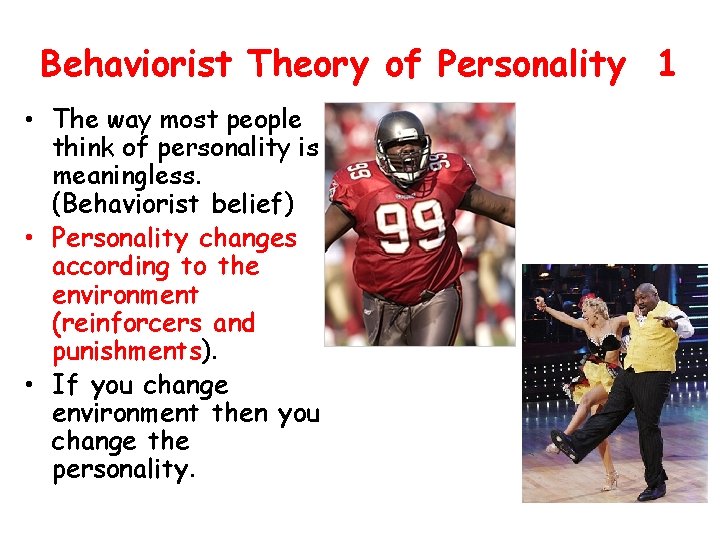
Behaviorist Theory of Personality 1 • The way most people think of personality is meaningless. (Behaviorist belief) • Personality changes according to the environment (reinforcers and punishments). • If you change environment then you change the personality.

Somatotype Theory 2 • A biological Theory by William Sheldon. • Endomorphs (Fat) tend to be friendly and outgoing. • Mesomorphs (muscular) tend to be more aggressive. • Ectomorphs (thin) tend to be more shy and secretive. • Study has not been replicated – what does this mean? .

Biological Theories of Personality 3 • What % of personality is inherited – heritability? • We are not sure BUT temperaments do seem to be stable from infants to old age.

Reciprocal Influences 4 The three factors, behavior, cognition, and Bandura called the process of interacting with environment, are interlocking determinants of our environment reciprocal determinism. each other. Stephen Wade/ Allsport/ Getty Images 4
Trait • A characteristic of behavior or a disposition to feel and act as assessed by self-reported inventories or peer reports. 5
Traits…. 5 a • Examples of traits: – Honest – Dependable – Moody – Impulsive – Unique group of durable dispositions and consistent ways of behaving (traits) constitutes his or her own personality
Trait Theories of Personality 6 • They believe that we can describe people’s personalities by specifying their main characteristics (traits). • Traits like honestly, laziness, ambition, outgoing are thought to be stable over the course of your lives.
Factor Analysis 7 • A statistical procedure used to identify different components of your intelligence or personality (depending on the test). • FA takes the answers you give on tests and compiles them into general traits.

Factor Analysis 8 Cattell found that large groups of traits could be reduced down to 16 core personality traits based on statistical correlations. Superficial traits Boisterous Impatient Irritable Excitement Basic trait Impulsive 9
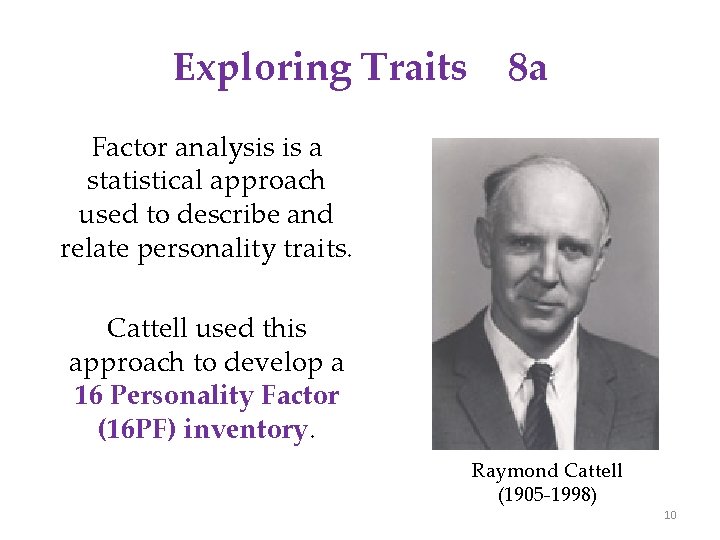
Exploring Traits 8 a Factor analysis is a statistical approach used to describe and relate personality traits. Cattell used this approach to develop a 16 Personality Factor (16 PF) inventory. Raymond Cattell (1905 -1998) 10
Idiographic Theorists • Using the same set of traits to classify everyone is impossible. • Each person may have a few traits that are unique to them (selfish may be important to describe one person but not another). • Gordon Allport and his cardinal dispositions (also central and secondary). 9
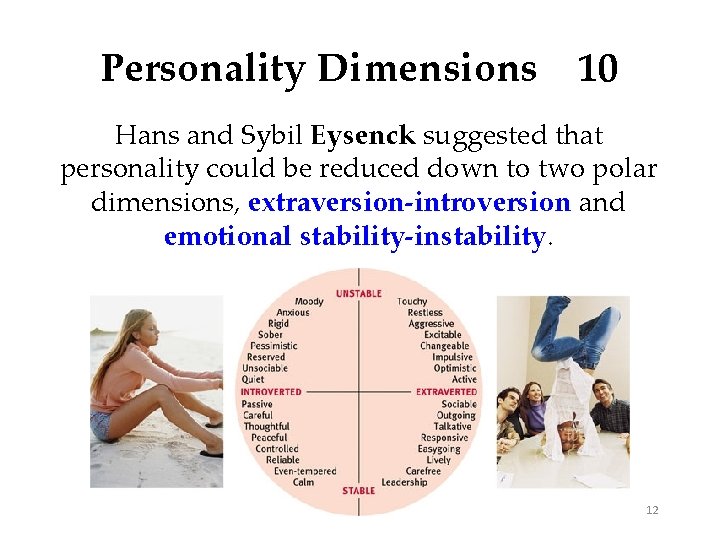
Personality Dimensions 10 Hans and Sybil Eysenck suggested that personality could be reduced down to two polar dimensions, extraversion-introversion and emotional stability-instability. 12

Eysenck Personality Questionnaire 10

The Big Five 11 Once you take a test that measures your personality according to the Big Five Scale…. Your traits will be stable over time. They can be attributed to your genetics They apply across different cultures They predict other attributes.
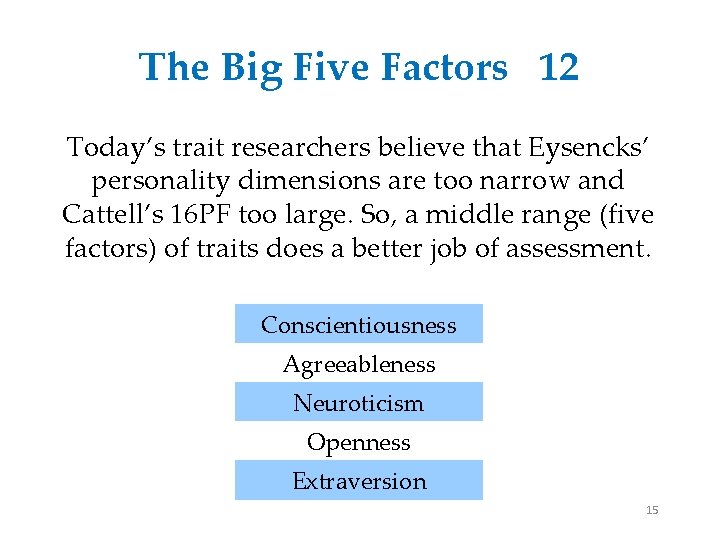
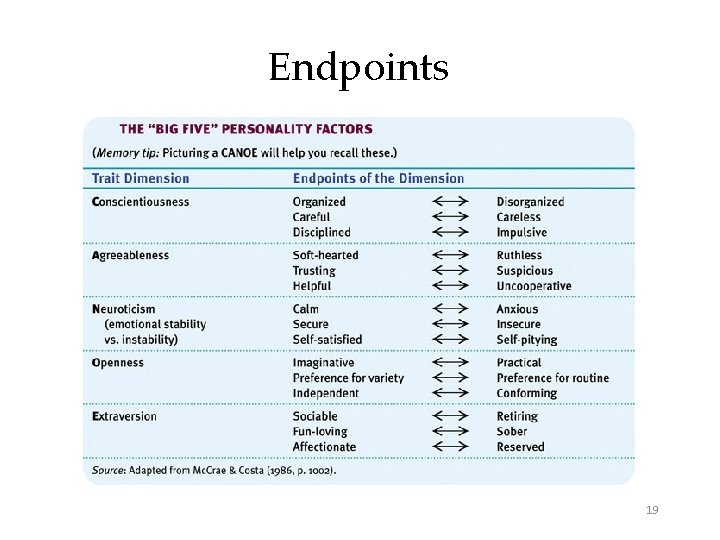
The Big Five Factors 12 Today’s trait researchers believe that Eysencks’ personality dimensions are too narrow and Cattell’s 16 PF too large. So, a middle range (five factors) of traits does a better job of assessment. Conscientiousness Agreeableness Neuroticism Openness Extraversion 15
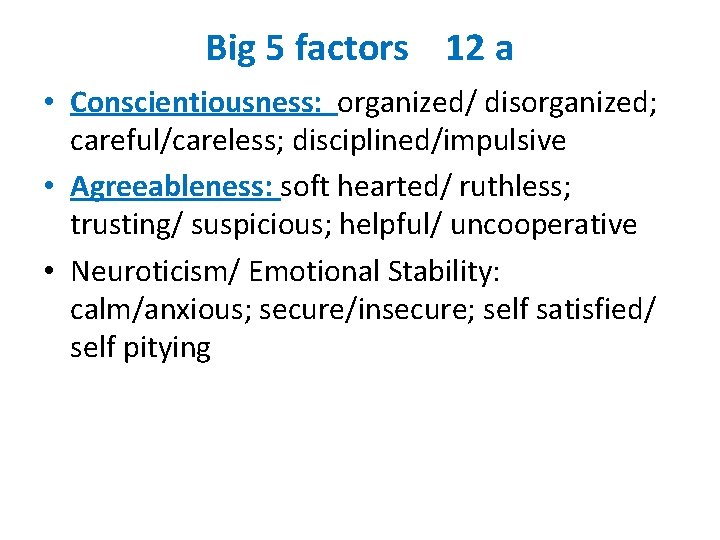
Big 5 factors 12 a • Conscientiousness: organized/ disorganized; careful/careless; disciplined/impulsive • Agreeableness: soft hearted/ ruthless; trusting/ suspicious; helpful/ uncooperative • Neuroticism/ Emotional Stability: calm/anxious; secure/insecure; self satisfied/ self pitying
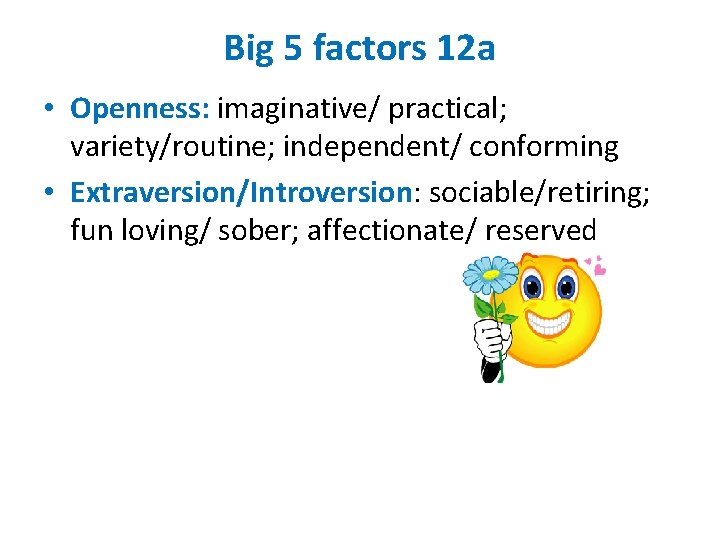
Big 5 factors 12 a • Openness: imaginative/ practical; variety/routine; independent/ conforming • Extraversion/Introversion: sociable/retiring; fun loving/ sober; affectionate/ reserved
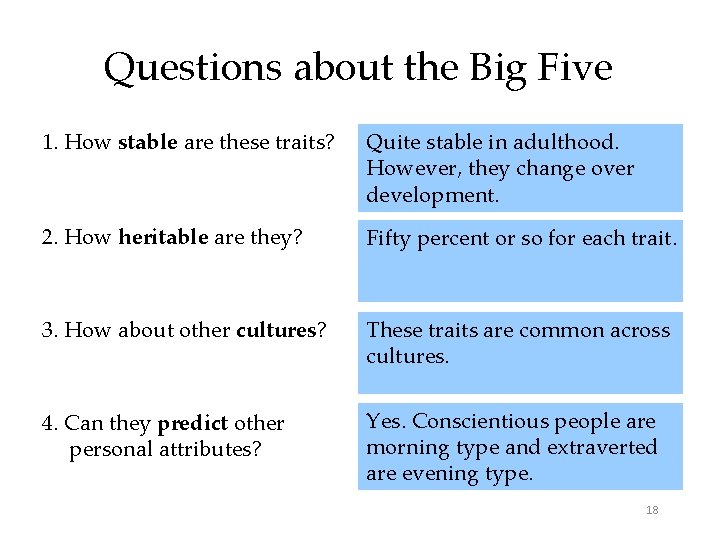
Questions about the Big Five 1. How stable are these traits? Quite stable in adulthood. However, they change over development. 2. How heritable are they? Fifty percent or so for each trait. 3. How about other cultures? These traits are common across cultures. 4. Can they predict other personal attributes? Yes. Conscientious people are morning type and extraverted are evening type. 18
Endpoints 19
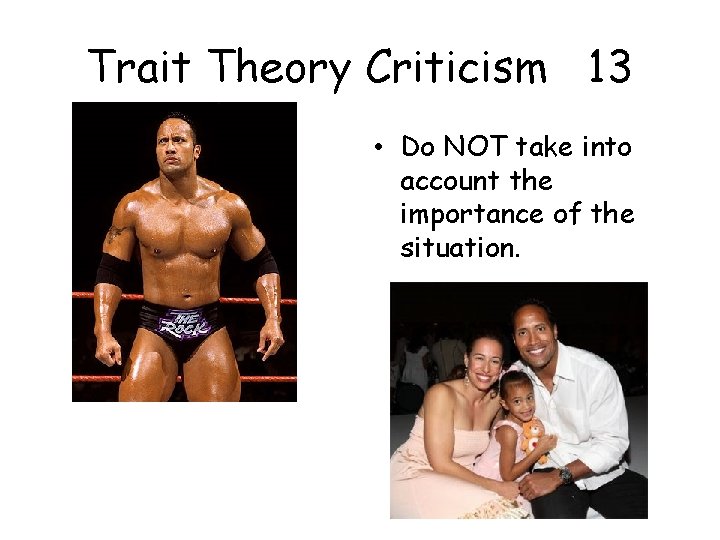
Trait Theory Criticism 13 • Do NOT take into account the importance of the situation.
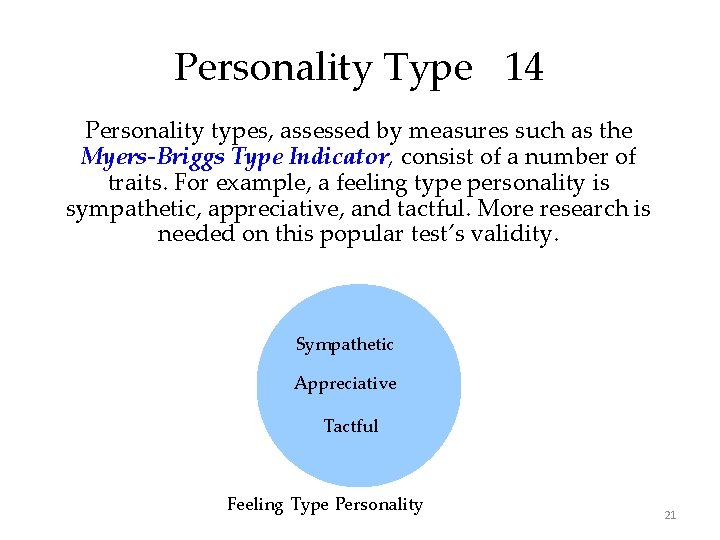
Personality Type 14 Personality types, assessed by measures such as the Myers-Briggs Type Indicator, consist of a number of traits. For example, a feeling type personality is sympathetic, appreciative, and tactful. More research is needed on this popular test’s validity. Sympathetic Appreciative Tactful Feeling Type Personality 21
- Slides: 21