
Behavioral Styles DISC Presentation Train the Trainer Directions
Behavioral Styles DISC Presentation Train the Trainer
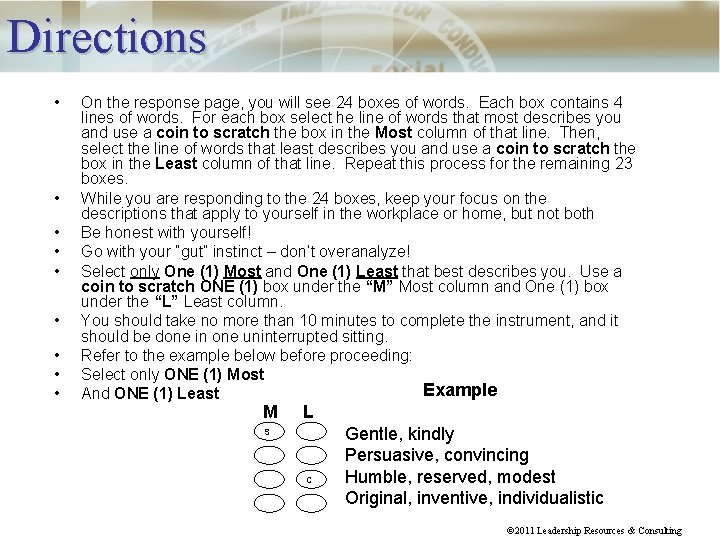
Directions • • • On the response page, you will see 24 boxes of words. Each box contains 4 lines of words. For each box select he line of words that most describes you and use a coin to scratch the box in the Most column of that line. Then, select the line of words that least describes you and use a coin to scratch the box in the Least column of that line. Repeat this process for the remaining 23 boxes. While you are responding to the 24 boxes, keep your focus on the descriptions that apply to yourself in the workplace or home, but not both Be honest with yourself! Go with your “gut” instinct – don’t overanalyze! Select only One (1) Most and One (1) Least that best describes you. Use a coin to scratch ONE (1) box under the “M” Most column and One (1) box under the “L” Least column. You should take no more than 10 minutes to complete the instrument, and it should be done in one uninterrupted sitting. Refer to the example below before proceeding: Select only ONE (1) Most Example And ONE (1) Least M L S C Gentle, kindly Persuasive, convincing Humble, reserved, modest Original, inventive, individualistic © 2011 Leadership Resources & Consulting
Plotting The Graphs © 2011 Leadership Resources & Consulting
Unusual Graphs © 2011 Leadership Resources & Consulting

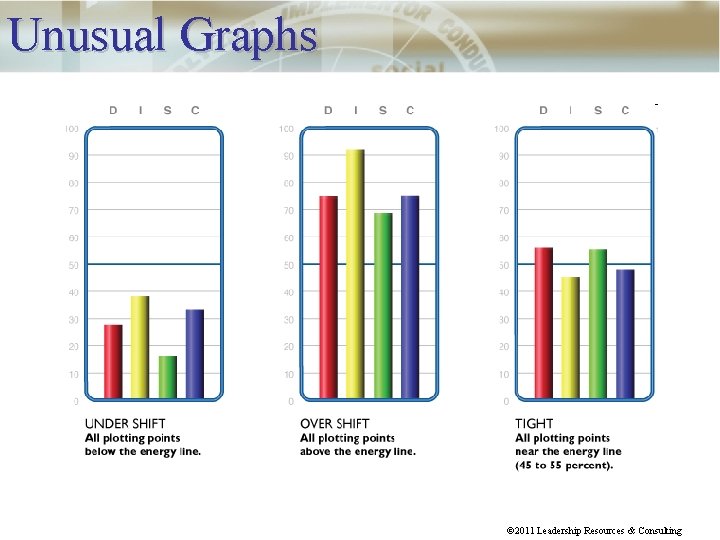
Response Notes E-mail Content Over Shift Response Note • Sandra Sample's responses to the questionnaire indicate she may be under pressure to be an overachiever. Have her look at the demands being placed on her and set priorities. She should deal only with those demands that are most critical and put the rest on hold, or seek assistance with the lower priority demands. Therefore, we recommend that the report be carefully scrutinized to ensure the greatest of accuracy in the information presented about Sandra Sample. In addition, she may want to consider retaking the instrument later when she feels comfortable in achieving this balance. Tight Response Note • The adjectives Sample selected as being least like him may indicate that he is going through some type of transition or change in his personal life. This can be a result of him being in a new job or changing home environment. It may also result from a change in roles or responsibilities in the present environment. External pressures not directly related to the focus environment may be on his mind. Any of the aforementioned may cause temporary stress or anxiety which in turn may have altered the responses to the instrument. • Therefore, we recommend that the report be carefully scrutinized to ensure the greatest of accuracy in the information presented about Sample. In addition, he may want to consider retaking the instrument later at a less stressful time. Under Shift Response Notes • An under shift graph will not be seen due to the high validity of the Style Insights® questionnaire. Therefore, no response note is available. © 2011 Leadership Resources & Consulting
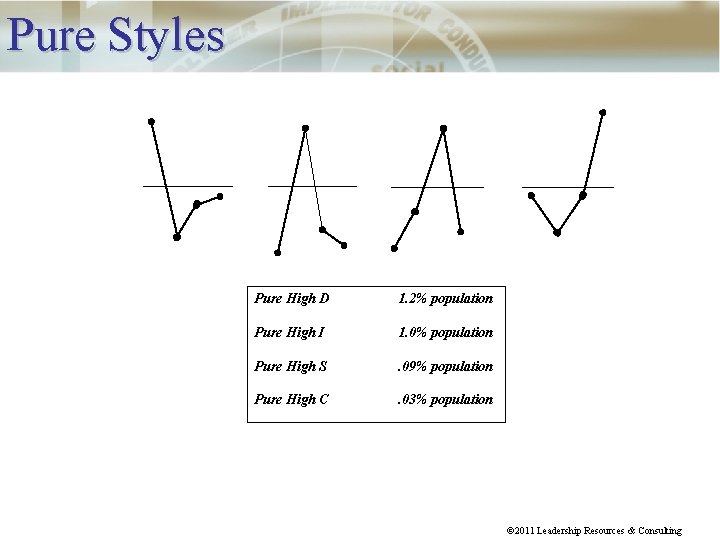
Pure Styles Pure High D 1. 2% population Pure High I 1. 0% population Pure High S . 09% population Pure High C . 03% population © 2011 Leadership Resources & Consulting
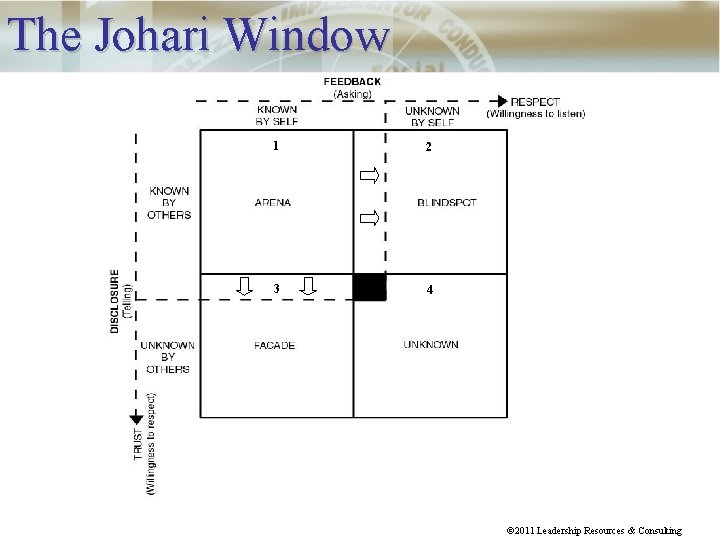
The Johari Window 1 2 3 4 © 2011 Leadership Resources & Consulting
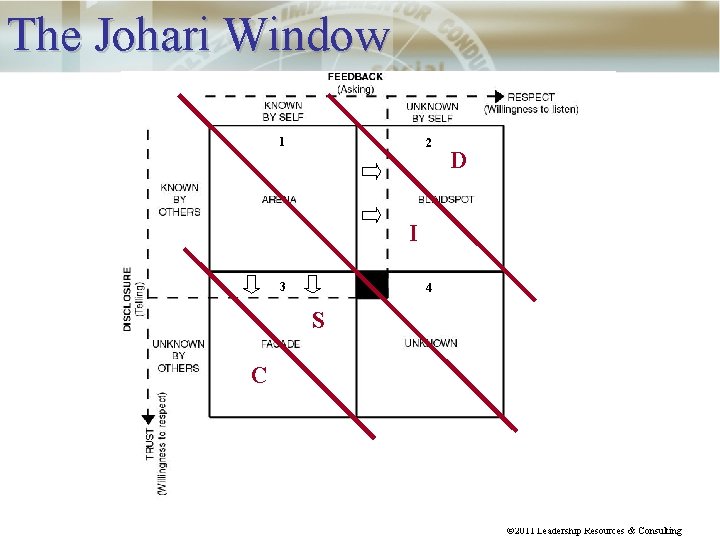
The Johari Window 1 2 D I 3 4 S C © 2011 Leadership Resources & Consulting
Situational Leadership II Model A DESCRIPTION OF THE MODEL The Situational Leadership model is founded in the belief that there is no one best leadership style. Leaders are most effective when they use different techniques according to the differing needs of the people they manage. Flexibility is important because no two people come to a task with identical skills, knowledge, confidence, or motivation. Directive and Supportive Leadership Behavior Directive Behavior is the extent to which a leader tells a subordinate what to do, how, when and where to do it, and then closely supervises performance. This leadership behavior is characterized by structure, control, and supervision. Supportive Behavior is the extent to which the leader lets subordinates take responsibility for their own work. Praise, listening, and facilitation characterize this leadership style. The Four Leadership Styles The following four styles of leadership vary in three ways in terms of: 1) The amount of direction the leader provides, 2) the amount of support the leader provides, and 3) the amount of subordinate involvement in decision-making. S 1 – Directing: a combination of high directive and low supportive behavior. The leader provides specific instruction about roles and goals, and then closely supervises the subordinate’s behavior. S 2 – Coaching: a combination of high directive and high supportive behavior. The leader explains his/her directions, solicits suggestions, praises approximately right behavior, but continues to direct task accomplishment. S 3 – Supporting: a combination of high supportive and low directive behavior. The leader and subordinate make decisions together. The role of the leader is to facilitate, listen, encourage, and support. S 4 – Delegating: a combination of low directive and low supportive behavior. The leader turns over responsibility for task accomplishment to the follower; the follower provides his/her own direction and support. © 2011 Leadership Resources & Consulting
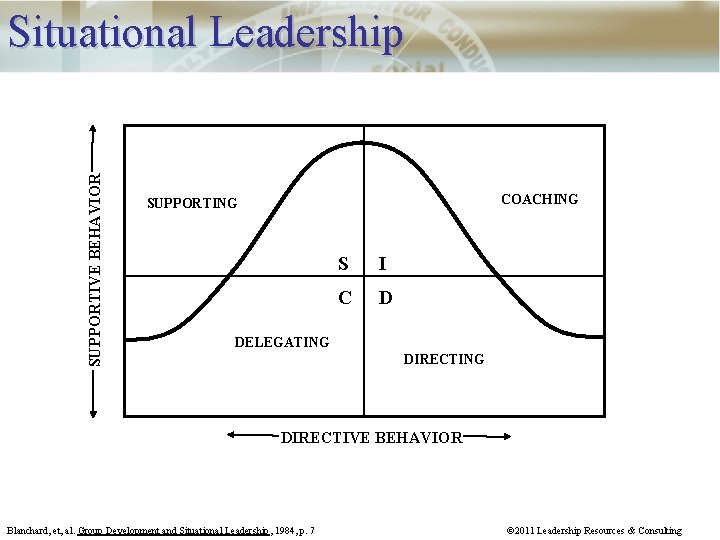
SUPPORTIVE BEHAVIOR Situational Leadership COACHING SUPPORTING S I C D DELEGATING DIRECTIVE BEHAVIOR Blanchard, et, al. Group Development and Situational Leadership, 1984, p. 7 © 2011 Leadership Resources & Consulting
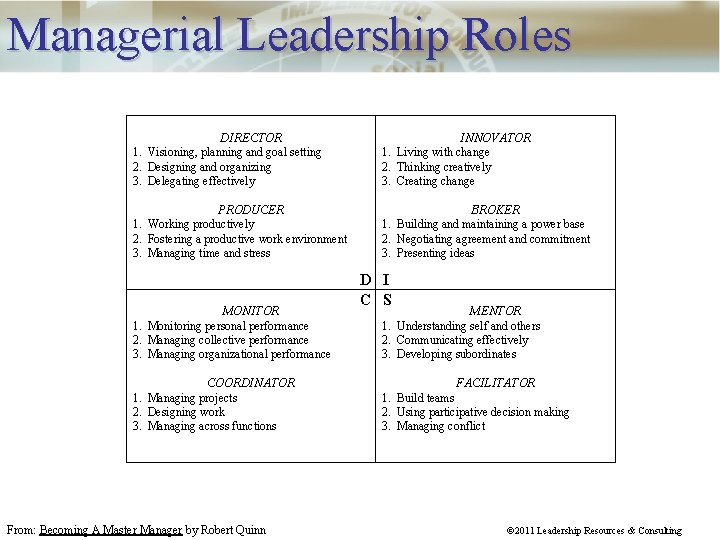
Managerial Leadership Roles DIRECTOR 1. Visioning, planning and goal setting 2. Designing and organizing 3. Delegating effectively INNOVATOR 1. Living with change 2. Thinking creatively 3. Creating change PRODUCER 1. Working productively 2. Fostering a productive work environment 3. Managing time and stress BROKER 1. Building and maintaining a power base 2. Negotiating agreement and commitment 3. Presenting ideas MONITOR 1. Monitoring personal performance 2. Managing collective performance 3. Managing organizational performance COORDINATOR 1. Managing projects 2. Designing work 3. Managing across functions From: Becoming A Master Manager by Robert Quinn D I C S MENTOR 1. Understanding self and others 2. Communicating effectively 3. Developing subordinates FACILITATOR 1. Build teams 2. Using participative decision making 3. Managing conflict © 2011 Leadership Resources & Consulting
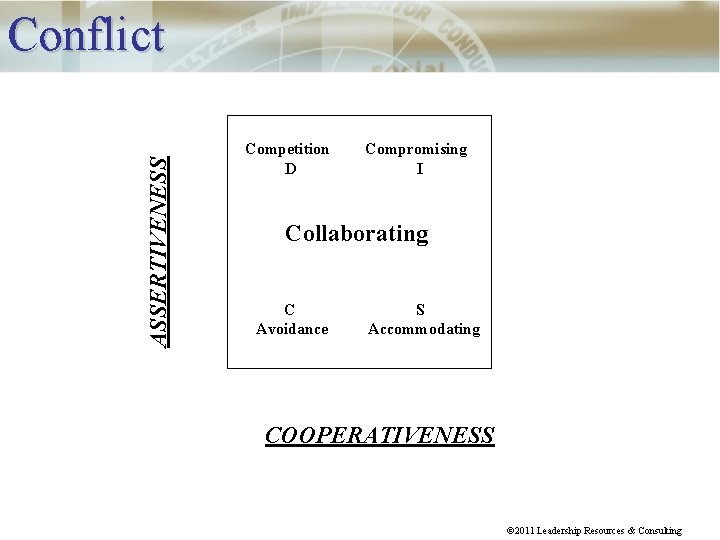
ASSERTIVENESS Conflict Competition D Compromising I Collaborating C Avoidance S Accommodating COOPERATIVENESS © 2011 Leadership Resources & Consulting
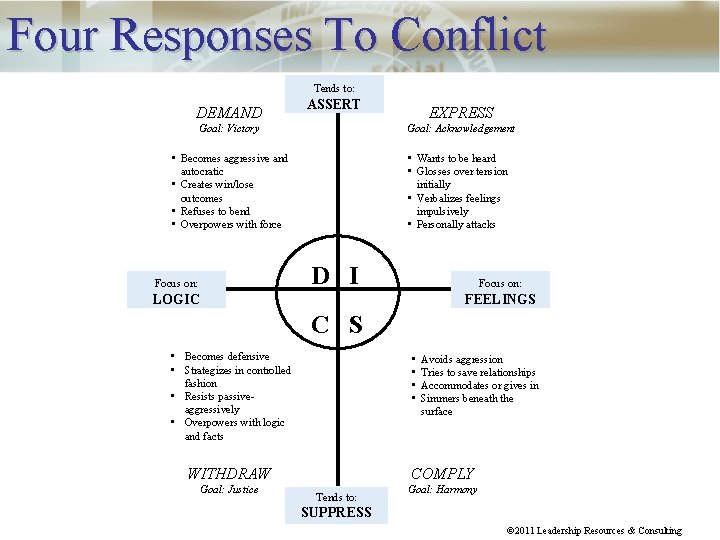
Four Responses To Conflict Tends to: DEMAND ASSERT Goal: Victory EXPRESS Goal: Acknowledgement • Becomes aggressive and • Wants to be heard • Glosses over tension autocratic • Creates win/lose outcomes • Refuses to bend • Overpowers with force initially • Verbalizes feelings impulsively • Personally attacks D I Focus on: LOGIC FEELINGS C S • Becomes defensive • Strategizes in controlled • • fashion • Resists passiveaggressively • Overpowers with logic Avoids aggression Tries to save relationships Accommodates or gives in Simmers beneath the surface and facts WITHDRAW Goal: Justice COMPLY Tends to: Goal: Harmony SUPPRESS © 2011 Leadership Resources & Consulting
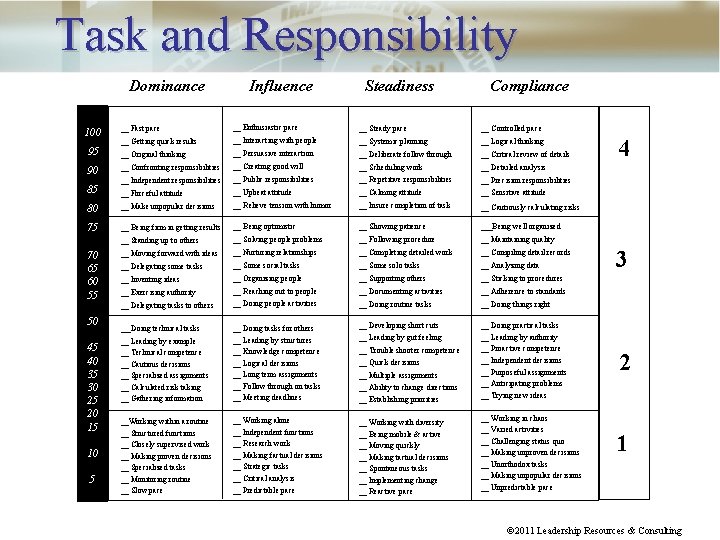
Task and Responsibility Dominance Influence Steadiness Compliance __ Fast pace __ Enthusiastic pace __ Steady pace __ Controlled pace __ Getting quick results __ Interacting with people __ Systemic planning __ Logical thinking __ Original thinking __ Persuasive interaction __ Deliberate follow through __ Critical review of details 90 __ Confronting responsibilities __ Creating good will __ Scheduling work __ Detailed analysis 85 __ Independent responsibilities __ Public responsibilities __ Repetitive responsibilities __ Forceful attitude __ Upbeat attitude __ Calming attitude __ Precision responsibilities __ Sensitive attitude 80 __ Make unpopular decisions __ Relieve tension with humor __ Insure completion of task __ Cautiously calculating risks 75 __ Being firm in getting results __ Being optimistic __ Showing patience __Being well organized __ Standing up to others __ Solving people problems __ Following procedure __ Maintaining quality __ Moving forward with ideas __ Nurturing relationships __ Completing detailed work __ Compiling detail records __ Delegating some tasks __ Some social tasks __ Some solo tasks __ Analyzing data __ Inventing ideas __ Organizing people __ Supporting others __ Sticking to procedures __ Exercising authority __ Reaching out to people __ Documenting activities __ Adherence to standards __ Delegating tasks to others __ Doing people activities __ Doing routine tasks __ Doing things right __Doing technical tasks __ Developing short cuts __ Leading by example __ Technical competence __ Cautious decisions __ Specialized assignments __ Calculated risk taking __ Gathering information __ Doing tasks for others __ Leading by structures __ Knowledge competence __ Logical decisions __ Long term assignments __ Follow through on tasks __ Meeting deadlines __ Doing practical tasks __ Leading by authority __ Proactive competence __ Independent decisions __ Purposeful assignments __ Anticipating problems __ Trying new ideas __Working within a routine __ Structured functions __ Closely supervised work __ Making proven decisions __ Specialized tasks __ Monitoring routine __ Slow pace __ Working alone __ Independent functions __ Research work __ Making factual decisions __ Strategic tasks __ Critical analysis __ Predictable pace __ Working with diversity __ Being mobile & active __ Moving quickly __ Making tactual decisions __ Spontaneous tasks __ Implementing change __ Reactive pace 100 95 70 65 60 55 50 45 40 35 30 25 20 15 10 5 __ Leading by gut feeling __ Trouble shooter competence __ Quick decisions __ Multiple assignments __ Ability to change directions __ Establishing priorities __ Working in chaos __ Varied activities __ Challenging status quo __ Making unproven decisions __ Unorthodox tasks __ Making unpopular decisions __ Unpredictable pace 4 3 2 1 © 2011 Leadership Resources & Consulting
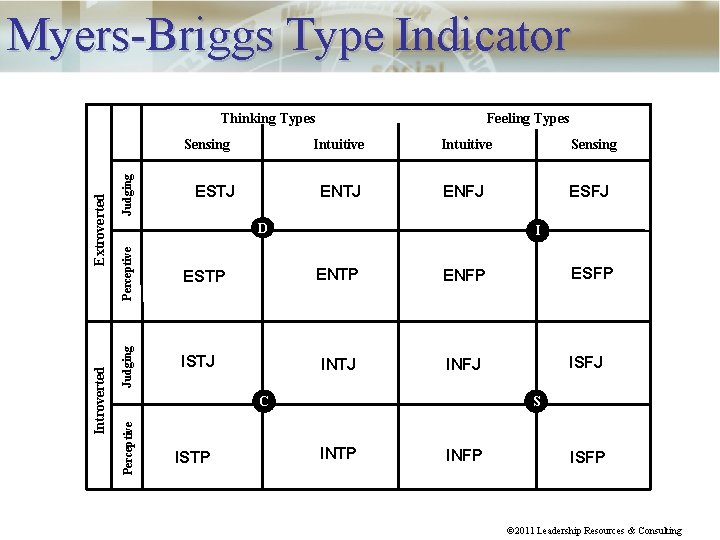
Myers-Briggs Type Indicator Thinking Types Judging ESTJ Intuitive Sensing ENTJ ENFJ ESFJ Perceptive ESTP Judging D ISTJ I ENTP ENFP ESFP INTJ INFJ ISFJ C Perceptive Introverted Extroverted Sensing Feeling Types ISTP S INTP INFP ISFP © 2011 Leadership Resources & Consulting
Examples of DISC Leadership Styles D=Dominance High D Behavior: Direct, Domineering, Risk Taker Leadership Example: General Douglas Mac. Arthur Macarthur had a strong drive, and was gifted at achieving goals through dramatic presentations. He intimidated others, and had to win every argument he was in. Low D Behavior: Unassuming, Mild, Modest Leadership Example: General George C. Marshall liked having ownership of tasks, and following through with those tasks. He had intense loyalty, and was very blunt. © 2011 Leadership Resources & Consulting
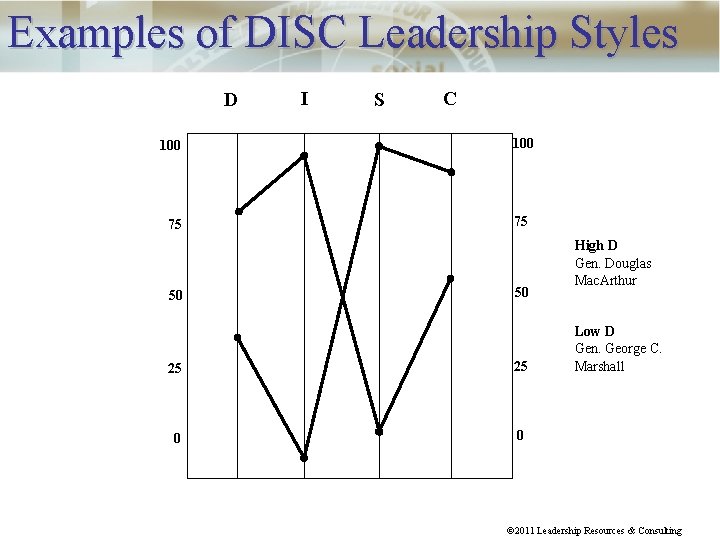
Examples of DISC Leadership Styles D 100 75 50 I S C 100 75 50 25 25 0 0 High D Gen. Douglas Mac. Arthur Low D Gen. George C. Marshall © 2011 Leadership Resources & Consulting
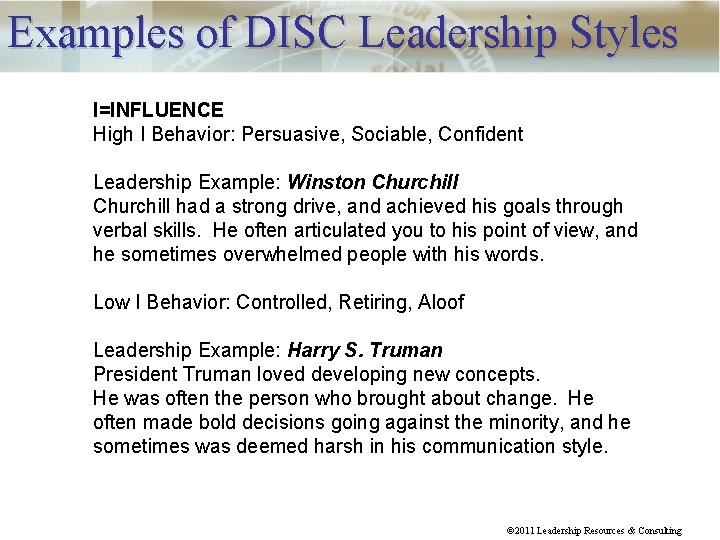
Examples of DISC Leadership Styles I=INFLUENCE High I Behavior: Persuasive, Sociable, Confident Leadership Example: Winston Churchill had a strong drive, and achieved his goals through verbal skills. He often articulated you to his point of view, and he sometimes overwhelmed people with his words. Low I Behavior: Controlled, Retiring, Aloof Leadership Example: Harry S. Truman President Truman loved developing new concepts. He was often the person who brought about change. He often made bold decisions going against the minority, and he sometimes was deemed harsh in his communication style. © 2011 Leadership Resources & Consulting
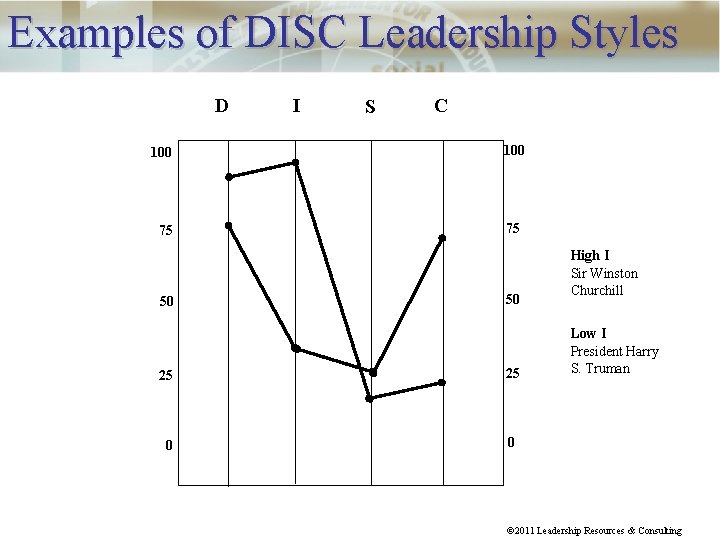
Examples of DISC Leadership Styles D 100 75 50 I S C 100 75 50 25 25 0 0 High I Sir Winston Churchill Low I President Harry S. Truman © 2011 Leadership Resources & Consulting
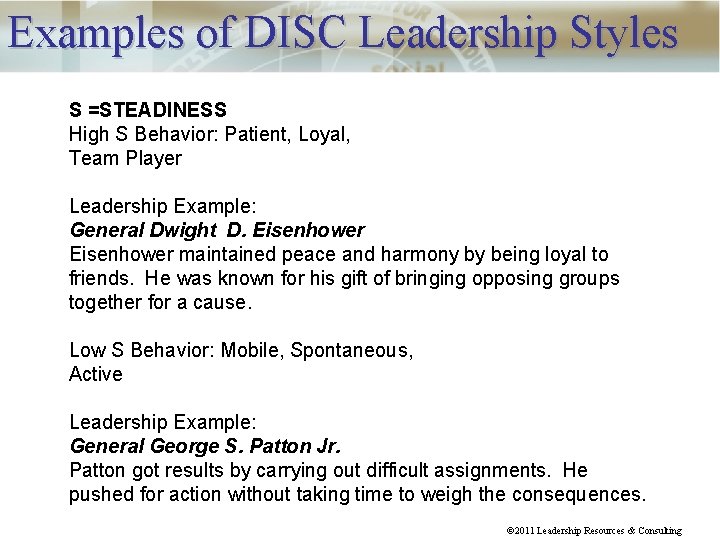
Examples of DISC Leadership Styles S =STEADINESS High S Behavior: Patient, Loyal, Team Player Leadership Example: General Dwight D. Eisenhower maintained peace and harmony by being loyal to friends. He was known for his gift of bringing opposing groups together for a cause. Low S Behavior: Mobile, Spontaneous, Active Leadership Example: General George S. Patton Jr. Patton got results by carrying out difficult assignments. He pushed for action without taking time to weigh the consequences. © 2011 Leadership Resources & Consulting
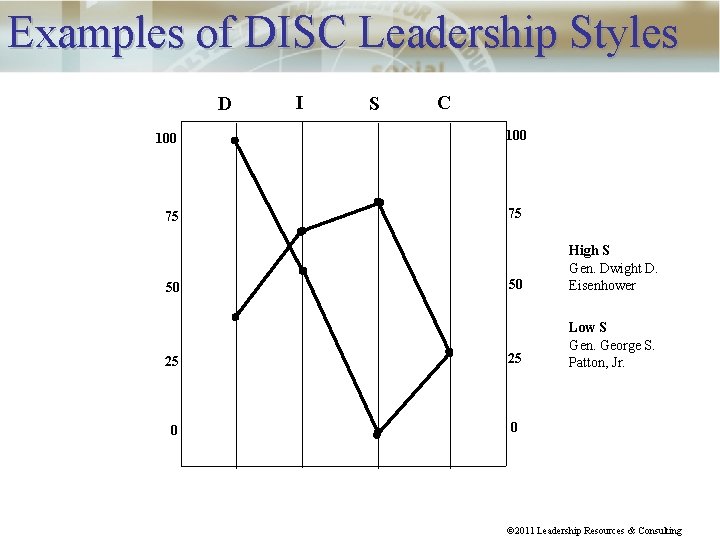
Examples of DISC Leadership Styles D 100 75 I S C 100 75 50 High S Gen. Dwight D. Eisenhower 25 25 Low S Gen. George S. Patton, Jr. 0 0 50 © 2011 Leadership Resources & Consulting
Examples of DISC Leadership Styles C=COMPLIANCE High C Behavior: Accurate, Detailed, Restrained Leadership Example: General Omar N. Bradley was a critical thinker who was committed to quality and order. He adapted to those in authority because he feared criticism towards him. Low C Behavior: Own Person, Firm, Defiant Leadership Example: General H. Norman Schwarzkopf is known for his strength in character. He takes charge, but is sometimes slow in seeing a task completed. He has trouble seeing where aggressive actions can have negative consequences. © 2011 Leadership Resources & Consulting
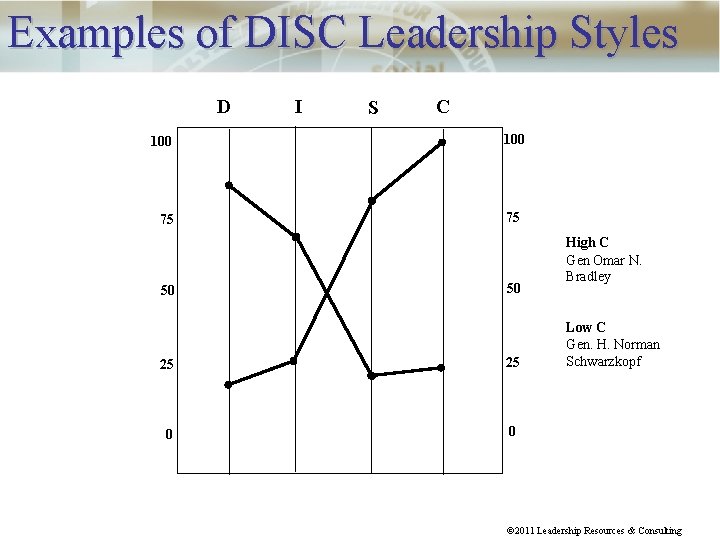
Examples of DISC Leadership Styles D 100 75 50 I S C 100 75 50 25 25 0 0 High C Gen Omar N. Bradley Low C Gen. H. Norman Schwarzkopf © 2011 Leadership Resources & Consulting
- Slides: 23