
BEHAVIORAL MODIFICATION STRATEGIES FOR WEIGHT MANAGEMENT IN CHILDREN
BEHAVIORAL MODIFICATION STRATEGIES FOR WEIGHT MANAGEMENT IN CHILDREN By: Betty Antwi
Purpose Statement Identify probable causes that can lead to childhood obesity and provided some behavioral modification strategies for weight management of children.
Overview Importance Physical Activity Nutrition Environmental Stimulus/Obstacles Parental Involvement Weight Management Programs Conclusion
Importance Affects 17% of all children and adolescents in the United States Since 1980, obesity prevalence among children and adolescents has almost tripled. risk in the development in morbidity and mortality factors � High cholesterol � Hypertension � Type 2 diabetes � Respiratory complications � Depression Centers for Disease Control and Prevention. Prevalence of Obesity in the United States, 2009– 2010.
Clarification The selected studies or information had different definitions on what age was considered as a “child”. � Adolescent ages were included in the childhood category in some studies. � A child could range between ages 2 to 19.
Nutrition q q Eating habits Consumption of Fruits/Vegetables
Eating Habits Factors influence the foods children consume � Eating more food away from home � Drinking more sugar-sweetened drinks � Snacking more frequently � Ready-to-eat and low cost meals These factors affect food choices provided to children U. S. Department of Health & Human Services. Assistant Secretary for Planning and Evaluation: Childhood Obesity.
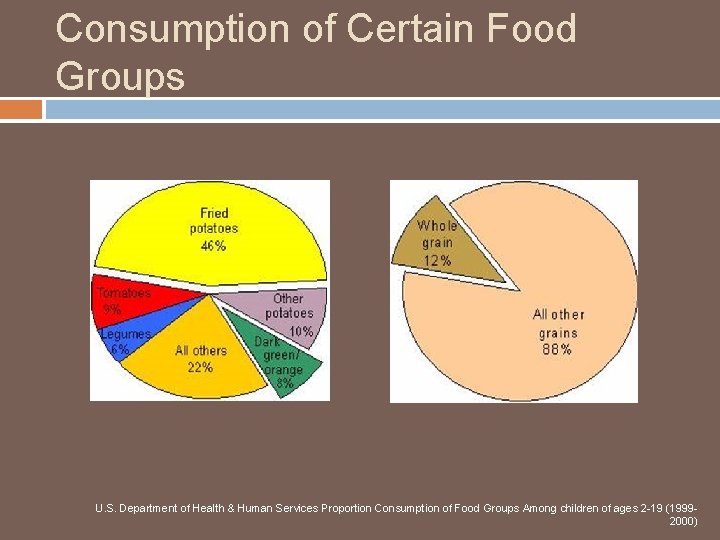
Consumption of Certain Food Groups U. S. Department of Health & Human Services Proportion Consumption of Food Groups Among children of ages 2 -19 (19992000)
Consumption of Fruits and Vegetables The consumption of fruits and vegetables are vital to a child’s diet. � Important nutrients for development of the body � May replace unhealthy high calorie foods. Approximately 21 percent of children eat the recommended five or more servings of fruits and vegetables daily. U. S. Department of Health & Human Services. Assistant Secretary for Planning and Evaluation: Childhood Obesity.
Study in New South Wale, Australia To observe consumption of fruits and vegetables. Home food environment provided to children. 396 parents of children ages 3 -5 years old. Telephone surveys were used to collect data. Wyse R, Campbell E, Nathan N, Wolfenden L. Associations between characteristics of the home food environment and fruit and vegetable intake in preschool children: a cross-sectional study. (2011)

Results Positive associations � Parental fruit and vegetable intake � Fruit and vegetable accessibility � # of occurrences each day that parents provided their child with fruit and vegetables � Eating only at set meal times for meals Associations accounted for 48% of the difference in overall score. Children provided with healthier options are likelihood to consume healthier food options. Wyse R, Campbell E, Nathan N, Wolfenden L. Associations between characteristics of the home food environment and fruit and vegetable intake in preschool children: a cross-sectional study. (2011)
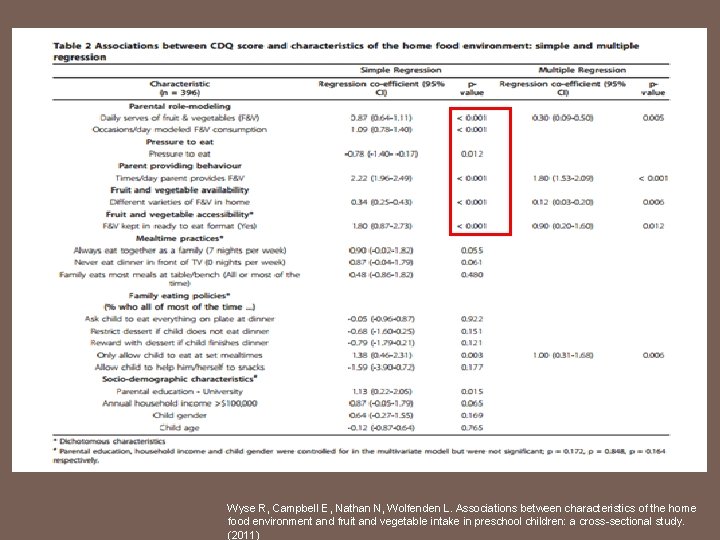
Wyse R, Campbell E, Nathan N, Wolfenden L. Associations between characteristics of the home food environment and fruit and vegetable intake in preschool children: a cross-sectional study. (2011)
Physical Activity q q Importance of Physical Activity Emphasis on Play
Physical Activity Key factor in weight management The usage electronic devices influences physical activity levels The absence of physical activity
Benefits of Physical Activity Benefits � Excess fat reduction � Lowering blood pressure � Reduce risk of illnesses � Increase brain development � Improve psychosocial well-being
Emphasis on Play Letting children “play” is very vital. Examples of play “Play allows children to use creative while developing their imagination, dexterity, and physical, cognitive and emotional strength. Ginsburg KR. The importance of play in promoting healthy child development and maintaining strong parent-child bonds. Pediatrics. 2007
Environmental Stimulus and Obstacles q q q Resources of Environment Television Advertisement
Resources of Environment Urban or Suburban Area Communities Safety Schools Lack of supervision at home
Television Research states: “It is estimated that children in the United States are spending 25 percent of their waking hours watching television Increase incidence of obesity Concurrent consumption of high-calorie snacks Reduction of electric devices like the television � engage � in more physical activity reduce consumption of unhealthy snacks
Advertisement High correlation with weight gain. Indirect evidence of how advertisements increase the consumption of unhealthy highcalorie foods Advertisement companies spend use time and resources to find out what children’s interests Andreyeva T, Kelly IR, Harris JL. Exposure to food advertising on television: associations with children's fast food and soft drink consumption and obesity. Econ Hum Biol. 2011
Advertisement Only $11. 4 million was spent on marketing fruits and vegetables to youth in 2006, representing less than 1 percent of the $2 billion spent on all food marketing to youth. Reduction the amount of advisements could reduce nutrient-poor foods. National Fruit & Vegetable Alliance http: //www. yaleruddcenter. org/newsletter/issue. aspx? id=52
Parental Involvement q q q Importance Effects on children Studies
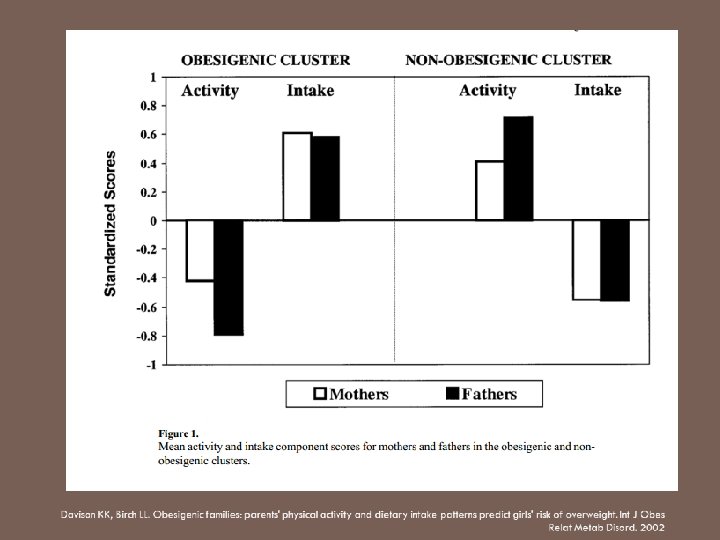
Parental Involvement Parents or guardians are role models to children. Absence of parental involvement can counteract outcomes. Overweight children have a 70 % chance of becoming overweight or obese adults. Increases to 80 % if one or more parent is overweight or obese.
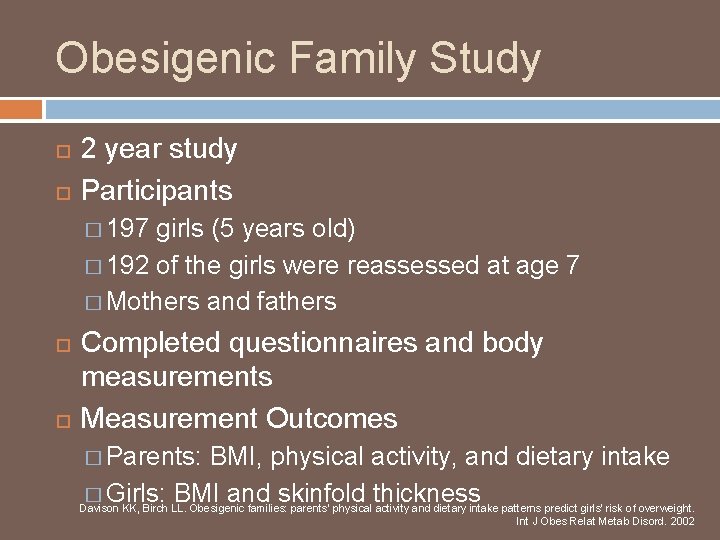
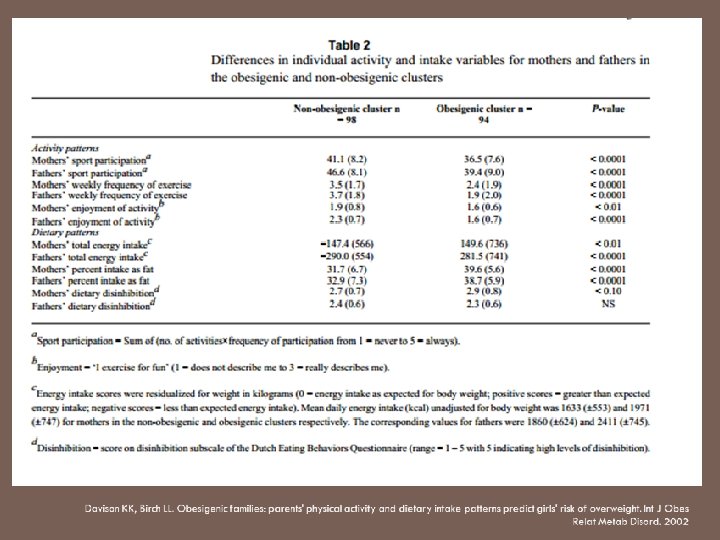
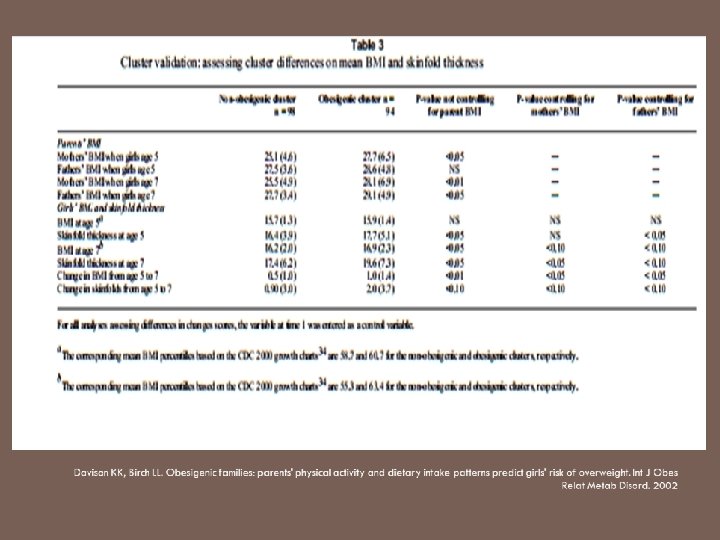
Obesigenic Family Study 2 year study Participants � 197 girls (5 years old) � 192 of the girls were reassessed at age 7 � Mothers and fathers Completed questionnaires and body measurements Measurement Outcomes � Parents: BMI, physical activity, and dietary intake � Girls: BMI and skinfold thickness Davison KK, Birch LL. Obesigenic families: parents' physical activity and dietary intake patterns predict girls' risk of overweight. Int J Obes Relat Metab Disord. 2002
Weight Management Programs q q Parental Guidance Benefits Studies Example
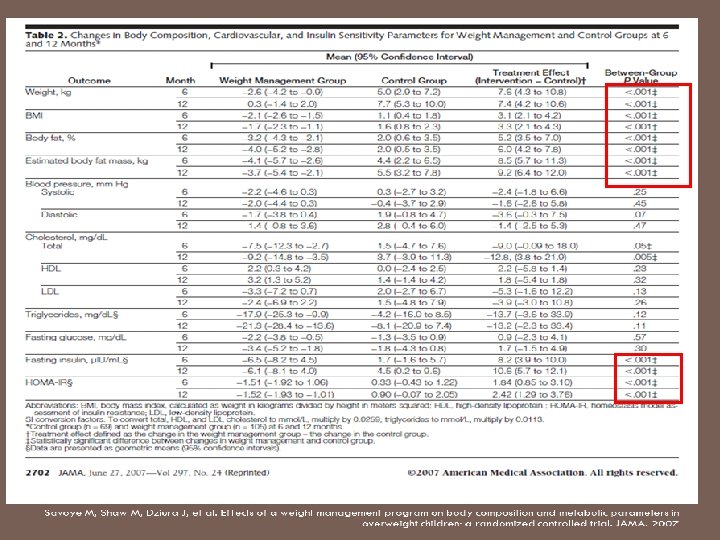
Weight Management Programs Implementing lifestyle changes in child’s life can be very difficult Benefits � Improve family communication � Education � Meet new people � Prevent or improve conditions (ex: Type 2 diabetes) � Lose weight � Increase self-esteem Savoye M, Shaw M, Dziura J, et al. Effects of a weight management program on body composition and metabolic parameters in overweight children: a randomized controlled trial. JAMA. 2007
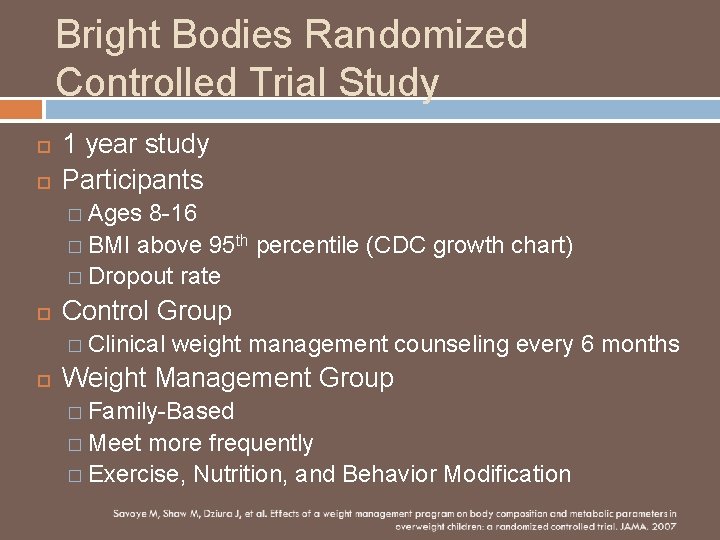
Bright Bodies Randomized Controlled Trial Study 1 year study Participants � Ages 8 -16 � BMI above 95 th percentile (CDC growth chart) � Dropout rate Control Group � Clinical weight management counseling every 6 months Weight Management Group � Family-Based � Meet more frequently � Exercise, Nutrition, and Behavior Modification
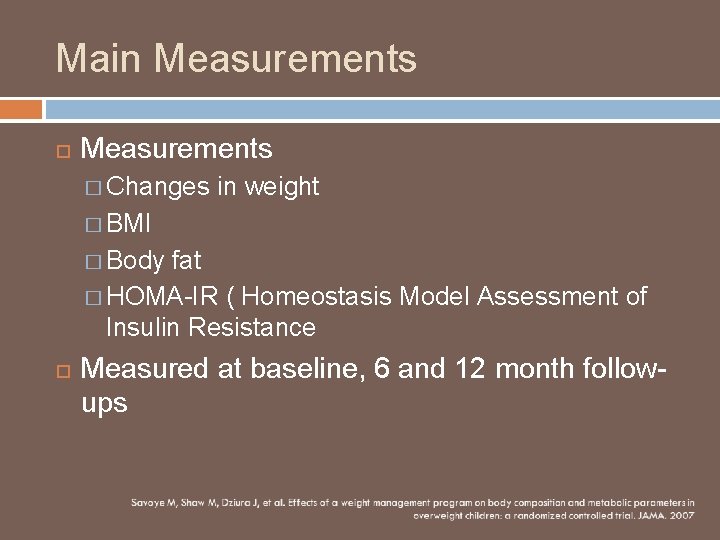
Main Measurements � Changes in weight � BMI � Body fat � HOMA-IR ( Homeostasis Model Assessment of Insulin Resistance Measured at baseline, 6 and 12 month followups
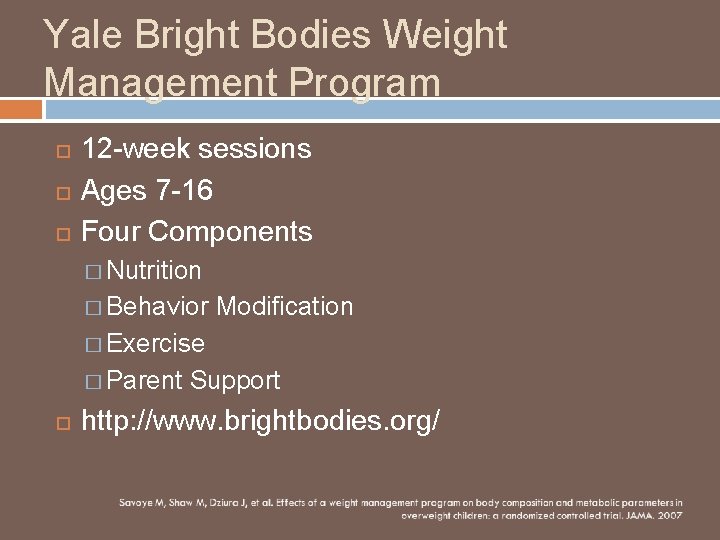
Yale Bright Bodies Weight Management Program 12 -week sessions Ages 7 -16 Four Components � Nutrition � Behavior Modification � Exercise � Parent Support http: //www. brightbodies. org/
Conclusion Weight management in children is very crucial to a child development Positive behavioral modifications produce long -term outcomes. Parents involvement and weight management programs can provide guidance. Continuous research on effective interventions for children could reduce childhood obesity.

Thank You! Questions?
- Slides: 35