
Behavioral models of impulsivity in humans and nonhumans
Behavioral models of impulsivity in humans and non-humans: Individual differences and effects of drugs. Harriet de Wit The University of Chicago Jerry Richards University of Buffalo (SUNY)
Impulsivity closely linked with drug abuse • As a determinant – Individual differences: risk factor – Momentary changes • As a consequence – Acute drug effects – Chronic drug effects
Impulsive Symptoms in Psychiatry: Common but Heterogeneous * failure to consider consequences; aggression (Antisocial Personality Disorder) * engaging in behaviors with damaging consequences (e. g. , excessive spending, drug use) (Borderline Personality, Substance Use Disorder) * distractibility, difficulty waiting, lack of inhibitory control (ADHD) * impaired judgment, risk-taking (Substance-Induced Disorder)
Two broad types of impulsivity Cognitive impulsivity – Insensitivity to delayed consequences – Lack of planning, lack of forethought Behavioral inhibition – Difficulty inhibiting prepotent responses – Difficulty suppressing unwanted behavior, resisting temptation – Difficulty waiting
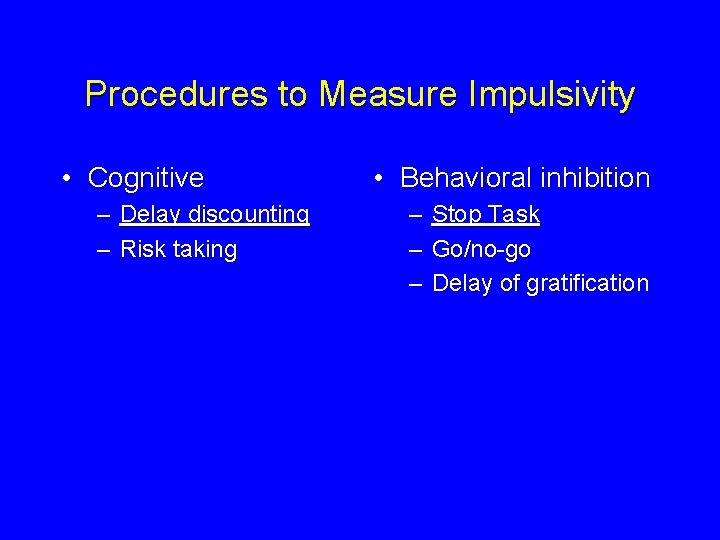
Procedures to Measure Impulsivity • Cognitive – Delay discounting – Risk taking • Behavioral inhibition – – – Stop Task Go/no-go Delay of gratification
Data to be presented • Individual differences • Effects of drugs • Humans • Rats and mice
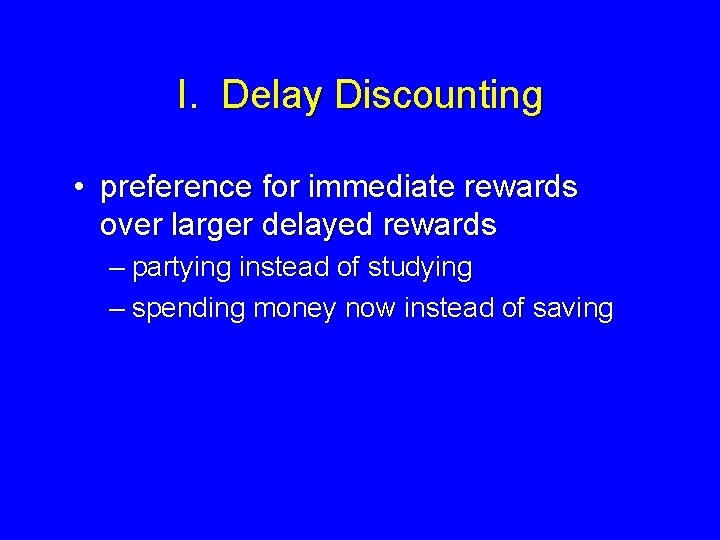
I. Delay Discounting • preference for immediate rewards over larger delayed rewards – partying instead of studying – spending money now instead of saving
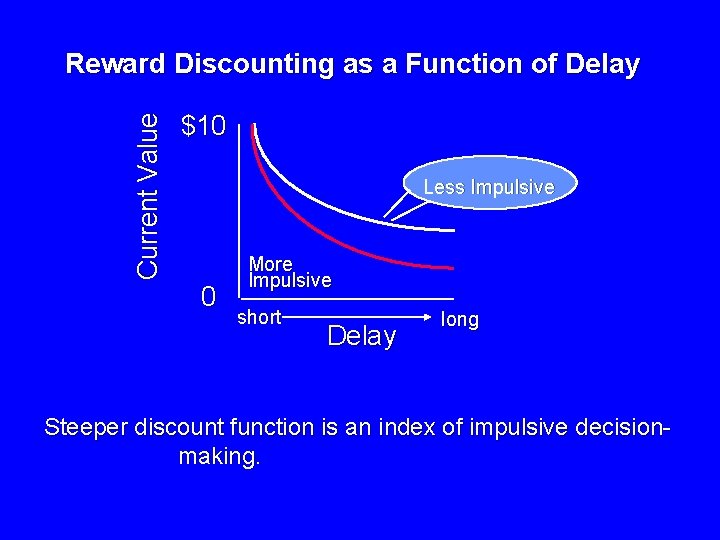
Current Value Reward Discounting as a Function of Delay $10 Less Impulsive 0 More Impulsive short Delay long Steeper discount function is an index of impulsive decisionmaking.
Individual Differences in Delay Discounting • psychiatric patients (Crean et al, 2000) • gamblers (Petry, 2001) • drug users (Bickel, 1999; Mitchell, 1999) • variability among healthy volunteers • Relationship to personality
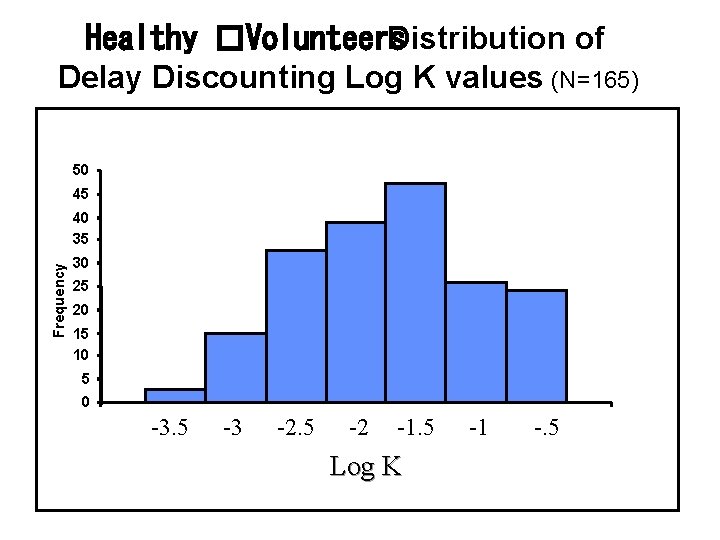
Healthy �Volunteers : Distribution of Delay Discounting Log K values (N=165) 50 45 Frequency 40 35 30 25 20 15 10 5 0 -3. 5 -3 -2. 5 -2 -1. 5 Log K -1 -. 5
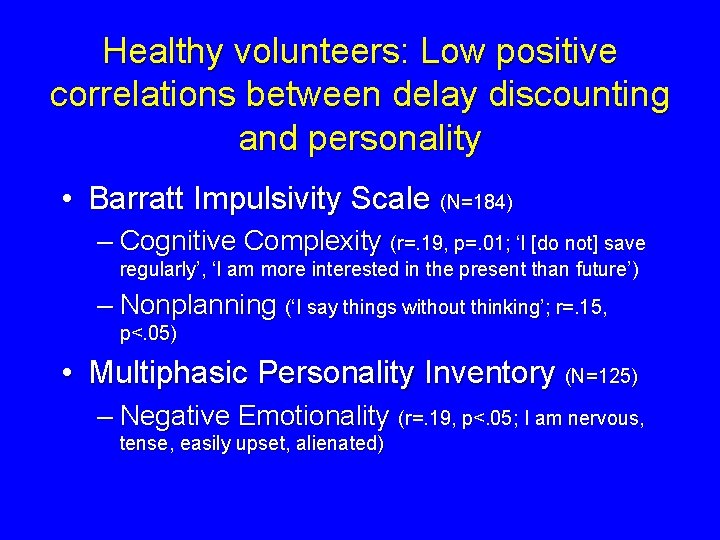
Healthy volunteers: Low positive correlations between delay discounting and personality • Barratt Impulsivity Scale (N=184) – Cognitive Complexity (r=. 19, p=. 01; ‘I [do not] save regularly’, ‘I am more interested in the present than future’) – Nonplanning (‘I say things without thinking’; r=. 15, p<. 05) • Multiphasic Personality Inventory (N=125) – Negative Emotionality (r=. 19, p<. 05; I am nervous, tense, easily upset, alienated)
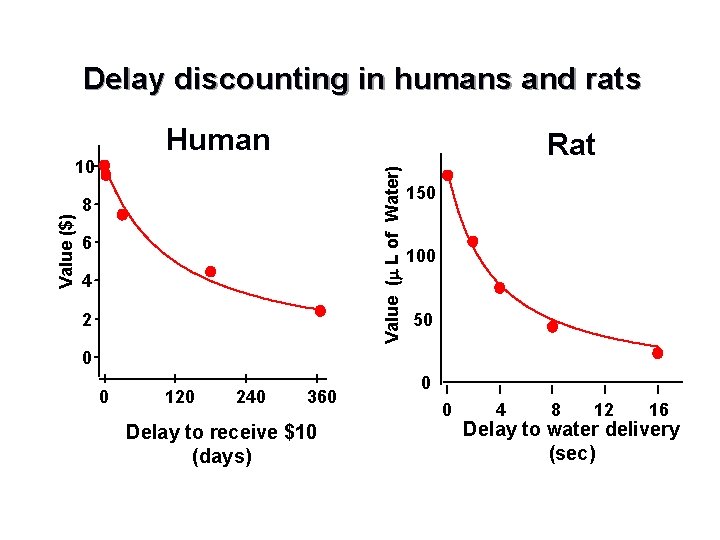
Delay discounting in humans and rats Human Value ( L of Water) Value ($) 10 Rat 8 6 4 2 150 100 50 0 0 120 240 360 Delay to receive $10 (days) 0 0 4 8 12 16 Delay to water delivery (sec)
Individual differences in delay discounting in rats: Relationship to novelty responding • Rats that exhibit “high” responding in novel environment more readily selfadminister drugs than “low” responders (Piazza et al). • Do “high” responders also exhibit steeper delay discounting?
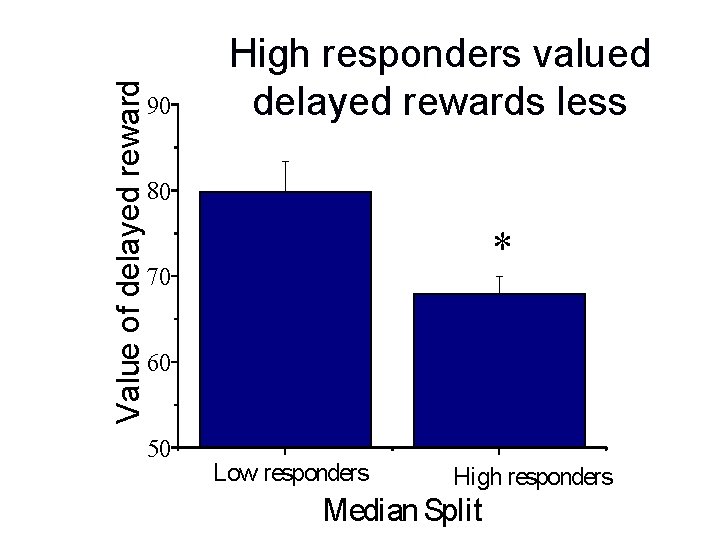
Value of delayed reward 90 High responders valued delayed rewards less 80 * 70 60 50 Low responders High responders Median Split
Novelty Response and Delay Discounting in Two Inbred Mouse Strains: S 129 vs C 57 • Compared to C 129, C 57 mice: • Respond more to novel environments • Respond more (locomotor activity) to stimulants • Self-administer alcohol more readily
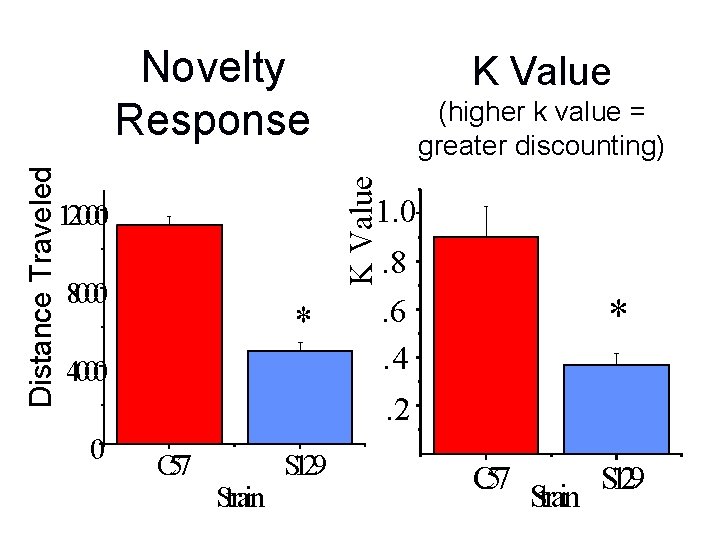
K Value (higher k value = greater discounting) K Value Distance Traveled Novelty Response 1. 0 12000 8000 * 4000 . 8. 6. 4 * . 2 0 C 57 Strain S 129
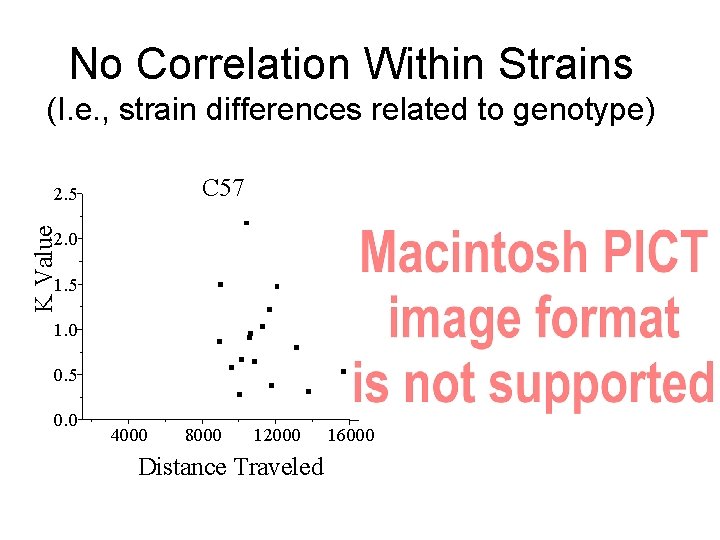
No Correlation Within Strains (I. e. , strain differences related to genotype) C 57 K Value 2. 5 2. 0 1. 5 1. 0 0. 5 0. 0 4000 8000 12000 Distance Traveled 16000
Effects of Drugs on Delay Discounting ( = decrease in impulsivity )
II. Behavioral Inhibition Stop Task Ability to inhibit a prepotent response Subject told to respond as quickly as possible to a visual Go signal. . . but to withhold the response if an auditory Stop signal is presented immediately after the Go signal How long does the individual need to Stop the response?
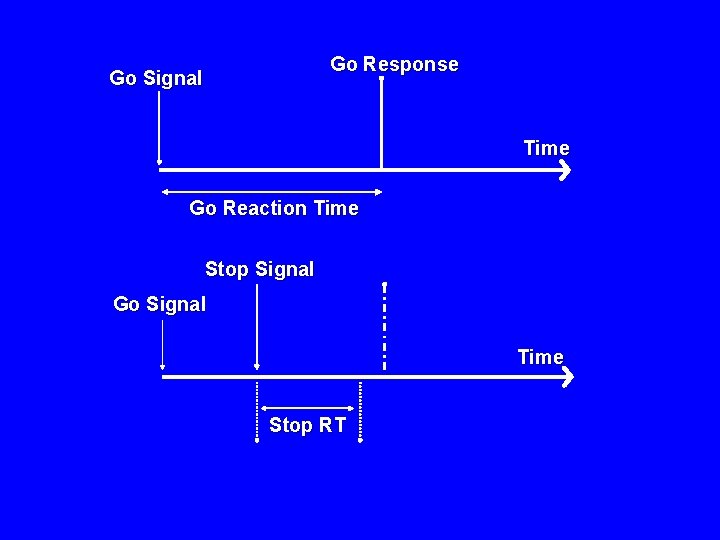
Go Response Go Signal Time Go Reaction Time Stop Signal Go Signal Time Stop RT
Individual Differences in Stop RT on Stop Task • ADHD children have slower Stop RT’s (Schachar et al, 1993) • Methylphenidate normalizes Stop RT in ADHD children (Tannock et al, 1989) • Cocaine users have slower Stop RT’s than controls (Fillmore and Rush, 2002)
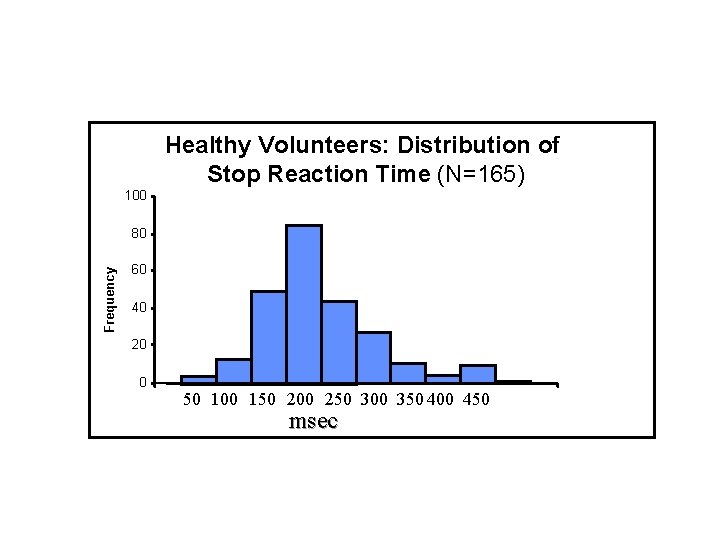
Healthy Volunteers: Distribution of Stop Reaction Time (N=165) 100 Frequency 80 60 40 20 0 50 100 150 200 250 300 350 400 450 msec
Healthy volunteers: Low positive correlations between Stop RT and personality (N=239) • Correlations between Stop RT and Barratt Impulsivity Subscales – Self-Control (r=. 18, p=. 005 ‘I [do not] plan tasks carefully’, ‘I am a careful thinker’, ‘I say things without thinking’) – Attention (r=. 19, p=. 003) ‘I [do not] concentrate easily’, ‘I squirm at plays or lectures’, ‘I am [not] a steady thinker’)
Is delay discounting (k value) related to behavioral inhibition (Stop RT)? • 165 healthy volunteers • correlation • factor analysis
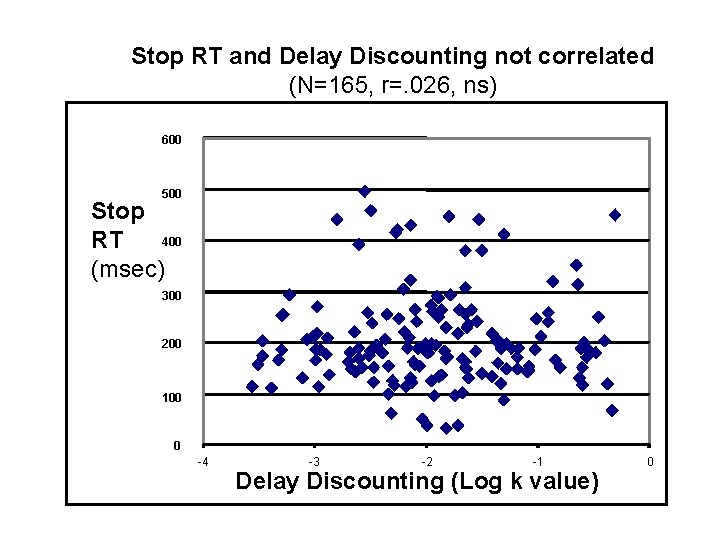
Stop RT and Delay Discounting not correlated (N=165, r=. 026, ns) 600 500 Stop 400 RT (msec) 300 200 100 0 -4 -3 -2 -1 Delay Discounting (Log k value) 0
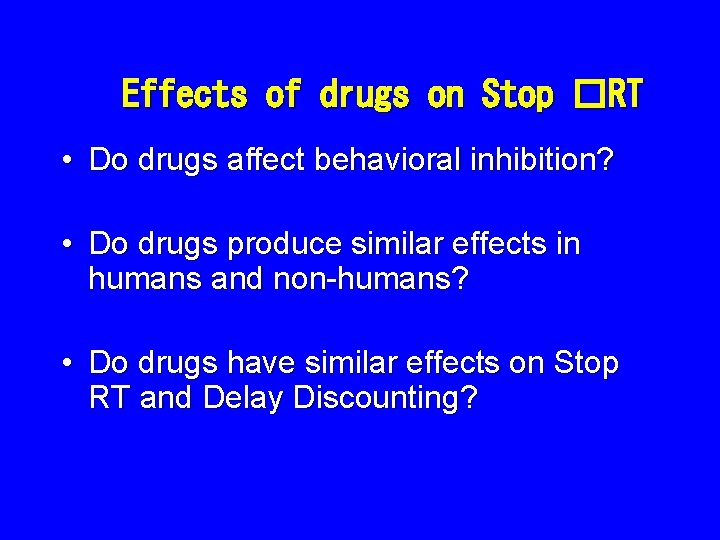
Effects of drugs on Stop �RT • Do drugs affect behavioral inhibition? • Do drugs produce similar effects in humans and non-humans? • Do drugs have similar effects on Stop RT and Delay Discounting?
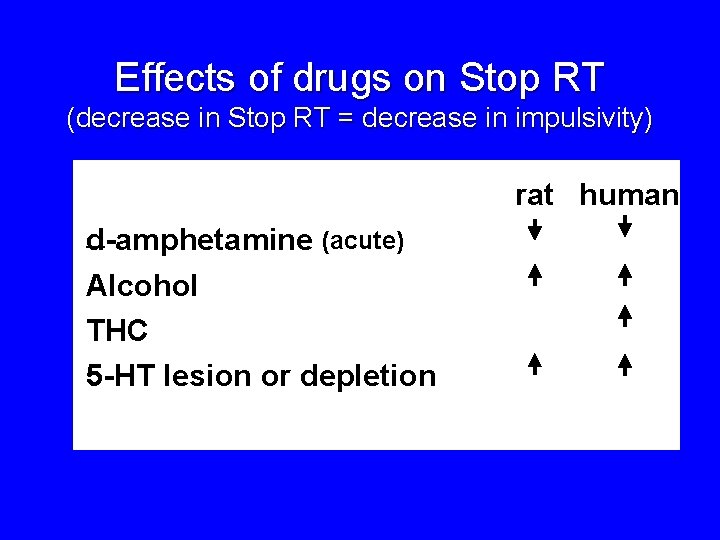
Effects of drugs on Stop RT (decrease in Stop RT = decrease in impulsivity) rat human d-amphetamine (acute) Alcohol THC 5 -HT lesion or depletion
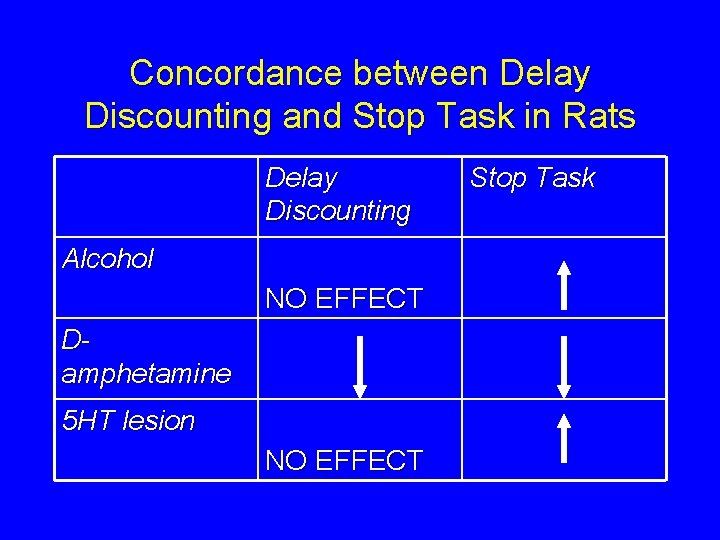
Concordance between Delay Discounting and Stop Task in Rats Delay Discounting Alcohol NO EFFECT Damphetamine 5 HT lesion NO EFFECT Stop Task
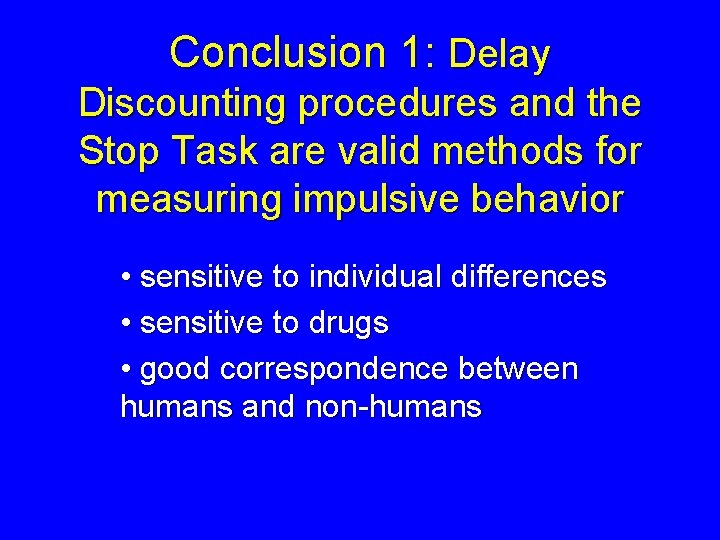
Conclusion 1: Delay Discounting procedures and the Stop Task are valid methods for measuring impulsive behavior • sensitive to individual differences • sensitive to drugs • good correspondence between humans and non-humans
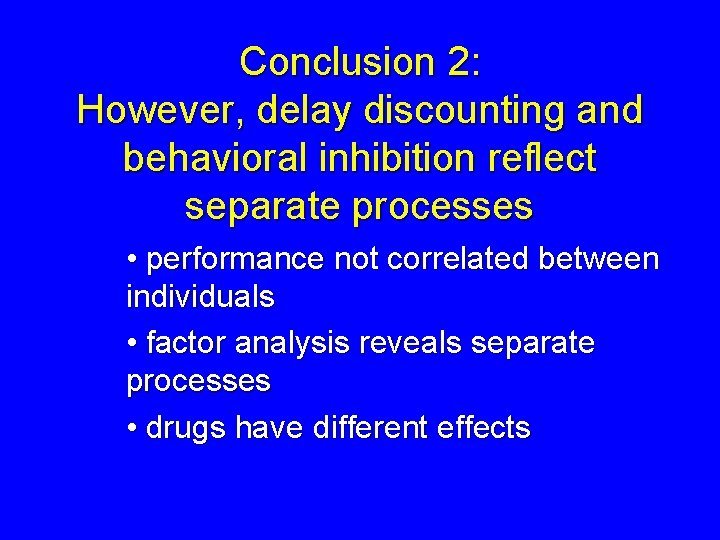
Conclusion 2: However, delay discounting and behavioral inhibition reflect separate processes • performance not correlated between individuals • factor analysis reveals separate processes • drugs have different effects
Acknowledgments • • John Crean, Ph. D Justin Enggasser, MA Henry Chi, MA Jen Mc. Donald, BA Andrea King, Ph. D Brady Reynolds, Ph. D Jim Zacny, Ph. D GCRC, NIDA
- Slides: 31