
Behavioral Interviews An EvidenceBased Approach to Hiring the
Behavioral Interviews An Evidence-Based Approach to Hiring the Right Candidate Supplemental Self-Study Presentation

Behavioral Interviews: An Evidence-Based Approach to Hiring the Right Candidate Overview
Behavioral Interviews: An Evidence-Based Approach to Hiring the Right Candidate Introduction A survey by Career. Builder found that 69 percent of organizations have been adversely affected by a bad hire in the past year. i A bad hire was considered someone with any of the following issues: poor performance, failure to get along with others, negative attitude, attendance problems, and complaints from customers. The consequences included any of the following: lost productivity, time required to hire and train another person, drag on morale throughout the department or organization, loss of sales, and legal issues. A survey by Robert Half Finance & Accounting found that poor performance was the number one reason that resulted in a failed hire. A poor skills match was the second most cited reason. ii In addition, failed hires result from a “culture clash, ” where the new hire doesn’t fit in with the company culture. Behavioral interviewing is an evidence-based approach for ensuring you hire the right person for the job, effectively minimizing all of these potential problems.
Behavioral Interviews: An Evidence-Based Approach to Hiring the Right Candidate Introduction Part 2 Premise of Behavioral Interviewing The basic premise of behavioral interviewing is that past performance is the best indicator of future performance. Therefore, by asking candidates questions that relate to specific past experiences, the interviewer(s) will gain the most useful information to evaluate the candidate’s potential performance in the position they are interviewing for. In fact, behavioral interviews nearly triple the correlation with job success compared to traditional interviews. iii Compare these two questions: • “Do you work well under pressure? ” • “Tell me about a time you felt a lot of pressure at work. What were the circumstances, and what did you do about it? ” The first question is closed-ended, and even if candidates elaborate, they are not likely to connect their explanation to a real-life situation. The second question gives you specific information—what the candidate perceives as pressure and how successfully they handled it. This is the purpose of behavioral interviewing—to give you pertinent information and an objective way to evaluate it in order to make the best possible hiring decision.
Behavioral Interviews: An Evidence-Based Approach to Hiring the Right Candidate Goals of Behavioral Interviewing Eliminate Bias There are several goals or benefits of behavioral interviewing. The first is to eliminate bias. Bias occurs in many ways. The most obvious instances are when you rely on any of the following to make a hiring decision: • First impressions • Physical characteristics • Preference for candidates who are most similar to the interviewer. For example, they went to the same school, enjoy the same leisure activities, grew up in the same city, etc. • Preference for candidates because they seem to like the interviewer
Behavioral Interviews: An Evidence-Based Approach to Hiring the Right Candidate Goals of Behavioral Interviewing Part 2 Eliminate Inconsistency and Randomness The next goal is to eliminate inconsistency and randomness. The evaluation process is often haphazard and unplanned. Here are some ways it can be ineffective: • Gut Instinct: Relying on how you feel about the interviewee rather than on objective criteria. • Halo/horn effect: Allowing one aspect of the candidate to influence the overall judgment, either positively or negatively. • Recency effect: The most recently interviewed candidate is judged more favorably than those interviewed earlier. Establish Consistency, Objectivity, Reliability, and Fairness The last goal is to establish consistency, objectivity, reliability, and fairness. By creating a structured interview process with set behavioral-based interview questions and probing followup questions, you can ensure that you are using an evidence-based approach to hiring the right candidate.
Behavioral Interviews: An Evidence-Based Approach to Hiring the Right Candidate Goals of Behavioral Interviewing Part 3 Overview of the Behavioral Interviewing Process A structured behavioral interviewing process involves: • Identifying competencies • Developing behavioral-based questions • Reviewing resumes • Conducting the interview using behavioral-based questions and follow-up questions • Evaluating candidates objectively Throughout this program we will use a customer service position as the basis of most of the examples. This is intended to make the five steps of the overall process easier to learn and understand.
Behavioral Interviews: An Evidence-Based Approach to Hiring the Right Candidate Module 1: Identifying Competencies
Behavioral Interviews: An Evidence-Based Approach to Hiring the Right Candidate Identifying General Competencies Before you can develop behavioral-based questions, you need to know the skills and abilities or competencies necessary to be successful in the position. This requires developing a job description or a list of job responsibilities and competencies that is specific enough to differentiate it from any other position in your organization. Your objective is to translate general competencies into performance criteria, which describe what is needed to accomplish the desired results in the position. Competencies should include “hard” skills (technical knowledge, education, and experience) and “soft” skills (interpersonal communication, conflict resolution, stress management, team cooperation, energy/pace of work, and so on).
Behavioral Interviews: An Evidence-Based Approach to Hiring the Right Candidate Identifying General Competencies Part 2 Characteristics of Competencies Effectively written competencies will: • Define expectations, not tasks. • Describe observable knowledge, such as skills and abilities (as opposed to attitudes). • Explain appropriate job performance. – There are various levels of performance. For example, the general competency of effective decision making would have different expectations depending on the position or level of the job. General Competency Examples • Decision making • Teamwork • Fiscal accountability • Initiative
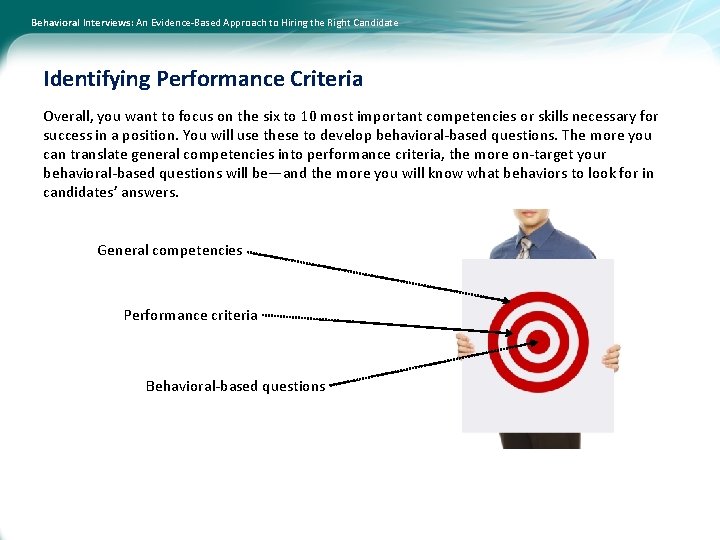
Behavioral Interviews: An Evidence-Based Approach to Hiring the Right Candidate Identifying Performance Criteria Overall, you want to focus on the six to 10 most important competencies or skills necessary for success in a position. You will use these to develop behavioral-based questions. The more you can translate general competencies into performance criteria, the more on-target your behavioral-based questions will be—and the more you will know what behaviors to look for in candidates’ answers. General competencies Performance criteria Behavioral-based questions
Behavioral Interviews: An Evidence-Based Approach to Hiring the Right Candidate Identifying Performance Criteria Part 2 Performance Criteria Examples Here are some performance criteria examples (based on the general competencies listed previously). • Makes timely, reasoned decisions that are based on gathering necessary information, facts, goals, constraints, and risks (general competency: decision making). • Actively fosters cooperation and commitment within a team to achieve the group’s goals and deliverables (general competency: teamwork). • Follows fiscal regulations, principles, and standards when processing financial transactions or committing fiscal resources (general competency: fiscal accountability). • Identifies opportunities and issues to address or improve, and then proactively follows through to resolve those issues or capitalize on those opportunities (general competency: initiative).
Behavioral Interviews: An Evidence-Based Approach to Hiring the Right Candidate Identifying Competencies and Performance Criteria: Example The following job description will serve as the basis for identifying competencies and developing performance criteria in the section that follows. It is written like a typical job description in that it doesn’t specifically call out competencies and performance criteria. These are identified from the information in the job description and additional thought put into the process. Sample Job Description: Customer Service Representative Summary: This position requires you to interact with customers on the phone and online to provide information, handle issues, and resolve complaints. As a customer service representative, you will be accountable for maintaining a high level of customer satisfaction. Main Responsibilities: • Answer customer calls/inquiries. • Assist with placement of orders, exchanges, and refunds. • Resolve customer complaints by determining the cause of the problem and the best solution. • Explain issues to the customer’s satisfaction. • Effectively handle angry customers. (continued on next slide)
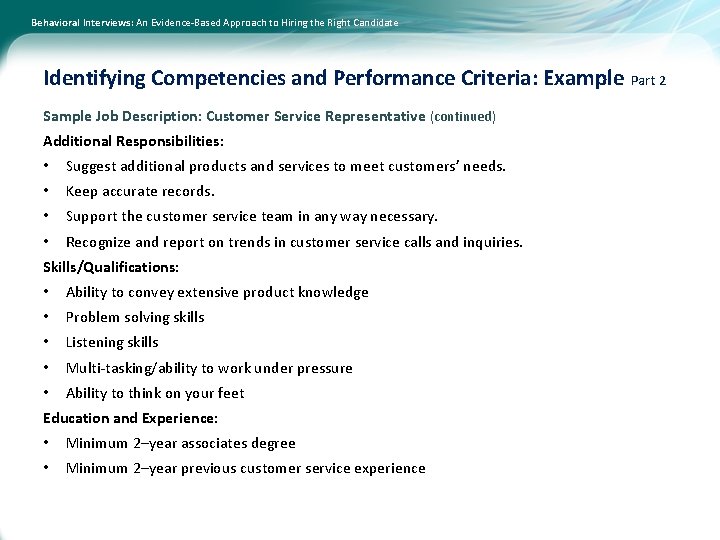
Behavioral Interviews: An Evidence-Based Approach to Hiring the Right Candidate Identifying Competencies and Performance Criteria: Example Part 2 Sample Job Description: Customer Service Representative (continued) Additional Responsibilities: • Suggest additional products and services to meet customers’ needs. • Keep accurate records. • Support the customer service team in any way necessary. • Recognize and report on trends in customer service calls and inquiries. Skills/Qualifications: • Ability to convey extensive product knowledge • Problem solving skills • Listening skills • Multi-tasking/ability to work under pressure • Ability to think on your feet Education and Experience: • Minimum 2–year associates degree • Minimum 2–year previous customer service experience
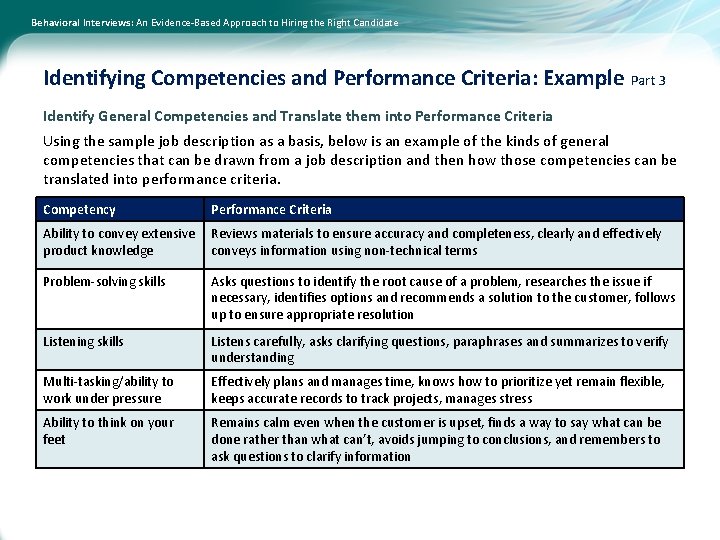
Behavioral Interviews: An Evidence-Based Approach to Hiring the Right Candidate Identifying Competencies and Performance Criteria: Example Part 3 Identify General Competencies and Translate them into Performance Criteria Using the sample job description as a basis, below is an example of the kinds of general competencies that can be drawn from a job description and then how those competencies can be translated into performance criteria. Competency Performance Criteria Ability to convey extensive product knowledge Reviews materials to ensure accuracy and completeness, clearly and effectively conveys information using non-technical terms Problem-solving skills Asks questions to identify the root cause of a problem, researches the issue if necessary, identifies options and recommends a solution to the customer, follows up to ensure appropriate resolution Listening skills Listens carefully, asks clarifying questions, paraphrases and summarizes to verify understanding Multi-tasking/ability to work under pressure Effectively plans and manages time, knows how to prioritize yet remain flexible, keeps accurate records to track projects, manages stress Ability to think on your feet Remains calm even when the customer is upset, finds a way to say what can be done rather than what can’t, avoids jumping to conclusions, and remembers to ask questions to clarify information
Behavioral Interviews: An Evidence-Based Approach to Hiring the Right Candidate Test Your Knowledge Read the question, then click on the answer. Which of the following is true of competencies? A. They describe tasks and duties. B. They are pertinent only for the technical skills necessary to do the job. C. They describe reporting relationships in an organization. D. They define expectations of how people should perform.

Behavioral Interviews: An Evidence-Based Approach to Hiring the Right Candidate Module 2: Developing Questions
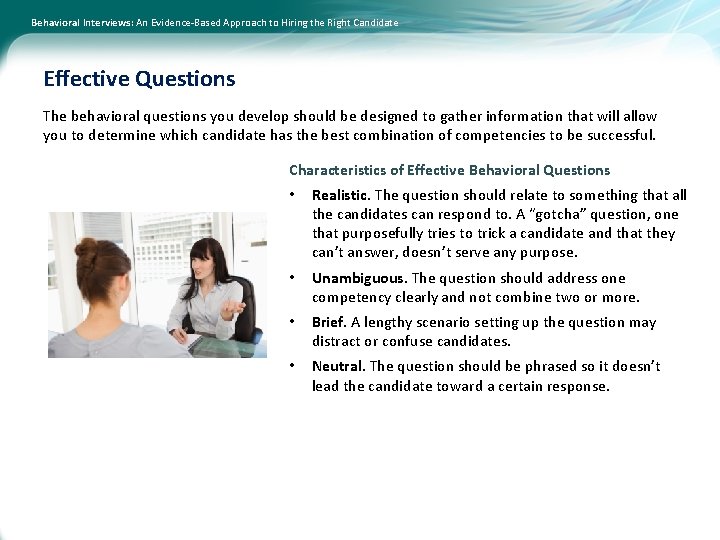
Behavioral Interviews: An Evidence-Based Approach to Hiring the Right Candidate Effective Questions The behavioral questions you develop should be designed to gather information that will allow you to determine which candidate has the best combination of competencies to be successful. Characteristics of Effective Behavioral Questions • Realistic. The question should relate to something that all the candidates can respond to. A “gotcha” question, one that purposefully tries to trick a candidate and that they can’t answer, doesn’t serve any purpose. • Unambiguous. The question should address one competency clearly and not combine two or more. • Brief. A lengthy scenario setting up the question may distract or confuse candidates. • Neutral. The question should be phrased so it doesn’t lead the candidate toward a certain response.
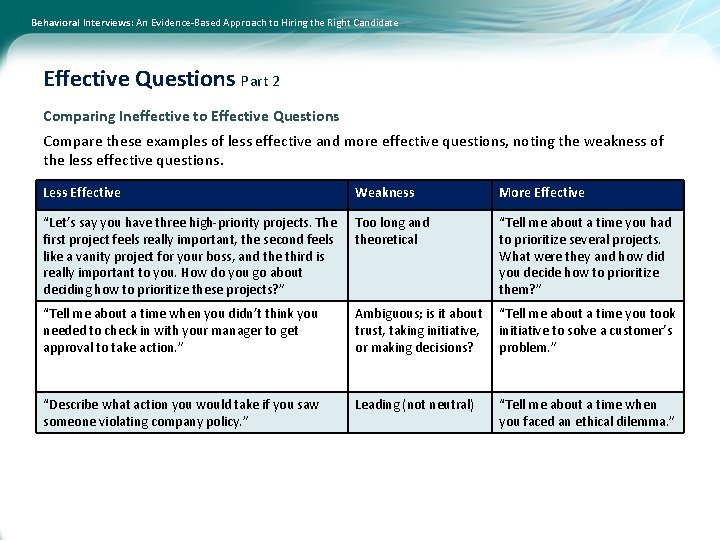
Behavioral Interviews: An Evidence-Based Approach to Hiring the Right Candidate Effective Questions Part 2 Comparing Ineffective to Effective Questions Compare these examples of less effective and more effective questions, noting the weakness of the less effective questions. Less Effective Weakness More Effective “Let’s say you have three high-priority projects. The first project feels really important, the second feels like a vanity project for your boss, and the third is really important to you. How do you go about deciding how to prioritize these projects? ” Too long and theoretical “Tell me about a time you had to prioritize several projects. What were they and how did you decide how to prioritize them? ” “Tell me about a time when you didn’t think you needed to check in with your manager to get approval to take action. ” Ambiguous; is it about trust, taking initiative, or making decisions? “Tell me about a time you took initiative to solve a customer’s problem. ” “Describe what action you would take if you saw someone violating company policy. ” Leading (not neutral) “Tell me about a time when you faced an ethical dilemma. ”
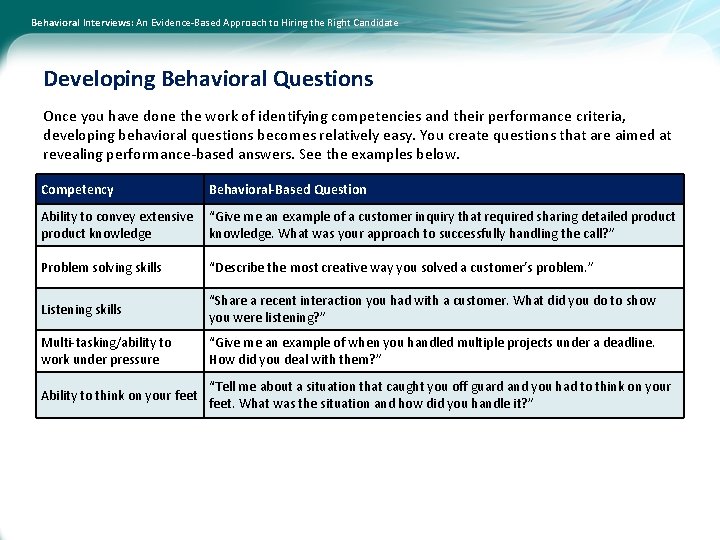
Behavioral Interviews: An Evidence-Based Approach to Hiring the Right Candidate Developing Behavioral Questions Once you have done the work of identifying competencies and their performance criteria, developing behavioral questions becomes relatively easy. You create questions that are aimed at revealing performance-based answers. See the examples below. Competency Behavioral-Based Question Ability to convey extensive product knowledge “Give me an example of a customer inquiry that required sharing detailed product knowledge. What was your approach to successfully handling the call? ” Problem solving skills “Describe the most creative way you solved a customer’s problem. ” Listening skills “Share a recent interaction you had with a customer. What did you do to show you were listening? ” Multi-tasking/ability to work under pressure “Give me an example of when you handled multiple projects under a deadline. How did you deal with them? ” Ability to think on your feet “Tell me about a situation that caught you off guard and you had to think on your feet. What was the situation and how did you handle it? ”
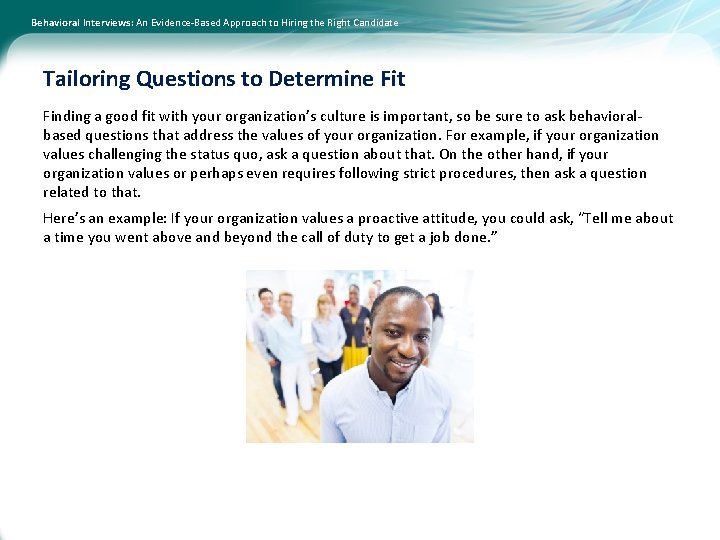
Behavioral Interviews: An Evidence-Based Approach to Hiring the Right Candidate Tailoring Questions to Determine Fit Finding a good fit with your organization’s culture is important, so be sure to ask behavioralbased questions that address the values of your organization. For example, if your organization values challenging the status quo, ask a question about that. On the other hand, if your organization values or perhaps even requires following strict procedures, then ask a question related to that. Here’s an example: If your organization values a proactive attitude, you could ask, “Tell me about a time you went above and beyond the call of duty to get a job done. ”
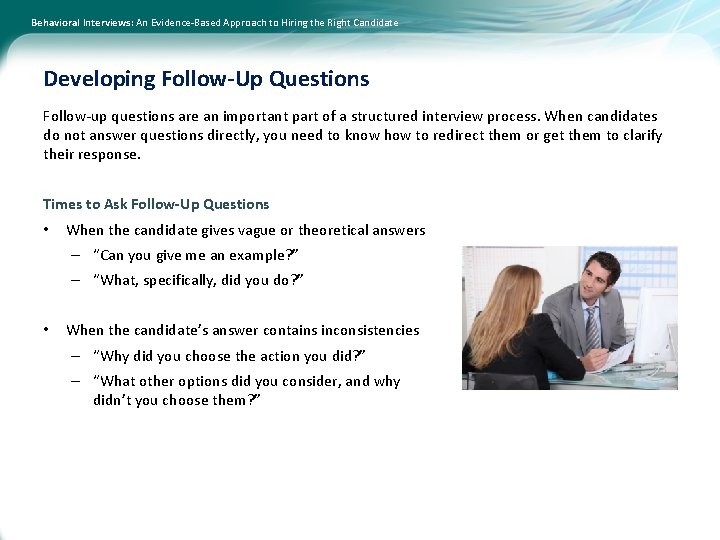
Behavioral Interviews: An Evidence-Based Approach to Hiring the Right Candidate Developing Follow-Up Questions Follow-up questions are an important part of a structured interview process. When candidates do not answer questions directly, you need to know how to redirect them or get them to clarify their response. Times to Ask Follow-Up Questions • When the candidate gives vague or theoretical answers – “Can you give me an example? ” – “What, specifically, did you do? ” • When the candidate’s answer contains inconsistencies – “Why did you choose the action you did? ” – “What other options did you consider, and why didn’t you choose them? ”
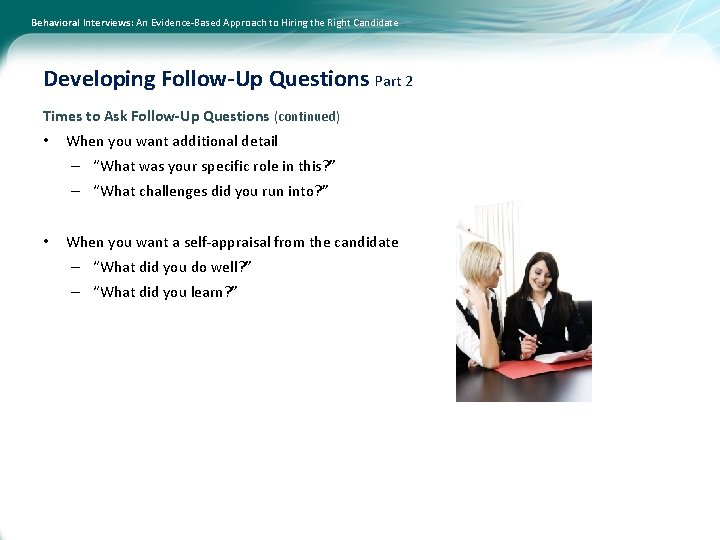
Behavioral Interviews: An Evidence-Based Approach to Hiring the Right Candidate Developing Follow-Up Questions Part 2 Times to Ask Follow-Up Questions (continued) • When you want additional detail – “What was your specific role in this? ” – “What challenges did you run into? ” • When you want a self-appraisal from the candidate – “What did you do well? ” – “What did you learn? ”
Behavioral Interviews: An Evidence-Based Approach to Hiring the Right Candidate Test Your Knowledge Read the question, then click on the answer. Which of the following describes an effective behavioral-based question? A. It is realistic, unambiguous, and neutral. B. It is realistic, unambiguous, and lengthy. C. It is realistic, subjective, and lengthy. D. It is unambiguous, theoretical, and subjective.
Behavioral Interviews: An Evidence-Based Approach to Hiring the Right Candidate Module 3: Reviewing Resumes
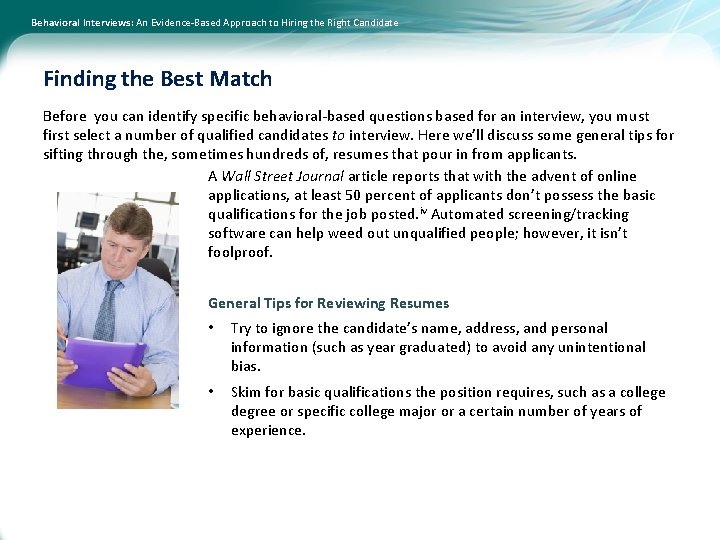
Behavioral Interviews: An Evidence-Based Approach to Hiring the Right Candidate Finding the Best Match Before you can identify specific behavioral-based questions based for an interview, you must first select a number of qualified candidates to interview. Here we’ll discuss some general tips for sifting through the, sometimes hundreds of, resumes that pour in from applicants. A Wall Street Journal article reports that with the advent of online applications, at least 50 percent of applicants don’t possess the basic qualifications for the job posted. iv Automated screening/tracking software can help weed out unqualified people; however, it isn’t foolproof. General Tips for Reviewing Resumes • Try to ignore the candidate’s name, address, and personal information (such as year graduated) to avoid any unintentional bias. • Skim for basic qualifications the position requires, such as a college degree or specific college major or a certain number of years of experience.
Behavioral Interviews: An Evidence-Based Approach to Hiring the Right Candidate Finding the Best Match Part 2 General Tips for Reviewing Resumes (continued) • Weed out resumes that have careless mistakes, such as spelling or grammar errors, or resumes that display a lack of attention to detail, e. g. , a wrong job position listed, indicating the candidate didn’t take the time to tailor the resume to this position. • Look for potential red flags including gaps in employment, numerous short-term jobs, evidence of decreasing responsibility, multiple career paths, or ambiguous terms such as “familiar with, ” “involved with”. Note: These are not necessarily deal-killers, just areas you will want to investigate and clarify. • Look for accomplishments that support the competencies required for the position. • If candidates have included a cover letter, review that carefully as well. It can reveal if they’ve done their homework researching your organization, which is a plus. • Separate the resumes into three piles: one for those that most closely match the job requirements, one for those that clearly don’t meet the requirements, and one for those in between—they have something interesting in them/show some merit, but need additional information or clarification.
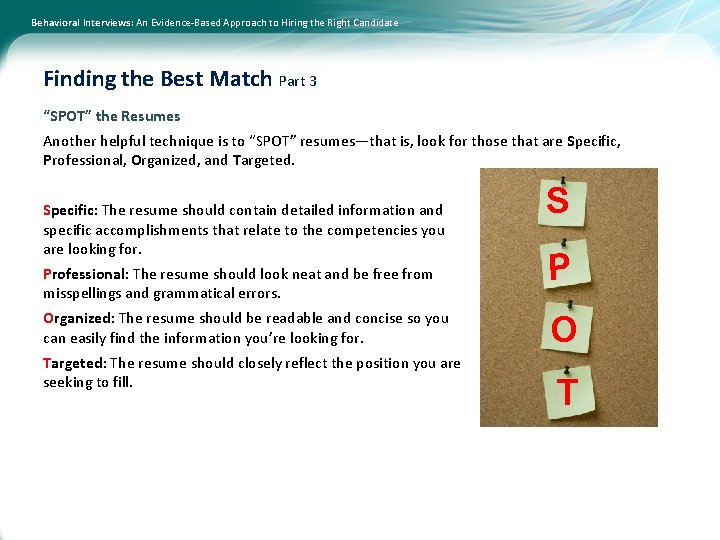
Behavioral Interviews: An Evidence-Based Approach to Hiring the Right Candidate Finding the Best Match Part 3 “SPOT” the Resumes Another helpful technique is to “SPOT” resumes—that is, look for those that are Specific, Professional, Organized, and Targeted. Specific: The resume should contain detailed information and specific accomplishments that relate to the competencies you are looking for. Professional: The resume should look neat and be free from misspellings and grammatical errors. Organized: The resume should be readable and concise so you can easily find the information you’re looking for. Targeted: The resume should closely reflect the position you are seeking to fill. S P O T
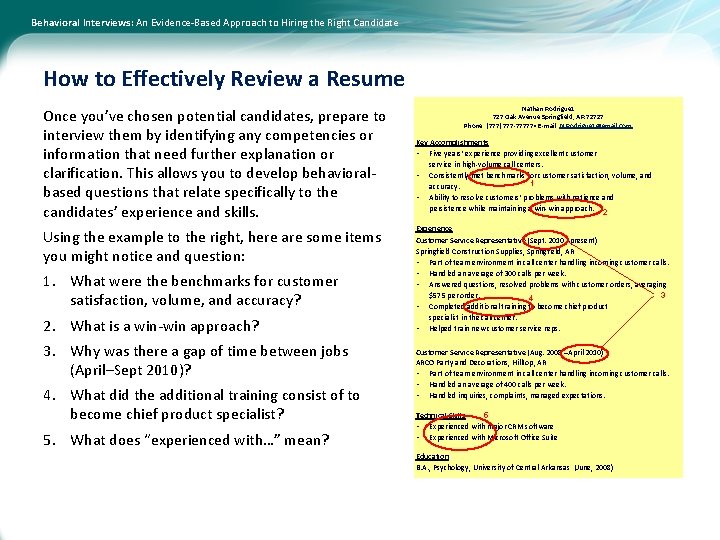
Behavioral Interviews: An Evidence-Based Approach to Hiring the Right Candidate How to Effectively Review a Resume Once you’ve chosen potential candidates, prepare to interview them by identifying any competencies or information that need further explanation or clarification. This allows you to develop behavioralbased questions that relate specifically to the candidates’ experience and skills. Using the example to the right, here are some items you might notice and question: 1. What were the benchmarks for customer satisfaction, volume, and accuracy? 2. What is a win-win approach? 3. Why was there a gap of time between jobs (April–Sept 2010)? 4. What did the additional training consist of to become chief product specialist? 5. What does “experienced with…” mean? Nathan Rodriguez 727 Oak Avenue Springfield, AR 72727 Phone: (777) 777 -77777 • E-mail: N. Rodriguez@email. com Key Accomplishments • Five years’ experience providing excellent customer service in high-volume call centers. • Consistently met benchmarks for customer satisfaction, volume, and 1 accuracy. • Ability to resolve customers’ problems with patience and persistence while maintaining a win-win approach. 2 Experience Customer Service Representative (Sept. 2010 –present) Springfield Construction Supplies, Springfield, AR • Part of team environment in call center handling incoming customer calls. • Handled an average of 300 calls per week. • Answered questions, resolved problems with customer orders, averaging $575 per order. 3 4 • Completed additional training to become chief product specialist in the call center. • Helped train new customer service reps. Customer Service Representative (Aug. 2008 –April 2010) ARCO Party and Decorations, Hilltop, AR • Part of team environment in call center handling incoming customer calls. • Handled an average of 400 calls per week. • Handled inquiries, complaints, managed expectations. Technical Skills 5 • Experienced with major CRM software • Experienced with Microsoft Office Suite Education B. A. , Psychology, University of Central Arkansas (June, 2008)
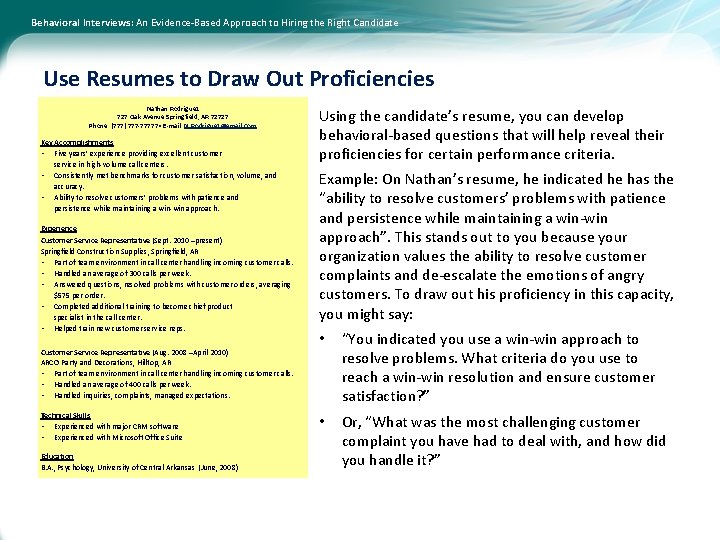
Behavioral Interviews: An Evidence-Based Approach to Hiring the Right Candidate Use Resumes to Draw Out Proficiencies Nathan Rodriguez 727 Oak Avenue Springfield, AR 72727 Phone: (777) 777 -77777 • E-mail: N. Rodriguez@email. com Key Accomplishments • Five years’ experience providing excellent customer service in high-volume call centers. • Consistently met benchmarks for customer satisfaction, volume, and accuracy. • Ability to resolve customers’ problems with patience and persistence while maintaining a win-win approach. Experience Customer Service Representative (Sept. 2010 –present) Springfield Construction Supplies, Springfield, AR • Part of team environment in call center handling incoming customer calls. • Handled an average of 300 calls per week. • Answered questions, resolved problems with customer orders, averaging $575 per order. • Completed additional training to become chief product specialist in the call center. • Helped train new customer service reps. Customer Service Representative (Aug. 2008 –April 2010) ARCO Party and Decorations, Hilltop, AR • Part of team environment in call center handling incoming customer calls. • Handled an average of 400 calls per week. • Handled inquiries, complaints, managed expectations. Technical Skills • Experienced with major CRM software • Experienced with Microsoft Office Suite Education B. A. , Psychology, University of Central Arkansas (June, 2008) Using the candidate’s resume, you can develop behavioral-based questions that will help reveal their proficiencies for certain performance criteria. Example: On Nathan’s resume, he indicated he has the “ability to resolve customers’ problems with patience and persistence while maintaining a win-win approach”. This stands out to you because your organization values the ability to resolve customer complaints and de-escalate the emotions of angry customers. To draw out his proficiency in this capacity, you might say: • “You indicated you use a win-win approach to resolve problems. What criteria do you use to reach a win-win resolution and ensure customer satisfaction? ” • Or, “What was the most challenging customer complaint you have had to deal with, and how did you handle it? ”
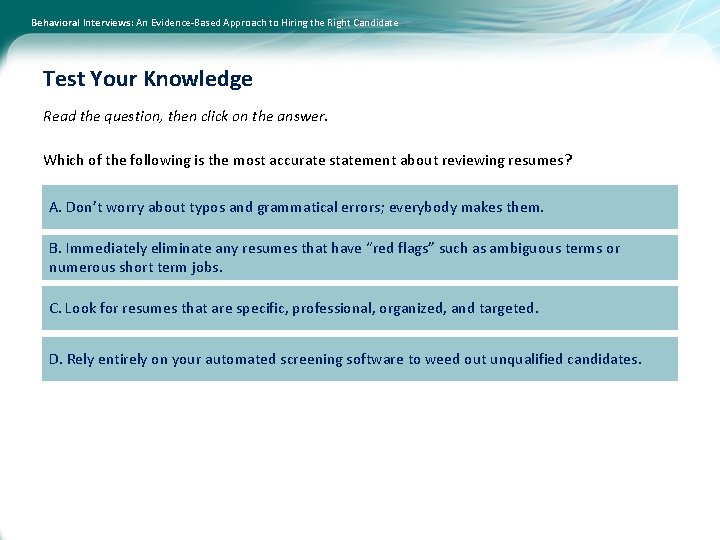
Behavioral Interviews: An Evidence-Based Approach to Hiring the Right Candidate Test Your Knowledge Read the question, then click on the answer. Which of the following is the most accurate statement about reviewing resumes? A. Don’t worry about typos and grammatical errors; everybody makes them. B. Immediately eliminate any resumes that have “red flags” such as ambiguous terms or numerous short term jobs. C. Look for resumes that are specific, professional, organized, and targeted. D. Rely entirely on your automated screening software to weed out unqualified candidates.
Behavioral Interviews: An Evidence-Based Approach to Hiring the Right Candidate Module 4: Conducting Interviews
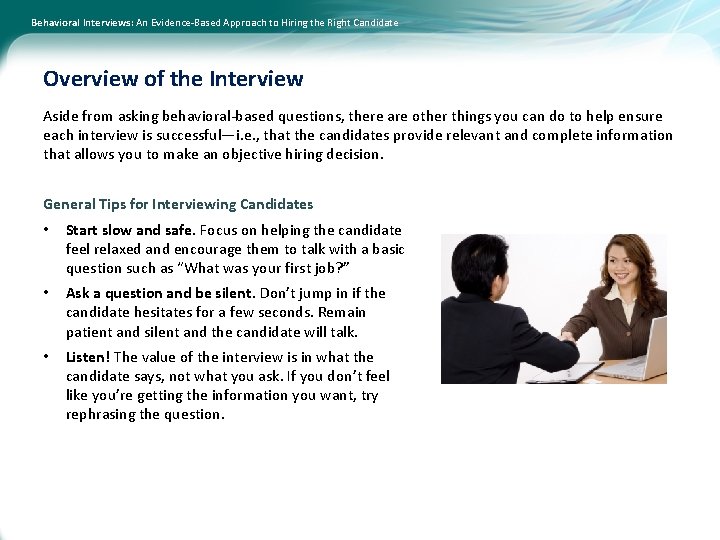
Behavioral Interviews: An Evidence-Based Approach to Hiring the Right Candidate Overview of the Interview Aside from asking behavioral-based questions, there are other things you can do to help ensure each interview is successful—i. e. , that the candidates provide relevant and complete information that allows you to make an objective hiring decision. General Tips for Interviewing Candidates • Start slow and safe. Focus on helping the candidate feel relaxed and encourage them to talk with a basic question such as “What was your first job? ” • Ask a question and be silent. Don’t jump in if the candidate hesitates for a few seconds. Remain patient and silent and the candidate will talk. • Listen! The value of the interview is in what the candidate says, not what you ask. If you don’t feel like you’re getting the information you want, try rephrasing the question.
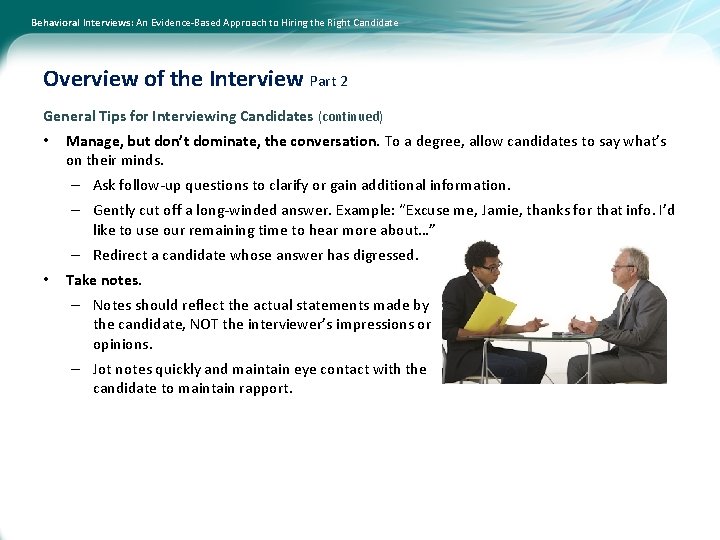
Behavioral Interviews: An Evidence-Based Approach to Hiring the Right Candidate Overview of the Interview Part 2 General Tips for Interviewing Candidates (continued) • Manage, but don’t dominate, the conversation. To a degree, allow candidates to say what’s on their minds. – Ask follow-up questions to clarify or gain additional information. – Gently cut off a long-winded answer. Example: “Excuse me, Jamie, thanks for that info. I’d like to use our remaining time to hear more about…” – Redirect a candidate whose answer has digressed. • Take notes. – Notes should reflect the actual statements made by the candidate, NOT the interviewer’s impressions or opinions. – Jot notes quickly and maintain eye contact with the candidate to maintain rapport.
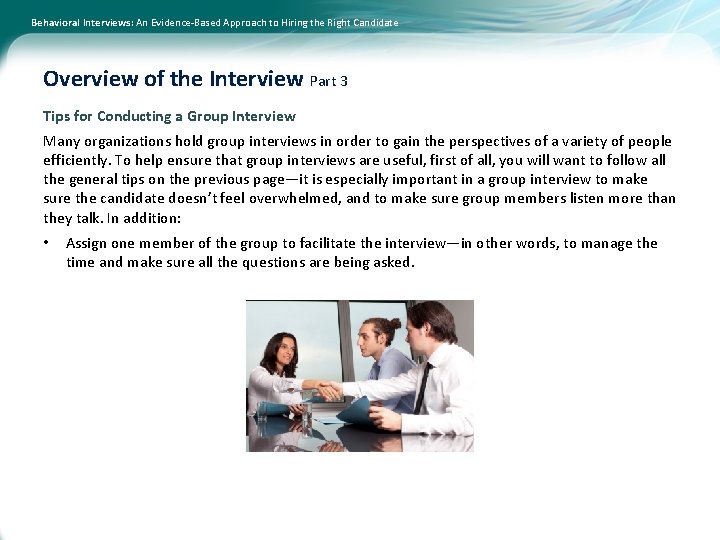
Behavioral Interviews: An Evidence-Based Approach to Hiring the Right Candidate Overview of the Interview Part 3 Tips for Conducting a Group Interview Many organizations hold group interviews in order to gain the perspectives of a variety of people efficiently. To help ensure that group interviews are useful, first of all, you will want to follow all the general tips on the previous page—it is especially important in a group interview to make sure the candidate doesn’t feel overwhelmed, and to make sure group members listen more than they talk. In addition: • Assign one member of the group to facilitate the interview—in other words, to manage the time and make sure all the questions are being asked.
Behavioral Interviews: An Evidence-Based Approach to Hiring the Right Candidate Overview of the Interview Part 4 Tips for Conducting a Group Interview (continued) • Meet ahead of time to review the resumes of the candidates to be interviewed, and the questions the group plans on asking. Consider assigning each person in the group one or two of the questions to ask to make sure that each candidate is asked the same questions. • Review the evaluation form so that as much as possible, each person is using the same basis for measuring the candidates’ responses.
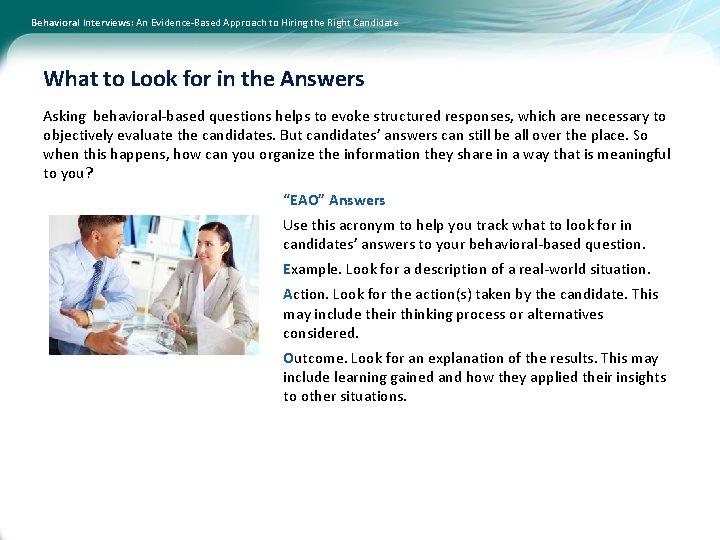
Behavioral Interviews: An Evidence-Based Approach to Hiring the Right Candidate What to Look for in the Answers Asking behavioral-based questions helps to evoke structured responses, which are necessary to objectively evaluate the candidates. But candidates’ answers can still be all over the place. So when this happens, how can you organize the information they share in a way that is meaningful to you? “EAO” Answers Use this acronym to help you track what to look for in candidates’ answers to your behavioral-based question. Example. Look for a description of a real-world situation. Action. Look for the action(s) taken by the candidate. This may include their thinking process or alternatives considered. Outcome. Look for an explanation of the results. This may include learning gained and how they applied their insights to other situations.
Behavioral Interviews: An Evidence-Based Approach to Hiring the Right Candidate What to Look for in the Answers Part 2 If candidates don’t include one of the “EAO” parts in their answers, ask a follow-up question to prompt them to provide additional information or clarification. Additional Tips Listen for words such as “I did…, ” “I said…” “I thought…” Beware of words such as “I would…, ” “I might…, ” “We…”
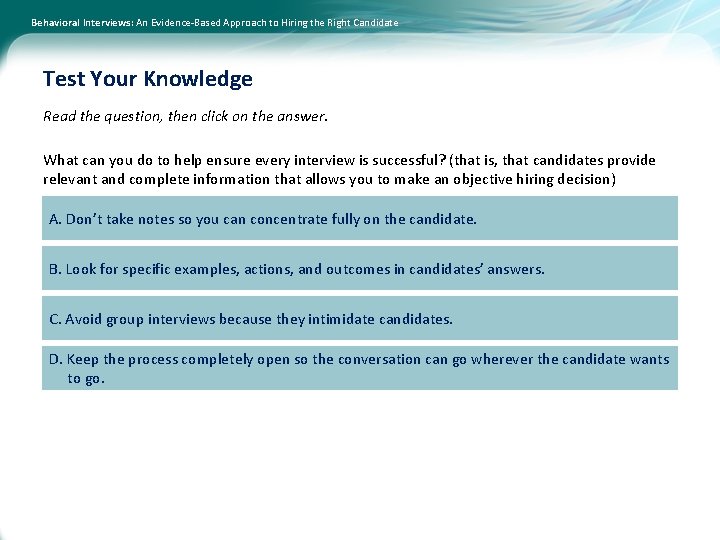
Behavioral Interviews: An Evidence-Based Approach to Hiring the Right Candidate Test Your Knowledge Read the question, then click on the answer. What can you do to help ensure every interview is successful? (that is, that candidates provide relevant and complete information that allows you to make an objective hiring decision) A. Don’t take notes so you can concentrate fully on the candidate. B. Look for specific examples, actions, and outcomes in candidates’ answers. C. Avoid group interviews because they intimidate candidates. D. Keep the process completely open so the conversation can go wherever the candidate wants to go.

Behavioral Interviews: An Evidence-Based Approach to Hiring the Right Candidate Module 5: Evaluating Candidates
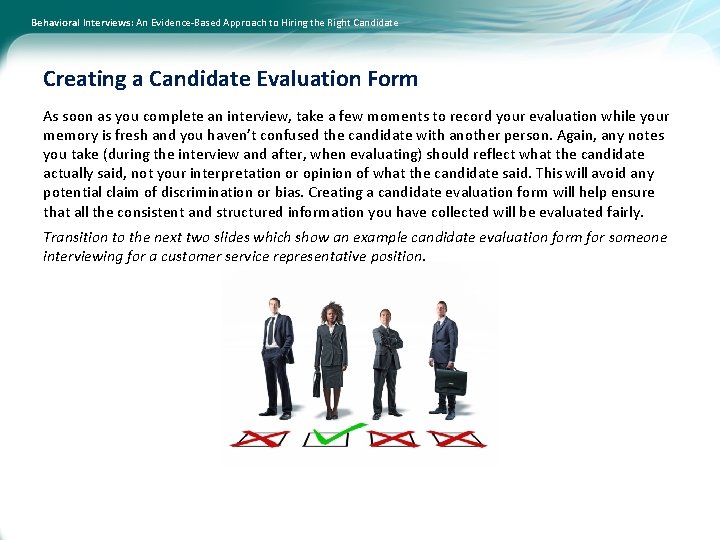
Behavioral Interviews: An Evidence-Based Approach to Hiring the Right Candidate Creating a Candidate Evaluation Form As soon as you complete an interview, take a few moments to record your evaluation while your memory is fresh and you haven’t confused the candidate with another person. Again, any notes you take (during the interview and after, when evaluating) should reflect what the candidate actually said, not your interpretation or opinion of what the candidate said. This will avoid any potential claim of discrimination or bias. Creating a candidate evaluation form will help ensure that all the consistent and structured information you have collected will be evaluated fairly. Transition to the next two slides which show an example candidate evaluation form for someone interviewing for a customer service representative position.
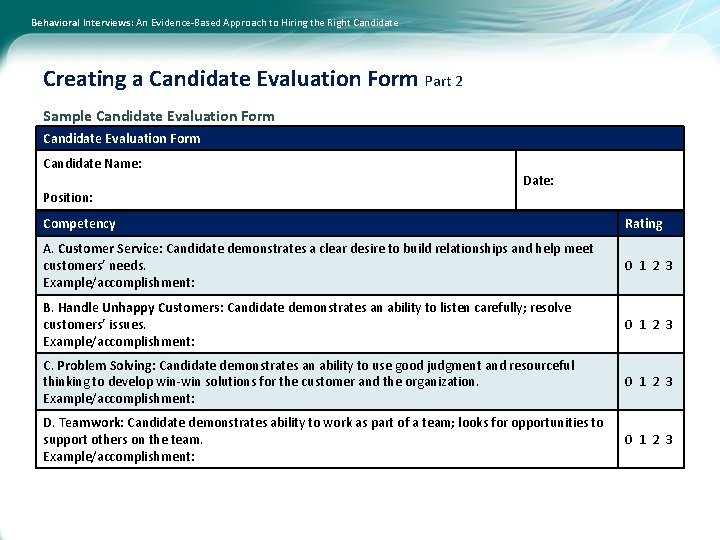
Behavioral Interviews: An Evidence-Based Approach to Hiring the Right Candidate Creating a Candidate Evaluation Form Part 2 Sample Candidate Evaluation Form Candidate Name: Position: Date: Competency Rating A. Customer Service: Candidate demonstrates a clear desire to build relationships and help meet customers’ needs. Example/accomplishment: 0 1 2 3 B. Handle Unhappy Customers: Candidate demonstrates an ability to listen carefully; resolve customers’ issues. Example/accomplishment: 0 1 2 3 C. Problem Solving: Candidate demonstrates an ability to use good judgment and resourceful thinking to develop win-win solutions for the customer and the organization. Example/accomplishment: 0 1 2 3 D. Teamwork: Candidate demonstrates ability to work as part of a team; looks for opportunities to support others on the team. Example/accomplishment: 0 1 2 3
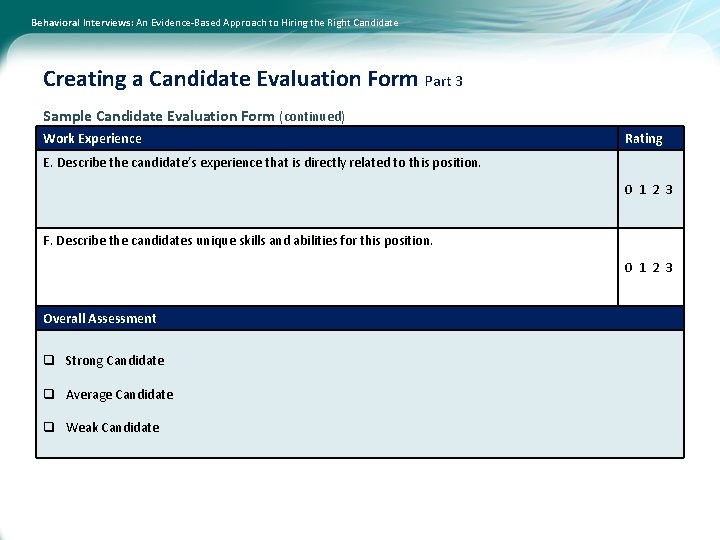
Behavioral Interviews: An Evidence-Based Approach to Hiring the Right Candidate Creating a Candidate Evaluation Form Part 3 Sample Candidate Evaluation Form (continued) Work Experience Rating E. Describe the candidate’s experience that is directly related to this position. 0 1 2 3 F. Describe the candidates unique skills and abilities for this position. 0 1 2 3 Overall Assessment q Strong Candidate q Average Candidate q Weak Candidate
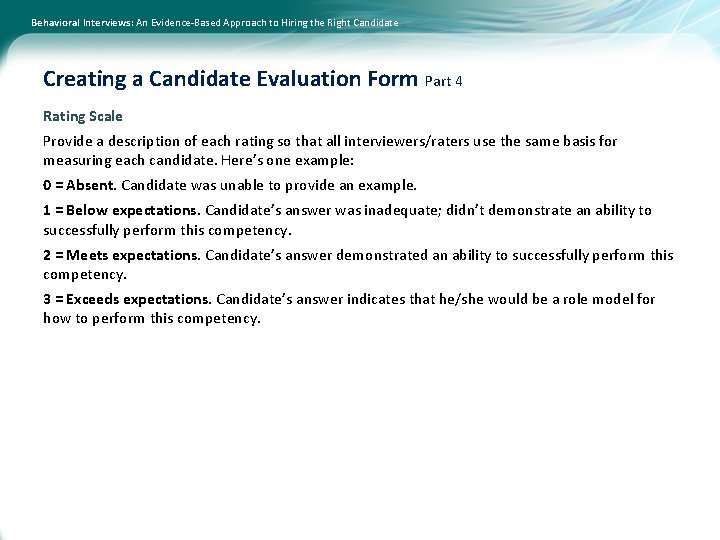
Behavioral Interviews: An Evidence-Based Approach to Hiring the Right Candidate Creating a Candidate Evaluation Form Part 4 Rating Scale Provide a description of each rating so that all interviewers/raters use the same basis for measuring each candidate. Here’s one example: 0 = Absent. Candidate was unable to provide an example. 1 = Below expectations. Candidate’s answer was inadequate; didn’t demonstrate an ability to successfully perform this competency. 2 = Meets expectations. Candidate’s answer demonstrated an ability to successfully perform this competency. 3 = Exceeds expectations. Candidate’s answer indicates that he/she would be a role model for how to perform this competency.
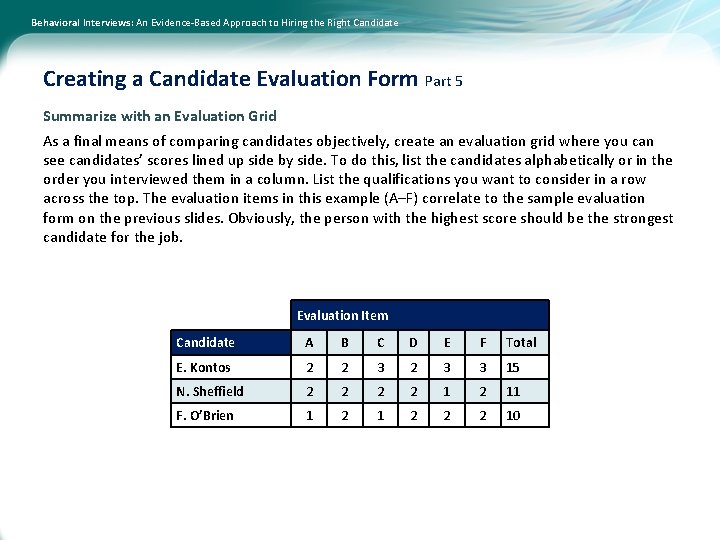
Behavioral Interviews: An Evidence-Based Approach to Hiring the Right Candidate Creating a Candidate Evaluation Form Part 5 Summarize with an Evaluation Grid As a final means of comparing candidates objectively, create an evaluation grid where you can see candidates’ scores lined up side by side. To do this, list the candidates alphabetically or in the order you interviewed them in a column. List the qualifications you want to consider in a row across the top. The evaluation items in this example (A–F) correlate to the sample evaluation form on the previous slides. Obviously, the person with the highest score should be the strongest candidate for the job. Evaluation Item Candidate A B C D E F Total E. Kontos 2 2 3 3 15 N. Sheffield 2 2 1 2 11 F. O’Brien 1 2 2 2 10
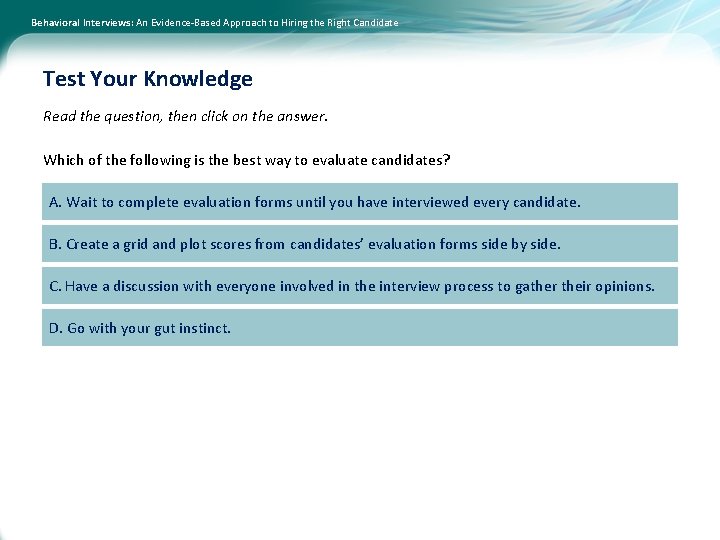
Behavioral Interviews: An Evidence-Based Approach to Hiring the Right Candidate Test Your Knowledge Read the question, then click on the answer. Which of the following is the best way to evaluate candidates? A. Wait to complete evaluation forms until you have interviewed every candidate. B. Create a grid and plot scores from candidates’ evaluation forms side by side. C. Have a discussion with everyone involved in the interview process to gather their opinions. D. Go with your gut instinct.

Behavioral Interviews: An Evidence-Based Approach to Hiring the Right Candidate Review
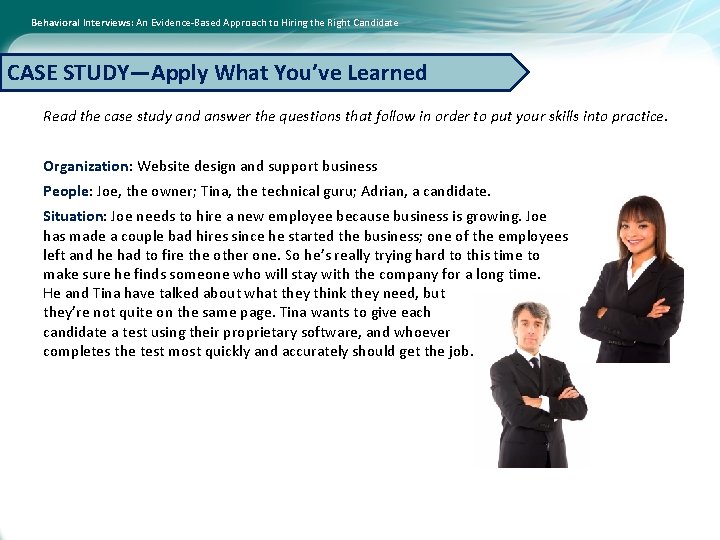
Behavioral Interviews: An Evidence-Based Approach to Hiring the Right Candidate CASE STUDY—Apply What You’ve Learned Read the case study and answer the questions that follow in order to put your skills into practice. Organization: Website design and support business People: Joe, the owner; Tina, the technical guru; Adrian, a candidate. Situation: Joe needs to hire a new employee because business is growing. Joe has made a couple bad hires since he started the business; one of the employees left and he had to fire the other one. So he’s really trying hard to this time to make sure he finds someone who will stay with the company for a long time. He and Tina have talked about what they think they need, but they’re not quite on the same page. Tina wants to give each candidate a test using their proprietary software, and whoever completes the test most quickly and accurately should get the job.
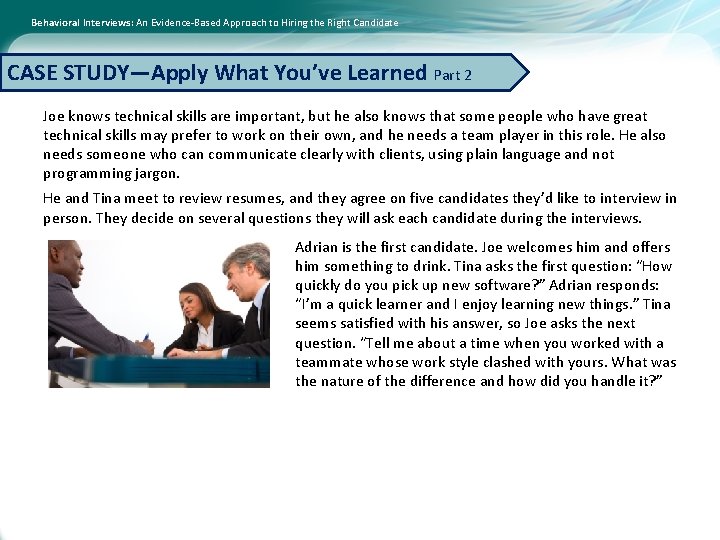
Behavioral Interviews: An Evidence-Based Approach to Hiring the Right Candidate CASE STUDY—Apply What You’ve Learned Part 2 Joe knows technical skills are important, but he also knows that some people who have great technical skills may prefer to work on their own, and he needs a team player in this role. He also needs someone who can communicate clearly with clients, using plain language and not programming jargon. He and Tina meet to review resumes, and they agree on five candidates they’d like to interview in person. They decide on several questions they will ask each candidate during the interviews. Adrian is the first candidate. Joe welcomes him and offers him something to drink. Tina asks the first question: “How quickly do you pick up new software? ” Adrian responds: “I’m a quick learner and I enjoy learning new things. ” Tina seems satisfied with his answer, so Joe asks the next question. “Tell me about a time when you worked with a teammate whose work style clashed with yours. What was the nature of the difference and how did you handle it? ”
Behavioral Interviews: An Evidence-Based Approach to Hiring the Right Candidate CASE STUDY—Apply What You’ve Learned Part 3 Adrian: “Wow, good question. Well, I worked with someone at my last job and we were always competing for projects—we wanted to work on the same stuff, and we both wanted to be in charge. At first it annoyed me, but then we realized we were in a way supporting each other by driving each other to be better. So we quit looking at it like a win-lose competition and more like ‘I got this one; you get the next one. ’” Joe and Tina interviewed the rest of the candidates, then met to discuss their opinions. Tina: “Brittany really impressed me. “ Joe: “Why? ” Tina: “She just seemed really sharp and we hit it off. ” Joe: “That’s great and all, but what about Adrian? He had some thoughtful answers I noted. ” Tina: “Well, I don’t remember exactly what he said. ” Joe: “Didn’t you write anything down? ” Tina: “Uh, no. I wanted to pay attention to what they were saying. ”
Behavioral Interviews: An Evidence-Based Approach to Hiring the Right Candidate CASE STUDY—Apply What You’ve Learned Part 4 Joe: “I have some blank evaluation forms and a rating scale. Let’s fill them in, separately, tally scores in an evaluation grid and then share our results. ” They fill out the evaluation forms and meet again to discuss. Tina: “Wow, these results are interesting. When I see it in black and white, Adrian ranks higher than Brittany. ” Joe: “I agree. I’m glad we took the time to sort through the candidates in a systematic way. ” Tina: “Yes, I feel confident that we made a good choice and Adrian will be a great addition to the company. ” Joe: “I hope so! Thanks for your help. ”
Behavioral Interviews: An Evidence-Based Approach to Hiring the Right Candidate CASE STUDY—Questions to Consider 1. How well did Joe identify the competencies he was looking for in the new employee? 2. Look at the two questions Joe and Tina asked. How well did they follow the characteristics of effective behavioral-based questions (realistic, unambiguous, brief, neutral)? 3. How could they have improved the questions, or what could they have asked as a follow-up question to elicit a more behavioral-based response? 4. How well did Joe and Tina evaluate the candidates? Review the ideas and suggested answers provided on the following slides.
Behavioral Interviews: An Evidence-Based Approach to Hiring the Right Candidate CASE STUDY—Suggested Answers 1. How well did Joe identify the competencies he was looking for in the new employee? Joe gave some thought to the competencies he wanted in his next employee. In addition to technical skills, he wanted a team player and someone who could communicate clearly with clients. This was a good start as these are general competencies. He should have taken it a step further by identifying the performance criteria he wanted for each competency. 2. Look at the two questions Joe and Tina asked. How well did they follow the characteristics of effective behavioral-based questions (realistic, unambiguous, brief, neutral)? The first question, “How quickly do you pick up new software? ” was brief. But it was leading in that any candidate would recognize the response they were looking for, and it wasn’t realistic because it didn’t offer any context—it didn’t ask for any examples. The second question, “Tell me about a time when you worked with a teammate whose work style clashed with yours. What was the nature of the difference and how did you handle it? ” was much better. Perhaps a bit long, but otherwise it followed all four characteristics.
Behavioral Interviews: An Evidence-Based Approach to Hiring the Right Candidate CASE STUDY—Suggested Answers Part 2 3. How could they have improved the questions, or what could they have asked as a followup question to elicit a more behavioral-based response? The first question simply could have been followed up with, “Can you give me an example? ” Or, “Tell me about a time when you had to learn a new program. What approach did you use to become proficient at it? ” As noted, the second question was already behavioral-based. They should be looking for EAO (example, action, outcome) answers to their questions. 4. How well did Joe and Tina evaluate the candidates? It appeared that Tina made a couple mistakes—she didn’t take notes and she based her initial opinion of Brittany on the fact that they hit it off—gut instinct. While she doesn’t have to ignore her feeling, she should also objectively evaluate the interviews; when she did evaluate Brittany’s interview objectively, she found that she rated another candidate higher. Joe evaluated candidates objectively—he took notes about what each person said so he didn’t have to rely strictly on memory, and he developed an evaluation form and rating scale to objectively compare the candidates.
Behavioral Interviews: An Evidence-Based Approach to Hiring the Right Candidate Congratulations! By now you should be able to: • Identify general competencies and translate them into performance criteria. • Recognize the characteristics of, and effectively develop, behavioral-based questions. • Explore useful techniques for reviewing resumes. • Identify the elements to look for in candidates’ answers to behavioral-based questions. • Follow a structured method for evaluating candidates objectively.

Behavioral Interviews: An Evidence-Based Approach to Hiring the Right Candidate Appendix
Behavioral Interviews: An Evidence-Based Approach to Hiring the Right Candidate References Falcone, Paul. 96 Great Interview Questions to Ask Before You Hire. New York: AMACOM, 2009. Fry, Ron. Ask the Right Questions, Hire the Best People, Third Edition. Franklin Lakes, NJ: The Career Press, Inc. , 2009. Hoevemeyer, Victoria A. High-Impact Interview Questions: 701 Behavior-Based Questions to Find the Right Person for Every Job. New York: AMACOM, 2006. Kessler, Robin. Competency-Based Interviews: How to Master the Tough Interview Style Used by the Fortune 500, Revised Edition. Pompton Plains, NJ: Career Press, Inc. , 2012. Pinsker, Richard J. Seven Rules for Hiring Extraordinary Talent: A Business Story. Amherts, MA: HRD Press, 2009. Turner, Tom S. Behavioral Interviewing Guide: A Practical Structured Approach for Conducting Effective Selection Interviews. Victoria, BC, Canada: Trafford Publishing, 2004. i http: //thehiringsite. careerbuilder. com/2012/12/13/cost-of-a-bad-hire/. ii http: //www. bloomberg. com/apps/news? pid=conewsstory&tkr=RHJ: GR&sid=a_kzg. KZZ_q. No. iii http: //www. inc. com/magazine/20060801/hiring_pagen_2. html. iv http: //online. wsj. com/article/SB 10001424052970204624204577178941034941330. html.
Behavioral Interviews: An Evidence-Based Approach to Hiring the Right Candidate © 2014 HRDQ. All rights reserved. Published by HRDQ and the HRDQ logo are registered trademarks of Organization Design and Development, Inc. This publication is distributed under the terms and conditions of the Reproducible Content End User License Agreement (EULA). For specific details, visit www. hrdq. com/legal. For more information about this publication or to order additional copies, please contact the HRDQ Customer Service Team by phone at 610279 -2002 or by email at custserv@hrdq. com. For more information about HRDQ products, visit www. hrdq. com. ISBN 978 -1 -58854 -810 -8 Title slide image: Cora. Max/Shutterstock. com. Images used under license from Shutterstock. com. Microsoft®, Word®, Power. Point®, and Outlook® are registered trademarks of Microsoft Corporation. 2750 E 1 BHI EN-01 -NV-18
- Slides: 58