
Behavioral Interviewing Techniques Chapter 6 Behavioral Interviewing Interrogation
Behavioral Interviewing Techniques Chapter 6
Behavioral Interviewing & Interrogation n n Smart Talk: Contemporary Interviewing and Interrogation By Denise Kindschi Gosselin The approach is based on theories of communications and learning which influence unintended communications that can be observed by the astute interviewer It involves the application of communication theory and patterns of behavior to guide the process 6 -2 PRENTICE HALL © 2006 Pearson Education, Inc. Upper Saddle River, NJ 07458
Kinesics n A form of nonverbal communication known as body language u Learning styles affect the behavioral kinesic behavior Visual « Auditory « Kinesthetic « Smart Talk: Contemporary Interviewing and Interrogation By Denise Kindschi Gosselin 6 -3 PRENTICE HALL © 2006 Pearson Education, Inc. Upper Saddle River, NJ 07458
Neuro-linguistic Programming n n n Smart Talk: Contemporary Interviewing and Interrogation By Denise Kindschi Gosselin “Neuro” refers to the brain u Behavior originates from the five senses “linguistics” the way that we communicate both verbally and nonverbally “Programming” refers to the unique way that humans manipulate the signals and convert them into useful information 6 -4 PRENTICE HALL © 2006 Pearson Education, Inc. Upper Saddle River, NJ 07458
Culture and Expression n Smart Talk: Contemporary Interviewing and Interrogation By Denise Kindschi Gosselin The way in which feelings and emotions are expressed through facial expression is dictated by culture 6 -5 n Behavioral indicators must be used with caution to avoid misinterpretations when the interviewee is not from a similar cultural background to the interviewer PRENTICE HALL © 2006 Pearson Education, Inc. Upper Saddle River, NJ 07458
Gender and Expression n n Smart Talk: Contemporary Interviewing and Interrogation By Denise Kindschi Gosselin Non-verbal communications are also affected by gender Interpretation and use of facial expressions may be different among men versus women 6 -6 n n Men appear to use different nonverbal communication styles when speaking with other men vs. women Women may smile more frequently then men PRENTICE HALL © 2006 Pearson Education, Inc. Upper Saddle River, NJ 07458
Facial Expression n Five universal expressions are controlled by the autonomic nervous system u Smart Talk: Contemporary Interviewing and Interrogation By Denise Kindschi Gosselin Anger, fear, disgust, sadness, and enjoyment 6 -7 PRENTICE HALL © 2006 Pearson Education, Inc. Upper Saddle River, NJ 07458
Body Posture n Body positions make a statement about the individual or send signals about the way that they think of themselves n n n Smart Talk: Contemporary Interviewing and Interrogation By Denise Kindschi Gosselin 6 -8 Truthful postures: u Open and relaxed posture u Upright in chair Deceptive postures: u Toilet position u Slouching u Rigid posture Stressed postures: u Rubbing of hands u Hair twirling PRENTICE HALL © 2006 Pearson Education, Inc. Upper Saddle River, NJ 07458
Eye Movement n Everyone processes in all three modes but often develops a dominant sensatory mode u u u Smart Talk: Contemporary Interviewing and Interrogation By Denise Kindschi Gosselin Visual Auditory Kinesthetic 6 -9 u u Establish a baseline for the subject Watch the direction of the subject’s eyes in response to visual, auditory, or kinesthetic terms during a rapport building phase PRENTICE HALL © 2006 Pearson Education, Inc. Upper Saddle River, NJ 07458
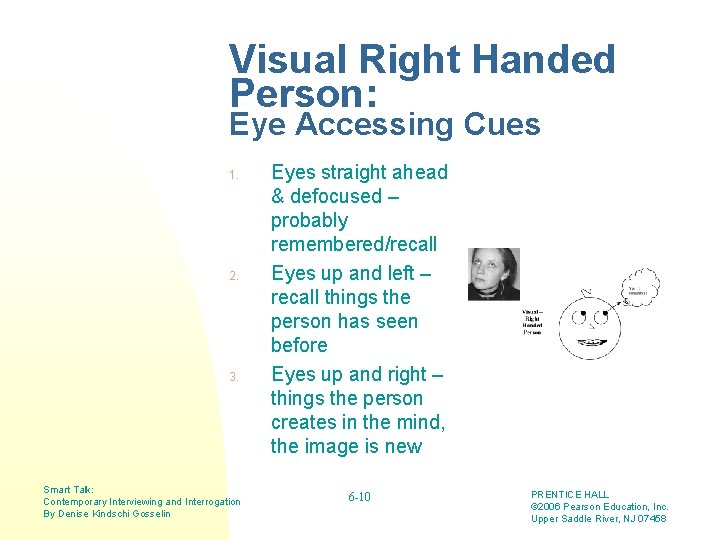
Visual Right Handed Person: Eye Accessing Cues 1. 2. 3. Smart Talk: Contemporary Interviewing and Interrogation By Denise Kindschi Gosselin Eyes straight ahead & defocused – probably remembered/recall Eyes up and left – recall things the person has seen before Eyes up and right – things the person creates in the mind, the image is new 6 -10 PRENTICE HALL © 2006 Pearson Education, Inc. Upper Saddle River, NJ 07458
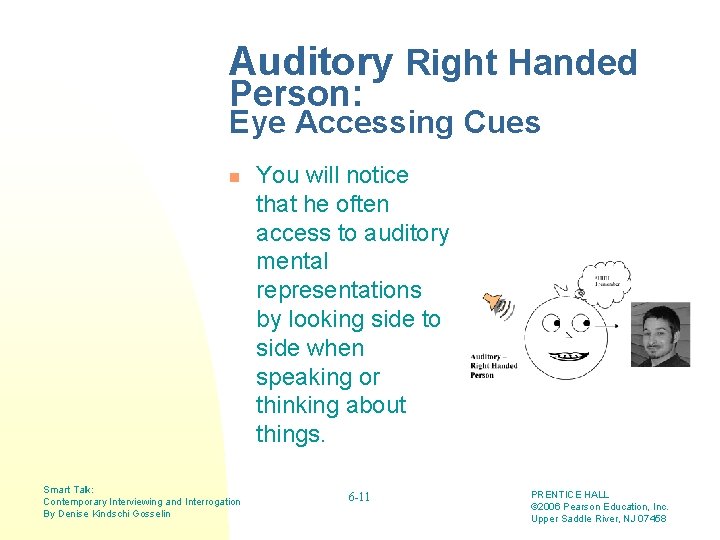
Auditory Right Handed Person: Eye Accessing Cues n Smart Talk: Contemporary Interviewing and Interrogation By Denise Kindschi Gosselin You will notice that he often access to auditory mental representations by looking side to side when speaking or thinking about things. 6 -11 PRENTICE HALL © 2006 Pearson Education, Inc. Upper Saddle River, NJ 07458
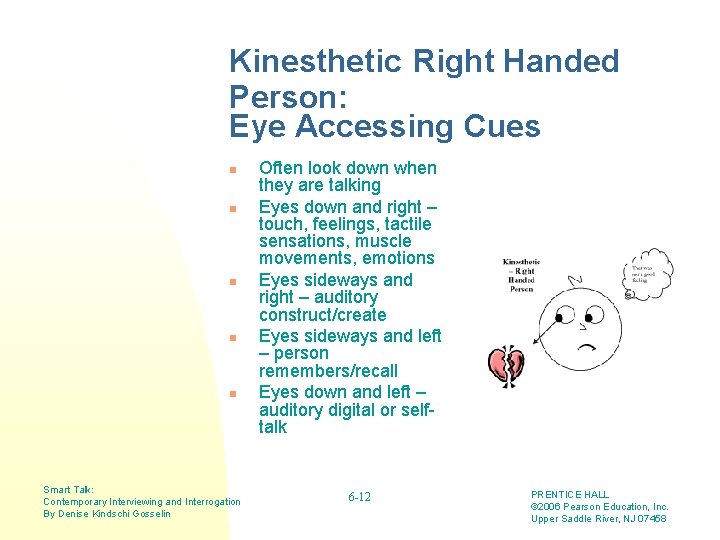
Kinesthetic Right Handed Person: Eye Accessing Cues n n n Smart Talk: Contemporary Interviewing and Interrogation By Denise Kindschi Gosselin Often look down when they are talking Eyes down and right – touch, feelings, tactile sensations, muscle movements, emotions Eyes sideways and right – auditory construct/create Eyes sideways and left – person remembers/recall Eyes down and left – auditory digital or selftalk 6 -12 PRENTICE HALL © 2006 Pearson Education, Inc. Upper Saddle River, NJ 07458
Sensatory Verbal Communication n Smart Talk: Contemporary Interviewing and Interrogation By Denise Kindschi Gosselin People tend to speak in the same sensatory manner to which they learn 6 -13 PRENTICE HALL © 2006 Pearson Education, Inc. Upper Saddle River, NJ 07458
Mirroring the sensatory language n Smart Talk: Contemporary Interviewing and Interrogation By Denise Kindschi Gosselin Mirroring occurs when the interviewer uses the same sensatory language as the interviewee to establish rapport or to facilitate communication 6 -14 n n Examples of sensatory victim statements can be: "I heard him coming through the door. " or "I heard a noise. " The interviewer responds by mirroring. For example: “I hear what you are saying. " PRENTICE HALL © 2006 Pearson Education, Inc. Upper Saddle River, NJ 07458
Shifting the sensatory language n Smart Talk: Contemporary Interviewing and Interrogation By Denise Kindschi Gosselin Shifting is when the interviewer uses the same sensatory language to ask a question and to move the subject into the area under investigation 6 -15 n n Examples of sensatory victim statements can be: "I heard him coming through the door. " or "I heard a noise. “ The interviewer responds by shifting. For example: “What did that sound like? " PRENTICE HALL © 2006 Pearson Education, Inc. Upper Saddle River, NJ 07458
Sense Shifting the sensatory language n Smart Talk: Contemporary Interviewing and Interrogation By Denise Kindschi Gosselin To attempt shifting the interview from one sense of relating to another sense, new terms are incorporated into the investigator’s questions 6 -16 n n For example: The victim who states “it was awful, I can still feel his hands on me” The interviewer shifts the sense by saying, “What did you see when you felt his hands? ” PRENTICE HALL © 2006 Pearson Education, Inc. Upper Saddle River, NJ 07458
Visual Thought Process Persons Characteristics of n n The majority of the population are visual processors. The principal values of the visual modality are dynamism and perfection. u Smart Talk: Contemporary Interviewing and Interrogation By Denise Kindschi Gosselin Hand arms moving near their neck level when they are talking is common 6 -17 PRENTICE HALL © 2006 Pearson Education, Inc. Upper Saddle River, NJ 07458
Verbal Examples of the Visual Thought Process n n Smart Talk: Contemporary Interviewing and Interrogation By Denise Kindschi Gosselin Do I have to draw you a picture? I don’t see why I am here, you are looking at the wrong guy! Look at it this way. I see what you mean! 6 -18 PRENTICE HALL © 2006 Pearson Education, Inc. Upper Saddle River, NJ 07458
Auditory Thought Process Persons Characteristics of n n Smart Talk: Contemporary Interviewing and Interrogation By Denise Kindschi Gosselin Approximately 20% of the population are auditory. They are impacted by what they hear. They are the great speakers, singers, and musicians. They tend to speak moderately and rhythmically. Moderate your vocal rate and breathe deeply to communicate with this personality. 6 -19 PRENTICE HALL © 2006 Pearson Education, Inc. Upper Saddle River, NJ 07458
Verbal Examples of the Auditory Thought Process n n Smart Talk: Contemporary Interviewing and Interrogation By Denise Kindschi Gosselin I hear what you are saying Listen to this! Tell me what you mean! Aren’t you listening to me? 6 -20 PRENTICE HALL © 2006 Pearson Education, Inc. Upper Saddle River, NJ 07458
Characteristics of Kinesthetic Thought Process Persons n n Smart Talk: Contemporary Interviewing and Interrogation By Denise Kindschi Gosselin A small percentage of the population They feel what they are thinking Impacted by emotions and feelings, not necessarily facts or charts Note if their gaze is frequently down and their breathing is slow and deep. Slow down and be particularly calm to communicate with this personality. 6 -21 PRENTICE HALL © 2006 Pearson Education, Inc. Upper Saddle River, NJ 07458
Verbal Examples of the Kinesthetic Thought Process n n Smart Talk: Contemporary Interviewing and Interrogation By Denise Kindschi Gosselin I feel your pain. I know what you are going though, how you feel. How can you not feel it? I feel just terrible! 6 -22 PRENTICE HALL © 2006 Pearson Education, Inc. Upper Saddle River, NJ 07458
Detecting Deceit n n Smart Talk: Contemporary Interviewing and Interrogation By Denise Kindschi Gosselin No gesture, facial express, or muscle twitch by itself means a person is lying The polygraph only measures arousal of emotion, not which emotion is felt 6 -23 PRENTICE HALL © 2006 Pearson Education, Inc. Upper Saddle River, NJ 07458
Physiological Changes n Smart Talk: Contemporary Interviewing and Interrogation By Denise Kindschi Gosselin To detect deceit look for physiological changes which are difficult to control! 6 -24 n Examples include changes in skin color, voice tone, speech pattern, dry mouth, cracking or voice or changes in the breathing rate PRENTICE HALL © 2006 Pearson Education, Inc. Upper Saddle River, NJ 07458
Qualifiers n Qualifier is a word that modifies or limits the meaning of the phrase n For example: using “it” to refer to victim or perpetrator u Smart Talk: Contemporary Interviewing and Interrogation By Denise Kindschi Gosselin 6 -25 Used to soften the image, lessen guilt, or describe an imaginary situation PRENTICE HALL © 2006 Pearson Education, Inc. Upper Saddle River, NJ 07458
Hedging n Smart Talk: Contemporary Interviewing and Interrogation By Denise Kindschi Gosselin Hedging is a lack of commitment to the statement 6 -26 n For example: “I think …” u “uh” u “ya know” u stuttering u PRENTICE HALL © 2006 Pearson Education, Inc. Upper Saddle River, NJ 07458
Manipulators n n Smart Talk: Contemporary Interviewing and Interrogation By Denise Kindschi Gosselin Manipulators are movements that may indicate discomfort or relaxation and vary according to the stakes involved. They are poor indicators of deceit! 6 -27 n Don’t rely on these to determine deceit! u u Most people associate lying with ‘shifty eyes’ and fidgeting behavior. Lip biting and lip sucking PRENTICE HALL © 2006 Pearson Education, Inc. Upper Saddle River, NJ 07458
To Detect Deceit Make comparisons between suspect’s usual behavior and when under suspicion u The person may feel and exhibit an emotion about being suspected of lying u Discount the sign of the emotion as a clue to deceit if suspect is likely to have the feeling when truthful u Smart Talk: Contemporary Interviewing and Interrogation By Denise Kindschi Gosselin 6 -28 PRENTICE HALL © 2006 Pearson Education, Inc. Upper Saddle River, NJ 07458
- Slides: 28