
Behavioral Interactions Chapter 7 Section 2 Notes Social
Behavioral Interactions Chapter 7 Section 2 Notes
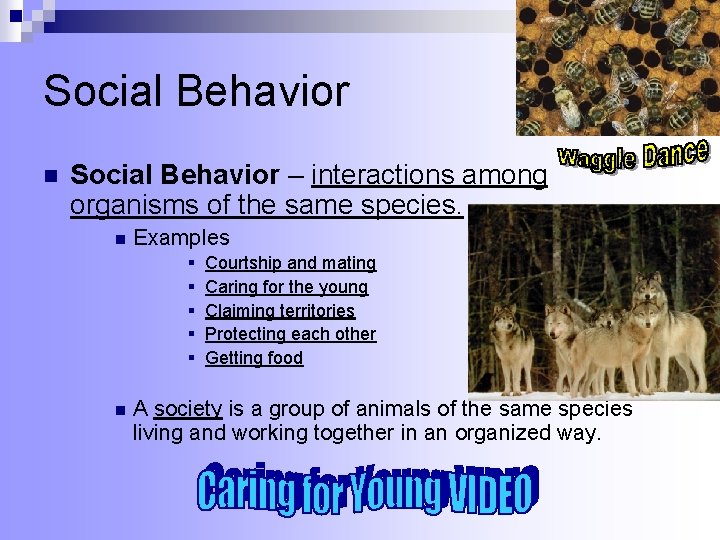
Social Behavior n Social Behavior – interactions among organisms of the same species. n Examples § § § n Courtship and mating Caring for the young Claiming territories Protecting each other Getting food A society is a group of animals of the same species living and working together in an organized way.

Territorial Behavior n A territory is an area that an animal defends from other members of the same species. n Territories contain food, shelter, and potential mates.

Territorial Behavior (continued) n Defending territory from members of the same species is an instinctive behavior. n Aggression is a forceful behavior used to dominate or control another animal. n Submission – animals might show submissive behavior to avoid conflict, to avoid being injured, or to show that another animal is dominant.
Planet Earth Video n Territorial Coral – A closer look at coral reef species interaction.
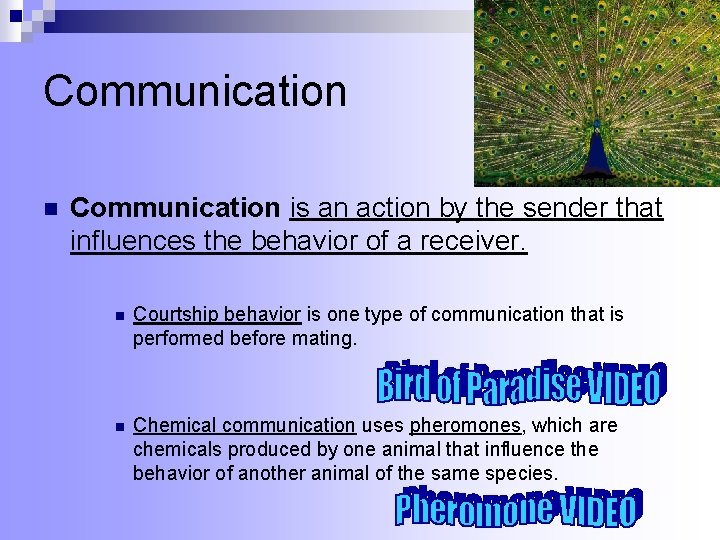
Communication n Communication is an action by the sender that influences the behavior of a receiver. n Courtship behavior is one type of communication that is performed before mating. n Chemical communication uses pheromones, which are chemicals produced by one animal that influence the behavior of another animal of the same species.
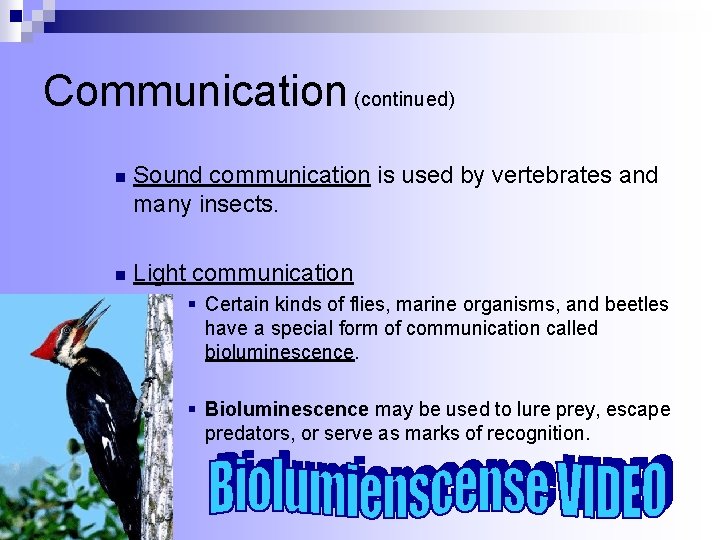
Communication (continued) n Sound communication is used by vertebrates and many insects. n Light communication § Certain kinds of flies, marine organisms, and beetles have a special form of communication called bioluminescence. § Bioluminescence may be used to lure prey, escape predators, or serve as marks of recognition.

Cyclic Behavior n Cyclic behavior is an innate behavior that occurs in a repeating pattern, often in response to changes in the environment. n Circadian rhythm – behavior based on a 24 -hour cycle. § Animals that are active during the day are diurnal. § Animals that are active at night are nocturnal.

Cyclic Behavior (continued) n Hibernation is a cyclic response to cold temperatures and limited food supplies. § An animal in hibernation remains inactive until the weather becomes warm in the spring. § Body response – body temperature and breathing rate drop. § Some mammals and many amphibians and reptiles hibernate.
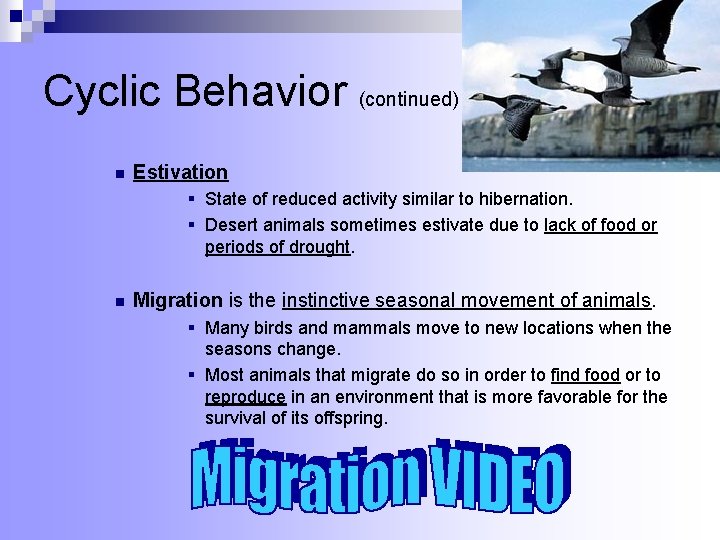
Cyclic Behavior (continued) n Estivation § State of reduced activity similar to hibernation. § Desert animals sometimes estivate due to lack of food or periods of drought. n Migration is the instinctive seasonal movement of animals. § Many birds and mammals move to new locations when the seasons change. § Most animals that migrate do so in order to find food or to reproduce in an environment that is more favorable for the survival of its offspring.
- Slides: 10