
Behavioral Health Alliance of Rural Pennsylvania BHARP Recovery
Behavioral Health Alliance of Rural Pennsylvania (BHARP) Recovery Initiative 2007 -2012 Promoting Recovery Oriented Environments
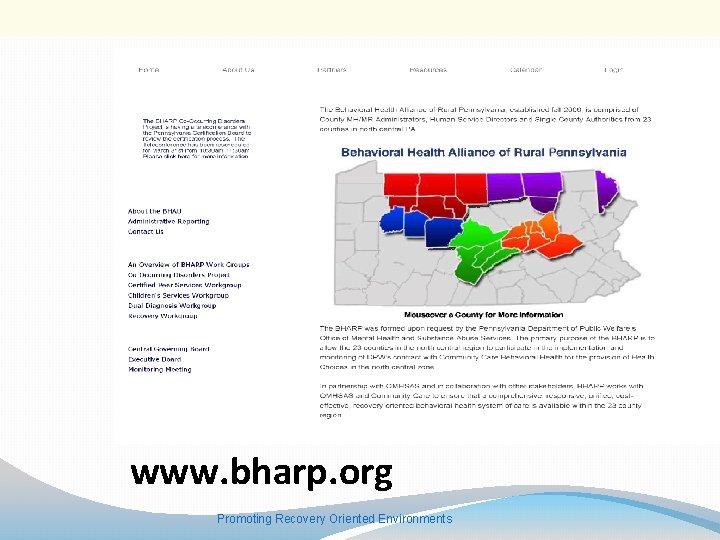
BHARP Behavioral Health Alliance of Rural Pennsylvania q BHARP was established in the Fall of 2006. It is comprised of County Mental Health Administrators, Human Service Directors and Single County Authorities from 23 counties in Northcentral PA. q The purpose of the BHARP is to allow the 23 counties in the Northcentral region to participate in the implementation and monitoring of the Department of Public Welfare contract with Community Care Behavioral Health for the provision of Health Choices in this zone. q In partnership with Office of Mental Health and Substance Abuse Services (OMHSAS) and Bureau of Drug and Alcohol Programs (BDAP) and in collaboration with other stakeholders, BHARP works to ensure that a comprehensive, responsive, unified, cost-effective, recovery oriented behavioral health system of care is available within the 23 county region. q Administrative functions for the BHARP are performed by the Behavioral Health Administrative Unit or BHAU. The BHAU is operated by a private not-for-profit organization, Service Access Management, Inc. (SAM Inc. ). Promoting Recovery Oriented Environments

Behavioral Health Alliance of Rural Pennsylvania (BHARP) North Central Health. Choices State Option Zone Erie Warren Mc. Kean Crawford Venango Clarion Elk Cameron Clearfield Butler Lycoming Union Centre Armstrong Mifflin Indiana Allegheny Snyder Lackawanna Sullivan Columbia Montour Cambria Blair Perry Monroe Carbon Northumberland Dauphin Huntingdon Washington Northampton Schuylkill Lehigh Berks Lebanon Cumberland Fayette Somerset Fulton Franklin Adams Bucks Montgomery Lancaster Bedford Pike Luzerne Juniata Westmoreland Greene Wayne Clinton Jefferson Lawrence Beaver Susquehanna Bradford Wyoming Forest Mercer Tioga Potter Chester York Average covered lives (January 2011 -June 2011): 154, 175 Delaware Philadelphia
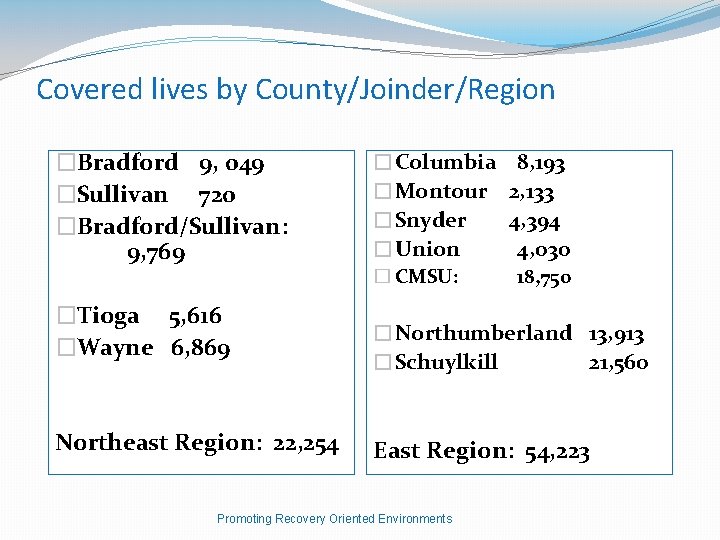
Covered lives by County/Joinder/Region �Bradford 9, 049 �Sullivan 720 �Bradford/Sullivan: 9, 769 �Tioga 5, 616 �Wayne 6, 869 Northeast Region: 22, 254 �Columbia 8, 193 �Montour 2, 133 �Snyder 4, 394 �Union 4, 030 � CMSU: 18, 750 �Northumberland 13, 913 �Schuylkill 21, 560 East Region: 54, 223 Promoting Recovery Oriented Environments
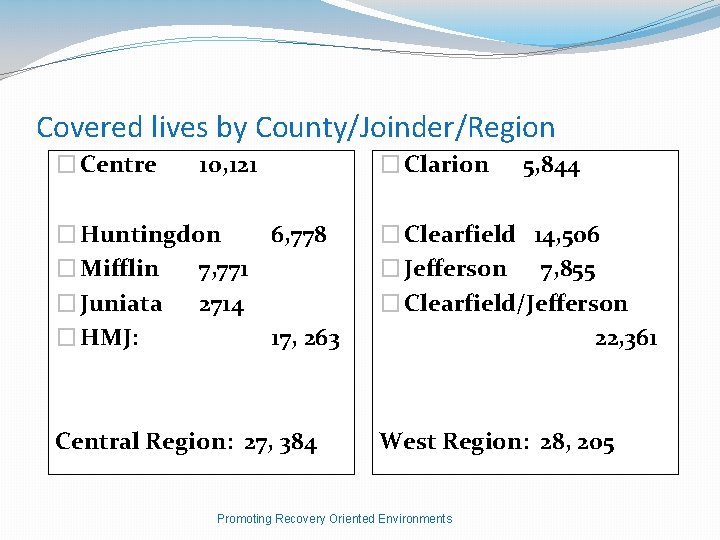
Covered lives by County/Joinder/Region � Centre 10, 121 � Clarion 5, 844 � Huntingdon 6, 778 � Mifflin 7, 771 � Juniata 2714 � HMJ: 17, 263 � Clearfield 14, 506 � Jefferson 7, 855 � Clearfield/Jefferson 22, 361 Central Region: 27, 384 West Region: 28, 205 Promoting Recovery Oriented Environments
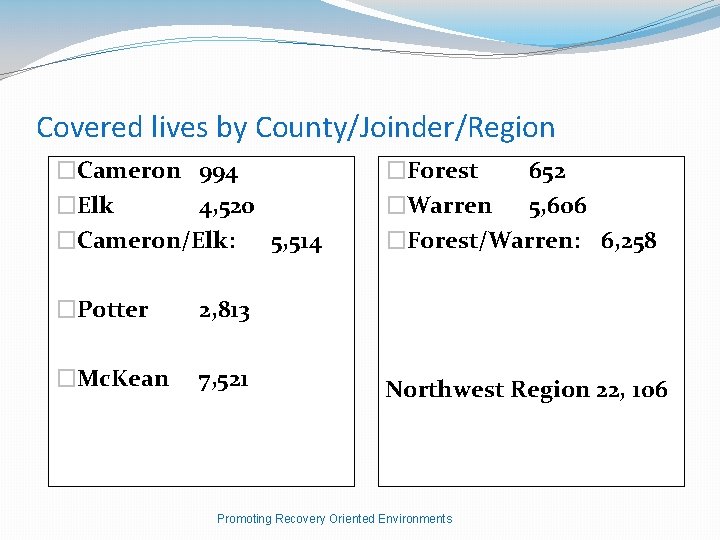
Covered lives by County/Joinder/Region �Cameron 994 �Elk 4, 520 �Cameron/Elk: 5, 514 �Potter 2, 813 �Mc. Kean 7, 521 �Forest 652 �Warren 5, 606 �Forest/Warren: 6, 258 Northwest Region 22, 106 Promoting Recovery Oriented Environments
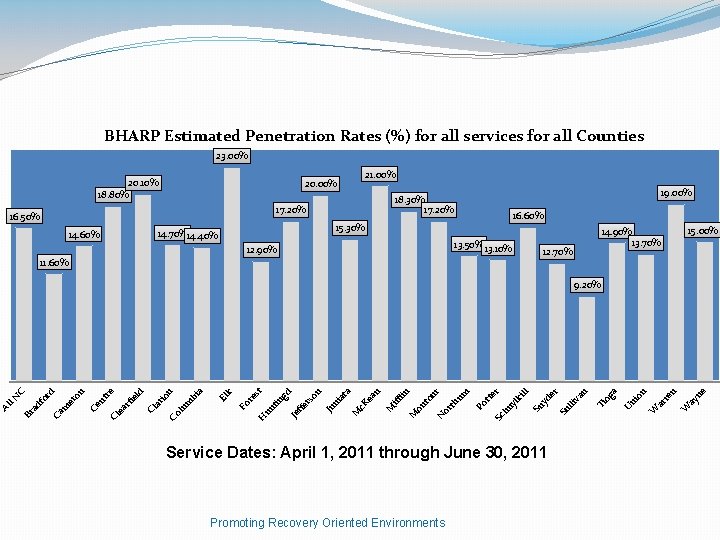
BHARP Estimated Penetration Rates (%) for all services for all Counties 23. 00% 18. 80% 20. 10% 21. 00% 20. 00% 18. 30% 17. 20% 16. 50% 17. 20% 16. 60% 15. 30% 14. 70%14. 40% 14. 60% 19. 00% 14. 90% 13. 50% 13. 10% 12. 90% 11. 60% 12. 70% 15. 00% 13. 70% Promoting Recovery Oriented Environments ay ne n W W ar re on ni U og a Ti n va er Service Dates: April 1, 2011 through June 30, 2011 Su lli yd ll Sn ki r hu yl tte Sc Po or t hu m r ou N on t M iff lin n ea c. K M a at M Ju ni on Je ffe rs gd t tin es un k H Fo r El a bi lu m io n Co ar ld Cl ar fie re nt Cl e Ce on er rd Ca m fo ad Br Al l N C 9. 20%
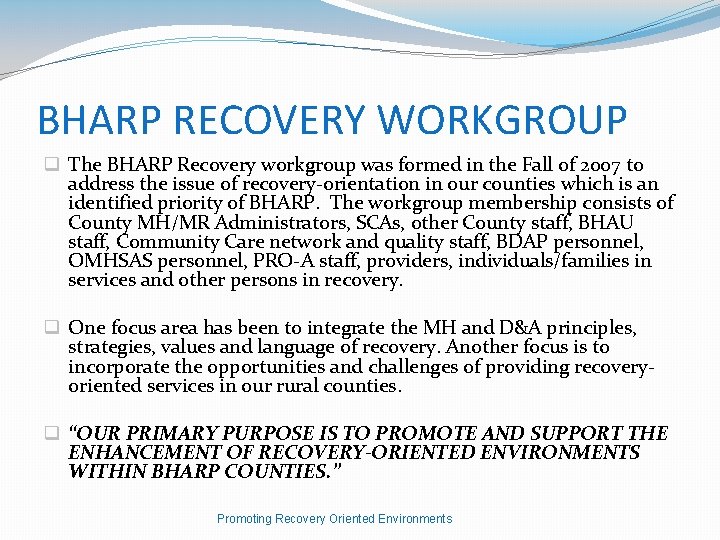
BHARP RECOVERY WORKGROUP q The BHARP Recovery workgroup was formed in the Fall of 2007 to address the issue of recovery-orientation in our counties which is an identified priority of BHARP. The workgroup membership consists of County MH/MR Administrators, SCAs, other County staff, BHAU staff, Community Care network and quality staff, BDAP personnel, OMHSAS personnel, PRO-A staff, providers, individuals/families in services and other persons in recovery. q One focus area has been to integrate the MH and D&A principles, strategies, values and language of recovery. Another focus is to incorporate the opportunities and challenges of providing recoveryoriented services in our rural counties. q “OUR PRIMARY PURPOSE IS TO PROMOTE AND SUPPORT THE ENHANCEMENT OF RECOVERY-ORIENTED ENVIRONMENTS WITHIN BHARP COUNTIES. ” Promoting Recovery Oriented Environments
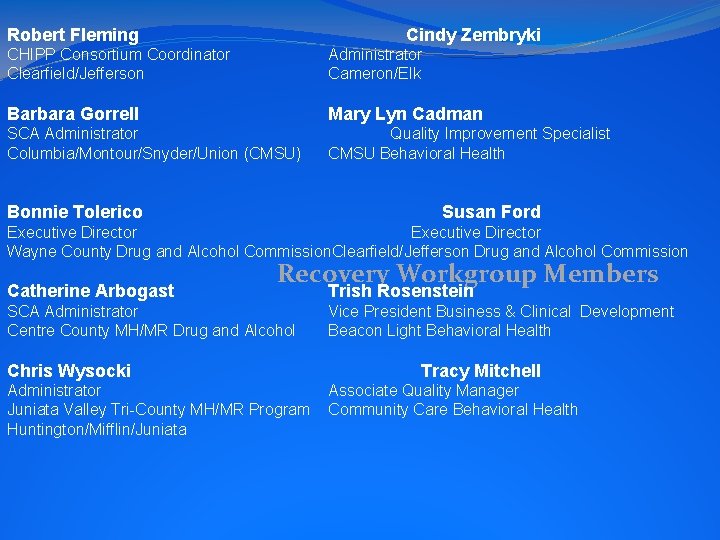
Robert Fleming Cindy Zembryki CHIPP Consortium Coordinator Clearfield/Jefferson Administrator Cameron/Elk Barbara Gorrell Mary Lyn Cadman SCA Administrator Columbia/Montour/Snyder/Union (CMSU) Quality Improvement Specialist CMSU Behavioral Health Bonnie Tolerico Susan Ford Executive Director Wayne County Drug and Alcohol Commission. Clearfield/Jefferson Drug and Alcohol Commission Catherine Arbogast Recovery Workgroup Members SCA Administrator Centre County MH/MR Drug and Alcohol Chris Wysocki Administrator Juniata Valley Tri-County MH/MR Program Huntington/Mifflin/Juniata Trish Rosenstein Vice President Business & Clinical Development Beacon Light Behavioral Health Tracy Mitchell Associate Quality Manager Community Care Behavioral Health
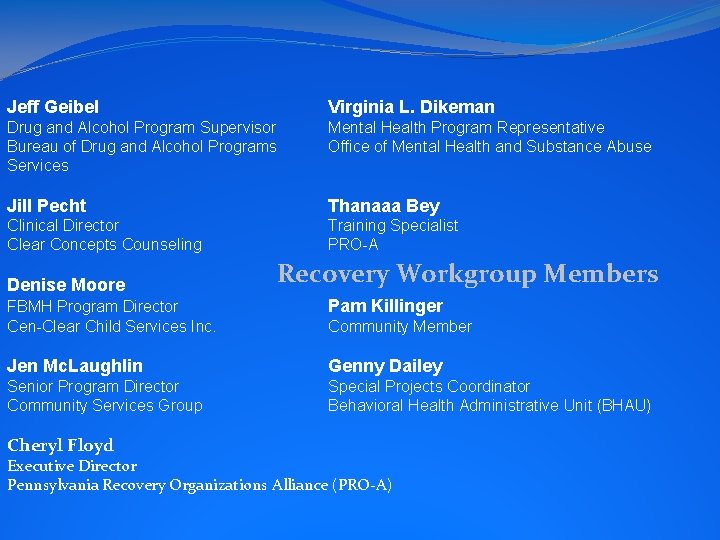
Jeff Geibel Virginia L. Dikeman Drug and Alcohol Program Supervisor Bureau of Drug and Alcohol Programs Services Mental Health Program Representative Office of Mental Health and Substance Abuse Jill Pecht Thanaaa Bey Clinical Director Clear Concepts Counseling Training Specialist PRO-A Denise Moore Recovery Workgroup Members FBMH Program Director Cen-Clear Child Services Inc. Pam Killinger Jen Mc. Laughlin Genny Dailey Senior Program Director Community Services Group Special Projects Coordinator Behavioral Health Administrative Unit (BHAU) Cheryl Floyd Community Member Executive Director Pennsylvania Recovery Organizations Alliance (PRO-A)
We believe: q that behavioral health is essential to health – for individuals, families, and communities qthat prevention works, q that treatment is effective, qand that people can and do recover from mental health and substance use disorders. Source: http: //www. samhsa. gov
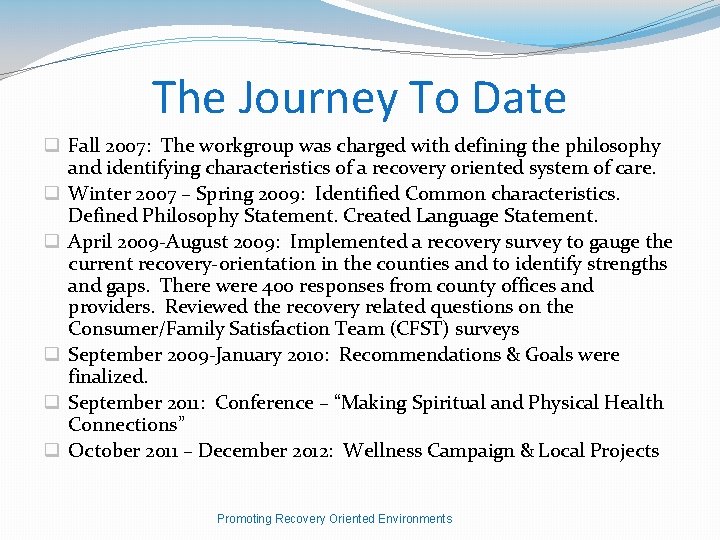
The Journey To Date q Fall 2007: The workgroup was charged with defining the philosophy and identifying characteristics of a recovery oriented system of care. q Winter 2007 – Spring 2009: Identified Common characteristics. Defined Philosophy Statement. Created Language Statement. q April 2009 -August 2009: Implemented a recovery survey to gauge the current recovery-orientation in the counties and to identify strengths and gaps. There were 400 responses from county offices and providers. Reviewed the recovery related questions on the Consumer/Family Satisfaction Team (CFST) surveys q September 2009 -January 2010: Recommendations & Goals were finalized. q September 2011: Conference – “Making Spiritual and Physical Health Connections” q October 2011 – December 2012: Wellness Campaign & Local Projects Promoting Recovery Oriented Environments
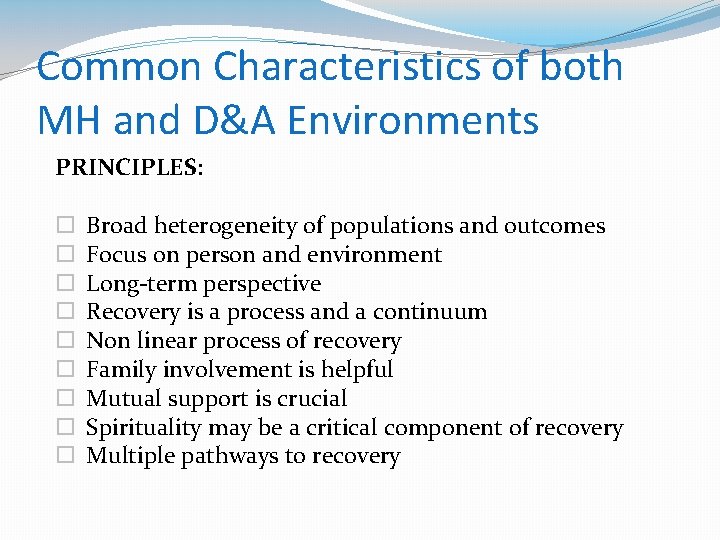
Common Characteristics of both MH and D&A Environments PRINCIPLES: Broad heterogeneity of populations and outcomes Focus on person and environment Long-term perspective Recovery is a process and a continuum Non linear process of recovery Family involvement is helpful Mutual support is crucial Spirituality may be a critical component of recovery Multiple pathways to recovery
Common Characteristics continued VALUES: q Person-centered q Partnerships q Growth q Choice q Strengths perspective q Focus on wellness and health q Cultural diversity Promoting Recovery Oriented Environments
Common Characteristics continued STRATEGIES TO FACILITATE RECOVERY: q Treatment as an array/menu of services q Coordinated treatment q Assertive linkages to communities of recovery q Skills for valued roles q On-going, flexible recovery-enhancing services q Advocacy q Cultural competency
Common Characteristics continued INGREDIENTS OF A RECOVERY-ORIENTED SYSTEM: · Prevention · Rehabilitation · Vocational and educational supports · Community education and support · Family education and support · Basic support (housing, nutrition, income) · Protection and advocacy Promoting Recovery Oriented Environments · Treatment · Mutual support · Spirituality · Enrichment · Legal aid
The Importance of Language BHARP recommends the following documents as resources on recovery-oriented language: IAPSRS Language Guidelines (2003) (available at www. uspra. org) PA D&A Coalition White Paper (2010) (available at www. bharp. org - Resources) Recovery-oriented language is person-centered and not focused on a diagnostic label. Recovery-oriented language fosters hope and avoids stereotypical and stigmatizing terms. The ultimate goal of recovery-oriented language is to make contact with the person not their disease and to give every individual the value, respect, and dignity he/she deserves.
Our Philosophy on the Journey of Recovery q Recovery is a continuous lifelong process q It requires linkages to recovery support services, natural supports and community supports q Each individual self-directs his/her recovery journey q Each individual has ownership of his/her recovery q Recovery oriented environments provide: -Person-centered planning -Partnerships between individuals receiving services and those providing services -Linkages to community based supports
Our Philosophy on the Journey of Recovery Formal systems of care that are focused on recovery: - Actively welcome and engage people when and where they approach the system - Allow formal and natural supports to work together - Balance the management of treatment and the empowerment of the individual to maximize successful outcomes It is necessary to combine the best of the medical and recovery models of care It is necessary to bridge the gap between behavioral and physical health care delivery
The Road Ahead This initiative reflects our intention to promote and to support the enhancement of recovery-oriented environments in all of our communities. Communities have always been an important part of rural life and we hope to strengthen those connections – creating relationships between the formal and informal networks of care. The vision is to nurture communities where individuals have the opportunity to attain and maintain health, wellness, and on-going recovery. The mission is to work towards the evolution and transformation of the behavioral healthcare system. It could be considered a ‘Rural Call for Change’. Promoting Recovery Oriented Environments
The Recovery Initiative will provide: q Information and resources q Education and training opportunities q Enrichment and partnership opportunities q Technical assistance options Promoting Recovery Oriented Environments
Recommendations and Key Activities Recommendation #1: BHARP will develop and promote a shared understanding of recovery-oriented environments throughout the Drug and Alcohol and Mental Health systems. Distribute Recovery brochures – “Promoting Recovery Oriented Environments” and “Recommendations & Goals” (handouts) Provide information to local Boards/Advisory Councils, Committees and Coalitions, Advocacy groups, and Providers Promote on-going local dialogues between MH and D&A system stakeholders Establish the topics of health, wellness, and on-going recovery as regular agenda items at local meetings Promoting Recovery Oriented Environments
Recommendations and Key Activities Recommendation #2: BHARP will collect and provide access to information, tools and other resources on creating and maintaining recovery-oriented environments in rural areas. Create information clearinghouse on BHARP website Develop reference book on Prevention programs, Promising practices, and Evidenced-Based practices Promoting Recovery Oriented Environments
Recommendations and Key Activities Recommendation #3: BHARP will encourage the service system to work assertively with individuals to explore and to make connections with natural supports in their community which will assist individuals to attain recovery and to sustain on-going recovery. Provide information and education Create a resource manual Held 2011 Recovery Conference & are developing local projects Promote acceptance and work towards decreasing stigma and discrimination Promoting Recovery Oriented Environments
Recommendations and Key Activities Recommendation #4: BHARP will encourage the service system to work assertively to build linkages between an individual’s behavioral and physical healthcare which will assist individuals to attain and maintain recovery and wellness. Create awareness through Wellness Campaign Provide information and education using SAMHSA Wellness Campaign tools Build resource manual for both behavioral healthcare providers and physical healthcare providers Promoting Recovery Oriented Environments
Next Steps? Promoting Recovery Oriented Environments
www. bharp. org Promoting Recovery Oriented Environments
Contact INFORMATION: County Mental Health and Drug & Alcohol offices and BHARP RECOVERY WORKGROUP Behavioral Health Administrative Unit 131 South Allegheny Street Bellefonte, PA 16823 Tel: 814 -355 -3408 Promoting Recovery Oriented Environments
- Slides: 28