
Behavioral Finance Economics 437 Behavioral Finance Introduction January
Behavioral Finance Economics 437 Behavioral Finance Introduction January 21, 2016

Course Information n n n Three Books n Andre Shleifer – “Inefficient Markets” n Daniel Kahneman – “Thinking: Fast and Slow (should have already read) n Edwin Burton – Sunit Shah – “Behavioral Finance” n Richard Thaler -- Misbehaving Online Reading at Toolkit Reading is difficult I-Clickers - required Lectures Exams n Two mid terms n Mch 3 and April 14 Final May 9: 2 PM Office Hours 11 -12: Tues Thur at VNB office (not on grounds) Behavioral Finance Introduction January 21, 2016
Course Topics n Review of MPT & EMH n Limits to Arbitrage n Anomalies n Serial Correlation in Stock Returns Behavioral Finance Introduction January 21, 2016
Immediate Reading (today, Jan 21) n Malkiel (online) n Shiller (online) n Shleifer (book, Ch 1) n Fama (online) Behavioral Finance Introduction January 21, 2016
Reading (starting Jan 28) “Noise Trading” – Limits to Arbitrage n Black on Toolkit n Shliefer on Toolkit n Burton & Shah, pp 1 -51 Behavioral Finance Introduction January 21, 2016
The Efficient Market Hypothesis (EMH) n Price captures all relevant information n Modern version based upon “No Arbitrage” assumption n Why do we care? n Implications n Only new information effects prices n Publicly known information has no value n Investors should “index” n Allocation efficiency Behavioral Finance Introduction January 21, 2016
The Milton Friedman argument for market efficiency in the presence of “noise traders” n If noise traders are truly “random, ” then their effects will “cancel out. ” (Kind of a law of large numbers result) n Noise traders are “systematic, ” then arbitrage traders will “trade against them” and take all of their money n Thus prices will be efficient in either case Behavioral Finance Introduction January 21, 2016
But, then n October 19, 1987 n 1992, Article by Eugene Fama and Ken French n The Tech Bubble n The Rise of Hedge Funds Behavioral Finance Introduction January 21, 2016
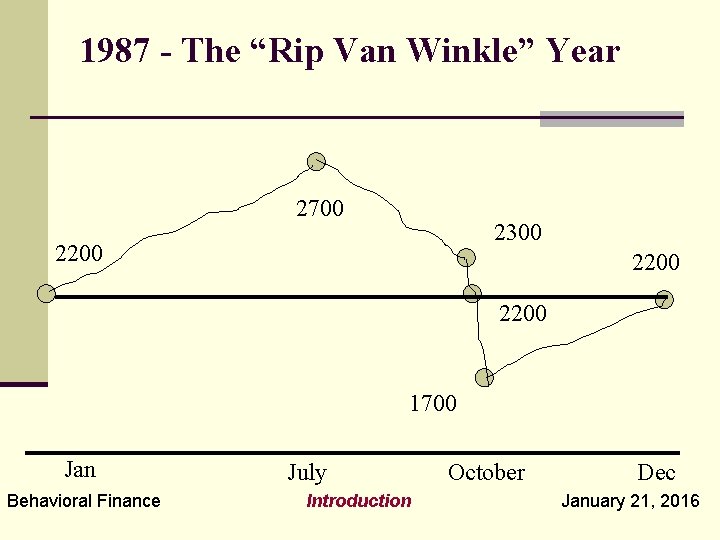
1987 - The “Rip Van Winkle” Year 2700 2300 2200 1700 Jan Behavioral Finance July Introduction October Dec January 21, 2016
Fama and French n Both authors are staunch supporters of EMH n 1992 Article gave a simple formula to pick stocks that “beat the market” consistently n This lead “respectability” to a growing literature that simple formulae could “beat the market” Behavioral Finance Introduction January 21, 2016
The Tech Bubble n 1999 Nasdaq up 100 percent for the year n Priceline: n Came public at 20, rose to 200, fell to under 1 n No news of substance n Nasdaq peaked at 5000 in March 2000 n Fell to 1800 by 2002 Behavioral Finance Introduction January 21, 2016
Hedge Funds n Industry grew from cottage industry to massive industry n Charges very, very high fees to customers n Idea: they can outperform the market; thus they deserve the big fees n Used by Harvard and Yale endowments (UVA as well) Behavioral Finance Introduction January 21, 2016
And There Things Stood n In 1970 Behavioral Finance Introduction January 21, 2016
The End Behavioral Finance Introduction January 21, 2016
- Slides: 14