
BEHAVIORAL APPROACHES TO STUTTERING TREATMENT SPEAK MORE FLUENTLY
BEHAVIORAL APPROACHES TO STUTTERING TREATMENT ‘SPEAK MORE FLUENTLY’ ‘STUTTER MORE FLUENTLY’ ‘NORMAL TALKING PROCESS’
SPEAK MORE FLUENTLY (aka “Fluency Shaping” “Prolonged Speech” or “Smooth Speech” via Fluency-Enhancing Strategies) • Slow rate • Prolonged vowels • Slow and smooth speech initiation • Phrasing and pausing
• Light articulatory contact • Connecting across word boundaries • Goals of Therapy: Spontaneous fluency and controlled fluency ENTIRE SPEECH PATTERN IS CHANGED
STUTTER MORE FLUENTLY (aka “Stuttering Modification”) • Identify and modify moments or instances of stuttering (tools include holding and tolerating and pull-out) • Reducing fear of stuttering and speaking • Reducing or eliminating avoidance behaviors
• Counseling • Goals of Therapy: Spontaneous fluency, controlled fluency, and acceptable stuttering (aka “easy” stuttering) MOMENTS OR INSTANCES OF STUTTERING ARE CHANGED

‘NORMAL TALKING’ PROCESS • Introduced by Williams (1957; 1979) • Instead of focusing on reducing or replacing undesirable behavior, emphasis is placed on increasing desirable behavior. • Attention is directed away from the perception of what is happening to the client, toward those things (s)he is doing to both facilitate and interfere with talking.
‘NORMAL TALKING’ PROCESS Emphasis placed on behavioral awareness of five parameters that contribute to ‘forward moving speech. ’ - tensing - movement - airflow - voicing - timing
INTEGRATED (CLIENT-CENTERED) APPROACH • Behavioral awareness of the talking process • Fluency enhancing strategies across entirety of speech • Modification of moments or instances of stuttering using identification and fluency enhancing strategies • Reducing fear of stuttering and speaking • Reducing or eliminating avoidance behaviors
INTEGRATED APPROACH • Fluency enhancing strategies across entirety of speech • Modification of moments or instances of stuttering using identification and fluency enhancing strategies • Reducing fear of stuttering and speaking • Reducing or eliminating avoidance behaviors
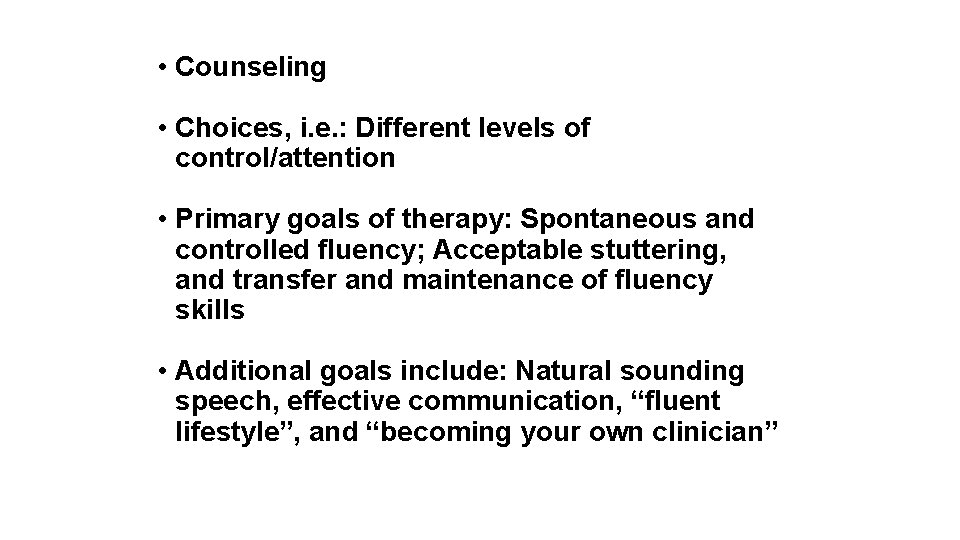
• Counseling • Choices, i. e. : Different levels of control/attention • Primary goals of therapy: Spontaneous and controlled fluency; Acceptable stuttering, and transfer and maintenance of fluency skills • Additional goals include: Natural sounding speech, effective communication, “fluent lifestyle”, and “becoming your own clinician”
- Slides: 10