
Behavioral and Motivational Mechanisms of the Brain The
Behavioral and Motivational Mechanisms of the Brain – The Limbic System and the Hypothalamus Dr. Ejlal Abu-El-Rub , Pharm. D, Ph. D Department of Basic Medical Sciences Yarmouk University
Activating - Driving Systems of the Brain
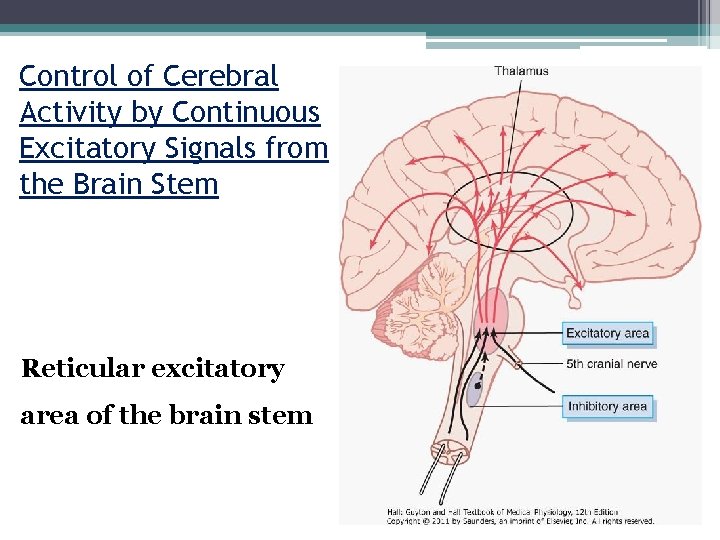
Control of Cerebral Activity by Continuous Excitatory Signals from the Brain Stem Reticular excitatory area of the brain stem
Control of Cerebral Activity by Continuous Excitatory Signals from the Brain Stem • Reticular excitatory area of the brain stem ▫ The central driving component of this system is an excitatory area located in the reticular substance of the pons and mesencephalon. This area is also known by the name bulboreticular excitatory area. ▫ It transmits facilitory signals downward to the spinal cord and upwards to the thalamus, then to all regions of the cerebral cortex.
Control of Cerebral Activity by Continuous Excitatory Signals from the Brain Stem Upward signals passing through the thalamus are: 1. Rapidly transmitted action potentials that excite the cerebrum for only a few milliseconds [acetylcholine]. 2. Signals transmitted through small slow fibers Excitatory effects build up progressively for seconds to minutes important for controlling longer-term background excitability level of the brain.
Excitation by Peripheral Sensory Signals • The level of activity of the excitatory area in the brain stem, and therefore the level of activity of the entire brain, is determined to a great extent by the number and type of sensory signals that enter the brain from the periphery. (ex. : pain signals).
Increased Activity of the Excitatory Area Caused by Feedback Signals Returning from the Cerebral Cortex • Positive feedback signals return from the cerebral cortex back to the bulboreticular excitatory area of the brain stem. Ø allows any beginning activity in the cerebral cortex to support still more activity, thus leading to an “awake” mind.
Thalamus Is a Distribution Center That Controls Activity in Specific Regions of the Cortex • Almost every area of the cerebral cortex connects with its own highly specific area in the thalamus. ▫ Therefore, electrical stimulation of a specific point in the thalamus generally activates its own specific small region of the cortex. • Signals regularly reverberate back and forth between the thalamus and the cerebral cortex
A Reticular Inhibitory Area Is Located in the Lower Brain Stem • Located medially and ventrally in the medulla. • This area can inhibit the reticular excitatory area of the upper brain stem and thereby decrease activity in the superior portions of the brain as well. Ø By excitation of serotonergic neurons secrete the inhibitory neurohormone serotonin at crucial points in the brain.
Neurohormonal Control of Brain Activity • Secretion of excitatory or inhibitory neurotransmitter hormonal agents into the substance of the brain.
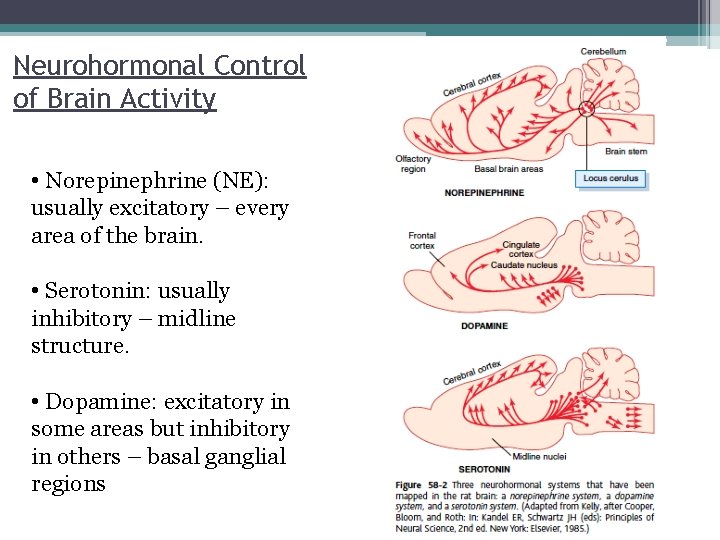
Neurohormonal Control of Brain Activity • Norepinephrine (NE): usually excitatory – every area of the brain. • Serotonin: usually inhibitory – midline structure. • Dopamine: excitatory in some areas but inhibitory in others – basal ganglial regions
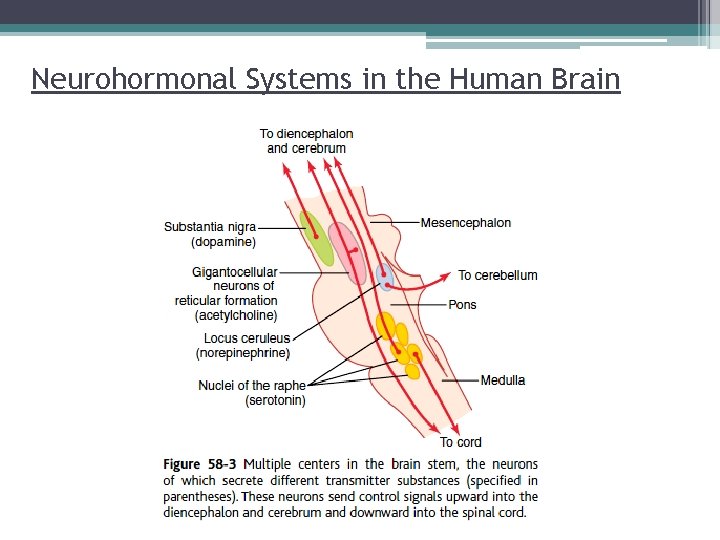
Neurohormonal Systems in the Human Brain
1. The locus ceruleus and the NE system: ▫ located bilaterally and posteriorly at the juncture between the pons and mesencephalon. ▫ Nerve fibers from this area spread throughout the brain and secrete NE � Generally excites the brain to increased activity � In a few brain areas inhibitory due to inhibitory receptors at certain neuronal synapses. ▫ Probably involved in dreaming and REM sleep.
2. The substantia nigra and the dopamine system. ▫ The substantia nigra lies anteriorly in the superior mesencephalon, and its neurons send nerve endings mainly to the caudate nucleus and putamen of the cerebrum, where they secrete dopamine. ▫ Other neurons located in adjacent regions also secrete dopamine, but they send their endings into the hypothalamus and the limbic system. ▫ The dopamine is believed to act as an inhibitory transmitter in the basal ganglia, but in some other areas of the brain it is possibly excitatory.
3. The raphe nuclei and the serotonin system. ▫ Located in the midline of the pons and medulla. Many of the neurons in these nuclei secrete serotonin. They send fibers into the diencephalon and a few fibers to the cerebral cortex; still other fibers descend to the spinal cord. ▫ The serotonin secreted at the cord fiber endings has the ability to suppress pain. ▫ The serotonin released in the diencephalon and cerebrum almost certainly plays an essential inhibitory role to help cause normal sleep.
4. The gigantocellular neurons of the reticular excitatory area and the acetylcholine system. ▫ The fibers from these large cells divide immediately into two branches, one passing upward to the higher levels of the brain and the other passing downward through the reticulospinal tracts into the spinal cord. They secrete acetylcholine. ▫ In most places, acetylcholine functions as an excitatory neurotransmitter. Ø Activation of these acetylcholine neurons leads to an acutely awake and excited nervous system.
The limbic system
• Limbic = border ▫ originally the border structures around the basal regions of the cerebrum. ▫ Now the entire neuronal circuitry that controls emotional behavior and motivational drives. • A major part of the limbic system is the hypothalamus, with its related structures. • These areas control many internal conditions of the body (body temperature, osmolality of the body fluids, and the drives to eat and drink and to control body weight). Ø called vegetative functions of the brain.
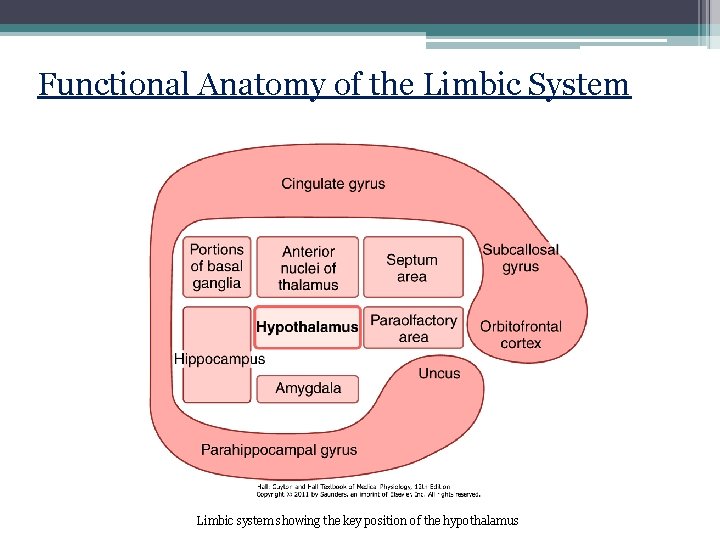
Functional Anatomy of the Limbic System Limbic system showing the key position of the hypothalamus
Functional Anatomy of the Limbic System • Interconnected complex of basal brain elements. • Hypothalamus central elements of the limbic system key position.
Functional Anatomy of the Limbic System • Many of the behavioral functions elicited from the hypothalamus and other limbic structures are also mediated through the reticular nuclei in the brain stem and their associated nuclei.
Hypothalamus, a Major Control Headquarters for the Limbic System
Hypothalamus • Has two-way communicating pathways with all levels of the limbic system; sends output signals in three directions: 1. To the brain stem (mesencephalon, medulla, and pons), and then to the ANS. 2. To higher areas of the diencephalon and cerebrum 3. To the infundibulum to control secretions of the anterior and posterior pituitary.
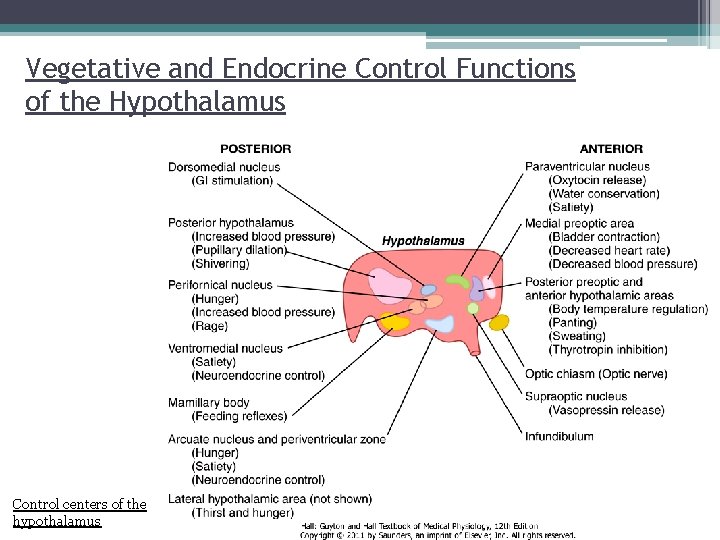
Vegetative and Endocrine Control Functions of the Hypothalamus Control centers of the hypothalamus
Behavioral Functions of the Hypothalamus and Associated Limbic Structures • Effects caused by stimulation of the hypothalamus 1. Lateral - thirst and eating; increases the general level of activity (possibly rage and fighting). 2. Ventromedial nucleus - satiety, decreased eating, and tranquility. 3. Periventricular nuclei - fear and punishment reactions. 4. Anterior and posterior hypothalamus - sex drive
Reward centers • the major reward centers (mesocorticolimbic circuit) have been found to be located along the course of the medial forebrain bundle, especially in the lateral and ventromedial nuclei of the hypothalamus.
Punishment centers • Electrical stimulation of punishment centers in signs of displeasure, fear, terror, pain and even sickness. • The most potent areas for punishment and escape tendencies are the central gray area surrounding the aqueduct of Sylvius in the mesencephalon and extending upward into the periventricular zones of the hypothalamus and thalamus.
• Stimulation in the punishment centers can frequently inhibit the reward and pleasure centers completely Ø punishment and fear can take precedence over pleasure and reward.
• Rage is associated with strong stimulation of punishment centers. ▫ This is inhibited by signals from ventromedial nuclei of the hypothalamus. • Stimulation of the reward centers cause placidity and tameness.
Importance of Reward or Punishment on Behavior • Almost every behavior is related in some way to reward and punishment. • A sensory experience that causes neither reward nor punishment is hardly remembered at all. • If a sensory experience does not elicit a sense of either reward or punishment, repetition of the stimulus over and over leads to almost complete extinction of the cerebral cortical response habituation.
• If the stimulus does cause either reward or punishment, the cerebral cortical response becomes progressively more and more intense during repeated stimulation reinforced. The reward and punishment centers of the limbic system have much to do with selecting the information that we learn.
Specific Functions of Other Parts of the Limbic System
Hippocampus • It has numerous indirect connections with many portions of the cerebral cortex and the basal structures of the limbic system. • Almost any type of sensory experience causes activation of at least some part of the hippocampus it then distributes outgoing signals to anterior thalamus, hypothalamus and other parts of the limbic system.
Role of hippocampus in learning • Bilateral removal of hippocampus causes inability to learn and anterograde amnesia. • The hippocampus originated as part of the olfactory cortex in lower animals, it contributes to decisions related to smells. • Hippocampus is a critical decision-making neuronal mechanism that determines the importance of the incoming sensory signals. Ø if the hippocampus signals that a neuronal input is important, the information is likely to be committed to memory.
• The hippocampus provides the drive that causes translation of short-term memory into long-term memory ▫ transmits some signal or signals that seem to make the mind rehearse over and over the new information until permanent storage takes place. v Hippocampus is necessary for consolidation of long-term memories of the verbal or symbolic thinking.
The amygdala • The amygdala receives neuronal signals from all portions of the limbic cortex and the temporal, parietal, and occipital cortex —especially from the auditory and visual association areas. Ø It is the “window” through which the limbic system sees the place of the person in the world. • It also transmits signals (1) back into these same cortical areas, (2) into the hippocampus, (3) into the septum, (4) into the thalamus, and (5) especially into the hypothalamus.
• Stimulation in the amygdala can cause almost all the effects elicited by direct stimulation of the hypothalamus. • It also causes several types of involuntary movements, such as: (1) tonic movements, such as raising the head or bending the body (2) circling movements (3) occasionally clonic, rhythmical movements (4) movements associated with olfaction and eating, such as licking, chewing, and swallowing.
• Stimulation of certain amygdaloid nuclei can cause a pattern of rage, escape, punishment, severe pain, and fear (similar to the rage pattern elicited from the hypothalamus). • Stimulation of other amygdaloid nuclei can give reactions of reward and pleasure. • Amygdala plays a role in sexual activities.
Limbic cortex • The limbic cortex functions as a cerebral association area for control of behavior. • Stimulation of the different regions of the limbic cortex has failed to give any real idea of their functions. ▫ However, essentially all behavioral patterns can be elicited by stimulation of specific portions of the limbic cortex.
• Some of the functions of the limbic cortex include: 1. Intermediate associative positions between cerebral cortex and subcortical limbic structures. 2. Control of behavioral patterns. 3. Induction of sleep. 4. Inhibition of rage.
- Slides: 40