
Behavioral and electrophysiological results in auditory processing disorders
Behavioral and electrophysiological results in auditory processing disorders Luciana Macedo de Resende Ph. D
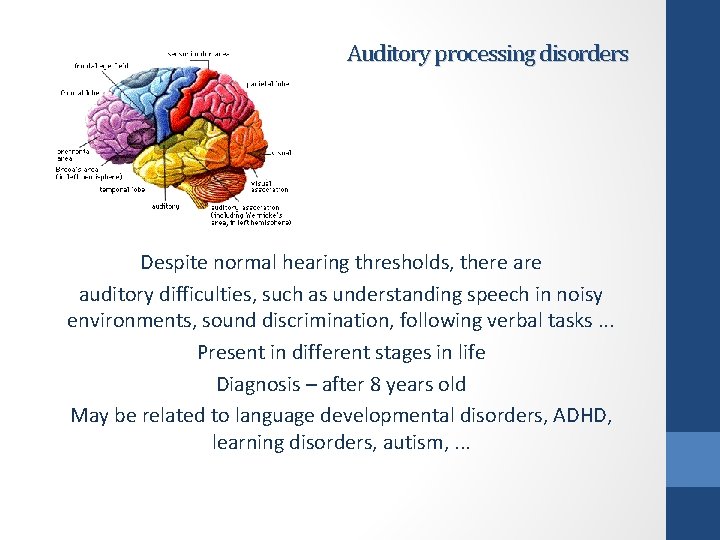
Auditory processing disorders Despite normal hearing thresholds, there auditory difficulties, such as understanding speech in noisy environments, sound discrimination, following verbal tasks. . . Present in different stages in life Diagnosis – after 8 years old May be related to language developmental disorders, ADHD, learning disorders, autism, . . .
Auditory processing disorders In Brazil: - Lack of epidemiological data concerning APD - Recommendation on Diagnostic procedures advise inclusion of behavioral and electrophysyologic audiological measures
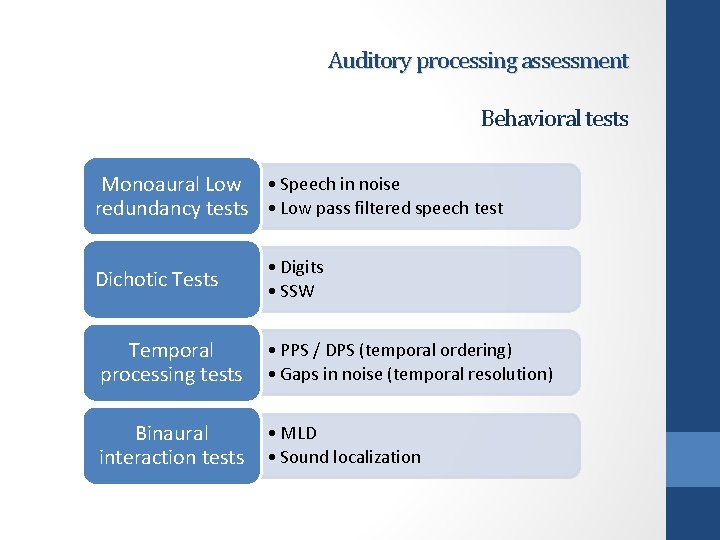
Auditory processing assessment Behavioral tests Monoaural Low • Speech in noise redundancy tests • Low pass filtered speech test Dichotic Tests • Digits • SSW Temporal processing tests • PPS / DPS (temporal ordering) • Gaps in noise (temporal resolution) Binaural interaction tests • MLD • Sound localization
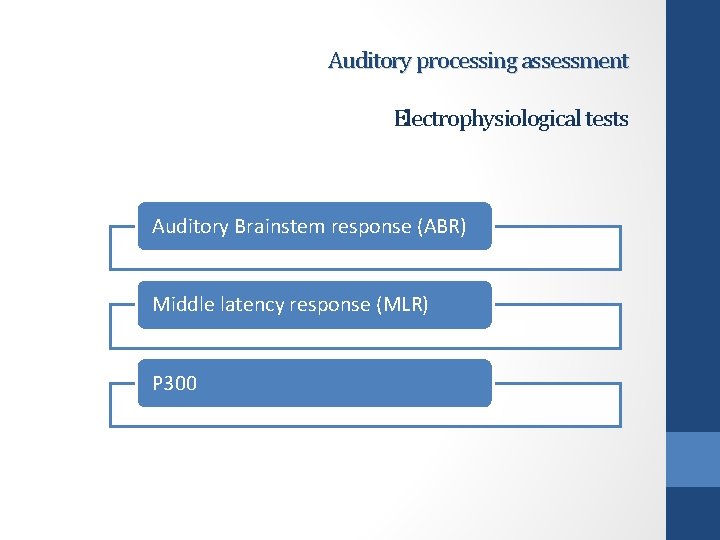
Auditory processing assessment Electrophysiological tests Auditory Brainstem response (ABR) Middle latency response (MLR) P 300
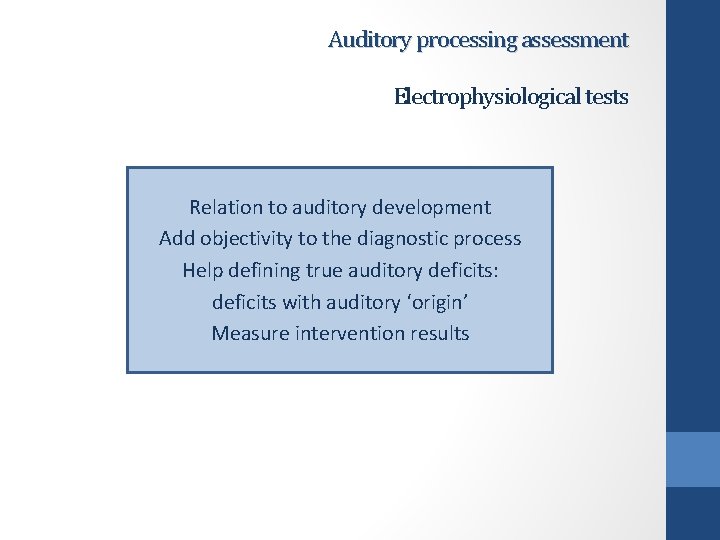
Auditory processing assessment Electrophysiological tests Relation to auditory development Add objectivity to the diagnostic process Help defining true auditory deficits: deficits with auditory ‘origin’ Measure intervention results
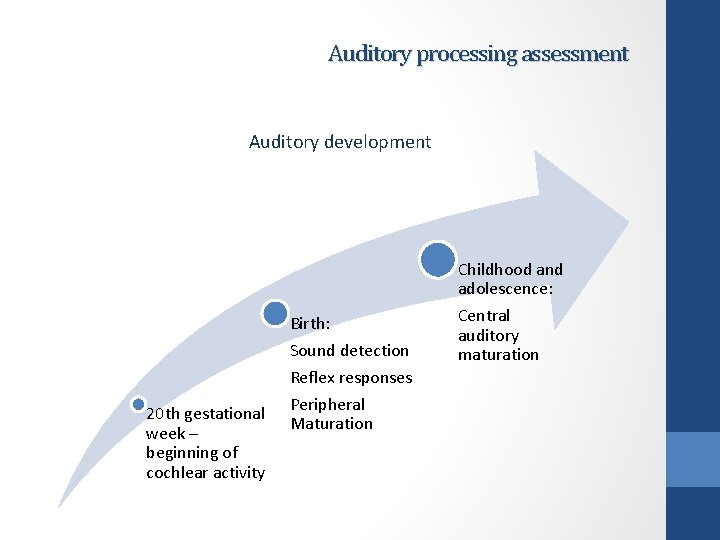
Auditory processing assessment Auditory development Birth: 20 th gestational week – beginning of cochlear activity Sound detection Reflex responses Peripheral Maturation Childhood and adolescence: Central auditory maturation
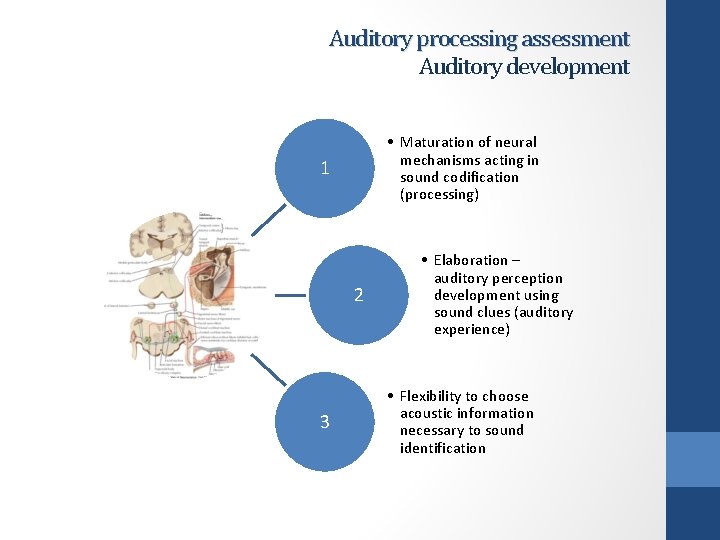
Auditory processing assessment Auditory development • Maturation of neural mechanisms acting in sound codification (processing) 1 2 3 • Elaboration – auditory perception development using sound clues (auditory experience) • Flexibility to choose acoustic information necessary to sound identification
Behavioral and electrophysiological results in auditory processing disorders • Purpose: describe the carachteristics and performance of patients referenced to auditory processing assessment and associate findings to complaints and also correlate behavioral and electrophysiological findings. Context: - University Hospital (Hospital das Clínicas /UFMG) - Secondary and tertiary health care facility - Aprox. 200 patients referred for auditory processing assessment during the study period
Behavioral and electrophysiological results in auditory processing disorders Methods • Study design: Cross-sectional descriptive study. • UFMG Ethical aproval no. 668376. • Patients referenced to the audiology service for auditory processing assessment were invited to participate in the study. All patients and/or parent´s patients signed an informed consent allowing assessment results to be included in the study.
Behavioral and electrophysiological results in auditory processing disorders Methods • Procedures: - tonal audiometry, - tympanometry and acoustic reflexes, - behavioral and electrophysiological measures. Selected behavioral procedures included dichotic tests, monaural low redundancy tests, temporal processing tests and binaural interactions tests. Auditory brainstem response (ABR), middle latency responses (MLR) and P 300 were the electrophysiological measures.
Behavioral and electrophysiological results in auditory processing disorders Methods • Statistical analisys: - Chi square and Fisher’s exact test were used at statistical analysis to associate categorical variables, followed by Kappa’s to observe the degree of associations. T test and Mann-Whitney were also used. Variables distribution was assessed with Kolmogorov. Smirnov and a p-value of 5% was adopted
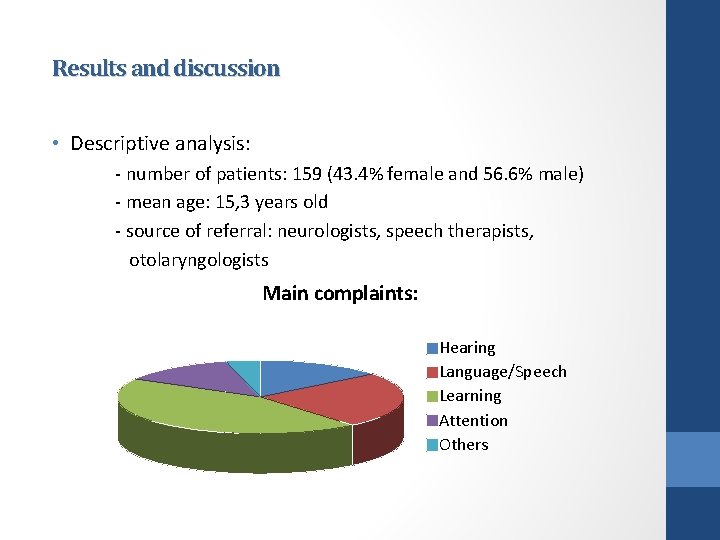
Results and discussion • Descriptive analysis: - number of patients: 159 (43. 4% female and 56. 6% male) - mean age: 15, 3 years old - source of referral: neurologists, speech therapists, otolaryngologists Main complaints: Hearing Language/Speech Learning Attention Others
Results and discussion Audiometry and Immitance results: 100% with hearing thresholds within normal limits 100% with type A tympanometry 89% contra lateral acoustic reflexes present 11% contra lateral acoustic reflexes absent or increased
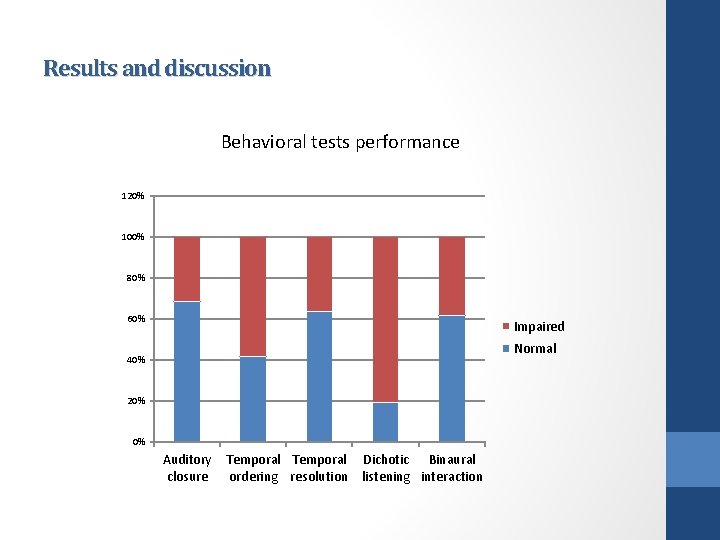
Results and discussion Behavioral tests performance 120% 100% 80% 60% Impaired Normal 40% 20% 0% Auditory closure Temporal Dichotic Binaural ordering resolution listening interaction
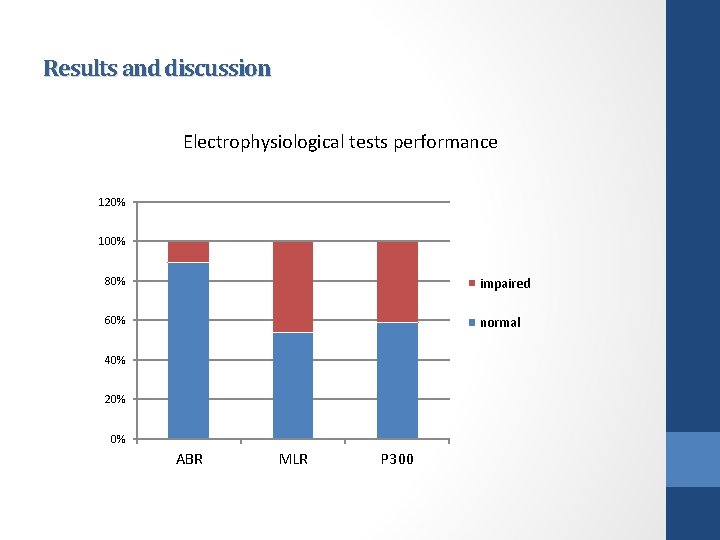
Results and discussion Electrophysiological tests performance 120% 100% 80% impaired 60% normal 40% 20% 0% ABR MLR P 300
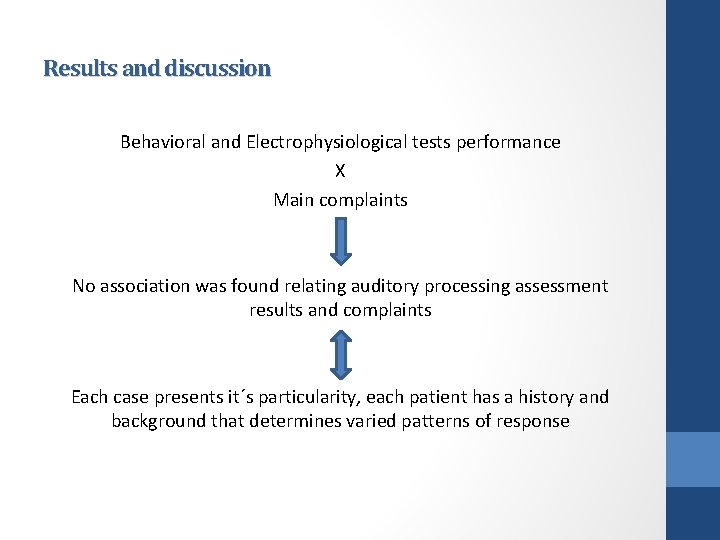
Results and discussion Behavioral and Electrophysiological tests performance X Main complaints No association was found relating auditory processing assessment results and complaints Each case presents it´s particularity, each patient has a history and background that determines varied patterns of response
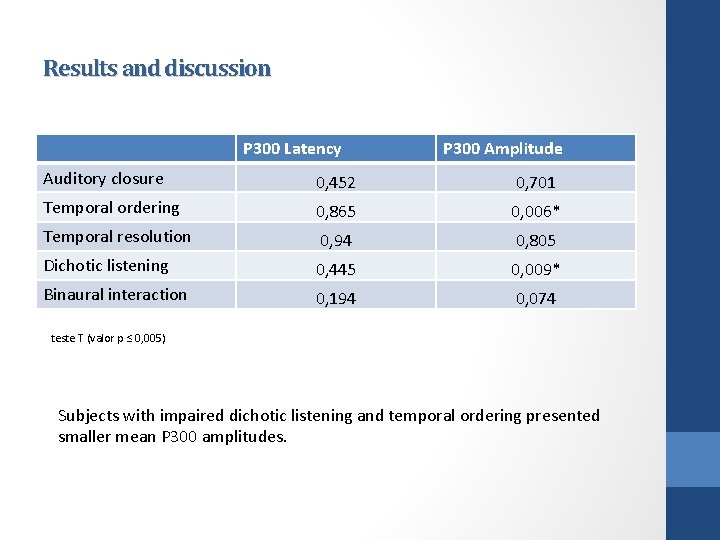
Results and discussion P 300 Latency P 300 Amplitude Auditory closure 0, 452 0, 701 Temporal ordering 0, 865 0, 006* Temporal resolution 0, 94 0, 805 Dichotic listening 0, 445 0, 009* Binaural interaction 0, 194 0, 074 teste T (valor p ≤ 0, 005) Subjects with impaired dichotic listening and temporal ordering presented smaller mean P 300 amplitudes.
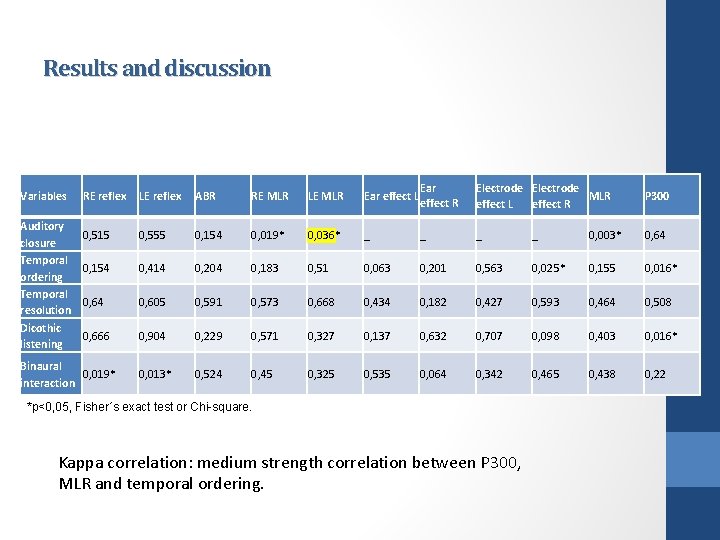
Results and discussion Variables RE reflex LE reflex Auditory 0, 515 0, 555 closure Temporal 0, 154 0, 414 ordering Temporal 0, 64 0, 605 resolution Dicothic 0, 904 teste T 0, 666 (valor p ≤ 0, 005) listening Binaural 0, 019* interaction 0, 013* ABR RE MLR LE MLR Ear effect L Ear effect R Electrode MLR effect L effect R P 300 0, 154 0, 019* 0, 036* _ _ 0, 003* 0, 64 0, 204 0, 183 0, 51 0, 063 0, 201 0, 563 0, 025* 0, 155 0, 016* 0, 591 0, 573 0, 668 0, 434 0, 182 0, 427 0, 593 0, 464 0, 508 0, 229 0, 571 0, 327 0, 137 0, 632 0, 707 0, 098 0, 403 0, 016* 0, 524 0, 45 0, 325 0, 535 0, 064 0, 342 0, 465 0, 438 0, 22 *p<0, 05, Fisher´s exact test or Chi-square. Kappa correlation: medium strength correlation between P 300, MLR and temporal ordering.
Results and discussion Correlation among behavioral and electrophysiological tests, when assessing auditory processing, adds objectivity in intervention definition and diagnostic confirmation. Auditory processing may be the cause of learning and language disabilities or may be a manifestation of other conditions such as ADHD, SLI. A detailed auditory processing assessment is crucial for a successful intervention plan.
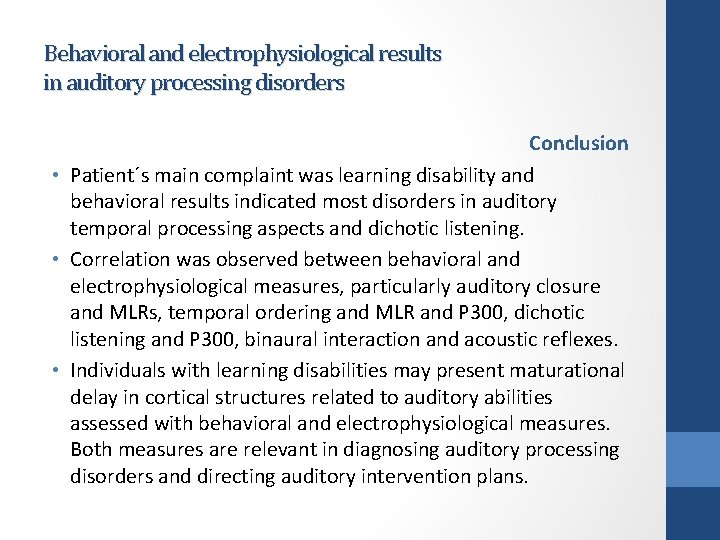
Behavioral and electrophysiological results in auditory processing disorders Conclusion • Patient´s main complaint was learning disability and behavioral results indicated most disorders in auditory temporal processing aspects and dichotic listening. • Correlation was observed between behavioral and electrophysiological measures, particularly auditory closure and MLRs, temporal ordering and MLR and P 300, dichotic listening and P 300, binaural interaction and acoustic reflexes. • Individuals with learning disabilities may present maturational delay in cortical structures related to auditory abilities assessed with behavioral and electrophysiological measures. Both measures are relevant in diagnosing auditory processing disorders and directing auditory intervention plans.

Thank you! lucianamr@medicina. ufmg. br
- Slides: 22