
BEHAVIORAL ACTIVATION FOR DEPRESSION ADVANCED PSYCHOTHERAPY COGNITIVEBEHAVIORAL PSYCHOTHERAPY
BEHAVIORAL ACTIVATION FOR DEPRESSION ADVANCED PSYCHOTHERAPY: COGNITIVEBEHAVIORAL PSYCHOTHERAPY
OBJECTIVES • Understand a behavioral conceptualization of depression. • Understand a session-by-session plan for behavioral activation.
BACKGROUND • Neil Jacobson (Ph. D) is best known for developing and testing behavioral activation. – His research showed that the behavioral component of CBT (called behavioral activation) was a effective as a full CBT treatment package. • Carl Le. Juez (Ph. D) refined behavioral activation and provided free treatment manual and materials for clinicians. • Lots of scientific support for the efficacy of behavioral activation. • Today’s class focuses on this treatment.
BEHAVIORAL CONCEPTUALIZATION OF BA • Focus on environmental influences as opposed to intrapsychic causes • Focus on lack of positive reinforcement in environment and aversive environment • Depression is an individual’s best attempts to respond to environment using unhelpful strategies – mostly AVOIDANCE • Avoidance = disengaging from problem solving and engaging in the environment • Avoidance = using short-term coping strategy on a long-term basis • What are some examples of avoidance? Staying in bed; binging on Netflix
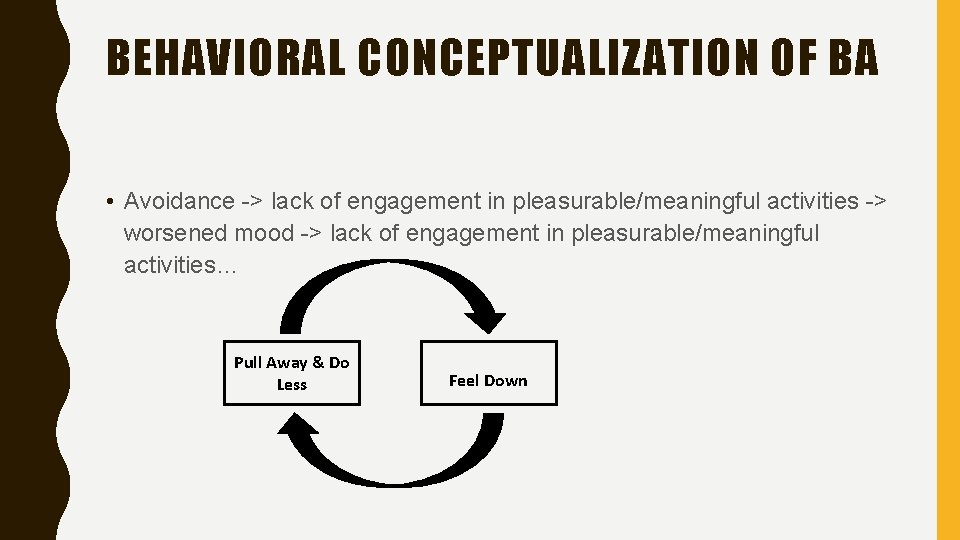
BEHAVIORAL CONCEPTUALIZATION OF BA • Avoidance -> lack of engagement in pleasurable/meaningful activities -> worsened mood -> lack of engagement in pleasurable/meaningful activities… Pull Away & Do Less Feel Down
IMPORTANT TREATMENT PRINCIPLES • The key to changing how we feel is changing what we do. • Changes in life (e. g. , stress, trauma, bad relationships, disappointments) can lead to depression. • To figure out what will improve mood, we will examine what occurs before and after important behaviors. This allows us to determine what behaviors worsen mood and what behaviors improve mood. • Activities will be structured and scheduled following a plan, not a mood. Instead of not doing anything like our mood tells us, we want to follow our plan. This will involve engaging in activities that once led to pleasure, provide a sense of accomplishment, or that solve current problems. • Change will be easier when starting small.
IMPORTANT TREATMENT PRINCIPLES • We will emphasize activities that are more likely to bring forth a natural reinforcement (e. g. , healthy eating, exercise, sleep hygiene tips, etc. ) • Your provider will act as a coach and help you plan strategies, make suggestions, give direction, and keep up morale. • We will emphasize a problem-solving approach in which we help develop, evaluate, and try out potential solutions. • Don’t just talk, do! Practice assignments are required in each and every session. • We will troubleshoot possible and actual barriers to activation.
SESSION #1 • Session One Key Elements: • 1. Discussion of Depression • 2. Introduction to Treatment Rationale – What about stressful life events and loss in your life? • 3. Introduction to Daily Monitoring (Form 1) – Importance and Enjoyment Ratings – When should you complete the Daily Monitoring Form? • 4. Important Points about the Structure of This Treatment • Assignments: • 1. Complete Daily Monitoring Form
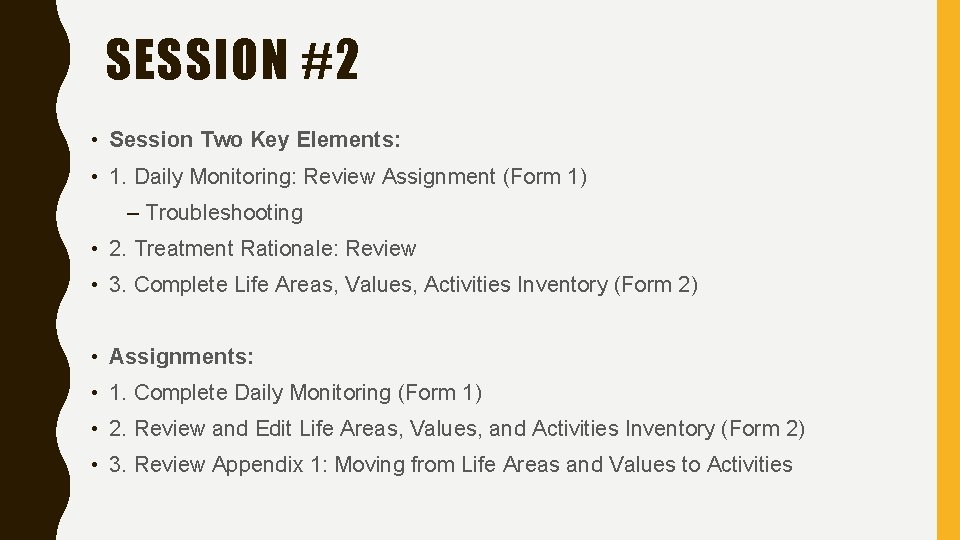
SESSION #2 • Session Two Key Elements: • 1. Daily Monitoring: Review Assignment (Form 1) – Troubleshooting • 2. Treatment Rationale: Review • 3. Complete Life Areas, Values, Activities Inventory (Form 2) • Assignments: • 1. Complete Daily Monitoring (Form 1) • 2. Review and Edit Life Areas, Values, and Activities Inventory (Form 2) • 3. Review Appendix 1: Moving from Life Areas and Values to Activities
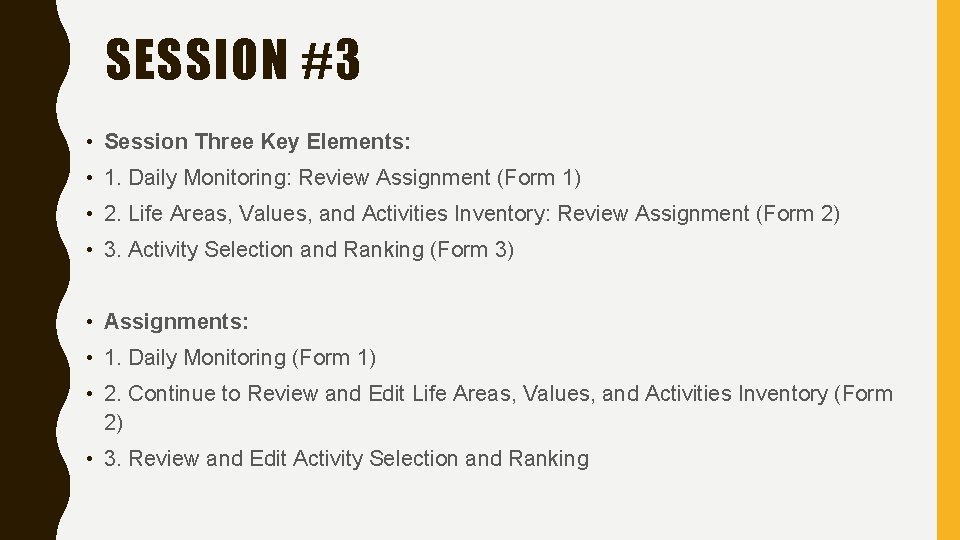
SESSION #3 • Session Three Key Elements: • 1. Daily Monitoring: Review Assignment (Form 1) • 2. Life Areas, Values, and Activities Inventory: Review Assignment (Form 2) • 3. Activity Selection and Ranking (Form 3) • Assignments: • 1. Daily Monitoring (Form 1) • 2. Continue to Review and Edit Life Areas, Values, and Activities Inventory (Form 2) • 3. Review and Edit Activity Selection and Ranking
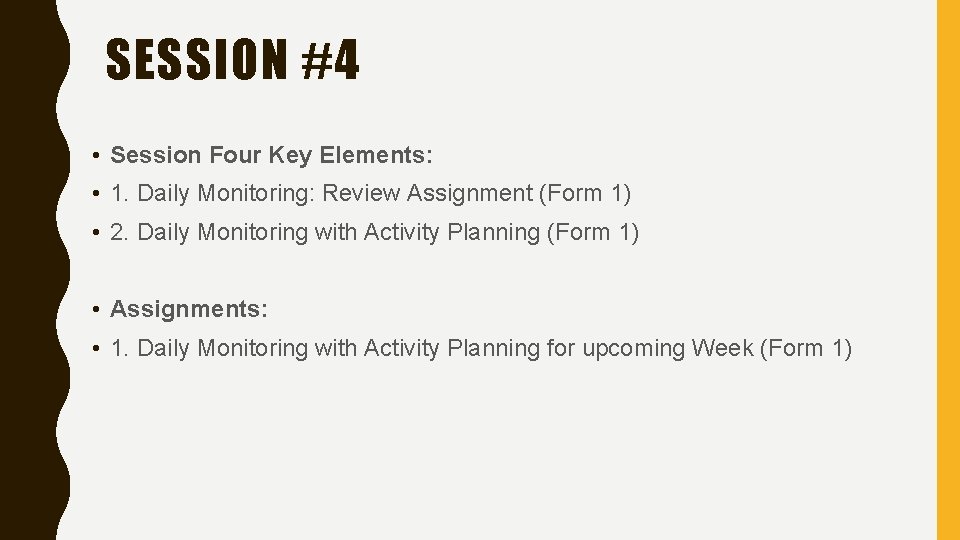
SESSION #4 • Session Four Key Elements: • 1. Daily Monitoring: Review Assignment (Form 1) • 2. Daily Monitoring with Activity Planning (Form 1) • Assignments: • 1. Daily Monitoring with Activity Planning for upcoming Week (Form 1)
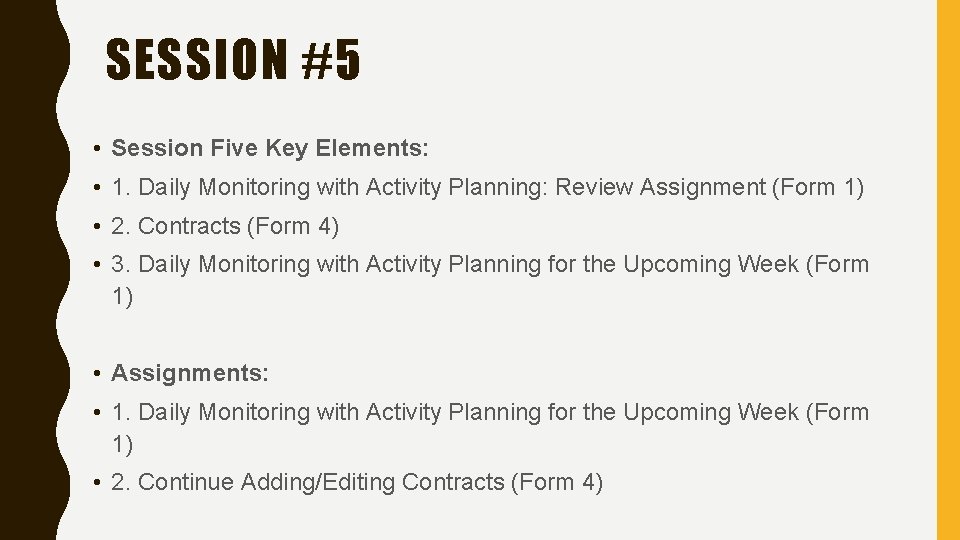
SESSION #5 • Session Five Key Elements: • 1. Daily Monitoring with Activity Planning: Review Assignment (Form 1) • 2. Contracts (Form 4) • 3. Daily Monitoring with Activity Planning for the Upcoming Week (Form 1) • Assignments: • 1. Daily Monitoring with Activity Planning for the Upcoming Week (Form 1) • 2. Continue Adding/Editing Contracts (Form 4)
SESSION #6 • Session Six Key Elements: • 1. Daily Monitoring with Activity Planning: Review Assignment (Form 1) • 2. Contracts: Review Assignment (Form 4) • 3. Daily Monitoring with Activity Planning for the Upcoming Week (Form 1) • Assignments: • 1. Daily Monitoring with Activity Planning for the Upcoming Week (Form 1) • 2. Continue Adding/Editing Contracts (Form 4)
SESSION #7 • Session Seven Key Elements: • 1. Daily Monitoring with Activity Planning: Review Assignment (Form 1) • 2. Life Areas, Values, and Activities Inventory: Concept Review and Edit (Form 2) • 3. Daily Monitoring with Activity Planning for the Upcoming Week (Form 1) • Assignments: • 1. Daily Monitoring with Activity Planning for the Upcoming Week (Form 1) • 2. Continue Adding/Editing Contracts (Form 4)
SESSION #8 • Session Eight Key Elements: • 1. Daily Monitoring with Activity Planning: Review Assignment (Form 1) • 2. Activity Selection and Ranking: Concept Review and Edit (Form 3) • 3. Daily Monitoring with Activity Planning for the Upcoming Week (Form 1) • Assignments: • 1. Daily Monitoring with Activity Planning for the Upcoming Week (Form 1) • 2. Continue Adding/Editing Contracts (Form 4)
SESSION #9 • Session Nine Key Elements: • 1. Daily Monitoring with Activity Planning: Review Assignment (Form 1) • 2. Contracts: Concept Review and Edit (Form 4) • 3. Daily Monitoring with Activity Planning for the Upcoming Week (Form 1) • Assignments: • 1. Daily Monitoring with Activity Planning for the Upcoming Week (Form 1) • 2. Continue Adding/Editing Contracts (Form 4)
SESSION #10 • Session Ten and Beyond Key Elements: • 1. Daily Monitoring with Activity Planning: Review Assignment (Form 1) • 2. Daily Monitoring with Activity Planning for the Upcoming Week (Form 1) • 3. Preparing for the End of Treatment • Assignments: • 1. Daily Monitoring with Activity Planning for the Upcoming Week (Form 1) • 2. Continue Adding/Editing Contracts (Form 4)
- Slides: 17