
Behavior Theories in A Classroom Management Setting Leora
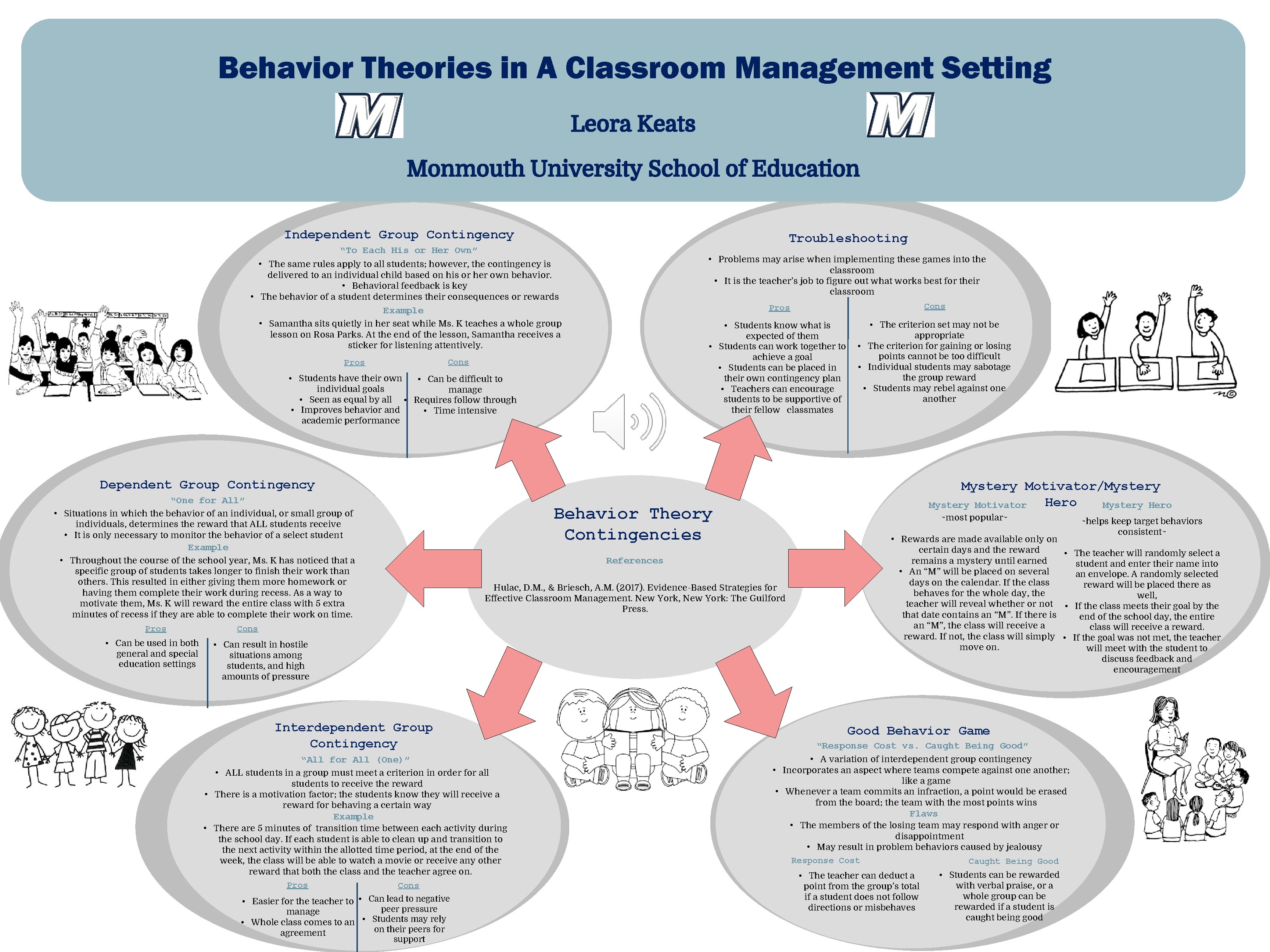
Behavior Theories in A Classroom Management Setting Leora Keats Monmouth University School of Education Independent Group Contingency Troubleshooting “To Each His or Her Own” • Problems may arise when implementing these games into the Conclusion classroom • It is the teacher’s job to figure out what works best for their Add your information, graphs and images to this section. classroom • The same rules apply to all students; however, the contingency is Introduction delivered to an individual child based on his or her own behavior. • Behavioral feedback is keyto this section. Add your information, graphs and images • The behavior of a student determines their consequences or rewards Example • Samantha sits quietly in her seat while Ms. K teaches a whole group lesson on Rosa Parks. At the end of the lesson, Samantha receives a sticker for listening attentively. Cons Pros • Students have their own • Can be difficult to individual goals manage • Seen as equal by all • Requires follow through • Improves behavior and • Time intensive academic performance Pros Cons • Students know what is expected of them • Students can work together to achieve a goal • Students can be placed in their own contingency plan • Teachers can encourage students to be supportive of their fellow classmates • The criterion set may not be appropriate • The criterion for gaining or losing points cannot be too difficult • Individual students may sabotage the group reward • Students may rebel against one another Dependent Group Contingency “One for All” Behavior Theory Contingencies • Situations in which the behavior of an individual, or small group of individuals, determines the reward that ALL students receive • It is only necessary to monitor the behavior of a select student Materials Example • Throughout the course of the school year, Ms. K has noticed that a Addof your information, graphstoand images this section. specific group students takes longer finish theirtowork than others. This resulted in either giving them more homework or having them complete their work during recess. As a way to motivate them, Ms. K will reward the entire class with 5 extra minutes of recess if they are able to complete their work on time. Pros • Can be used in both general and special education settings Mystery Motivator/Mystery Hero Mystery Motivator Mystery Hero ~most popular~ References Hulac, D. M. , & Briesch, A. M. (2017). Evidence-Based Strategies for Effective Classroom Management. New York, New York: The Guilford Press. Cons • Can result in hostile situations among students, and high amounts of pressure Interdependent Group Contingency “All for All (One)” • ALL students in a group must meet a criterion in order for all students to receive the reward • There is a motivation factor; the students know they will receive a reward for behaving a certain way Example • There are 5 minutes of transition time between each activity during the school day. If each student is able to clean up and transition to the next activity within the allotted time period, at the end of the week, the class will be able to watch a movie or receive any other reward that both the class and the teacher agree on. Pros Cons • Easier for the teacher to • Can lead to negative peer pressure manage • Whole class comes to an • Students may rely on their peers for agreement support ~helps keep target behaviors consistent~ • Rewards are made available only on Results certain days and the reward • The teacher will randomly select a remains a mystery until earned student and enter their name into Add your information, graphs and images to this section. • An “M” will be placed on several an envelope. A randomly selected days on the calendar. If the class reward will be placed there as behaves for the whole day, the well, teacher will reveal whether or not • If the class meets their goal by the that date contains an “M”. If there is end of the school day, the entire an “M”, the class will receive a reward. If not, the class will simply • If the goal was not met, the teacher move on. will meet with the student to discuss feedback and encouragement Good Behavior Game “Response Cost vs. Caught Being Good” • A variation of interdependent group contingency • Incorporates an aspect where teams compete against one another; like a game • Whenever a team commits an infraction, a point would be erased from the board; the team with the most points wins Flaws • The members of the losing team may respond with anger or disappointment • May result in problem behaviors caused by jealousy Response Cost Caught Being Good • The teacher can deduct a point from the group’s total if a student does not follow directions or misbehaves • Students can be rewarded with verbal praise, or a whole group can be rewarded if a student is caught being good
- Slides: 1