
Behavior Purpose and Teleology Authors Arturo Rosenblueth Norbert

Behavior, Purpose and Teleology Authors: Arturo Rosenblueth, Norbert Wiener, and Julian Bigelow Present by Marcus Nguyen
Goal of the paper ● Define and classify behavior ● Emphasize the importance of the concept of purpose
What is behavior? ● The behavioristic approach consists of the examination of the output and of the relations between the output and the input Output : any change produced in the surroundings by the object Input: any event external to the object that modifies this object in any manner ● Definition : any change of an entity with respect to its surroundings.
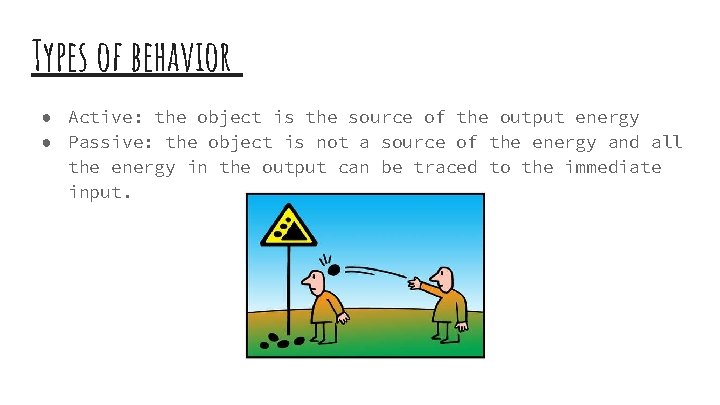
Types of behavior ● Active: the object is the source of the output energy ● Passive: the object is not a source of the energy and all the energy in the output can be traced to the immediate input.
Types of Active Behavior ● Purposeful : is interpreted as directed to the attainment of a goal. ● Purposeless : is not interpreted as directed to a goal. The basis of the concept of purpose is the awareness of voluntary activity.
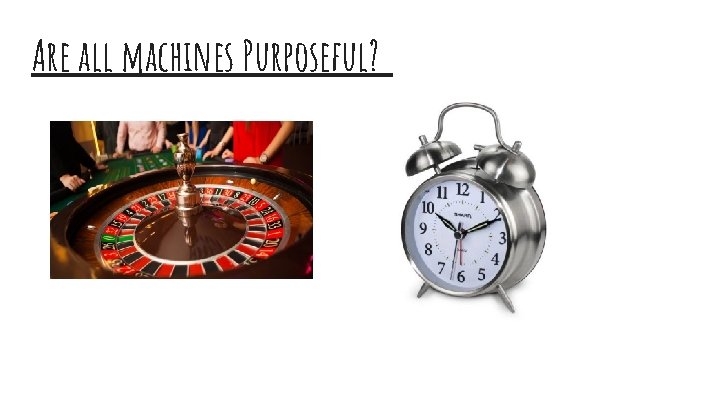
Are all machines Purposeful?
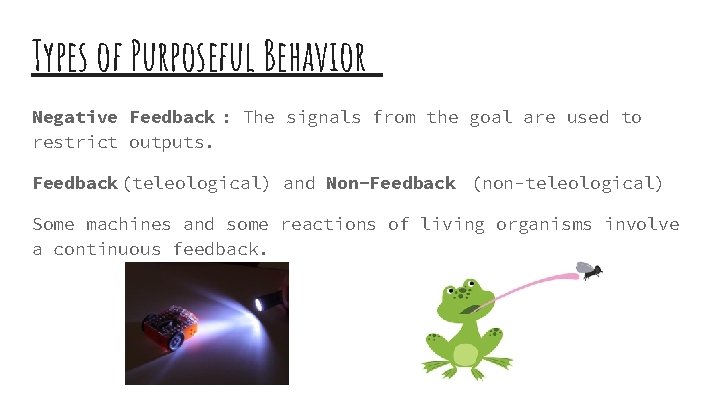
Types of Purposeful Behavior Negative Feedback : The signals from the goal are used to restrict outputs. Feedback (teleological) and Non-Feedback (non-teleological) Some machines and some reactions of living organisms involve a continuous feedback.
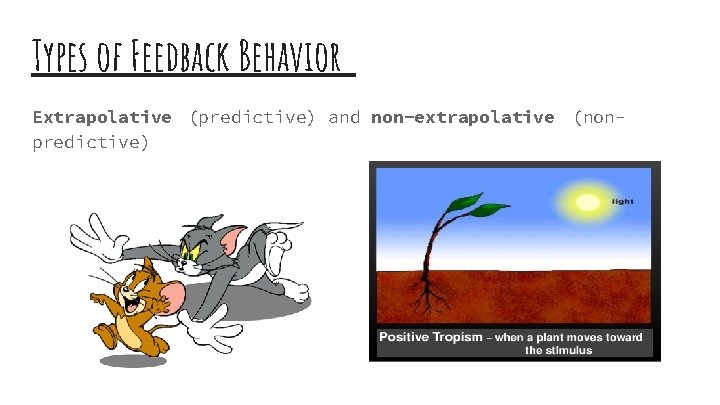
Types of Feedback Behavior Extrapolative (predictive) and non-extrapolative (nonpredictive)
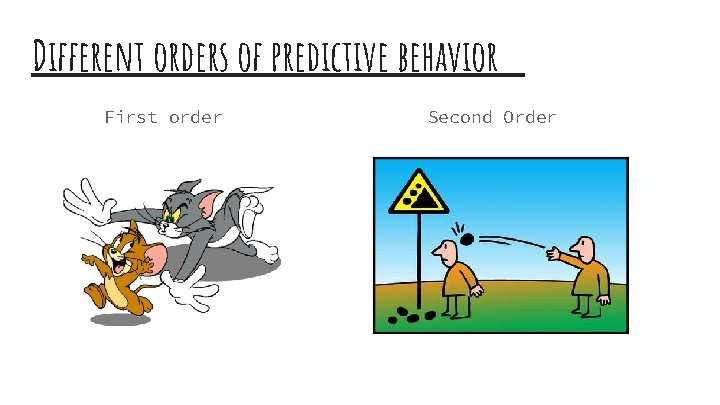
Different orders of predictive behavior First order Second Order
Limitation to high order Predictive Behavior ● Predictive behavior requires at least two coordinates: a temporal and at least one spatial axis. ● The sensory receptors may limit the predictive behavior ● The internal organization’s limitation to perceive certain input also limit the predictive behavior

Classification of Behavior
Benefit of the classification table ● Single out of the class of predictive behavior ● Emphasize the concepts of purpose and of teleology ● Reveals that a uniform behavioristic analysis can be applied to both machines and living organisms.
Animal behavior vs. Machine Behavior ● Animal behaviors include many varieties of all possible modes of behavior and machines have not had all those modes. ● However, machines have many behaviors that transcends human behaviors, such as outputting electrical or radio transmission.
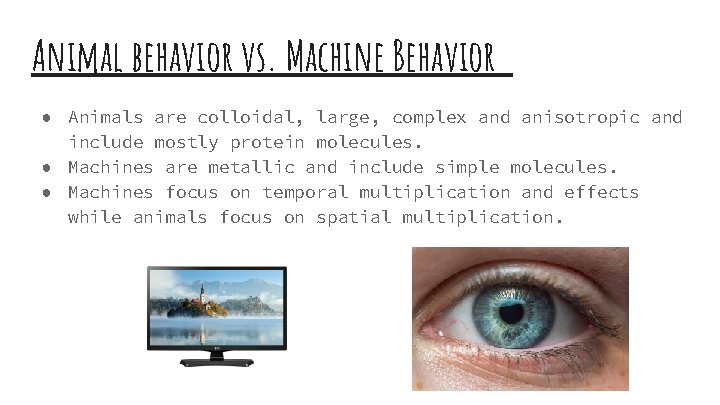
Animal behavior vs. Machine Behavior ● Animals are colloidal, large, complex and anisotropic and include mostly protein molecules. ● Machines are metallic and include simple molecules. ● Machines focus on temporal multiplication and effects while animals focus on spatial multiplication.
RElevance to AI Relevance : ● The paper analyzes different types of behavior which help us differentiate human behaviors vs. animal behaviors vs. machines behaviors. ● Give a quick approach at creating machines with not only behavior but also with animal’s structure Evaluations : Interesting paper but does it include all types of behaviors?
Discussion Questions ● Relate to our previous papers, which behaviors does each agent have? Which one, if any, has high-order predictive behavior? ● If no agent has high-order predictive behavior, what are these agents lacking to have such behavior? ● What is the relation between behavior and intelligence?
- Slides: 16