
Behavior of Aggregate Demand IncreaseDecrease Shift RightLeft RecessionaryInflationary
Behavior of Aggregate Demand Increase/Decrease Shift Right/Left Recessionary/Inflationary Gaps
Major Questions to Address • What are the components of aggregate demand? • What determines the level of spending for each component? • Will there be enough demand to maintain full employment?
Four Components of Aggregate Demand • • Consumption (C) Investment (I) Government spending (G) Net exports (X - IM)
Consumption Big but Stable Two Components – Autonomous Consumption – Income-Dependent (Induced) Consumption
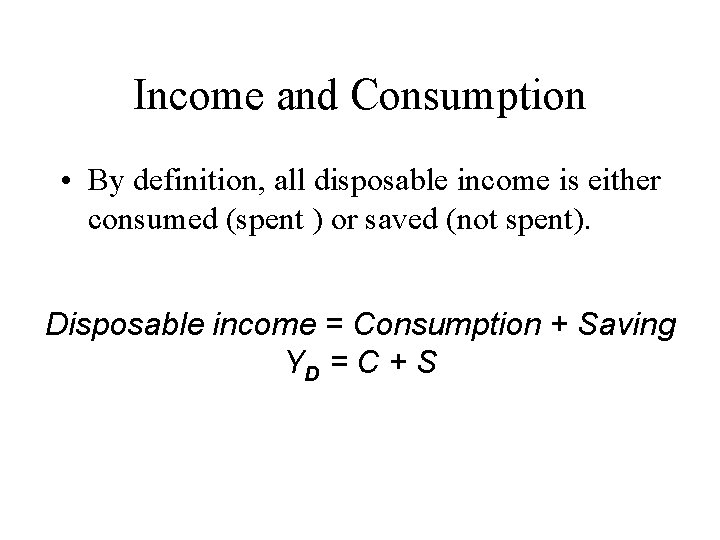
Income and Consumption • By definition, all disposable income is either consumed (spent ) or saved (not spent). Disposable income = Consumption + Saving YD = C + S
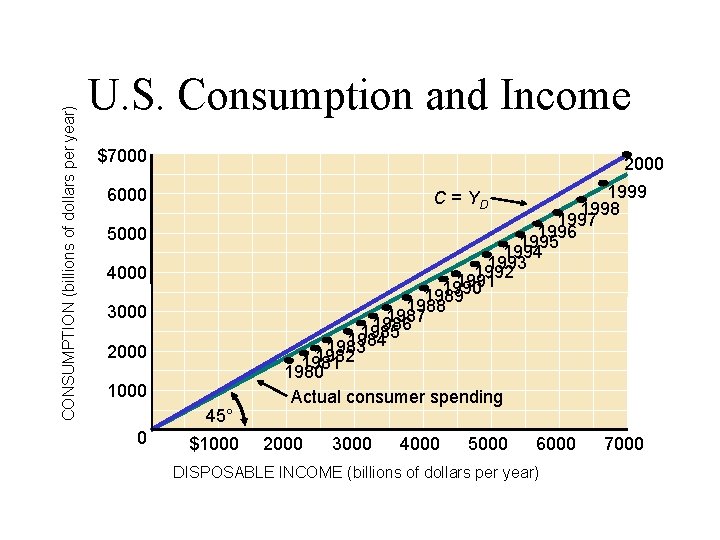
CONSUMPTION (billions of dollars per year) U. S. Consumption and Income $7000 2000 1999 1998 1997 1996 1995 1994 1993 1992 1991 1990 1989 1988 1987 1986 1985 1984 1983 1982 1981 1980 6000 C = YD 5000 4000 3000 2000 1000 45° 0 $1000 Actual consumer spending 2000 3000 4000 5000 6000 DISPOSABLE INCOME (billions of dollars per year) 7000
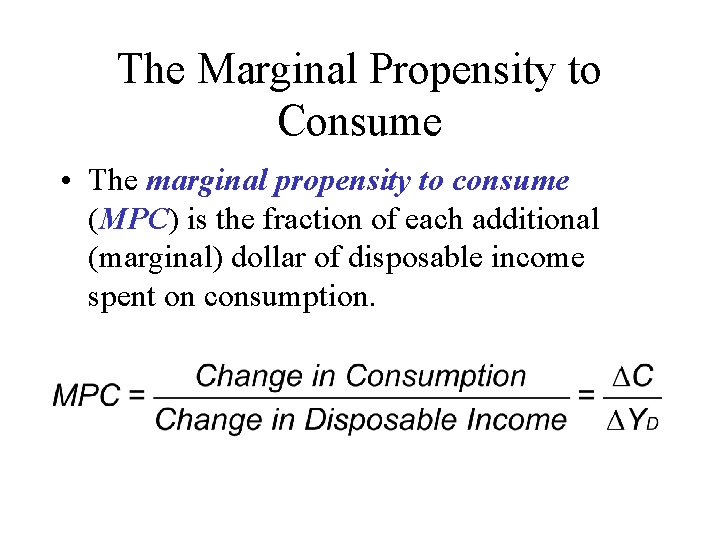
The Marginal Propensity to Consume • The marginal propensity to consume (MPC) is the fraction of each additional (marginal) dollar of disposable income spent on consumption.
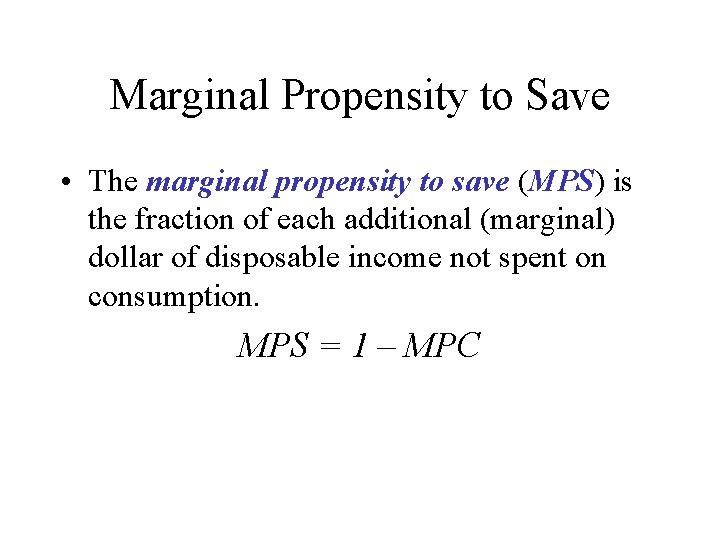
Marginal Propensity to Save • The marginal propensity to save (MPS) is the fraction of each additional (marginal) dollar of disposable income not spent on consumption. MPS = 1 – MPC
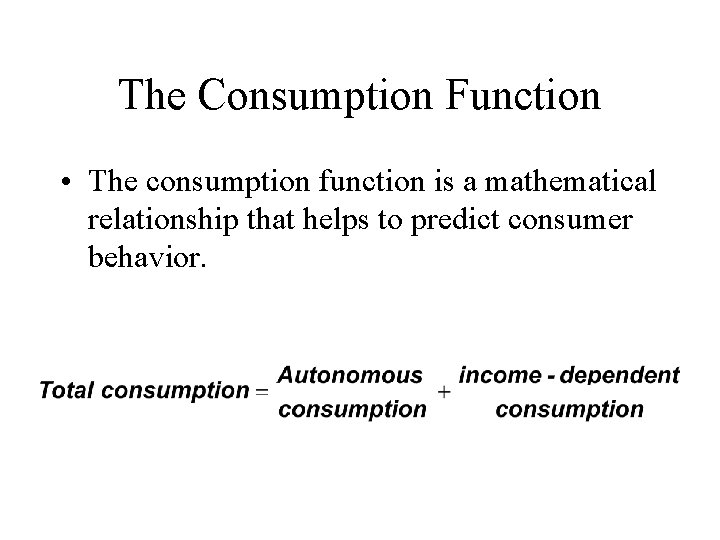
The Consumption Function • The consumption function is a mathematical relationship that helps to predict consumer behavior.
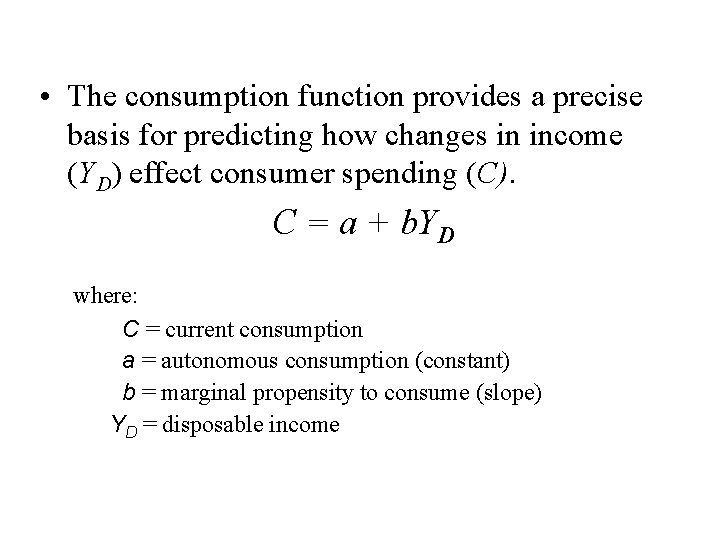
• The consumption function provides a precise basis for predicting how changes in income (YD) effect consumer spending (C). C = a + b. YD where: C = current consumption a = autonomous consumption (constant) b = marginal propensity to consume (slope) YD = disposable income
Autonomous Consumption • The non income determinants of consumption include – expectations, – wealth, – credit, – taxes, – and price levels.
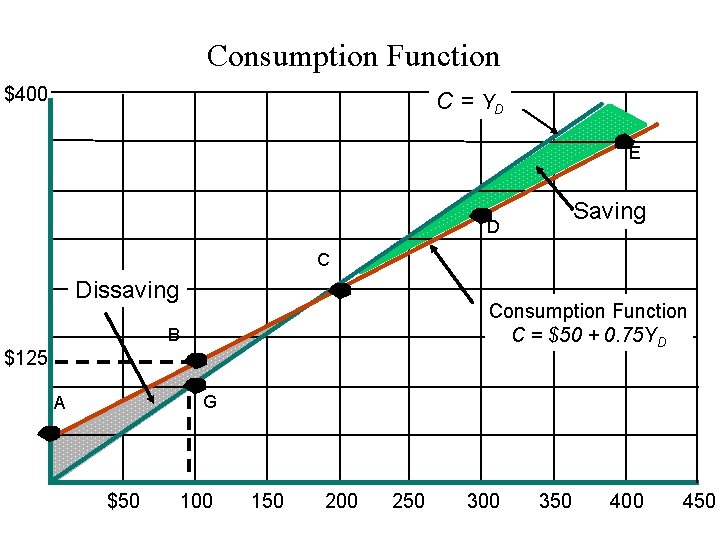
Consumption Function $400 C = YD E Saving D C Dissaving Consumption Function C = $50 + 0. 75 YD B $125 G A $50 100 150 200 250 300 350 400 450
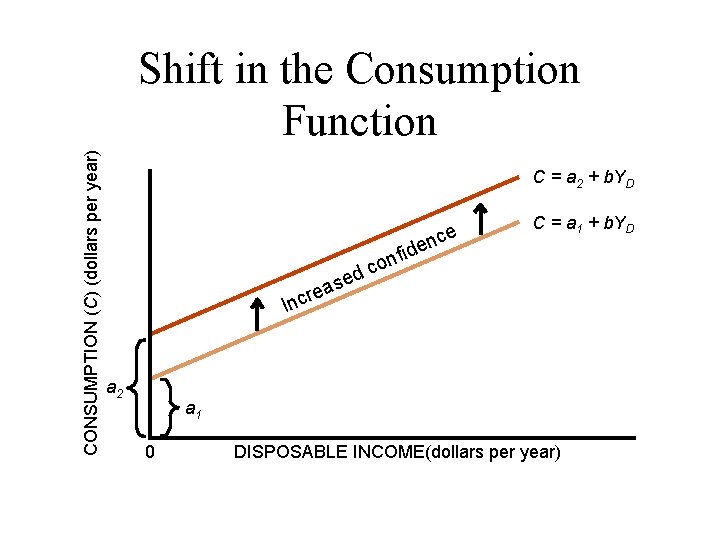
CONSUMPTION (C) (dollars per year) Shift in the Consumption Function C = a 2 + b. YD e nce d se a e r fid n o c C = a 1 + b. YD Inc a 2 a 1 0 DISPOSABLE INCOME(dollars per year)
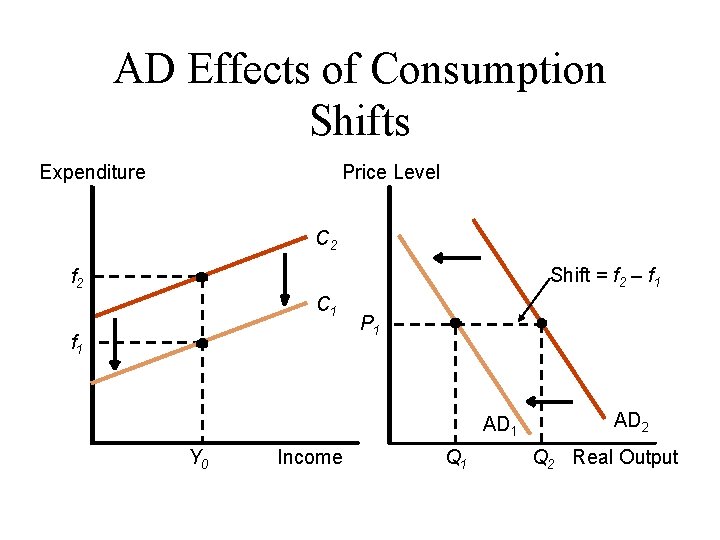
AD Effects of Consumption Shifts Expenditure Price Level C 2 Shift = f 2 – f 1 f 2 C 1 f 1 P 1 AD 1 Y 0 Income Q 1 AD 2 Q 2 Real Output
Investment Small but Volatile • Investment are expenditures on new plant, equipment, and structures (capital) in a given time period, plus changes in business inventories. • investment depends on: – Expectations. – Interest rates. – Technology and innovation.
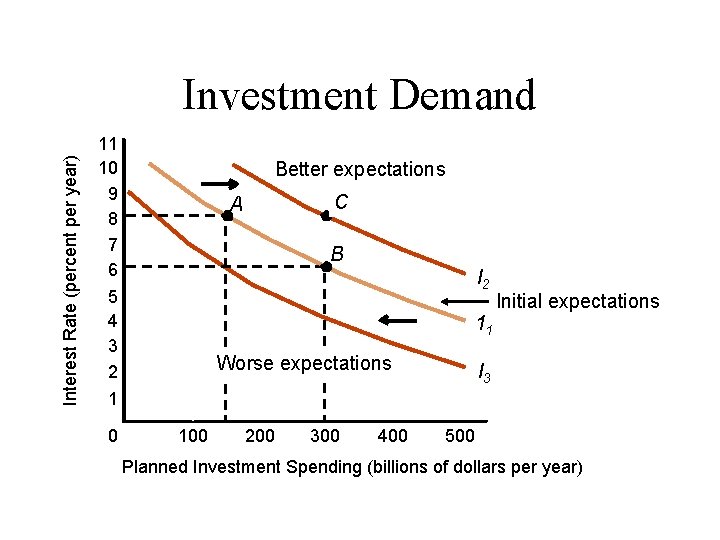
Interest Rate (percent per year) Investment Demand 11 10 9 8 7 6 5 4 3 2 1 0 Better expectations C A B I 2 11 Worse expectations 100 200 300 400 Initial expectations I 3 500 Planned Investment Spending (billions of dollars per year)
Government Spending • The government sector (federal, state, and local) currently spends over $2 trillion a year on goods and services. • Government spending decisions are made independently of current income.
Net Exports • Net exports can be both uncertain and unstable, creating further shifts of aggregate demand.
GDP Gaps • equilibrium GDP may not occur at fullemployment GDP. – Equilibrium GDP is the value of total output (real GDP) produced at macro equilibrium (AS=AD). – Full-employment GDP is the value of total output (real GDP) produced at full employment.
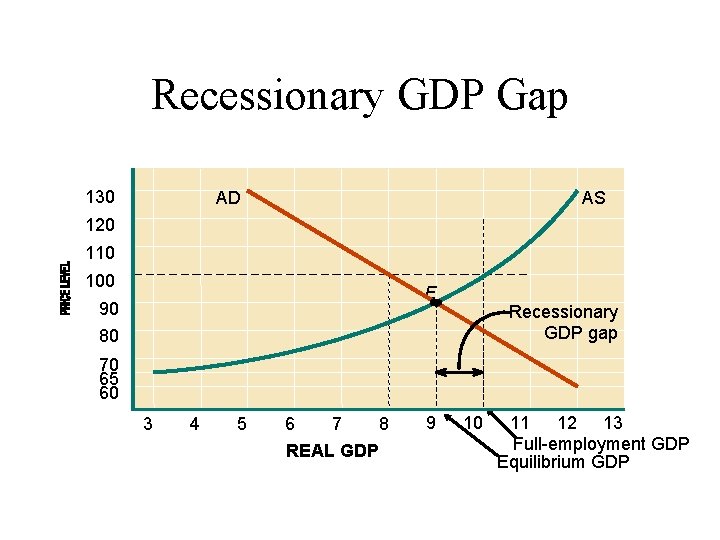
Recessionary GDP Gap 130 AD AS 120 110 100 E 90 Recessionary GDP gap 80 70 65 60 3 4 5 6 7 REAL GDP 8 9 10 11 12 13 Full-employment GDP Equilibrium GDP
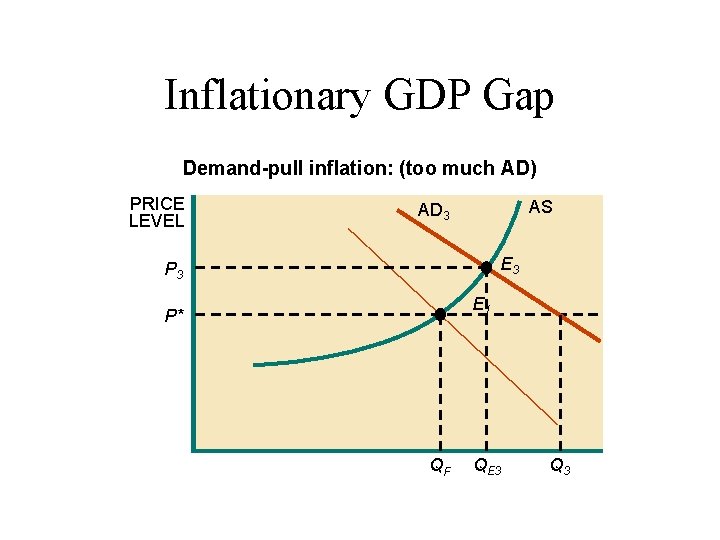
Inflationary GDP Gap Demand-pull inflation: (too much AD) PRICE LEVEL AS AD 3 E 3 P 3 E 1 P* QF QE 3 Q 3
The Keynesian Cross The Keynesian cross relates aggregate expenditure to total income (output). At equilibrium, aggregate expenditure equals income (output).
Aggregate Expenditures • Aggregate expenditures are the rate of total expenditure desired at alternative levels of income, ceteris paribus, at a given price level • Aggregate expenditures is the sum of C, I, G, and NX, at a given price level
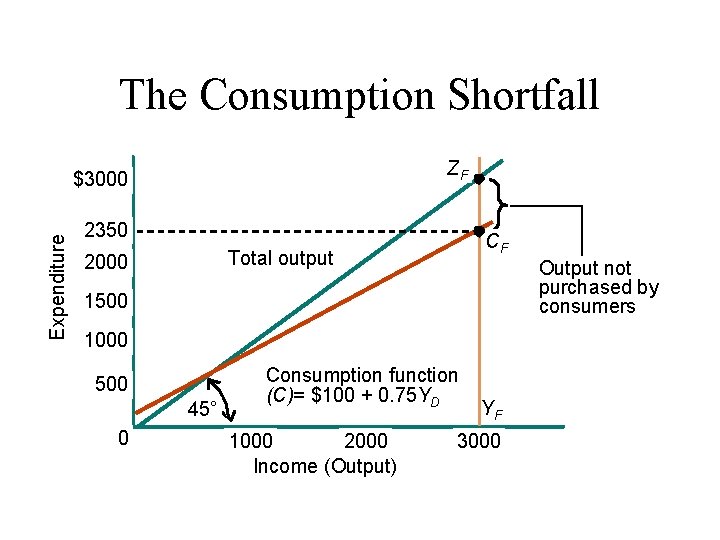
The Consumption Shortfall ZF Expenditure $3000 2350 CF Total output 2000 Output not purchased by consumers 1500 1000 500 45° 0 Consumption function (C)= $100 + 0. 75 YD 1000 2000 Income (Output) YF 3000
Aggregate Expenditures includes Nonconsumer Spending • Investors, governments, and net export buyers add to consumer spending to equal aggregate expenditure.
Expenditure Equilibrium • Equilibrium is the point where aggregate expenditure and 45 degree lines meet. • Recall that real GDP can be calculated as the value of final goods and services, or as the payments to all inputs in its production. • In essence real output = income
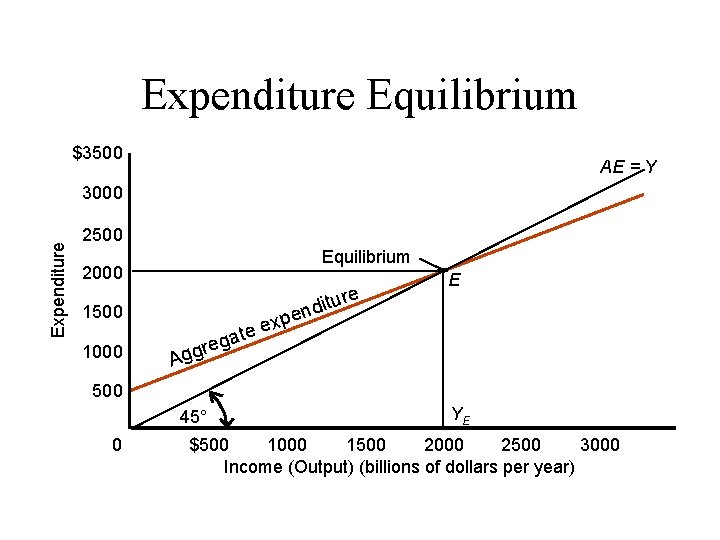
Expenditure Equilibrium $3500 AE = Y Expenditure 3000 2500 Equilibrium 2000 1500 1000 p ex e t ga itu d n e re E re Agg 500 45° 0 YE $500 1000 1500 2000 2500 3000 Income (Output) (billions of dollars per year)
• When AE > Y, inventories depleting, signals expansion • When Y > AE, inventories increasing, signals contraction
Aggregate Expenditure at different price levels Plots out Aggregate Demand • Wealth, • Int’l Trade and • Money Demand Effects
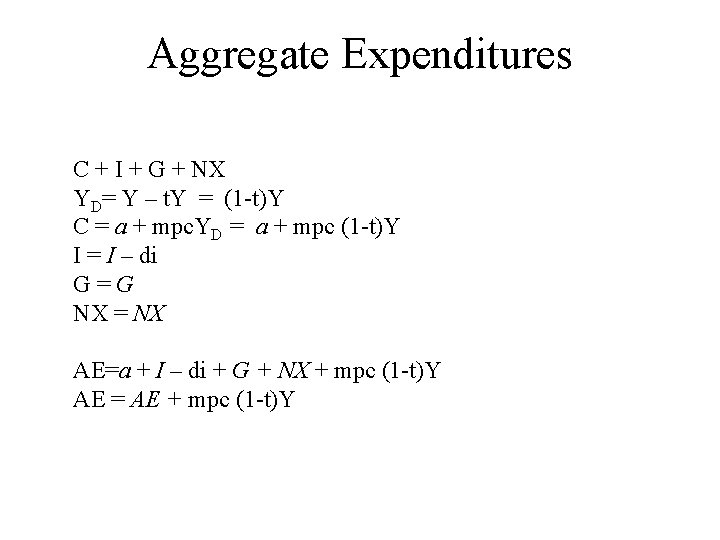
Aggregate Expenditures C + I + G + NX YD= Y – t. Y = (1 -t)Y C = a + mpc. YD = a + mpc (1 -t)Y I = I – di G=G NX = NX AE=a + I – di + G + NX + mpc (1 -t)Y AE = AE + mpc (1 -t)Y
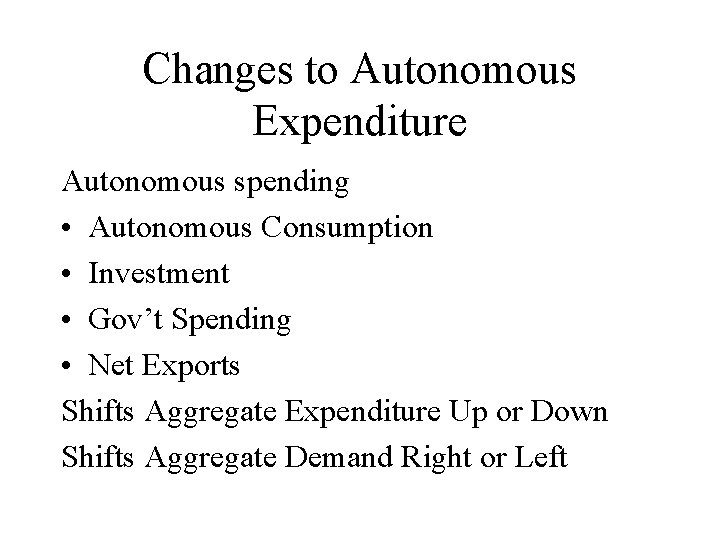
Changes to Autonomous Expenditure Autonomous spending • Autonomous Consumption • Investment • Gov’t Spending • Net Exports Shifts Aggregate Expenditure Up or Down Shifts Aggregate Demand Right or Left
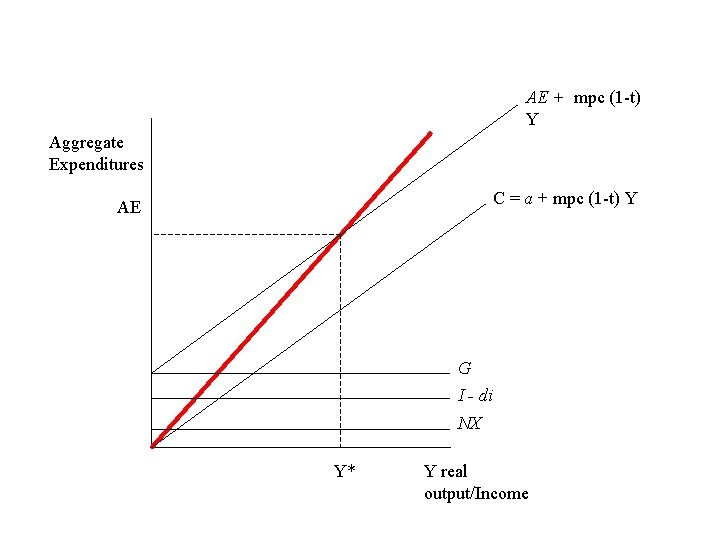
AE + mpc (1 -t) Y Aggregate Expenditures C = a + mpc (1 -t) Y AE G I - di NX Y* Y real output/Income
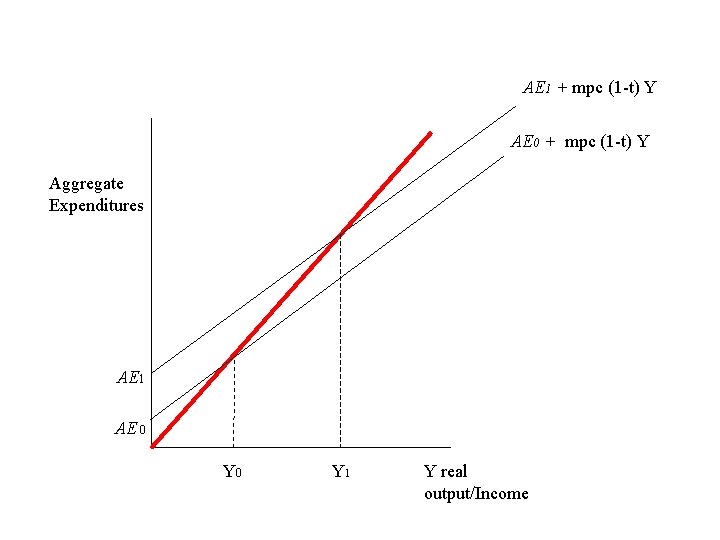
AE 1 + mpc (1 -t) Y AE 0 + mpc (1 -t) Y Aggregate Expenditures AE 1 AE 0 Y 1 Y real output/Income
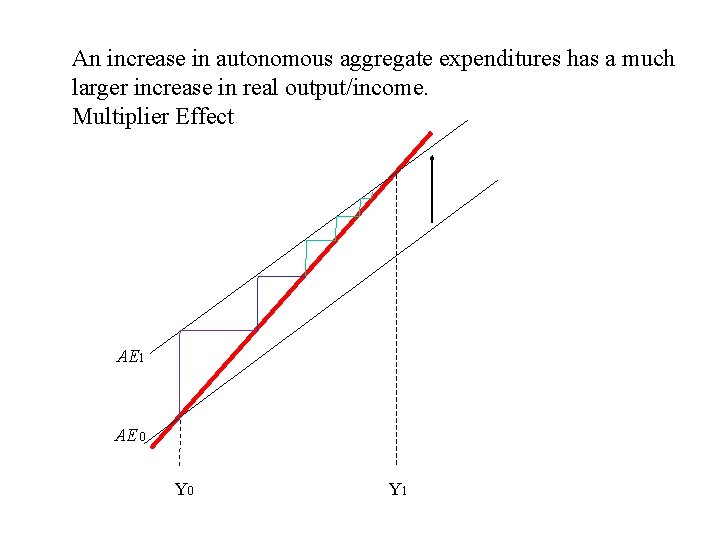
An increase in autonomous aggregate expenditures has a much larger increase in real output/income. Multiplier Effect AE 1 AE 0 Y 1
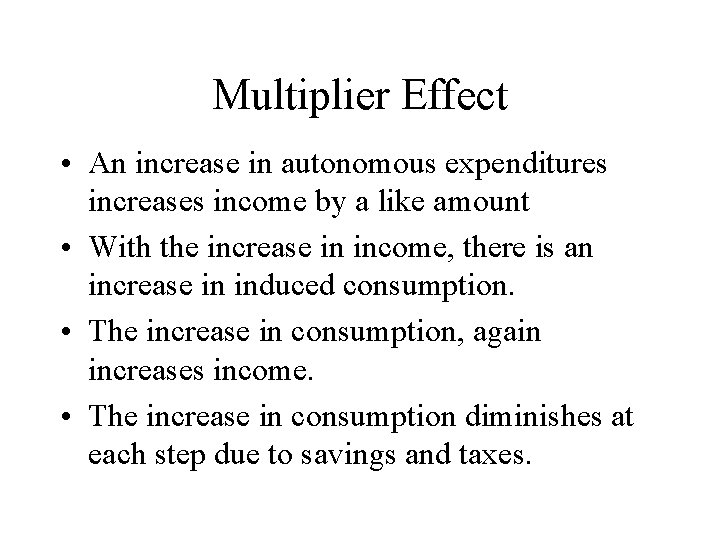
Multiplier Effect • An increase in autonomous expenditures increases income by a like amount • With the increase in income, there is an increase in induced consumption. • The increase in consumption, again increases income. • The increase in consumption diminishes at each step due to savings and taxes.
![Deriving the Multiplier ΔY =ΔAE + mpc(1 -t)[mpc(1 t)ΔAE] + mpc(1 -t)[mpc(1 -t)ΔAE] +……](http://slidetodoc.com/presentation_image/2eecb83d8396c962c4a3388c6c0fdd81/image-36.jpg "Deriving the Multiplier ΔY =ΔAE + mpc(1 -t)[mpc(1 t)ΔAE] + mpc(1 -t)[mpc(1 -t)ΔAE] +……")
Deriving the Multiplier ΔY =ΔAE + mpc(1 -t)[mpc(1 t)ΔAE] + mpc(1 -t)[mpc(1 -t)ΔAE] +…… ΔY =ΔAE{1 + mpc(1 -t)+ [mpc(1 -t)]2 + [mpc(1 -t)]3 +……+ [mpc(1 -t)] } M = ΔY / ΔAE = 1 + mpc(1 -t)+ [mpc(1 -t)]2 + [mpc(1 -t)]3 +……+ [mpc(1 -t)]
![Multiplier derived a) M = 1 + mpc(1 -t)+ [mpc(1 -t)]2 + [mpc(1 -t)]3](http://slidetodoc.com/presentation_image/2eecb83d8396c962c4a3388c6c0fdd81/image-37.jpg "Multiplier derived a) M = 1 + mpc(1 -t)+ [mpc(1 -t)]2 + [mpc(1 -t)]3")
Multiplier derived a) M = 1 + mpc(1 -t)+ [mpc(1 -t)]2 + [mpc(1 -t)]3 +……+ [mpc(1 -t)] b) M [mpc(1 -t)] = mpc(1 -t)+ [mpc(1 -t)]2 + [mpc(1 -t)]3 +……+ [mpc(1 -t)] c) Subtract equation b from a, and we get M - M [mpc(1 -t)] = 1 or M (1 - mpc(1 -t)) = 1 d) M = 1 / (1 - mpc(1 -t))
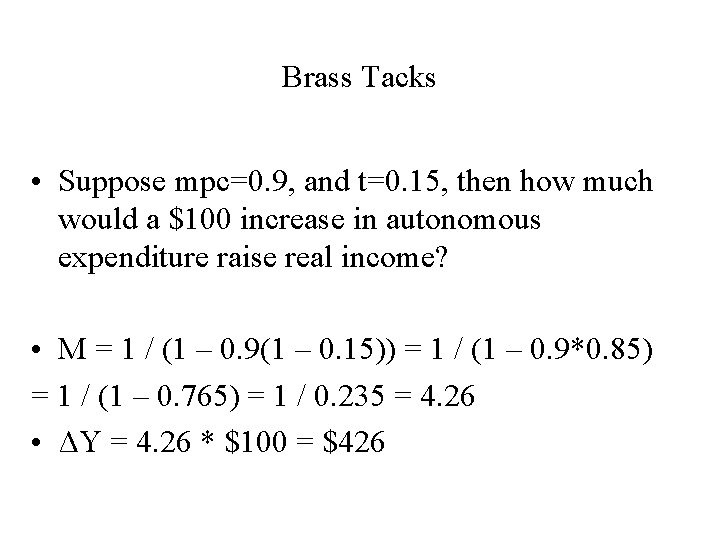
Brass Tacks • Suppose mpc=0. 9, and t=0. 15, then how much would a $100 increase in autonomous expenditure raise real income? • M = 1 / (1 – 0. 9(1 – 0. 15)) = 1 / (1 – 0. 9*0. 85) = 1 / (1 – 0. 765) = 1 / 0. 235 = 4. 26 • ΔY = 4. 26 * $100 = $426
Size of Multiplier • Depends on the circular flow of income in the economy • In a macroeconomic equilibrium aggregate expenditures equal national income
Circular Flow Draw on the Board Injections versus Leakages Equilibrium Investment + Government Spending + Exports = Savings + Taxes + Imports
Multiplier Decreases as Leakages Increase • With each increase in income that motivates the multiplier, – consumers save some portion, – the government taxes another portion, – and consumers may purchase imports • With each leakage, the less the consumer spends on domestic products, lowering the amount of additional income in the next round of the multiplier.
- Slides: 41