
BEHAVIOR MODIFICATION REPORT WITH PEAK REDUCTION COMPONENT PRESENTATION
BEHAVIOR MODIFICATION REPORT WITH PEAK REDUCTION COMPONENT PRESENTATION TO THE TECHNICAL SUB-COMMITTEE OF THE ENERGY WASTE REDUCTION COLLABORATIVE DEREK KIRCHNER, DTE ENERGY APRIL 18, 2017 Behavior Modification Report with Peak Reduction Component © 2017 NAVIGANT CONSULTING, INC. ALL RIGHTS RESERVED
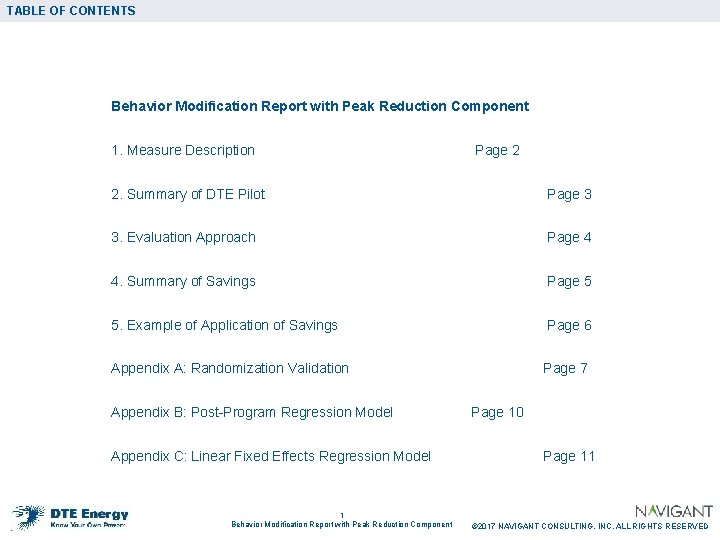
TABLE OF CONTENTS Behavior Modification Report with Peak Reduction Component 1. Measure Description Page 2 2. Summary of DTE Pilot Page 3 3. Evaluation Approach Page 4 4. Summary of Savings Page 5 5. Example of Application of Savings Page 6 Appendix A: Randomization Validation Page 7 Appendix B: Post-Program Regression Model Appendix C: Linear Fixed Effects Regression Model 1 Behavior Modification Report with Peak Reduction Component Page 10 Page 11 © 2017 NAVIGANT CONSULTING, INC. ALL RIGHTS RESERVED

1. MEASURE DESCRIPTION The behavior modification report with a peak reduction component delivers periodic energy consumption reports with targeted notifications regarding peak demand. • Behavior modification reports provide residential households accurate and timely information on their energy consumption through a variety of communication methods to change the consumers’ energy usage behavior. • The peak reduction component provides report recipients with additional messaging targeting energy consumption during specific hours on specific days. • Table 1, below, describes the behavior modification report with and without the peak reduction Table 1. Measure Description component. Behavior Modification Report With Peak Reduction Component • Delivers periodic energy consumption reports • Comparison of the customer’s home energy use compared to neighbors’ energy usage • An energy consumption grade • A simple opt-out process • Comparison of the current period’s energy usage with a past period’s use and comments on increased or decreased energy utilization 1 • Suggested actions the customer can take to improve energy efficiency including some low or no cost ideas, as well as higher impact ideas that may require capital expenses • • Delivers targeted notifications Pre-peak day event notification including suggestions on how to reduce energy during a peak event • A post event summary on energy reduction efforts • A simple opt-out process • Comparison of current peak demand with past peak demand commentary on increased or decreased utilization 2 • Suggested actions the customer can take to improve peak demand reductions including low the or prior no cost ideas, for asclimate well as higher 1 Typically, this compares the current month or quarter with the same month orsome quarter from year, adjusted 2 Typically, this compares the current day with the same weekday from the previous 10 days, adjusted for climate impact ideas that may require capital expenses 2 Behavior Modification Report with Peak Reduction Component © 2017 NAVIGANT CONSULTING, INC. ALL RIGHTS RESERVED
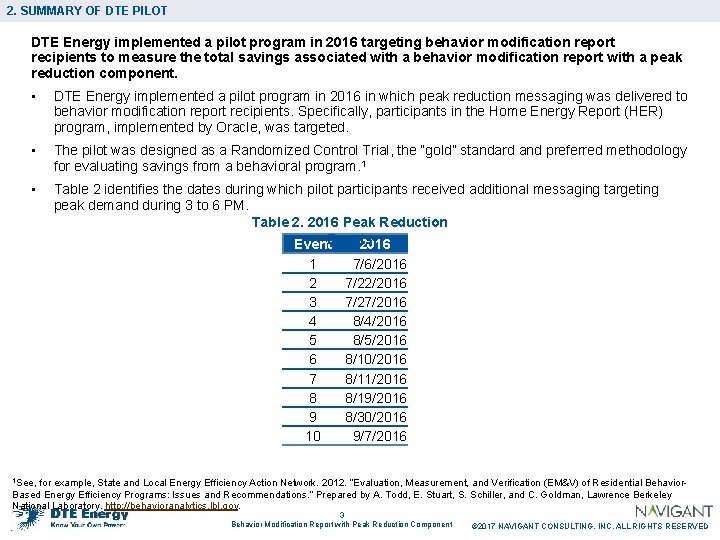
2. SUMMARY OF DTE PILOT DTE Energy implemented a pilot program in 2016 targeting behavior modification report recipients to measure the total savings associated with a behavior modification report with a peak reduction component. • DTE Energy implemented a pilot program in 2016 in which peak reduction messaging was delivered to behavior modification report recipients. Specifically, participants in the Home Energy Report (HER) program, implemented by Oracle, was targeted. • The pilot was designed as a Randomized Control Trial, the “gold” standard and preferred methodology for evaluating savings from a behavioral program. 1 • Table 2 identifies the dates during which pilot participants received additional messaging targeting peak demand during 3 to 6 PM. Table 2. 2016 Peak Reduction Events 2016 1 2 3 4 5 6 7 8 9 10 7/6/2016 7/22/2016 7/27/2016 8/4/2016 8/5/2016 8/10/2016 8/11/2016 8/19/2016 8/30/2016 9/7/2016 1 See, for example, State and Local Energy Efficiency Action Network. 2012. “Evaluation, Measurement, and Verification (EM&V) of Residential Behavior. Based Energy Efficiency Programs: Issues and Recommendations. ” Prepared by A. Todd, E. Stuart, S. Schiller, and C. Goldman, Lawrence Berkeley National Laboratory. http: //behavioranalytics. lbl. gov. 3 Behavior Modification Report with Peak Reduction Component © 2017 NAVIGANT CONSULTING, INC. ALL RIGHTS RESERVED
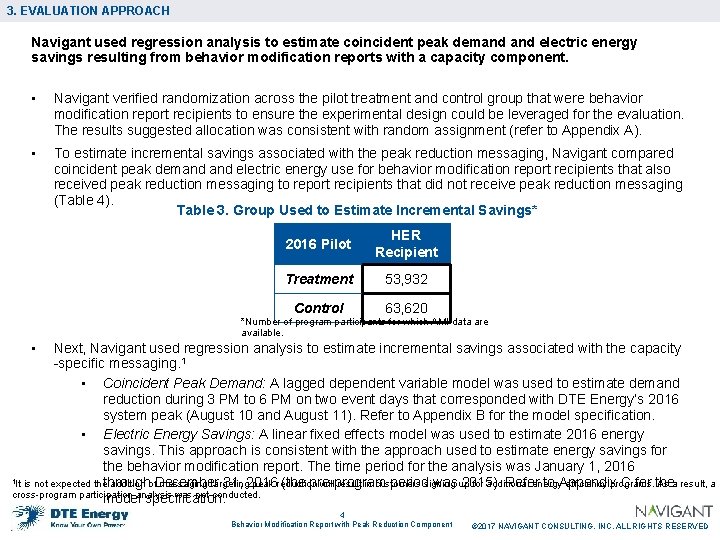
3. EVALUATION APPROACH Navigant used regression analysis to estimate coincident peak demand electric energy savings resulting from behavior modification reports with a capacity component. • Navigant verified randomization across the pilot treatment and control group that were behavior modification report recipients to ensure the experimental design could be leveraged for the evaluation. The results suggested allocation was consistent with random assignment (refer to Appendix A). • To estimate incremental savings associated with the peak reduction messaging, Navigant compared coincident peak demand electric energy use for behavior modification report recipients that also received peak reduction messaging to report recipients that did not receive peak reduction messaging (Table 4). Table 3. Group Used to Estimate Incremental Savings* 2016 Pilot HER Recipient Treatment 53, 932 Control 63, 620 *Number of program participants for which AMI data are available. • Next, Navigant used regression analysis to estimate incremental savings associated with the capacity -specific messaging. 1 • Coincident Peak Demand: A lagged dependent variable model was used to estimate demand reduction during 3 PM to 6 PM on two event days that corresponded with DTE Energy’s 2016 system peak (August 10 and August 11). Refer to Appendix B for the model specification. • Electric Energy Savings: A linear fixed effects model was used to estimate 2016 energy savings. This approach is consistent with the approach used to estimate energy savings for the behavior modification report. The time period for the analysis was January 1, 2016 1 It is not expected the addition of. December messaging targeting peak reduction will result in customers for additional energy efficiency programs. As a result, a through 31, 2016 (the pre-program periodsigning wasup 2015). Refer to Appendix C for the cross-program participation analysis was not conducted. model specification. 4 Behavior Modification Report with Peak Reduction Component © 2017 NAVIGANT CONSULTING, INC. ALL RIGHTS RESERVED
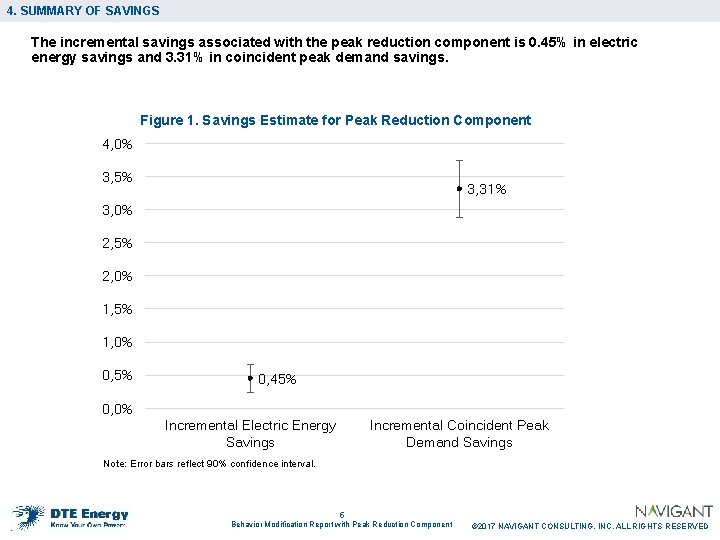
4. SUMMARY OF SAVINGS The incremental savings associated with the peak reduction component is 0. 45% in electric energy savings and 3. 31% in coincident peak demand savings. Figure 1. Savings Estimate for Peak Reduction Component 4, 0% 3, 5% 3, 31% 3, 0% 2, 5% 2, 0% 1, 5% 1, 0% 0, 5% 0, 45% 0, 0% Incremental Electric Energy Savings Incremental Coincident Peak Demand Savings Note: Error bars reflect 90% confidence interval. 5 Behavior Modification Report with Peak Reduction Component © 2017 NAVIGANT CONSULTING, INC. ALL RIGHTS RESERVED
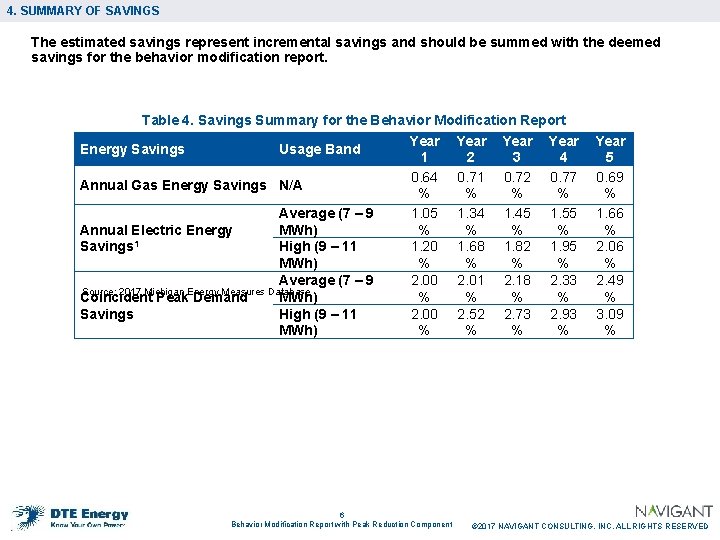
4. SUMMARY OF SAVINGS The estimated savings represent incremental savings and should be summed with the deemed savings for the behavior modification report. Table 4. Savings Summary for the Behavior Modification Report Year Energy Savings Usage Band 1 2 3 4 0. 64 0. 71 0. 72 0. 77 Annual Gas Energy Savings N/A % % Average (7 – 9 1. 05 1. 34 1. 45 1. 55 Annual Electric Energy MWh) % % 1 High (9 – 11 1. 20 1. 68 1. 82 1. 95 Savings MWh) % % Average (7 – 9 2. 00 2. 01 2. 18 2. 33 Source: 2017 Michigan Energy Measures Database Coincident Peak Demand MWh) % % Savings High (9 – 11 2. 00 2. 52 2. 73 2. 93 MWh) % % 6 Behavior Modification Report with Peak Reduction Component Year 5 0. 69 % 1. 66 % 2. 06 % 2. 49 % 3. 09 % © 2017 NAVIGANT CONSULTING, INC. ALL RIGHTS RESERVED
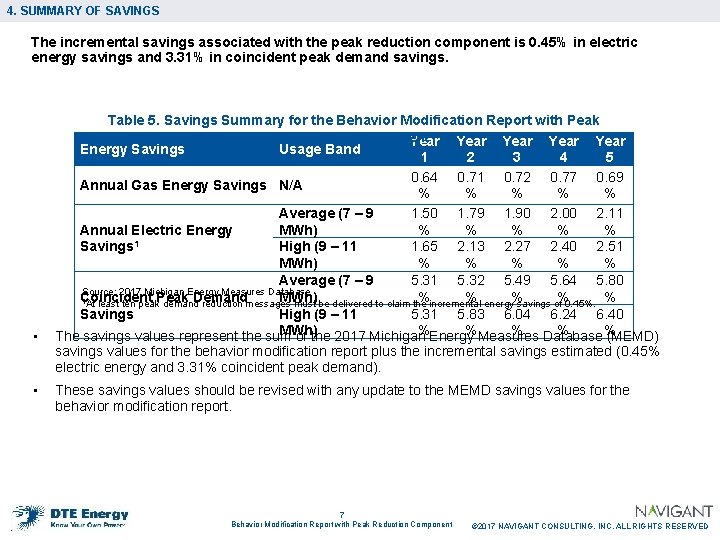
4. SUMMARY OF SAVINGS The incremental savings associated with the peak reduction component is 0. 45% in electric energy savings and 3. 31% in coincident peak demand savings. • Table 5. Savings Summary for the Behavior Modification Report with Peak Reduction Component Year Year Energy Savings Usage Band 1 2 3 4 5 0. 64 0. 71 0. 72 0. 77 0. 69 Annual Gas Energy Savings N/A % % % Average (7 – 9 1. 50 1. 79 1. 90 2. 00 2. 11 Annual Electric Energy MWh) % % % 1 High (9 – 11 1. 65 2. 13 2. 27 2. 40 2. 51 Savings MWh) % % % Average (7 – 9 5. 31 5. 32 5. 49 5. 64 5. 80 Source: 2017 Michigan Energy Measures Database Coincident Peak Demand MWh) % % % 1 At least ten peak demand reduction messages must be delivered to claim the incremental energy savings of 0. 45%. Savings High (9 – 11 5. 31 5. 83 6. 04 6. 24 6. 40 MWh) %Energy % Measures % Database % % The savings values represent the sum of the 2017 Michigan (MEMD) savings values for the behavior modification report plus the incremental savings estimated (0. 45% electric energy and 3. 31% coincident peak demand). • These savings values should be revised with any update to the MEMD savings values for the behavior modification report. 7 Behavior Modification Report with Peak Reduction Component © 2017 NAVIGANT CONSULTING, INC. ALL RIGHTS RESERVED
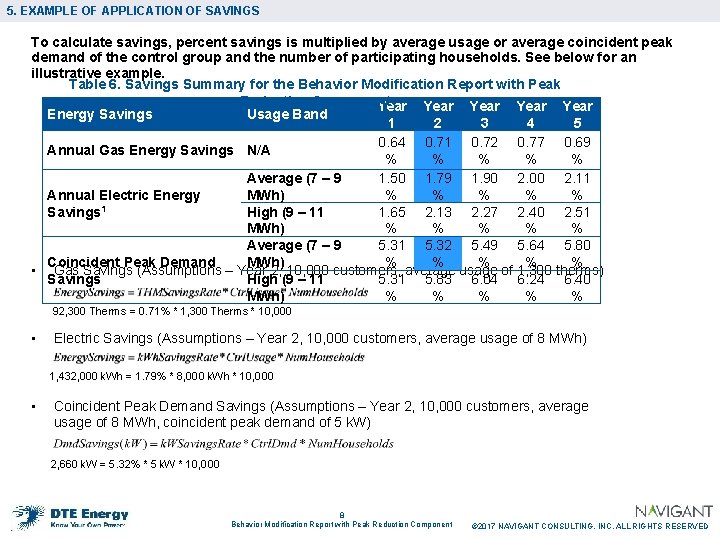
5. EXAMPLE OF APPLICATION OF SAVINGS To calculate savings, percent savings is multiplied by average usage or average coincident peak demand of the control group and the number of participating households. See below for an illustrative example. Table 6. Savings Summary for the Behavior Modification Report with Peak Reduction Component Year Year Energy Savings Usage Band 1 2 3 4 5 0. 64 0. 71 0. 72 0. 77 0. 69 Annual Gas Energy Savings N/A % % % Average (7 – 9 1. 50 1. 79 1. 90 2. 00 2. 11 Annual Electric Energy MWh) % % % High (9 – 11 1. 65 2. 13 2. 27 2. 40 2. 51 Savings 1 MWh) % % % Average (7 – 9 5. 31 5. 32 5. 49 5. 64 5. 80 Coincident Peak Demand MWh) % % % • Gas Savings (Assumptions – Year 2, 10, 000 customers, average usage of 1, 300 therms) High (9 – 11 5. 31 5. 83 6. 04 6. 24 6. 40 Savings MWh) % % % 92, 300 Therms = 0. 71% * 1, 300 Therms * 10, 000 • Electric Savings (Assumptions – Year 2, 10, 000 customers, average usage of 8 MWh) 1, 432, 000 k. Wh = 1. 79% * 8, 000 k. Wh * 10, 000 • Coincident Peak Demand Savings (Assumptions – Year 2, 10, 000 customers, average usage of 8 MWh, coincident peak demand of 5 k. W) 2, 660 k. W = 5. 32% * 5 k. W * 10, 000 8 Behavior Modification Report with Peak Reduction Component © 2017 NAVIGANT CONSULTING, INC. ALL RIGHTS RESERVED
APPENDIX A: RANDOMIZATION VALIDATION Navigant’s analysis ensures the allocation of customers in the pilot program is consistent with random assignment. » » Navigant conducted the following analysis (referred to as the “RCT Check”) to validate randomization: 1. t-tests on the difference in hourly demand by month for the summer season (July, August, September) prior to the start of the program to determine if the mean usage was statistically different between the two groups after accounting for differences in the variance. 2. Plots of average hour demand by month to determine if the mean demand between the two groups was practically or statistically different. 3. A regression analysis on the pre-program summer season data, regressing usage on a binary indicator of treatment and a set of hourly, daily, and monthly fixed effects. The implementation contractor, Oracle, conducted randomization using monthly usage. As a result, Navigant also conducted t-tests and made plots of the difference in average monthly usage for the entire year prior to the program to determine if monthly usage was statistically different across the two groups. 9 Behavior Modification Report with Peak Reduction Component © 2017 NAVIGANT CONSULTING, INC. ALL RIGHTS RESERVED
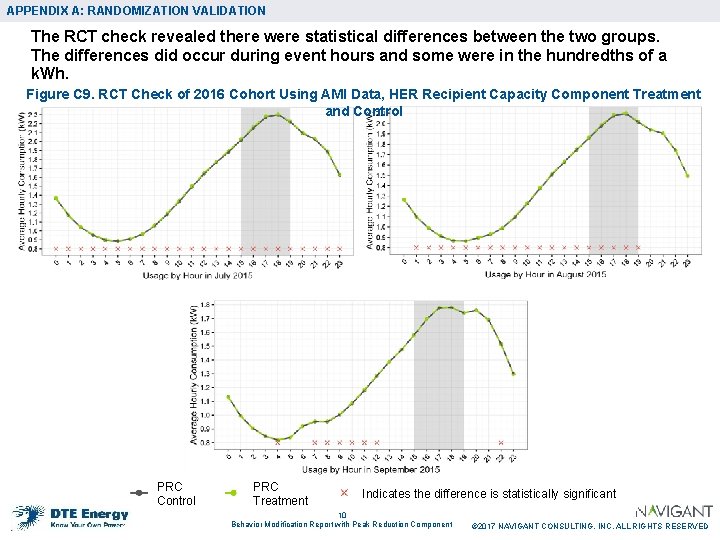
APPENDIX A: RANDOMIZATION VALIDATION The RCT check revealed there were statistical differences between the two groups. The differences did occur during event hours and some were in the hundredths of a k. Wh. Figure C 9. RCT Check of 2016 Cohort Using AMI Data, HER Recipient Capacity Component Treatment and Control PRC Treatment Indicates the difference is statistically significant 10 Behavior Modification Report with Peak Reduction Component © 2017 NAVIGANT CONSULTING, INC. ALL RIGHTS RESERVED
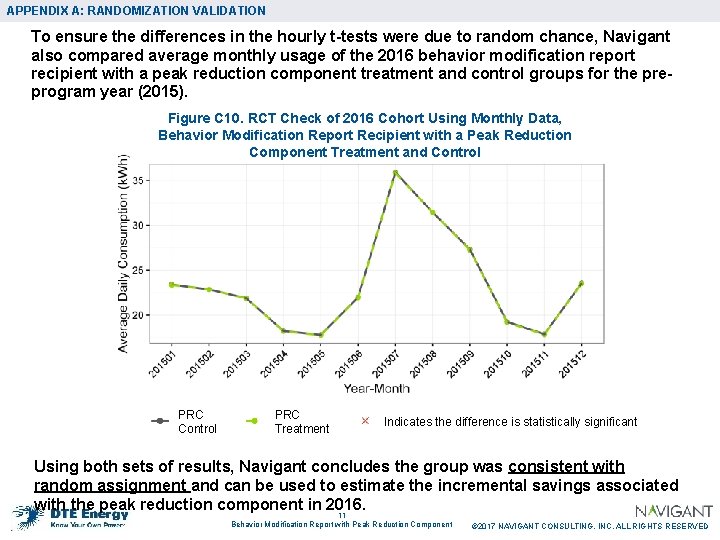
APPENDIX A: RANDOMIZATION VALIDATION To ensure the differences in the hourly t-tests were due to random chance, Navigant also compared average monthly usage of the 2016 behavior modification report recipient with a peak reduction component treatment and control groups for the preprogram year (2015). Figure C 10. RCT Check of 2016 Cohort Using Monthly Data, Behavior Modification Report Recipient with a Peak Reduction Component Treatment and Control PRC Treatment Indicates the difference is statistically significant Using both sets of results, Navigant concludes the group was consistent with random assignment and can be used to estimate the incremental savings associated with the peak reduction component in 2016. 11 Behavior Modification Report with Peak Reduction Component © 2017 NAVIGANT CONSULTING, INC. ALL RIGHTS RESERVED
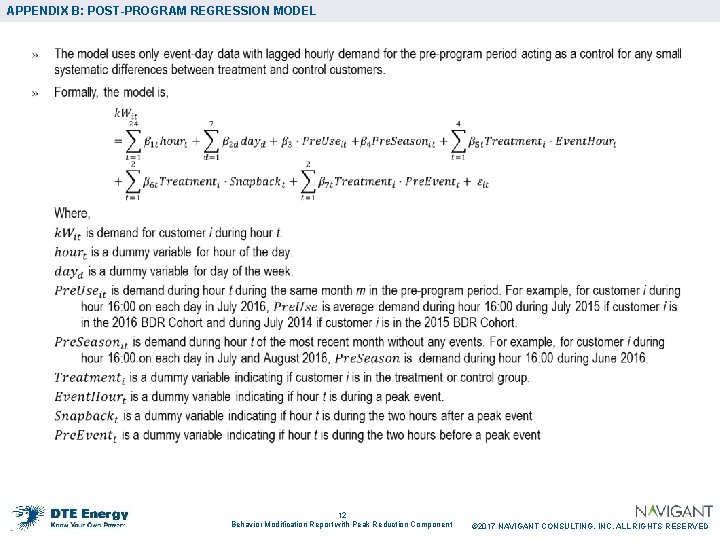
APPENDIX B: POST-PROGRAM REGRESSION MODEL 12 Behavior Modification Report with Peak Reduction Component © 2017 NAVIGANT CONSULTING, INC. ALL RIGHTS RESERVED
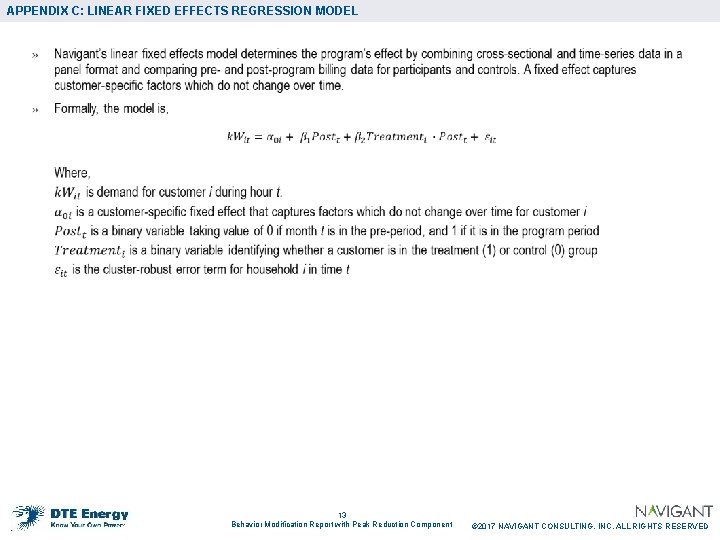
APPENDIX C: LINEAR FIXED EFFECTS REGRESSION MODEL 13 Behavior Modification Report with Peak Reduction Component © 2017 NAVIGANT CONSULTING, INC. ALL RIGHTS RESERVED
- Slides: 14