
Behavior modification 9 th Class Application changing individual
Behavior modification 9 th Class Application – changing individual behavior
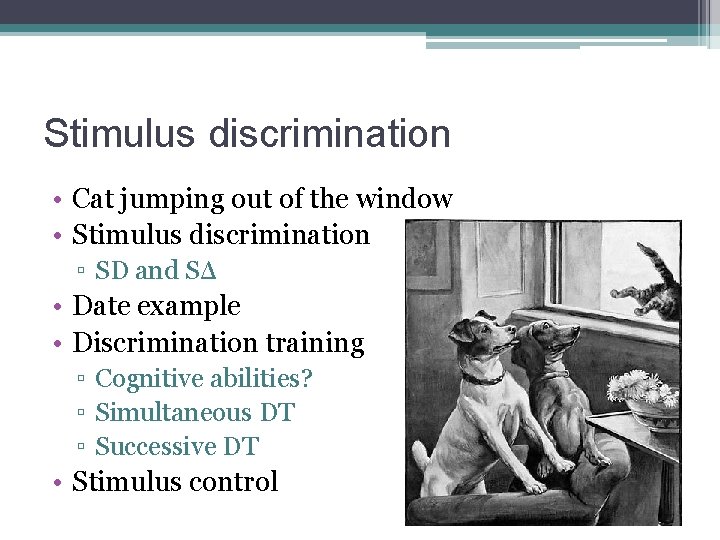
Stimulus discrimination • Cat jumping out of the window • Stimulus discrimination ▫ SD and SΔ • Date example • Discrimination training ▫ Cognitive abilities? ▫ Simultaneous DT ▫ Successive DT • Stimulus control
Maintenance • How to get the effects of your treatment to endure after the treatment?
Maintenance schedules • Fixed Ratio ▫ FR– 1 = CRF (continuous reinforcement) ▫ FR-2 = every 2 nd occurrence to reinforce • Variable ratio (VR) • Interval schedules (IR) ▫ delay between reinforcement • Duration schedules ▫ reinforcement only after behavior for specified time without interruption
Maintenance • Stretching the ratio ▫ Gradually increasing the number of times behavior must occur before reinforcement • Ratio strain ▫ Increase of emotional behavior resulting from increase in the ratio of reinforcement
Maintenance training • Intervention procedures increasing the likelihood that change in the behavior will persists after the intervention • Continue intervention well after te target behavior has changed • Expose the target behavior to its natural reinforcers • Teach the person to obtain reinforcement for target behavior • Shape tolerance for delayed and uncertain reinforcement • Fade the intervention program
Round up. . and lets apply. .
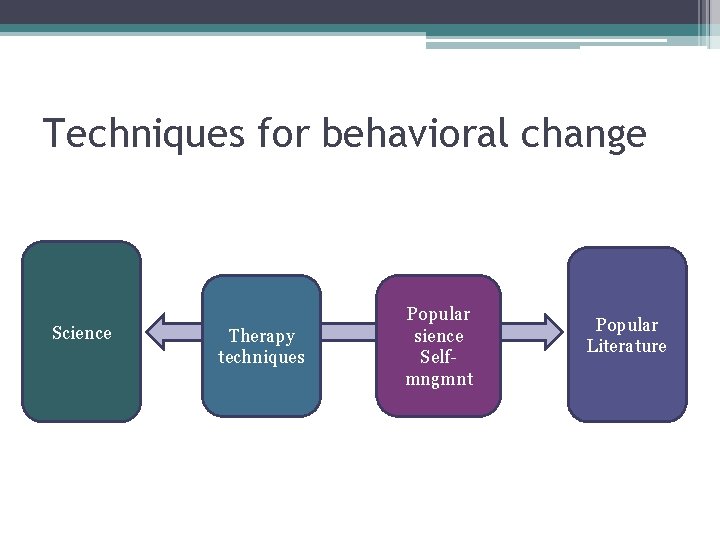
Techniques for behavioral change Science Therapy techniques Popular sience Selfmngmnt Popular Literature
Behavioral therapy • Approach to psychotherapy based on learning theory which aims to treat psychopathology through techniques designed to reinforce desired and extinguish undesired behaviours. • Pioneers: Skinner, Wolpe, Eysenck
Classical conditioning • • • Ivan Pavlov Neutral stimuli – e. g. bell ringing Unconditioned stimuli - e. g. food This evokes Unconditioned response - salivation If bell ringing and salivation are repeatedly paired, bell ringing starts to produce salivation even when the food is not there – Conditioned response (CR)
Systematic desensitization • Joseph Wolpe • Helps effectively overcome phobias and other anxiety disorders • Escaping from the phobic object reduces their anxiety, patients’ behavior to reduce fear is reinforced through negative reinforcement • Overcoming avoidance pattern by gradually exposing patients to the phobic object until it can be tolerated
Flooding • Thomas Stampfl • Method for overcoming phobias • In order to demonstrate the irrationality of the fear a psychologist would put a person in a situation where they would face their phobia at its worst.
Aversion therapy • Avoiding inappropriate positive response • The desirable stimuli is paired with an unpleasant one • Emetic (antabus), electric shocks • Mostly used for reatment of sexual deviations and drug(alcohol) addiction
Behavior activation • For depression treatment • Theory: not enough environmental reinforcement or too much environmental punishment can contribute to depression. • Clients are asked to create a hierarchy of reinforcing activities that are rank-ordered by difficulty • They track their own goals along with clinicians who reinforce their success in moving through the hierarchy of activities
Acceptance and Commitment therapy - ACT • Cognitive defusion: Learning to perceive thoughts, images, emotions, and memories as what they are, not what they appear to be. • Acceptance: Allowing them to come and go without struggling with them. • Contact with the present moment: Awareness of the here and now, experienced with openness, interest, and receptiveness. • Observing the self: Accessing a transcendent sense of self, a continuity of consciousness which is changing. • Values: Discovering what is most important to one's true self. • Committed action: Setting goals according to values and carrying them out responsibly
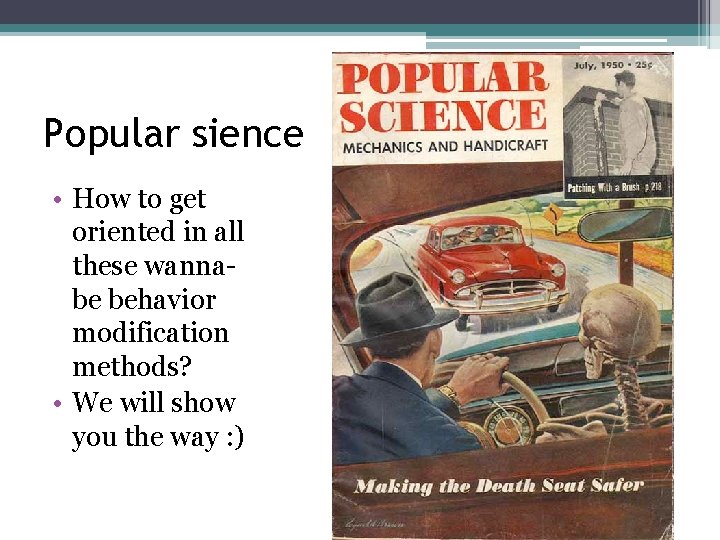
Popular sience • How to get oriented in all these wannabe behavior modification methods? • We will show you the way : )
Exercises • 13 Things to Avoid When Changing Habits • The Habit Change Cheatsheet: 29 Ways to Successfully Ingrain a Behavior
![Discussion [The end of the today's class]](http://slidetodoc.com/presentation_image_h2/eb25128e67eb333cfc918f0e55453f0a/image-18.jpg "Discussion [The end of the today's class]")
Discussion [The end of the today's class]
- Slides: 18