
BEHAVIOR LEARNING DISABILITIES Adrian Carter DEFINING BEHAVIOR LEARNING
BEHAVIOR & LEARNING DISABILITIES Adrian Carter

DEFINING BEHAVIOR & LEARNING DISABILITIES • Behavior Disability • an inability to learn that cannot be explained by intellectual, sensory, or health factors • an inability to build or maintain satisfactory interpersonal relationships with peers and teachers • inappropriate types of behavior or feelings under normal circumstances • a general pervasive mood of unhappiness or depression. • Learning Disability • a heterogeneous group of disorders manifested by significant difficulties in the acquisition and use of listening, speaking, reading, writing, reasoning or mathematical abilities
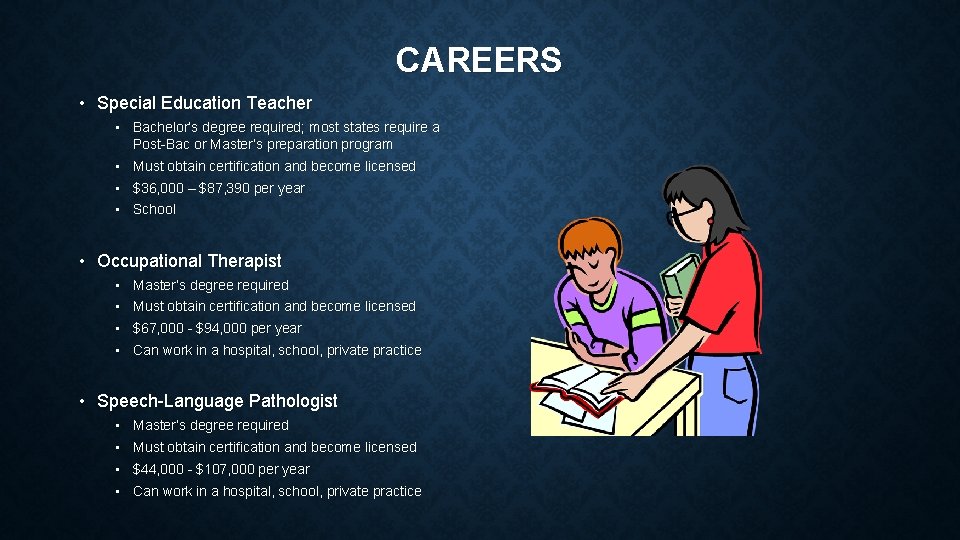
CAREERS • Special Education Teacher • Bachelor’s degree required; most states require a Post-Bac or Master’s preparation program • Must obtain certification and become licensed • $36, 000 – $87, 390 per year • School • Occupational Therapist • Master’s degree required • Must obtain certification and become licensed • $67, 000 - $94, 000 per year • Can work in a hospital, school, private practice • Speech-Language Pathologist • Master’s degree required • Must obtain certification and become licensed • $44, 000 - $107, 000 per year • Can work in a hospital, school, private practice
GRADUATE PROGRAMS • Georgia State University • University of Georgia • Minimum GPA – 3. 0 • Minimum GPA – 2. 7 • GRE & GACE Basic Skills Test • GRE, MAT, or GMAT • 2 recommendation letters • 36 credit hours • Resume • University of West Georgia • Minimum GPA – 2. 7 • GACE Basic Skills Test • Essay • 36 credit hours • Tennessee State University • Those who enter with no certification may need up to 21 additional hours in perquisites • Minimum GPA – 2. 5 • 36 credit hours + an exit exam • 33 credit hours • GRE or MAT
ARTICLE #1 • Video Games for Children and Adolescents with Special Educational Needs • This purpose of this article is to outline the challenges that video games can present to young people with exceptional characteristics and needs, and to present the potential to adapt this technology for use by children with a range of SEN’s. There have been some studies conducted that show that children who engaged in video games showed more improvement than those who do not, and there have been some that show that there has been no improvement. Research on this topic is still in its early stages.
ARTICLE #2 • Free play time of children with learning disabilities in a noninclusive preschool setting: an analysis of play and nonplay behaviours • The purpose of this study was to find what kind of free play children with learning disabilities engaged in when not supported by adults. A group of occupational therapists came in to observe five students ages 3 -6 during play and nonplay activities to see how they behaved. Results showed that the children did not tend to fully explore their environment without the help of an adult.
REFRENCES • Durkin, K. , Boyle, J. , Hunter, S. , & Conti-Ramsden, G. (2013). Video games for children and adolescents with special educational needs. Zeitschrift Für Psychologie, 221(2), 7989. doi: 10. 1027/2151 -2604/a 000138 • Fallon, J. , & Mac. Cobb, S. (2013). Free play time of children with learning disabilities in a noninclusive preschool setting: an analysis of play and nonplay behaviours. British Journal Of Learning Disabilities, 41(3), 212 -219. doi: 10. 1111/bld. 12052
- Slides: 7