
Behavior Classroom Management Week 9 FunctionBased Interventions Introduction
Behavior & Classroom Management Week 9 – Function-Based Interventions; Introduction to BSP J Geurts, M. S. Special Education Portland State University jgeurts@pdx. edu Adapted from slides by Chris Borgmeier
Proactive v. Reactive - REVIEW PBS v. Aversive approach
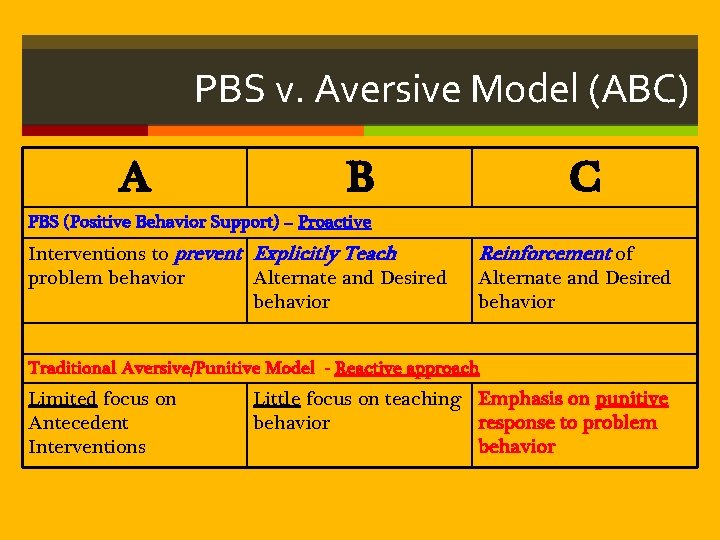
PBS v. Aversive Model (ABC) A B C PBS (Positive Behavior Support) – Proactive Interventions to prevent Explicitly Teach problem behavior Alternate and Desired behavior Reinforcement of Alternate and Desired behavior Traditional Aversive/Punitive Model - Reactive approach Limited focus on Antecedent Interventions Little focus on teaching Emphasis on punitive behavior response to problem behavior
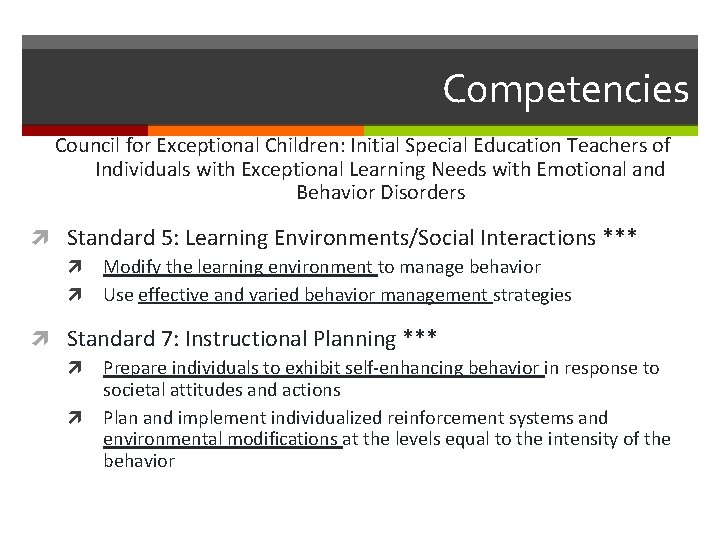
Competencies Council for Exceptional Children: Initial Special Education Teachers of Individuals with Exceptional Learning Needs with Emotional and Behavior Disorders Standard 5: Learning Environments/Social Interactions *** Modify the learning environment to manage behavior Use effective and varied behavior management strategies Standard 7: Instructional Planning *** Prepare individuals to exhibit self-enhancing behavior in response to societal attitudes and actions Plan and implement individualized reinforcement systems and environmental modifications at the levels equal to the intensity of the behavior

Traditional / Punitive Approach A B C Traditional Aversive Model - Reactive approach No intervention: No focus on teaching: repeatedly ask student “would have to do problem on board; learned it if he was “should be able to do it just like everyone else” Find punitive response: send student to hallway, Behavior Intervention paying attention in class Center, or office or tried harder” Student Situation & what the student has learned 1 st time…tried to do the Peers laughed and said problem and struggled “that one’s easy”. Asked to do math problem at the board, in Ever since…student front of the whole class refuses loudly and/or is silly at the board Teacher sends student out & calls on someone else to do the problem.
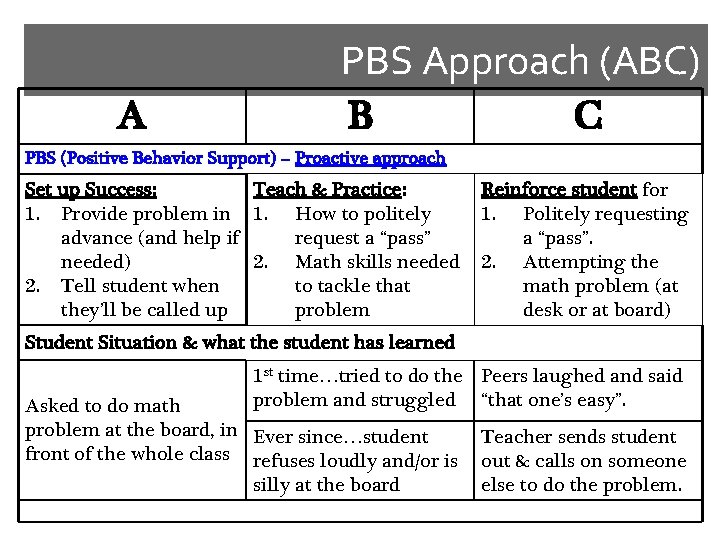
A PBS Approach (ABC) B C PBS (Positive Behavior Support) – Proactive approach Set up Success: Teach & Practice: 1. Provide problem in 1. How to politely advance (and help if request a “pass” needed) 2. Math skills needed 2. Tell student when to tackle that they’ll be called up problem Reinforce student for 1. Politely requesting a “pass”. 2. Attempting the math problem (at desk or at board) Student Situation & what the student has learned 1 st time…tried to do the Peers laughed and said problem and struggled “that one’s easy”. Asked to do math problem at the board, in Ever since…student front of the whole class refuses loudly and/or is silly at the board Teacher sends student out & calls on someone else to do the problem.
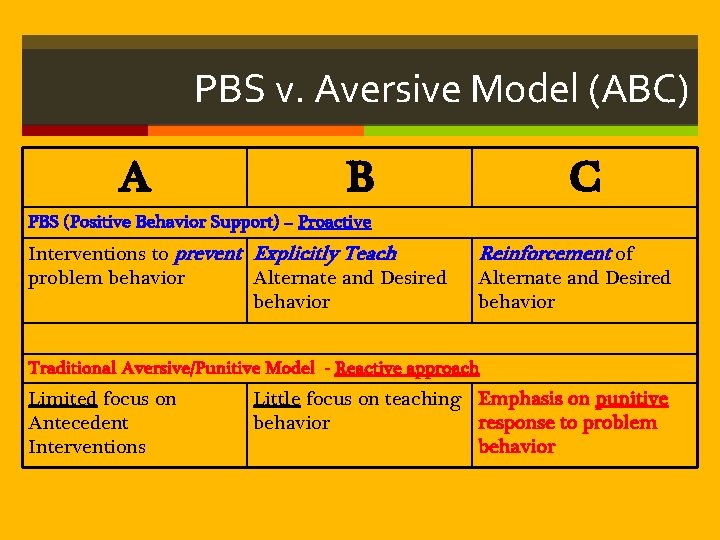
PBS v. Aversive Model (ABC) A B C PBS (Positive Behavior Support) – Proactive Interventions to prevent Explicitly Teach problem behavior Alternate and Desired behavior Reinforcement of Alternate and Desired behavior Traditional Aversive/Punitive Model - Reactive approach Limited focus on Antecedent Interventions Little focus on teaching Emphasis on punitive behavior response to problem behavior

Function Based Interventions
Activity 1: Function Based Interventions 2 copies of the Pre-Test Complete 1 (be sure your name is on it). Keep 1 for your notes/today’s activities. You may want to transcribe your answer from the “turn-in” copy to the “keep” copy. Turn in Pre-Test

Behavior Support Planning FBA BSP The most important outcomes/characteristics of FBA: Identify the function of the problem behavior Identify the variables that predict (A) and maintain (C) the problem behavior Develop a Behavior Support Plan that addresses the function of the problem behavior Of these, the MOST IMPORTANT…. and the reason for FBA: Develop a Behavior Support Plan that addresses the function of the problem behavior
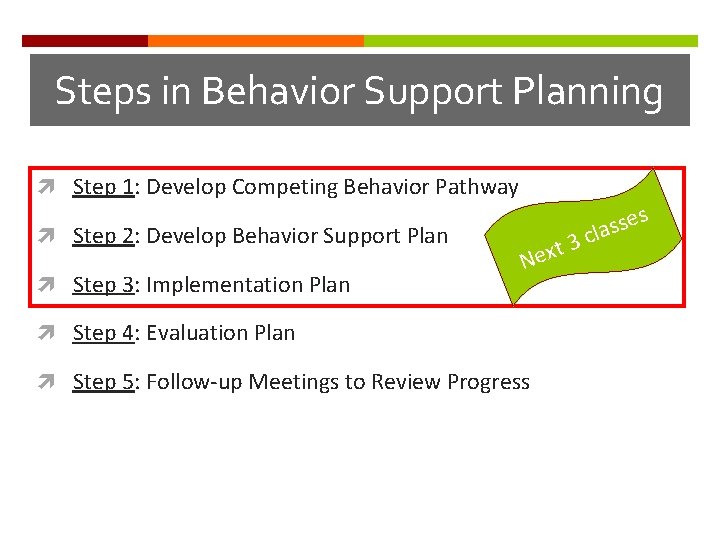
Steps in Behavior Support Planning Step 1: Develop Competing Behavior Pathway Step 2: Develop Behavior Support Plan Step 3: Implementation Plan 3 t x Ne Step 4: Evaluation Plan Step 5: Follow-up Meetings to Review Progress s e s s cla
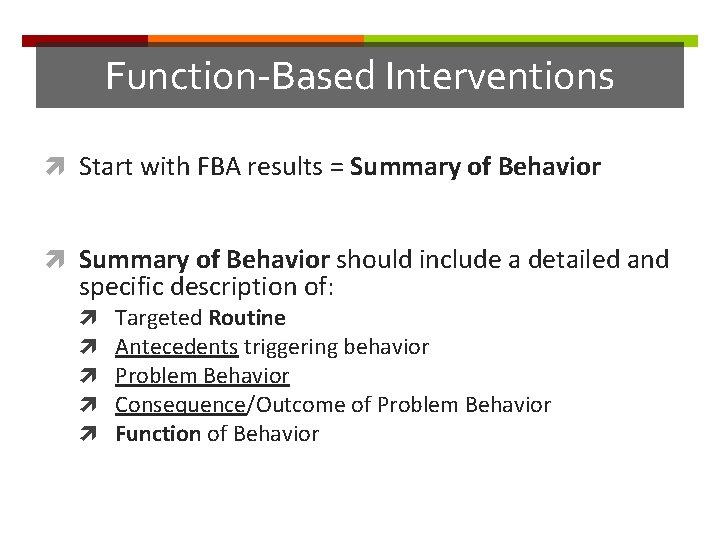
Function-Based Interventions Start with FBA results = Summary of Behavior should include a detailed and specific description of: Targeted Routine Antecedents triggering behavior Problem Behavior Consequence/Outcome of Problem Behavior Function of Behavior
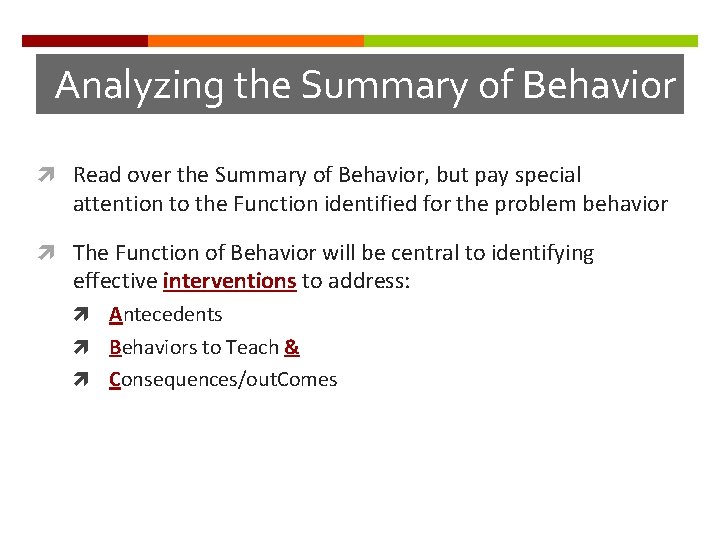
Analyzing the Summary of Behavior Read over the Summary of Behavior, but pay special attention to the Function identified for the problem behavior The Function of Behavior will be central to identifying effective interventions to address: Antecedents Behaviors to Teach & Consequences/out. Comes
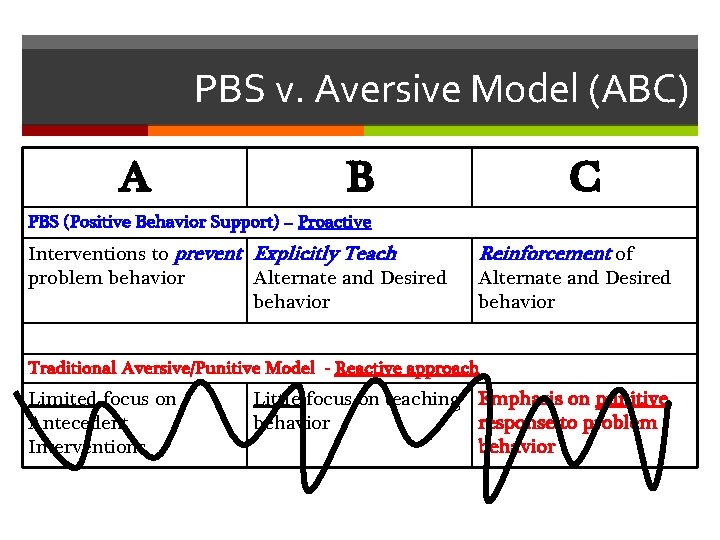
PBS v. Aversive Model (ABC) A B C PBS (Positive Behavior Support) – Proactive Interventions to prevent Explicitly Teach problem behavior Alternate and Desired behavior Reinforcement of Alternate and Desired behavior Traditional Aversive/Punitive Model - Reactive approach Limited focus on Antecedent Interventions Little focus on teaching Emphasis on punitive behavior response to problem behavior
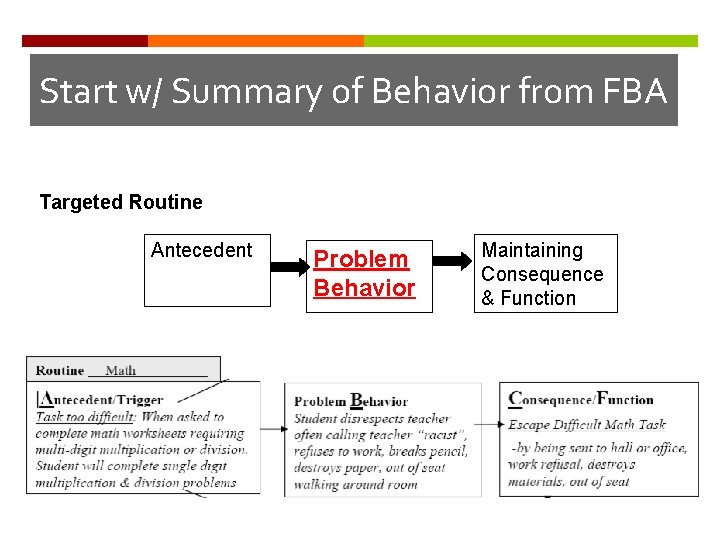
Start w/ Summary of Behavior from FBA Targeted Routine Antecedent Problem Behavior Maintaining Consequence & Function

FBA: Summary of Behavior Targeted Routine Antecedent Problem Behavior Maintaining Consequence & Function FUNCTION is where student behavior intersects with the environment Function = Learning Student learns…. When (A), if I (B), then (C)… Function = how I benefit so I keep doing B
Competing Behavior Pathway

Summary of Behavior Setting Events: Antecedent: Current Behavior: Currency/out. Come: This information comes from your FBA Summary Statement Adapted by C. Borgmeier (2002) from multiple sources: M. Bergstrom and D. Crone (2000); March, Horner, Lewis-Palmer, Brown, Crone & Todd (1999); O’Neill, Horner, Albin, Sprague, Story, & Newton (1997); Palmer & Sugai (2000); and Sprick, & Garrison (1993); Martin, Hagan. Burke, & Sugai (2000)

!!!Function-Based Planning!!! (Interventions at SE, A, B, and C) SETTING EVENTS Describe: • Makes student’s day worse. • Outside the environment you control. ANTECENDENT Prevent: • Change the environment to prevent known trigger from setting off problem behavior. Minimize: Prompt alternate • You can’t change…but behavior: you can minimize the effects. • Ex: Hungry food; Conflict check in; Forgot supplies offer extras. • Cue the alternate behavior before a behavior choice has been made by the student. BEHAVIOR Teach Alternate: • Immediate replacement behavior you will teach the student. • How and when will you teach; review? Teach Desired: • Behavior you will eventually teach the student to improve upon the immediate replacement/alternate behavior. CURRENCY Reinforce alternate behavior: • Contingent response to alternate behavior. • Reinforces student use of replacement behavior you taught. Correct misbehavior: • How will you respond if the problem behavior occurs? Adapted by C. Borgmeier (2002) from multiple sources: M. Bergstrom and D. Crone (2000); March, Horner, Lewis-Palmer, Brown, Crone & Todd (1999); O’Neill, Horner, Albin, Sprague, Story, & Newton (1997); Palmer & Sugai (2000); and Sprick, & Garrison (1993); Martin, Hagan. Burke, & Sugai (2000)
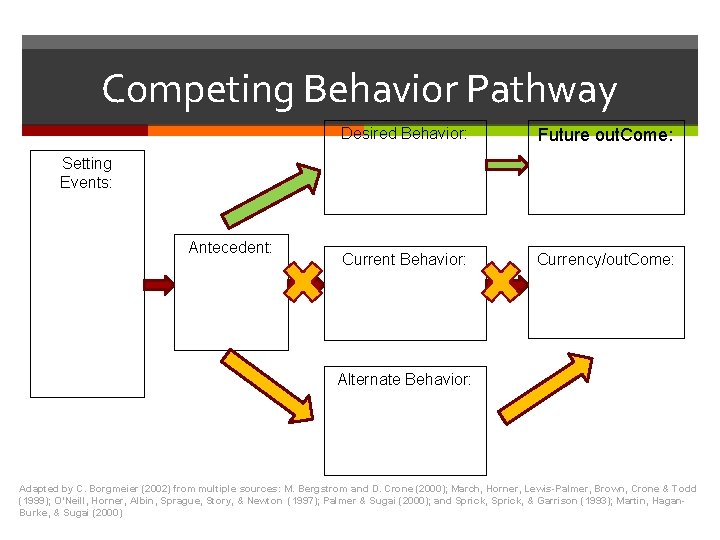
Competing Behavior Pathway Desired Behavior: Future out. Come: Current Behavior: Currency/out. Come: Setting Events: Antecedent: Alternate Behavior: Adapted by C. Borgmeier (2002) from multiple sources: M. Bergstrom and D. Crone (2000); March, Horner, Lewis-Palmer, Brown, Crone & Todd (1999); O’Neill, Horner, Albin, Sprague, Story, & Newton (1997); Palmer & Sugai (2000); and Sprick, & Garrison (1993); Martin, Hagan. Burke, & Sugai (2000)
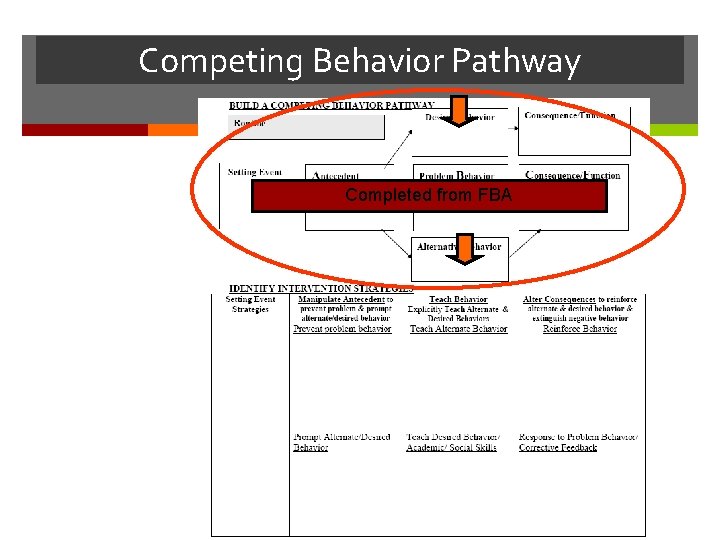
Competing Behavior Pathway Completed from FBA

So this is what we want…. Targeted Routine Antecedent Desired Behavior Natural Consequence Problem Behavior Maintaining Consequence & Function Alternate Behavior But… Why can’t we go right to the Desired Behavior?

Understanding Desired Behavior Long-term goal = to follow regular classrooms routines and norms, as independently as possible (w/ supports reduced or eliminated) and looking as similar as possible to peers Often requires a sustained, focused teaching effort to build missing skills Academic deficits (often related to Avoiding difficult tasks) Social Skills deficits (often related to seeking attention) Example: student seeks negative attention due to isolation from peers and adults resulting from aggressive behavior and limited social skills… requires sustained, targeted social skill instruction generalized to natural context Communication deficit Example: student avoids reading because 3 grade levels behind in reading… requires intensive reading instruction to close gap Example: student screams and rocks vigorously back and forth due to limited communication skills which might result in getting a snack… requires teaching communication skills (PECS, sign language, etc. ) Organizational/school skills deficits Example: student doesn’t complete homework due to limited scheduling and organization strategies which might result in (a) task avoidance due to limited background knowledge or (b) avoiding negative interactions with teacher because homework is frequently not done… requires teaching school skills

Why the Alternate Behavior? 4. The student is going to need to gain the math skills before being able to do this like peers 1. This is what we’re asking the student to do. None identified Given double digit addn problems 3. Look how different this is from what’s happening now Complete math problem Success, another problem Throws a Tantrum Sent back to table (escape task) Raise hand & ask for break 5. So… in the meantime we use the alternate behavior 2. This is what the student wants now.
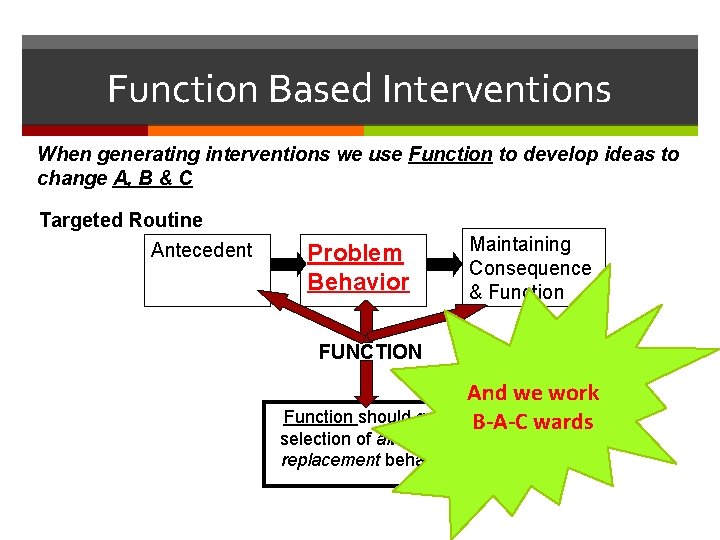
Function Based Interventions When generating interventions we use Function to develop ideas to change A, B & C Targeted Routine Antecedent Problem Behavior Maintaining Consequence & Function FUNCTION Function should guide selection of alternative/ replacement behaviors And we work B-A-C wards
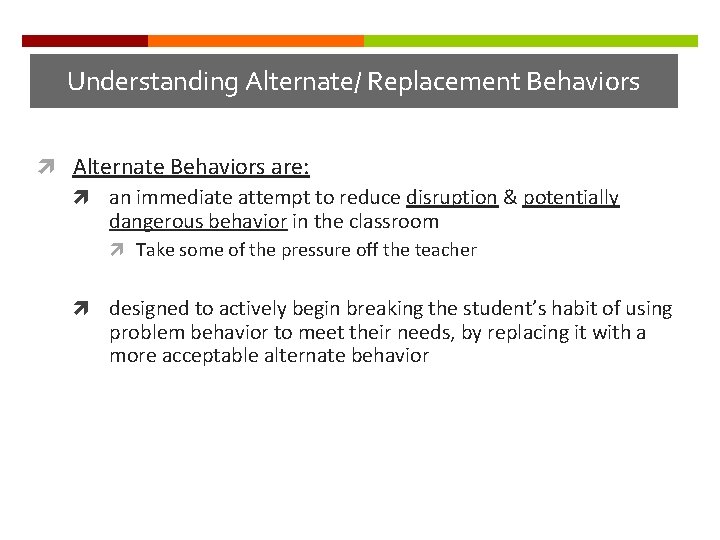
Understanding Alternate/ Replacement Behaviors Alternate Behaviors are: an immediate attempt to reduce disruption & potentially dangerous behavior in the classroom Take some of the pressure off the teacher designed to actively begin breaking the student’s habit of using problem behavior to meet their needs, by replacing it with a more acceptable alternate behavior
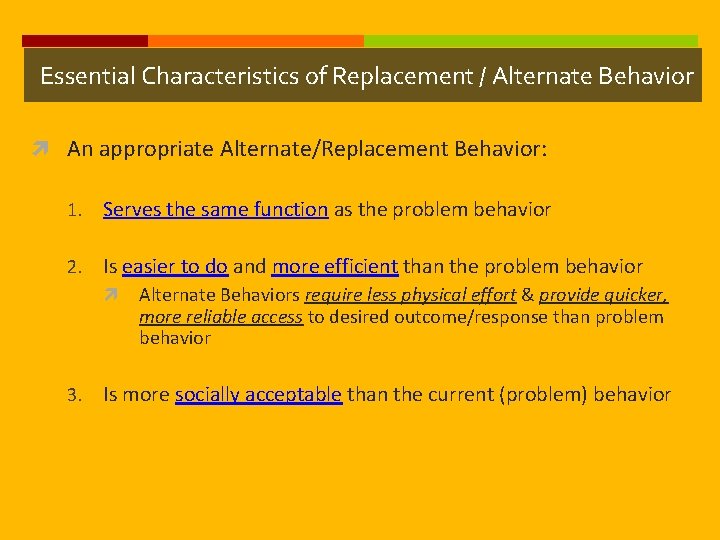
Essential Characteristics of Replacement / Alternate Behavior An appropriate Alternate/Replacement Behavior: 1. Serves the same function as the problem behavior 2. Is easier to do and more efficient than the problem behavior 3. Alternate Behaviors require less physical effort & provide quicker, more reliable access to desired outcome/response than problem behavior Is more socially acceptable than the current (problem) behavior
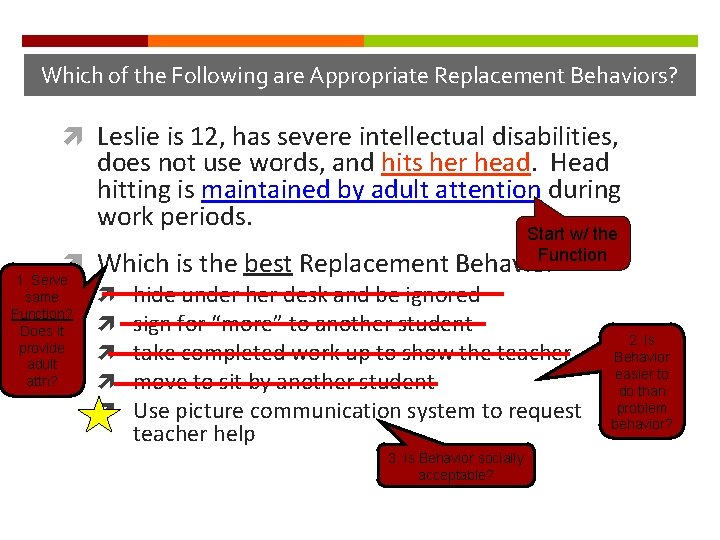
Which of the Following are Appropriate Replacement Behaviors? Leslie is 12, has severe intellectual disabilities, does not use words, and hits her head. Head hitting is maintained by adult attention during work periods. Start w/ the Function Which is the best Replacement Behavior 1. Serve same Function? Does it provide adult attn? hide under her desk and be ignored sign for “more” to another student take completed work up to show the teacher move to sit by another student Use picture communication system to request teacher help 3. Is Behavior socially acceptable? 2. Is Behavior easier to do than problem behavior?
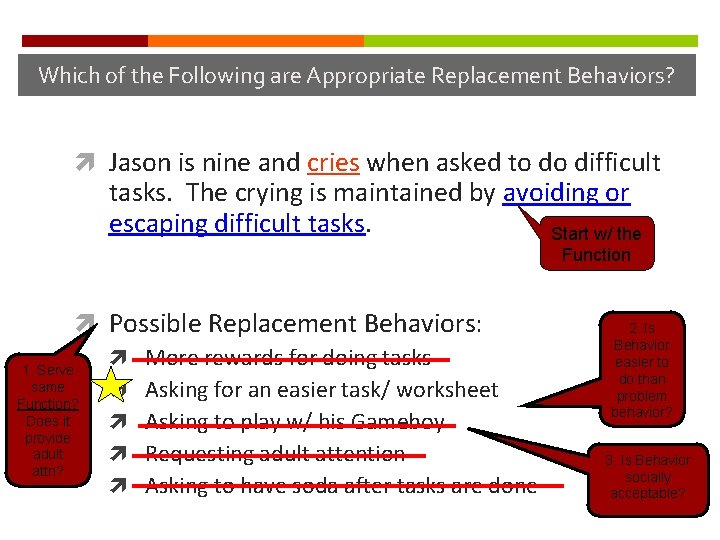
Which of the Following are Appropriate Replacement Behaviors? Jason is nine and cries when asked to do difficult tasks. The crying is maintained by avoiding or escaping difficult tasks. Start w/ the Function Possible Replacement Behaviors: 1. Serve same Function? Does it provide adult attn? More rewards for doing tasks Asking for an easier task/ worksheet Asking to play w/ his Gameboy Requesting adult attention Asking to have soda after tasks are done 2. Is Behavior easier to do than problem behavior? 3. Is Behavior socially acceptable?
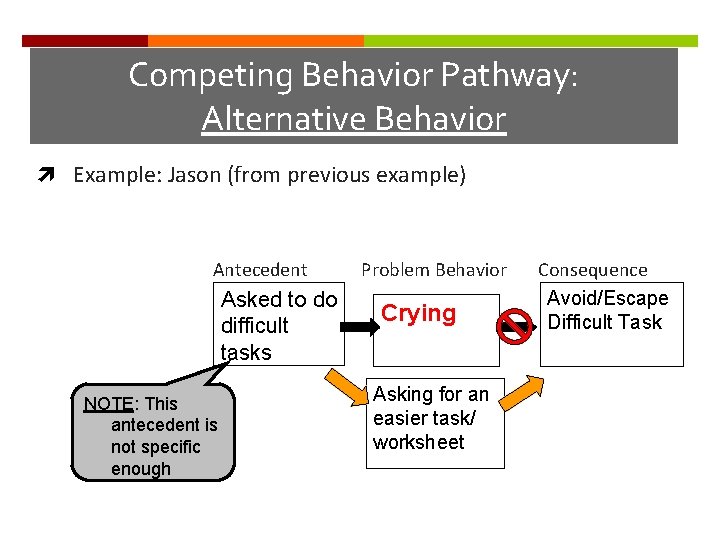
Competing Behavior Pathway: Alternative Behavior Example: Jason (from previous example) Antecedent Asked to do difficult tasks NOTE: This antecedent is not specific enough Problem Behavior Crying Asking for an easier task/ worksheet Consequence Avoid/Escape Difficult Task

Identifying the Alternate Behavior Yes or No? Why? What are the critical features of an Alternate Behavior? 1. Serve same Function? Does it provide adult attn? 2. Is Behavior easier to do than problem behavior? 3. Is Behavior socially acceptable?
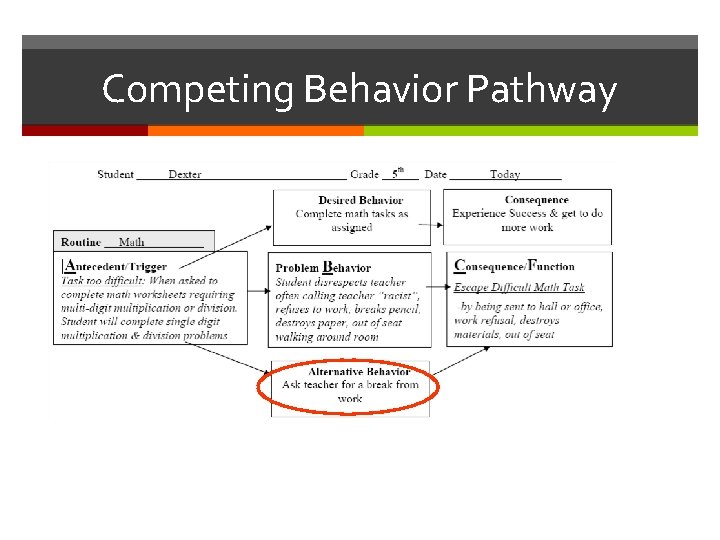
Competing Behavior Pathway
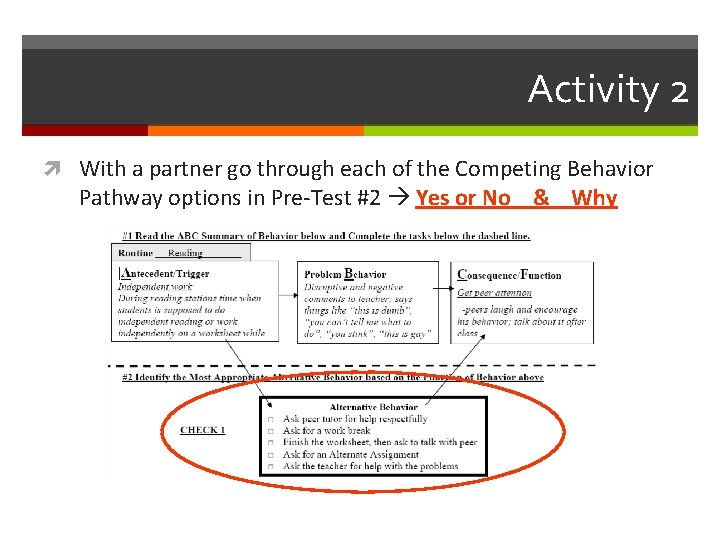
Activity 2 With a partner go through each of the Competing Behavior Pathway options in Pre-Test #2 Yes or No & Why

BREAK 5 minutes
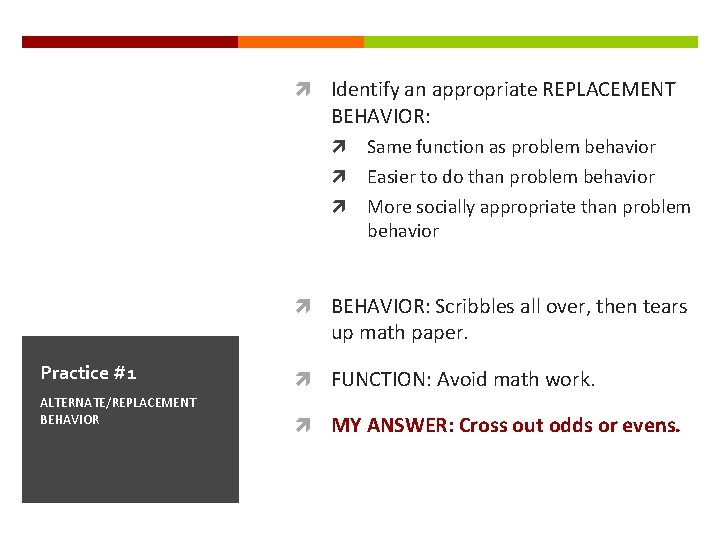
Identify an appropriate REPLACEMENT BEHAVIOR: Same function as problem behavior Easier to do than problem behavior More socially appropriate than problem behavior BEHAVIOR: Scribbles all over, then tears up math paper. Practice #1 ALTERNATE/REPLACEMENT BEHAVIOR FUNCTION: Avoid math work. MY ANSWER: Cross out odds or evens.
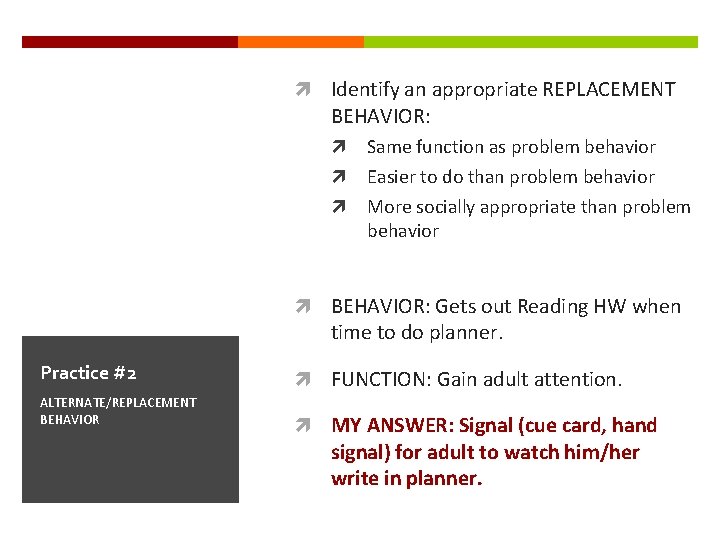
Identify an appropriate REPLACEMENT BEHAVIOR: Same function as problem behavior Easier to do than problem behavior More socially appropriate than problem behavior BEHAVIOR: Gets out Reading HW when time to do planner. Practice #2 ALTERNATE/REPLACEMENT BEHAVIOR FUNCTION: Gain adult attention. MY ANSWER: Signal (cue card, hand signal) for adult to watch him/her write in planner.
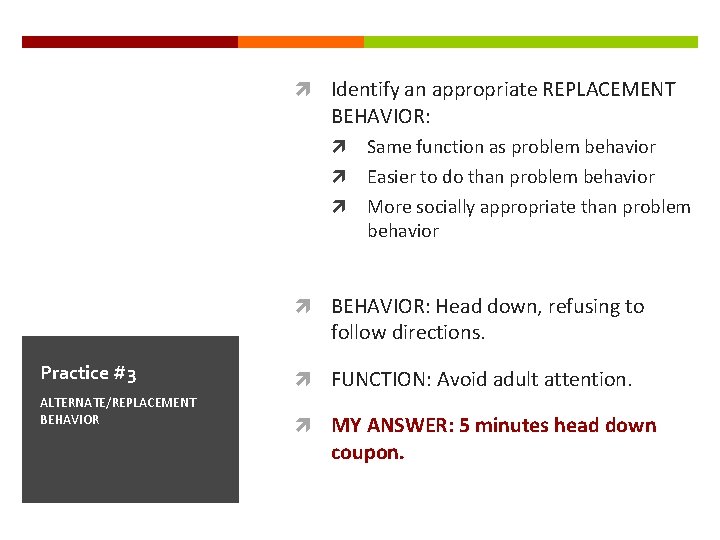
Identify an appropriate REPLACEMENT BEHAVIOR: Same function as problem behavior Easier to do than problem behavior More socially appropriate than problem behavior BEHAVIOR: Head down, refusing to follow directions. Practice #3 ALTERNATE/REPLACEMENT BEHAVIOR FUNCTION: Avoid adult attention. MY ANSWER: 5 minutes head down coupon.
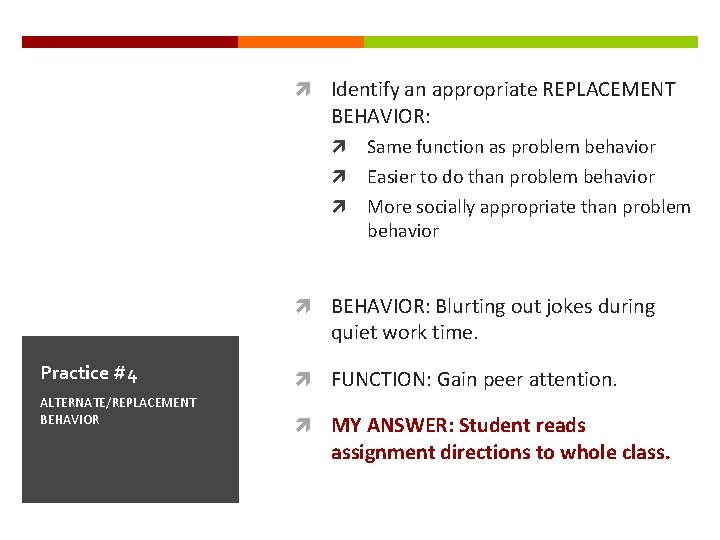
Identify an appropriate REPLACEMENT BEHAVIOR: Same function as problem behavior Easier to do than problem behavior More socially appropriate than problem behavior BEHAVIOR: Blurting out jokes during quiet work time. Practice #4 ALTERNATE/REPLACEMENT BEHAVIOR FUNCTION: Gain peer attention. MY ANSWER: Student reads assignment directions to whole class.
Developing Function-Based Interventions
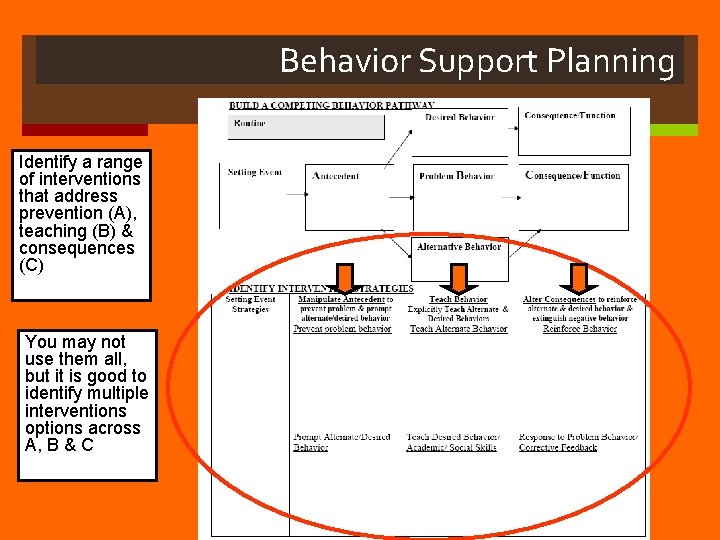
Behavior Support Planning Identify a range of interventions that address prevention (A), teaching (B) & consequences (C) You may not use them all, but it is good to identify multiple interventions options across A, B & C
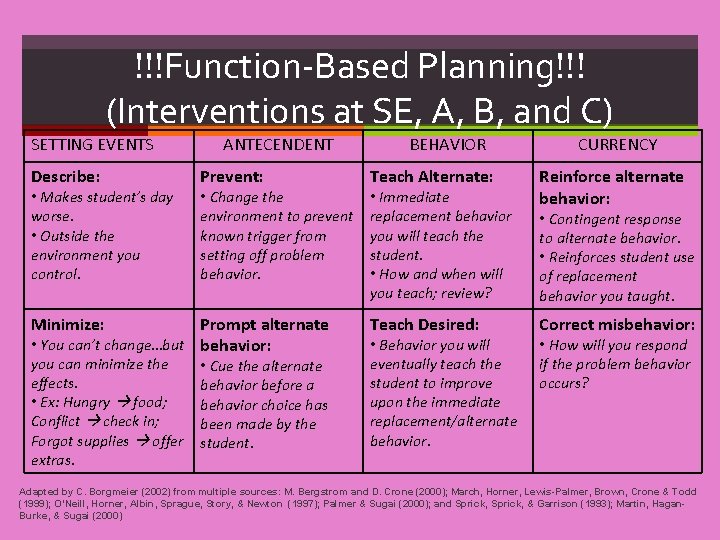
!!!Function-Based Planning!!! (Interventions at SE, A, B, and C) SETTING EVENTS Describe: • Makes student’s day worse. • Outside the environment you control. ANTECENDENT Prevent: • Change the environment to prevent known trigger from setting off problem behavior. Minimize: Prompt alternate • You can’t change…but behavior: you can minimize the effects. • Ex: Hungry food; Conflict check in; Forgot supplies offer extras. • Cue the alternate behavior before a behavior choice has been made by the student. BEHAVIOR Teach Alternate: • Immediate replacement behavior you will teach the student. • How and when will you teach; review? Teach Desired: • Behavior you will eventually teach the student to improve upon the immediate replacement/alternate behavior. CURRENCY Reinforce alternate behavior: • Contingent response to alternate behavior. • Reinforces student use of replacement behavior you taught. Correct misbehavior: • How will you respond if the problem behavior occurs? Adapted by C. Borgmeier (2002) from multiple sources: M. Bergstrom and D. Crone (2000); March, Horner, Lewis-Palmer, Brown, Crone & Todd (1999); O’Neill, Horner, Albin, Sprague, Story, & Newton (1997); Palmer & Sugai (2000); and Sprick, & Garrison (1993); Martin, Hagan. Burke, & Sugai (2000)
- Slides: 41