
Behavior and Attitudes CHAPTER 4 How Well Do
Behavior and Attitudes CHAPTER 4
How Well Do Our Attitudes Predict Our Behavior?
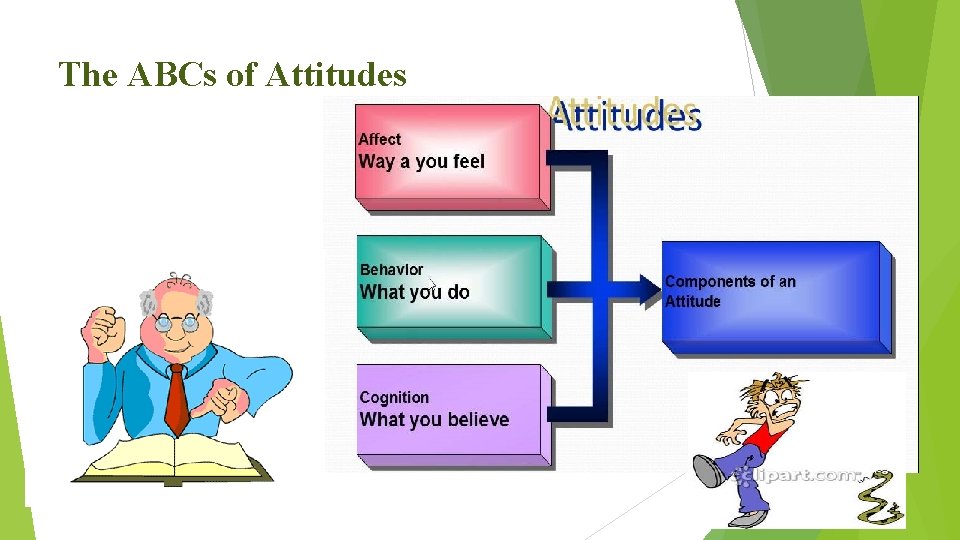
The ABCs of Attitudes
When Attitudes Predict Behavior Our attitudes do predict our behavior when these other influences on what we say and do are minimal, when attitude is specific to the behaviour, and when attitude is potent.
When social influences on what we say are minimal Unlike a physician measuring heart rate, social psychologists never get a direct reading on attitudes. Rather, we measured expressed attitudes. Like other behaviors, expressions are subject to outside influences. Sometimes, for example, we say what we think others want to hear.
When other influences on behavior are minimal It’s not only our inner attitudes that guide us but also the situation we face. Principle of aggregation: the effects of an attitude become more apparent when we look at a person’s aggregate or average behavior than when we consider isolated acts.
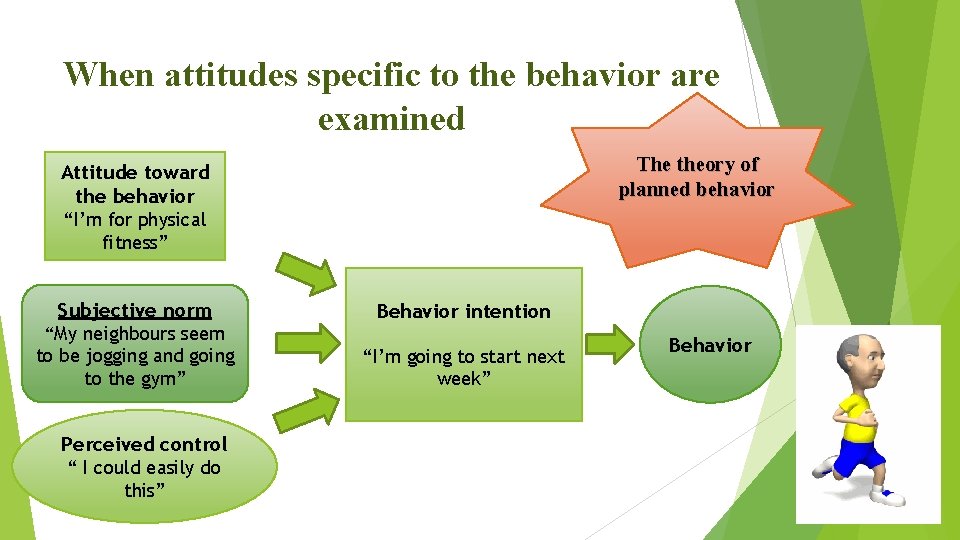
When attitudes specific to the behavior are examined The theory of planned behavior Attitude toward the behavior “I’m for physical fitness” Subjective norm “My neighbours seem to be jogging and going to the gym” Perceived control “ I could easily do this” Behavior intention “I’m going to start next week” Behavior
When attitudes are potent Much of our behavior is automatic. We act out familiar scripts without reflecting on what we’re doing. • We respond to people we meet in the hall with an automatic “ Hi”. • We answer the restaurant cashier’s question “ How was your meal? ” by saying, “ Fine”, even if we found it tasteless.
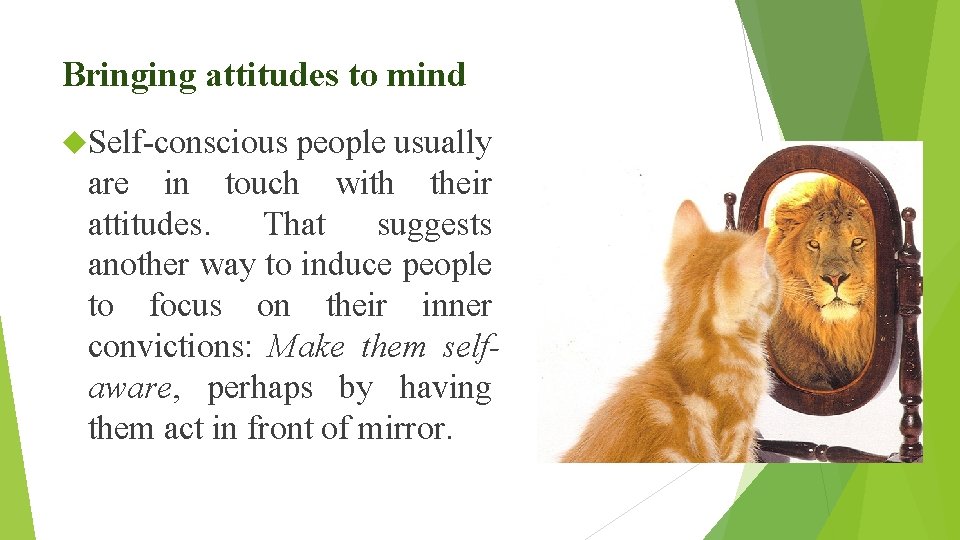
Bringing attitudes to mind Self-conscious people usually are in touch with their attitudes. That suggests another way to induce people to focus on their inner convictions: Make them selfaware, perhaps by having them act in front of mirror.
Forging strong attitudes through experience The attitudes that the best predict behavior are accessible as well as stable. And when attitudes are forged by experience, not just by hearsay, they are more accessible, more enduring and more likely to guide actions.
How well do our attitudes predict our behavior? If these “other influences” are minimized (2) If the attitude corresponds very closely to the predicted behaviour (as in voting studies) (3) If the attitude is potent (because something reminds us of it, or because we acquired it by direct experience). (1)
When does our behavior affect our attitudes?
Now we turn to the more startling idea that behavior determines attitudes. It’s true that we sometimes stand up for what we believe. But it’s also true that we come to believe in what we stand up for. As we engage the evidence that behavior affects attitudes, speculate why actions affect attitudes and then compare your ideas with social psychologists’ explanation. (incidents). Sarah is hypnotized and told to take off her shoes when a book drops on the floor. Fifteen minutes later a book drops, and Sarah quietly slips out of her loafers. "Sarah, ” asks the hypnotist, ” why did you take off your shoes? ” “well… my feet are hot and tired, ” Sarah replies “It has been a long day” The act Produces Idea. George has electrodes temporarily implanted in the brain region that controls his head movements. When neurosurgeon stimulates the electrodes by remote control, George always turns his head. Unaware of the remote stimulation, he offers a reasonable explanation for his head turning: ”I’m looking for my slipper. ” “I heard a noise. ” “I’m restless. ” “I was looking under the bed. ”
Role playing ROLE – a set of norms that defines how people in a given social position ought to behave. The word role is borrowed from theater and, as in theater, refers to actions expected of those who occupy a particular social position. When enacting new social roles, we may at first feel phony. But our unease seldom lasts The deeper lesson of the role playing studies is not that we are powerless machines. Rather, it concerns how what is unreal (an artificial role) can subtly evolve into what is real. As teacher, soldier, or businessperson, we enact a role that shapes our attitude. As a teacher, soldier, or business person , we enact a role that shapes our attitudes.
Saying becomes believing People often adapt what they say to please their listeners. They are quicker to tell people good news than bad, and they adjust their message toward their listener’s position. When induced to give written or spoken support to something they doubt, people will often feel bad about their deceit. Nevertheless, they begin to believe what they are saying, provided they weren’t bribed or coerced into doing so. When there is no compelling external explanation for one’s words, saying becomes believing.
The foot-in-the-door phenomenon
Summing Up: When does our behavior affect our attitudes? The attitude-action relation also works in the reverse direction: We are likely not only to think ourselves into action but also to act ourselves into a way of thinking. When we act, we amplify the idea underlying what we have done, especially when we feel responsible for it. Many streams of evidence converge on this principle. The actions prescribed by social roles mold the attitudes of the role players. Similarly, what we say or write can strongly influence attitudes that we subsequently hold. Research on the foot-in the- door phenomenon reveals that committing a small act makes people more willing to do a larger one later. Actions also affect our moral attitudes : that which we have done , even if it is evil, we tend to justify as right. Similarly, our racial and political behaviors help shape our social consciousness: We not only stand up for what we believe, we also believe in what we have stood up for. Political and social movements may legislate behavior designed to lead to attitude change on a mass scale.
SOCIAL MOVEMENT We have now seen that a society’s law and, therefore, its behavior can have a strong influence on its racial attitudes. A danger lies in the possibility of employing the same idea for political socialization on a mass scale. Example: Political rituals- The daily flag salute by school children, singing the national anthem- use public conformity to build a private belief in patriotism
Why Does our Behavior Affect our Attitude?
Why action affects attitude? -Social Psychology’s detectives suspect three possible sources. 1. Self Presentation Theory: Assumes that for strategic reasons we express attitudes that make us appear consistent. 2. Cognitive Dissonance Theory: Assumes that to reduce discomfort, we justify our actions to ourselves. 3. Self Perception Theory: Assumes that our self-revealing ( when uncertain about our feelings or beliefs, we look to our behavior, much as anyone else would.
Self-Presentation : Impression Management
Who among us does not care what people think? • We spend countless dollars on clothes, diets, cosmetics, and now plastic surgery- all because of our fretting over what others think. • No one wants to look foolishly inconsistent.
Self-Justification : Cognitive Dissonance – Tension that arises when one is simultaneously aware of two inconsistent cognitions. Dissonance – It assumes that we feel tension, or a lack of harmony. Cognition – When two simultaneously accessible thoughts or beliefs are psychologically inconsistent.
Insufficient Justification : Reduction of dissonance by internally justifying one’s behavior when external justification is insufficient.
Self-perception Theory : The theory that when we are unsure of our attitudes, we infer them much as would someone observing us, by looking at our behavior and the circumstances under which it occurs.
Over justification and Intrinsic Motivation: Intrinsically Motivated : When we do something because we enjoy it and not for some external reward. Overjustification effect : occurs when the introduction of some extrinsic rewards leads to a reduction in a persons intrinsic motivation
Over justification effect : The result of bribing people to do what they already like doing: they may then see their actions as externally controlled rather than intrinsically appealing.
- Slides: 27