
Beginnings 1 Earths formation 2 Earths timeline Earths


Beginnings 1. Earth’s formation 2. Earth’s timeline
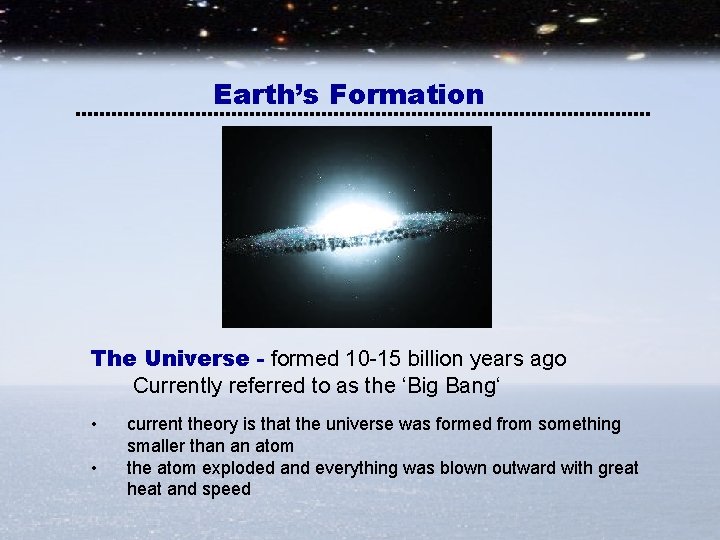
Earth’s Formation The Universe - formed 10 -15 billion years ago Currently referred to as the ‘Big Bang‘ • • current theory is that the universe was formed from something smaller than an atom the atom exploded and everything was blown outward with great heat and speed
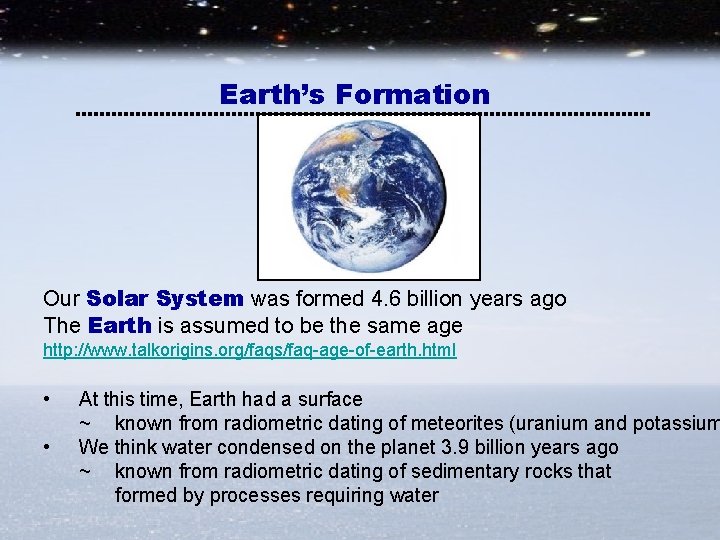
Earth’s Formation Our Solar System was formed 4. 6 billion years ago The Earth is assumed to be the same age http: //www. talkorigins. org/faqs/faq-age-of-earth. html • • At this time, Earth had a surface ~ known from radiometric dating of meteorites (uranium and potassium We think water condensed on the planet 3. 9 billion years ago ~ known from radiometric dating of sedimentary rocks that formed by processes requiring water
Earth’s Formation Where did oceans come from? Old Theory: a) H 2 O came from big comets during period of heavy bombardment a) H 2 O locked up in minerals released from differentiation (cooling and melting of magma) and heating processes
Earth’s Formation Where did oceans come from? (cont’d) New Theory: a) Oceans are still forming and H 2 O comes from many small cometessimals that continually bombard the Earth a) H 2 O came from big comets during period of heavy bombardment a) H 2 O locked up in minerals released from differentiation b) and heating
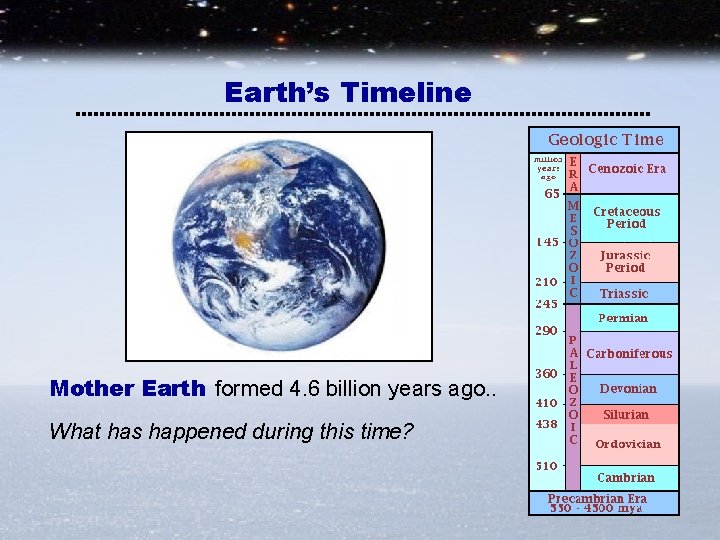
Earth’s Timeline Mother Earth formed 4. 6 billion years ago. . What has happened during this time?
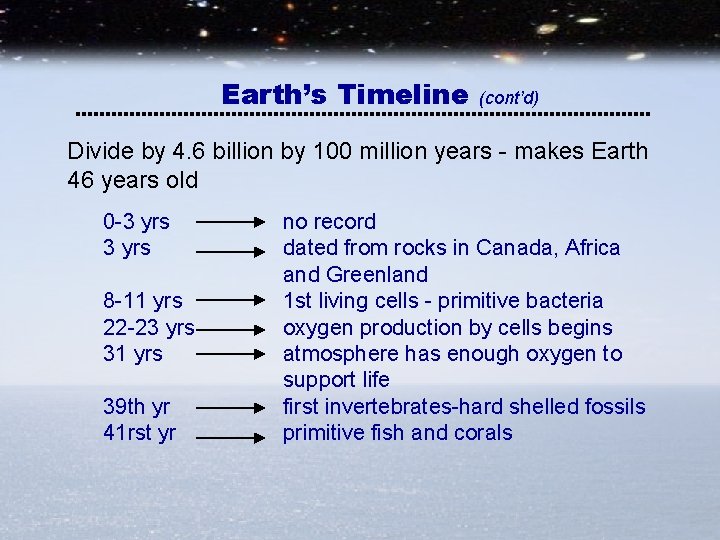
Earth’s Timeline (cont’d) Divide by 4. 6 billion by 100 million years - makes Earth 46 years old 0 -3 yrs 8 -11 yrs 22 -23 yrs 31 yrs 39 th yr 41 rst yr no record dated from rocks in Canada, Africa and Greenland 1 st living cells - primitive bacteria oxygen production by cells begins atmosphere has enough oxygen to support life first invertebrates-hard shelled fossils primitive fish and corals
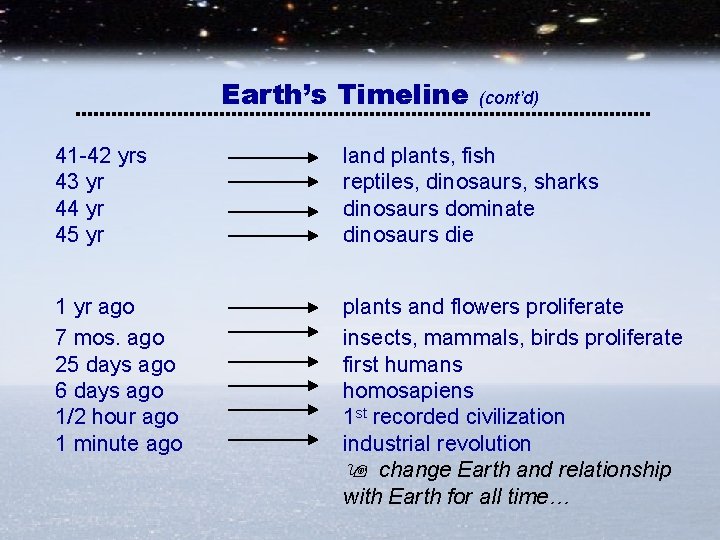
Earth’s Timeline (cont’d) 41 -42 yrs 43 yr 44 yr 45 yr land plants, fish reptiles, dinosaurs, sharks dinosaurs dominate dinosaurs die 1 yr ago 7 mos. ago 25 days ago 6 days ago 1/2 hour ago 1 minute ago plants and flowers proliferate insects, mammals, birds proliferate first humans homosapiens 1 st recorded civilization industrial revolution change Earth and relationship with Earth for all time…
Earth 1. Coordinates 2. Earth’s Water 3. Earth’s Structure
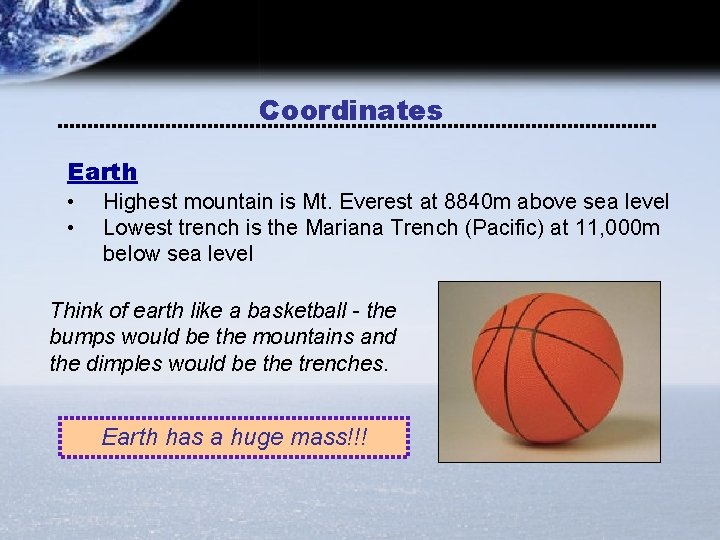
Coordinates Earth • • Highest mountain is Mt. Everest at 8840 m above sea level Lowest trench is the Mariana Trench (Pacific) at 11, 000 m below sea level Think of earth like a basketball - the bumps would be the mountains and the dimples would be the trenches. Earth has a huge mass!!!
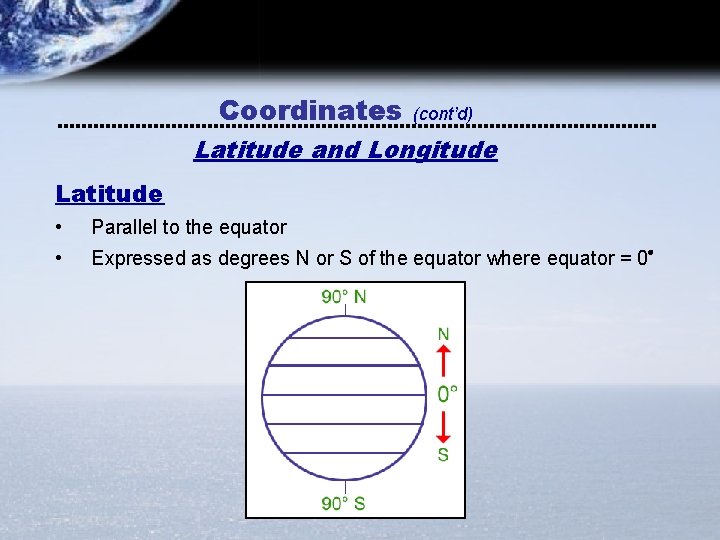
Coordinates (cont’d) Latitude and Longitude Latitude • Parallel to the equator • Expressed as degrees N or S of the equator where equator = 0
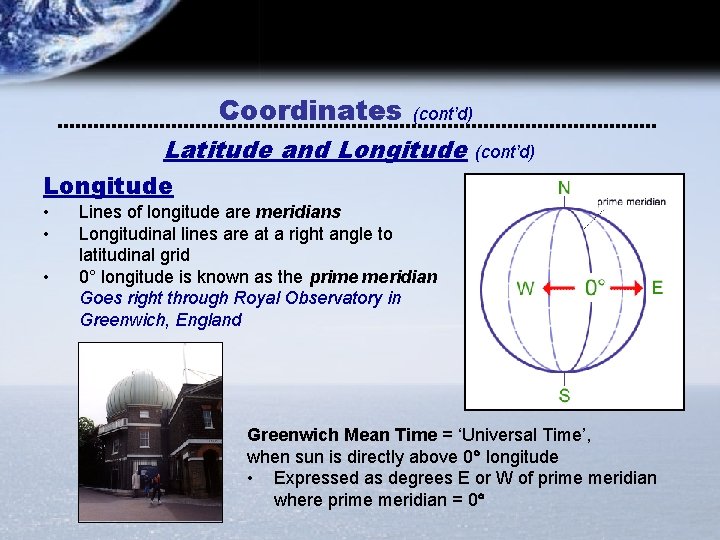
Coordinates (cont’d) Latitude and Longitude (cont’d) Longitude • • • Lines of longitude are meridians Longitudinal lines are at a right angle to latitudinal grid 0° longitude is known as the prime meridian Goes right through Royal Observatory in Greenwich, England Greenwich Mean Time = ‘Universal Time’, when sun is directly above 0 longitude • Expressed as degrees E or W of prime meridian where prime meridian = 0
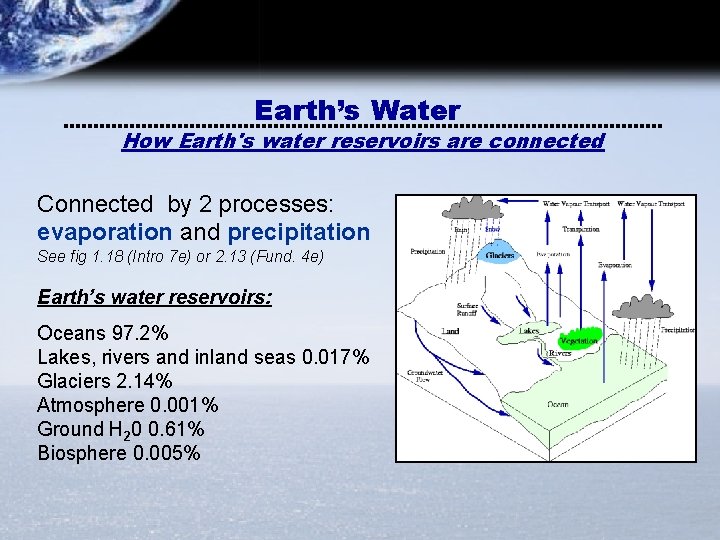
Earth’s Water How Earth's water reservoirs are connected Connected by 2 processes: evaporation and precipitation See fig 1. 18 (Intro 7 e) or 2. 13 (Fund. 4 e) Earth’s water reservoirs: Oceans 97. 2% Lakes, rivers and inland seas 0. 017% Glaciers 2. 14% Atmosphere 0. 001% Ground H 20 0. 61% Biosphere 0. 005%
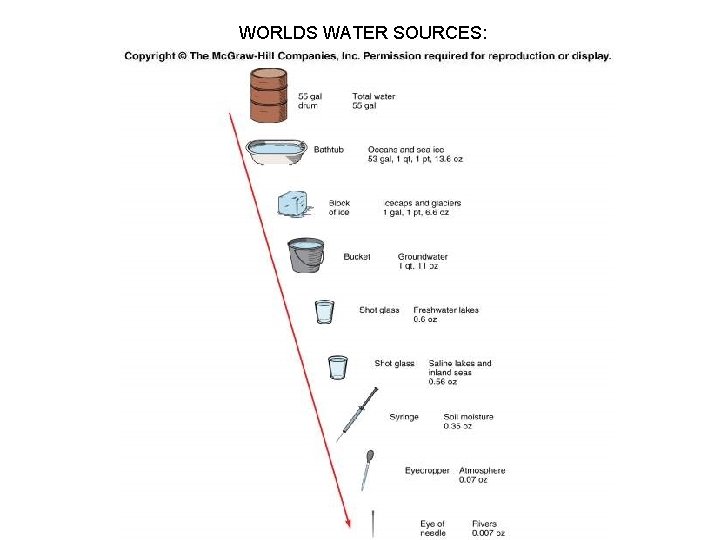
WORLDS WATER SOURCES:
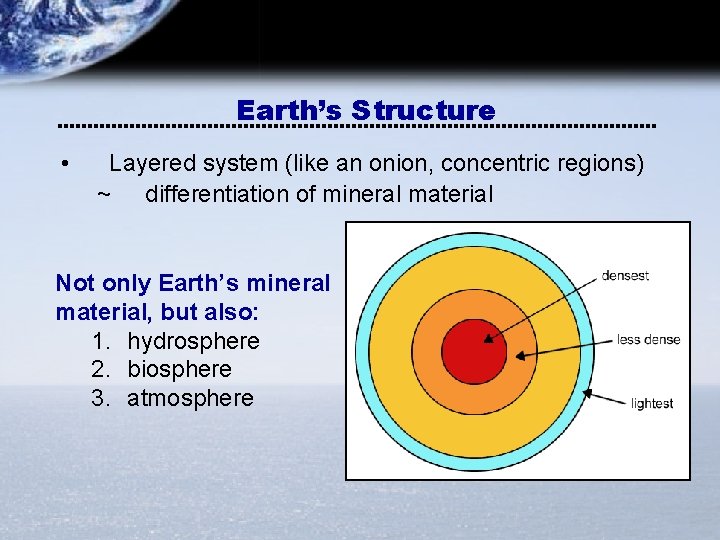
Earth’s Structure • Layered system (like an onion, concentric regions) ~ differentiation of mineral material Not only Earth’s mineral material, but also: 1. hydrosphere 2. biosphere 3. atmosphere

Earth’s Structure (cont’d. ) Classification according to chemical composition 4 concentric regions of mineral material: 1. crust 2. mantle 3. outer core - molten 4. inner core - solid
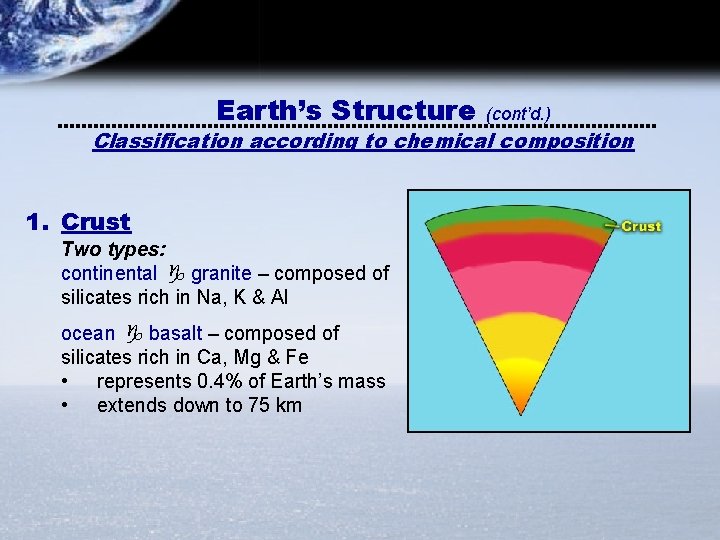
Earth’s Structure (cont’d. ) Classification according to chemical composition 1. Crust Two types: continental g granite – composed of silicates rich in Na, K & Al ocean g basalt – composed of silicates rich in Ca, Mg & Fe • represents 0. 4% of Earth’s mass • extends down to 75 km
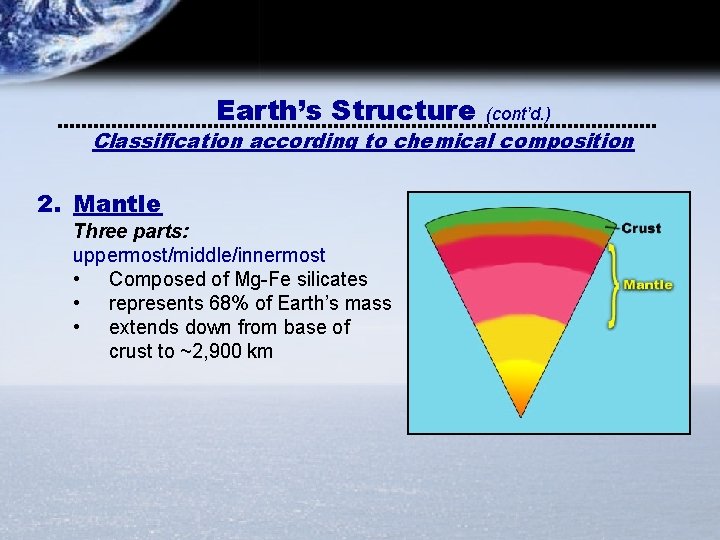
Earth’s Structure (cont’d. ) Classification according to chemical composition 2. Mantle Three parts: uppermost/middle/innermost • Composed of Mg-Fe silicates • represents 68% of Earth’s mass • extends down from base of crust to ~2, 900 km
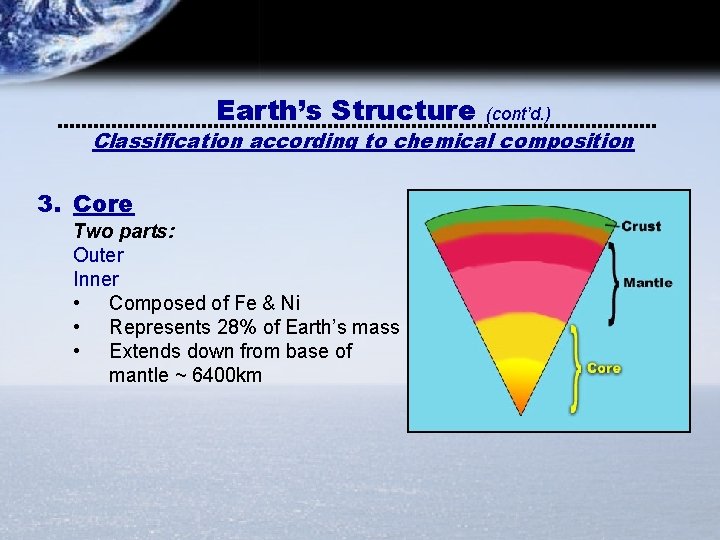
Earth’s Structure (cont’d. ) Classification according to chemical composition 3. Core Two parts: Outer Inner • Composed of Fe & Ni • Represents 28% of Earth’s mass • Extends down from base of mantle ~ 6400 km
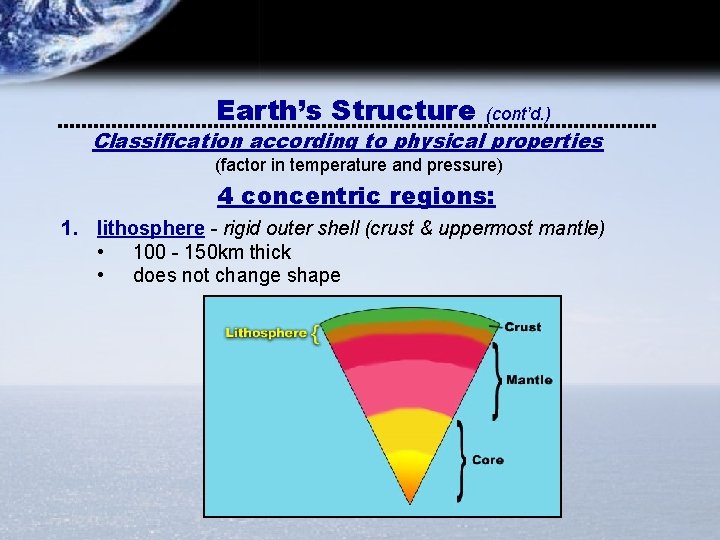
Earth’s Structure (cont’d. ) Classification according to physical properties (factor in temperature and pressure) 4 concentric regions: 1. lithosphere - rigid outer shell (crust & uppermost mantle) • 100 - 150 km thick • does not change shape
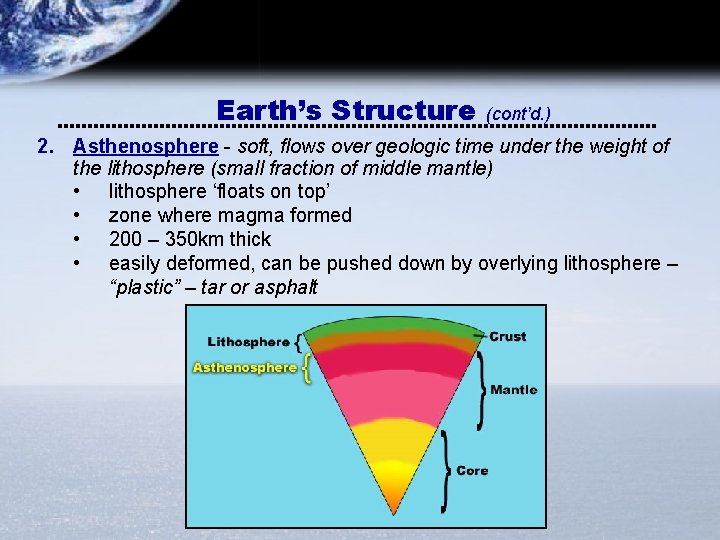
Earth’s Structure (cont’d. ) 2. Asthenosphere - soft, flows over geologic time under the weight of the lithosphere (small fraction of middle mantle) • lithosphere ‘floats on top’ • zone where magma formed • 200 – 350 km thick • easily deformed, can be pushed down by overlying lithosphere – “plastic” – tar or asphalt
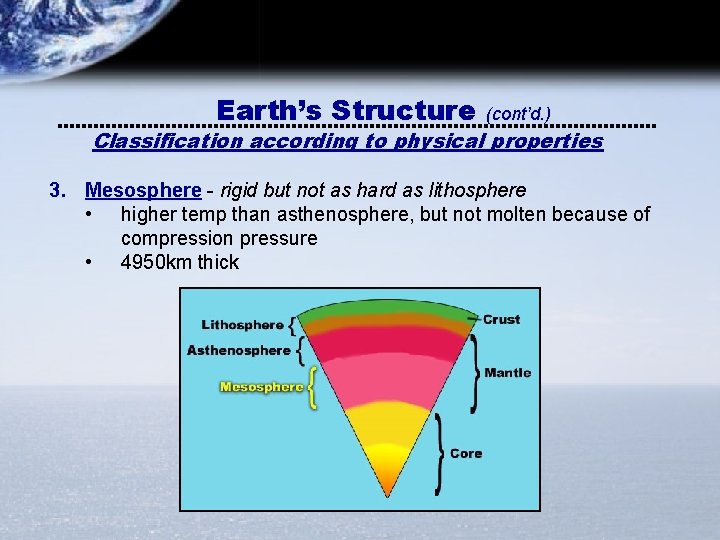
Earth’s Structure (cont’d. ) Classification according to physical properties 3. Mesosphere - rigid but not as hard as lithosphere • higher temp than asthenosphere, but not molten because of compression pressure • 4950 km thick
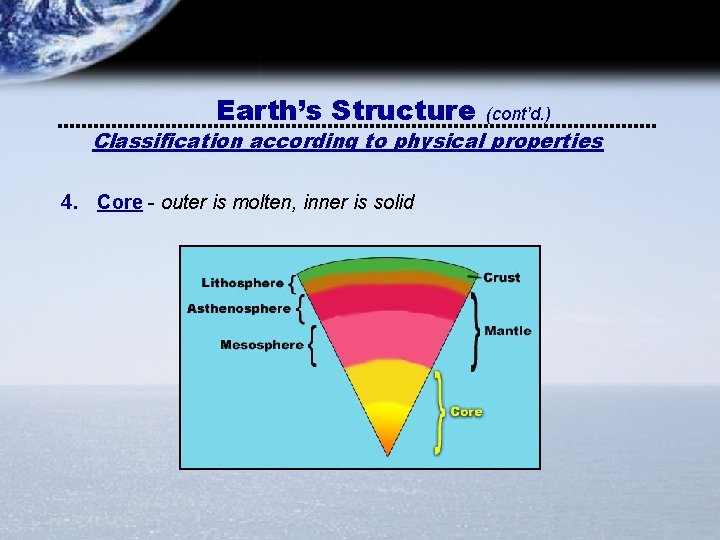
Earth’s Structure (cont’d. ) Classification according to physical properties 4. Core - outer is molten, inner is solid
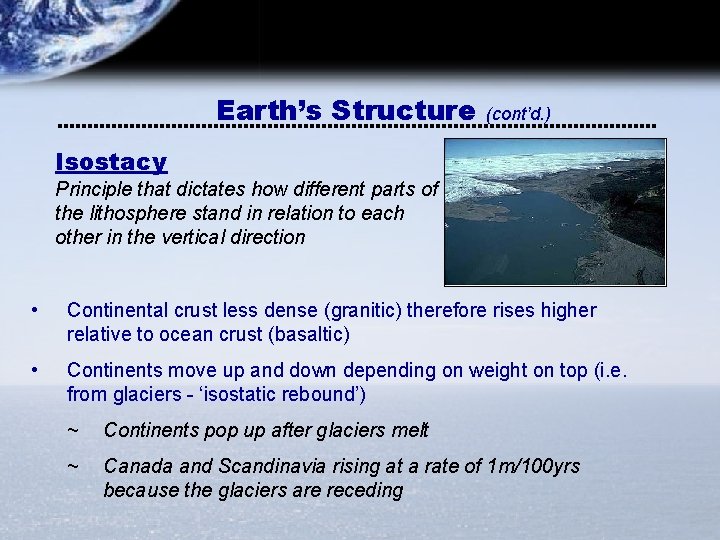
Earth’s Structure (cont’d. ) Isostacy Principle that dictates how different parts of the lithosphere stand in relation to each other in the vertical direction • Continental crust less dense (granitic) therefore rises higher relative to ocean crust (basaltic) • Continents move up and down depending on weight on top (i. e. from glaciers - ‘isostatic rebound’) ~ Continents pop up after glaciers melt ~ Canada and Scandinavia rising at a rate of 1 m/100 yrs because the glaciers are receding
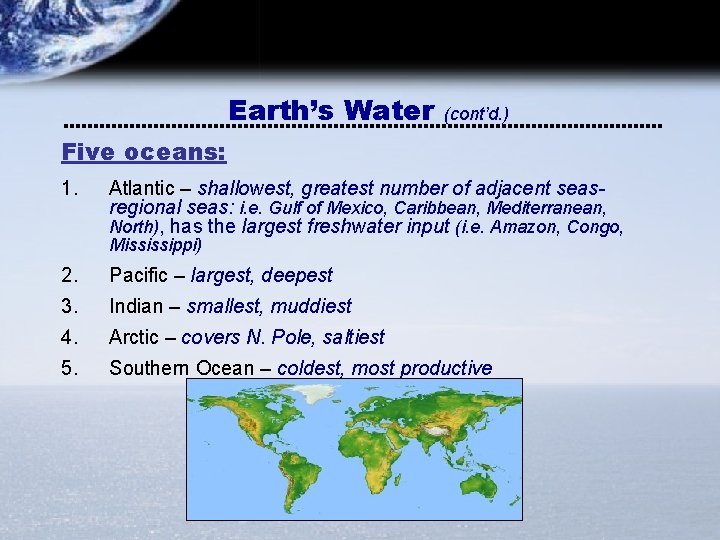
Earth’s Water (cont’d. ) Five oceans: 1. Atlantic – shallowest, greatest number of adjacent seasregional seas: i. e. Gulf of Mexico, Caribbean, Mediterranean, North), has the largest freshwater input (i. e. Amazon, Congo, Mississippi) 2. Pacific – largest, deepest 3. Indian – smallest, muddiest 4. Arctic – covers N. Pole, saltiest 5. Southern Ocean – coldest, most productive
(Some) OCEANS’ FACTS: Ø Our planet is actually the Ocean Planet - 77% of the Earth’s surface is covered by oceans and seas. However, less than 10% has been investigated. Ø Oceans provide more than 70% of oxygen we breathe Ø 80% of world’s plant and animal species live in oceans Ø More than 60% of the current human population (5. 8 billion) lives in the coastal zones (~60 km wide), the areas representing only 8% of the Earth surface! Ø ‘Poorest of the poor’ - 1. 1 billion people ‘survive’ on less than 1$/day Ø 1 billion people rely on fish as the only daily source of protein Ø Global climate change and the humans’ well being depend on the conditions and health of the oceans; Ø Poverty, hunger, diseases as well as casualties from natural disasters can be alleviated by improving the health of the environment and by sustainable use and management of the coasts and oceans!
- Slides: 27