
Beginning Safety Scaffolding By Scott Santon Click Here
Beginning Safety Scaffolding By Scott Santon Click Here to Begin
Buttons Click on to move forward Click on to move back to Previous screen Next Back Click on to go Home Next
Objectives ØScaffolding – Without assistance, students will identify the three different scaffolds and the parts of a supported scaffold without error. ØHazards – without assistance, students will be able to recognize improper uses, and construction in scaffolding, without error. ØRemediation/Inspection - without assistance, students will be able to identify the traits of a competent person and a qualified erector, without error. Forward
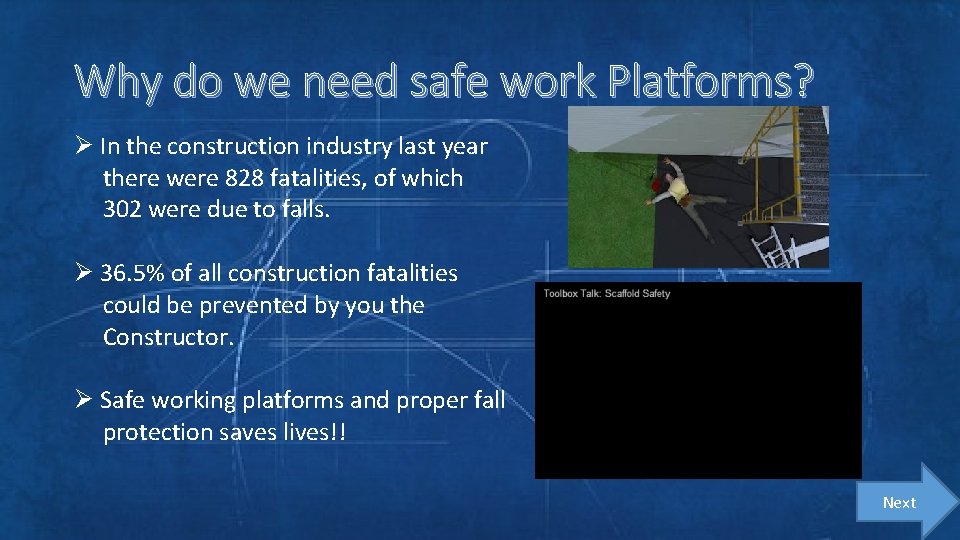
Why do we need safe work Platforms? Ø In the construction industry last year there were 828 fatalities, of which 302 were due to falls. Ø 36. 5% of all construction fatalities could be prevented by you the Constructor. Ø Safe working platforms and proper fall protection saves lives!! Next
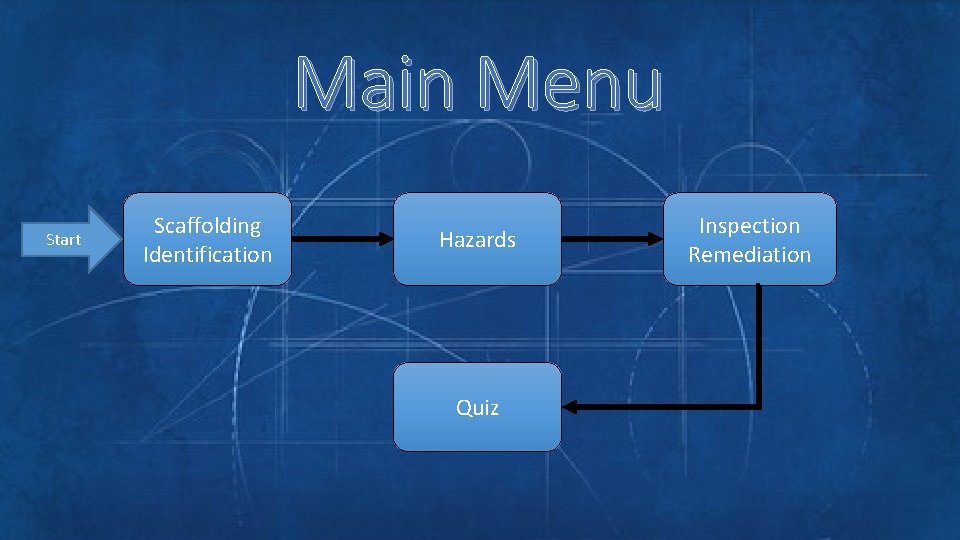
Main Menu Start Scaffolding Identification Hazards Quiz Inspection Remediation
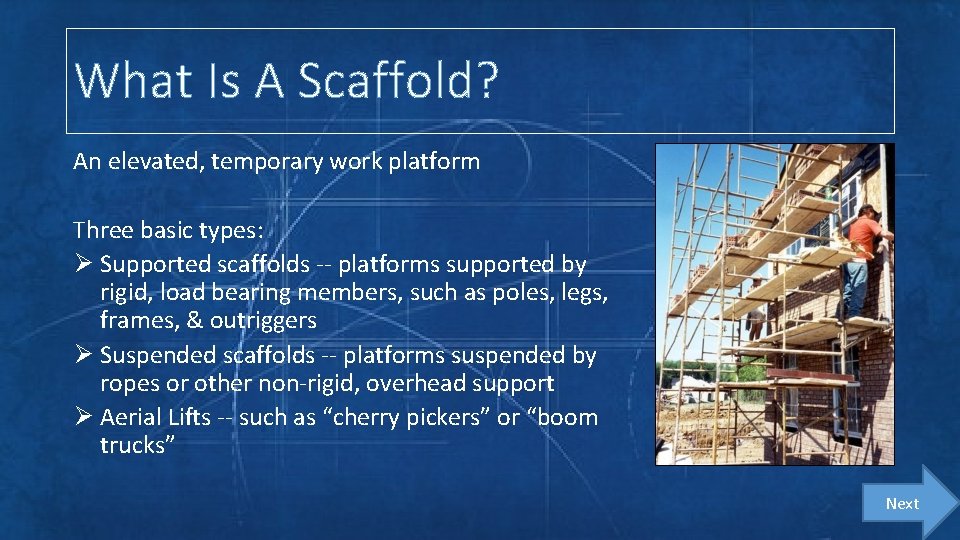
What Is A Scaffold? An elevated, temporary work platform Three basic types: Ø Supported scaffolds -- platforms supported by rigid, load bearing members, such as poles, legs, frames, & outriggers Ø Suspended scaffolds -- platforms suspended by ropes or other non-rigid, overhead support Ø Aerial Lifts -- such as “cherry pickers” or “boom trucks” Next
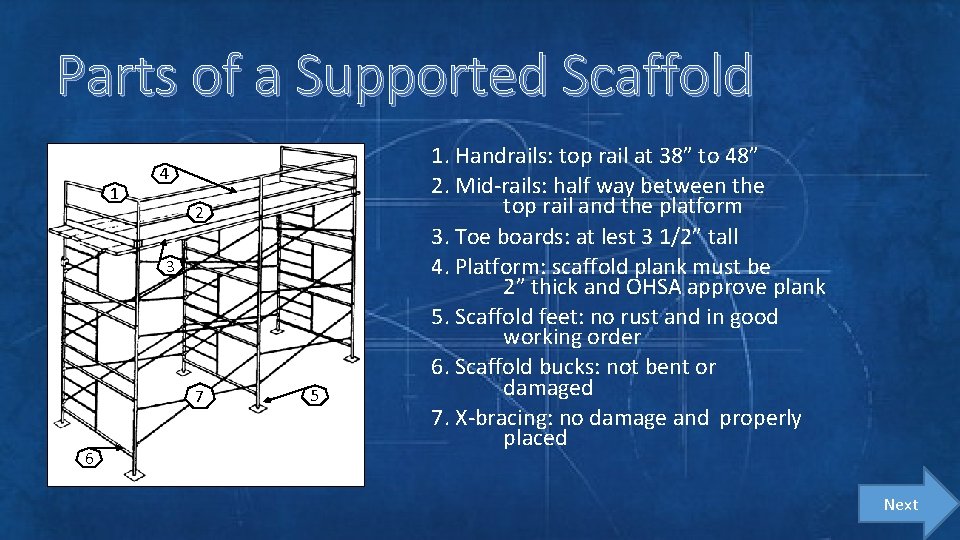
Parts of a Supported Scaffold 1 4 2 3 7 6 5 1. Handrails: top rail at 38” to 48” 2. Mid-rails: half way between the top rail and the platform 3. Toe boards: at lest 3 1/2” tall 4. Platform: scaffold plank must be 2” thick and OHSA approve plank 5. Scaffold feet: no rust and in good working order 6. Scaffold bucks: not bent or damaged 7. X-bracing: no damage and properly placed Next
Suspended Scaffoldings ØPlatforms suspended by ropes or wires. ØRope must be capable of supporting 6 times the load ØTrain employees to recognize hazards Secure/tie to prevent swaying ØSupport devices must rest on surfaces that can support four times the load ØCompetent person v evaluate connections to ensure the supporting surfaces can support load v inspect ropes for defects before shift Ø PFAS must have anchors independent of the scaffold support system Next
Ariel Lifts Ø Daily inspections of all mechanical and moving parts Ø Must use outriggers when operating boom or deck Ø Must operate lift on a level surface Ø Must wear fall protection when in the basket or work platform Next

Supported Scaffold Activity Instructions: Fill in the box with the name of the scaffold part where the arrow is pointing. Please take a screen shot of this slide, and print and turn in at the end of the Power. Point. Next
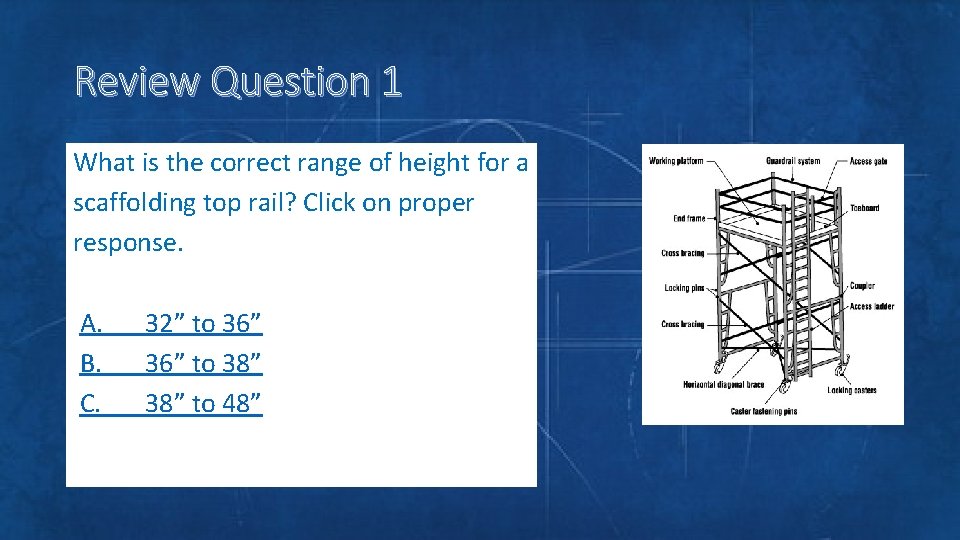
Review Question 1 What is the correct range of height for a scaffolding top rail? Click on proper response. A. B. C. 32” to 36” to 38” to 48”

Incorrect Please try again
You are Correct The top rail of a scaffold is built between 38” to 48” off the platform. Next
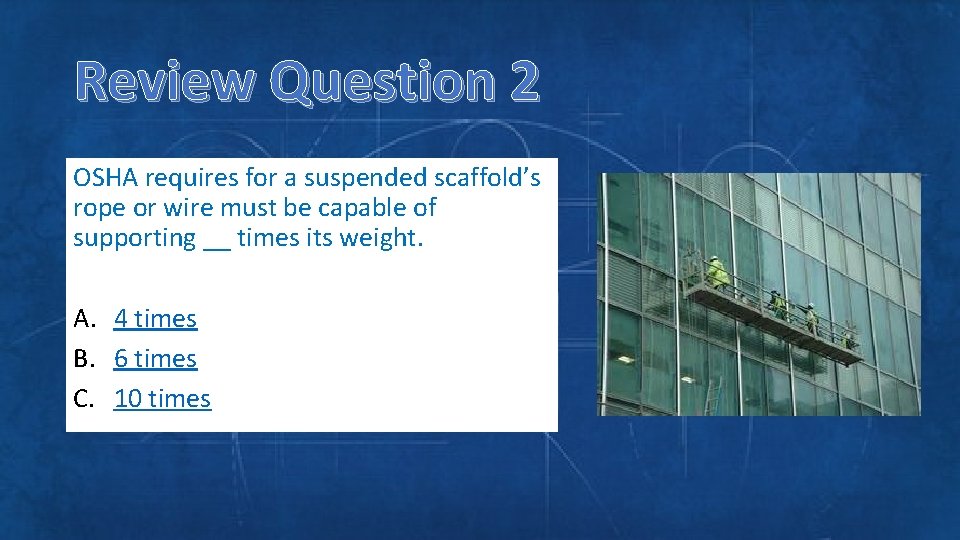
Review Question 2 OSHA requires for a suspended scaffold’s rope or wire must be capable of supporting __ times its weight. A. 4 times B. 6 times C. 10 times

Incorrect Please try again
You are Correct Rope and cable must be capable of supporting 6 times the load! Next
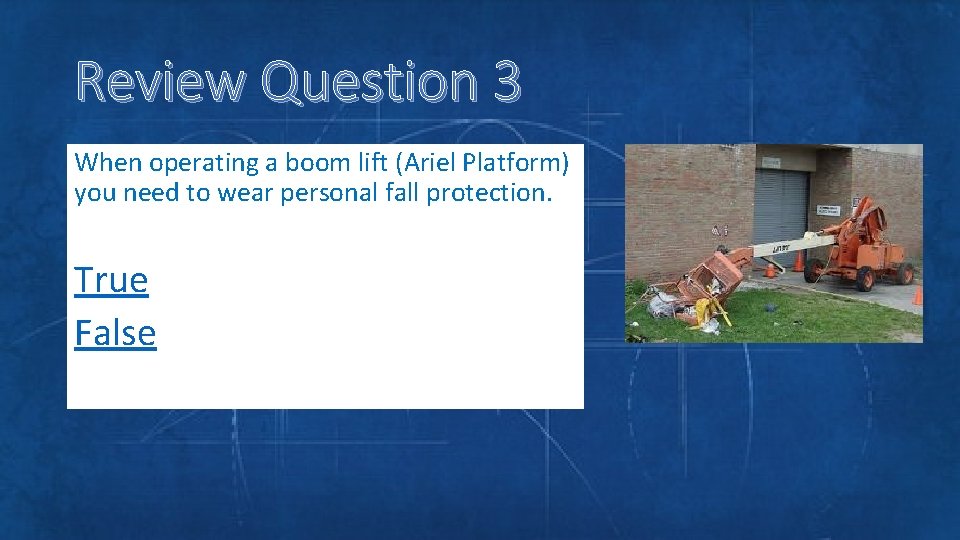
Review Question 3 When operating a boom lift (Ariel Platform) you need to wear personal fall protection. True False
You are Correct The answer is true. You must wear fall protection when operating an Ariel lift.
Incorrect The answer was True. You must wear personal fall protection when in the lift.
Hazards ØEmployees working on scaffolds are exposed to these hazards: ØFalls from elevation – caused by slipping, unsafe access, and the lack of fall protection Ø Struck by falling tools / debris Ø Electrocution – from overhead power lines Ø Scaffold collapse - caused by instability or overloading Ø Bad planking giving way Next
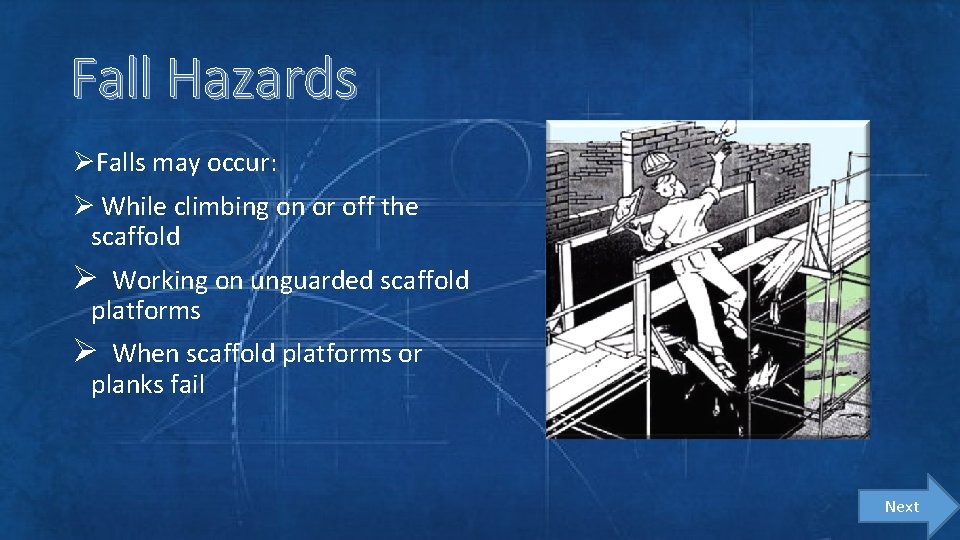
Fall Hazards ØFalls may occur: Ø While climbing on or off the scaffold Ø Working on unguarded scaffold platforms Ø When scaffold platforms or planks fail Next
Struck By Falling Object Protection: Ø Wear hardhats Ø Barricade area below scaffold to forbid entry into that area Ø Use panels or screens if material is stacked higher than the toe board Ø Build a canopy or erect a net below the scaffold that will contain or deflect falling objects Next
ØNo paint on wood platforms Ø Use scaffold grade wood Ø Fully planked between front upright and guardrail support Ø Component pieces used must match and be of the same type Ø Erect on stable and level ground Ø Lock wheels and braces Next
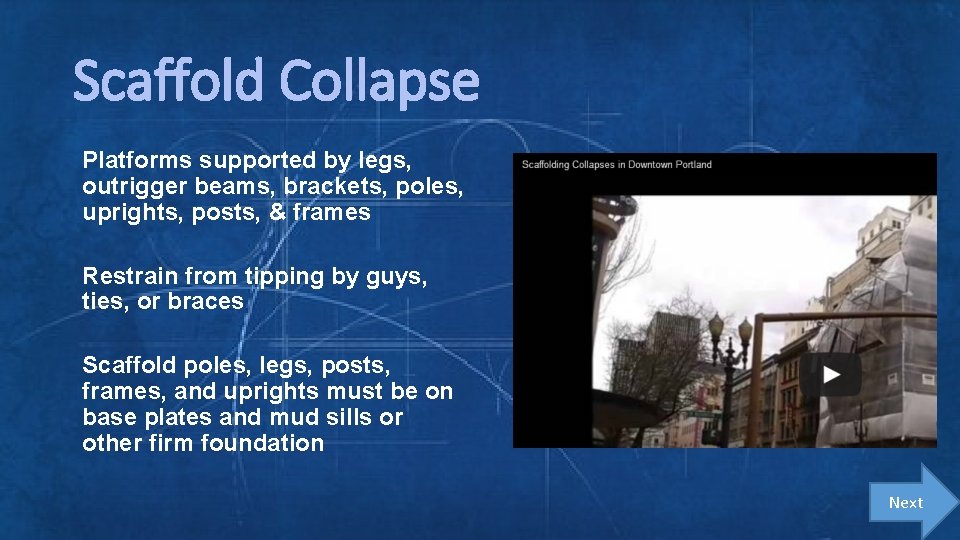
Scaffold Collapse Platforms supported by legs, outrigger beams, brackets, poles, uprights, posts, & frames Restrain from tipping by guys, ties, or braces Scaffold poles, legs, posts, frames, and uprights must be on base plates and mud sills or other firm foundation Next
Electrocution The possibility of electrocution is a serious consideration when working near overhead power lines Check the clearance distances listed in the standard Next
Reflection Reflect on the Hazards Module and make a short List of 5 Hazards in working with the three different types of scaffolding , and what you have to do to remedy the Hazard. Example: Hazard – Hit in the head by a falling object. Remedy – Always wear hardhat when on a construction site. Bring your list with you to the next OSHA class. Next
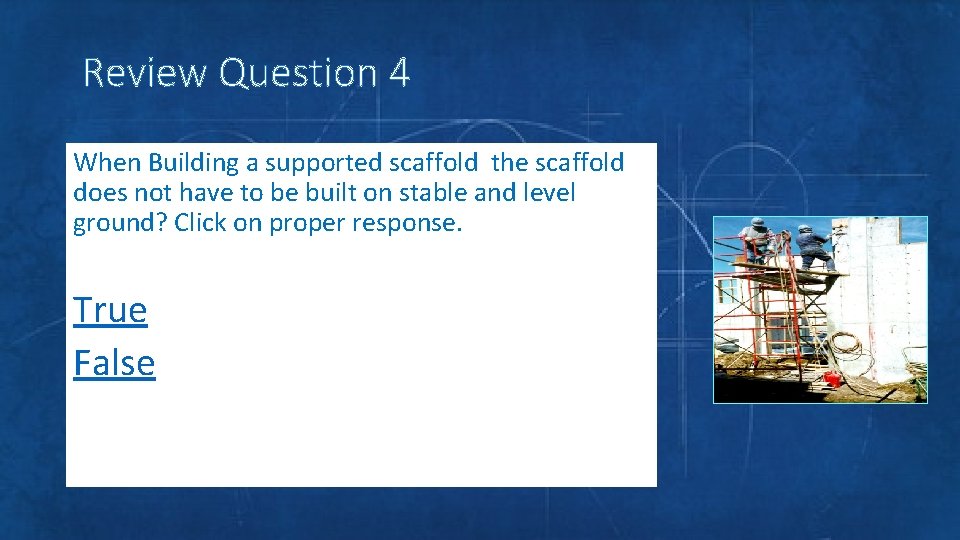
Review Question 4 When Building a supported scaffold the scaffold does not have to be built on stable and level ground? Click on proper response. True False
You are Correct You must build scaffolding on stable and level ground. Next

Incorrect The answer is false. You must build scaffolding on stable and level ground. Next
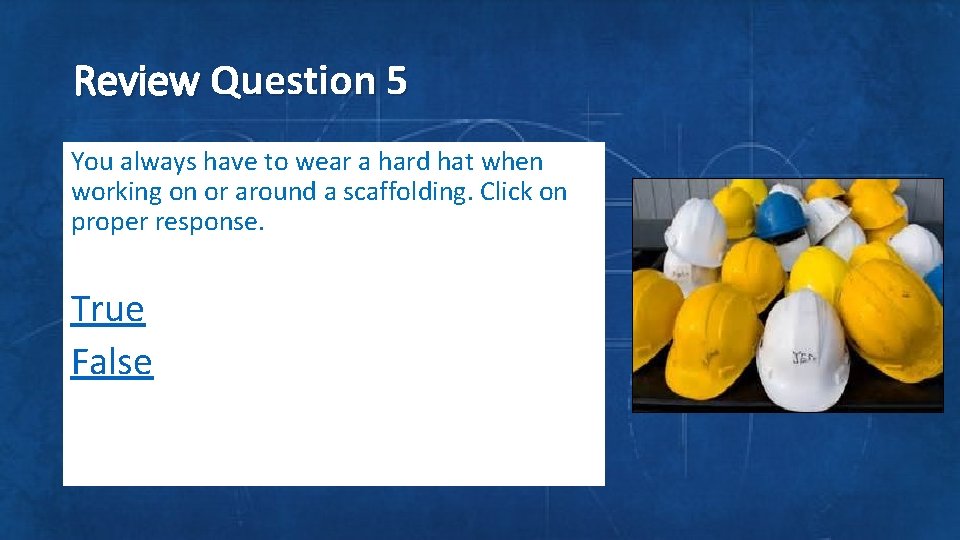
Review Question 5 You always have to wear a hard hat when working on or around a scaffolding. Click on proper response. True False
You are Correct You must always wear a hardhat when working on or around a scaffolding! Next

Incorrect The answer is true. You must always wear a hardhat when working on or around a scaffolding! Next
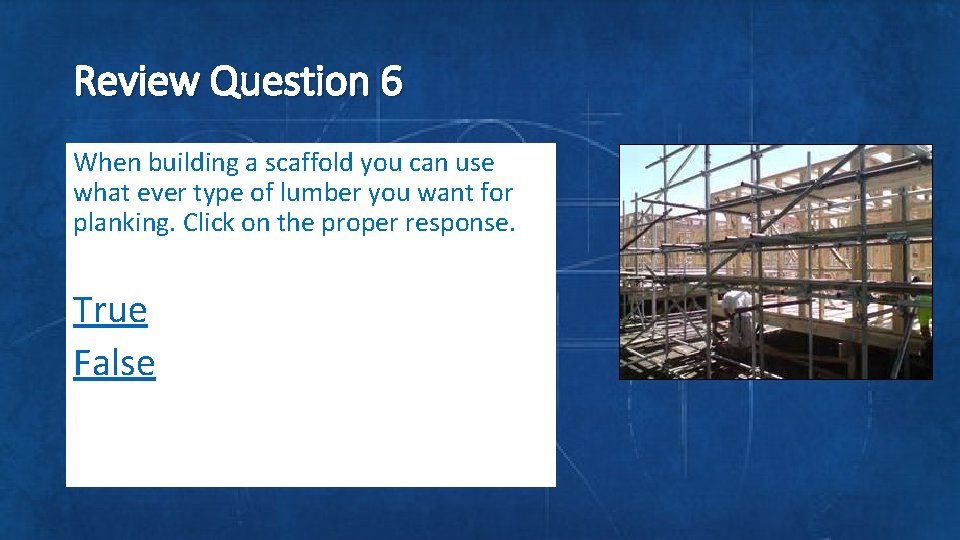
Review Question 6 When building a scaffold you can use what ever type of lumber you want for planking. Click on the proper response. True False
You are Correct You must always use scaffold grade planking when building a scaffold platform
Incorrect The answer is false. You must always use scaffold grade planking when building a scaffold platform
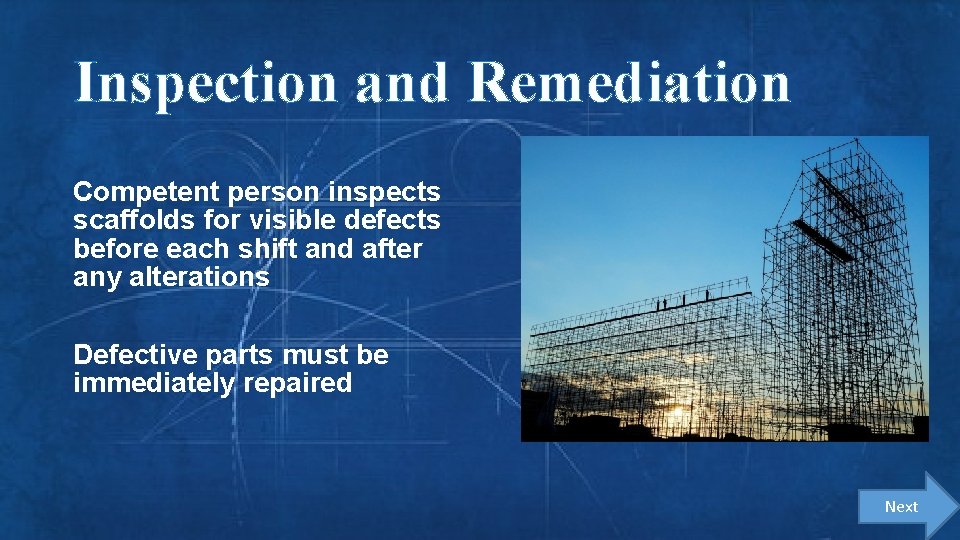
Inspection and Remediation Competent person inspects scaffolds for visible defects before each shift and after any alterations Defective parts must be immediately repaired Next
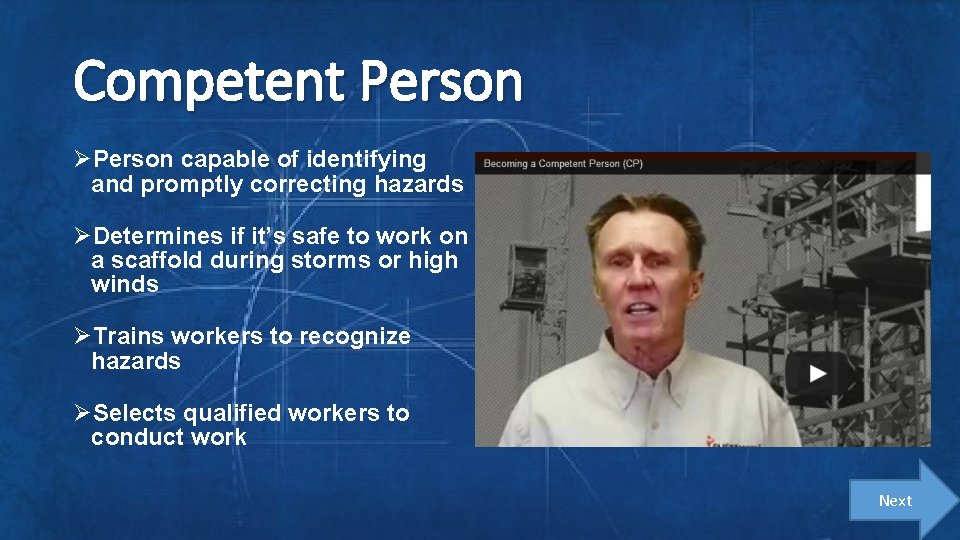
Competent Person ØPerson capable of identifying and promptly correcting hazards ØDetermines if it’s safe to work on a scaffold during storms or high winds ØTrains workers to recognize hazards ØSelects qualified workers to conduct work Next
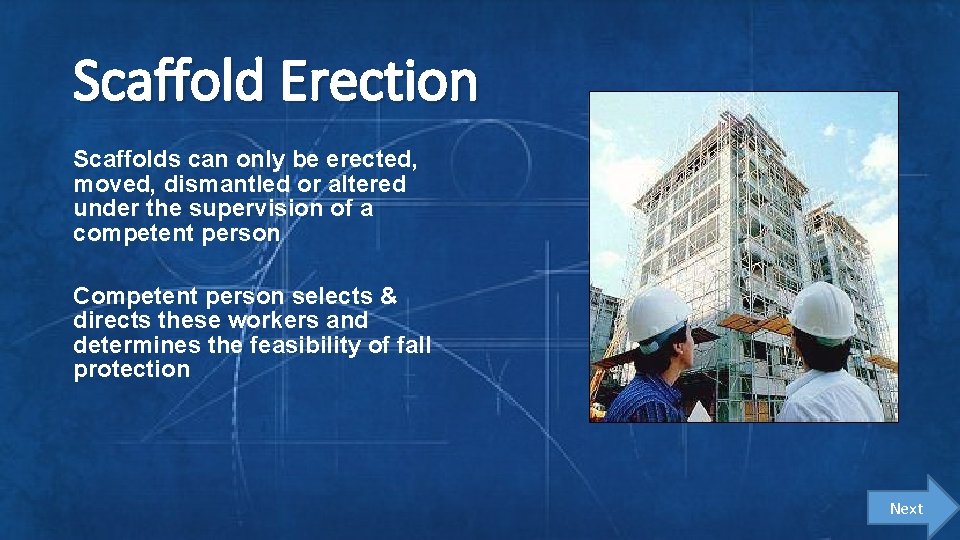
Scaffold Erection Scaffolds can only be erected, moved, dismantled or altered under the supervision of a competent person Competent person selects & directs these workers and determines the feasibility of fall protection Next
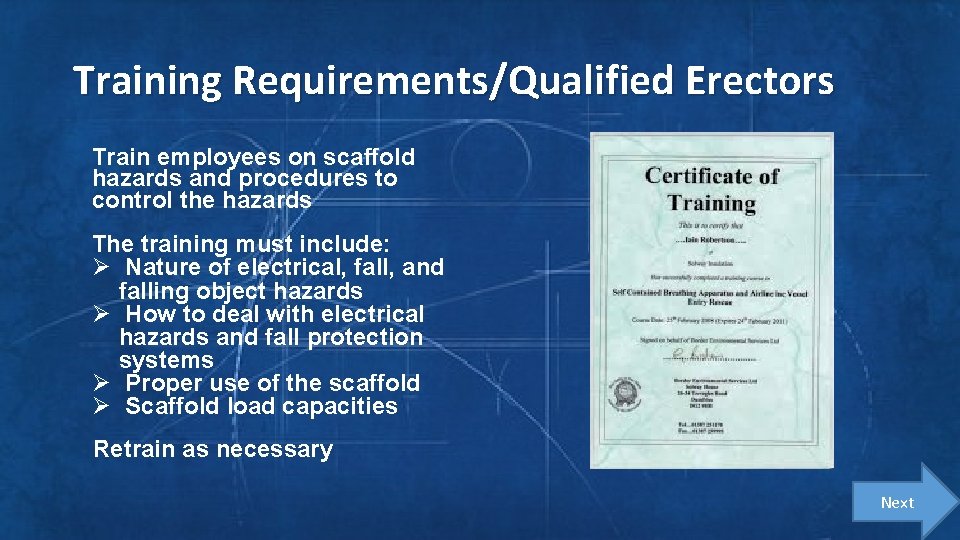
Training Requirements/Qualified Erectors Train employees on scaffold hazards and procedures to control the hazards The training must include: Ø Nature of electrical, fall, and falling object hazards Ø How to deal with electrical hazards and fall protection systems Ø Proper use of the scaffold Ø Scaffold load capacities Retrain as necessary Next
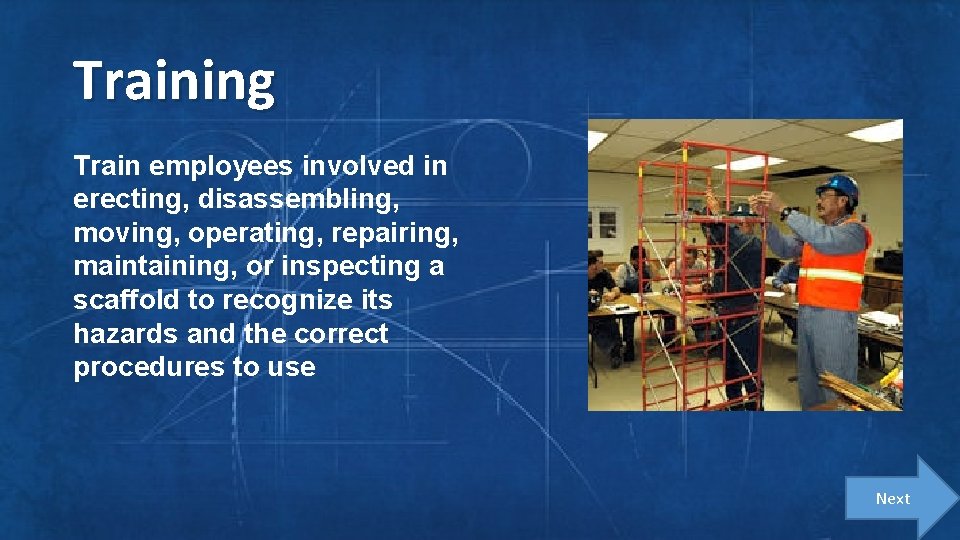
Training Train employees involved in erecting, disassembling, moving, operating, repairing, maintaining, or inspecting a scaffold to recognize its hazards and the correct procedures to use Next

In the text box below 3 qualifications of a competent person. Print screen shot bring to class. Next
A competent does have the authority to make immediate changes to hazards they observe while doing scaffold Inspections? True False
You are Correct Yes a competent person does have the authority to make on the spot changes. Next

Incorrect The answer is true. The competent person does have this authority. Next
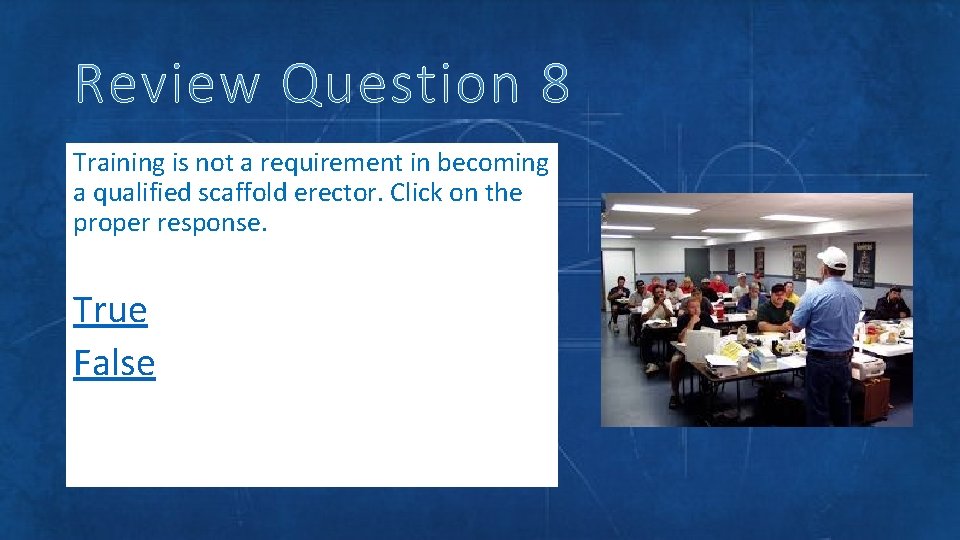
Training is not a requirement in becoming a qualified scaffold erector. Click on the proper response. True False
You are Correct Yes training is a critical element in becoming a qualified scaffold erector.
Incorrect The answer is False. Training is a requirement in becoming a qualified scaffold erector.
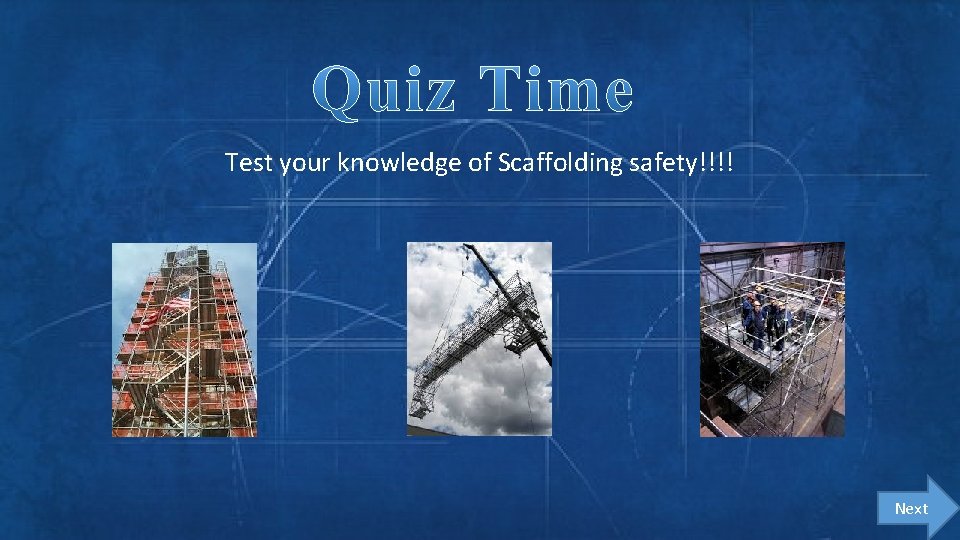
Test your knowledge of Scaffolding safety!!!! Next
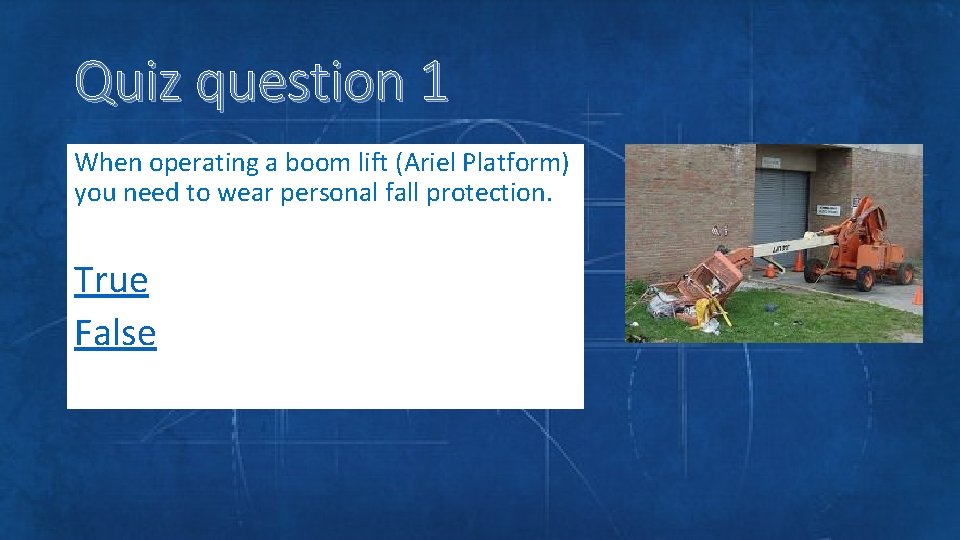
Quiz question 1 When operating a boom lift (Ariel Platform) you need to wear personal fall protection. True False
You are Correct Yes you must wear your personal fall protection when in an Ariel lift. Next

Incorrect The answer is true. You must have personal fall protection on when in an Ariel lift. Next
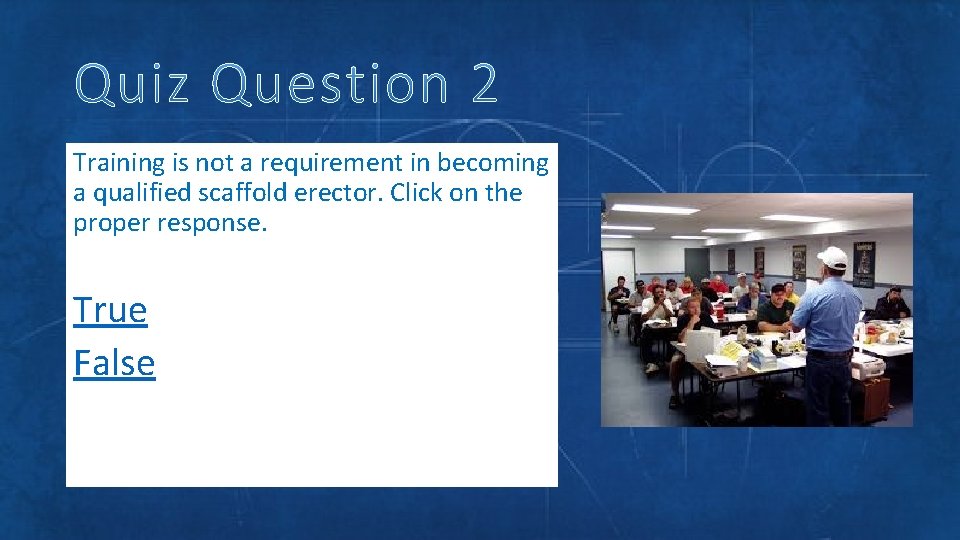
Training is not a requirement in becoming a qualified scaffold erector. Click on the proper response. True False
You are Correct Yes training is a critical element in becoming a qualified scaffold erector. Next
Incorrect The answer is False. Training is a requirement in becoming a qualified scaffold erector. Next
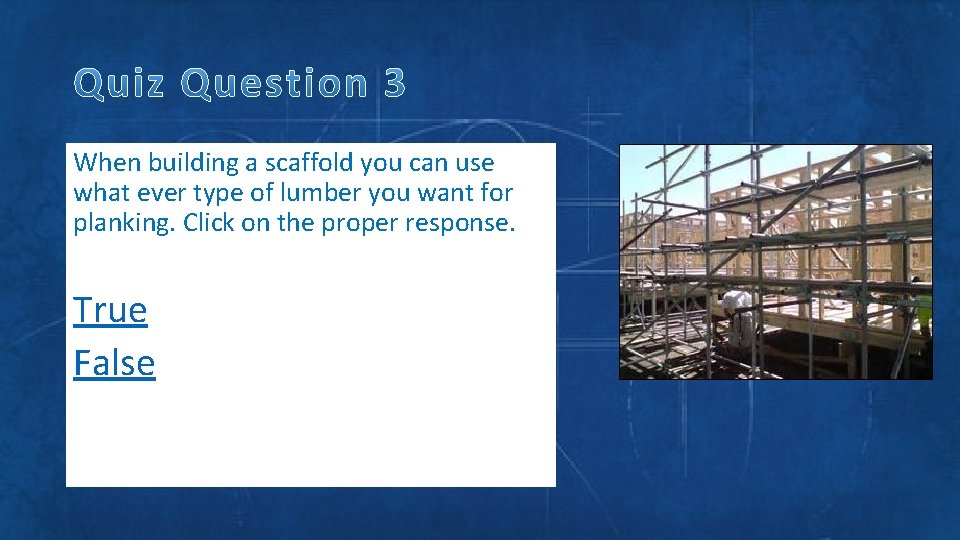
When building a scaffold you can use what ever type of lumber you want for planking. Click on the proper response. True False
You are Correct You must always use scaffold grade planking when building a scaffold platform Next

Incorrect The answer is false. You must always use scaffold grade planking when building a scaffold platform Next
You have completed your basic scaffolding safety training module!! See you in class!
- Slides: 58