
Before You Were Mine Im ten years away
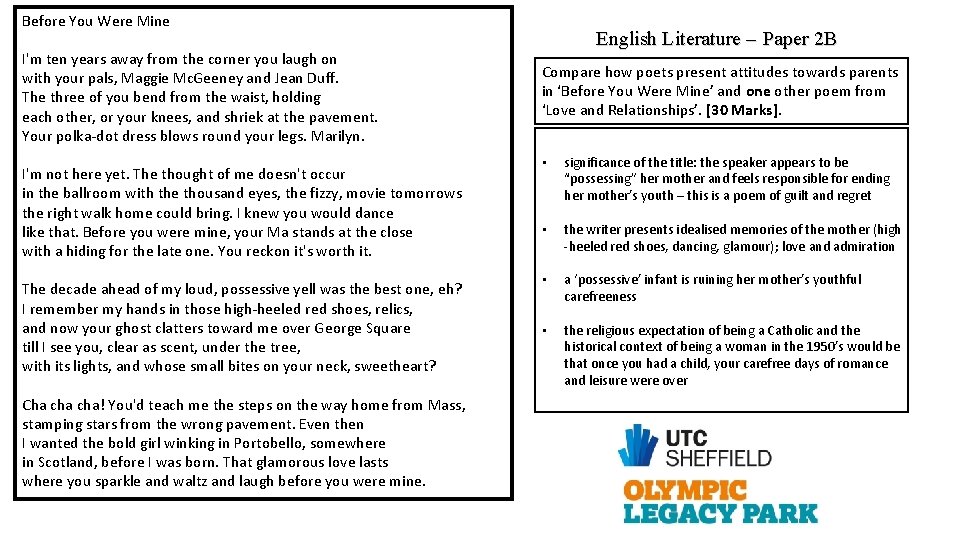
Before You Were Mine I'm ten years away from the corner you laugh on with your pals, Maggie Mc. Geeney and Jean Duff. The three of you bend from the waist, holding each other, or your knees, and shriek at the pavement. Your polka-dot dress blows round your legs. Marilyn. I'm not here yet. The thought of me doesn't occur in the ballroom with the thousand eyes, the fizzy, movie tomorrows the right walk home could bring. I knew you would dance like that. Before you were mine, your Ma stands at the close with a hiding for the late one. You reckon it's worth it. The decade ahead of my loud, possessive yell was the best one, eh? I remember my hands in those high-heeled red shoes, relics, and now your ghost clatters toward me over George Square till I see you, clear as scent, under the tree, with its lights, and whose small bites on your neck, sweetheart? Cha cha! You'd teach me the steps on the way home from Mass, stamping stars from the wrong pavement. Even then I wanted the bold girl winking in Portobello, somewhere in Scotland, before I was born. That glamorous love lasts where you sparkle and waltz and laugh before you were mine. English Literature – Paper 2 B Compare how poets present attitudes towards parents in ‘Before You Were Mine’ and one other poem from ‘Love and Relationships’. [30 Marks]. • significance of the title: the speaker appears to be “possessing” her mother and feels responsible for ending her mother’s youth – this is a poem of guilt and regret • the writer presents idealised memories of the mother (high -heeled red shoes, dancing, glamour); love and admiration • a ‘possessive’ infant is ruining her mother’s youthful carefreeness • the religious expectation of being a Catholic and the historical context of being a woman in the 1950’s would be that once you had a child, your carefree days of romance and leisure were over
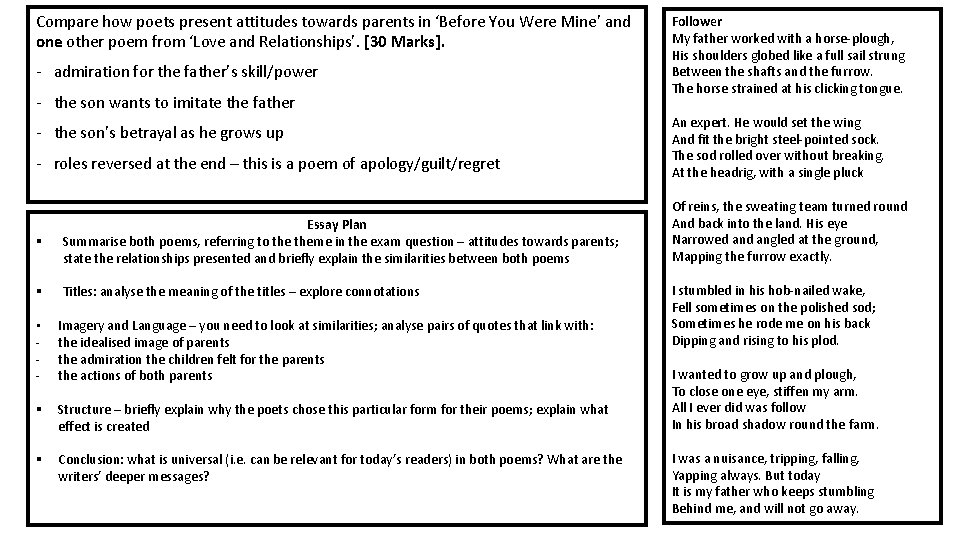
Compare how poets present attitudes towards parents in ‘Before You Were Mine’ and one other poem from ‘Love and Relationships’. [30 Marks]. - admiration for the father’s skill/power - the son wants to imitate the father - the son’s betrayal as he grows up - roles reversed at the end – this is a poem of apology/guilt/regret § Essay Plan Summarise both poems, referring to theme in the exam question – attitudes towards parents; state the relationships presented and briefly explain the similarities between both poems § Titles: analyse the meaning of the titles – explore connotations • - Imagery and Language – you need to look at similarities; analyse pairs of quotes that link with: the idealised image of parents the admiration the children felt for the parents the actions of both parents § Structure – briefly explain why the poets chose this particular form for their poems; explain what effect is created § Conclusion: what is universal (i. e. can be relevant for today’s readers) in both poems? What are the writers’ deeper messages? Follower My father worked with a horse-plough, His shoulders globed like a full sail strung Between the shafts and the furrow. The horse strained at his clicking tongue. An expert. He would set the wing And fit the bright steel-pointed sock. The sod rolled over without breaking. At the headrig, with a single pluck Of reins, the sweating team turned round And back into the land. His eye Narrowed angled at the ground, Mapping the furrow exactly. I stumbled in his hob-nailed wake, Fell sometimes on the polished sod; Sometimes he rode me on his back Dipping and rising to his plod. I wanted to grow up and plough, To close one eye, stiffen my arm. All I ever did was follow In his broad shadow round the farm. I was a nuisance, tripping, falling, Yapping always. But today It is my father who keeps stumbling Behind me, and will not go away.
- Slides: 2