
Before You Start To be able to properly
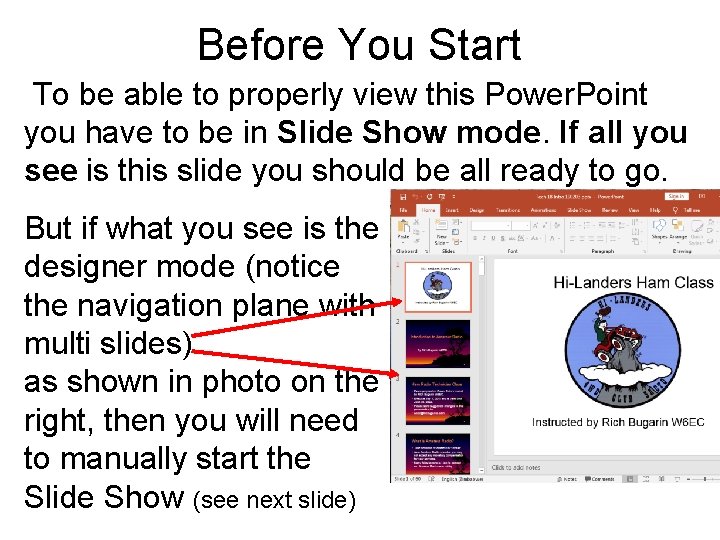
Before You Start To be able to properly view this Power. Point you have to be in Slide Show mode. If all you see is this slide you should be all ready to go. But if what you see is the designer mode (notice the navigation plane with multi slides) as shown in photo on the right, then you will need to manually start the Slide Show (see next slide)

To manually start Slide Show if needed Left click on “Slide Show” Then Left click on “From Beginning” That’s it you should now be on your way. To advance slide use Lift click or mouse scroll or space bar or left/right arrows. For more options Right click

Hi-Landers Ham Class Instructed by Rich Bugarin W 6 EC
Sub-element 5 of 10

Ham Radio Technician Class Exam preparation Power Point created by Rich Bugarin W 6 EC. Effective July 1, 2018 and is valid until June 30, 2022. Please send suggested changes to this presentation to: w 6 ec@thebugarins. com

Study Hints • I suggest you read each question and only the correct answer. Read through the complete question pool at least three times before you attempt taking a practice exams. For higher impact and better results read the correct answer first then the question and again the correct answer. • The key to passing the exam is to get the most questions correct using the above method the correct response will often jump out at you on test day even if you don’t remember the question.

Text Color • Black: Original/Official questions and information in original format (unaltered). • Red: Original information text color simply changed to highlight subject. • Blue: Notes and information added by Rich (W 6 EC).
• SUBELEMENT T 5 – Electrical principles, math for electronics, electronic principles, Ohm’s Law • [4 Exam Questions - 4 Groups]
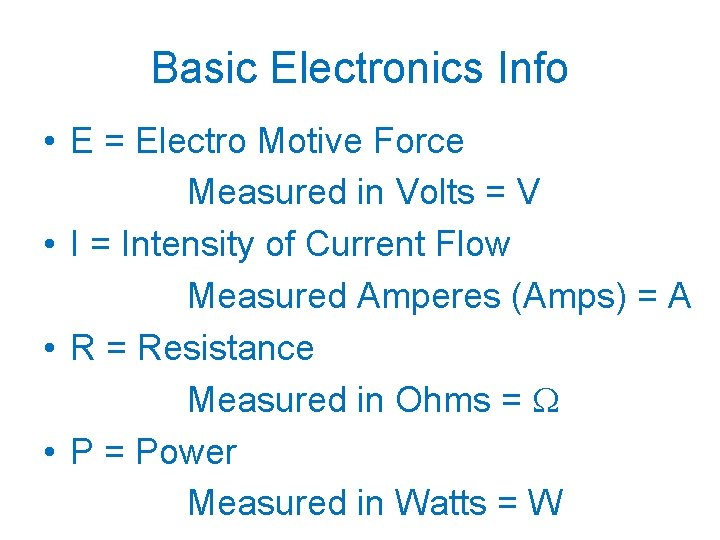
Basic Electronics Info • E = Electro Motive Force Measured in Volts = V • I = Intensity of Current Flow Measured Amperes (Amps) = A • R = Resistance Measured in Ohms = • P = Power Measured in Watts = W
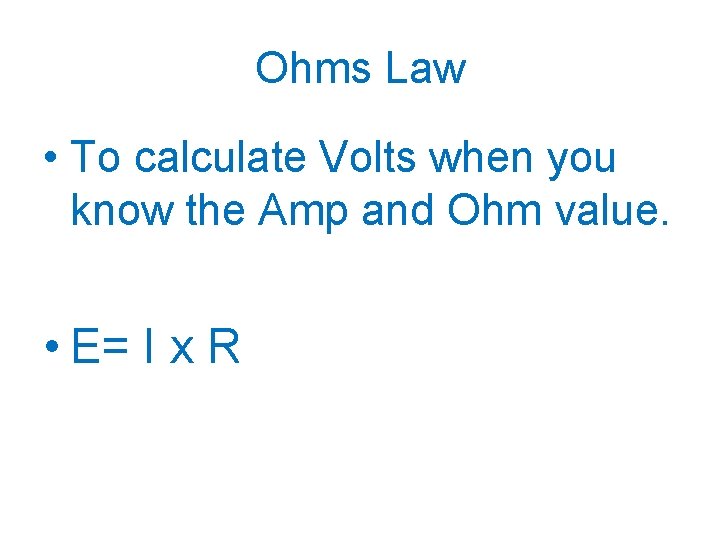
Ohms Law • To calculate Volts when you know the Amp and Ohm value. • E= I x R
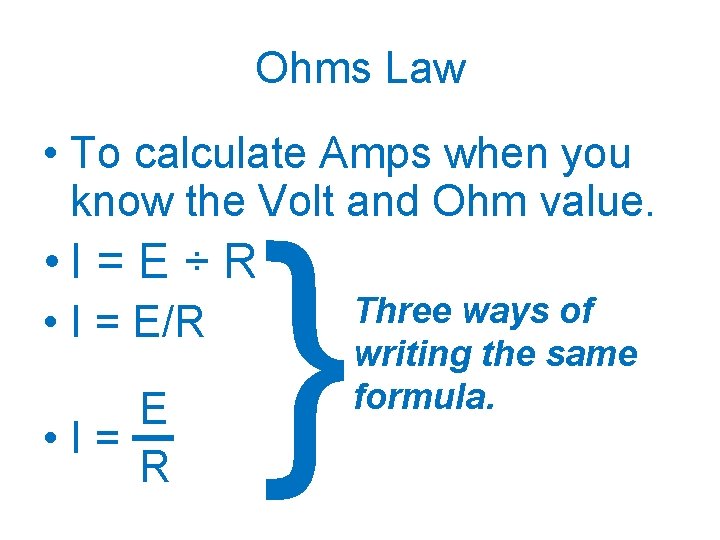
Ohms Law • To calculate Amps when you know the Volt and Ohm value. • I = E ÷ R • I = E/R E • I= R } Three ways of writing the same formula.
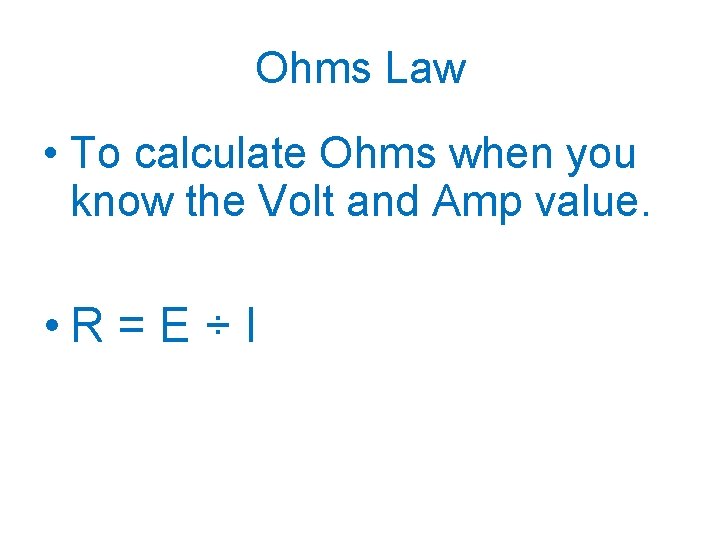
Ohms Law • To calculate Ohms when you know the Volt and Amp value. • R = E ÷ I
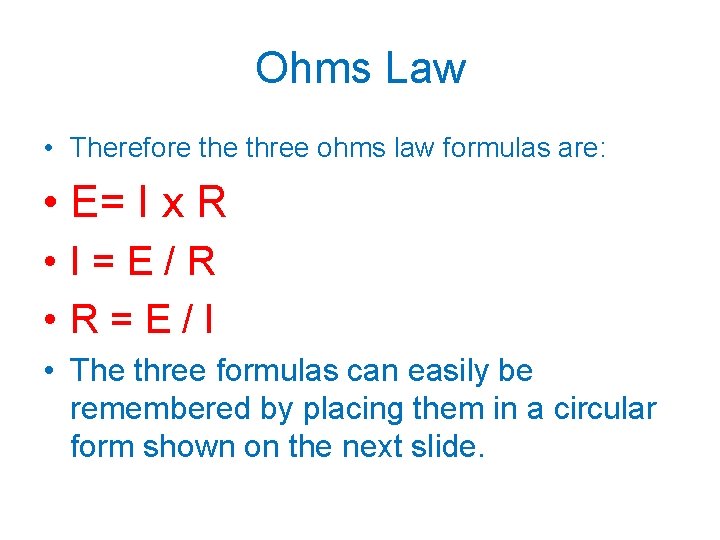
Ohms Law • Therefore three ohms law formulas are: • E= I x R • I=E/R • R=E/I • The three formulas can easily be remembered by placing them in a circular form shown on the next slide.
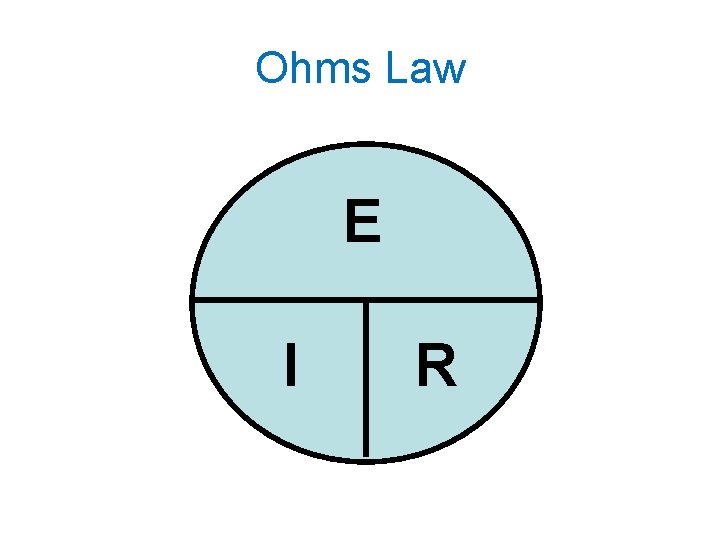
Ohms Law E I R
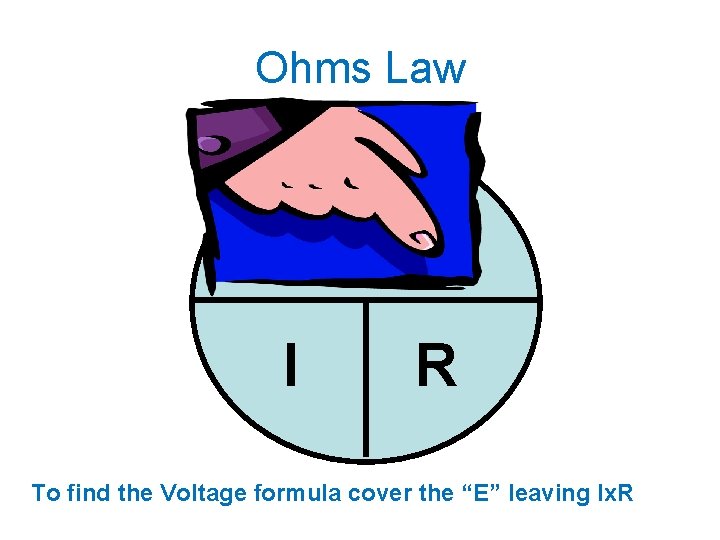
Ohms Law E I R To find the Voltage formula cover the “E” leaving Ix. R
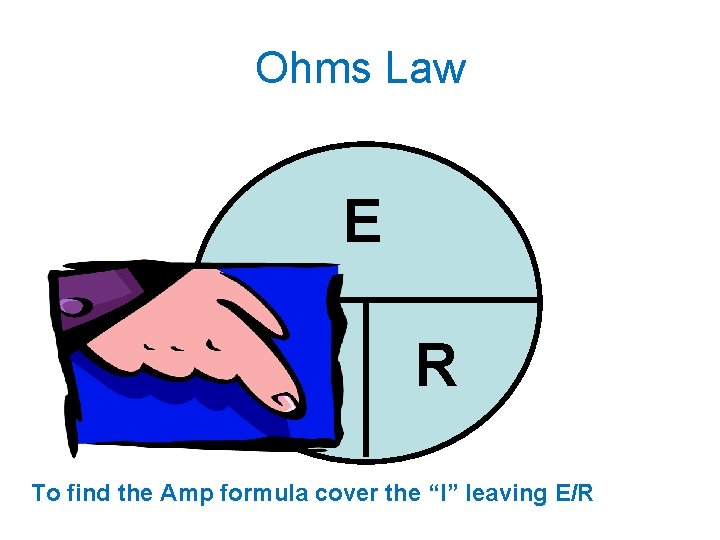
Ohms Law E I R To find the Amp formula cover the “I” leaving E/R
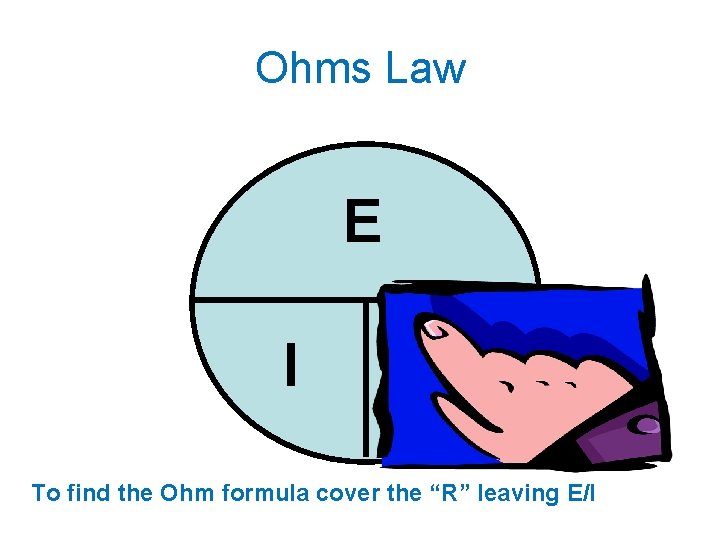
Ohms Law E I R To find the Ohm formula cover the “R” leaving E/I
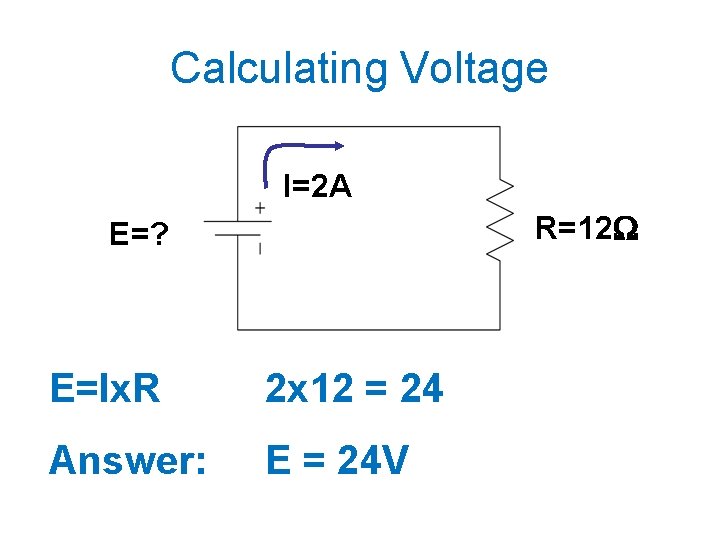
Calculating Voltage I=2 A R=12 E=? E=Ix. R 2 x 12 = 24 Answer: E = 24 V
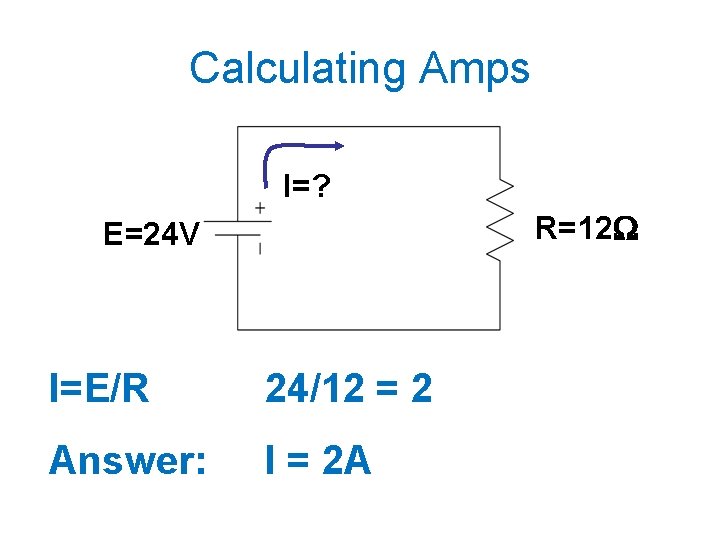
Calculating Amps I=? R=12 E=24 V I=E/R 24/12 = 2 Answer: I = 2 A
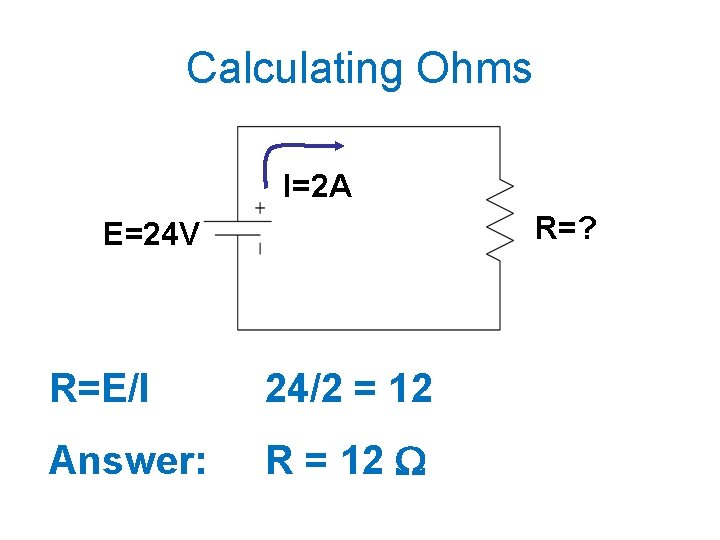
Calculating Ohms I=2 A R=? E=24 V R=E/I 24/2 = 12 Answer: R = 12
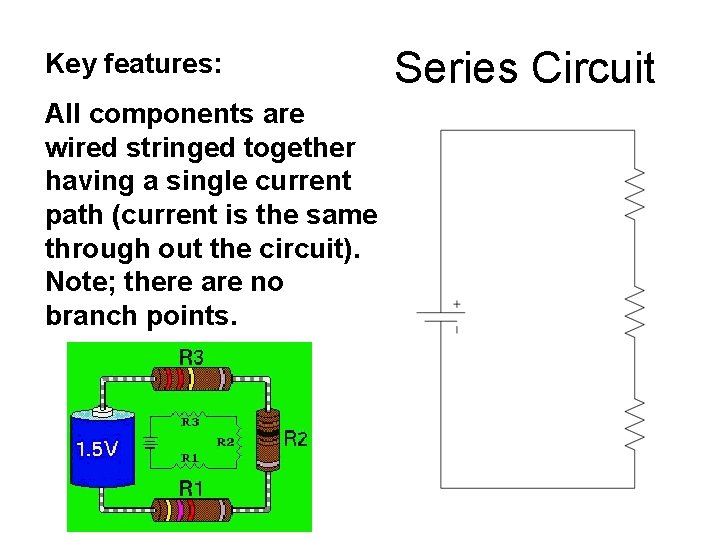
Key features: All components are wired stringed together having a single current path (current is the same through out the circuit). Note; there are no branch points. Series Circuit
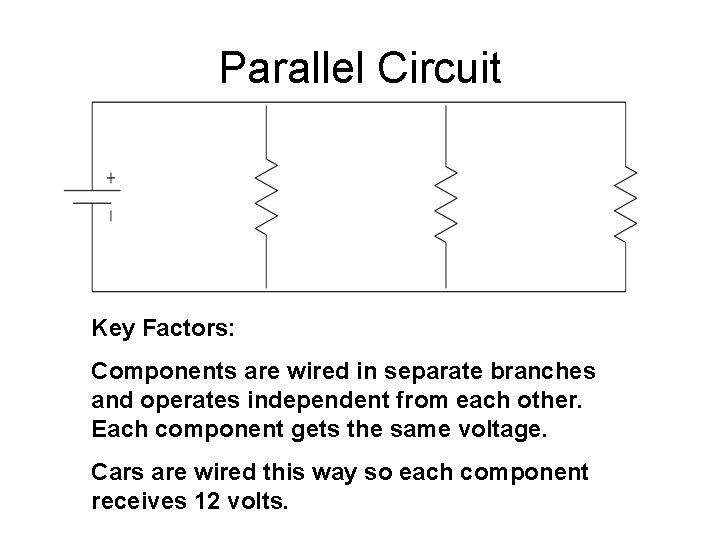
Parallel Circuit Key Factors: Components are wired in separate branches and operates independent from each other. Each component gets the same voltage. Cars are wired this way so each component receives 12 volts.
• T 5 A - Electrical principles, units, and terms: current and voltage; conductors and insulators; alternating and direct current; series and parallel circuits • #15 of 35
T 5 A 01 Electrical current is measured in which of the following units? A. Volts B. Watts Current = Amps C. Ohms (flow of Electrons) D. Amperes
T 5 A 02 Electrical power is measured in which of the following units? A. Volts B. Watts Power = Watts C. Ohms A unit of total work D. Amperes
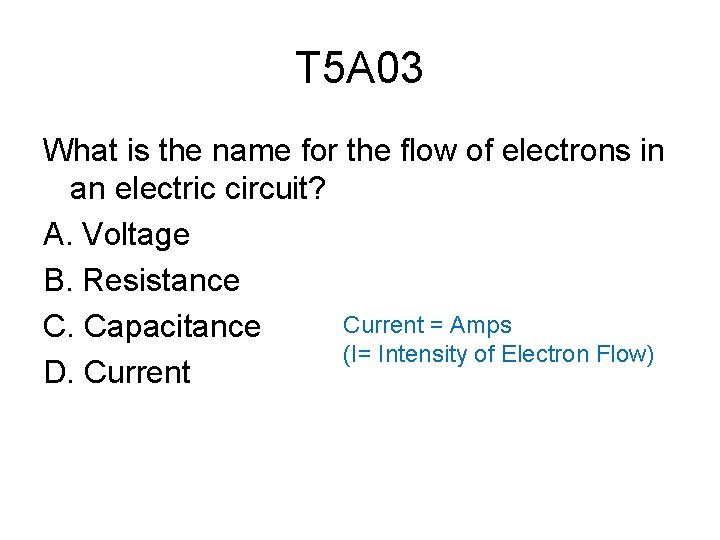
T 5 A 03 What is the name for the flow of electrons in an electric circuit? A. Voltage B. Resistance Current = Amps C. Capacitance (I= Intensity of Electron Flow) D. Current
T 5 A 04 What is the name for a current that flows only in one direction? A. Alternating current B. Direct current C. Normal current D. Smooth current
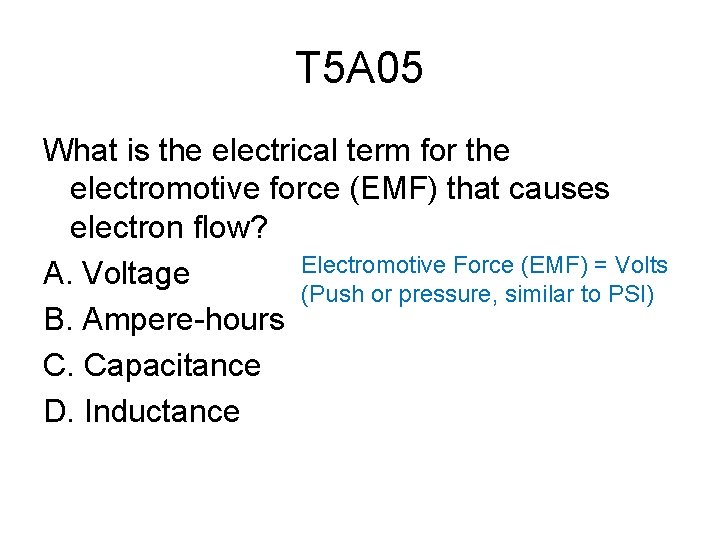
T 5 A 05 What is the electrical term for the electromotive force (EMF) that causes electron flow? Electromotive Force (EMF) = Volts A. Voltage (Push or pressure, similar to PSI) B. Ampere-hours C. Capacitance D. Inductance
T 5 A 06 How much voltage does a mobile transceiver usually require? A. About 12 volts B. About 30 volts C. About 120 volts D. About 240 volts
T 5 A 07 Which of the following is a good electrical conductor? A. Glass B. Wood C. Copper D. Rubber
T 5 A 08 Which of the following is a good electrical insulator? A. Copper B. Glass C. Aluminum D. Mercury
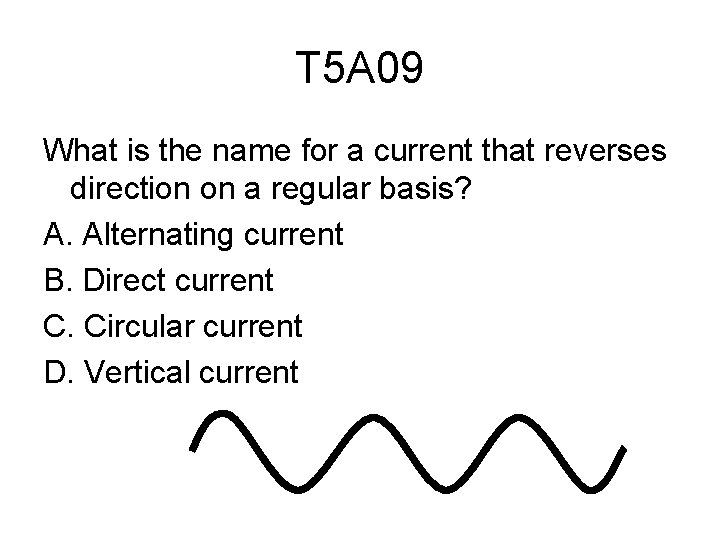
T 5 A 09 What is the name for a current that reverses direction on a regular basis? A. Alternating current B. Direct current C. Circular current D. Vertical current
T 5 A 10 Which term describes the rate at which electrical energy is used? A. Resistance B. Current Power = Watts C. Power A unit of total work or use of energy D. Voltage
T 5 A 11 What is the basic unit of electromotive force? A. The volt Electromotive Force (EMF) = Volts B. The watt (Push or pressure, similar to PSI) C. The ampere D. The ohm
T 5 A 12 What term describes the number of times per second that an alternating current reverses direction? A. Pulse rate B. Speed C. Wavelength D. Frequency is measured in Hertz = Hz, it is a measure of how many cycles occur in one second
T 5 A 13 In which type of circuit is current the same through all components? A. Series B. Parallel C. Resonant D. Branch
T 5 A 14 In which type of circuit is voltage the same across all components? A. Series B. Parallel C. Resonant D. Branch
• T 5 B - Math for electronics: conversion of electrical units; decibels; the metric system • #16 of 35

METRIC PREFIX • Metric prefixes are used to shorten a number to allow easer handling and communications of the value. • Metric prefixes were originally used in the scientific and electronics sectors, but with high tech equipment all around us it has found its way into every day life. • An example is a computer has 512, 000 bytes of memory, it is easer to say 512 Mega Bytes and very easy to write it as 512 Mb. • Following is the most common metric prefixes used in electronics and a convenient chart to organize them.
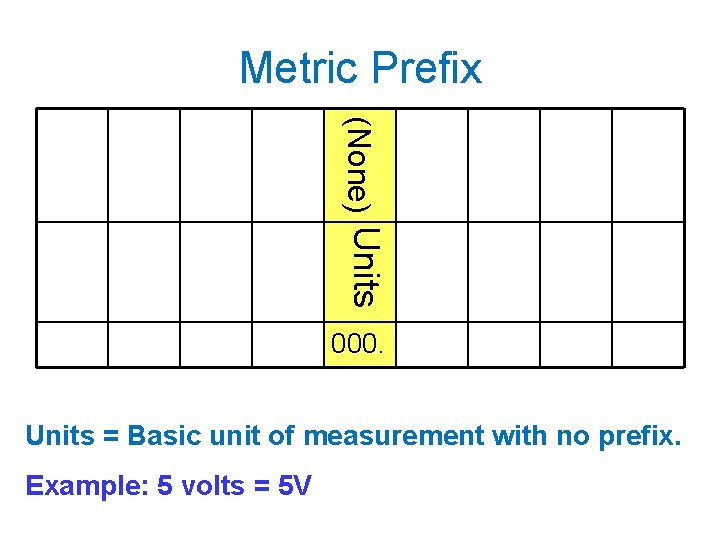
Metric Prefix (None) Units 000. Units = Basic unit of measurement with no prefix. Example: 5 volts = 5 V
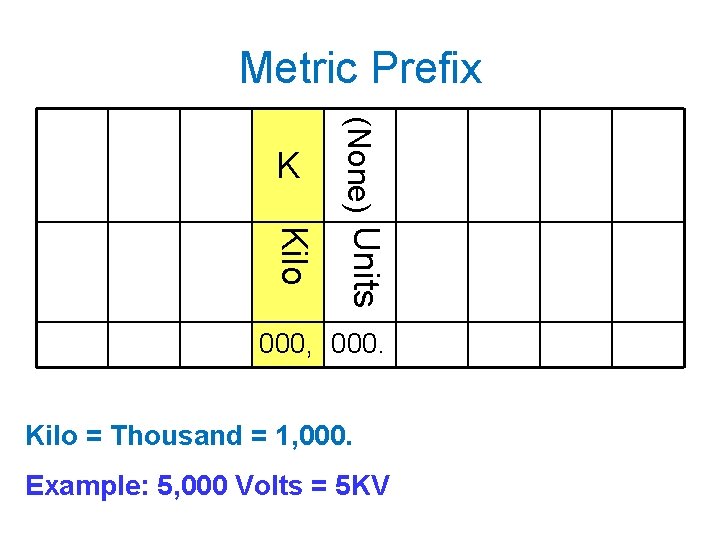
Metric Prefix Kilo (None) Units K 000, 000. Kilo = Thousand = 1, 000. Example: 5, 000 Volts = 5 KV
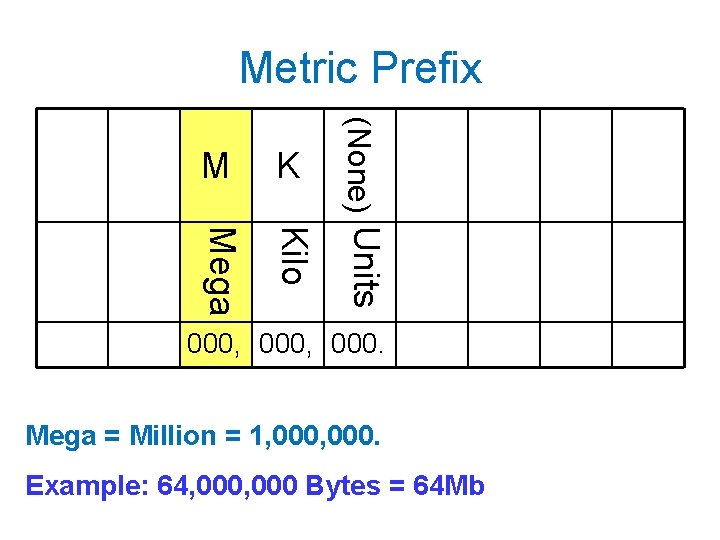
Metric Prefix K Mega Kilo (None) Units M 000, 000. Mega = Million = 1, 000. Example: 64, 000 Bytes = 64 Mb
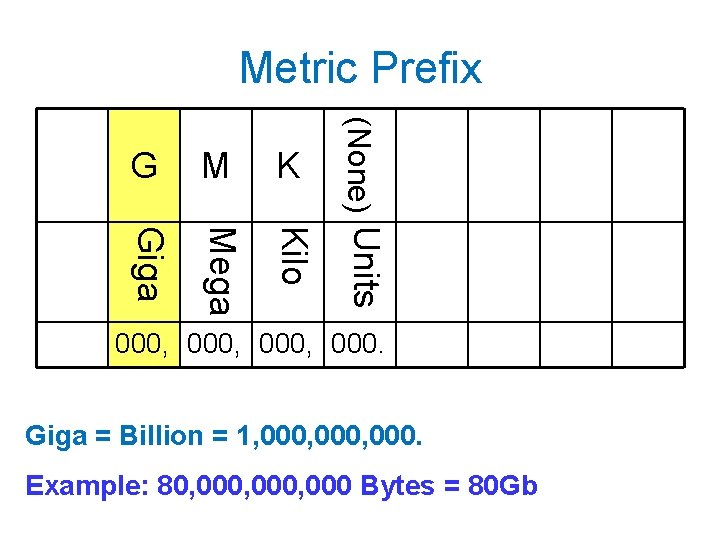
Metric Prefix M K Giga Mega Kilo (None) Units G 000, 000. Giga = Billion = 1, 000, 000. Example: 80, 000, 000 Bytes = 80 Gb
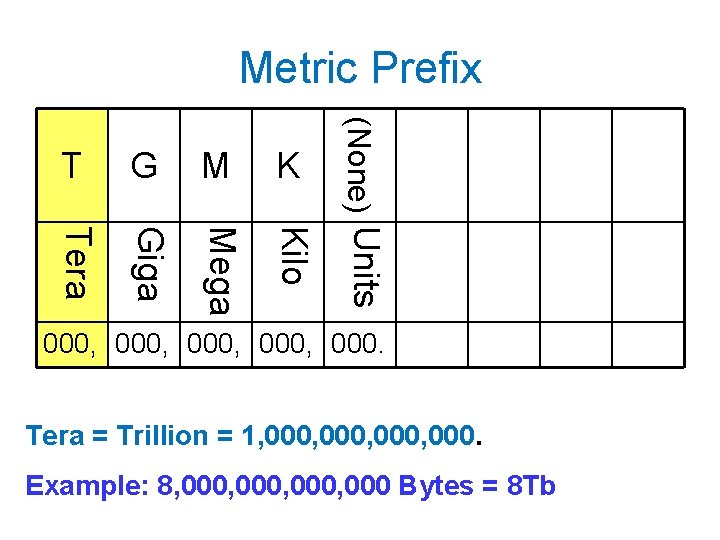
Metric Prefix G M K Tera Giga Mega Kilo (None) Units T 000, 000. Tera = Trillion = 1, 000, 000. Example: 8, 000, 000 Bytes = 8 Tb
• Kilo, Mega Giga and Tera are conveniently spaced 1000 apart from each other. • Mega is a thousand times larger than Kilo. • Mega is a thousand times smaller than Giga. • Kilo, Mega Giga and Tera are all used to represent numbers that are larger than the number 1.
• Some times we will be dealing with numbers that are smaller than the number 1. • Lets say we have a meter stick and we brake it into a thousand pieces, we then keep 5 of the thousand pieces we can express that as 5/1000 or 0. 005 meters. • Using metric prefixes it is known as 5 milli meters and written as 5 mm.
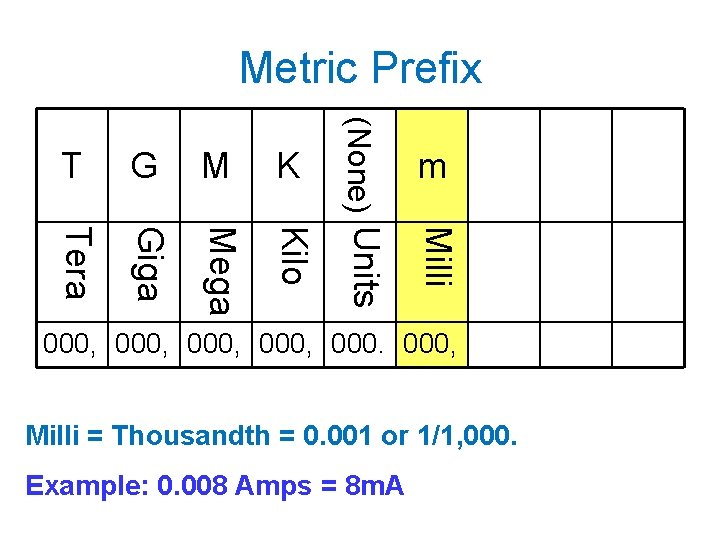
Metric Prefix M K Tera Giga Mega Kilo m Milli G (None) Units T 000, 000, Milli = Thousandth = 0. 001 or 1/1, 000. Example: 0. 008 Amps = 8 m. A
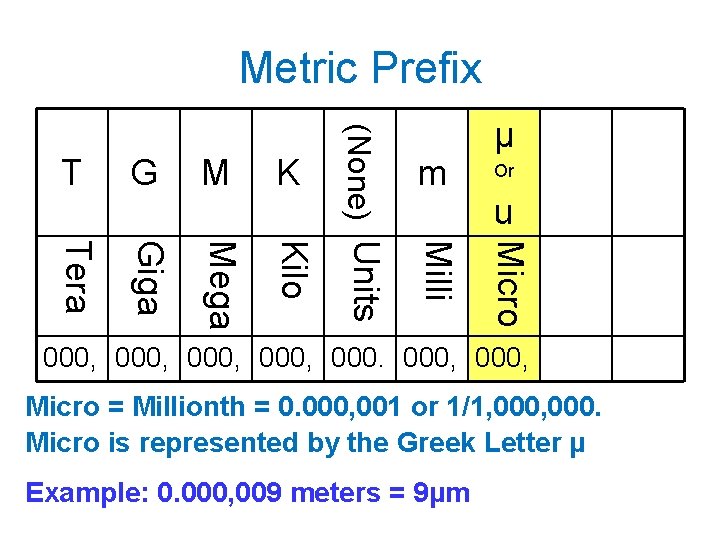
Metric Prefix K Tera Giga Mega Kilo m Or u Micro M Milli G (None) Units T µ 000, 000, Micro = Millionth = 0. 000, 001 or 1/1, 000. Micro is represented by the Greek Letter µ Example: 0. 000, 009 meters = 9µm
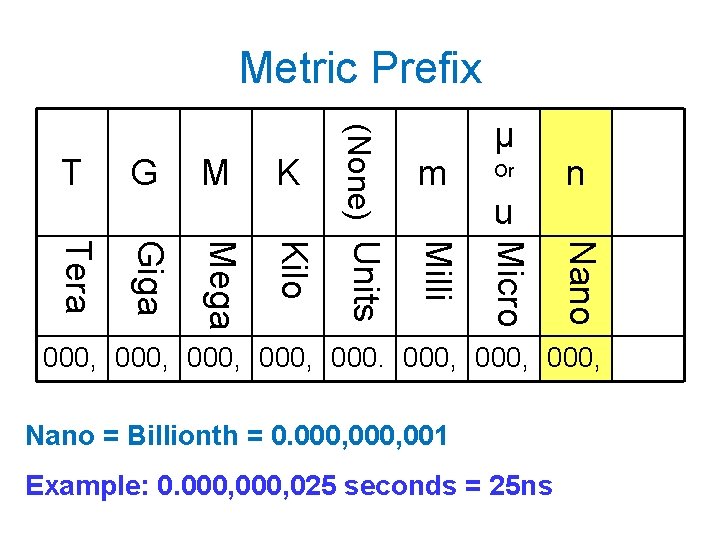
Metric Prefix Tera Giga Mega Kilo m Or u n Nano K Micro M Milli G (None) Units T µ 000, 000, Nano = Billionth = 0. 000, 001 Example: 0. 000, 025 seconds = 25 ns
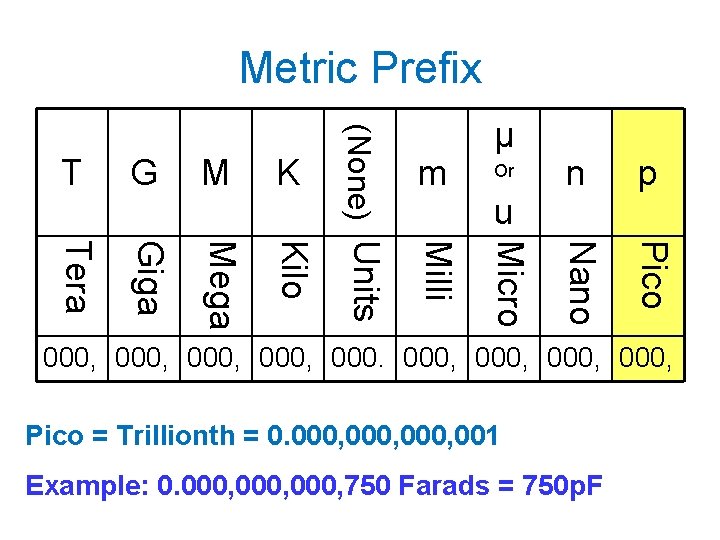
Metric Prefix Giga Mega Kilo Or u n p Pico Tera m Nano K Micro M Milli G (None) Units T µ 000, 000, Pico = Trillionth = 0. 000, 001 Example: 0. 000, 750 Farads = 750 p. F
• Milli, Micro, Nano and Pico are also conveniently spaced 1000 apart from each other. • Micro is a thousand times smaller than Milli. • Micro is a thousand times larger than Nano. • Milli, Micro, Nano and Pico are all used to represent numbers that are smaller than the number 1.
Prefix Conversion • The Prefix chart we have been using can also be used as a visual aid in converting a number from one metric prefix to another such as from Kilo to Mega. • The following pages show examples of how to convert the number.
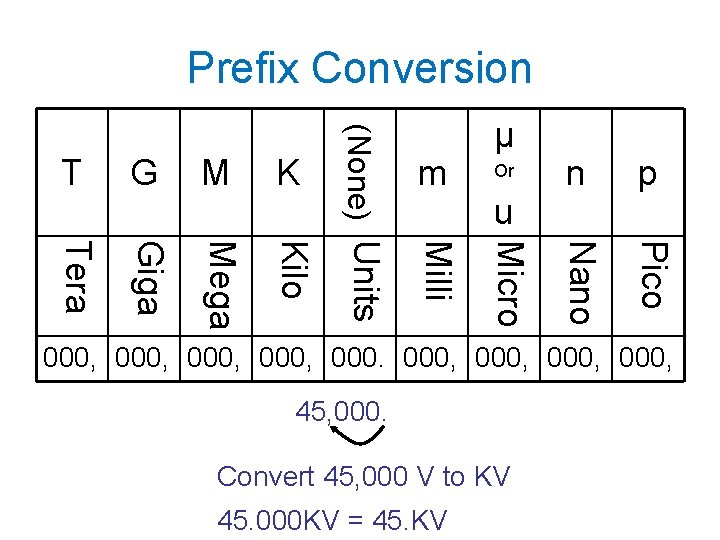
Prefix Conversion Giga Mega Kilo Or u n p Pico Tera m Nano K Micro M Milli G (None) Units T µ 000, 000, 45, 000. Convert 45, 000 V to KV 45. 000 KV = 45. KV
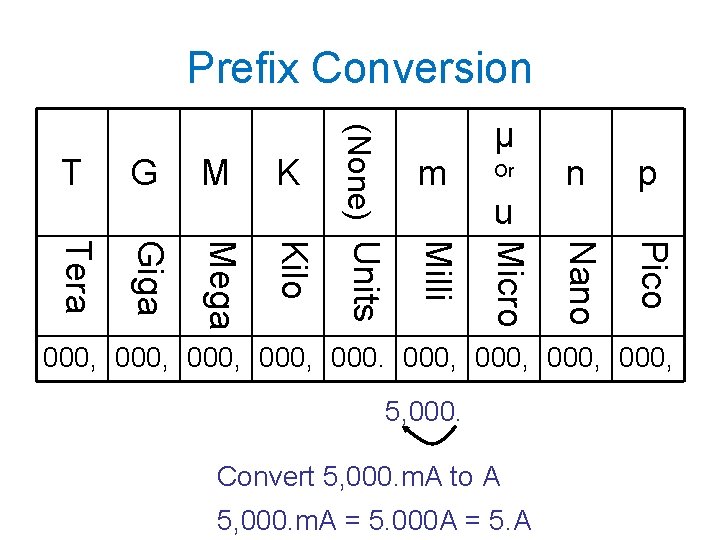
Prefix Conversion Giga Mega Kilo Or u n p Pico Tera m Nano K Micro M Milli G (None) Units T µ 000, 000, 5, 000. Convert 5, 000. m. A to A 5, 000. m. A = 5. 000 A = 5. A
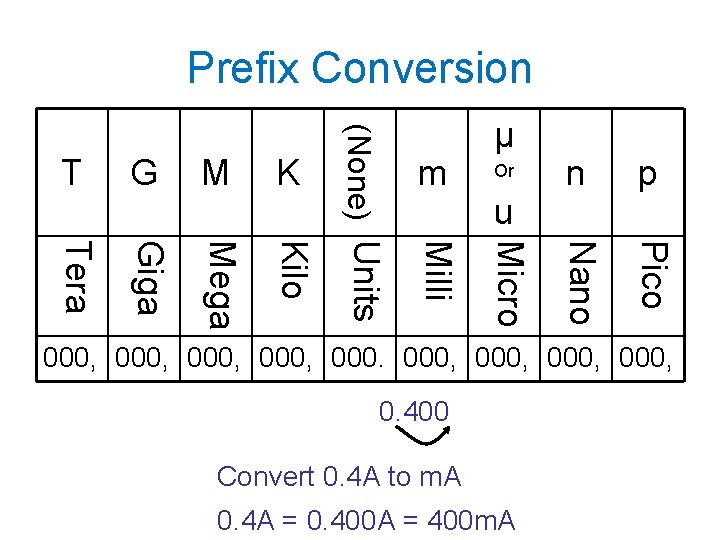
Prefix Conversion Giga Mega Kilo Or u n p Pico Tera m Nano K Micro M Milli G (None) Units T µ 000, 000, 0. 400 Convert 0. 4 A to m. A 0. 4 A = 0. 400 A = 400 m. A
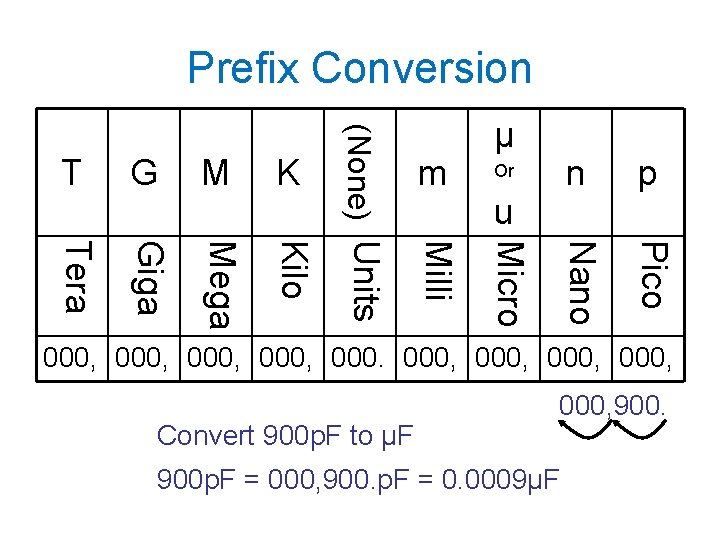
Prefix Conversion Giga Mega Kilo Or u n p Pico Tera m Nano K Micro M Milli G (None) Units T µ 000, 000, Convert 900 p. F to µF 000, 900 p. F = 000, 900. p. F = 0. 0009µF
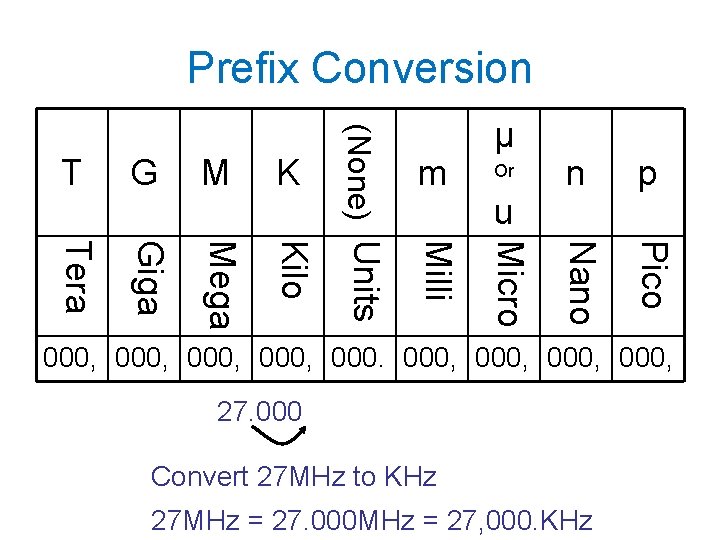
Prefix Conversion Giga Mega Kilo Or u n p Pico Tera m Nano K Micro M Milli G (None) Units T µ 000, 000, 27. 000 Convert 27 MHz to KHz 27 MHz = 27. 000 MHz = 27, 000. KHz
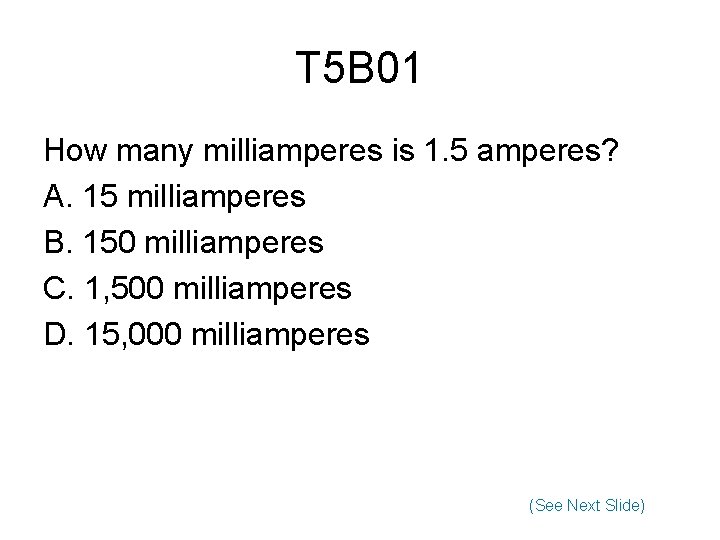
T 5 B 01 How many milliamperes is 1. 5 amperes? A. 15 milliamperes B. 150 milliamperes C. 1, 500 milliamperes D. 15, 000 milliamperes (See Next Slide)
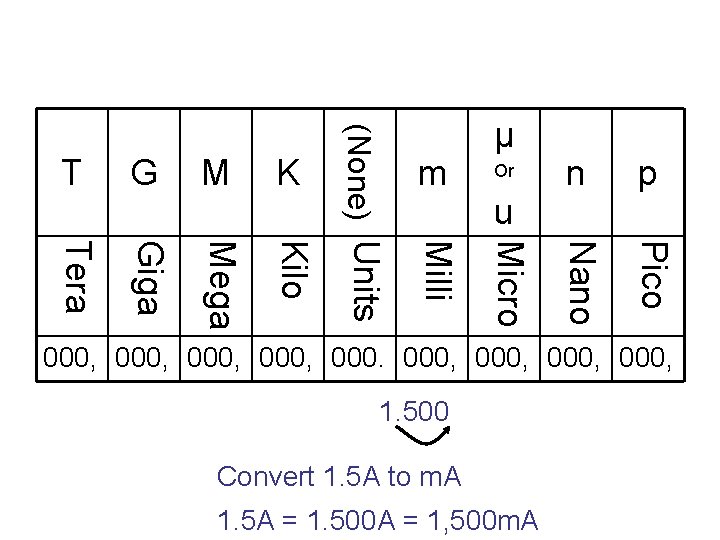
Giga Mega Kilo Or u n p Pico Tera m Nano K Micro M Milli G (None) Units T µ 000, 000, 1. 500 Convert 1. 5 A to m. A 1. 5 A = 1. 500 A = 1, 500 m. A
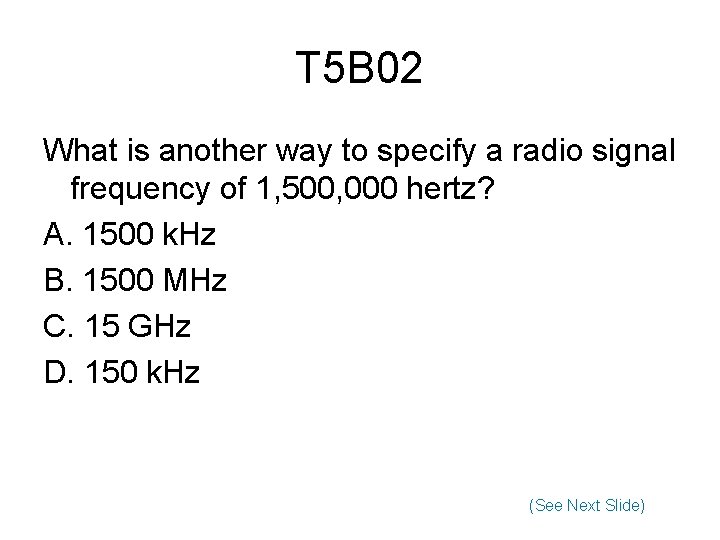
T 5 B 02 What is another way to specify a radio signal frequency of 1, 500, 000 hertz? A. 1500 k. Hz B. 1500 MHz C. 15 GHz D. 150 k. Hz (See Next Slide)
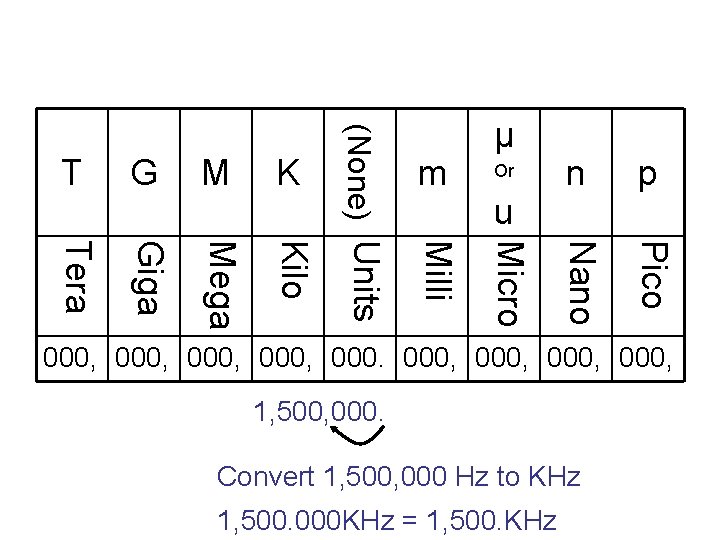
u n p Pico Mega Or Nano Giga m Micro Tera K Milli M (None) Units G Kilo T µ 000, 000, 1, 500, 000. Convert 1, 500, 000 Hz to KHz 1, 500. 000 KHz = 1, 500. KHz
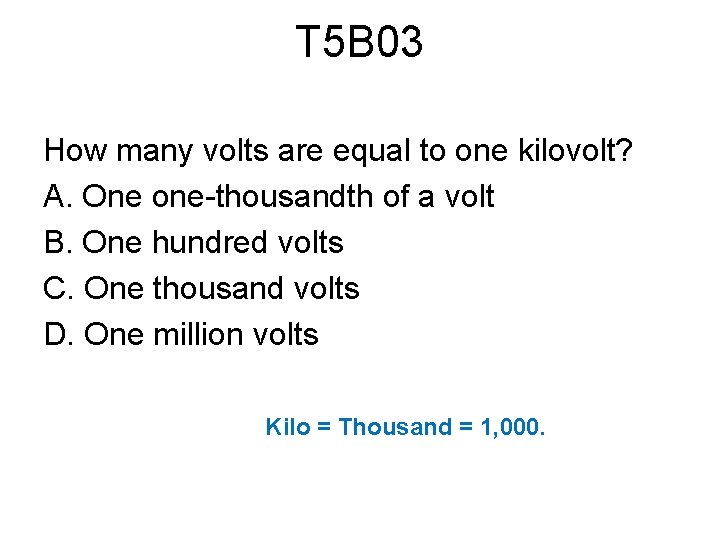
T 5 B 03 How many volts are equal to one kilovolt? A. One one-thousandth of a volt B. One hundred volts C. One thousand volts D. One million volts Kilo = Thousand = 1, 000.
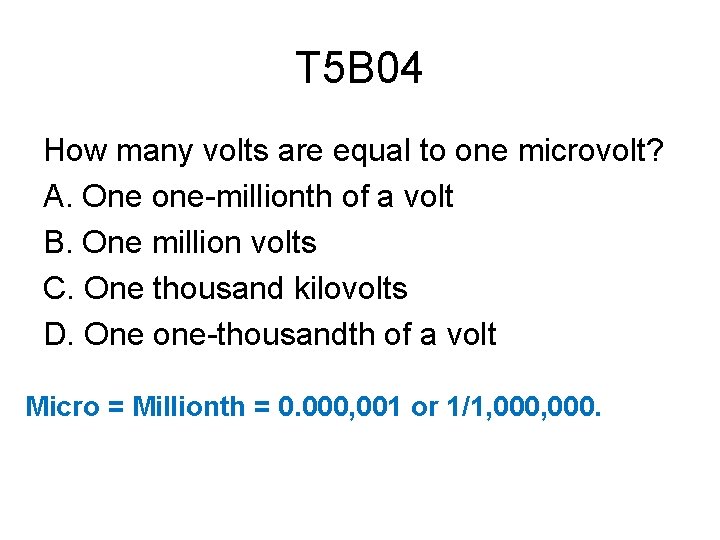
T 5 B 04 How many volts are equal to one microvolt? A. One one-millionth of a volt B. One million volts C. One thousand kilovolts D. One one-thousandth of a volt Micro = Millionth = 0. 000, 001 or 1/1, 000.
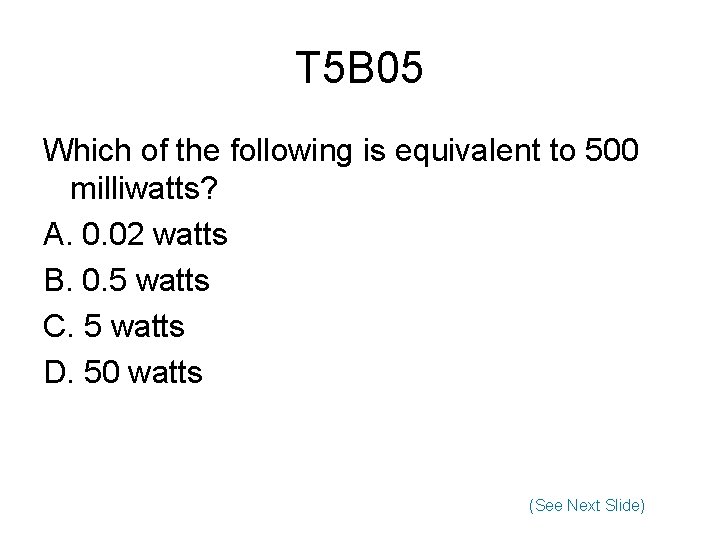
T 5 B 05 Which of the following is equivalent to 500 milliwatts? A. 0. 02 watts B. 0. 5 watts C. 5 watts D. 50 watts (See Next Slide)
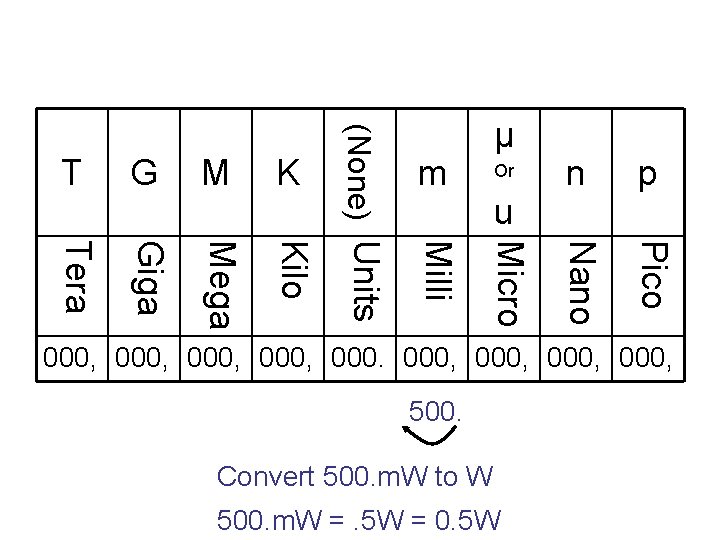
Giga Mega Kilo Or u n p Pico Tera m Nano K Micro M Milli G (None) Units T µ 000, 000, 500. Convert 500. m. W to W 500. m. W =. 5 W = 0. 5 W
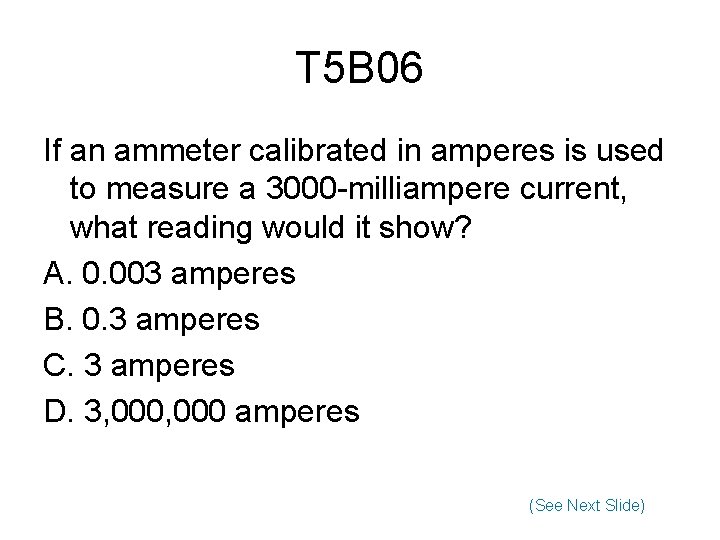
T 5 B 06 If an ammeter calibrated in amperes is used to measure a 3000 -milliampere current, what reading would it show? A. 0. 003 amperes B. 0. 3 amperes C. 3 amperes D. 3, 000 amperes (See Next Slide)
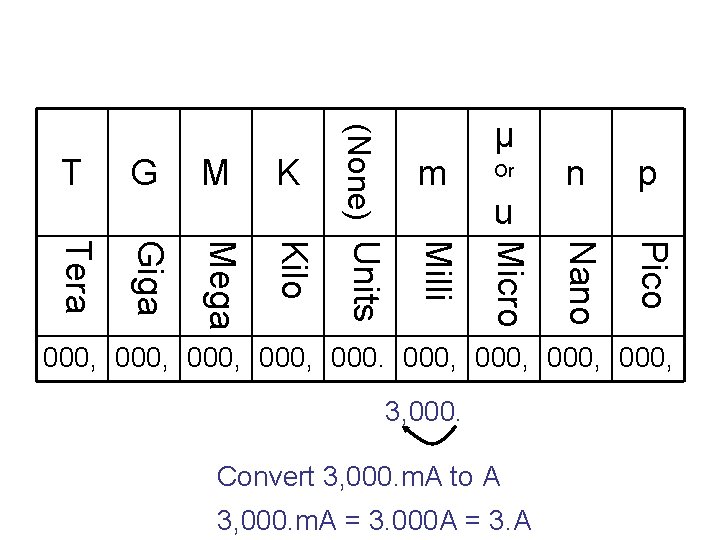
Giga Mega Kilo Or u n p Pico Tera m Nano K Micro M Milli G (None) Units T µ 000, 000, 3, 000. Convert 3, 000. m. A to A 3, 000. m. A = 3. 000 A = 3. A
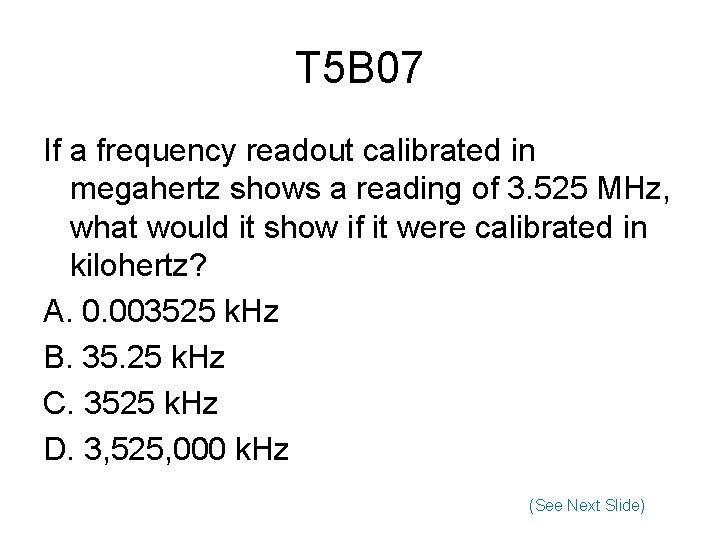
T 5 B 07 If a frequency readout calibrated in megahertz shows a reading of 3. 525 MHz, what would it show if it were calibrated in kilohertz? A. 0. 003525 k. Hz B. 35. 25 k. Hz C. 3525 k. Hz D. 3, 525, 000 k. Hz (See Next Slide)
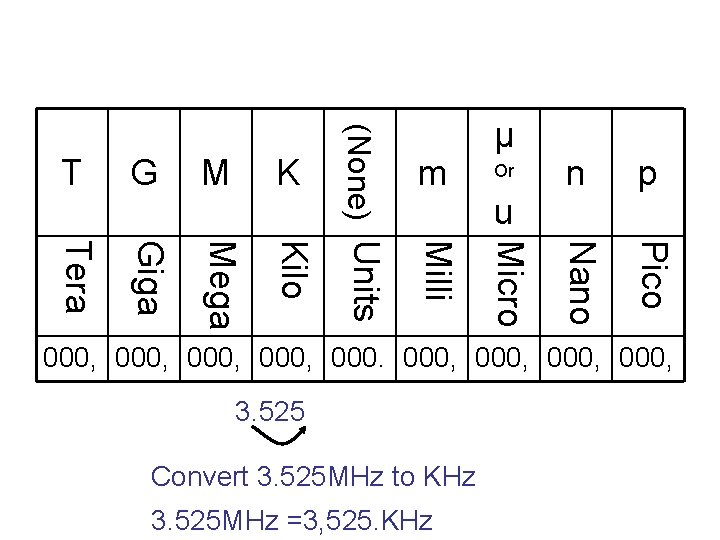
u n p Pico Mega Or Nano Giga m Micro Tera K Milli M (None) Units G Kilo T µ 000, 000, 3. 525 Convert 3. 525 MHz to KHz 3. 525 MHz =3, 525. KHz
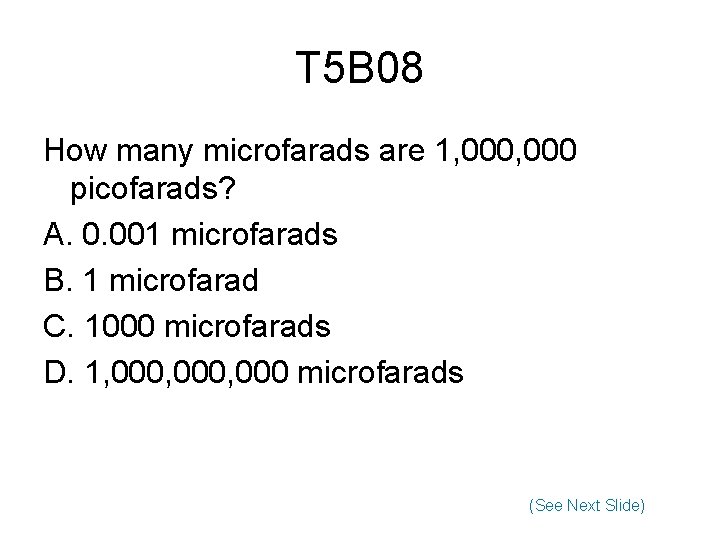
T 5 B 08 How many microfarads are 1, 000 picofarads? A. 0. 001 microfarads B. 1 microfarad C. 1000 microfarads D. 1, 000, 000 microfarads (See Next Slide)
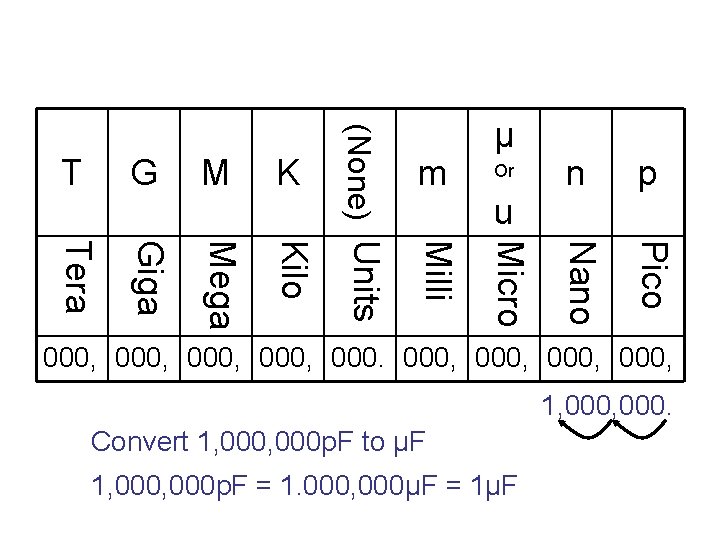
Giga Mega Kilo Or u n p Pico Tera m Nano K Micro M Milli G (None) Units T µ 000, 000, 1, 000. Convert 1, 000 p. F to µF 1, 000 p. F = 1. 000, 000µF = 1µF
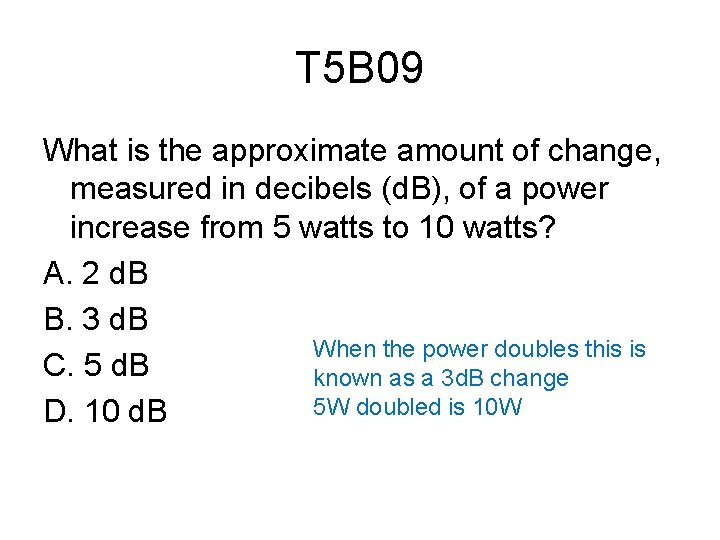
T 5 B 09 What is the approximate amount of change, measured in decibels (d. B), of a power increase from 5 watts to 10 watts? A. 2 d. B B. 3 d. B When the power doubles this is C. 5 d. B known as a 3 d. B change 5 W doubled is 10 W D. 10 d. B
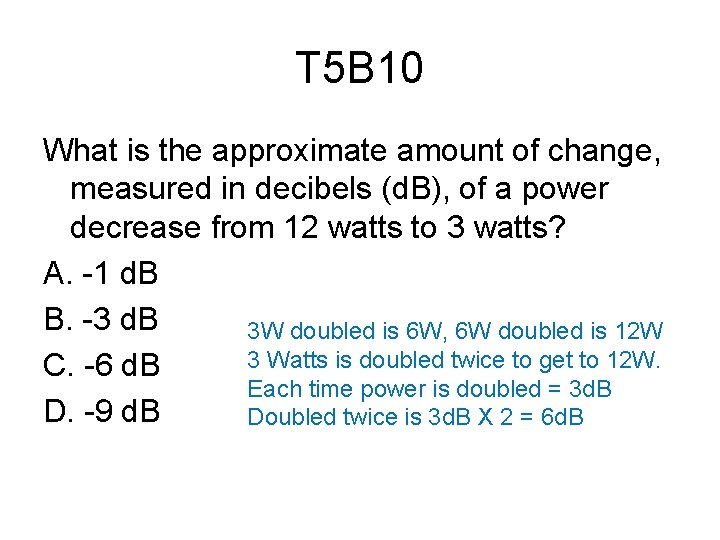
T 5 B 10 What is the approximate amount of change, measured in decibels (d. B), of a power decrease from 12 watts to 3 watts? A. -1 d. B B. -3 d. B 3 W doubled is 6 W, 6 W doubled is 12 W 3 Watts is doubled twice to get to 12 W. C. -6 d. B Each time power is doubled = 3 d. B D. -9 d. B Doubled twice is 3 d. B X 2 = 6 d. B
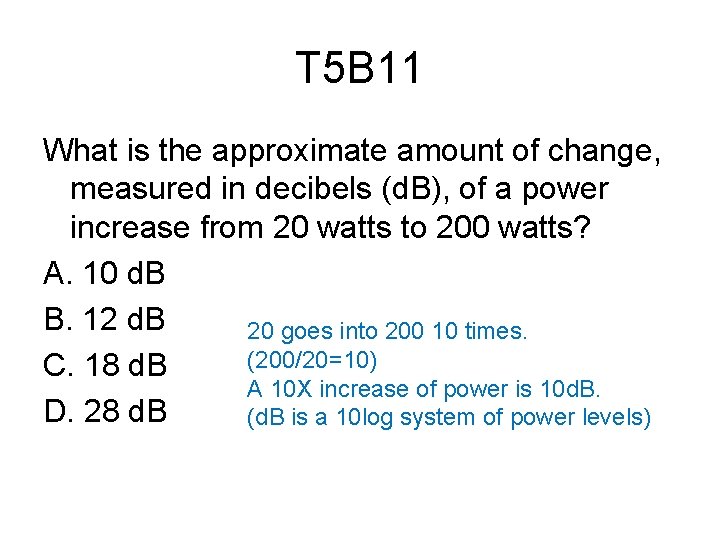
T 5 B 11 What is the approximate amount of change, measured in decibels (d. B), of a power increase from 20 watts to 200 watts? A. 10 d. B B. 12 d. B 20 goes into 200 10 times. (200/20=10) C. 18 d. B A 10 X increase of power is 10 d. B. D. 28 d. B (d. B is a 10 log system of power levels)
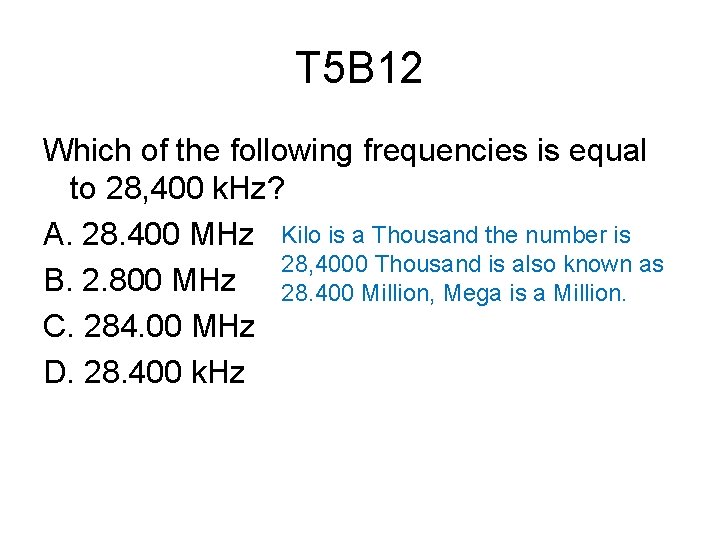
T 5 B 12 Which of the following frequencies is equal to 28, 400 k. Hz? A. 28. 400 MHz Kilo is a Thousand the number is 28, 4000 Thousand is also known as B. 2. 800 MHz 28. 400 Million, Mega is a Million. C. 284. 00 MHz D. 28. 400 k. Hz
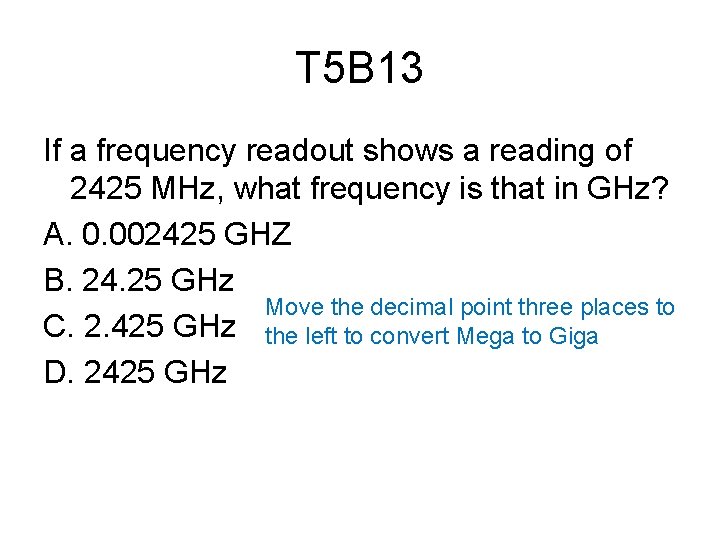
T 5 B 13 If a frequency readout shows a reading of 2425 MHz, what frequency is that in GHz? A. 0. 002425 GHZ B. 24. 25 GHz Move the decimal point three places to C. 2. 425 GHz the left to convert Mega to Giga D. 2425 GHz
• T 5 C - Electronic principles: capacitance; inductance; current flow in circuits; alternating current; definition of RF; definition of polarity; DC power calculations; impedance • #17 of 35
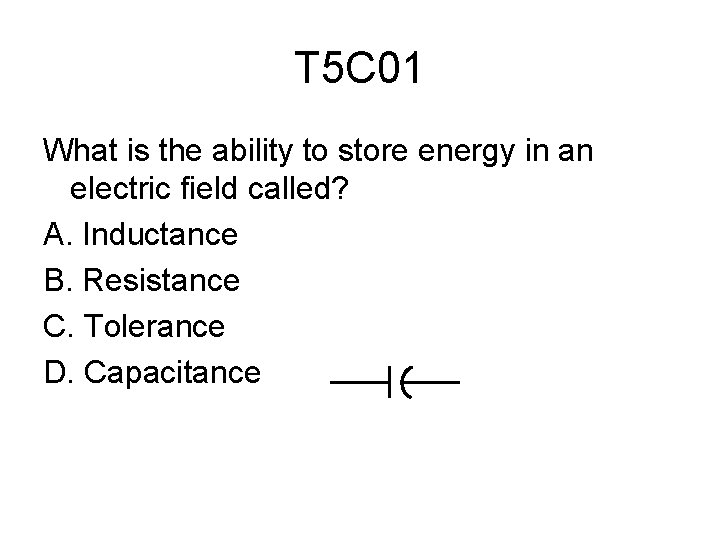
T 5 C 01 What is the ability to store energy in an electric field called? A. Inductance B. Resistance C. Tolerance D. Capacitance
T 5 C 02 What is the basic unit of capacitance? A. The farad B. The ohm C. The volt D. The henry
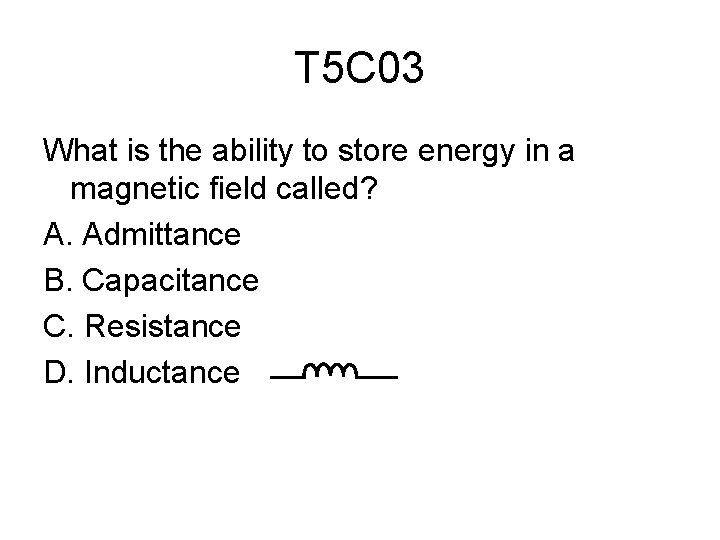
T 5 C 03 What is the ability to store energy in a magnetic field called? A. Admittance B. Capacitance C. Resistance D. Inductance
T 5 C 04 What is the basic unit of inductance? A. The coulomb B. The farad C. The henry D. The ohm
T 5 C 05 What is the unit of frequency? A. Hertz B. Henry C. Farad D. Tesla
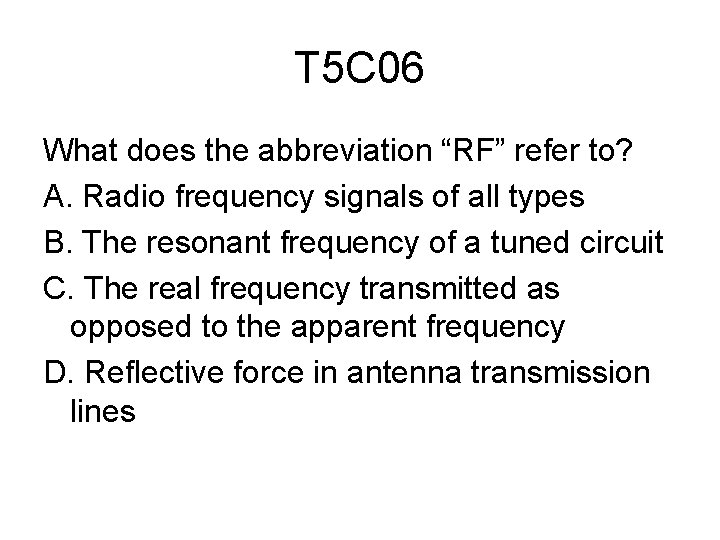
T 5 C 06 What does the abbreviation “RF” refer to? A. Radio frequency signals of all types B. The resonant frequency of a tuned circuit C. The real frequency transmitted as opposed to the apparent frequency D. Reflective force in antenna transmission lines
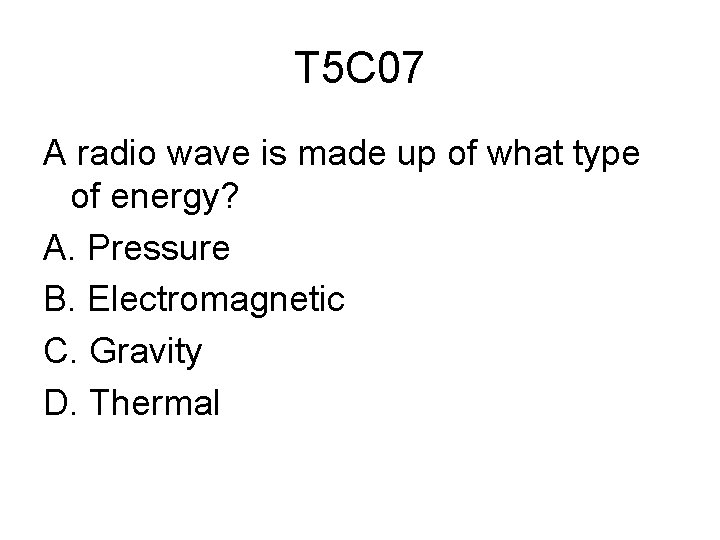
T 5 C 07 A radio wave is made up of what type of energy? A. Pressure B. Electromagnetic C. Gravity D. Thermal
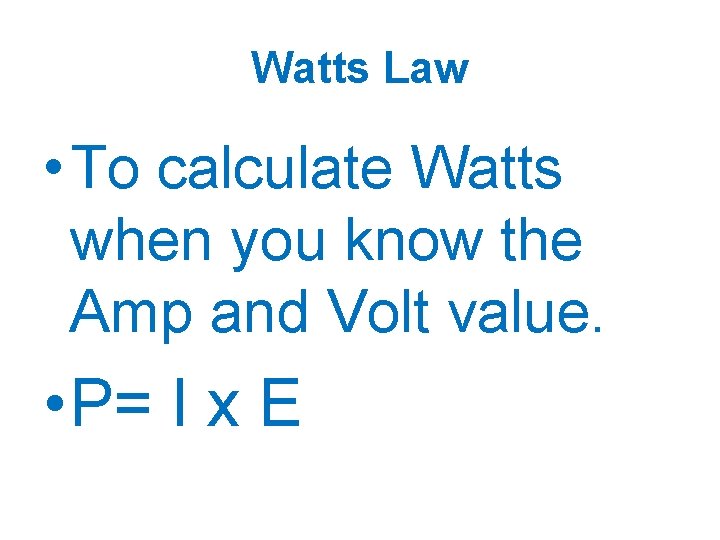
Watts Law • To calculate Watts when you know the Amp and Volt value. • P= I x E

Watts Law • To calculate Volts when you know the Watt and Amp value. • E = P ÷ I
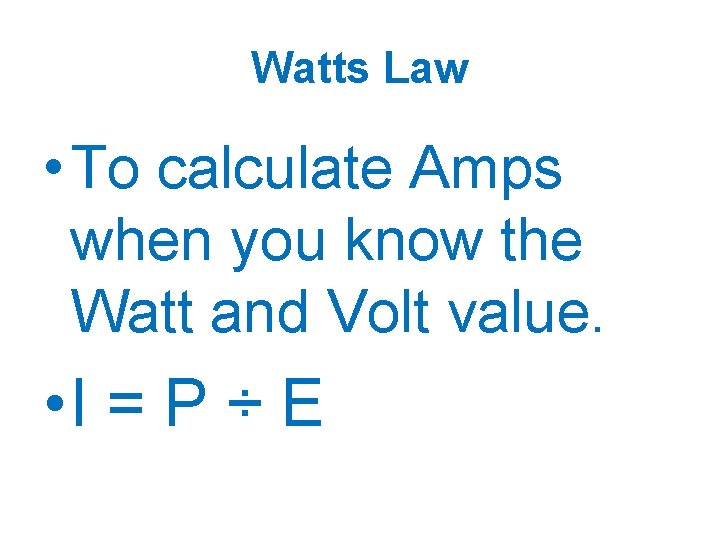
Watts Law • To calculate Amps when you know the Watt and Volt value. • I = P ÷ E
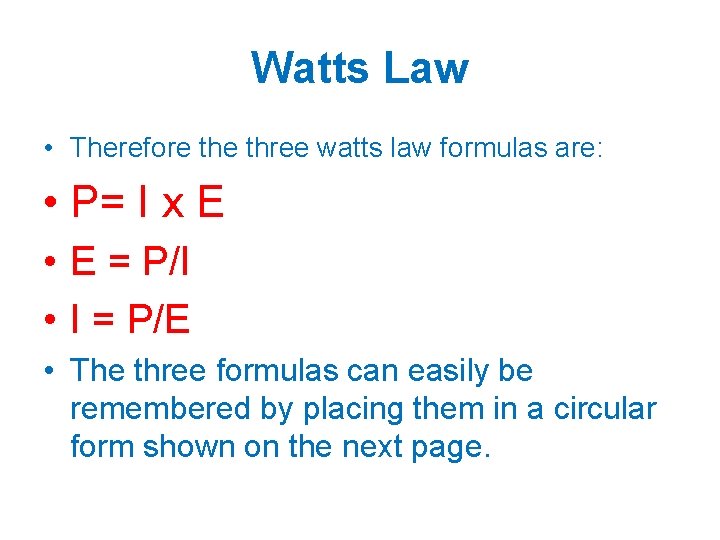
Watts Law • Therefore three watts law formulas are: • P= I x E • E = P/I • I = P/E • The three formulas can easily be remembered by placing them in a circular form shown on the next page.
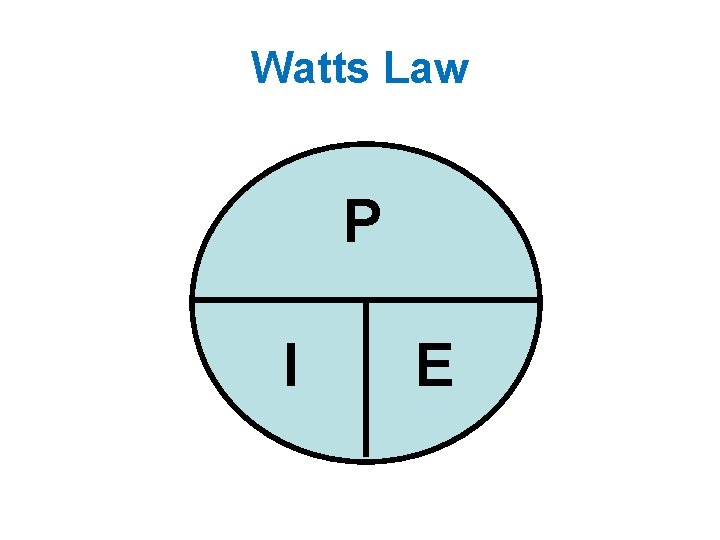
Watts Law P I E
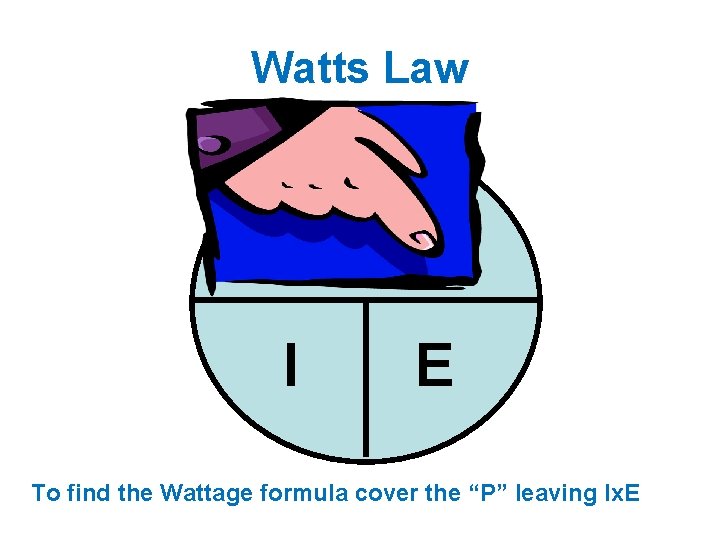
Watts Law P I E To find the Wattage formula cover the “P” leaving Ix. E
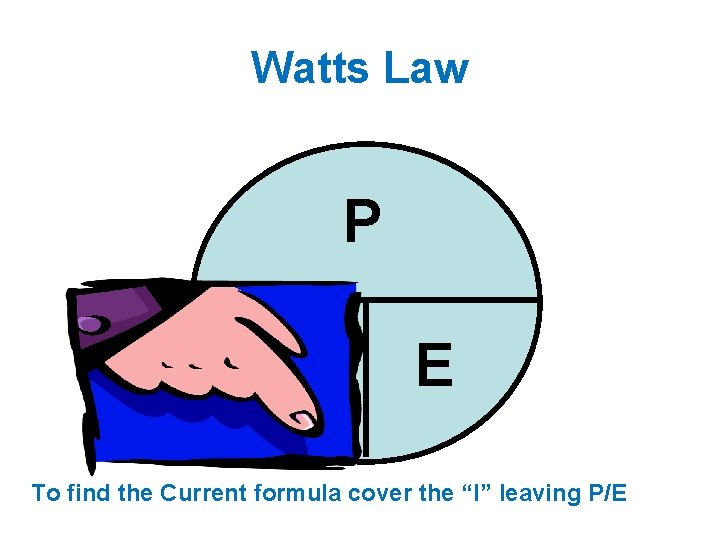
Watts Law P I E To find the Current formula cover the “I” leaving P/E
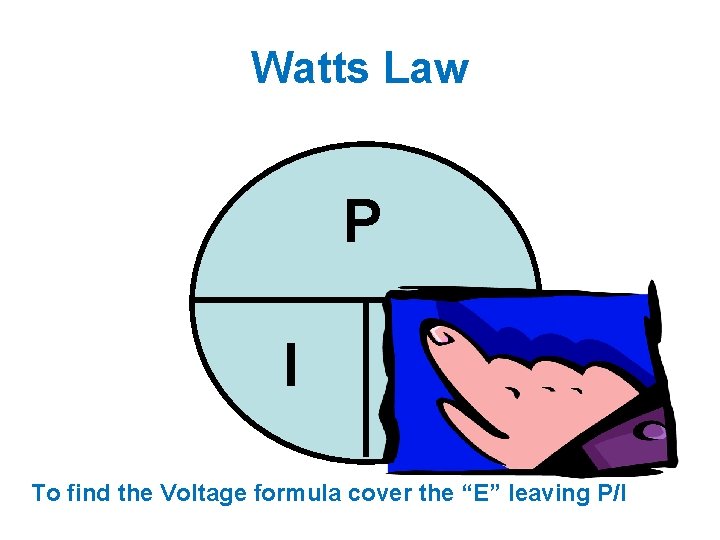
Watts Law P I E To find the Voltage formula cover the “E” leaving P/I
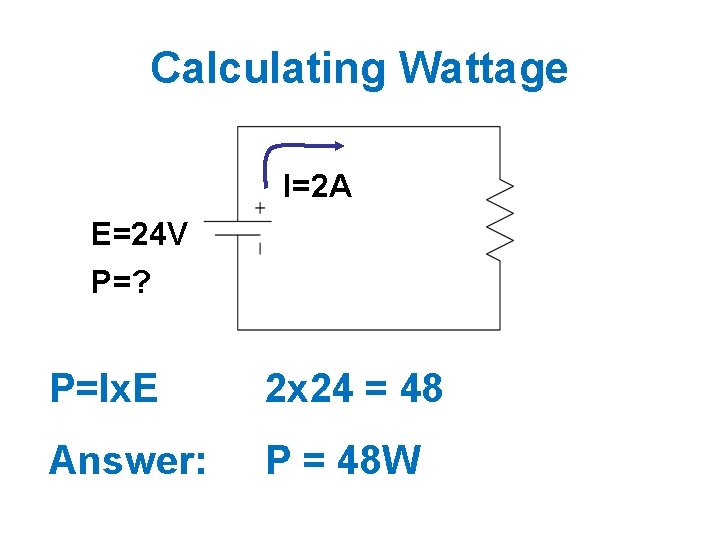
Calculating Wattage I=2 A E=24 V P=? P=Ix. E 2 x 24 = 48 Answer: P = 48 W
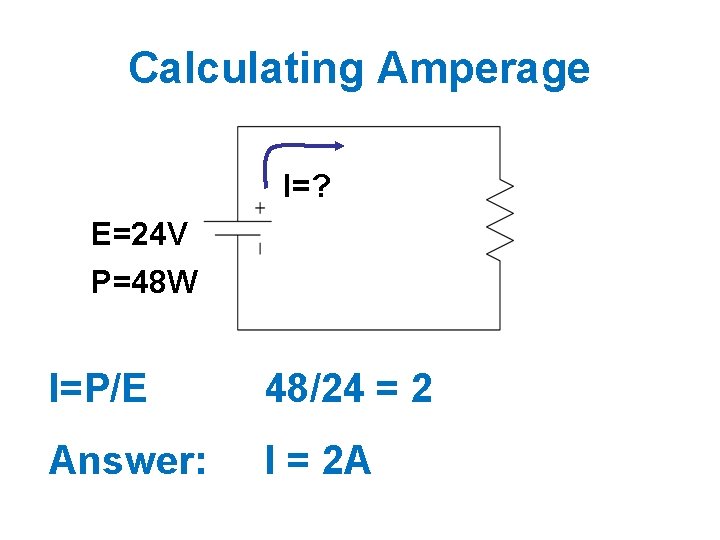
Calculating Amperage I=? E=24 V P=48 W I=P/E 48/24 = 2 Answer: I = 2 A
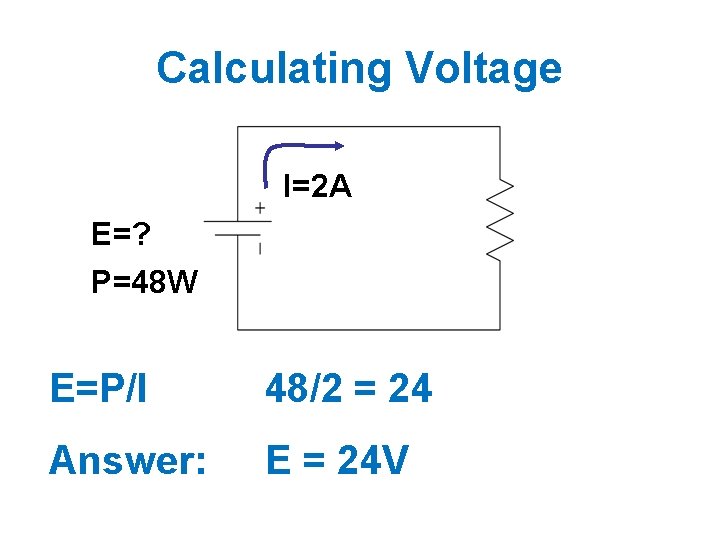
Calculating Voltage I=2 A E=? P=48 W E=P/I 48/2 = 24 Answer: E = 24 V
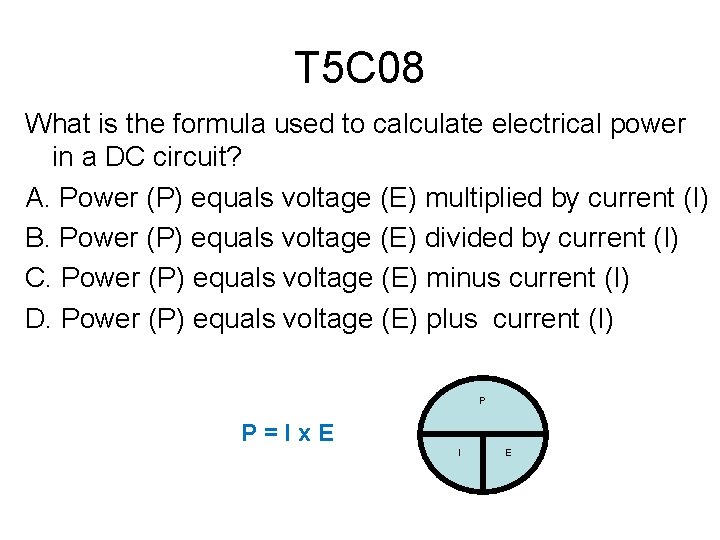
T 5 C 08 What is the formula used to calculate electrical power in a DC circuit? A. Power (P) equals voltage (E) multiplied by current (I) B. Power (P) equals voltage (E) divided by current (I) C. Power (P) equals voltage (E) minus current (I) D. Power (P) equals voltage (E) plus current (I) P P=Ix. E I E
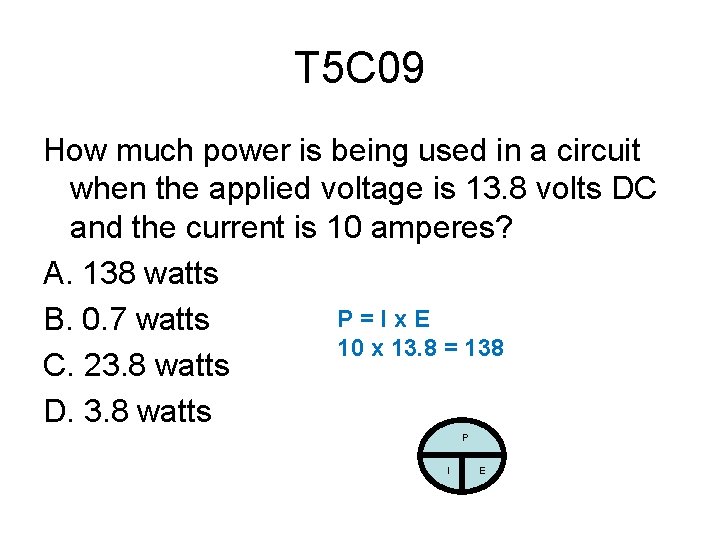
T 5 C 09 How much power is being used in a circuit when the applied voltage is 13. 8 volts DC and the current is 10 amperes? A. 138 watts P=Ix. E B. 0. 7 watts 10 x 13. 8 = 138 C. 23. 8 watts D. 3. 8 watts P I E
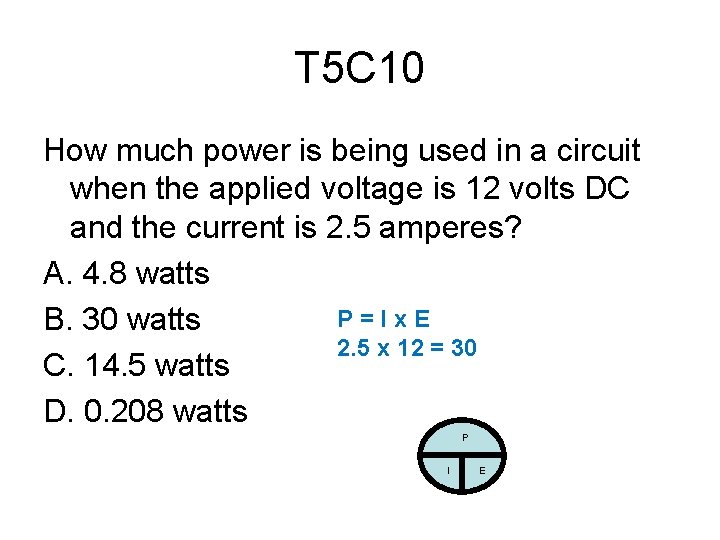
T 5 C 10 How much power is being used in a circuit when the applied voltage is 12 volts DC and the current is 2. 5 amperes? A. 4. 8 watts P=Ix. E B. 30 watts 2. 5 x 12 = 30 C. 14. 5 watts D. 0. 208 watts P I E
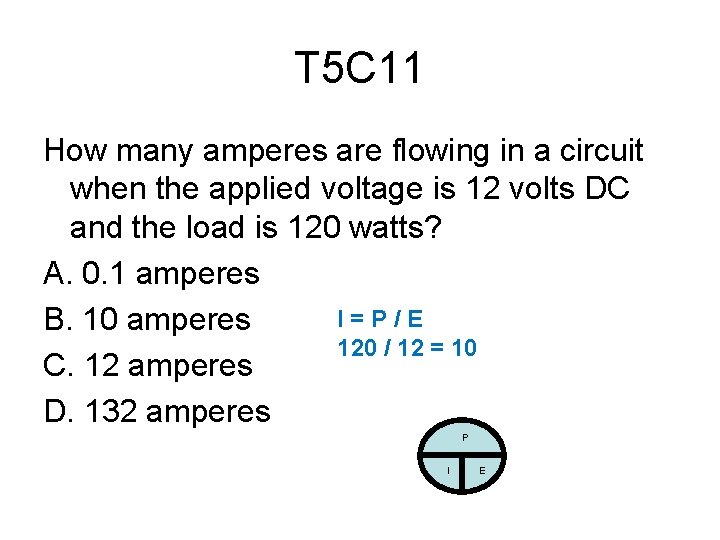
T 5 C 11 How many amperes are flowing in a circuit when the applied voltage is 12 volts DC and the load is 120 watts? A. 0. 1 amperes I=P/E B. 10 amperes 120 / 12 = 10 C. 12 amperes D. 132 amperes P I E
T 5 C 12 What is meant by the term impedance? A. It is a measure of the opposition to AC current flow in a circuit B. It is the inverse of resistance C. It is a measure of the Q or Quality Factor of a component D. It is a measure of the power handling capability of a component
T 5 C 13 What are the units of impedance? A. Volts B. Amperes C. Coulombs D. Ohms
T 5 C 14 What is the proper abbreviation for megahertz? A. m. Hz B. mh. Z C. Mhz Capital “M” for Mega D. MHz Capital “H” lower case “z” for Hertz
• T 5 D – Ohm’s Law: formulas and usage; components in series and parallel • #18 of 35
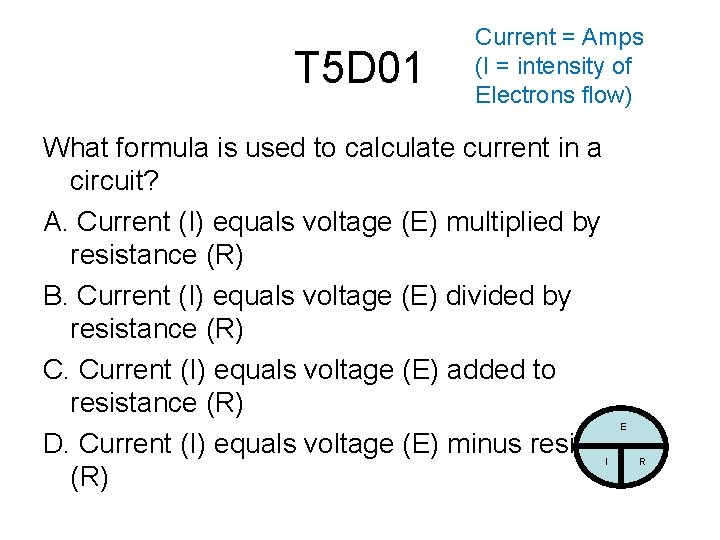
T 5 D 01 Current = Amps (I = intensity of Electrons flow) What formula is used to calculate current in a circuit? A. Current (I) equals voltage (E) multiplied by resistance (R) B. Current (I) equals voltage (E) divided by resistance (R) C. Current (I) equals voltage (E) added to resistance (R) D. Current (I) equals voltage (E) minus resistance (R) E I R
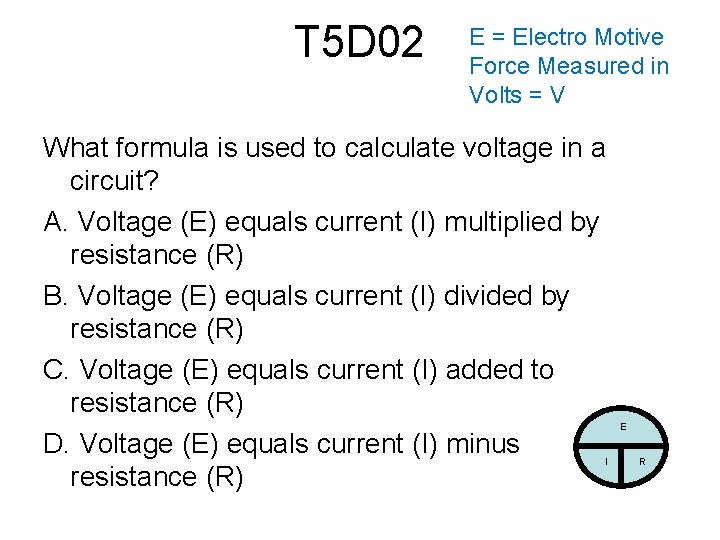
T 5 D 02 E = Electro Motive Force Measured in Volts = V What formula is used to calculate voltage in a circuit? A. Voltage (E) equals current (I) multiplied by resistance (R) B. Voltage (E) equals current (I) divided by resistance (R) C. Voltage (E) equals current (I) added to resistance (R) D. Voltage (E) equals current (I) minus resistance (R) I E R
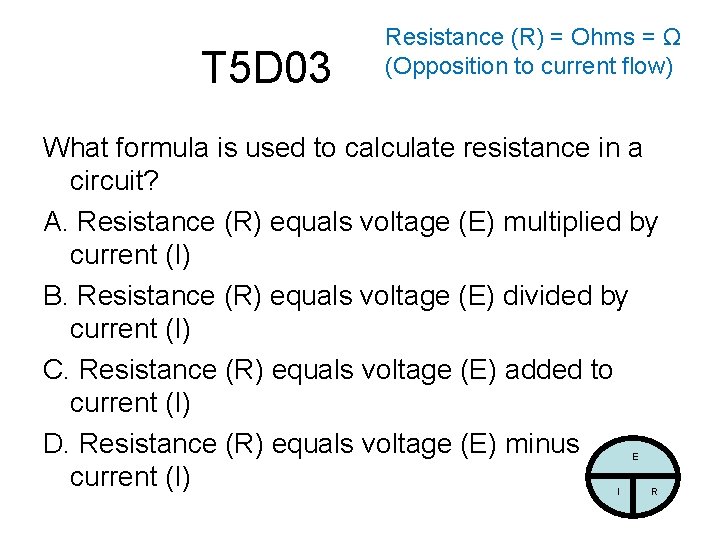
T 5 D 03 Resistance (R) = Ohms = Ω (Opposition to current flow) What formula is used to calculate resistance in a circuit? A. Resistance (R) equals voltage (E) multiplied by current (I) B. Resistance (R) equals voltage (E) divided by current (I) C. Resistance (R) equals voltage (E) added to current (I) D. Resistance (R) equals voltage (E) minus current (I) E I R
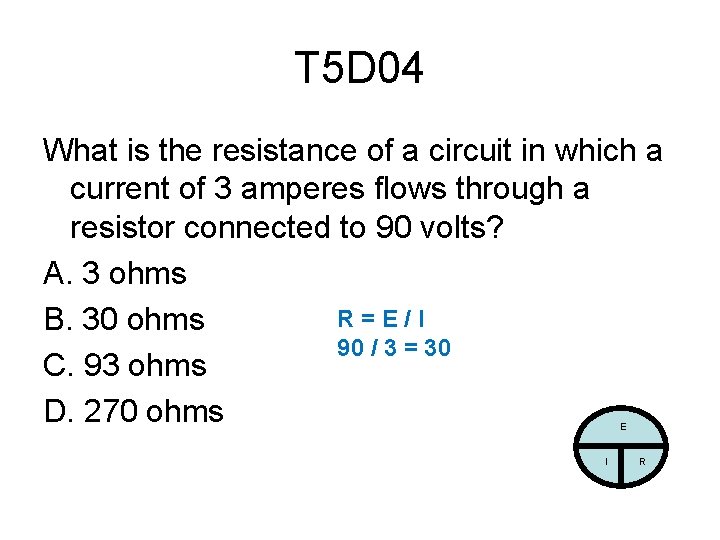
T 5 D 04 What is the resistance of a circuit in which a current of 3 amperes flows through a resistor connected to 90 volts? A. 3 ohms R=E/I B. 30 ohms 90 / 3 = 30 C. 93 ohms D. 270 ohms E I R
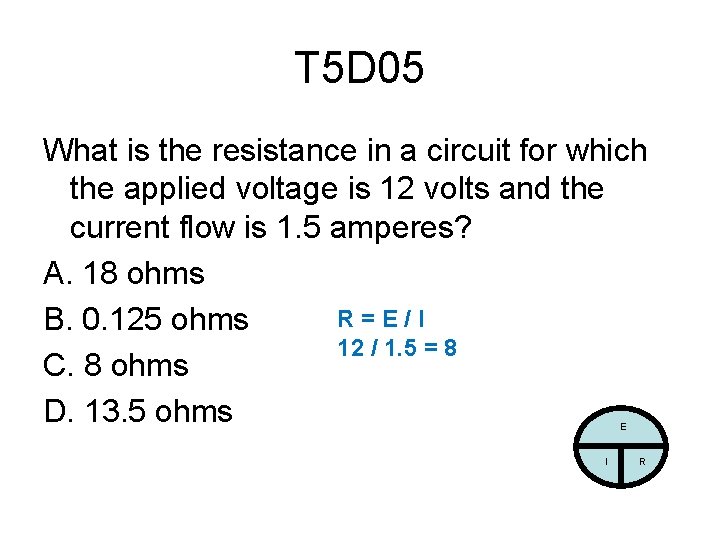
T 5 D 05 What is the resistance in a circuit for which the applied voltage is 12 volts and the current flow is 1. 5 amperes? A. 18 ohms R=E/I B. 0. 125 ohms 12 / 1. 5 = 8 C. 8 ohms D. 13. 5 ohms E I R
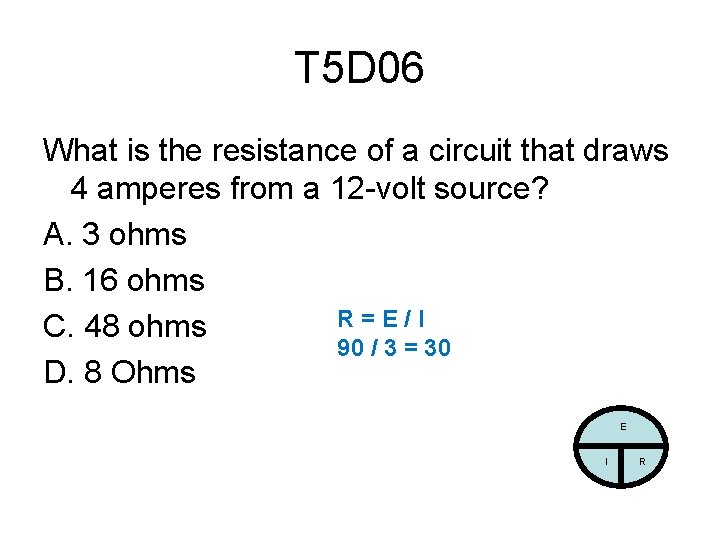
T 5 D 06 What is the resistance of a circuit that draws 4 amperes from a 12 -volt source? A. 3 ohms B. 16 ohms R=E/I C. 48 ohms 90 / 3 = 30 D. 8 Ohms E I R
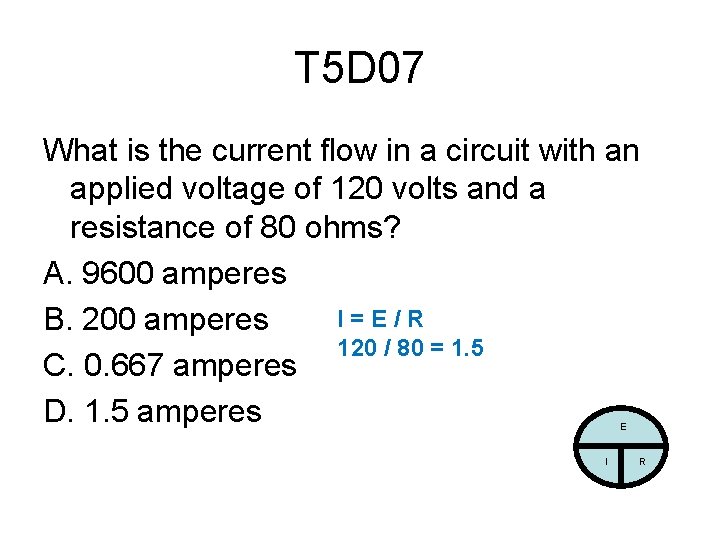
T 5 D 07 What is the current flow in a circuit with an applied voltage of 120 volts and a resistance of 80 ohms? A. 9600 amperes I=E/R B. 200 amperes 120 / 80 = 1. 5 C. 0. 667 amperes D. 1. 5 amperes E I R
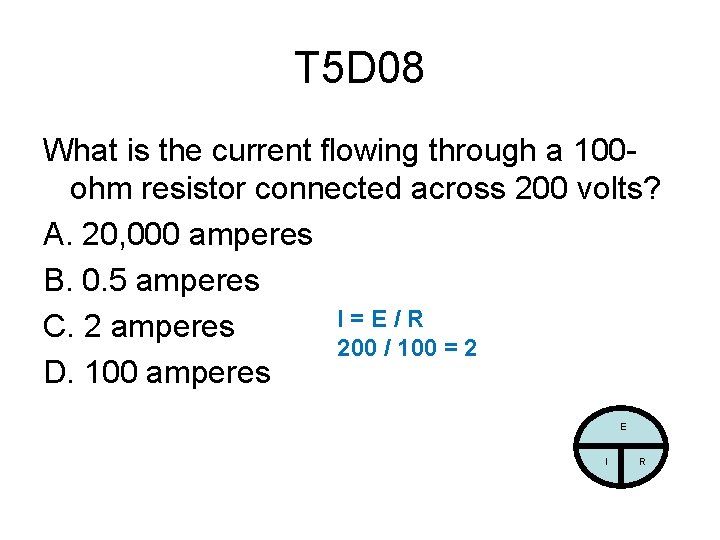
T 5 D 08 What is the current flowing through a 100 ohm resistor connected across 200 volts? A. 20, 000 amperes B. 0. 5 amperes I=E/R C. 2 amperes 200 / 100 = 2 D. 100 amperes E I R
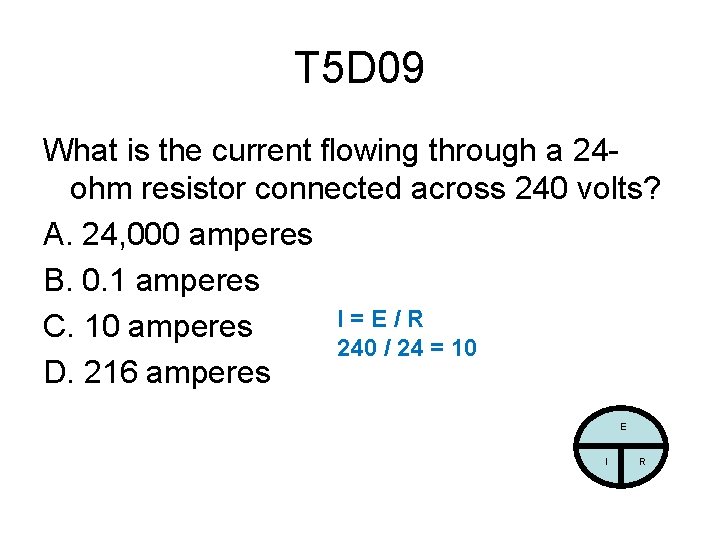
T 5 D 09 What is the current flowing through a 24 ohm resistor connected across 240 volts? A. 24, 000 amperes B. 0. 1 amperes I=E/R C. 10 amperes 240 / 24 = 10 D. 216 amperes E I R
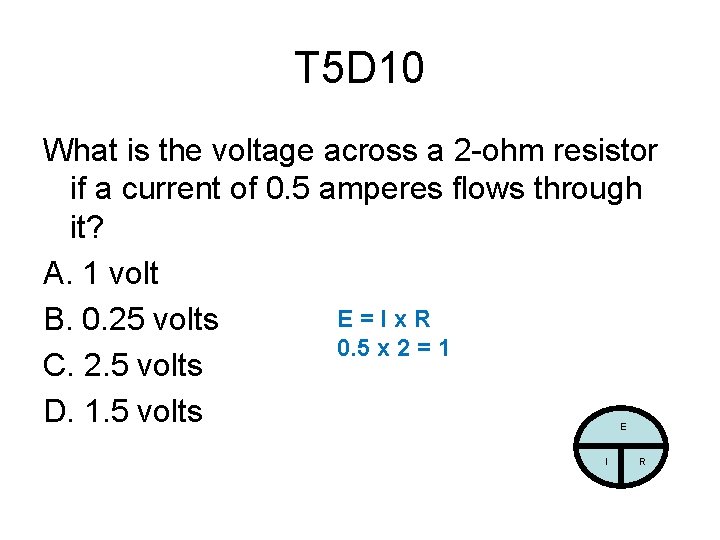
T 5 D 10 What is the voltage across a 2 -ohm resistor if a current of 0. 5 amperes flows through it? A. 1 volt E=Ix. R B. 0. 25 volts 0. 5 x 2 = 1 C. 2. 5 volts D. 1. 5 volts E I R
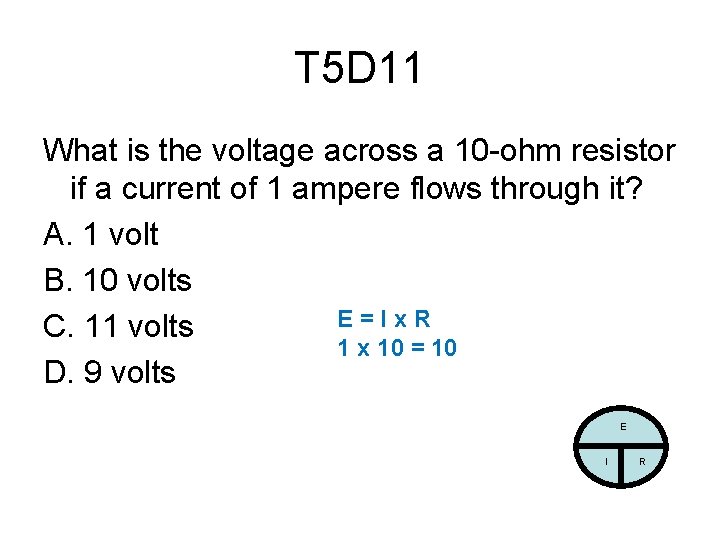
T 5 D 11 What is the voltage across a 10 -ohm resistor if a current of 1 ampere flows through it? A. 1 volt B. 10 volts E=Ix. R C. 11 volts 1 x 10 = 10 D. 9 volts E I R
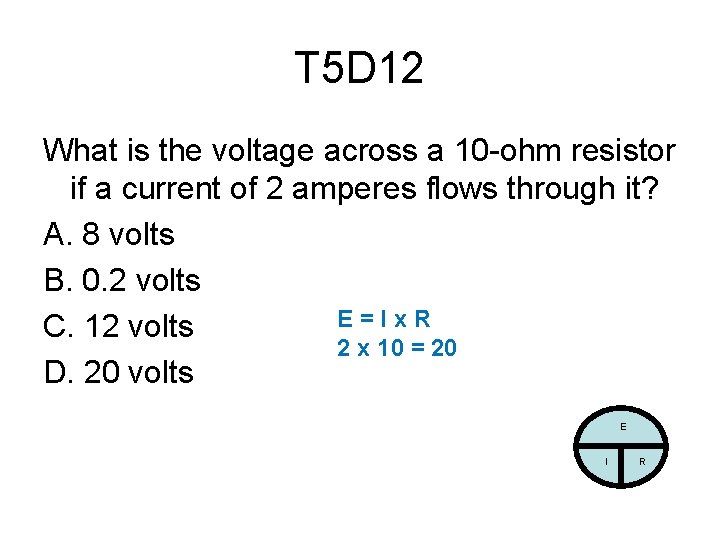
T 5 D 12 What is the voltage across a 10 -ohm resistor if a current of 2 amperes flows through it? A. 8 volts B. 0. 2 volts E=Ix. R C. 12 volts 2 x 10 = 20 D. 20 volts E I R
T 5 D 13 What happens to current at the junction of two components in series? A. It divides equally between them B. It is unchanged C. It divides based on the value of the components D. The current in the second component is zero Current is the same in all parts of a series circuit
T 5 D 14 What happens to current at the junction of two components in parallel? A. It divides between them dependent on the value of the components B. It is the same in both components C. Its value doubles D. Its value is halved
T 5 D 15 What is the voltage across each of two components in series with a voltage source? A. The same voltage as the source B. Half the source voltage C. It is determined by the type and value of the components D. Twice the source voltage
T 5 D 16 What is the voltage across each of two components in parallel with a voltage source? A. It is determined by the type and value of the components B. Half the source voltage C. Twice the source voltage D. The same voltage as the source Voltage is the same in all branches of a parallel circuit

End of Sub-element 5 (51% complete) Proceed to Sub-element 6 when ready
- Slides: 120