
Before we start our lesson please read the
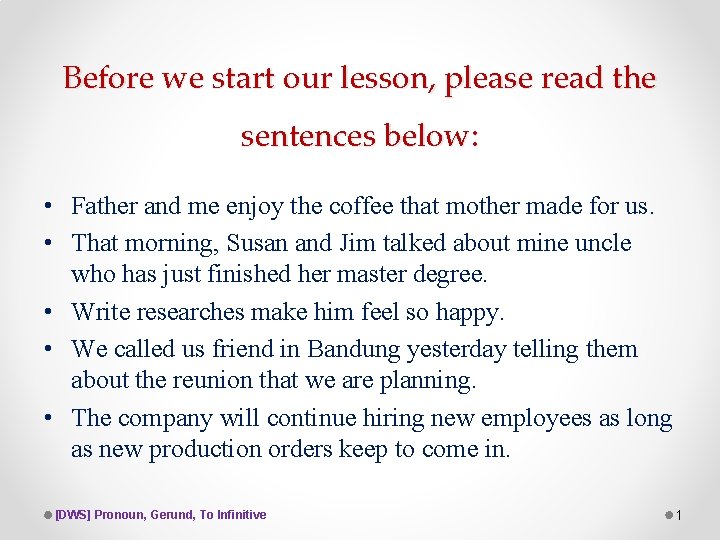
Before we start our lesson, please read the sentences below: • Father and me enjoy the coffee that mother made for us. • That morning, Susan and Jim talked about mine uncle who has just finished her master degree. • Write researches make him feel so happy. • We called us friend in Bandung yesterday telling them about the reunion that we are planning. • The company will continue hiring new employees as long as new production orders keep to come in. [DWS] Pronoun, Gerund, To Infinitive 1
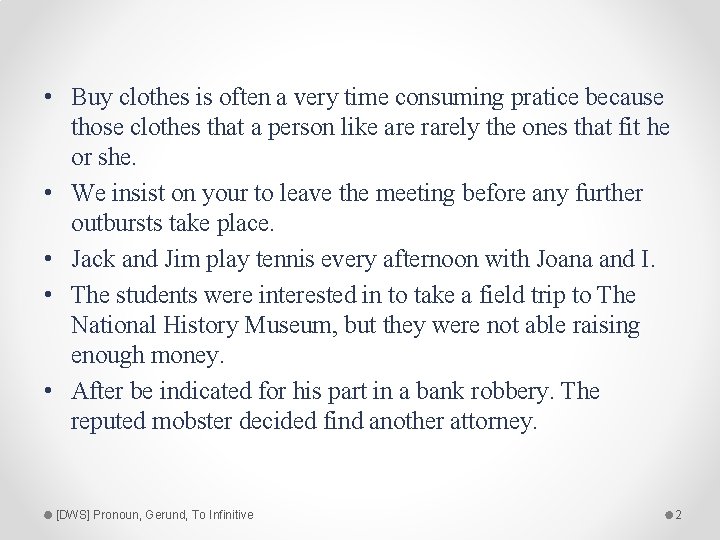
• Buy clothes is often a very time consuming pratice because those clothes that a person like are rarely the ones that fit he or she. • We insist on your to leave the meeting before any further outbursts take place. • Jack and Jim play tennis every afternoon with Joana and I. • The students were interested in to take a field trip to The National History Museum, but they were not able raising enough money. • After be indicated for his part in a bank robbery. The reputed mobster decided find another attorney. [DWS] Pronoun, Gerund, To Infinitive 2
Are you sure that all those sentences are grammatically correct? ? ? [DWS] Pronoun, Gerund, To Infinitive 3
The answer should be “NO”. [DWS] Pronoun, Gerund, To Infinitive 4

Pronouns, Gerund, & To Infinitive By: Dewi Wulan Sari [DWS] Pronoun, Gerund, To Infinitive 5
What is pronoun? Based on Oxford Advanced Learner’s Dictionary (2010) “pronoun is a word that is used instead of a noun or noun phrase, for example he, it, hers, me them, etc. ” (p. 1175) [DWS] Pronoun, Gerund, To Infinitive 6
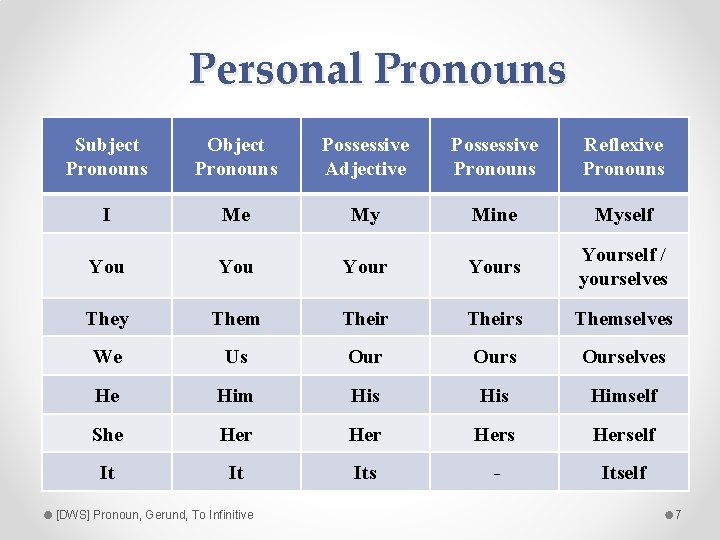
Personal Pronouns Subject Pronouns Object Pronouns Possessive Adjective Possessive Pronouns Reflexive Pronouns I Me My Mine Myself You Yourself / yourselves They Them Theirs Themselves We Us Ourselves He Him His Himself She Her Herself It It Its - Itself [DWS] Pronoun, Gerund, To Infinitive 7
YES there are five form of personal pronoun. Subject Pronoun and Object Pronoun. Through its name, we know that Subject Pronoun is used as the subject in the sentence. The position of Subject Pronoun is important because a sentence at least consists of a subject and a verb. While Object Pronoun or also called as complement pronoun can be found in complement position in the sentence Each of Subject Pronouns and Object Pronouns are used differently. [DWS] Pronoun, Gerund, To Infinitive 8
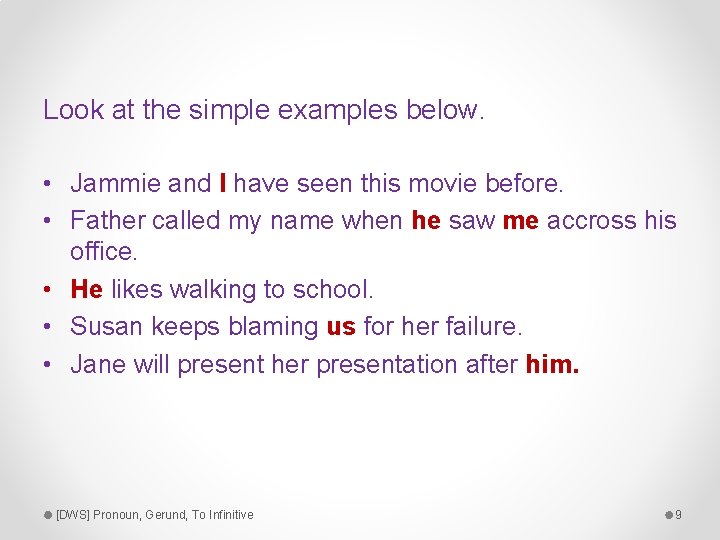
Look at the simple examples below. • Jammie and I have seen this movie before. • Father called my name when he saw me accross his office. • He likes walking to school. • Susan keeps blaming us for her failure. • Jane will present her presentation after him. [DWS] Pronoun, Gerund, To Infinitive 9
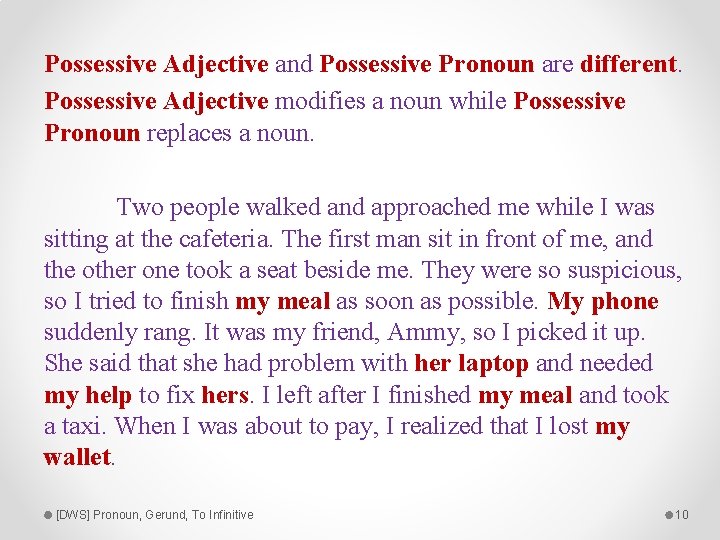
Possessive Adjective and Possessive Pronoun are different. Possessive Adjective modifies a noun while Possessive Pronoun replaces a noun. Two people walked and approached me while I was sitting at the cafeteria. The first man sit in front of me, and the other one took a seat beside me. They were so suspicious, so I tried to finish my meal as soon as possible. My phone suddenly rang. It was my friend, Ammy, so I picked it up. She said that she had problem with her laptop and needed my help to fix hers. I left after I finished my meal and took a taxi. When I was about to pay, I realized that I lost my wallet. [DWS] Pronoun, Gerund, To Infinitive 10
Reflexive Pronouns indicated that the subject is both giving and receiving the action. He himself set the fire to the fireplace. Sarah walks barefoot and hurt herself. Jack washed himself before went to bed. [DWS] Pronoun, Gerund, To Infinitive 11
Gerund and To Infinitive Based on Oxford Advanced Learner’s Dictionary (2010) “gerund is a noun in the form of present participle of a verb (that is, ending in –ing)” (p. 626), while “Infinitive is the basic form of a verb such as be or run. In English, an infinitive is used by itself, for example swim in She can swim or with to as in She likes to swim. ” (p. 769) [DWS] Pronoun, Gerund, To Infinitive 12
Here are the common verbs and adjectives that are followed by infinitives: agree, plan, hope, except, prepare, claim, fail, learn, pretend, want, decide, forget, need, refuse, offer, easy, dangerous, good, ready, difficult, hard, wish, intend, demand etc. [DWS] Pronoun, Gerund, To Infinitive 13
Examples: • I learned to swim when I was young. • The soldiers are preparing to attack the village. • I decided to postpone my holiday. • We are ready to leave now. • It is difficult to pass the test. [DWS] Pronoun, Gerund, To Infinitive 14
Common verbs followed by gerunds: Enjoy, finish, quit, mind, postpone, keep, consider, discuss, miss, admit, report, finish, appreciate, resume, go, avoid, delay, deny, etc. ADJECTIVE + PREPOSITIONS are also followed by GERUND, such as: Afraid of, interested in, capable of, successful in, tired of, fond of, etc. [DWS] Pronoun, Gerund, To Infinitive 15
VERB + PREPOSITIONS are also followed by GERUND, such as: Give up, rely on, worry about, insist on, succeed in, count on, keep on, think about, depend on, put off, think of, look forward to, confess to, etc. [DWS] Pronoun, Gerund, To Infinitive 16

Examples: • He is not looking forward to going back to school. • Giving charity is a good deed. • He’s excited about playing tennis. • John admitted stealing the jewels. • We are interested in seeing this film. • Mary insisted on taking the bus instead of the plane. [DWS] Pronoun, Gerund, To Infinitive 17
The following verbs can be followed by either the infinitive or the gerund with no change in meaning, such as: Begin, hate, regret, like, start, continue, love, try, prefer. These verbs can be followed by gerund or infinitive, but the meaning is different. Stop, remember, forget. [DWS] Pronoun, Gerund, To Infinitive 18
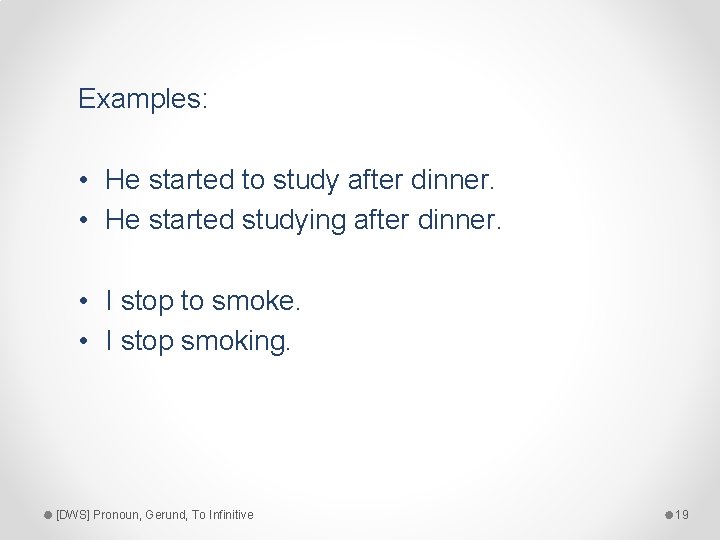
Examples: • He started to study after dinner. • He started studying after dinner. • I stop to smoke. • I stop smoking. [DWS] Pronoun, Gerund, To Infinitive 19
Now, try to analyze why those sentences are wrong and figure out the right answer! Thank you [DWS] Pronoun, Gerund, To Infinitive 20
Sources: Azar, Betty Schramfer. (1993). Fundamentals of English Grammar, Second. Edition. Jakarta: Binarupa Aksara. Azar, Betty Schramfer. (1993). Understanding and Using English Grammar, Second Edition. Jakarta: Binarupa Aksara. Hornby. (2010). Oxford Advanced Learner’s Dictionary. UK: Oxford University Press. Pyle, Michael A and Page, Narry Ellen Munoz. (1995). Cliff TOEFL Preparation Guide. Nebraska: John Wiley and Sons. [DWS] Pronoun, Gerund, To Infinitive 21
- Slides: 21