
Before we go into Sexual Reproduction in Plants
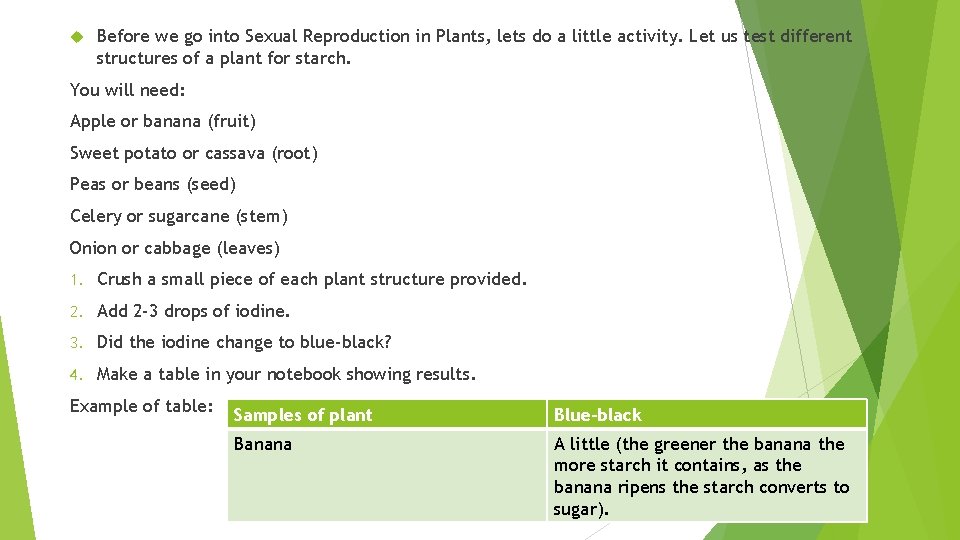
Before we go into Sexual Reproduction in Plants, lets do a little activity. Let us test different structures of a plant for starch. You will need: Apple or banana (fruit) Sweet potato or cassava (root) Peas or beans (seed) Celery or sugarcane (stem) Onion or cabbage (leaves) 1. Crush a small piece of each plant structure provided. 2. Add 2 -3 drops of iodine. 3. Did the iodine change to blue-black? 4. Make a table in your notebook showing results. Example of table: Samples of plant Blue-black Banana A little (the greener the banana the more starch it contains, as the banana ripens the starch converts to sugar).
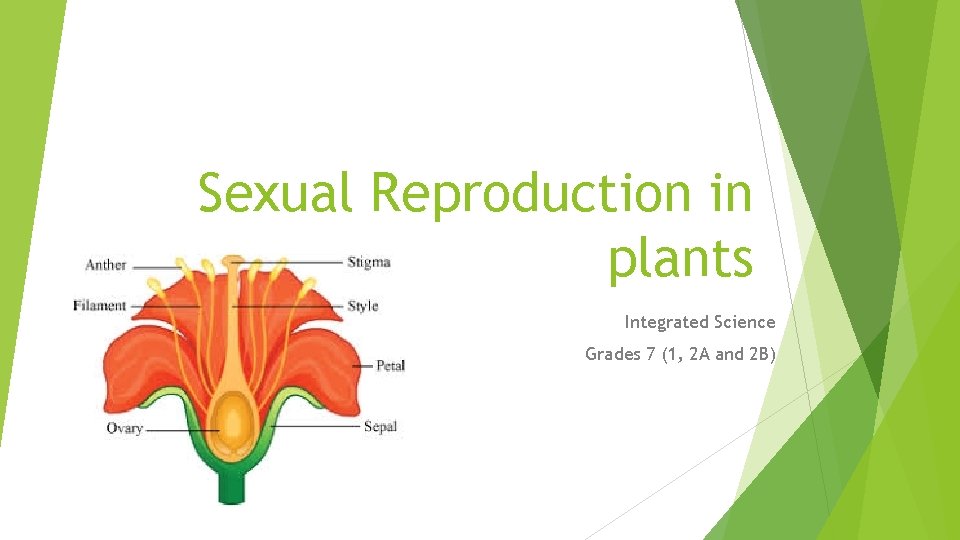
Sexual Reproduction in plants Integrated Science Grades 7 (1, 2 A and 2 B)

Sexual Reproduction in Plants Flowers are often believed only to serve the purpose of beautification or to express sentimental values like love. However, they have so much more important role in producing new plants.
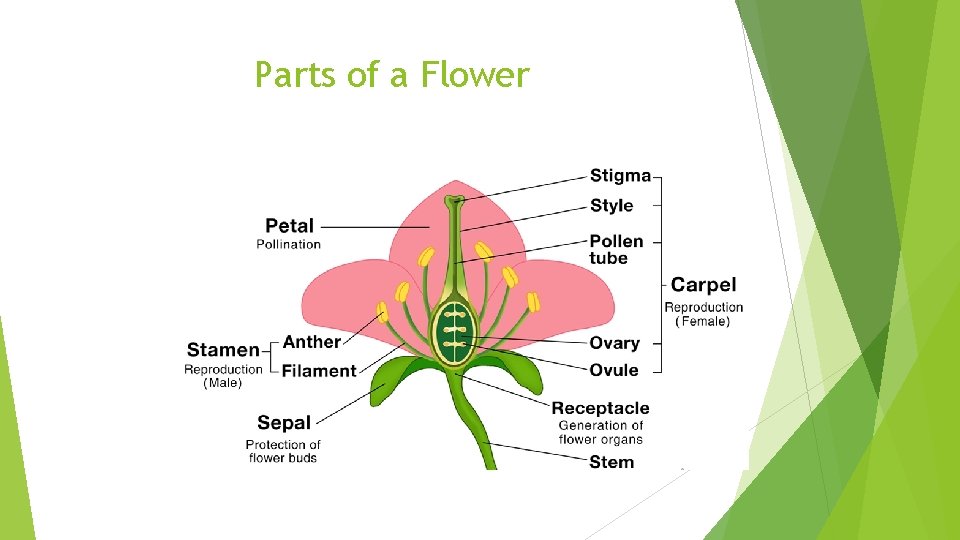
Parts of a Flower
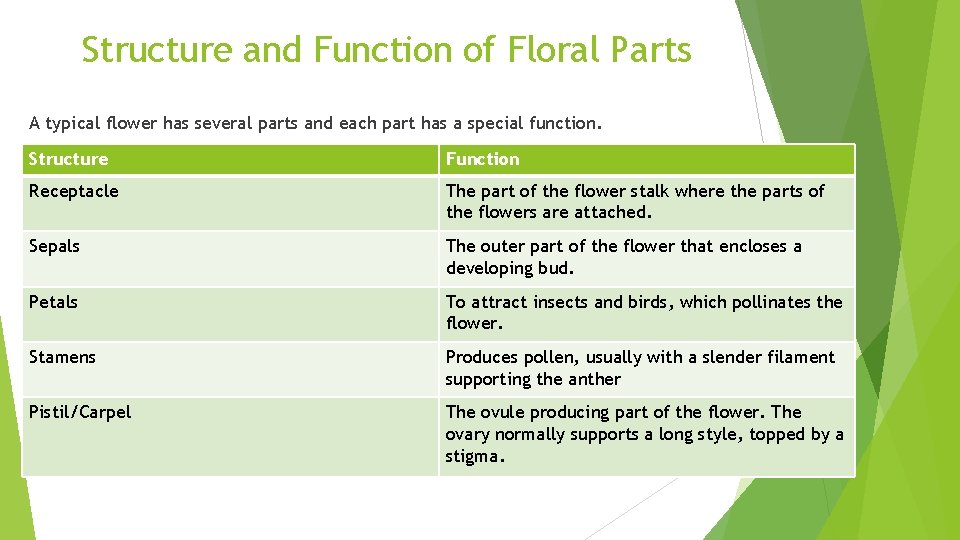
Structure and Function of Floral Parts A typical flower has several parts and each part has a special function. Structure Function Receptacle The part of the flower stalk where the parts of the flowers are attached. Sepals The outer part of the flower that encloses a developing bud. Petals To attract insects and birds, which pollinates the flower. Stamens Produces pollen, usually with a slender filament supporting the anther Pistil/Carpel The ovule producing part of the flower. The ovary normally supports a long style, topped by a stigma.

Complete and Incomplete Flowers v Complete flowers carry both male and female reproductive structures. v Incomplete flowers carry either male or female reproductive structures.
Here is something for you to do!! 1. Pick a hibiscus flower. 2. Look carefully at the flower and identify the different part. 3. Carefully pull the flower apart and count the different flower parts which you have identified. 4. Stick samples of the main parts of the flower in your notebook. Then make a labelled drawing of the structure besides it.
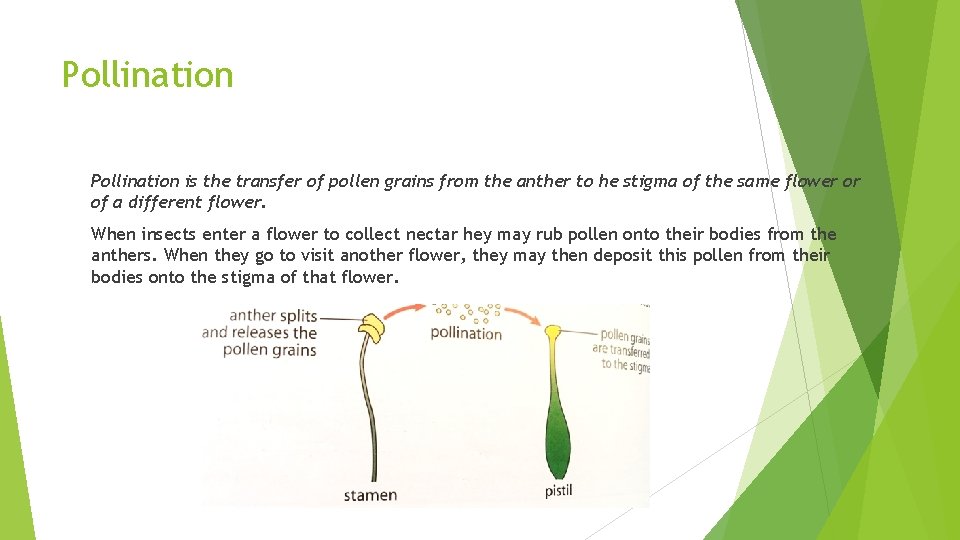
Pollination is the transfer of pollen grains from the anther to he stigma of the same flower or of a different flower. When insects enter a flower to collect nectar hey may rub pollen onto their bodies from the anthers. When they go to visit another flower, they may then deposit this pollen from their bodies onto the stigma of that flower.
Agents of Pollination Pollen grains are unable to move on their own from a mature anther of one flower to the sigma of another flower. Therefore, they need help from other agents such as wind and insects (bees and ants). These assisting agents are known as agents of pollination Grass flowers are pollinated by wind.

Differences between wind-pollinated and insect -pollinated flowers Features Wind-pollinated flowers, e. g. sugarcane, grass, corn, wheat, rice Insect-pollinated flowers, e. g. roses, buttercup, dandelion, mango, guinep Petals Small, dull petals; usually inconspiciuous Large, brightly-coloured petals Scent and nectar Odourless and produce no nectar Sweet scented flowers, which usually produced nectar Orientation of the flower Flowers hang down Flower general directed upwards Location of the stigma and anther Stigmas and anthers hang outside the flower for easy shaking in the wind Stigmas and anthers are usually inside or partly enclosed in the flower Traits of the stigma Feathery stigmas to catch airborne pollen grain Stigma rigid and smooth, and sticky at tip Quantity of pollen grains produced Large amount of pollen produced Relatively small AMOUNT OF POLLEN PRODUCED Traits of pollen grain Pollen grains are small, light and smooth Pollen grains are relatively large with rough and sticky surface
Fertilisation After pollination has occurred, the pollen grain on the stigma begins to grow a tube which grows down through the style into the ovary. The tube enters he ovule (egg cell) and the male gamete (nucleus) from the pollen grain fuses with the female gamete (ovum nucleus). This process is called fertilisation. When the two nuclei have fused, the ovule becomes a seed containing an embryo. When the seed is planted this embryo grows into a new plant. The ovary becomes the fruit which contains the seeds. Some fruits such as mango, contain only one seed. Other fruits like oranges or tomatoes, contain many seeds. Make a list of fruits that contain many seeds and single seeds except from the ones listed above.
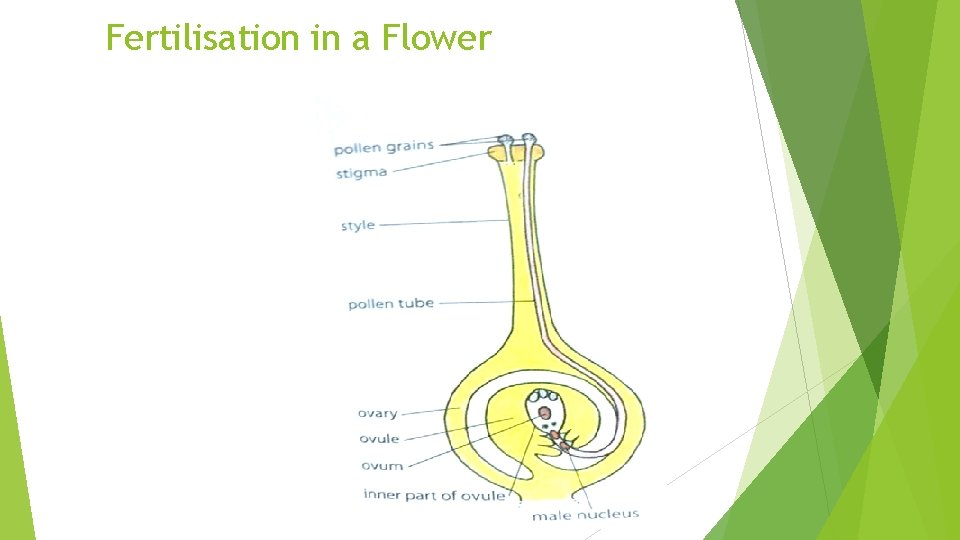
Fertilisation in a Flower
The importance of flowers, fruits, and seeds Flowers play an essential part in the formation of fruits and seeds. The seeds play a vital role in producing the next generation of plants when they germinate. This ensures the continuation of each species of plant which is very important in the cycle of life. Fruits are also important. Many fruits are edible and animals, including humans use them for food. Flowers also provide food for many insects, such as bees and butterflies. It is therefore very important that we protect the environment by making sure not to destroy flowers indiscriminately.
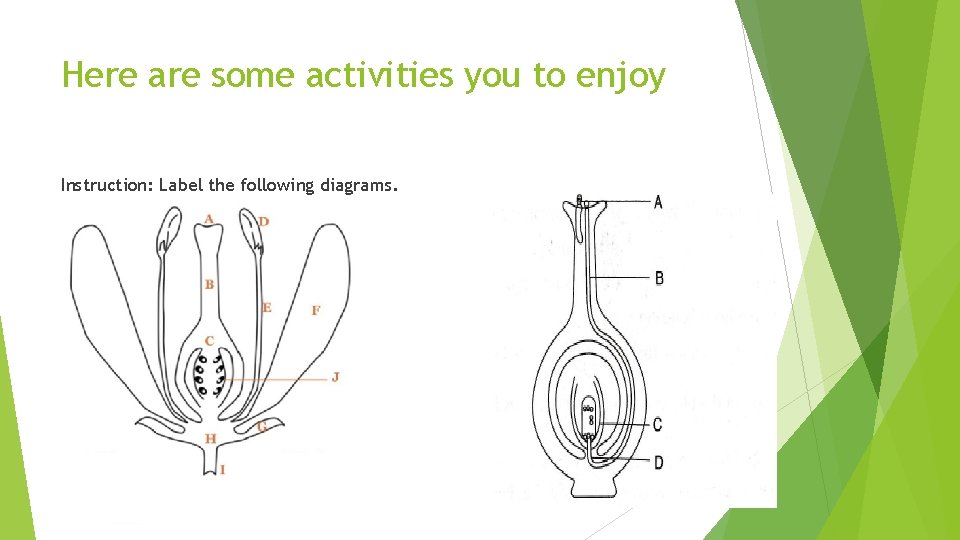
Here are some activities you to enjoy Instruction: Label the following diagrams.
- Slides: 14