
Before we get into 61 Note Taking Basics
Before we get into 6+1: Note Taking Basics I will be collecting these notes to see how you do, but here are some tips for you to take successful notes.

Note taking = Dictation Note taking is writing complete ideas; dictation is writing complete sentences.

Examples Dictation: A preposition shows the relationship between words in a sentence. Notes: Prep. = relationships btw. words in a sentence
Successful Note taking: Listen for KEY WORDS cau s es Voice Grammar s n o i t i prepos techno logy e s e r P n o i t nta

Successful Note taking: Use space. Move your hand. Three keys to green environment – educate public, improve techno. , and help increase demand for recycling. 3 keys to green environ 1 - educate public 2 - improve tech. 3 -help incr. demand for recy. ing

Use space to show relationships. Use vertical space. 3 keys to green environ 1 - educate public 2 - improve tech. 3 -help incr. demand for recy. ing Use horizontal space. Gas Use -Factors Europe U. S Less More $$ More trains +pub transp. good hwys cheap gas auto ind. oil comp.
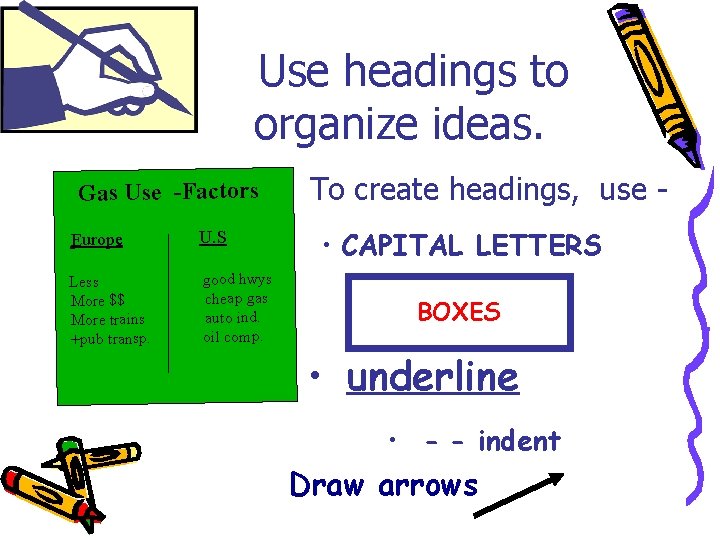
Use headings to organize ideas. Gas Use -Factors Europe U. S Less More $$ More trains +pub transp. good hwys cheap gas auto ind. oil comp. To create headings, use • CAPITAL LETTERS BOXES • underline • - - indent Draw arrows
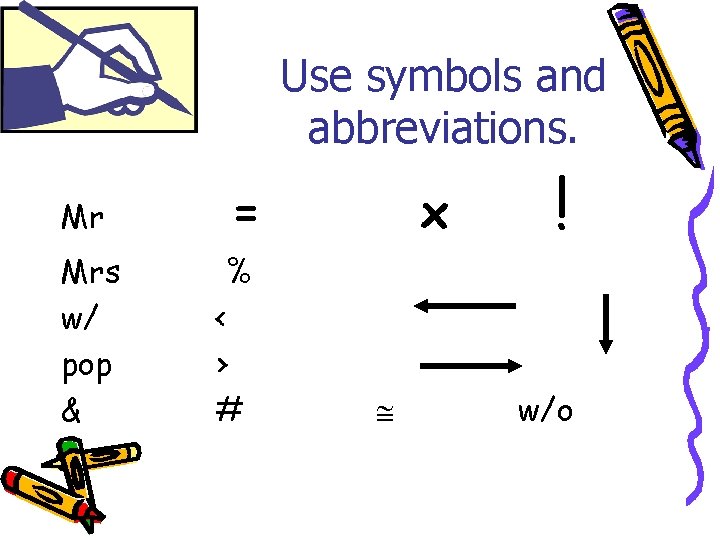
Use symbols and abbreviations. Mr Mrs w/ pop & = % ‹ › # x ! w/o
Use Outline Format and Bullets! • Put a big idea here – Then put a smaller idea related here • Then a subtopic of that subtopic • Possible another idea about that – Then another smaller idea about the big one • Then go back for another idea – Then something about that And so on, and so on.
BUT remember to Note complete ideas, not just random words. Get the BIG PICTURE! What’s the main point of the notes? What does he want you to learn?
Sjkjd foweu i voi fofwe Asdda row p dereeg skfpk ghhjyjh fdfgh ytyutyu hjrtt yuty jsk rrtyr dfjfije y irjeww One More Point jkjdf oweu voifo fwero w Dfjfjie fjwekg lhkglh kgpor tyo lweojw Quantity is important! e ehuw ehfwe weoirw fjfjiefjw eor ekglhk Sjkjd g lh foweu kgpor tyolwe i ojwe e huweh fwewe ry voifo fwero ty w r w w psk r e fpkfd Asdda irj tt fghhj e d ereegg j r i w rttrr j f j hhjyjhy o f h tyry D r ty d h f jf u ji ty e k e g uyuty js fjwekg s w j f kdfjfije lhkglh f y d t kgpor irjeww fo kf uyu tyolwe e ojwe e oi fp ui ty w v k e h j u u wehfw Sjkjd i eo ps ow foweu eweoir yty i voi weor lw eu w df yjh o w j o j f o y f o h r k werow t h r f e j g o d p w S s k g p fpk j r of ree kg jk Fdfgh eo if e lh r. S y w h d o g j r o r i a v r e hk eo w ty • ttr dd gl rtyry r ew As js ek r y w t t f jf w i u t • h A o s y e d r e d e j i aderee w jfj tyu gghhjy ew h jhytyuty hu Df yu w fgh t e f y uyuty js e h eh fd j w y j j w k o • h k u d p f jf h ijeirje Eh kf gg voifo ww. Sjkjdf ps r ee fwero o r o w psk weui p de Asdda fpkfd kg e da f d e h fghhj r e l d egghh o w jw g rttrr jyjhyty w As if tyry ew lhk eo o j u o ty y r r y w i v g r l e e r r k j y o i o w y e i t f y e t uyutyjs fj jw of rr rt eu kdfjfije or rw kd ief if tt irjeww tr oi ow gp o e jfj t f r w k f D fjfjiefjw r d j w h w D l j e e g k j h r g k lh k kglhkg fw ir gh lh eo Sj portyo ije eh lweojw kg oirw df w fjf e f u d e ehuw e k w h k o j D s ehfwe e p f f jf j w r ji e e f f e jw e weoirw y i w e t j k k g f we lh w u j k eor j s f g f lh y o kgpor p ehuwe D eh tyolwe yu lwe t h v w f w w u o e w jw u e o y e o irweor t eh eui hh rty hy jyj po ow f g h g f h k d fd lh gg kj pk ee lhkg r Sj kf e kg ad ps dd fjwe s A ie jfj oirweo r
6+1 Traits of Writing A refresher
What are they? • • Ideas Sentence Fluency Organization Word Choice Voice Conventions Presentation (+1)
I. Ideas • Make up the content of your piece • When ideas are STRONG, your overall message is CLEAR • In your writing, you should move your ideas from the general to the specific.
What do I do with it? • • First, select an idea (the topic!) Then, narrow the idea (focus!) Elaborate on the idea (develop!) Finally, discover the best information to convey the idea (details, details!)
II. Sentence Fluency • The flow of the language • The sound of word patterns • The way the writing plays to the ear, not just the eye • Not sure? Read it aloud!
III. Organization • • The internal structure of the piece The thread of meaning The logical pattern of ideas Paragraphing, paragraphing
IV. Word Choice • At its best when it includes the use of rich, colorful language • Your goal should be to move and enlighten the reader
V. Voice • The soul of the piece • It’s what makes the writer’s style singular • Your convictions (beliefs, personality) should come out in the words • IT’s all about you, you!
VI. Conventions • Spelling • Punctuation • Grammar
(+1) Presentation • Zeros in on the form and layout • How pleasing the piece is to the eye • If typed, double spaced and Times New Roman • If hand written, blue or black ink and every other line • And, of course, nothing on your paper that doesn’t belong there
Why? • Let’s you become problem solvers of your own writing • Lets me give you meaningful feedback, not just a grade
- Slides: 22