
Before We Became Canada When Who What Canadas
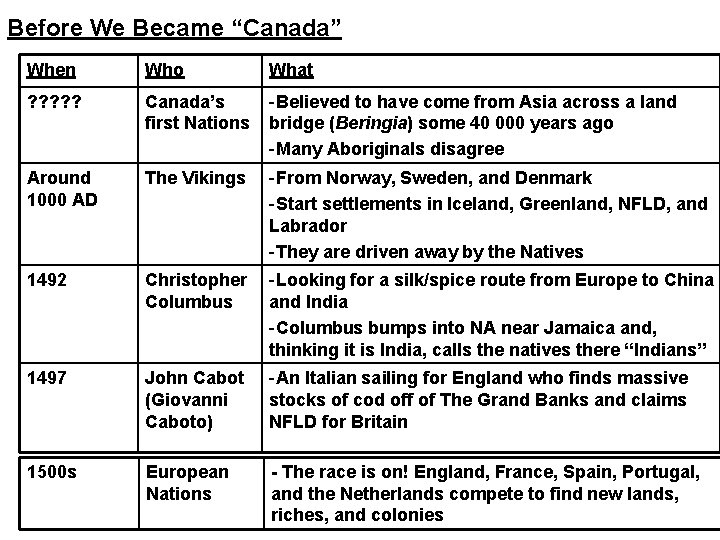
Before We Became “Canada” When Who What ? ? ? Canada’s first Nations -Believed to have come from Asia across a land bridge (Beringia) some 40 000 years ago -Many Aboriginals disagree Around 1000 AD The Vikings -From Norway, Sweden, and Denmark -Start settlements in Iceland, Greenland, NFLD, and Labrador -They are driven away by the Natives 1492 Christopher Columbus -Looking for a silk/spice route from Europe to China and India -Columbus bumps into NA near Jamaica and, thinking it is India, calls the natives there “Indians” 1497 John Cabot (Giovanni Caboto) -An Italian sailing for England who finds massive stocks of cod off of The Grand Banks and claims NFLD for Britain 1500 s European Nations - The race is on! England, France, Spain, Portugal, and the Netherlands compete to find new lands, riches, and colonies
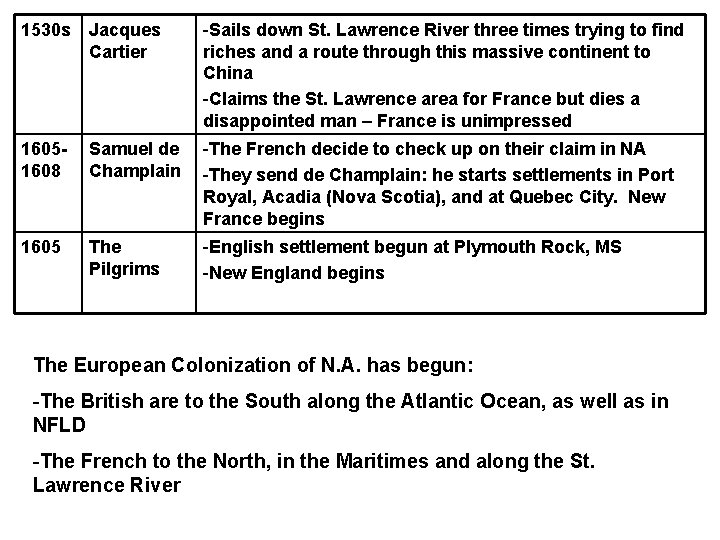
1530 s Jacques Cartier -Sails down St. Lawrence River three times trying to find riches and a route through this massive continent to China -Claims the St. Lawrence area for France but dies a disappointed man – France is unimpressed 16051608 Samuel de Champlain -The French decide to check up on their claim in NA -They send de Champlain: he starts settlements in Port Royal, Acadia (Nova Scotia), and at Quebec City. New France begins 1605 The Pilgrims -English settlement begun at Plymouth Rock, MS -New England begins The European Colonization of N. A. has begun: -The British are to the South along the Atlantic Ocean, as well as in NFLD -The French to the North, in the Maritimes and along the St. Lawrence River
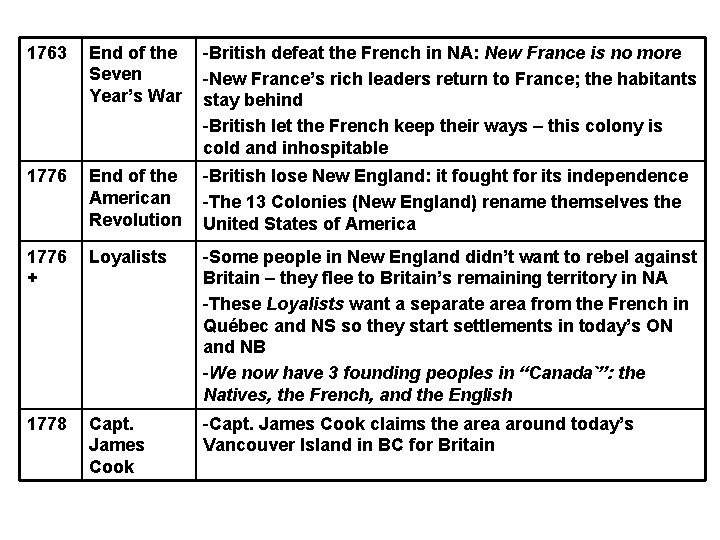
1763 End of the Seven Year’s War -British defeat the French in NA: New France is no more -New France’s rich leaders return to France; the habitants stay behind -British let the French keep their ways – this colony is cold and inhospitable 1776 End of the American Revolution -British lose New England: it fought for its independence -The 13 Colonies (New England) rename themselves the United States of America 1776 + Loyalists -Some people in New England didn’t want to rebel against Britain – they flee to Britain’s remaining territory in NA -These Loyalists want a separate area from the French in Québec and NS so they start settlements in today’s ON and NB -We now have 3 founding peoples in “Canada`”: the Natives, the French, and the English 1778 Capt. James Cook -Capt. James Cook claims the area around today’s Vancouver Island in BC for Britain
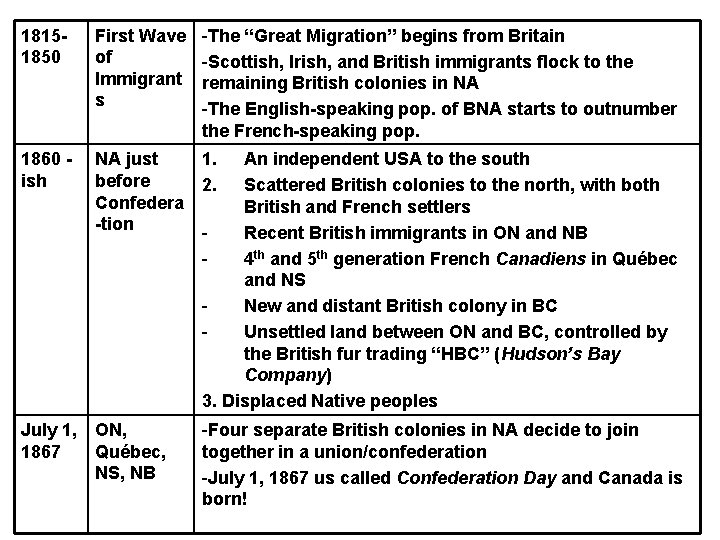
-The “Great Migration” begins from Britain -Scottish, Irish, and British immigrants flock to the remaining British colonies in NA -The English-speaking pop. of BNA starts to outnumber the French-speaking pop. 18151850 First Wave of Immigrant s 1860 ish NA just 1. before 2. Confedera -tion - July 1, ON, 1867 Québec, NS, NB An independent USA to the south Scattered British colonies to the north, with both British and French settlers Recent British immigrants in ON and NB 4 th and 5 th generation French Canadiens in Québec and NS New and distant British colony in BC Unsettled land between ON and BC, controlled by the British fur trading “HBC” (Hudson’s Bay Company) 3. Displaced Native peoples -Four separate British colonies in NA decide to join together in a union/confederation -July 1, 1867 us called Confederation Day and Canada is born!
The Road to Confederation I. What Was Canada before Confederation? - A scattered collection of British colonies (NFLD, PEI, NB, NS, Canada East [Québec], Canada West [Ontario], and BC) and some territories (i. e. Rupert’s Land [the Prairies] and NWT [northern prairies, Yukon, and NWT]) owned by fur trading companies - Each colony had its own government and was trying to find its own way; BUT, some people had a vision that they would be stronger if they united - One such person was Sir John A. Mac. Donald, our first Prime Minister. He favoured a strong central government called a Legislative Union rather than a Federal Union like that of the USA. Mac. Donald believed this would prevent one province from gaining too much power. However, French Canadians and Maritimers disagreed: why?
II. What Factors Led to Confederation? 1. War and Expansion in the USA - from 1861 -1865 there was a civil war in the USA - Britain appeared to support the Southern States (i. e. sold them battleships) - when the North won, the colonies were worried about the North’s attitude toward Britain (i. e. “them”) - America bought Alaska and was talking about taking over some of Canada - during the gold rush in BC, many Americans came into Canada, which led to an increased fear in an American take-over 2. Fenian Raids - Irish-American (Fenians) believed that if they captured the colonies they would force Britain to free Ireland - they raided places: people became worried and decided to defend themselves by joining together 3. The Trouble with Trade - the colonies had a preference with Britain for trading until Britain introduced free trade - the colonies decided to trade freely with the US until the US declared that it was costing them too much money - the best solution was for the colonies to trade freely with each other
4. The Need for Rail Links - for there to be trade among the colonies, they needed some sort of “link” - a railway offered the colonies the best means to trade amongst themselves - if the colonies built the railway as one “unit”, it would be much more cost-effective 5. Changing British Attitudes - the New England-ers thought that the colonies were too expensive for Britain to hang on to - many people agreed with the New England-ers III. Timeline leading to Confederation 1. Charlottetown Conference, August 1864 - NS, NB, and PEI were meeting to discuss a union in the Maritimes - Canada East and West (Québec and ON) invited themselves too - their presence was well-received, recognizing that a wider union was certainly possible 2. Québec Conference, October 1864 - Fathers of Confederation worked out the 72 Resolutions: a plan for how Confederation could work - the most important point: the central government must be more powerful than individual provinces
3. London Conference, 1866 - British Parliament agrees to the idea of a union - 1867: British North America Act is passed - the Dominion of Canada is born (NB, NS, ON, Québec) - Queen Victoria signs off on the BNA Act on July 1, 1867 and Canada is born! Unlike the USA who became independent from Britain through a war, Canada achieved the same independence by negotiation and compromise. Significant Developments After 1867: 1870 – Manitoba joins Canada 1871 – British Columbia joins Canada 1873 – Prince Edward Island joins Canada 1873 – Treaty of Washington signed. This guaranteed against an attack from the US, allowed Americans to fish off Canadian coastal waters, and gave Canadians the right to sell goods to the US without paying any taxes The Dream of a National Railway begins.
- Slides: 8