
Before the assignment some theory first EXPONENTIAL SOURCE
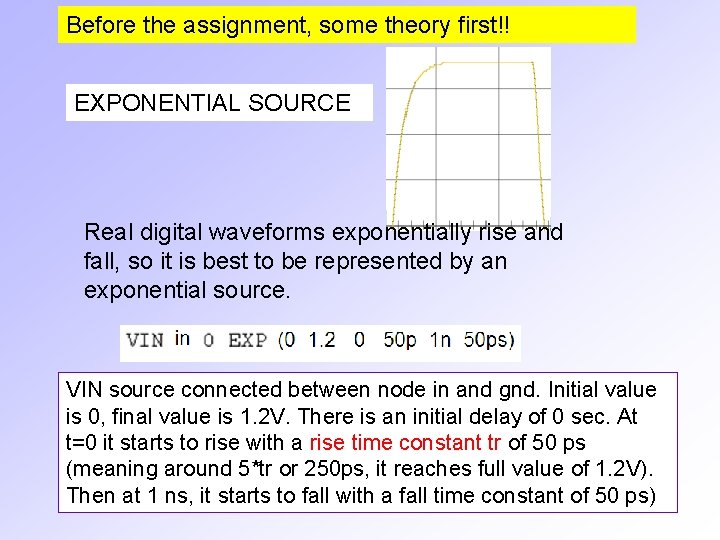
Before the assignment, some theory first!! EXPONENTIAL SOURCE Real digital waveforms exponentially rise and fall, so it is best to be represented by an exponential source. VIN source connected between node in and gnd. Initial value is 0, final value is 1. 2 V. There is an initial delay of 0 sec. At t=0 it starts to rise with a rise time constant tr of 50 ps (meaning around 5*tr or 250 ps, it reaches full value of 1. 2 V). Then at 1 ns, it starts to fall with a fall time constant of 50 ps)
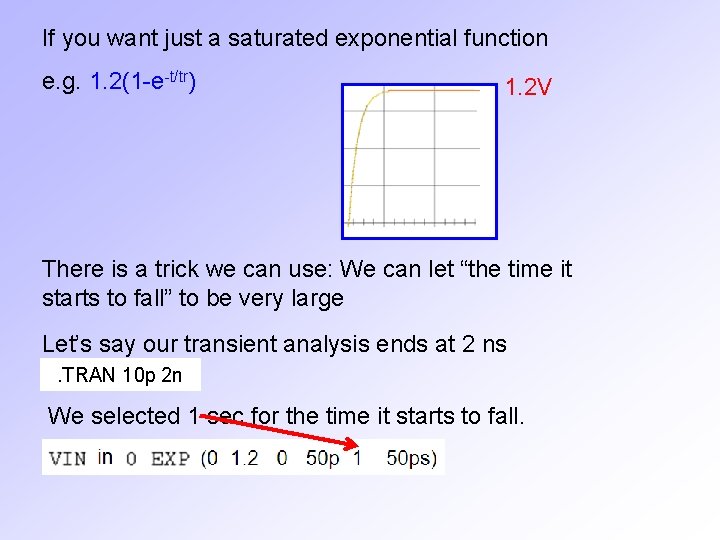
If you want just a saturated exponential function e. g. 1. 2(1 -e-t/tr) 1. 2 V There is a trick we can use: We can let “the time it starts to fall” to be very large Let’s say our transient analysis ends at 2 ns. TRAN 10 p 2 n We selected 1 sec for the time it starts to fall.
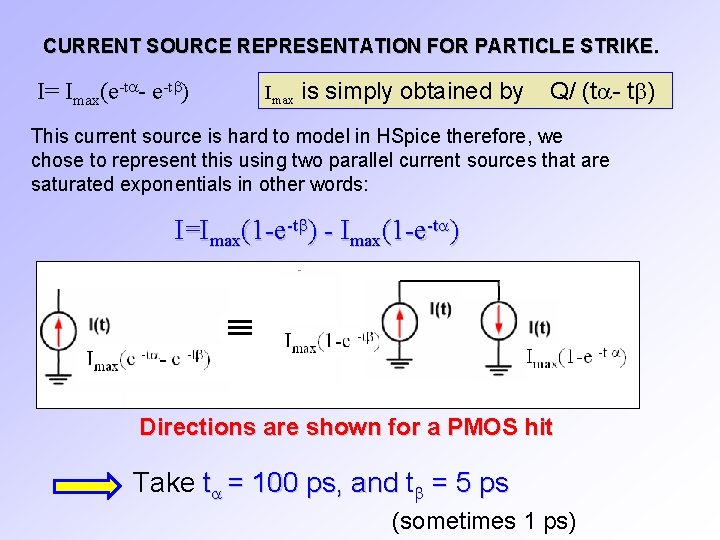
CURRENT SOURCE REPRESENTATION FOR PARTICLE STRIKE. I= Imax(e-t - e-t ) Imax is simply obtained by Q/ (t - t ) This current source is hard to model in HSpice therefore, we chose to represent this using two parallel current sources that are saturated exponentials in other words: I=Imax(1 -e-t ) - Imax(1 -e-t ) Directions are shown for a PMOS hit Take t = 100 ps, and t = 5 ps (sometimes 1 ps)
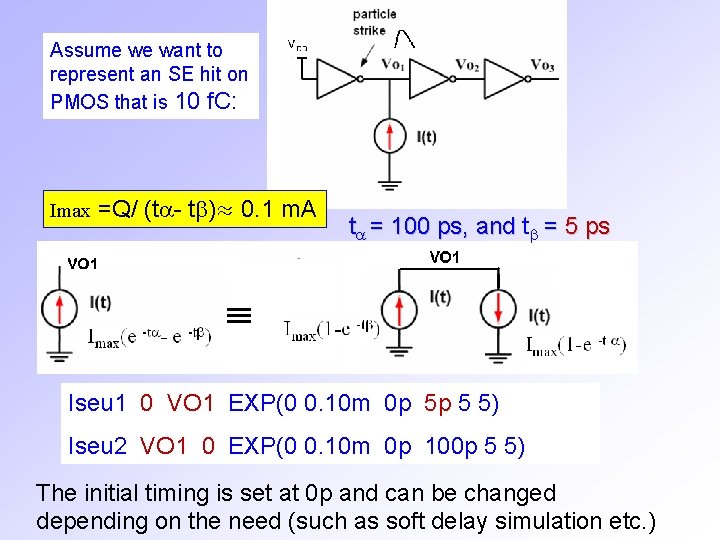
Assume we want to represent an SE hit on PMOS that is 10 f. C: Imax =Q/ (t - t )≈ 0. 1 m. A t = 100 ps, and t = 5 ps Iseu 1 0 VO 1 EXP(0 0. 10 m 0 p 5 p 5 5) Iseu 2 VO 1 0 EXP(0 0. 10 m 0 p 100 p 5 5) The initial timing is set at 0 p and can be changed depending on the need (such as soft delay simulation etc. )
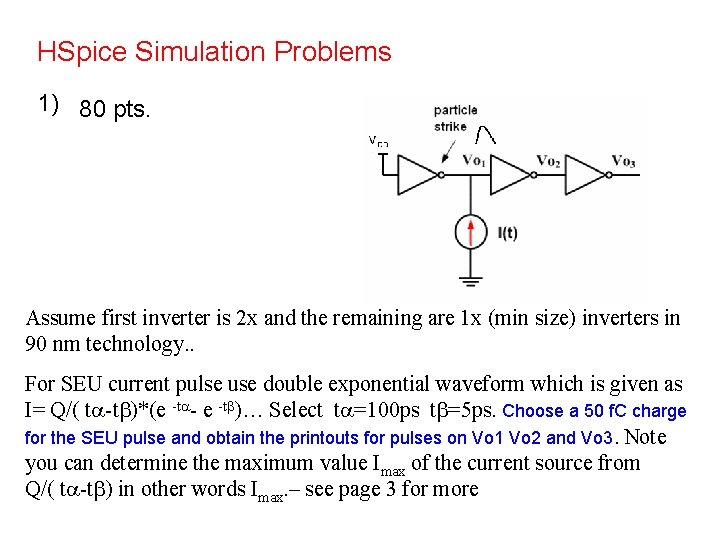
HSpice Simulation Problems 1) 80 pts. Assume first inverter is 2 x and the remaining are 1 x (min size) inverters in 90 nm technology. . For SEU current pulse use double exponential waveform which is given as I= Q/( t -t )*(e -t - e -t )… Select t =100 ps t =5 ps. Choose a 50 f. C charge for the SEU pulse and obtain the printouts for pulses on Vo 1 Vo 2 and Vo 3. Note you can determine the maximum value Imax of the current source from Q/( t -t ) in other words Imax. – see page 3 for more
In the next step, you will apply the gate sizing method. For that, you will need to size up the first inverter (increase transistor widths) until the pulses cannot propagate thru 2 nd and 3 rd inverter. Increase the sizing in 3 x, 4 x, 5 x and so on until mitigation is obtained and record that value. If the pulses propagating at Vo 3 is less then 100 m. V, we assume the sizing process is complete (since they are well below threshold) Provide the plots on outputs and include the new size that you found. For this assignment, provide the Hspice codes of each circuit.
2) SE Crosstalk Noise Simulation: Hspice - 120 pts Assume we have an aggressor and victim line that is coupled with coupling capacitance. Take victim and aggressor line resistance as 400 ohms each and take ground capacitances as 20 f. F. The coupling capacitance value is 110 f. C. Obtain 8 - model (Note the class example was for 10 pi) for both the aggressor and victim line and distribute the coupling capacitance as shown in class. (in 8 pi, middle capacitors have 1/8 th of total and the on edges have 1/16 times the total), wire resistance is 1/8 th always Finally obtain the circuit shown on next page.
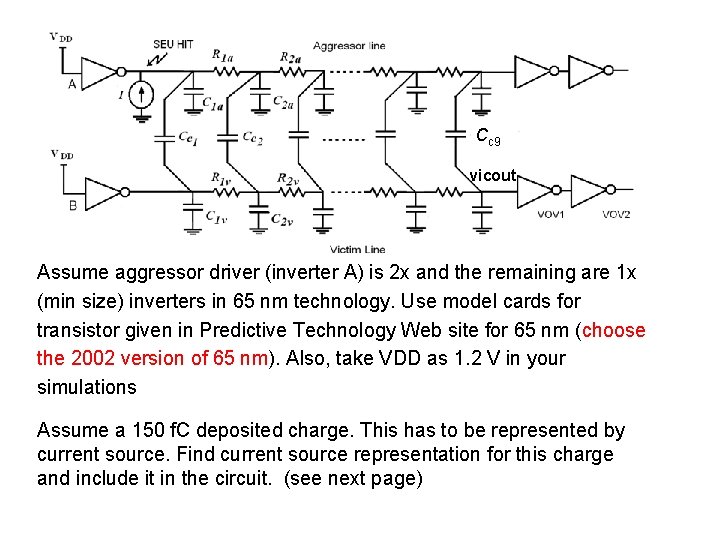
Cc 9 vicout Assume aggressor driver (inverter A) is 2 x and the remaining are 1 x (min size) inverters in 65 nm technology. Use model cards for transistor given in Predictive Technology Web site for 65 nm (choose the 2002 version of 65 nm). Also, take VDD as 1. 2 V in your simulations Assume a 150 f. C deposited charge. This has to be represented by current source. Find current source representation for this charge and include it in the circuit. (see next page)
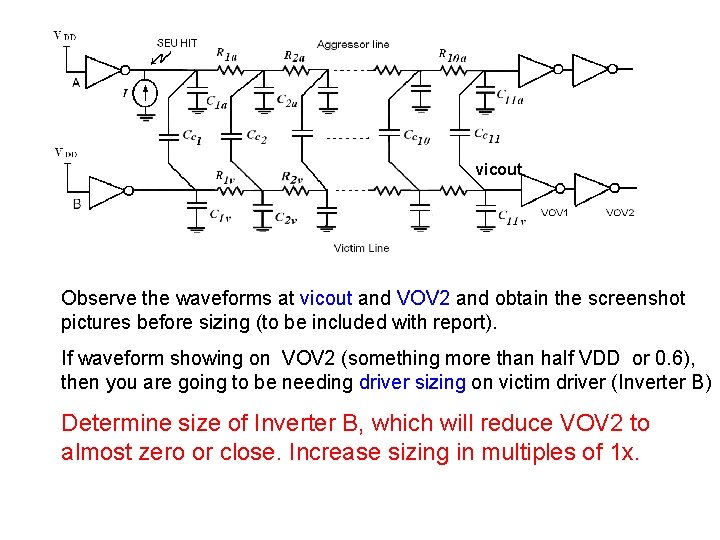
vicout Observe the waveforms at vicout and VOV 2 and obtain the screenshot pictures before sizing (to be included with report). If waveform showing on VOV 2 (something more than half VDD or 0. 6), then you are going to be needing driver sizing on victim driver (Inverter B) Determine size of Inverter B, which will reduce VOV 2 to almost zero or close. Increase sizing in multiples of 1 x.
For Question 1, these are what you will need to include: a) Include the printouts for the waveforms at vicout and VOV 2 before sizing simulation. Also include the HSpice Code. Also include the waveform at the strike location (output of aggressor driver) b) In your report mention, the size of Victim driver, which mitigates the SET transient. c) Include the HSpice code and the printout of waveforms of vicout and VOV 2 after doing the sizing simulation.
- Slides: 10