
BEESS UPDATE CASE June 2015 www FLDOE org
BEESS UPDATE CASE June 2015 www. FLDOE. org © 2014, Florida Department of Education. All Rights Reserved.

From Preschool to Post-School Outcomes Preparing Florida’s Students to Become College and Career Ready Ds Equity, Access and Attainment www. FLDOE. org © 2014, Florida Department of Education. All Rights Reserved.
Topics to Discuss • Changes to graduation/recently released TAP • Status of prior years’ legislation • Recently revised rules • Matrix Handbook changes • EOC/FSA waiver TAP • Guidance on service animals • State complaints – considerations for practices/procedures • MTSS, decisions about when to request evaluation & consent for evaluation • Data Review www. FLDOE. org © 2014, Florida Department of Education. All Rights Reserved. 3
The Emphasis of IDEA 04 “Improving educational results for children with disabilities is an essential element of our national policy of ensuring equality of opportunity, full participation, independent living, and economic self-sufficiency for individuals with disabilities” (sec. 1400(c)(1)) www. FLDOE. org © 2014, Florida Department of Education. All Rights Reserved.
Moving from Access to Attainment: Statewide Equity and Excellence Increase Number of Students Graduating College and Career Ready • Improve Graduation Rate • Decrease Dropout Rate • Improve Post-School Outcomes Results www. FLDOE. org © 2014, Florida Department of Education. All Rights Reserved.
Five Game Changers for SWD • Aligning early childhood services and k-12 services for students with disabilities • Developing policies that would push all teachers to be prepared and trained to work with SWD and parents • Providing access to differentiated instruction, and effective intervention to all SWD (OSEP, 2012) www. FLDOE. org © 2014, Florida Department of Education. All Rights Reserved.
Five Game Changers SWD • Including all students in assessment by making the assessments fully accessible • Providing more transition planning for students moving into post-secondary and career opportunities (OSEP, 2012) www. FLDOE. org © 2014, Florida Department of Education. All Rights Reserved.
GRADUATION REQUIREMENTS FOR STUDENTS WITH DISABILITIES: ENSURING MEANINGFUL DIPLOMAS FOR ALL STUDENTS www. FLDOE. org © 2014, Florida Department of Education. All Rights Reserved.
GRADUATION REQUIREMENTS FOR STUDENTS WITH DISABILITIES: ENSURING MEANINGFUL DIPLOMAS FOR ALL STUDENTS • Recommendations • Set high college and career expectations and clear goals for SWD • Limit the number of diploma options for SWD • Identify multiple, equally rigorous paths for SWD • Identify appropriate diploma options for students with SCD • Research the impact of state graduation requirements and diploma options on student outcomes www. FLDOE. org © 2014, Florida Department of Education. All Rights Reserved.
2014 Legislative Changes – Graduation/Transition www. FLDOE. org © 2014, Florida Department of Education. All Rights Reserved.
Review of recent changes • New opportunities for students with disabilities • Changes to graduation requirements • Repeal of special diploma • Expansion of 18 -22 year old programs • Our focus on equity and access • Data driven decision making related to our monitoring and targeted technical assistance www. FLDOE. org © 2014, Florida Department of Education. All Rights Reserved.
Special Diploma Section 1003. 438, Florida Statutes (F. S. ) • Repealed as of July 1, 2015 • Students who began 9 th grade in 2013 -14 and earlier and whose IEPs already documented special diploma may continue • Students who began 9 th grade in 2014 -15 or later MAY NOT work toward a special diploma www. FLDOE. org © 2014, Florida Department of Education. All Rights Reserved.
Transition S. 1003. 5716, F. S. • Much of this new statutory language was already in rule, but there are some additions www. FLDOE. org © 2014, Florida Department of Education. All Rights Reserved.
Rule 6 A-6. 03028, F. A. C. – What’s New • Begin transition planning before attaining age 14 and include the following: • Statement of intent with regard to standard diploma and Scholar or Merit designation (as determined by parent) • Preparation that will be needed to graduate from high school with standard diploma and diploma designation • Consider need for instruction or information in selfdetermination and self-advocacy in order for the student to actively and effectively participate in IEP process www. FLDOE. org © 2014, Florida Department of Education. All Rights Reserved.
Rule 6 A-6. 03028, F. A. C. – What’s new • Beginning no later than the IEP in effect when student attains age 16 (or younger, if appropriate) • A statement of intent to receive a standard diploma before age 22 and how student will fulfill requirements of 1003. 4282, F. S. • A statement of outcomes and additional benefits expected by the parent and the IEP team by graduation • A statement of measurable postsecondary and career goals www. FLDOE. org © 2014, Florida Department of Education. All Rights Reserved.
Rule 6 A-6. 03028, F. A. C. – What’s new • Beginning with the 2015 -2016 school year, a statement identifying the Career and Professional Education (CAPE) digital tool certificates and the CAPE industry certifications that the student seeks to attain before high school graduation, if any, pursuant to Section 1003. 4203, F. S. • This could apply to a student at any age – not limited to secondary students! www. FLDOE. org © 2014, Florida Department of Education. All Rights Reserved.
Rule 6 A-6. 03028, F. A. C. • The following changes require parental approval (or adult student) • Changes to postsecondary or career goals • Beginning with students entering grade 9 in 2014 -2015, changes in selected graduation option on IEP and waiver of statewide standardized results • Changes subject to verification for appropriateness by independent reviewer selected by the parent as provided in s. 1003. 572, F. S. • Law silent on who pays for reviewer if sought by parent; no obligation stipulated for district www. FLDOE. org © 2014, Florida Department of Education. All Rights Reserved.
Who is an independent reviewer? • Individuals certified under s. 393. 17 or licensed under chapter 490 or chapter 491 for applied behavior analysis services as defined in ss. 627. 6686 and 641. 31098. • Speech-language pathologists licensed under s. 468. 1185. • Occupational therapists licensed under part III of chapter 468. • Physical therapists licensed under chapter 486. • Psychologists licensed under chapter 490. • Clinical social workers licensed under chapter 491. www. FLDOE. org © 2014, Florida Department of Education. All Rights Reserved.
Who is an independent reviewer? • Individuals certified under s. 393. 17 or licensed under chapter 490 or chapter 491 for applied behavior analysis services as defined in ss. 627. 6686 and 641. 31098. • Speech-language pathologists licensed under s. 468. 1185. • Occupational therapists licensed under part III of chapter 468. • Physical therapists licensed under chapter 486. • Psychologists licensed under chapter 490. • Clinical social workers licensed under chapter 491. www. FLDOE. org © 2014, Florida Department of Education. All Rights Reserved.
High School Graduation Requirements S. 1003. 4282 (11), F. S. • The majority of students with disabilities will continue to earn a standard diploma by meeting the same graduation requirements as all students • Remember - in 2013 -14, 59. 9% of students with disabilities earned a standard diploma this way! www. FLDOE. org © 2014, Florida Department of Education. All Rights Reserved.
Rule 6 A-1. 09963, Florida Administrative Code • The statute required rulemaking, which became effective December 23, 2014 • Describes two high school graduation options available only to students with disabilities www. FLDOE. org © 2014, Florida Department of Education. All Rights Reserved.
Rule 6 A-1. 09963, F. A. C. – Graduation Rule • States that students with disabilities, starting with students entering 9 th grade in 2014 -15 may attain a standard diploma using the options in Section 1003. 4282 (11) • Does not restrict a student with a disability to these options • Clarifies how a certificate of completion is earned • Provides definitions for several terms used in the legislation www. FLDOE. org © 2014, Florida Department of Education. All Rights Reserved.
Standard Diploma via Access Courses • Must meet the same 24 credit requirement as all students, using access courses • Access Algebra 1 instead of Algebra 1, etc. • Other ESE courses and core courses may be used in certain circumstances • May substitute a CTE course with related content for access English IV, 1 access math, 1 access science and 1 access social studies • Not access Algebra, Geometry, Biology or US History • DOE must approve “content related” • CTE courses may be modified www. FLDOE. org © 2014, Florida Department of Education. All Rights Reserved.
Standard Diploma via Access Courses • Must take the Florida Alternate Assessment in reading, math and science until replaced • Must score 4 or above or have results waived • If results waived, demonstrate achievement via a portfolio (best practice - collect portfolio artifacts for all students) NOTE: There has been no change in who can take access courses and the alternate assessment. Students must have a significant cognitive disability and parents must consent. www. FLDOE. org © 2014, Florida Department of Education. All Rights Reserved.
Standard Diploma via Academic and Employment-based Courses • Must meet the same 24 credit requirement as all students • Must earn at least one-half credit in an employment-based course • Documented achievement of components on employment transition plan • May substitute a CTE course with content related for English IV, 1 math, 1 science & 1 social studies • Not Algebra, Geometry, Biology or US History • DOE must approve “content related” www. FLDOE. org © 2014, Florida Department of Education. All Rights Reserved.
Components of Employment Transition Plan • Signed by the student, parent, teacher and employer • Expected academic and employment competencies, industry certifications and OCPs • Criteria for determining and certifying competencies • Work schedule and minimum number of hours per week • Description of supervision to be provided by the district www. FLDOE. org © 2014, Florida Department of Education. All Rights Reserved.
Deferring Receipt of Standard Diploma • Allowed by the statute • Processes described in the rule www. FLDOE. org © 2014, Florida Department of Education. All Rights Reserved.
S. 1003. 4282(11)(c), F. S. • Receipt of diploma may be deferred under certain conditions • IEP “prescribes” special education, transition planning, transition services or related services through age 21; and • Is enrolled in accelerated college credit, industry certification courses that lead to college credit, a collegiate high school program, courses necessary for Scholar designation, or structured work-study, internship or preapprenticeship program www. FLDOE. org © 2014, Florida Department of Education. All Rights Reserved.
Key timelines for deferral • Decision made during the year the student is expected to meet all graduation requirements • By January 30 th of each year, inform students and parents that student expected to meet all requirements, and that failure to defer will release district from obligation to provide FAPE • May 15 th – deadline for acceptance or deferral of diploma • Reminder – sample letter was sent to ESE directors in December 2014 www. FLDOE. org © 2014, Florida Department of Education. All Rights Reserved.
How is deferral coded? • Go to the 2014 -2015 Automated Student Information System – Appendix A • http: //www. fldoe. org/accountability/datasys/database-manuals-updates/2014 -15 -studentinfo-system/index. stml • WD 1 – “any student with disabilities who met all of the requirements to receive a standard diploma who deferred receipt of diploma to remain eligible for FAPE, per section 1003. 4282(11)(c)” www. FLDOE. org © 2014, Florida Department of Education. All Rights Reserved.
“Counting” toward graduation rate • Will students who have met all graduation requirements but defer, “count” toward graduation rate? • Will students who receive a standard diploma via access courses “count” toward the standard diploma graduation rate? www. FLDOE. org © 2014, Florida Department of Education. All Rights Reserved.
Student Progression • Memoranda • Student Progression: New Requirements, Changes and Continued Requirements (DPS: 2015 -70, 5/8/15) • Preliminary Technical Assistance on House Bill 7069 (DPS: 2015: 81, 5/18/15) • Career and Education Planning System Changes (DPS: 2015 -72, 5/15/15) • High School Academic Advisement Flyers • Revisions for 2015 -2016 forthcoming • Visit Graduation Requirements page www. FLDOE. org © 2014, Florida Department of Education. All Rights Reserved.
Workforce Innovation and Opportunity Act (WIOA) • Replaces Workforce Investment Act (WIA) • Requires VR to spend a larger portion of their funds on pre-employment services for transition age students • BEESS working closely with VR – stay tuned www. FLDOE. org © 2014, Florida Department of Education. All Rights Reserved.
www. FLDOE. org © 2014, Florida Department of Education. All Rights Reserved. 34
A student with an emotional or behavior disorder and an IEP who is overage and struggling with the 24 credit standard diploma option available to all students may elect to take access courses and pursue part -time employment as their graduation option. www. FLDOE. org © 2014, Florida Department of Education. All Rights Reserved. 35
FALSE Only students with significant cognitive disabilities can receive instruction in access courses. This student could pursue the academic and employment competencies path. www. FLDOE. org © 2014, Florida Department of Education. All Rights Reserved. 36
Any change to a current 9 th grade (1 st time 9 th grader) student’s high school graduation option specified in the IEP must be approved by the parent and the district must pay for an independent reviewer selected by the parent if they do not agree with the IEP team’s decision. TRUE or FALSE? www. FLDOE. org © 2014, Florida Department of Education. All Rights Reserved. 37
TRUE & FALSE The parent does need to approved the change; however the law is silent about who pays www. FLDOE. org © 2014, Florida Department of Education. All Rights Reserved. 38
The 24 credit academic and employment option requires an employment transition plan, which is the same as the Individual Educational Plan or IEP. TRUE or FALSE? www. FLDOE. org © 2014, Florida Department of Education. All Rights Reserved. 39
FALSE Rule 6 A-1. 09963, F. A. C. , is clear – the employment transition plan is separate and apart from the IEP www. FLDOE. org © 2014, Florida Department of Education. All Rights Reserved. 40
Students who entered 9 th grade in 2014 -15, and whose middle school IEP already stated that they would work toward a special diploma may do so. TRUE or FALSE? www. FLDOE. org © 2014, Florida Department of Education. All Rights Reserved. 41
FALSE Special diploma is not available to students who entered grade 9 in 2014 -2015 www. FLDOE. org © 2014, Florida Department of Education. All Rights Reserved. 42
Recently Revised Rules IEP General Education Interventions Assessment DSI ASD www. FLDOE. org © 2014, Florida Department of Education. All Rights Reserved.
Rule 6 A-6. 03028, F. A. C. – IEP Rule • Legislative background • 2014 session – CS/SB 850 amended s. 1003. 4282, F. S. - Added (11) – Requirements for a standard high school diploma and created s. 1003. 5716, F. S. – Transition to postsecondary education and career opportunities • S. 1008. 22(9)-Student assessment program for public schools • S. 1003. 4203 - Digital materials, CAPE Digital Tool certificates, and technical assistance • Rule background • Amended in 11/18/14; became effective on 12/23/14 www. FLDOE. org © 2014, Florida Department of Education. All Rights Reserved.
Rule 6 A-6. 03028, F. A. C. – IEP Rule • Revises communication plan which is required for students who are deaf/hard of hearing and dual sensory impaired – plan adopted by reference (unrelated to statutory change) • Changed terminology – from vocational to career technical www. FLDOE. org © 2014, Florida Department of Education. All Rights Reserved.
Statewide Assessment for Students with Disabilities Rule 6 A-1. 0943, F. A. C. www. FLDOE. org © 2014, Florida Department of Education. All Rights Reserved.
Rule 6 A-1. 0943, F. A. C. – Assessment Rule • Legislative background • 2013 session -CS/SB 1108 created s. 1008. 212, F. S. – Students with disabilities; extraordinary exemption • 2014 session – CS/SB 1642 amended s. 1008. 22, F. S. - Student assessment program for public schools • Added (9) – Exemption from participation in statewide standardized assessment for children with medical complexity • Rule background • Rule amended twice in 2014 – 1/15/14 and 11/18/14 • Most recent revision effective 12/23/14 www. FLDOE. org © 2014, Florida Department of Education. All Rights Reserved.
Rule 6 A-1. 0943, F. A. C. – Assessment Rule • Adds reference to the statutory definition of medical complexity (s. 1008. 22, F. S. ) • Requires documentation from a physician licensed under chapter 458 (MD) or 459(DO) • Child is “medically fragile and needs intensive care due to a condition such as congenital or acquired multisystem disease; has a severe neurological or cognitive disorder with marked functional impairment; or is technology dependent for activities of daily living; and lacks the capacity to take or perform on an assessment” www. FLDOE. org © 2014, Florida Department of Education. All Rights Reserved.
Rule 6 A-1. 0943, F. A. C. – Assessment Rule • Amends section related to participation in the Florida Alternate Assessment • References requirements for parent consent • Eliminates redundant language in criteria • Even with appropriate and allowable accommodations, assistive technology, or accessible instructional materials the student requires modification to the grade-level general state content standards; AND • Student requires direct instruction in ELA, math, social studies and science based on access points www. FLDOE. org © 2014, Florida Department of Education. All Rights Reserved.
Rule 6 A-1. 0943, F. A. C. – Assessment Rule • Describes exemption options for children with medical complexity • A one-year exemption approved by the superintendent • A one-, two-, or three-year or permanent exemption approved the Commissioner • Selection of option – based on parent choice www. FLDOE. org © 2014, Florida Department of Education. All Rights Reserved.
New Resource Available! • Accommodations for Florida Statewide Student Assessment • http: //www. fldoe. org/core/fileparse. php/7690/urlt /statewideassessmentaccommodations. pdf • Manual updates the Guide to FCAT and FCAT 2. 0 Accommodations for Students with Disabilities (2010) and the Guide to Accommodations for Computer-Based FCAT, FCAT 2. 0, and End of Course (EOC) Assessments (Spring, 2012) previously published by FDOE- 2015 www. FLDOE. org © 2014, Florida Department of Education. All Rights Reserved.
General Education Intervention Procedures, Evaluation, Determination of Eligibility … Rule 6 A-6. 0331, F. A. C. www. FLDOE. org © 2014, Florida Department of Education. All Rights Reserved.
Rule 6 A-6. 0331, F. A. C • Rule background • Amended twice during 2014 – March and November • 2014 legislation related to repeal of special diploma required that consent form for FAA administration be changed • Language stating that participation in FAA would result in a special diploma modified and specifically references population entering grade 9 before 2014 -2015 • Additional areas addressed unrelated to legislation - timelines for requesting parental consent for evaluation and completing evaluations revised www. FLDOE. org © 2014, Florida Department of Education. All Rights Reserved.
Rule 6 A-6. 0331, F. A. C • Districts must seek parental consent for evaluation when a school based team determines - • That a K-12 student’s Rt. I data indicates that the student is responding to intensive interventions but the level of intensity & resources to sustain growth exceeds that available through general education OR • That a K-12 student’s Rt. I data indicates that the student is not making adequate growth given effective core instruction & intensive evidence based interventions • In these circumstances, consent must be requested within 30 calendar days of the determination, unless other timeline agreed to www. FLDOE. org © 2014, Florida Department of Education. All Rights Reserved.
Rule 6 A-6. 0331, F. A. C. • Districts must seek parental consent for evaluation when • A child age 3 to kindergarten entry age receives a developmental screening through the school district or through FDLRS and based on the results of the screening it is suspected that the child may be a child with a disability in need of special education and related services • In these circumstances, consent to evaluate must be requested within 30 calendar days of the determination, unless other timeline agreed to www. FLDOE. org © 2014, Florida Department of Education. All Rights Reserved.
Rule 6 A-6. 0331, F. A. C. • When a parent requests an evaluation and there is documentation or evidence that the K-12 student or a child age 3 to kindergarten entry age who is enrolled in a school district operated preschool program may be a student with a disability in need of special education • School district must obtain consent within 30 calendar days unless another timeline agreed to OR • Provide notice of refusal www. FLDOE. org © 2014, Florida Department of Education. All Rights Reserved.
Rule 6 A-6. 0331, F. A. C. • Changes to evaluation timeline beginning 7. 1. 15 • Districts must ensure that evaluations are completed within 60 calendar days after the receipt of parent consent for evaluation • Days that do not “count” as a “calendar day” • School holidays, Thanksgiving, winter and spring break, as adopted by the school board • Summer vacation beginning the day after last day of school for students and ending the 1 st day of school for students as adopted by the school board • Absences of a student for more that 8 school days in the 60 calendar day period www. FLDOE. org © 2014, Florida Department of Education. All Rights Reserved.
Rule 6 A-6. 0331, F. A. C. • Note about timelines • New 60 calendar day timeline to complete evaluations begins 7. 1. 15; current 60 school day provision applies to consents received on or before June 30, 2015 • All other changes became effective 12. 23. 14 www. FLDOE. org © 2014, Florida Department of Education. All Rights Reserved.
Questions to address in the TAP • If through FDLRS child find screening process, the results of developmental screening indicate that the child may be a child with a disability, who is responsible for obtaining consent? FDLRS? School District? • If a preschool child or K-12 student does not “pass” a vision or hearing screening, and it is suspected that the child may be a child with a disability in need of special education, can the school district postpone proceeding with requesting parental consent for evaluation? www. FLDOE. org © 2014, Florida Department of Education. All Rights Reserved.
Questions to be addressed in the TAP • If a parent requests an evaluation for their child who is enrolled in a private school does the 30 day timeline apply? www. FLDOE. org © 2014, Florida Department of Education. All Rights Reserved.
Eligibility for Students with Dual Sensory Impairments (DSI) Rule 6 A-6. 03022, F. A. C. www. FLDOE. org © 2014, Florida Department of Education. All Rights Reserved.
Rule 6 A-6. 03022, F. A. C. – DSI Rule • Rule background • Complete re-write of rule to reflect current knowledge in the field • Last substantive revision was in 1991 • Revision unrelated to any statutory changes, however, requirement related to having a Communication Plan applies • This population has been under-identified in the past. www. FLDOE. org © 2014, Florida Department of Education. All Rights Reserved.
Rule 6 A-6. 03022, F. A. C. – DSI Rule • Criteria for eligibility – (essentially 2 “options”) • The student has a medical condition with likely potential for resulting in dual sensory loss AND the student needs special education OR • The student meets existing rule criteria for visually impaired (Rule 6 A-6. 03014) or has functional blindness AND • The student meets existing rule criteria for deaf/hard-of –hearing (Rule 6 A-6. 03013) or has functional hearing loss AND • The student needs special education www. FLDOE. org © 2014, Florida Department of Education. All Rights Reserved.
Rule 6 A-6. 03022, F. A. C. – DSI Rule • Reporting criteria similar to that found in Rule 6 A 6. 03014 (VI rule) • Districts must register students to receive instructional materials from the Florida Instructional Materials Center for the Visually Impaired • Districts must report students in the state’s annual census report for the national child count of students with dual sensory loss www. FLDOE. org © 2014, Florida Department of Education. All Rights Reserved.
Rule 6 A-6. 03022, F. A. C. – DSI Rule • Reevaluation • Must occur at least every 3 years • Medical evaluations are not required • Comprehensive assessments are required – same assessments as noted for initial eligibility www. FLDOE. org © 2014, Florida Department of Education. All Rights Reserved.
Communication Plan Rule 6 A-6. 03028, F. A. C. www. FLDOE. org © 2014, Florida Department of Education. All Rights Reserved.
Feedback for Changes • District staff • Teachers of the deaf • Speech language pathologists • Staffing specialists • National Deaf Agenda – Florida Team www. FLDOE. org © 2014, Florida Department of Education. All Rights Reserved.
Section I Changes • Communication Plan instead of Model Communication Plan • Added “hearing age” – important to note when child was given auditory access since this allows better understanding of the data • More choices for student’s primary method of access • “Action in the home” changed to “information to be shared with the family” www. FLDOE. org © 2014, Florida Department of Education. All Rights Reserved.
Section III Changes • Simplified wording to focus on academic level and readiness to facilitate using data to answer questions Section IV and V • No Changes www. FLDOE. org © 2014, Florida Department of Education. All Rights Reserved.
Communication Plan • Located on the DHH page of our website – Make sure you are using the most current!!! • http: //www. fldoe. org/academics/exceptionalstudent-edu/ese-eligibility/deaf-or-hard-of-hearing -dhh. stml • Need help implementing? • Contact the Resource Materials and Technology Center for the Deaf/Hard-of-Hearing for assistance www. FLDOE. org © 2014, Florida Department of Education. All Rights Reserved.
Remember these other important changes • Parent consent is required for • Placement in an ESE center school • Instruction in Access Points curriculum and administration of the FAA (section 1003. 5715, F. S. ) • Parents have a right to bring an individual of choice to meetings • Give the opportunity to indicate if they have been discouraged from doing so (section 1002. 20, F. S. ) • You must provide information regarding the state appropriations for the 5 ESE funding levels (section 1003. 57, F. S. ) www. FLDOE. org © 2014, Florida Department of Education. All Rights Reserved.
Rule 6 A-6. 03023, F. A. C. Exceptional Student Education Eligibility for Students with Autism Spectrum Disorder www. FLDOE. org © 2014, Florida Department of Education. All Rights Reserved.
Rule Revision Rule history: 1979: Rule 6 A-6. 03023, F. A. C. , Special Programs for Students who are Autistic. 2007: Rule 6 A-6. 03023, F. A. C. , Exceptional Student Education Eligibility for Students with Autism Spectrum Disorder. 2009: Updated rule citations in Rule 6 A-6. 03023, F. A. C. 2015: Rule 6 A-6. 03023, Exceptional Student Education Eligibility for Students with Autism Spectrum Disorder. Update the language to reflect current knowledge in the field. Be consistent with related State Board of Education rules and current knowledge in the field. www. FLDOE. org © 2014, Florida Department of Education. All Rights Reserved.
Rule Revision (1) Definition: Autism spectrum disorder is a condition that reflects a wide range of symptoms and levels of impairment, which vary in severity from one individual to another. Autism spectrum disorder is characterized by an atypical developmental profile with a pattern of qualitative impairments in social interaction and social communication, and the presence of restricted or repetitive patterns of behavior, interests, or activities, which occur across settings. www. FLDOE. org © 2014, Florida Department of Education. All Rights Reserved.
Rule Revision (3) Evaluation In addition to the procedures identified in subsection 6 A 6. 0331(5), F. A. C. , the district shall conduct a full and individual evaluation that addresses the core features of autism spectrum disorder to include deficits in social interaction and social communication, and restricted or repetitive patterns of behavior, interests, or activities. An evaluation for determining eligibility shall include the following components: www. FLDOE. org © 2014, Florida Department of Education. All Rights Reserved.
Rule Revision (3) Evaluation (cont. ). An evaluation for determining eligibility shall include the following components: (a) Behavioral observations conducted by members of the evaluation team targeting social interaction, social communication skills, and restricted or repetitive patterns of behavior, interests, or activities across settings; (b) A social/developmental history based on an interview with the parents(s) or guardian(s); (c) A psychological evaluation that includes assessment of academic, intellectual, social-emotional, and behavioral functioning and must include at least one standardized instrument specific to autism spectrum disorder; www. FLDOE. org © 2014, Florida Department of Education. All Rights Reserved.
Rule Revision (3) Evaluation (cont. ). An evaluation for determining eligibility shall include the following components: (d) A language evaluation that includes assessment of the pragmatic (both verbal and nonverbal) and social interaction components of social communication. An observation of the student’s social communication skills must be conducted by a speech language pathologist; (e) A standardized assessment of adaptive behavior; and (f) If behavioral concerns are present, a functional behavioral assessment is conducted to inform behavioral interventions on the student’s individual educational plan. www. FLDOE. org © 2014, Florida Department of Education. All Rights Reserved.
Rule Revision (4) Criteria for Eligibility. A student with autism spectrum disorder is eligible for exceptional student education if all of the following criteria are met: (a) Evidence of all of the following: 1. Impairment in social interaction as evidenced by delayed, absent, or atypical ability to relate to individuals or the environment; 2. Impairment in verbal or nonverbal language skills used for social communication, and 3. Restricted or repetitive patterns of behavior, interests, or activities. (b) The core features identified in (4)(a)1. , (4)(a)2. , and (4)(a)3. occur across settings. (c) The student needs special education as defined in paragraph 6 A-6. 03411(1)(kk), F. A. C. www. FLDOE. org © 2014, Florida Department of Education. All Rights Reserved.
Need help? • Diana Mc. Lendon – ASD specialist • Diana. Mc. Lendon@fldoe. org www. FLDOE. org © 2014, Florida Department of Education. All Rights Reserved.
Other Important Information Extended School Year Services Revision to the Matrix Handbook Revision to guidance on service animals www. FLDOE. org © 2014, Florida Department of Education. All Rights Reserved.
ESY Statewide Complaint • Four sub issues • ESY eligibility determination • Type, amount and duration of ESY services • Limitation of the provision of ESY services to students with particular disabilities • Failure to provide needed related services www. FLDOE. org © 2014, Florida Department of Education. All Rights Reserved.
ESY Statewide Complaint • Nine districts with district-specific findings • Required actions for all districts • Participate in bureau-sponsored webinar • No later than May 29 th review with appropriate school and district staff • Alternate models of delivery/duration • Prohibition against limiting ESY services to a particular disability • Consideration of related services www. FLDOE. org © 2014, Florida Department of Education. All Rights Reserved.
ESY Statewide Complaint • Actions that the bureau will be undertaking • Sponsoring webinar with Julie Weatherly and Ann Siegel on May 4 th (3: 00 -4: 30) and May 5 th (10: 30 – Noon) • Email sent to you April 7 th with all details • Will initiate rule development • ESE Policies and Procedures – revise for the 2015 -2016 submission to add probe(s) regarding procedures • Incorporate follow-up activity in next year’s self- assessment monitoring • Future updating of bureau documents following rule revision www. FLDOE. org © 2014, Florida Department of Education. All Rights Reserved.
Matrix Handbook • Remember the checkbox on the 1 st page of matrix? • IT’S BACK! • Review Date and Reviewer’s Initials - In instances where interim IEP meetings are held, services are not changed, and the student’s matrix is less than three years old, the existing matrix must be reviewed but a new matrix does not have to be completed. In these cases, a reviewer must note the review date and put their initials in the spaces provided on page one of the matrix form. www. FLDOE. org © 2014, Florida Department of Education. All Rights Reserved.
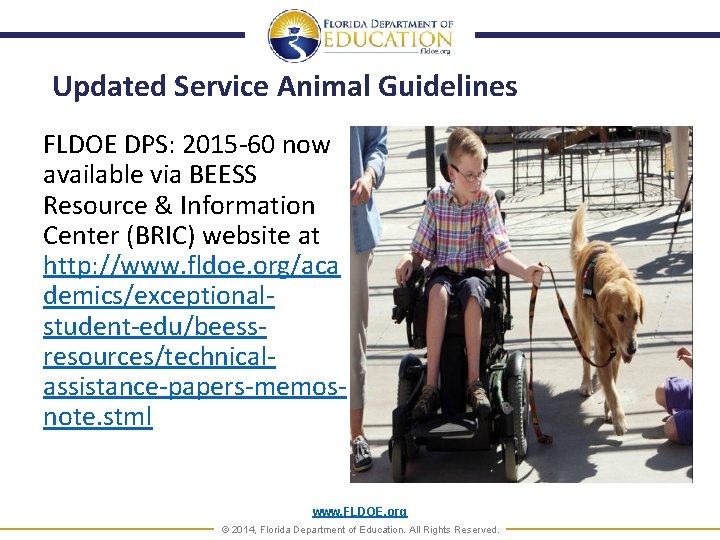
Updated Service Animal Guidelines FLDOE DPS: 2015 -60 now available via BEESS Resource & Information Center (BRIC) website at http: //www. fldoe. org/aca demics/exceptionalstudent-edu/beessresources/technicalassistance-papers-memosnote. stml www. FLDOE. org © 2014, Florida Department of Education. All Rights Reserved.
Guidance on Service Animals • Prior bureau guidance issued in August 2010 no longer current! • New guidance has been prepared by the bureau and will be disseminated shortly. • Information on a recent Florida case was sent to ESE directors • Alboniga v. School Bd. Of Broward County, Fla. – 65 IDELR 7 (S. D. FLA. 2015) • Districts should reevaluate their current guidance once our guidance released www. FLDOE. org © 2014, Florida Department of Education. All Rights Reserved.
Guidance on Services Animals • There are only 2 questions that may be asked answered when a request to allow a student to bring their service animal to school is made • Is the student a student with a disability? • Does the animal meet the definition of a “service animal? ” • According to OCR and DOJ, whether a SWD may bring their service animal to school does not depend upon whether the animal is necessary to provide FAPE (e. g. , it does not matter that the student’s para can provide the same assistance) www. FLDOE. org © 2014, Florida Department of Education. All Rights Reserved.
Guidance on Service Animals • Under ADA, service animals must be harnessed, leashed, or tethered, unless these devices interfere with the animal’s work or the student’s disability prevents use. • Certification or proof of service animal training, licensing or immunizations beyond rabies, cannot be required in the process of determining the granting of a request. However, you may request this information. www. FLDOE. org © 2014, Florida Department of Education. All Rights Reserved.
Guidance on Service Animals • The only allowable reasons for denying a proper request • The animal is out of control and the animal’s handler does not take effective action to control it. • The animal is not housebroken. • The animal’s presence poses a “direct threat” to the health or safety of others based on individual assessment. • The animal’s presence would constitute a “fundamental alteration” to the nature of the services, program or activity provided by the school. www. FLDOE. org © 2014, Florida Department of Education. All Rights Reserved.
2015 Legislative Session What’s New www. FLDOE. org © 2014, Florida Department of Education. All Rights Reserved.
Bills of Educational Interest • HB 7069 – Education Accountability – signed by the Governor on April 14, 2015 • HB 71 – Service Animals • HB 153 – Literacy Jump Start Pilot Project • SB 642 – Individuals with Disabilities • HB 954 – Involuntary Examination of Minors www. FLDOE. org © 2014, Florida Department of Education. All Rights Reserved.
Hot Topics and Issues of Concern Applying What We Learn From Complaints To Considerations for Practice www. FLDOE. org © 2014, Florida Department of Education. All Rights Reserved.
In a multi-tiered system of supports, when should a school refer a student for an initial evaluation? www. FLDOE. org © 2014, Florida Department of Education. All Rights Reserved.
Child Find • Child Find – responsibility to identify, locate, and evaluate students with disabilities in need of special education. • Either a parent or the district may initiate a request for an evaluation. • When a parent requests an evaluation the district must request consent or provide notice of refusal within 30 days – unless the parent and school agree otherwise in writing www. FLDOE. org © 2014, Florida Department of Education. All Rights Reserved.
Child Find & MTSS • MTSS as a systematic process for meeting Child Find. • How do we know which struggling students may need special education? • By implementing evidence-based interventions & monitoring student response to intervention as required by Rule 6 A-6. 0331, F. A. C. • Student response to intervention data identifies students who may need special education. • In a data-based process, student response to intervention “refers” the student. www. FLDOE. org © 2014, Florida Department of Education. All Rights Reserved.
What Triggers Child Find in a MTSS? • School-based problem solving team responsible for monitoring progress and determining when student response to intervention date indicates need. • When intensive, evidence-based interventions implemented with fidelity are insufficient to close the gap with expectations or peers, OR • When intensive interventions are effective but not sustainable over time (if you are providing special education de facto; good idea to evaluate). www. FLDOE. org © 2014, Florida Department of Education. All Rights Reserved.
What the Team Needs to Know • Level of Performance – discrepancy between current level and age or state-approved grade level standards. • Rate of Improvement – growth compared to grade-level performance and rate of improvement of peers (slope of the line on graph). • Gap Analysis – discrepancy in level of performance & rate of improvement. • Distinction between Intensity and Severity • Intensity – discrepancy in level of performance • Severity – discrepancy in rate of improvement • Base referral on discrepancy in both level of performance and rate of improvement – students with intense problem & poor response to intervention. www. FLDOE. org © 2014, Florida Department of Education. All Rights Reserved.
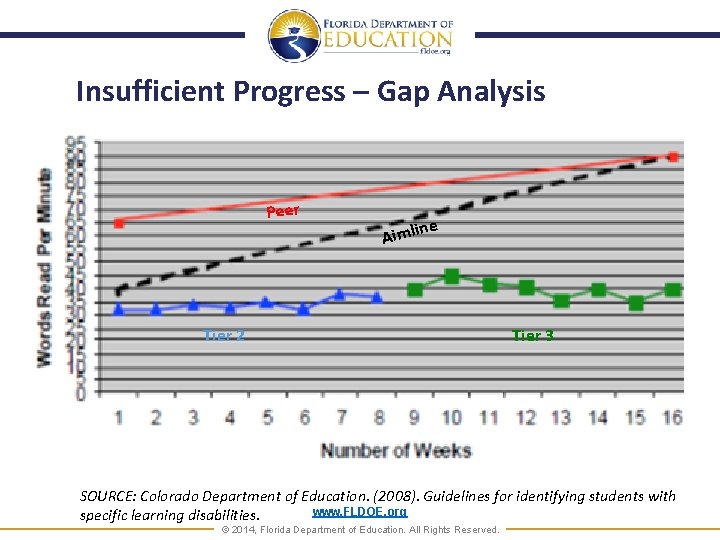
Insufficient Progress – Gap Analysis Peer ne Aimli Tier 2 Tier 3 SOURCE: Colorado Department of Education. (2008). Guidelines for identifying students with www. FLDOE. org specific learning disabilities. © 2014, Florida Department of Education. All Rights Reserved.
Assumptions of a Multi-tiered System of Supports • Screening and progress monitoring data are collected on all students. • School-based teams are engaged in a data-based problem solving process to address systemic and individual needs. • Tiered supports are evidence-based and matched to student need. • Interventions are implemented with fidelity. • The progress of students receiving supplemental and intensive interventions is periodically reviewed. www. FLDOE. org © 2014, Florida Department of Education. All Rights Reserved.
Watch for Other “Red Flags” • Multiple early warning system indicators • Academic concerns (e. g. , failing/declining grades, work completion, limited progress compared to peers). • Behavioral concerns (e. g. , disciplinary referrals, chronic absenteeism, social/interpersonal, withdrawal/depression). • Medical/clinical diagnoses or services (e. g. , medication, therapy, hospitalization/Baker Act, physician/clinician recommendation/referral). www. FLDOE. org © 2014, Florida Department of Education. All Rights Reserved.
Evaluations www. FLDOE. org © 2014, Florida Department of Education. All Rights Reserved.
Evaluations: Notice and Consent District Responsibility • Conduct a “full and individual” evaluation that assesses all areas related to the suspected disability (6 A-6. 0331(5)(f), F. A. C. ). • Provide the parent with written notice of the evaluation procedures the district is proposing to conduct (6 A-6. 0331(4)(a), F. A. C. ) • Consent should identify the broad evaluation categories or areas of assessment. • Identifying the suspected areas of disability as part of evaluation planning process is congruent with the IDEA. www. FLDOE. org © 2014, Florida Department of Education. All Rights Reserved.
Evaluations: Notice and Consent Rule 6 A-0331(5)(f), Florida Administrative Code • Effective as of December 23, 2014 • (5) Evaluation procedures…(f) A student shall be assessed in all areas related to a suspected disability, including, if appropriate, health, vision, hearing, social and emotional status, general intelligence, academic performance, communicative status, and motor abilities. www. FLDOE. org © 2014, Florida Department of Education. All Rights Reserved.
Evaluations Parent Consent • Consent must be “informed. ” • The parent consents to the proposed evaluation in its entirety. • Team considers parent request for specific evaluation procedures. • If denied, document in the “description of other options the team considered & reasons why those options were rejected. ”. www. FLDOE. org © 2014, Florida Department of Education. All Rights Reserved.
Evaluations Notice of Refusal • Only provide “Notice of Refusal” when refusing to conduct an evaluation, not parts of an evaluation requested by the parent. • Document on the consent form why the requested action is not being taken when rejecting evaluation procedures requested by a parent. A “Notice of Refusal” is not necessary in this circumstance. www. FLDOE. org © 2014, Florida Department of Education. All Rights Reserved.
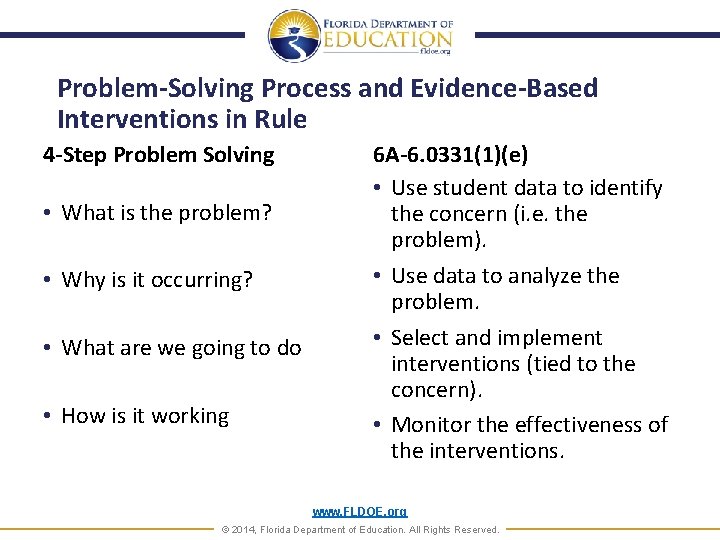
Problem-Solving Process and Evidence-Based Interventions in Rule 4 -Step Problem Solving • What is the problem? • Why is it occurring? • What are we going to do • How is it working 6 A-6. 0331(1)(e) • Use student data to identify the concern (i. e. the problem). • Use data to analyze the problem. • Select and implement interventions (tied to the concern). • Monitor the effectiveness of the interventions. www. FLDOE. org © 2014, Florida Department of Education. All Rights Reserved.
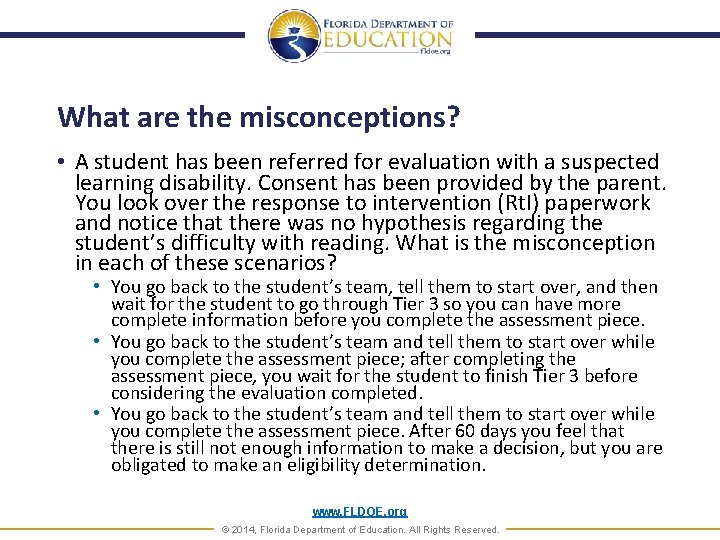
What are the misconceptions? • A student has been referred for evaluation with a suspected learning disability. Consent has been provided by the parent. You look over the response to intervention (Rt. I) paperwork and notice that there was no hypothesis regarding the student’s difficulty with reading. What is the misconception in each of these scenarios? • You go back to the student’s team, tell them to start over, and then wait for the student to go through Tier 3 so you can have more complete information before you complete the assessment piece. • You go back to the student’s team and tell them to start over while you complete the assessment piece; after completing the assessment piece, you wait for the student to finish Tier 3 before considering the evaluation completed. • You go back to the student’s team and tell them to start over while you complete the assessment piece. After 60 days you feel that there is still not enough information to make a decision, but you are obligated to make an eligibility determination. www. FLDOE. org © 2014, Florida Department of Education. All Rights Reserved.
IEP Development The IEP as an Integrated Whole www. FLDOE. org © 2014, Florida Department of Education. All Rights Reserved.
Development • Was the IEP designed • to meet the child’s unique needs, • reasonably calculated to enable the child to receive educational benefit • do the services correspond with the child’s IEP? www. FLDOE. org © 2014, Florida Department of Education. All Rights Reserved.
Development • Positive Behavioral Interventions • Section 300. 324, Title 34, Code of Federal Regulations • Consideration of special factors. The IEP Team must – (i) In the case of a child whose behavior impedes the child's learning or that of others, consider the use of positive behavioral interventions and supports, and other strategies, to address that behavior; www. FLDOE. org © 2014, Florida Department of Education. All Rights Reserved.
Development • Present levels • What is easy for the student (that might be used to motivate the student to push through something hard)? • What is difficult for the student? Why? • What does the student need to bridge the gaps? • What must the student do in order to bridge the gaps and progress in the general education curriculum? www. FLDOE. org © 2014, Florida Department of Education. All Rights Reserved.
Development • Measurable Annual Goals • If a goal is not measurable, it is hard to document a student’s progress toward mastery • Must pass the stranger test • • What must the stranger see the student doing? Under what conditions? By when? How will success be measured? www. FLDOE. org © 2014, Florida Department of Education. All Rights Reserved.
Development • Post-school transition • Age appropriate assessment • Computer programs • Florida Choices (free) – being replaced this year with a comparable program • Middle Career Course - a starting place • Project Ten: http: //project 10. info/ www. FLDOE. org © 2014, Florida Department of Education. All Rights Reserved.
Development • Transition goals: What the student WILL do BY WHEN • Needs to align with instruction that is happening in high school • Training and Education • Employment (short term) • Career (long term plan) www. FLDOE. org © 2014, Florida Department of Education. All Rights Reserved.
Development • The relationship between transition goals and measurable annual goals • Mastery of annual goals will indicate that the student is progressing in the general education curriculum • Mastery of some annual goals will also indicate the student is progressing toward the student’s post secondary career goal www. FLDOE. org © 2014, Florida Department of Education. All Rights Reserved.
Development • Accommodations • Change how a student accesses the curriculum • Help the student maneuver around the challenges caused by the disability • Do not change the curriculum requirements • Must be documented when provided www. FLDOE. org © 2014, Florida Department of Education. All Rights Reserved.
Development • Special Education Services and Supports • The Analysis of Comments and Changes section of volume 71 of the Federal Register page 46667 (71 Fed. Reg. 46667) includes the following statement regarding the requirement of 34 CFR § 300. 320(a)(7) that the IEP include initiation, frequency, location, and duration of services: “The meaning of the term ‘duration’ will vary, depending on such things as the needs of the child, the service being provided, the particular format used in an IEP, and how the child’s day and IEP are structured. What is required is that the IEP include information about the amount of services that will be provided to the child, so that the level of the agency’s commitment of resources will be clear to parents and other IEP team members. The amount of time to be committed to each of the various services to be provided must be appropriate to the specific service, and clearly stated in the IEP in a manner that can be understood by all involved in the development and implementation of the IEP. ” www. FLDOE. org © 2014, Florida Department of Education. All Rights Reserved.
Development • Conference Notes • Not required, but important as documentation of discussions and decisions www. FLDOE. org © 2014, Florida Department of Education. All Rights Reserved.
IEP Implementation Progress Reports www. FLDOE. org © 2014, Florida Department of Education. All Rights Reserved.
Implementation Progress Reports Section 300. 320 Title 34 Code of Federal Regulations states that the IEP must include: • When periodic reports on the progress the child is making toward meeting the annual goals (such as through the use of quarterly or other periodic reports, concurrent with the issuance of report cards) will be provided www. FLDOE. org © 2014, Florida Department of Education. All Rights Reserved.
Implementation Progress Reports A student’s progress reports consistently indicate that the student is progressing toward mastery of measureable annual goals. Progress reports are being provided as indicated in the IEP, so when the parent threatens to file a complaint, the student’s teachers are confident that they are in compliance with the requirements of the law. What do you think? www. FLDOE. org © 2014, Florida Department of Education. All Rights Reserved.
Implementation Documentation of Progress • A common complaint is that the teachers did not bring documentation of the student’s progress to IEP team meetings • How does one document a student’s progress? • Examples of student work • Formative and summative test scores based on the curriculum • Provider log entries • What else? www. FLDOE. org © 2014, Florida Department of Education. All Rights Reserved.
IEP Implementation Documentation of Provision of Services www. FLDOE. org © 2014, Florida Department of Education. All Rights Reserved.
Implementation Specialized Instruction • Logs from providers • • • Date, setting and intensity of service Type of service Duration of service IEP goal being addressed Results of the session • Lesson plans, classroom test results related to the student’s goals • Student work related to the student’s goals • Student data (progress monitoring) • Consult between teachers– needs to be documented www. FLDOE. org © 2014, Florida Department of Education. All Rights Reserved.
Implementation Related Services • Service logs, including provider notes • Student data • Teacher schedules • Student schedules • Progress reports www. FLDOE. org © 2014, Florida Department of Education. All Rights Reserved.
Implementation Accommodations • Lesson plans with accommodations listed for the student – check off the ones used on a given day • Student work with accommodations noted either by the teacher or the student • Give students a list of their accommodations and have them check off what they were provided in any given lesson (note: the student is not the one who is accountable for receiving accommodations) www. FLDOE. org © 2014, Florida Department of Education. All Rights Reserved.
Resource • Developing Quality IEPs – A Guide for Instructional Personnel and Families • In the process of being updated • Available through the FLDOE, BEESS www. FLDOE. org © 2014, Florida Department of Education. All Rights Reserved.
Resource for Documentation of Services • Write On! A Guide to Compliant Documentation of Special Education Policies and Procedures – LRP Publications www. FLDOE. org © 2014, Florida Department of Education. All Rights Reserved.
Bullying and Students with Disabilities www. FLDOE. org © 2014, Florida Department of Education. All Rights Reserved.
A 2013 dear colleague letter and enclosure by the Office of Special Education and Rehabilitative Services (OSERS) clarifying that when bullying of a student with a disability results in the student not receiving meaningful educational benefit under IDEA, the school must remedy the problem, regardless of whether the bullying was based on the student’s disability. www. FLDOE. org © 2014, Florida Department of Education. All Rights Reserved.
Bullying and Students with Disabilities • Is the bullying resulting in the student not attending school? • Is the student missing classes due to bullying? • Has there been any kind of a decline in the student’s behavior (academic or social/emotional)? • What actions has the school taken? www. FLDOE. org © 2014, Florida Department of Education. All Rights Reserved.
Mental Health Support www. FLDOE. org © 2014, Florida Department of Education. All Rights Reserved.
Importance of School-based Support • Mental health and psychological wellness are integral to school success. • Students who receive social-emotional supports achieve better academically. • Left unaddressed, mental health problems linked to academic and behavior difficulties, dropping out, delinquency, and physical and mental health problems as adults • Early prevention and intervention are cost effective compared to negative outcomes of unmet mental health problems. www. FLDOE. org © 2014, Florida Department of Education. All Rights Reserved.
Mental Health Service Providers • Student Services – professionals with mental heath training in schools • • School Psychologists School Social Workers School Counselors School Nurses • Contracted mental health professionals • Coordinated System of Care www. FLDOE. org © 2014, Florida Department of Education. All Rights Reserved.
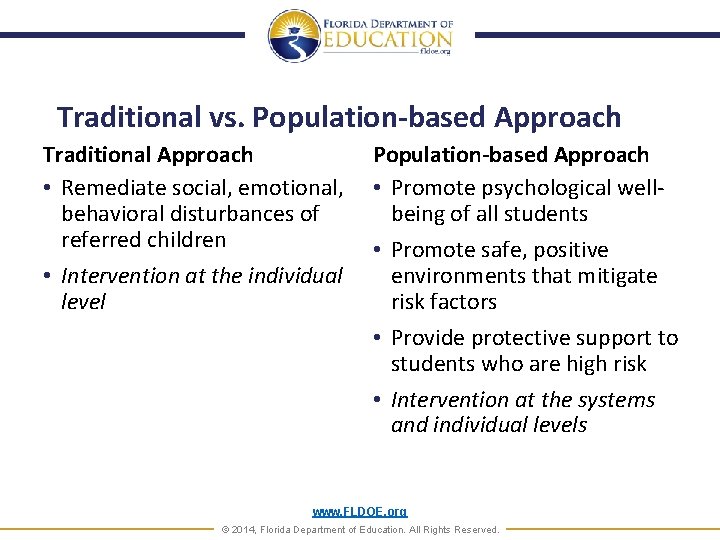
Traditional vs. Population-based Approach Traditional Approach Population-based Approach • Remediate social, emotional, • Promote psychological wellbehavioral disturbances of being of all students referred children • Promote safe, positive • Intervention at the individual environments that mitigate level risk factors • Provide protective support to students who are high risk • Intervention at the systems and individual levels www. FLDOE. org © 2014, Florida Department of Education. All Rights Reserved.
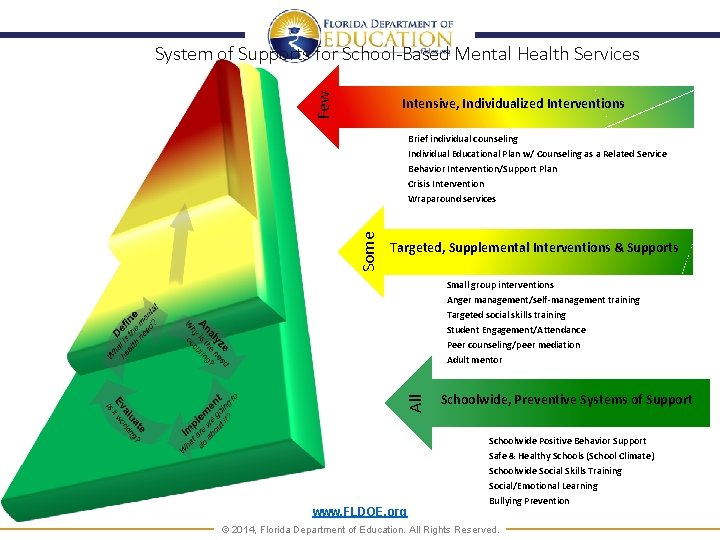
Few System of Supports for School-Based Mental Health Services Intensive, Individualized Interventions Brief individual counseling Some Individual Educational Plan w/ Counseling as a Related Service Behavior Intervention/Support Plan Crisis Intervention Wraparound services Targeted, Supplemental Interventions & Supports Small group interventions All Anger management/self-management training Targeted social skills training Student Engagement/Attendance Peer counseling/peer mediation Adult mentor Schoolwide, Preventive Systems of Support Schoolwide Positive Behavior Support www. FLDOE. org Safe & Healthy Schools (School Climate) Schoolwide Social Skills Training Social/Emotional Learning Bullying Prevention © 2014, Florida Department of Education. All Rights Reserved.
Best Practices for Creating Safe and Successful Schools • Implement multi-tiered systems of support. • Improve access to school-based mental health supports. • Integrate services through collaboration. • Integrate school safety and crisis/emergency prevention & response. • Balance physical and psychological safety. • Employ effective, positive school discipline. A Framework for Safe and Successful Schools, 2013 www. FLDOE. org © 2014, Florida Department of Education. All Rights Reserved.
Challenges • Systematic screening for mental health issues not a common practice. • School-based mental health professionals are typically assigned to multiple schools and too often used for crisis response as opposed to crisis prevention. • Limited access to professional development that addresses mental health issues. • Fragmentation of services within schools and between school and community-based services. www. FLDOE. org © 2014, Florida Department of Education. All Rights Reserved.
Youth Mental Health First Aid www. FLDOE. org © 2014, Florida Department of Education. All Rights Reserved.
What is Youth Mental Health First Aid • Youth Mental Health First Aid is the help offered to a young person experiencing a mental health challenge, mental disorder, or a mental health crisis. The first aid is given until appropriate help is received or until the crisis resolves. • Youth Mental Health First Aid is an 8 -hour course that • Youth Mental Health First Aid does not teach people to diagnose or to provide treatment for mental illness. www. FLDOE. org © 2014, Florida Department of Education. All Rights Reserved.
What participants learn… • Risk factors and warning signs of mental health concerns. • Information on depression, anxiety, trauma, psychosis, and substance use. • A five-step action plan to help someone developing a mental health concern or in crisis. • Available evidence-based professional, peer, and self-help resources. www. FLDOE. org © 2014, Florida Department of Education. All Rights Reserved.
Take a Course. You could be the help someone needs. Find a Course or Instructor near you: www. Mental. Health. First. Aid. org Contact Us: info@mentalhealthfirstaid. org 202. 684. 7457 Mental Health First Aid USA is coordinated by the National Council for Behavioral Health, the Maryland Department of Health and Mental Hygiene, and the Missouri Department of Mental Health. www. FLDOE. org © 2014, Florida Department of Education. All Rights Reserved.
The State of the State www. FLDOE. org © 2014, Florida Department of Education. All Rights Reserved.
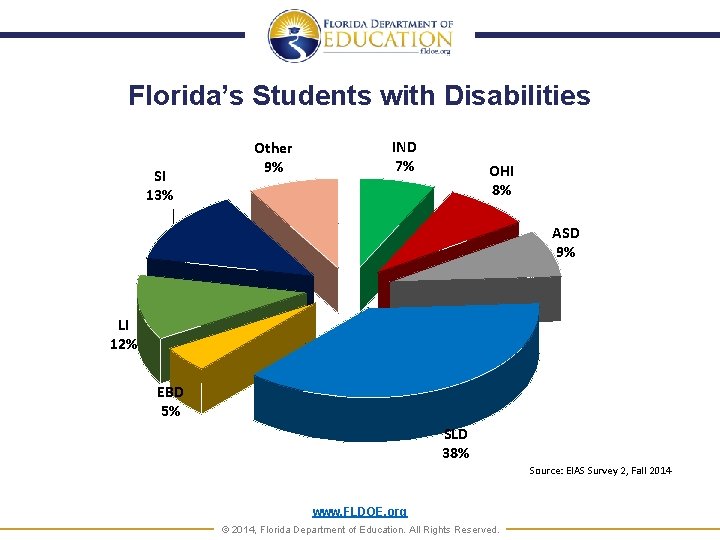
Florida’s Students with Disabilities SI 13% Other 9% IND 7% OHI 8% ASD 9% LI 12% EBD 5% SLD 38% Source: EIAS Survey 2, Fall 2014 www. FLDOE. org © 2014, Florida Department of Education. All Rights Reserved.
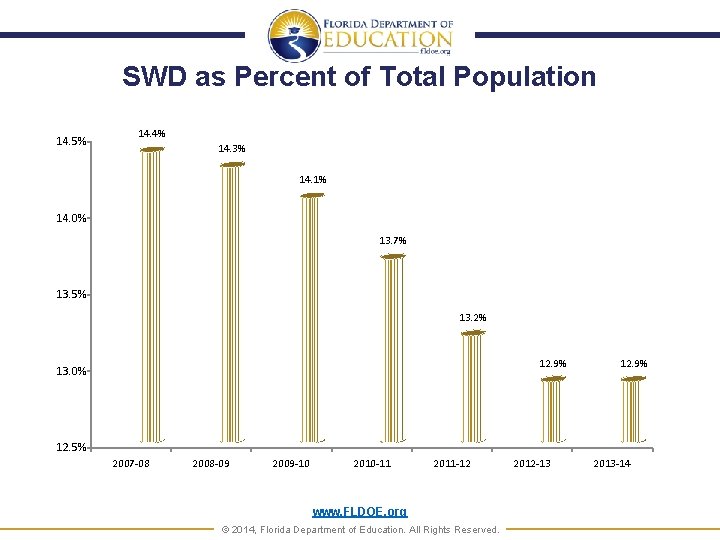
SWD as Percent of Total Population 14. 5% 14. 4% 14. 3% 14. 1% 14. 0% 13. 7% 13. 5% 13. 2% 12. 9% 13. 0% 12. 9% 12. 5% 2007 -08 2008 -09 2009 -10 2010 -11 2011 -12 www. FLDOE. org © 2014, Florida Department of Education. All Rights Reserved. 2012 -13 2013 -14
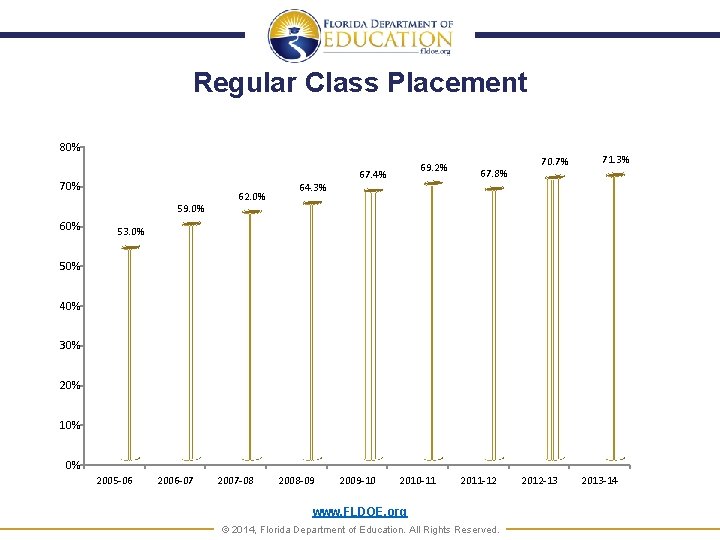
Regular Class Placement 80% 70% 59. 0% 62. 0% 64. 3% 69. 2% 67. 4% 67. 8% 70. 7% 71. 3% 53. 0% 50% 40% 30% 20% 10% 0% 2005 -06 2006 -07 2007 -08 2008 -09 2009 -10 2010 -11 2011 -12 www. FLDOE. org © 2014, Florida Department of Education. All Rights Reserved. 2012 -13 2013 -14
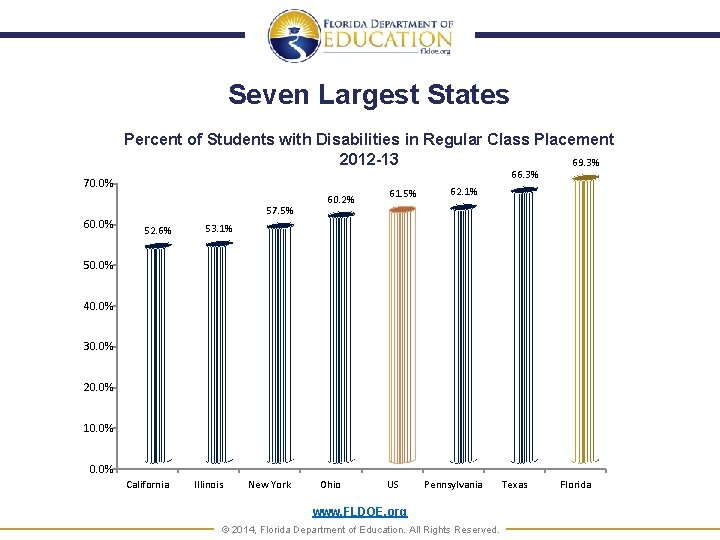
Seven Largest States Percent of Students with Disabilities in Regular Class Placement 2012 -13 69. 3% 66. 3% 70. 0% 60. 0% 57. 5% 52. 6% 60. 2% 61. 5% 62. 1% 53. 1% 50. 0% 40. 0% 30. 0% 20. 0% 10. 0% California Illinois New York Ohio US Pennsylvania www. FLDOE. org © 2014, Florida Department of Education. All Rights Reserved. Texas Florida
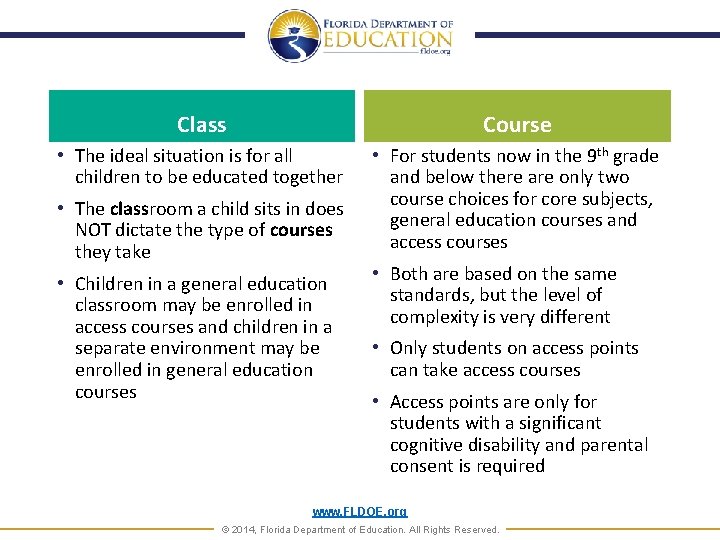
Class Course • The ideal situation is for all children to be educated together • For students now in the 9 th grade and below there are only two course choices for core subjects, general education courses and access courses • The classroom a child sits in does NOT dictate the type of courses they take • Children in a general education classroom may be enrolled in access courses and children in a separate environment may be enrolled in general education courses • Both are based on the same standards, but the level of complexity is very different • Only students on access points can take access courses • Access points are only for students with a significant cognitive disability and parental consent is required www. FLDOE. org © 2014, Florida Department of Education. All Rights Reserved.
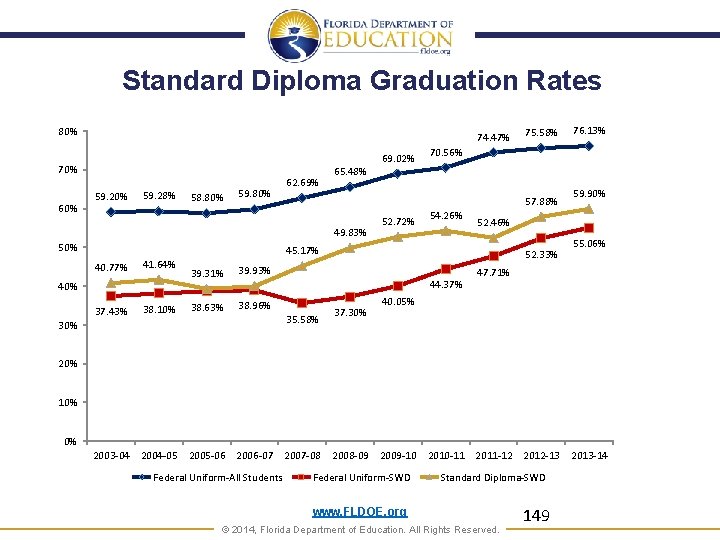
Standard Diploma Graduation Rates 80% 74. 47% 69. 02% 70% 60% 59. 28% 58. 80% 59. 80% 62. 69% 41. 64% 40% 30% 70. 56% 57. 88% 52. 72% 54. 26% 39. 31% 39. 93% 52. 33% 44. 37% 37. 43% 38. 10% 38. 63% 38. 96% 2003 -04 2004 -05 2005 -06 2006 -07 35. 58% 37. 30% 59. 90% 52. 46% 45. 17% 40. 77% 76. 13% 65. 48% 49. 83% 50% 75. 58% 55. 06% 47. 71% 40. 05% 20% 10% 0% Federal Uniform-All Students 2007 -08 2008 -09 2009 -10 Federal Uniform-SWD 2010 -11 2011 -12 2012 -13 Standard Diploma-SWD www. FLDOE. org © 2014, Florida Department of Education. All Rights Reserved. 149 2013 -14
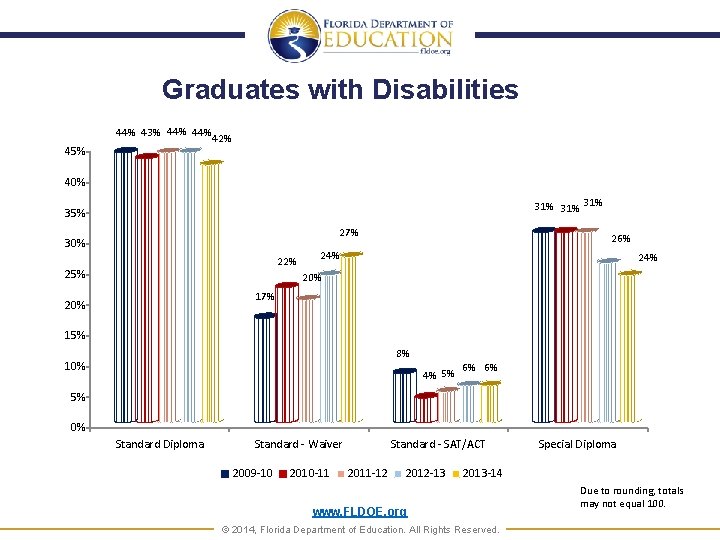
Graduates with Disabilities 44% 43% 44% 45% 42% 40% 31% 31% 35% 27% 30% 22% 25% 26% 24% 20% 17% 20% 15% 8% 10% 4% 5% 6% 6% 5% 0% Standard Diploma Standard - Waiver 2009 -10 2010 -11 Standard - SAT/ACT 2011 -12 2012 -13 Special Diploma 2013 -14 www. FLDOE. org © 2014, Florida Department of Education. All Rights Reserved. Due to rounding, totals may not equal 100.
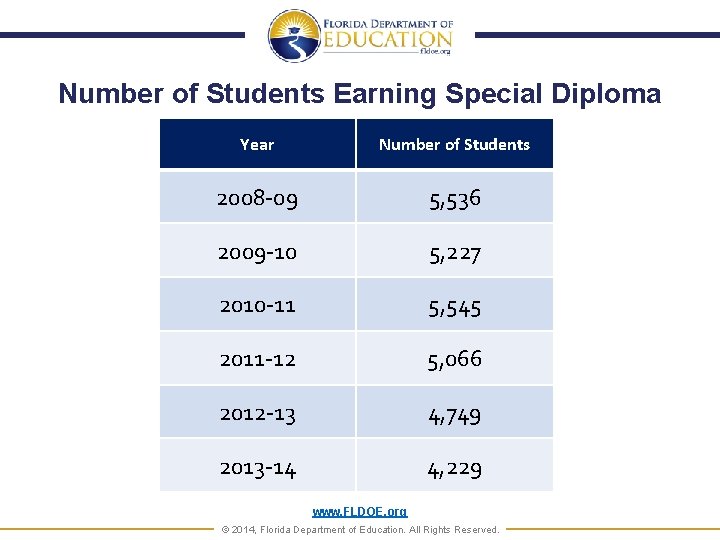
Number of Students Earning Special Diploma Year Number of Students 2008 -09 5, 536 2009 -10 5, 227 2010 -11 5, 545 2011 -12 5, 066 2012 -13 4, 749 2013 -14 4, 229 www. FLDOE. org © 2014, Florida Department of Education. All Rights Reserved.
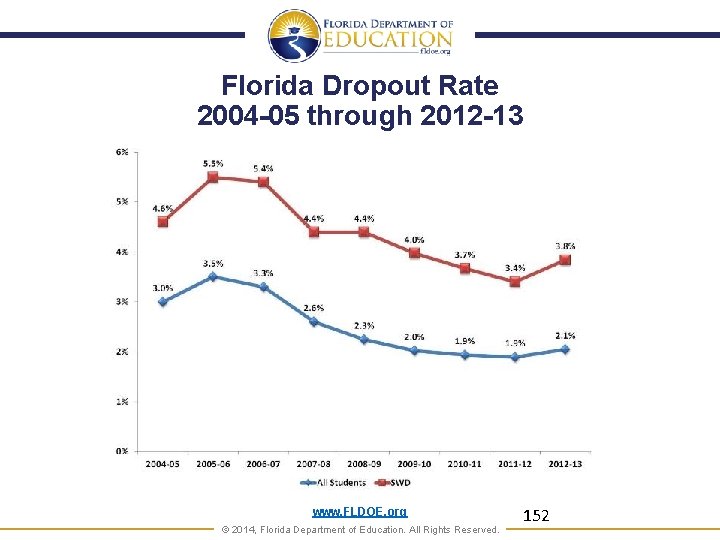
Florida Dropout Rate 2004 -05 through 2012 -13 www. FLDOE. org © 2014, Florida Department of Education. All Rights Reserved. 152
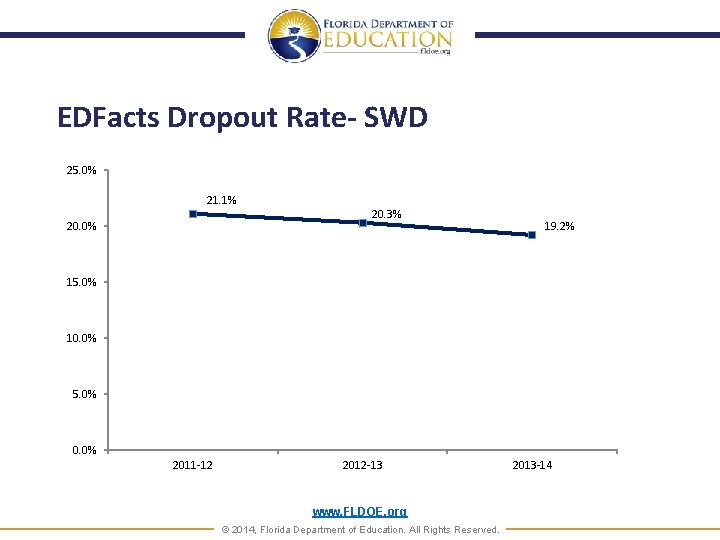
EDFacts Dropout Rate- SWD 25. 0% 21. 1% 20. 0% 20. 3% 19. 2% 15. 0% 10. 0% 5. 0% 0. 0% 2011 -12 2012 -13 www. FLDOE. org © 2014, Florida Department of Education. All Rights Reserved. 2013 -14
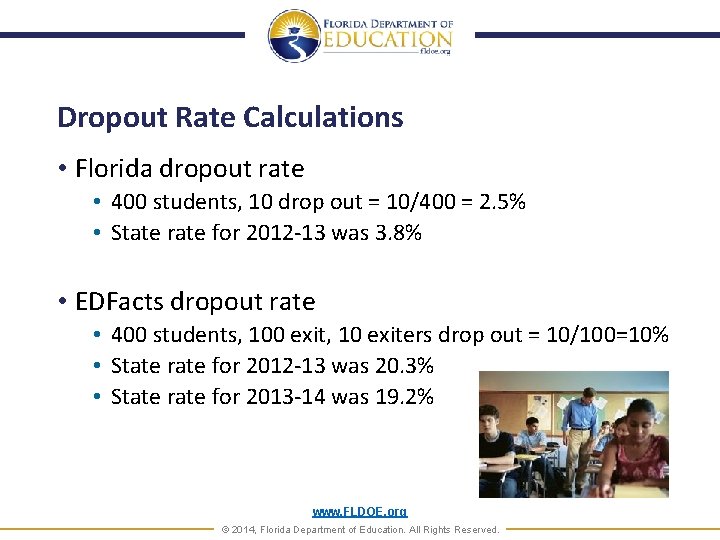
Dropout Rate Calculations • Florida dropout rate • 400 students, 10 drop out = 10/400 = 2. 5% • State rate for 2012 -13 was 3. 8% • EDFacts dropout rate • 400 students, 100 exit, 10 exiters drop out = 10/100=10% • State rate for 2012 -13 was 20. 3% • State rate for 2013 -14 was 19. 2% www. FLDOE. org © 2014, Florida Department of Education. All Rights Reserved.
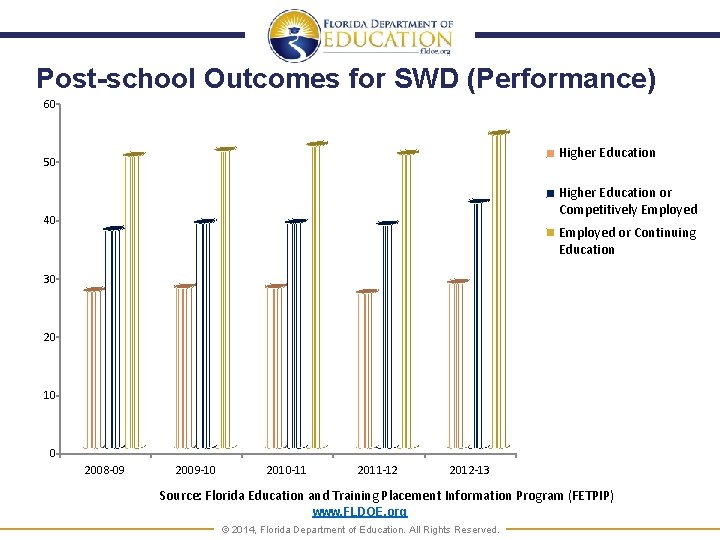
Post-school Outcomes for SWD (Performance) 60 Higher Education 50 Higher Education or Competitively Employed 40 Employed or Continuing Education 30 20 10 0 2008 -09 2009 -10 2010 -11 2011 -12 2012 -13 Source: Florida Education and Training Placement Information Program (FETPIP) www. FLDOE. org © 2014, Florida Department of Education. All Rights Reserved.
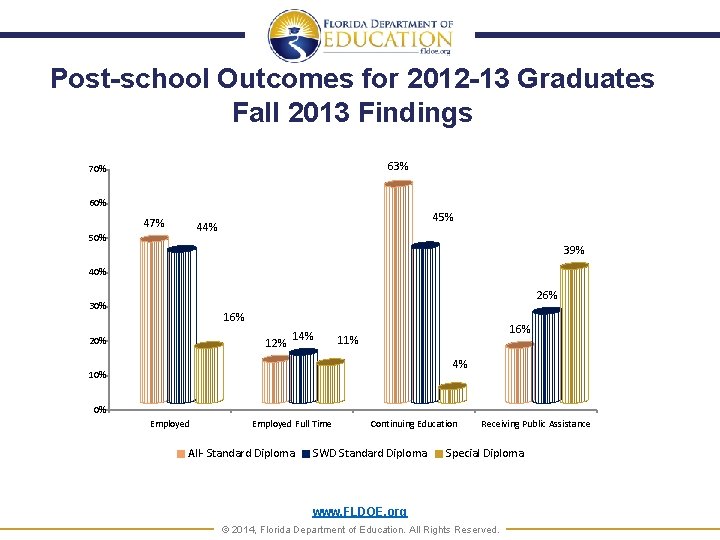
Post-school Outcomes for 2012 -13 Graduates Fall 2013 Findings 63% 70% 60% 47% 45% 44% 50% 39% 40% 26% 30% 16% 20% 12% 14% 16% 11% 4% 10% 0% Employed Full Time All- Standard Diploma Continuing Education SWD Standard Diploma Receiving Public Assistance Special Diploma www. FLDOE. org © 2014, Florida Department of Education. All Rights Reserved.
2013 -14 Parent Survey Data www. FLDOE. org © 2014, Florida Department of Education. All Rights Reserved.

It Takes a Village: Collaboration of Parents, Community and Educators www. FLDOE. org © 2014, Florida Department of Education. All Rights Reserved.
A Collaborative Culture Parent Engagement • Our work is best when we are able to build strong, collaborative partnerships with our parents with a focus on points of agreement. • We need to work with parents as partners. • Involving parents versus informing parents. • Parents have valuable information that we need to help us identify the best ways to support their children. www. FLDOE. org © 2014, Florida Department of Education. All Rights Reserved. 159
Effective Partnerships Between Families and Schools • The benefits cannot be overstated. • Higher parent involvement results in: • Higher student achievement • Improved student attendance • Higher aspirations for post secondary education and career development • Improved social competence • Lower rates of at-risk behavior for adolescents www. FLDOE. org © 2014, Florida Department of Education. All Rights Reserved. 160
What Did We Learn From the 2013 -14 ESE Parent Survey? Overall results : Preschool • 73. 2% of Preschool parents reported positively to the 25 item survey. • Fell short of meeting our target by 1. 8% K-12 • 75. 6 % of K-12 parents report positively to the 25 item survey. • Exceeded our target by. 06 www. FLDOE. org © 2014, Florida Department of Education. All Rights Reserved. 161
What Did We Learn From the 2013 -14 ESE Parent Survey? Pre-school survey top 3 items: • 95. 9% Pre-school staff respect my culture • 95. 0% My child’s evaluation was written in words I understand • 92. 7% Staff and service providers value my ideas www. FLDOE. org © 2014, Florida Department of Education. All Rights Reserved.
What Did We Learn From the 2013 -14 ESE Parent Survey? Pre-school survey lowest 3 items: • 35. 0% parents reported preschool staff connected families with one another for mutual support • 29. 9% parents reported that they were offered training about preschool education • 26. 2% reported that supports were offered to participate in trainings and workshops www. FLDOE. org © 2014, Florida Department of Education. All Rights Reserved. 163
What Did We Learn From the 2013 -14 Survey? K-12 survey top 3 Items: • 91. 2% reported that written information received was understandable • 90. 5% reported that the IEP tells how progress towards goals will be measured • 89. 9% reported that teachers are available to speak with parents www. FLDOE. org © 2014, Florida Department of Education. All Rights Reserved. 164
What Did We Learn From the 2013 -14 ESE Parent Survey? K-12 lowest 3 items: • 39. 7% of K-12 parents reported that they were offered special assistance (such as childcare) so that they could participate in the IEP meeting • 37. 9% reported that the school offers parents training about ESE • 31. 0% reported that the school provides information on agencies that can assist my child in the transition from school www. FLDOE. org © 2014, Florida Department of Education. All Rights Reserved. 165
School Level Data! School level data released for the first time • As long as your school had at least 10 surveys returned we can provide you with your survey results • Hard copy information in binders • Provided electronically to ESE Directors www. FLDOE. org © 2014, Florida Department of Education. All Rights Reserved.
Remember our focus !! Moving from Access to Attainment: Statewide Equity and Excellence Increase Number of Students Graduating College and Career Ready • Improve Graduation Rate • Decrease Dropout Rate • Improve Post-School Outcomes Results www. FLDOE. org © 2014, Florida Department of Education. All Rights Reserved.
www. FLDOE. org © 2014, Florida Department of Education. All Rights Reserved.
Thank You! On behalf of BEESS, we look forward to partnering with parents, schools and community members, as we create an environment where all students, including students with disabilities, will thrive as 21 st century learners! www. FLDOE. org © 2014, Florida Department of Education. All Rights Reserved.
- Slides: 169