
Beers Law Determine attenuation of radiant energy by

Beer's Law Determine attenuation of radiant energy by scattering and/or absorption passing through atmosphere Where is optical depth of layer Optical depth is path length required for attenuation to 1/e of original energy Depends on attenuation coefficients and density Transmissivity is proportion of original energy remaining: Depends on optical depth and zenith angle With no scattering, monochromatic absorptivity is:
Exercise 4. 10 Beam of radiation passing through layer 100 m thick at 60 o angle to normal Calculate optical thickness, transmissivity and absorptivity of layer Density is 0. 1 kg/m 3, absorption coefficients are 10 -3, 10 -1 and 1 m 2/kg Total mass of absorbing gas: Optical thickness: Transmissivity: Absorptivity: : :
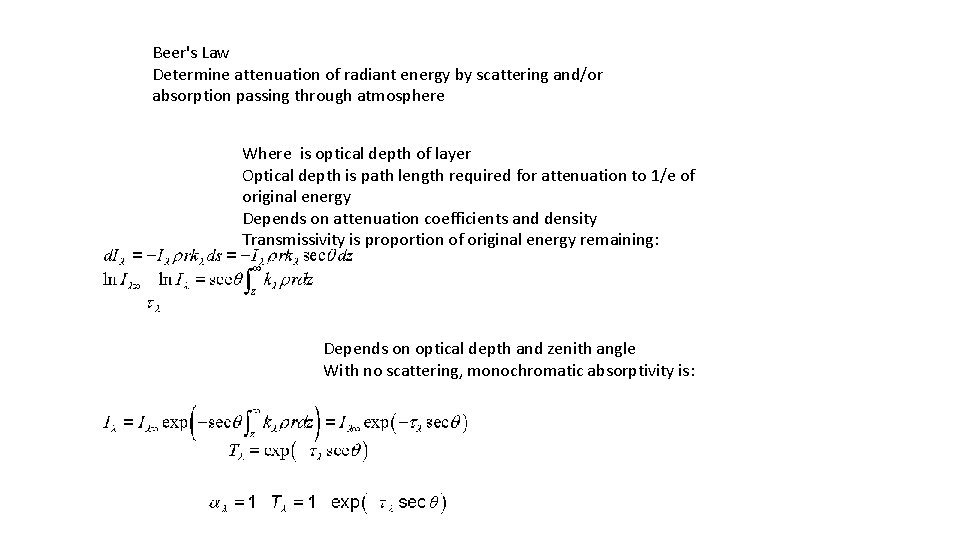
Beer's Law Determine attenuation of radiant energy by scattering and/or absorption passing through atmosphere Where is optical depth of layer Optical depth is path length required for attenuation to 1/e of original energy Depends on attenuation coefficients and density Transmissivity is proportion of original energy remaining: Depends on optical depth and zenith angle With no scattering, monochromatic absorptivity is:
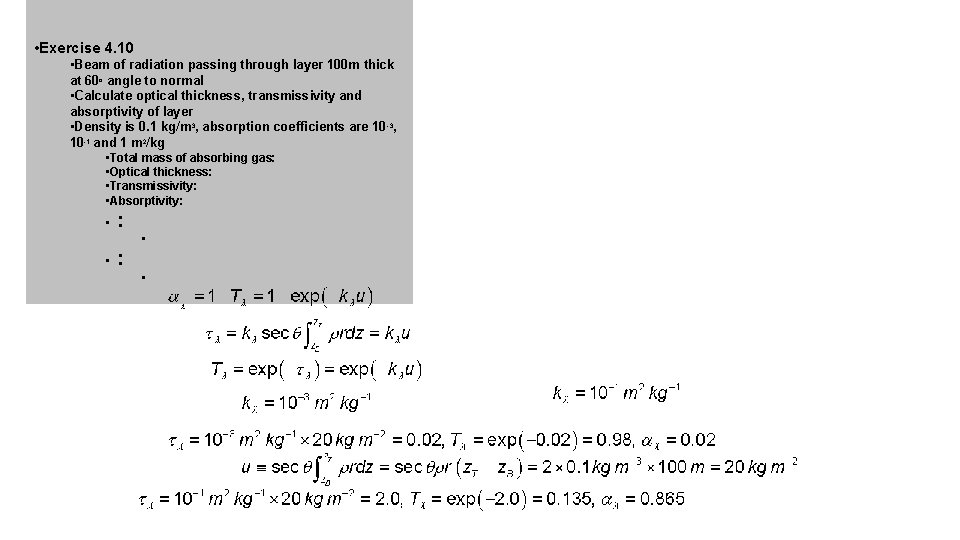
• Exercise 4. 10 • Beam of radiation passing through layer 100 m thick at 60 o angle to normal • Calculate optical thickness, transmissivity and absorptivity of layer • Density is 0. 1 kg/m 3, absorption coefficients are 10 -3, 10 -1 and 1 m 2/kg • Total mass of absorbing gas: • Optical thickness: • Transmissivity: • Absorptivity: • • : •
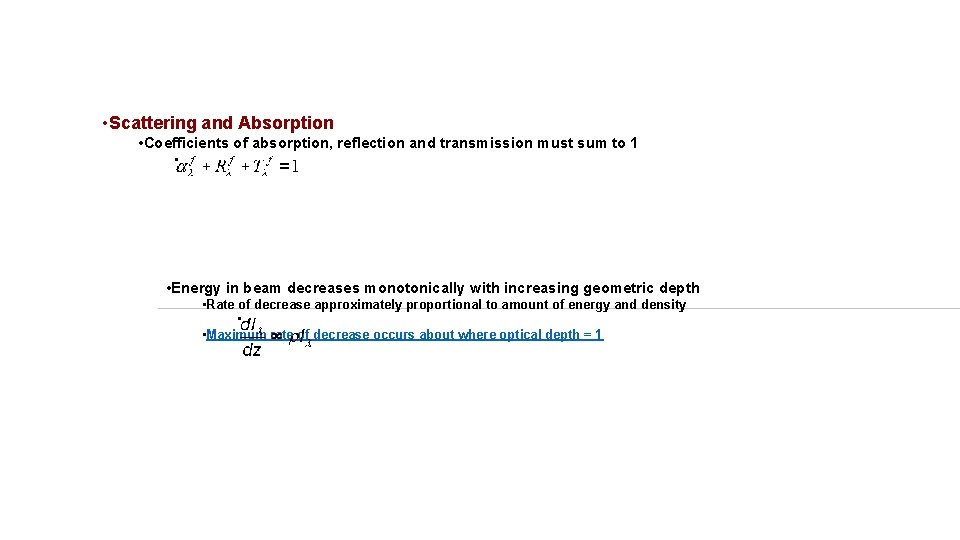
• Scattering and Absorption • Coefficients of absorption, reflection and transmission must sum to 1 • • Energy in beam decreases monotonically with increasing geometric depth • Rate of decrease approximately proportional to amount of energy and density • • Maximum rate of decrease occurs about where optical depth = 1
Extinction increased by multiple scattering Increases path length Increases likelihood of back scattering Increases possibility of absorption Cloud droplets mostly forward scatter, but high volume of droplets means great many scattering events Small likelihood of back scatter with each event adds up to significant contribution Impact of large particles like aerosols, cloud droplets and ice crystals characterized by set of parameters Volume extinction coefficient
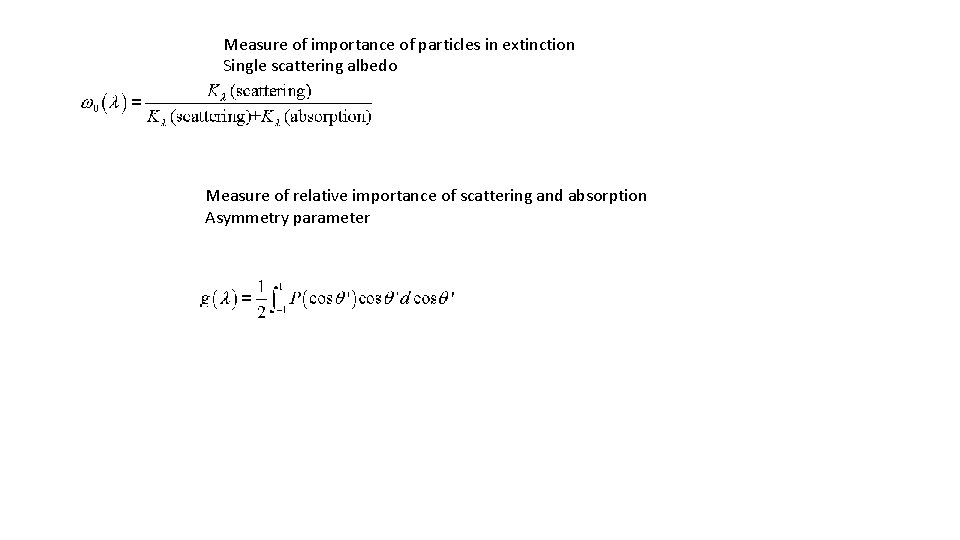
Measure of importance of particles in extinction Single scattering albedo Measure of relative importance of scattering and absorption Asymmetry parameter
Measures directional preference for scattering 0 for isotropic, -1 for back scatter, 1 for all forward scatter Effects of aerosols, water droplets, etc. on planetary albedo depends on variations in above parameters Increasingle scattering albedo while fixing other two increases backscatter and albedo Strong forward scattering (asymmetry parameter) reduces impact of aerosols at low zenith angles Layers with high optical thickness produce multiple scattering, increasing backscatter Water droplets in clouds mainly forward scatter, but multiple scattering leads to high backscatter and high albedo
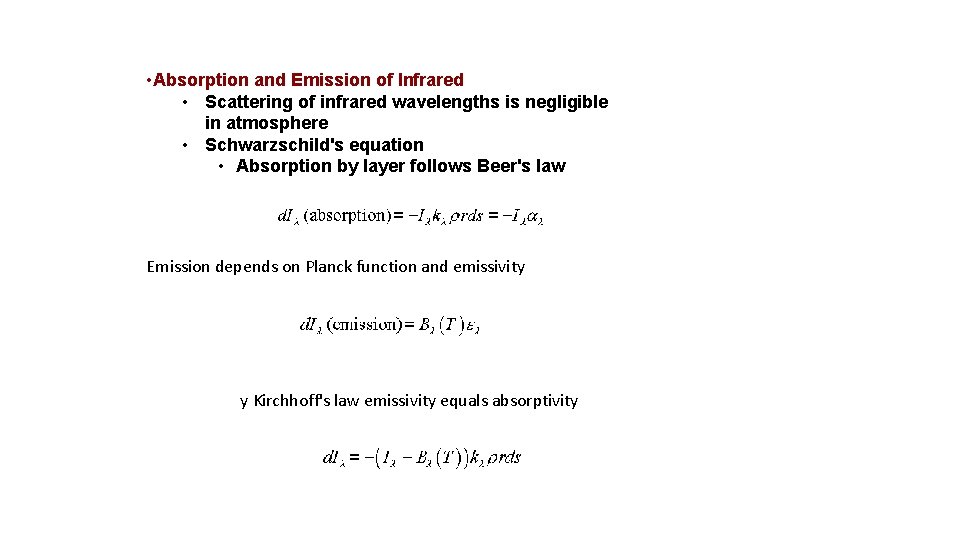
• Absorption and Emission of Infrared • Scattering of infrared wavelengths is negligible in atmosphere • Schwarzschild's equation • Absorption by layer follows Beer's law Emission depends on Planck function and emissivity y Kirchhoff's law emissivity equals absorptivity
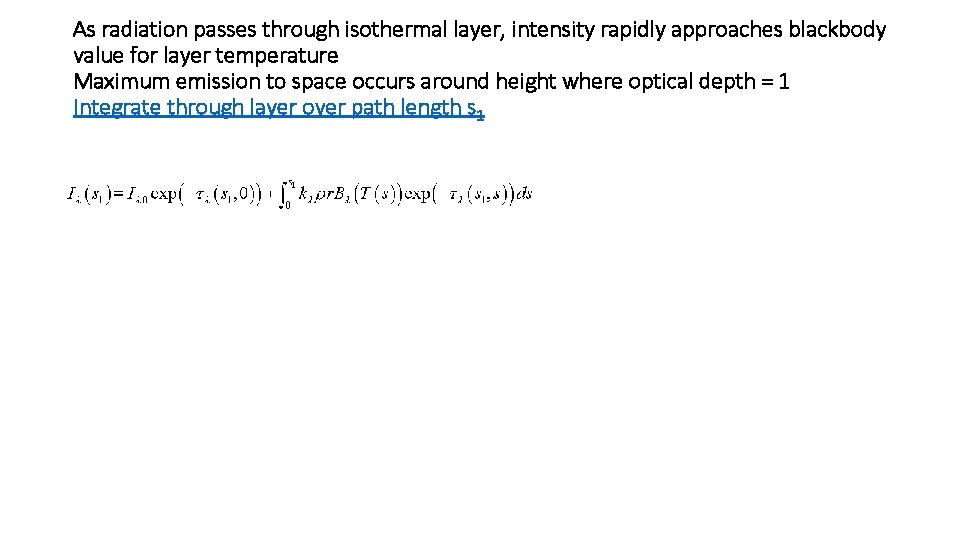
As radiation passes through isothermal layer, intensity rapidly approaches blackbody value for layer temperature Maximum emission to space occurs around height where optical depth = 1 Integrate through layer over path length s 1
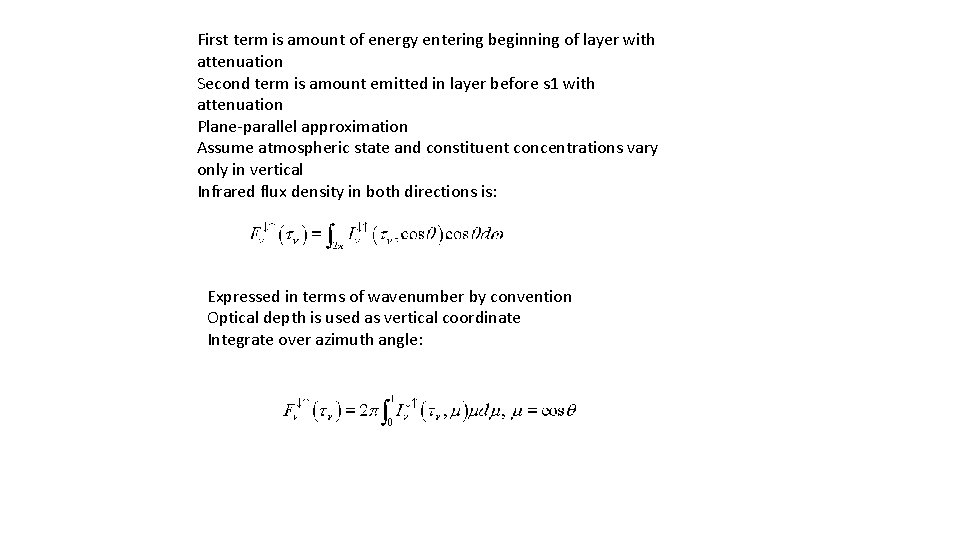
First term is amount of energy entering beginning of layer with attenuation Second term is amount emitted in layer before s 1 with attenuation Plane-parallel approximation Assume atmospheric state and constituent concentrations vary only in vertical Infrared flux density in both directions is: Expressed in terms of wavenumber by convention Optical depth is used as vertical coordinate Integrate over azimuth angle:
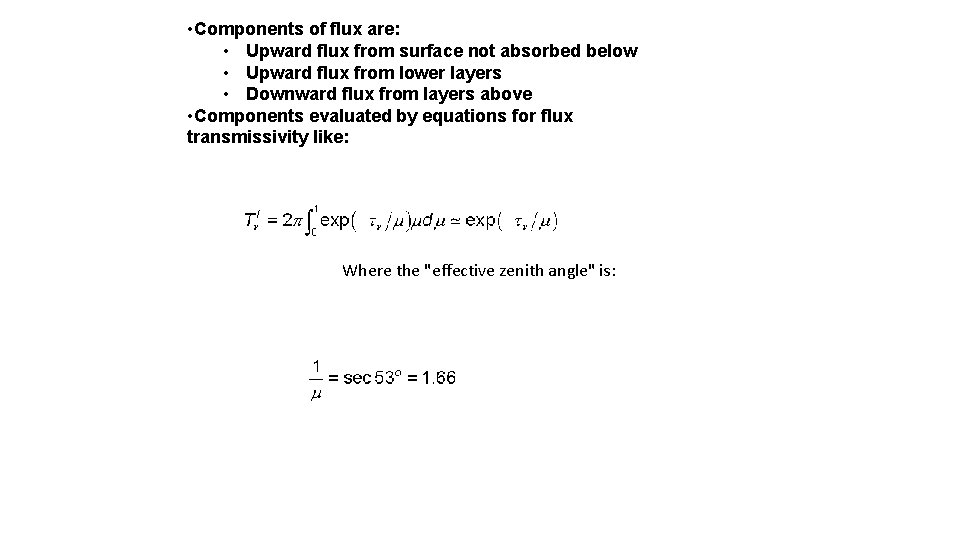
• Components of flux are: • Upward flux from surface not absorbed below • Upward flux from lower layers • Downward flux from layers above • Components evaluated by equations for flux transmissivity like: Where the "effective zenith angle" is:
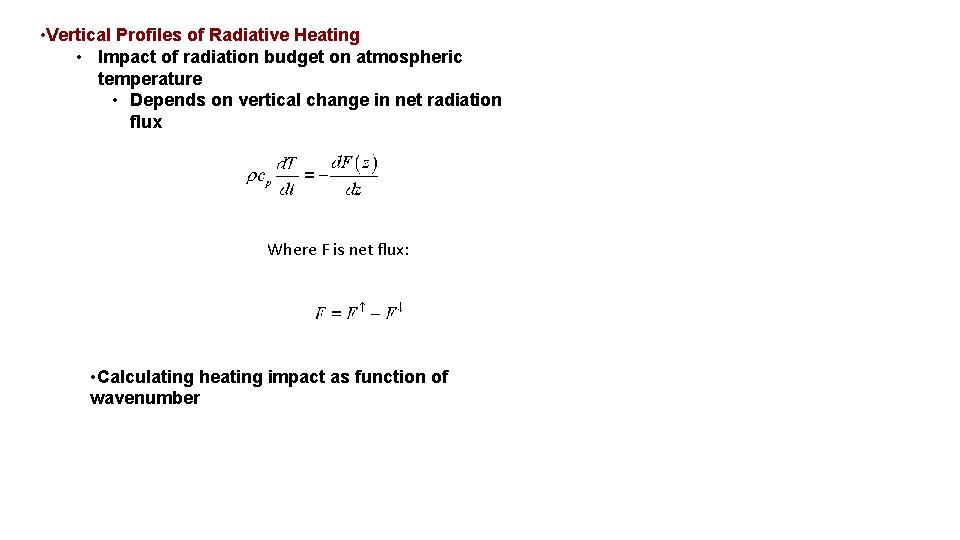
• Vertical Profiles of Radiative Heating • Impact of radiation budget on atmospheric temperature • Depends on vertical change in net radiation flux Where F is net flux: • Calculating heating impact as function of wavenumber
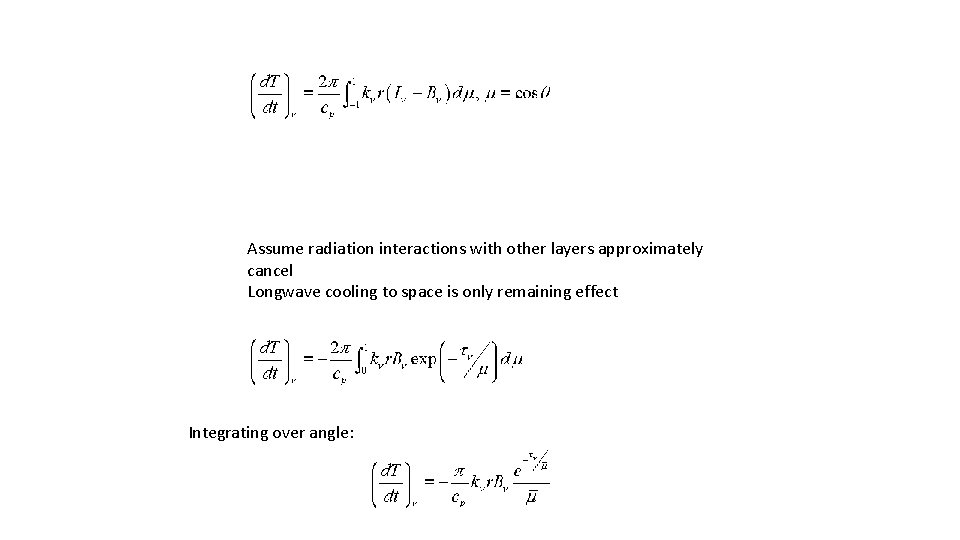
Assume radiation interactions with other layers approximately cancel Longwave cooling to space is only remaining effect Integrating over angle:
Relationship indicates that maximum cooling occurs about where optical depth is 1 Effects of water vapor, carbon dioxide, and ozone Radiation at Top of Atmosphere Annual Average Absorbed Solar Radiation Greatest (over 300 Wm-2) over tropical oceans - low zenith angle and low albedo Not as great over deserts - albedos above 0. 2 Decreasing to below 100 Wm-2 over polar regions - high albedo, low zenith angle, long dark periods Annual Average Outgoing Longwave Concentrated in cloud-free subtropical oceans and deserts Relatively low over equatorial land masses Annual Average Net Radiation Strong equator-to-pole gradient that drives atmospheric general circulation Highest positive values over equatorial oceans and maritime continent Negative values over subtropical deserts
• Relationship indicates that maximum cooling occurs about where optical depth is 1 • Effects of water vapor, carbon dioxide, and ozone • Radiation at Top of Atmosphere • Annual Average Absorbed Solar Radiation • Greatest (over 300 Wm-2) over tropical oceans - low zenith angle and low albedo • Not as great over deserts - albedos above 0. 2 • Decreasing to below 100 Wm-2 over polar regions - high albedo, low zenith angle, long dark periods • Annual Average Outgoing Longwave • Concentrated in cloud-free subtropical oceans and deserts • Relatively low over equatorial land masses • Annual Average Net Radiation • Strong equator-to-pole gradient that drives atmospheric general circulation • Highest positive values over equatorial oceans and maritime continent • Negative values over subtropical deserts
- Slides: 17