
Beer in the ancient world Beer dates back
Beer in the ancient world • Beer dates back to around 6 th century BCE • Most likely the result of spontaneous fermentation of breads • Beer was an important beverage in ancient Egypt and Mesopotamia and was used in religious ceremonies and as gifts to the pharaoh – 30, 000 gallons a year was offered to the gods • Even the dead were buried with beer! • A medical document written around 1600 BCE lists 700 prescriptions, around 100 of which contain beer • The Greeks felt beer was an integral part of a healthy diet • They spread the art of brewing to the Romans, who spread it to Britannia
Beer in the Industrial Revolution • The advent of the steam engine allowed for the industrialization of beer • Prior to the late 1700’s, malt was dried with fires made from wood charcoal, straw, or coke – They were not able to shield the malt from smoke, giving the malt a smoky flavour • Wood smoked malt was supposedly horrible • Using a hydrometer, brewers could calculate the yield from different malts – Pale malts gave the highest output, and coloured malts were added in small amounts to achieve the correct colour • The use of a drum roaster allowed for the creation of very dark, roasted malts, giving rise to stouts
After the Industrial Revolution • Bootleggers watered down their beer to increase profits during prohibition. This practice changed the American palette, which prefers milder beers to this day • In Europe, live beer (“real ales”) have become popular – Unfiltered, unpasteurized brews containing live yeast – Develop flavour and character over the course of several decades as opposed to several weeks or months
What’s in a Beer? • YEAST – the life of beer • WATER – the integrity & purity of beer • BARLEY – the body & soul of beer • HOPS – the spice of beer • ADJUNCTS – Additive grains like rice or corn, fruit or spices
Yeast – “Life of Beer” Yeast is the catalyst of change: • one cell micro-organism • produces carbon dioxide and alcohol Two types of yeast are used to produce beer: • ALE – top fermenting • LAGER – bottom fermenting There are literally thousands of brewers yeast that create a variety beer styles.
What is an Ale? • ale is synonymous for beer • top fermenting yeasts • ferment at higher temperatures (64° – 72 °) • ferments less fully and less discriminately • characterized by more-fruity flavors & aromas with a malty, full bodied flavor • prior to the 1800’s ales were almost universal
What is a Lager? • lager means “to store” • bottom fermenting yeasts • ferment at lower temperatures (50°) • lagered close to freezing for several weeks • characterized by a crisp-tasting, lighter body and less-fruity aroma – rounded, smooth beer • over last 150 years or so lagers have become the predominate beers
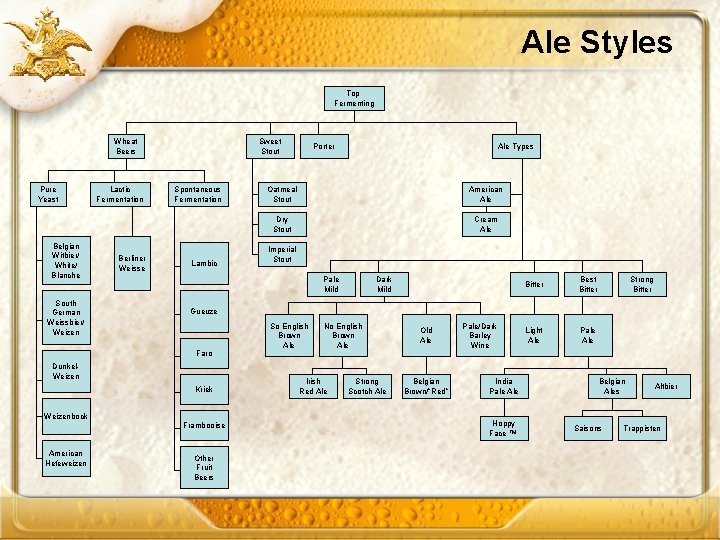
Ale Styles Top Fermenting Wheat Beers Pure Yeast Belgian Witbier/ White/ Blanche South German Weissbier/ Weizen Lactic Fermentation Berliner Weisse Sweet Stout Spontaneous Fermentation Lambic Ale Types Oatmeal Stout American Ale Dry Stout Cream Ale Imperial Stout Pale Mild Dark Mild Bitter Best Bitter Light Ale Pale Ale Strong Bitter Gueuze Faro Dunkel. Weizen Kriek Weizenbock Frambooise American Hefeweizen Porter Other Fruit Beers So English Brown Ale No English Brown Ale Irish Red Ale Strong Scotch Ale Old Ale Belgian Brown/”Red” Pale/Dark Barley Wine India Pale Ale Hoppy Face ™ Belgian Ales Saisons Altbier Trappisten
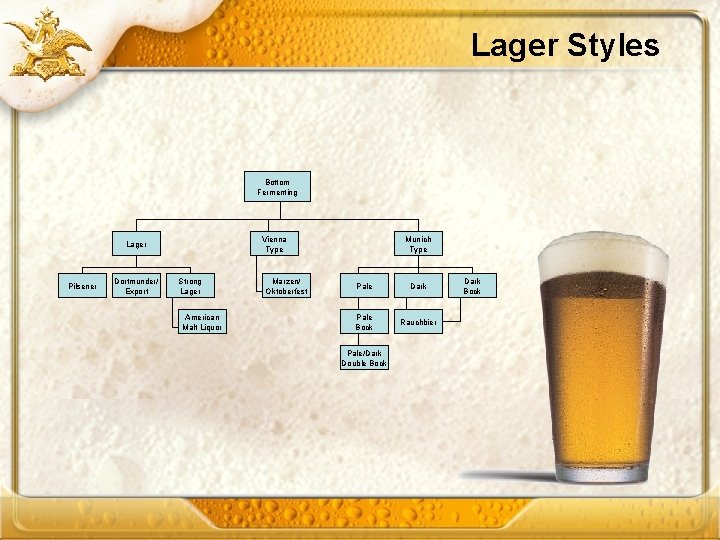
Lager Styles Bottom Fermenting Vienna Type Lager Pilsener Dortmunder/ Export Strong Lager American Malt Liquor Marzen/ Oktoberfest Munich Type Pale Dark Pale Bock Rauchbier Pale/Dark Double Bock Dark Bock
In other words • http: //bendbrewfest. com/beers. html
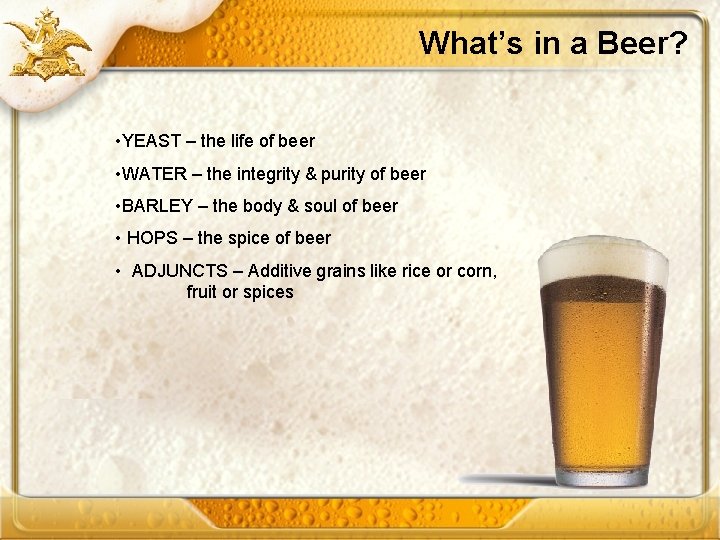
What’s in a Beer? • YEAST – the life of beer • WATER – the integrity & purity of beer • BARLEY – the body & soul of beer • HOPS – the spice of beer • ADJUNCTS – Additive grains like rice or corn, fruit or spices
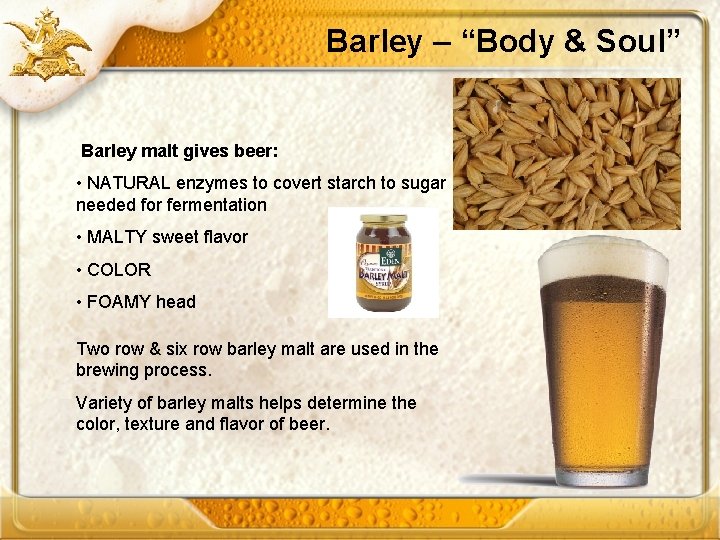
Barley – “Body & Soul” Barley malt gives beer: • NATURAL enzymes to covert starch to sugar needed for fermentation • MALTY sweet flavor • COLOR • FOAMY head Two row & six row barley malt are used in the brewing process. Variety of barley malts helps determine the color, texture and flavor of beer.
Water – “Integrity & Purity” Water’s role in beer: • water makes up 92% of beer • through filtration or boiling; impurities, aromas & flavor differences can be mitigated Water styles can effect flavor: • hard water – helps add crisp cleaness • soft water – adds smoothness
Hops – “Spice of Beer” Hop flowers are used to: • MICROBIAL STABILIZATION hops have antiseptic qualities • HOP AROMA fruity flowery characteristics • BITTERNESS balances malt sweetness • FOAM STABILIZATION enhances head properties There are two primary hop styles: • Aroma Hops – Saaz, Fuggle & Hallertua • Bitter Hops – Brewer’s Gold & Unique Hops are grown around the world between the 35 th and 55 th degrees of latitude and harvested in fall.
Adjuncts – “The Wild Card” Adjuncts add to beer: • adjuncts are added to change the flavor, character or profile of beer. • used to supplement main starch source to provide better foam retention, color or aroma Adjuncts fall into two categories: • Grains: • corn, rice, wheat, oats or rye • Specialty Ingredients: • sweets – honey or maple • fruits – raspberry, cherry or cranberry • spices – cinnamon, coriander or clove
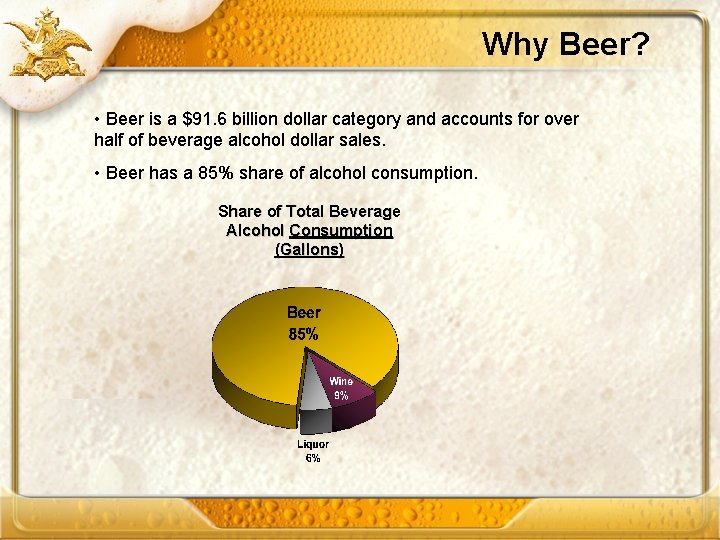
Why Beer? • Beer is a $91. 6 billion dollar category and accounts for over half of beverage alcohol dollar sales. • Beer has a 85% share of alcohol consumption. Share of Total Beverage Alcohol Consumption (Gallons)
What is a “Specialty/Craft” Beer? • all Malt Brewing Process • no “filler” adjuncts to lighten beer • tend to be non-pasteurized, using additional filtration for clarity if desired • small Batch Production • tend to produce beer in smaller vessels • regional based
Opportunity Selling? • Food Pairings • beer is an excellent complement to food • Amber Ales – wild game, meats & cheeses • Hefeweizens – salads, summer fair • IPA – spicy foods (Mexican or Asian) • Porters – deserts • cooking with beer • secret ingredient • adds depth and flavor • versatility
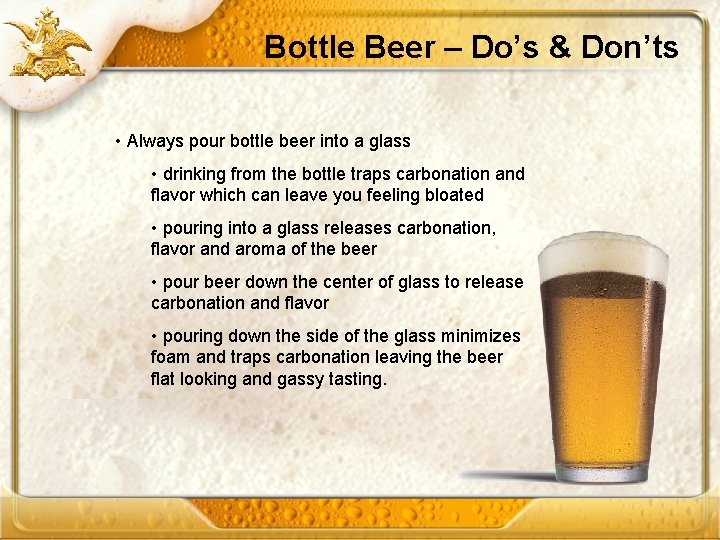
Bottle Beer – Do’s & Don’ts • Always pour bottle beer into a glass • drinking from the bottle traps carbonation and flavor which can leave you feeling bloated • pouring into a glass releases carbonation, flavor and aroma of the beer • pour beer down the center of glass to release carbonation and flavor • pouring down the side of the glass minimizes foam and traps carbonation leaving the beer flat looking and gassy tasting.
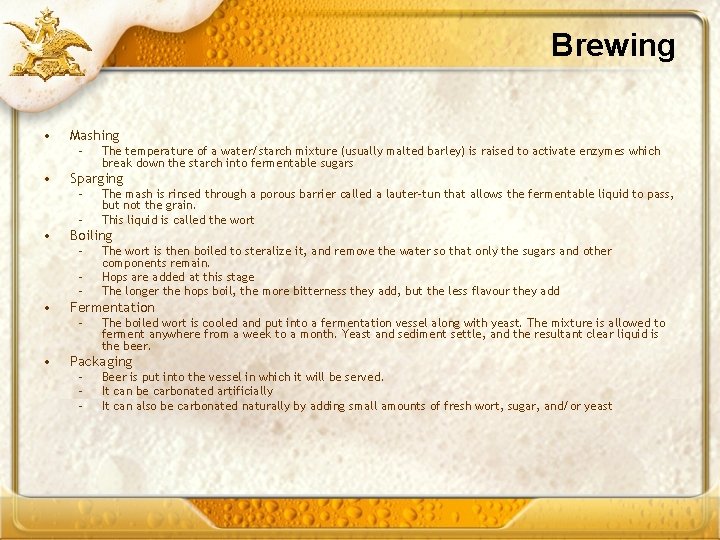
Brewing • • Mashing – Sparging – – • • The mash is rinsed through a porous barrier called a lauter-tun that allows the fermentable liquid to pass, but not the grain. This liquid is called the wort Boiling – – – • The temperature of a water/starch mixture (usually malted barley) is raised to activate enzymes which break down the starch into fermentable sugars The wort is then boiled to steralize it, and remove the water so that only the sugars and other components remain. Hops are added at this stage The longer the hops boil, the more bitterness they add, but the less flavour they add Fermentation – The boiled wort is cooled and put into a fermentation vessel along with yeast. The mixture is allowed to ferment anywhere from a week to a month. Yeast and sediment settle, and the resultant clear liquid is the beer. Packaging – – – Beer is put into the vessel in which it will be served. It can be carbonated artificially It can also be carbonated naturally by adding small amounts of fresh wort, sugar, and/or yeast
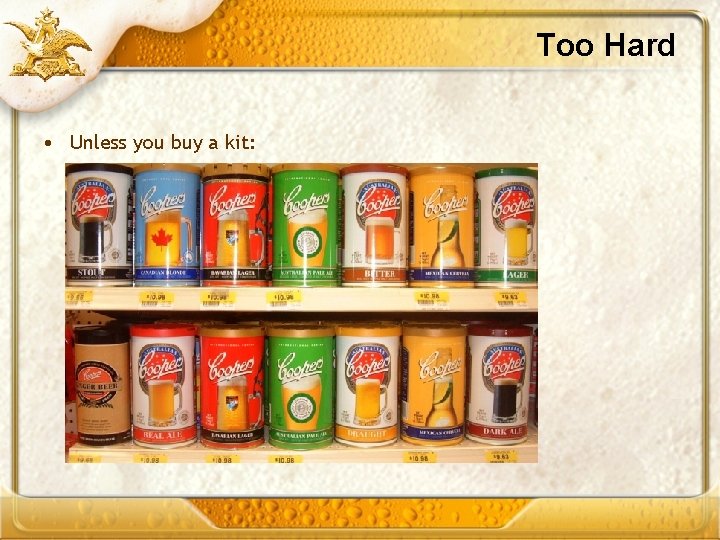
Too Hard • Unless you buy a kit:
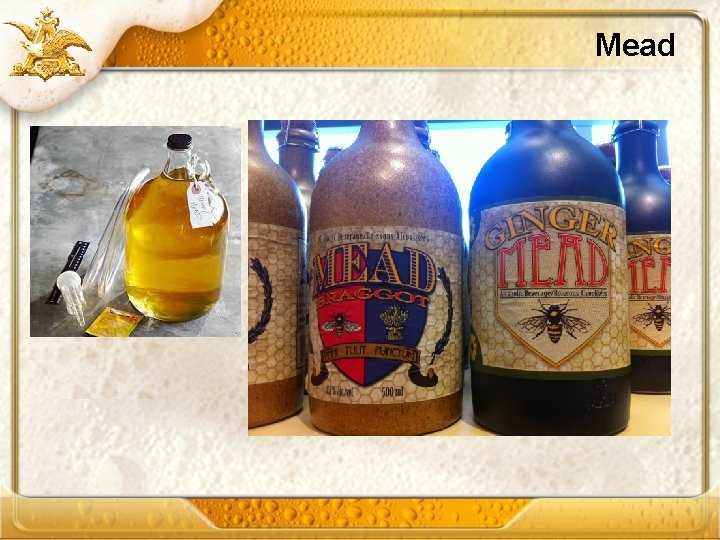
Mead
Mead Despite what you have heard, mead is the easiest alcoholic beverage you can make in your spare time. Not perfect, but easy. • Worlds oldest fermented beverage • Mead is made from honey, water, and yeast – Honeymoon is derived from the month long supply of mead given to a newlywed couple in order to help conceive a child • Is relatively simple to make with basic tools and materials • Cleanliness is next to godliness
Brewing • Yeast feeds on the sugars, and creates carbon dioxide and alcohol as waste products.
Recipe Makes approximately 20 L of Mead: 3 kg honey 1 kg sugar 1. 5 L of juice 1 pack of champagne yeast 5 tsp (25 g)Yeast nutrient Filtered Water 1. 2. 3. 4. 5. 6. !!!KEEP EVERYTHING CLEAN!!! Heat one gallon (3. 78 L) of water to 77 C Add honey, sugar and yeast nutrient. Stir until dissolved. Bring mixture back up to 82 C add juice and bring back up Temp. Add 1 gallon of filtered water to cool before transferring to carboy. Add yeast and more water Store in dark place with average room temp stable. Wait a month.
Recipe Cont. • 7. Rack (Industry term for bottling). Syphon Mead to your bottles. Be careful not to disturb the yeast at the bottom of the carboy or your yeast will be murky and not look as nice. Do not over fill if you are going to do step 8. • 8. OPTIONAL (but recommended) Add appropriate amount of sugar to the appropriate amount of volume to get proper carbonation. Use sugar calculator: http: //www. northernbrewer. com/primingsugar-calculator/ • 9. Wait approximately 10 days. If you used plastic bottles you will notice that they will expand get will get very hard. • 10. Refrigerate for a couple of hours and enjoy!
How much can you drink? DRINKS Body 1 2 3 4 5 6 7 8 9 10 11 12 100 lb. 0. 038 0. 075 0. 113 0. 15 0. 188 0. 225 0. 263 0. 338 0. 375 0. 413 0. 45 110 lb. 0. 034 0. 066 0. 103 0. 137 0. 172 0. 207 0. 241 0. 275 0. 309 0. 344 0. 379 0. 412 120 lb. 0. 031 0. 063 0. 094 0. 125 0. 156 0. 188 0. 219 0. 25 0. 281 0. 313 0. 344 0. 375 130 lb. 0. 029 0. 058 0. 087 0. 116 0. 145 0. 174 0. 203 0. 232 0. 261 0. 29 0. 32 0. 348 140 lb. 0. 027 0. 054 0. 08 0. 107 0. 134 0. 161 0. 188 0. 214 0. 241 0. 268 0. 295 0. 321 150 lb. 0. 025 0. 075 0. 125 0. 151 0. 176 0. 201 0. 226 0. 251 0. 276 0. 301 160 lb. 0. 023 0. 047 0. 094 0. 117 0. 141 0. 164 0. 188 0. 211 0. 234 0. 258 0. 281 170 lb. 0. 022 0. 045 0. 066 0. 088 0. 11 0. 132 0. 155 0. 178 0. 221 0. 244 0. 265 180 lb. 0. 021 0. 042 0. 063 0. 083 0. 104 0. 125 0. 146 0. 167 0. 188 0. 208 0. 229 0. 25 190 lb. 0. 02 0. 04 0. 059 0. 079 0. 099 0. 119 0. 138 0. 158 0. 179 0. 198 0. 217 0. 237 200 lb. 0. 019 0. 038 0. 056 0. 075 0. 094 0. 113 0. 131 0. 15 0. 169 0. 188 0. 206 0. 225 210 lb. 0. 018 0. 036 0. 053 0. 071 0. 09 0. 107 0. 125 0. 143 0. 161 0. 179 0. 197 0. 215 220 lb. 0. 017 0. 034 0. 051 0. 068 0. 085 0. 102 0. 119 0. 136 0. 153 0. 17 0. 188 0. 205 230 lb. 0. 016 0. 032 0. 049 0. 065 0. 081 0. 098 0. 115 0. 13 0. 147 0. 163 0. 18 0. 196 240 lb. 0. 016 0. 031 0. 047 0. 063 0. 078 0. 094 0. 109 0. 125 0. 141 0. 156 0. 172 0. 188 we igh t Source: http: //www. drunkdrivingdefense. com/general/bac. htm You burn 1. 5% (0. 015) per hour
Now, How ’bout a beer? Thank you.
- Slides: 29