
Beef Cattle Selection and Crossbreeding Chapter Two Two
Beef Cattle Selection and Crossbreeding Chapter Two

Two Major Changes in Cattle Breeding • Introduction of “Exotic” Breeds • Shift Toward Crossbred Cows – Estimated 65 breeds in US – Must have “Niche” to survive

Beef Cattle Selection • Purebred Seedstock • Will Always be in demand • Development of Crossbreeds
Selection of Traits • Selecting for too many traits--> – little improvement in any trait • Selecting for only a single trait--> – deterioration of other traits. • Balance is essential
Factors Affecting Genetic Improvement
A. Heritability Differences between animals due to genetics
Heritability Factors • Traits have varying heritability • More Environmental Influence-> – Lower heritability • Heritability can be compared--> – if the environment is the same • Heritability Estimates Pg. 16
B. Selection Pressure The amount of difference between herd average and selected replacements

Selection Pressure • The greater the difference between the selected animal and the herd average, the greater improvement can be expected. • Selection pressure = A general term
Selection Differential • Specific Numbers • Average difference in phenotype between selected animals and herd average • Example, Page 17
C. Genetic Correlations The effect of one trait upon another
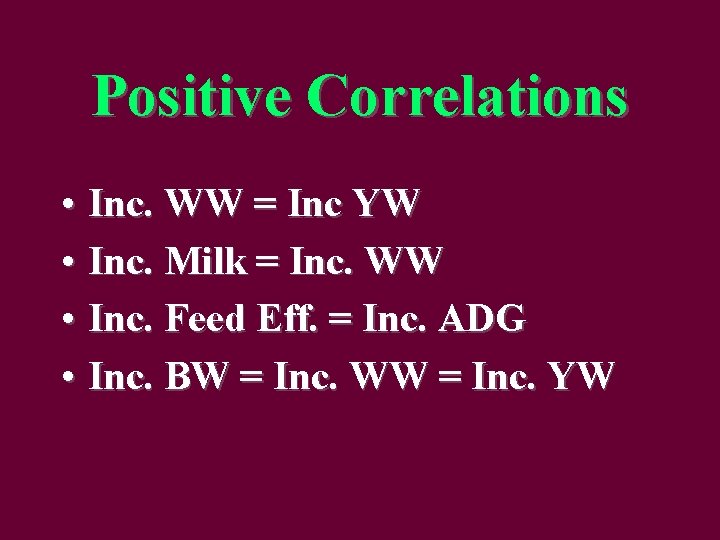
Positive Correlations • Inc. WW = Inc YW • Inc. Milk = Inc. WW • Inc. Feed Eff. = Inc. ADG • Inc. BW = Inc. WW = Inc. YW
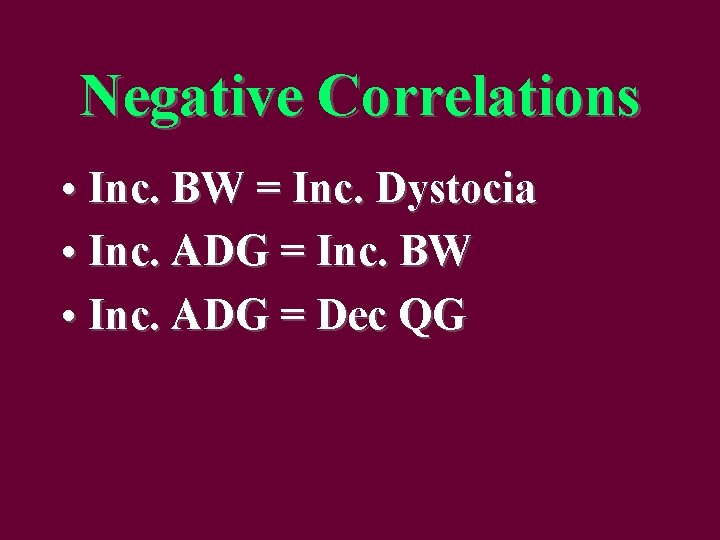
Negative Correlations • Inc. BW = Inc. Dystocia • Inc. ADG = Inc. BW • Inc. ADG = Dec QG
D. Generation Interval Rate of turnover within the herd
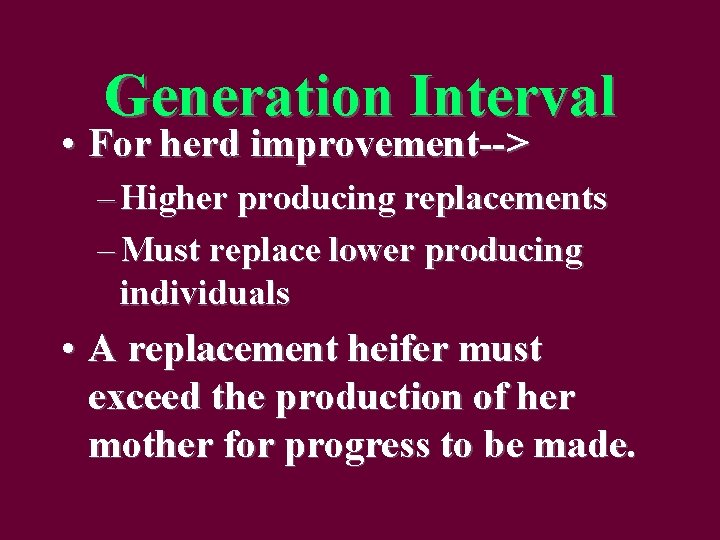
Generation Interval • For herd improvement--> – Higher producing replacements – Must replace lower producing individuals • A replacement heifer must exceed the production of her mother for progress to be made.

Types of Individual Records
1. Pedigree • Family History • Record of Sire and Dam • Grandsires and Grandam • Implies similar production • Only information available on young or newborns
2. Performance Data • An individual’s own numbers • Not related to pedigree • Not related to offspring • Implies a genetic trait
3. Progeny Data • Performance of offspring • By far, the most important • Only available on older seedstock
4. EPD Data • A projection of offspring performance • ACC increases with more data • ACC increases with increased progeny data • Older bulls are more predictable
Determining EPD’s • Calculated by Breed Associations • Pedigree (young animals) • Performance • Progeny and Grandprogeny • Emphasis changes with age
EPD Factors • Age of Dam • Heritability of trait • Number of progeny • Available pedigree
More EPD factors • Contemporary Group Information • Mates of Sires • Sire Production Records • Related traits (management style)
EPD Definition • An estimate of how offspring can be expected to perform • when compared to others within the same breed • when bred to mates of equal value
Contemporary Group Information • Same Sex • Born within 90 days • Similar Management – creep fed, implant, castration • Same % breed • Weighed same day
Two Kinds of EPD’s • Direct influence on calf • Indirect EPD’s • Influences future production of daughters or sons

Direct EPD’s Examples
1. Birth Weight • Influences dystocia • Exp. in lbs. , compared to breed • +3 = calves from this sire will have XX% chance of producing calves that are 3 lbs heavier than breed average. • XX% = Accuracy
2. Weaning Weight • Indicator of Pre-weaning growth • Expressed in lbs. • Heavily influenced by milking production
3. Yearling Weight • Includes WW + Post-weaning Rate of Gain • Mostly used for Bull evaluation • Less important for commercial herds
4. Scrotal Circumference • Related to age at puberty and fertility • Measured in centimeters
5. Gestation Length • Measured in Days • Short GL = – Inc in Post Partum Interval – Dec BW – Inc. in age at Weaning
6. Carcass EPD’s • Marbling = %fat in REA • Carcass Wt • Rib-eye Area • Fat Thickness • % Retail Cuts
Indirect EPD’s Maternal traits that relate to Daughters future production.
1. Milk EPD’s • WW of calves of daughters sired by this bull (Grandprogeny) • Expressed in lbs. of WW • Should match feed and management resources • Largest not always best
2. Total Maternal EPD • Combines weaning and milk EPD’s • Expressed in lbs of WW due to both milk and growth • Milk EPD + 1/2 of WW EPD = Maternal

Other EPD Terms
Accuracy • Reliability Due to information available • Numeric Value = 0 to 1 – Increases as information increases – Low accuracy = Less reliable
P Accuracy • Based on Pedigree only • 1/2 of Sire EPD + 1/2 of Dam EPD • Used until Production Info is available
P+ Accuracy • Pedigree + Progeny Information
Comparing EPD’s • Do not compare across breeds • Different methods of determination
Crossbreeding Beef Cattle
Crossbreeding Definition • Mating animals of different breeds
Heterosis • Hybrid Vigor • The difference between- • A. The trait of the offspring • B. The average of his parents
Importance of Heterosis 3 major points
Importance of Heterosis #1 • Undesirable recessive traits are often covered over by more desirable dominant traits
Importance of Heterosis #2 • High heterosis strengthens desirable production traits
Importance of Heterosis #3 • The more diverse the breeds, the greater the heterosis will be.
Breed Complimentarity • No Breed is perfect • All have defects • Combining strengths creates more desirable offspring.
Terminal Cross • Produces calves for sale as feeders • No Breeding Stock Saved.
F 1 Generation • First Generation offspring of a Cross
Choosing a Breeding System • For Commercial Herds
Straight Breeding Options within a Single Breed
Inbreeding • • Bulls and Cows from same bloodline Not for commercial producers Minimim heterosis More Expression of undesirable traits • Strengthens Traits-Good and Bad
Outcrossing • • Different bloodlines--same breed Some heterosis Most common Maximizes performance within breed • Simple
Straight Breeding Advantages • Breed Identity-Important to some • Maximizes adaptability • Simple
Cross-Breeding Crossing Two or more Breeds
Advantages • Heterosis • Influences traits exhibited at early age most – BW-->WW • Great influence on low Heritability traits
Two Breed Cross • Simple • Easy to change breeds • Terminal cross
3 Breed Terminal Cross • Popular cross breeding method • F 1 cross female X Straight bred bull • Utilizes high heterosis females
More 3 Breed Cross Stuff • High Availability of Bulls • Usually terminal • High heterosis
3 Breed Rotational Cross • Maximum Heterosis • Stacks pedigrees • 6 or 12 year cycle • Requires records
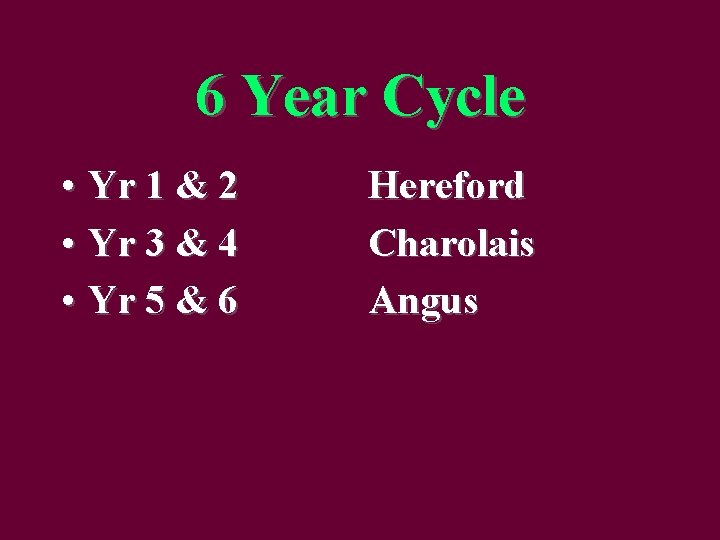
6 Year Cycle • Yr 1 & 2 • Yr 3 & 4 • Yr 5 & 6 Hereford Charolais Angus
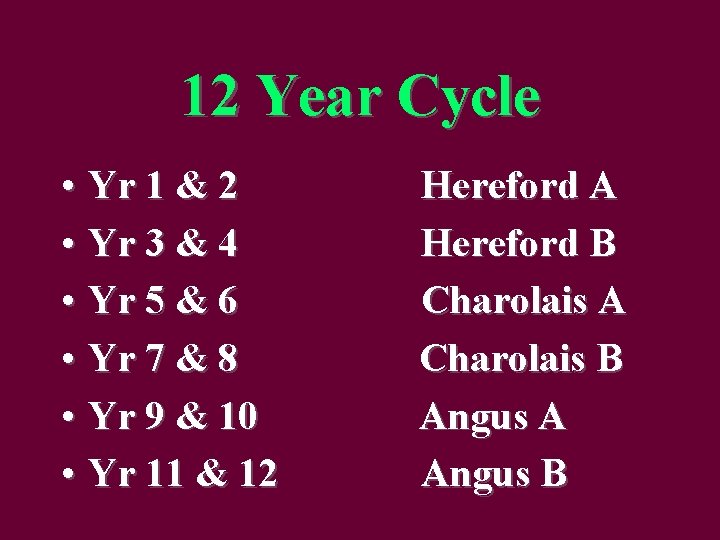
12 Year Cycle • Yr 1 & 2 • Yr 3 & 4 • Yr 5 & 6 • Yr 7 & 8 • Yr 9 & 10 • Yr 11 & 12 Hereford A Hereford B Charolais A Charolais B Angus A Angus B
Two Breed Criss-Cross • F 1 daughter bred to opposite breed of her sire • simple • Stacks pedigrees • Produce replacement females
Purebred Herds 2 General Methods
Purebred Inbreeding • Cows and Bulls from same bloodline • Enhances Traits-Good or Bad • Minimizes genetic variation between blood lines
Purebred Outcrossing • Uses 2 blood lines • Best for most producers

- Slides: 69