
Becoming Trauma Informed Practice Skills Presenter Names Presenter
Becoming Trauma Informed: Practice Skills Presenter Names Presenter Contacts w w w. healthfederation. org

Objectives • Discuss the three key components of trauma responsive and resilience-focused interventions. • Understand use the CAPPD skills • Identify practices to use in your classroom to increase safety, to improve emotional management skills, and to build connections w w w. healthfederation. org
Guidelines • VOLUNTARY Participation • Be Inclusive and Caring with each other • Preserve Confidentiality • Use SELF-REGULATING TOOLS to manage your physiology. CHOICE…CONTROL…EMOTIONAL MANAGEMENT w w w. healthfederation. org
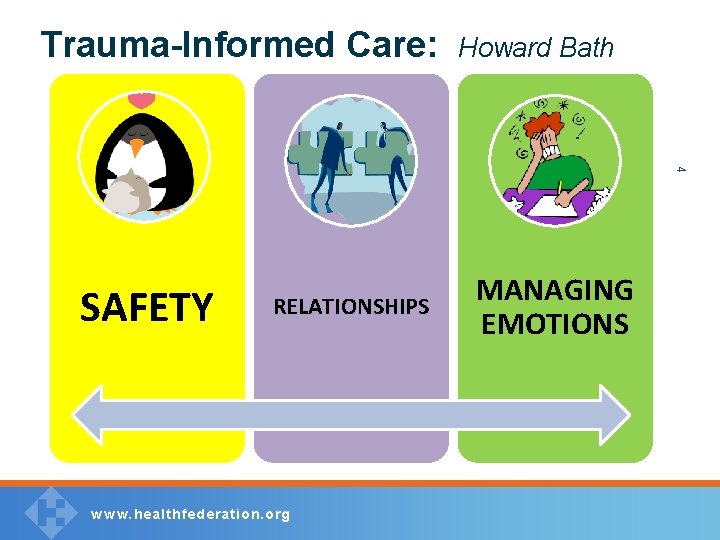
Trauma-Informed Care: Howard Bath 4 SAFETY RELATIONSHIPS w w w. healthfederation. org MANAGING EMOTIONS
It starts with US… How do you REGULATE, MODULATE, and MANAGE…. . • • Energy Level Emotions Behavior Attention In Socially Acceptable WAYS… w w w. healthfederation. org
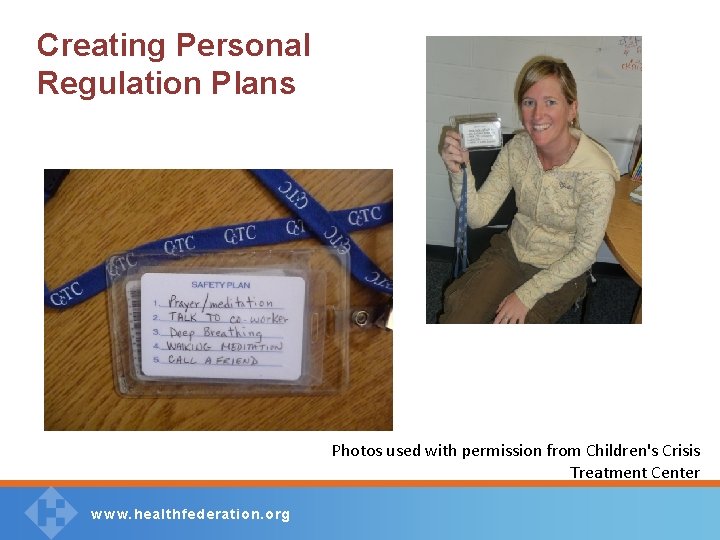
Creating Personal Regulation Plans Photos used with permission from Children's Crisis Treatment Center w w w. healthfederation. org
Resilience is the GOAL • Being resilient is the ability to manage the ups and downs of everyday life with the skills and tools we have available to us. • Being resilient is not just surviving, but thriving after difficult or challenging times. • Being resilient is being able to bounce back after tragedy and loss. VIDEO: Resilience, https: //kpjrfilms. co/resilience/ w w w. healthfederation. org
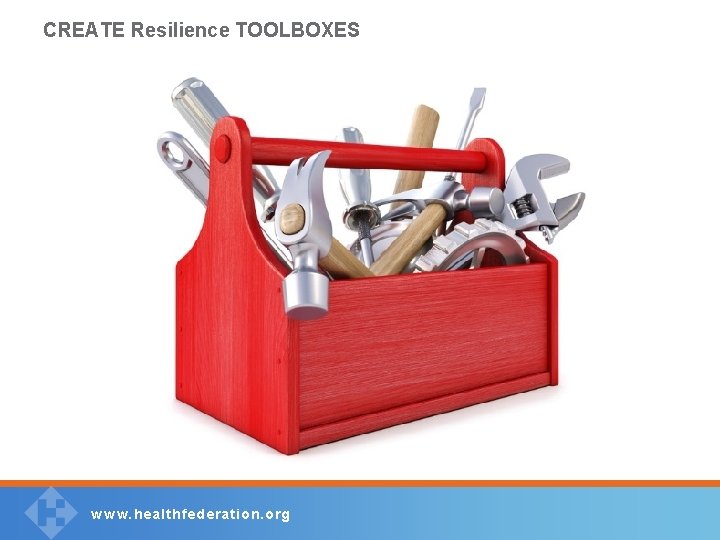
CREATE Resilience TOOLBOXES w w w. healthfederation. org
Key factors for resilience for ALL children -Masten and Coatsworth • A strong parent-child relationship, or, when such a relationship is not available, a surrogate caregiving figure who serves a mentoring role • Good cognitive skills—which predict academic success and lead to rule-abiding behavior • The ability to SELF-REGULATE—Attention, Emotions, and Behaviors w w w. healthfederation. org
Trauma Respnosive Framework • SAFETY • EMOTIONAL MANAGEMENT – CALMING the dysregulated nervous system – STRATEGIES for SELFREGULATION – Social Emotional Learning Every day…. ALL day… • BUILDING STRONG CONNECTIONS w w w. healthfederation. org
Safety • Healing begins by creating an atmosphere of safety (emotional, relational, physical, psychological) • Consider your setting • Consider how services are provided (consistency, transparency, affect and behavior of provider (s) • Consider the experience of the child and family • Provide opportunities for choice and control w w w. healthfederation. org
Connections • The brains of traumatized children have learned to associate adults with negative emotions. • The connection between traumatized individuals and their providers is essential to the healing process • “. . on average, the qualities of therapeutic relationship itself account for twice as much positive change as the specific therapeutic techniques used. (Asay and Lambertson, 2009) w w w. healthfederation. org
Emotional Management • The ability to manage emotions and impulses are essential skills for healthy development. • Exposure to trauma can undermine the capacity to effectively manage emotions and impulses. • The primary source for skills to modulate emotion should be parents/caregivers. • Children may also need adults to ‘co-regulate” with them before they are independent in selfregulation. w w w. healthfederation. org
SMALL GROUP WORK What do you already do in your practice and in your program routines and environments that… BUILD TRUST AND SAFETY? OFFER CHOICE and CONTROL BUILD OUR OWN and OTHERS’ EMOTIONAL COMPETENCE w w w. healthfederation. org
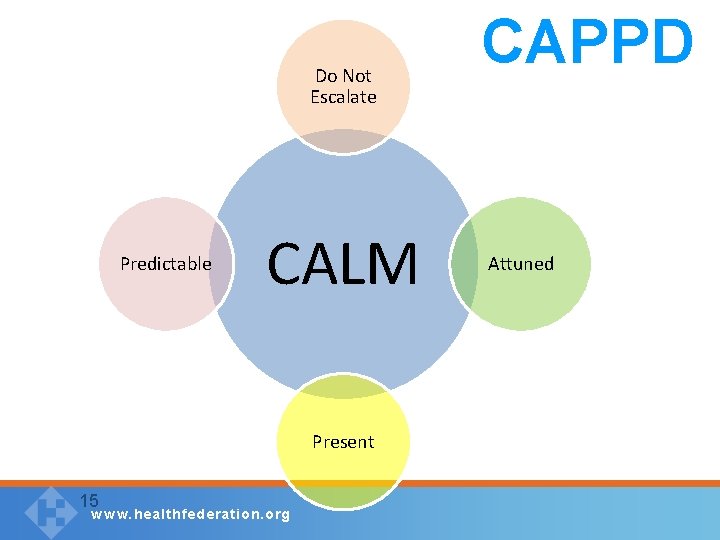
Do Not Escalate Predictable CALM Present 15 w w w. healthfederation. org CAPPD Attuned
WHY CALM? Ø Traumatized children/adults live in elevated states of stress as a survival mode. Ø Traumatized children/adults have difficulty calming themselves. Ø Our brains learn best when we are in a CALM and alert state. w w w. healthfederation. org
CO-REGULATION is the KEY! • Skill-building for young children requires coregulation with an adult – – Warm, responsive interactions Coaching Modeling Narrating a child’s emotional experience • Name it to Tame it—left and right hemispheres integrating understanding w w w. healthfederation. org
Calming Down �BREATHING �MOVEMENT �TACTILE EXPERIENCES �SENSORY-BASED EXPERIENCES �MUSIC VIDEO OPTIONS: Head Start Trauma Smart Giving children who’ve experienced trauma a Head Start in healing. w w w. healthfederation. org
CALMING and GROUNDING • Breathing – – – Four Square Breathing Counting breaths Lying down belly breaths Ocean breathing Wind breathing The Flower Field • Physical – – – – Weighted blankets, vest, packs Heavy stuffed animal on lap Safety Object Rocking Sand or water play Marching feet Chewable jewelry or pencil erasers w w w. healthfederation. org
Progressive Muscle Relaxation-PMR • • • Robot/Rag Doll Spaghetti Giraffe/Turtle Caterpillar Butterfly Doorway or wall press and stretch w w w. healthfederation. org
Attention, Focus, and Memory • • Music Drumming or rhythmic activities Simon Says…Do the Opposite! Tapping Game Follow the Leader Matching Games (changing rules) Sorting Games (changing rules) w w w. healthfederation. org
MOVEMENT and TACTILE • Games • Scheduling the day with breaks for large muscle and small muscle movement • Yoga/stretching • Moving with Music • Coloring • Clay • Fidgets w w w. healthfederation. org
In the moment strategies for regulation From the Community Resiliency Model of the Trauma Resource Institute www. communityresiliencymodel. com • • • Slow, steady, deep breaths (Breathe 2 Relax, Calm. com, ichill ) Push against a wall Count backwards from 10 -1 as you walk around the space Name the colors in the room or space Walk outside and name the sounds in the environment Drink a glass of water Hum a tune Open your eyes if you tend to close them Walk slowly and pay attention to the movement of your arms and legs • Recall a pleasurable, or at least neutral, experience • Stand up and pay attention to (feel) your feet…you can even stomp them. w w w. healthfederation. org
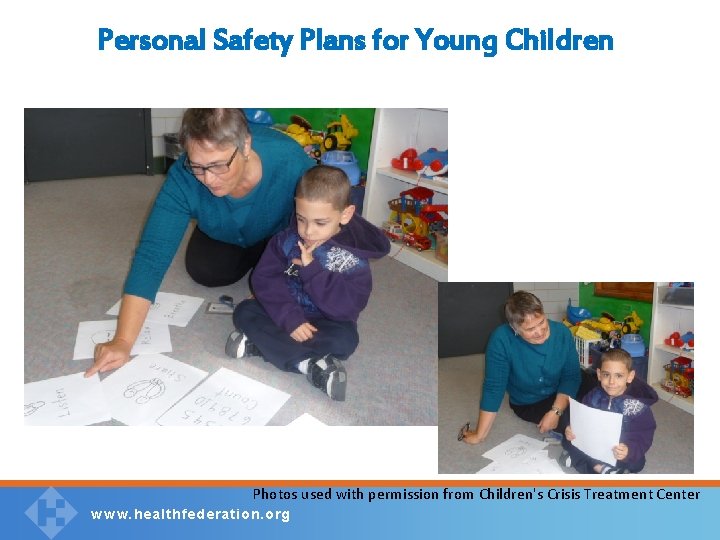
Personal Safety Plans for Young Children Photos used with permission from Children's Crisis Treatment Center w w w. healthfederation. org
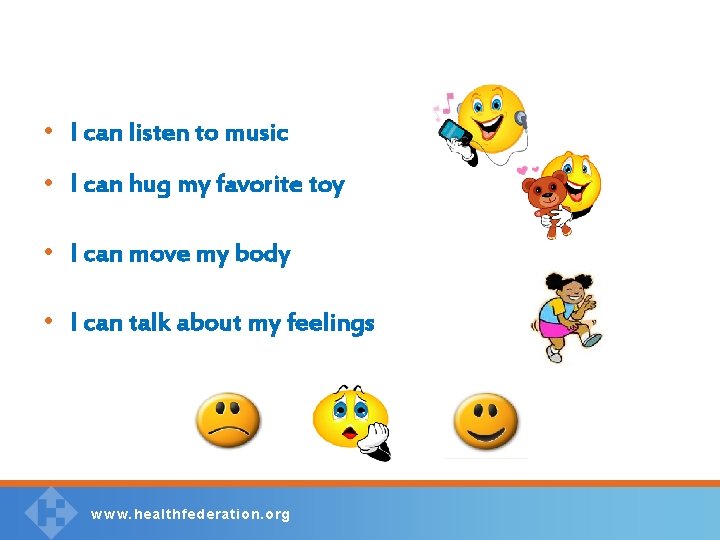
• I can listen to music • I can hug my favorite toy • I can move my body • I can talk about my feelings w w w. healthfederation. org
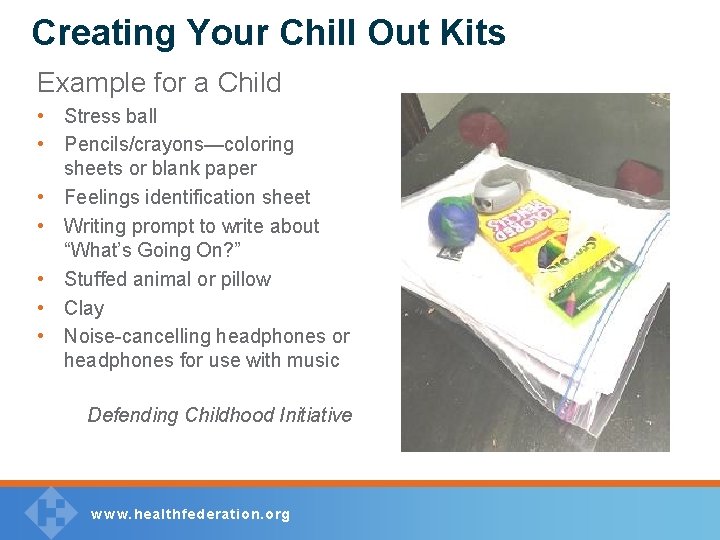
Creating Your Chill Out Kits Example for a Child • Stress ball • Pencils/crayons—coloring sheets or blank paper • Feelings identification sheet • Writing prompt to write about “What’s Going On? ” • Stuffed animal or pillow • Clay • Noise-cancelling headphones or headphones for use with music Defending Childhood Initiative w w w. healthfederation. org
PEACE CORNER SAFE SPOT CHILL OUT CORNER RELAX SPOT The THINK SPACE A place in each classroom where a child can choose to go when feeling upset, scared, irritated…physiologically dysregulated Area has activities that child can self-select to help them feel SAFER Includes FEELINGS identification and CHOICE https: //www. youtube. com/watch? v=i. V 1 -vn. Avs. Ao w w w. healthfederation. org
Self-Regulation Skills • • Are not innate Can be taught directly Strengthened over time Young childhood and adolescence are great windows of opportunity for this type of skillbuilding • Continue to develop over the lifespan w w w. healthfederation. org
Development of Self-Regulation Begins in infancy 12 -18 MONTHS – Children become aware of social demands – Ability to change behavior when asked – Requires adult co-regulation 2 YEARS – Begin to develop self-control 3 YEARS – Begin to generalize strategies from past experiences w w w. healthfederation. org
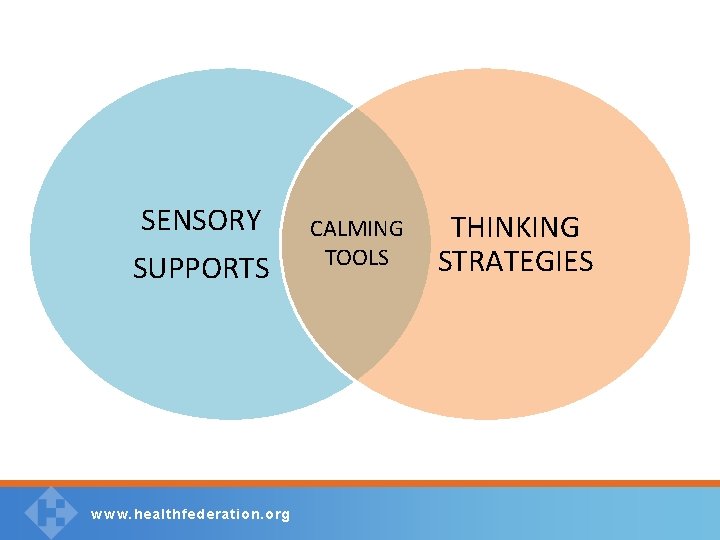
SENSORY SUPPORTS w w w. healthfederation. org CALMING TOOLS THINKING STRATEGIES
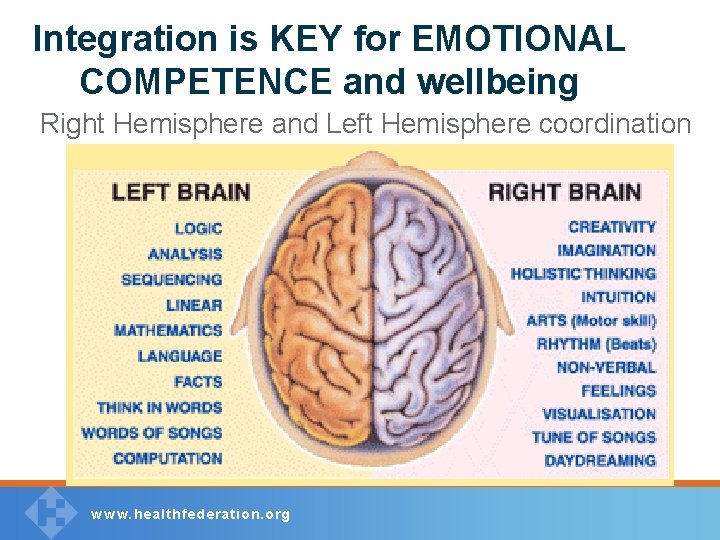
Integration is KEY for EMOTIONAL COMPETENCE and wellbeing Right Hemisphere and Left Hemisphere coordination w w w. healthfederation. org
Attuned Ø Trauma impacts the ability to TRUST. Ø Attunement sends the message that YOU matter to me and I care about what you NEED. Ø Attunement is often connected to nonverbal cues—reading facial expressions, tone of voice, posture, touch, intensity w w w. healthfederation. org Present Ø When we are checked out or distracted, we’re not paying attention. We’re missing many opportunities for interaction and connection. Ø We have to know ourselves well so that we can stay regulated, too. Ø People who’ve experienced trauma are used to being disregarded or abandoned and they can also have the tendency to be disconnected.
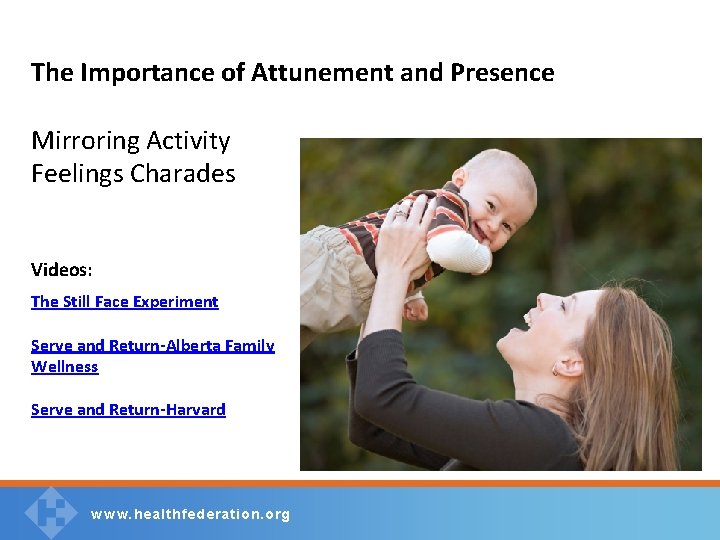
The Importance of Attunement and Presence Mirroring Activity Feelings Charades Videos: The Still Face Experiment Serve and Return-Alberta Family Wellness Serve and Return-Harvard w w w. healthfederation. org
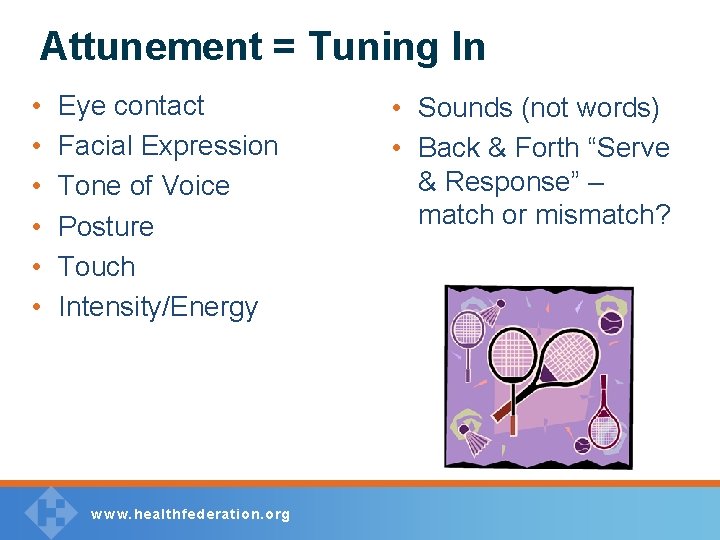
Attunement = Tuning In • • • Eye contact Facial Expression Tone of Voice Posture Touch Intensity/Energy w w w. healthfederation. org • Sounds (not words) • Back & Forth “Serve & Response” – match or mismatch?
BEING ATTUNED AND PRESENT—Reflecting the child’s WORLD… Knows me Did things with me Trusted me Listened to me Asked me about me Pushed me to do what they knew I could Saw something in me I couldn’t see Saw me in a positive light w w w. healthfederation. org Shared part of themselves (stories, skills) Looked happy to see me Remembered things about me What I liked or didn’t like Took time for me Let me teach them something Held me accountable
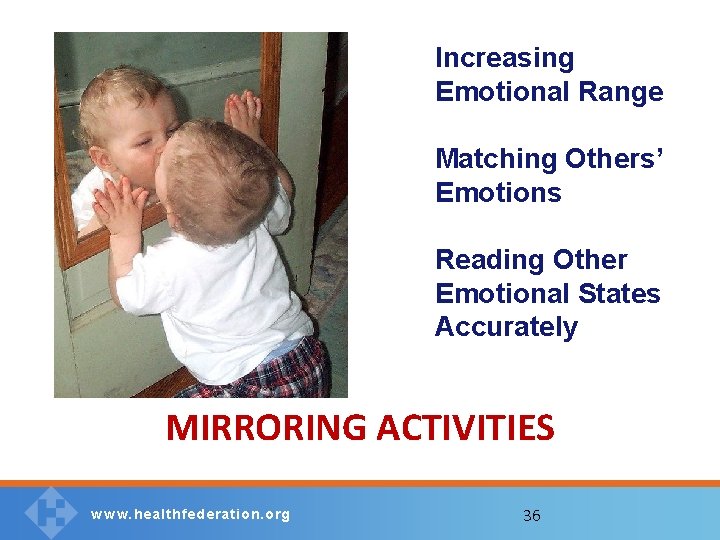
Increasing Emotional Range Matching Others’ Emotions Reading Other Emotional States Accurately MIRRORING ACTIVITIES w w w. healthfederation. org 36
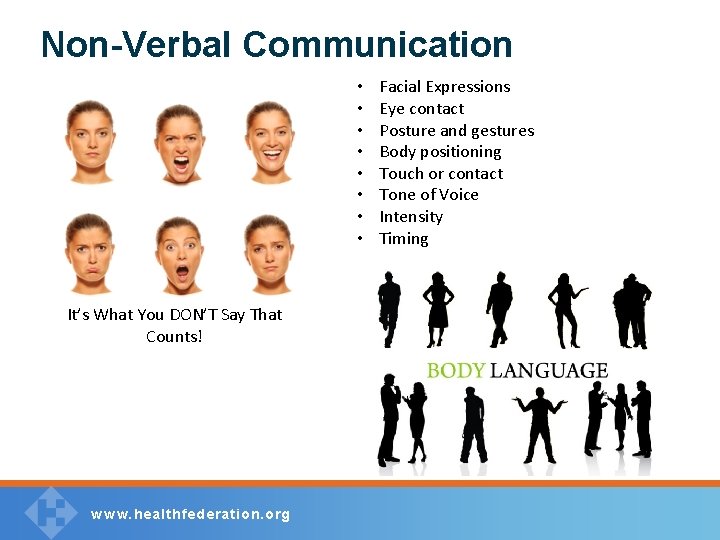
Non-Verbal Communication • • It’s What You DON’T Say That Counts! w w w. healthfederation. org Facial Expressions Eye contact Posture and gestures Body positioning Touch or contact Tone of Voice Intensity Timing
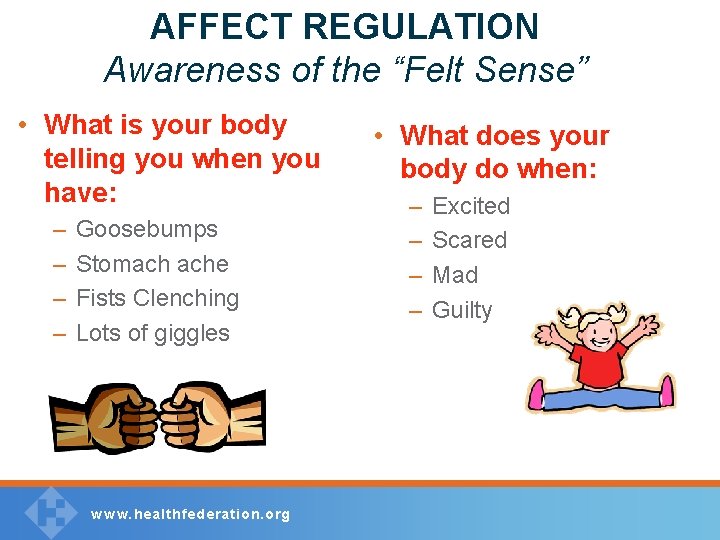
AFFECT REGULATION Awareness of the “Felt Sense” • What is your body telling you when you have: – – Goosebumps Stomach ache Fists Clenching Lots of giggles w w w. healthfederation. org • What does your body do when: – – Excited Scared Mad Guilty
PREDICTABLE Ø Trauma eliminates any sense of predictability in a victim’s life—the world seems unstable and unsafe. Ø Predictability decreases anxiety which is provoked by unpredictability Ø Predictability gives the child a greater sense of CONTROL. w w w. healthfederation. org
Do NOT Escalate Importance Benefits • When traumatized children/adults become upset they lose control. • Modeling calm reactions teaches children to react more positively to conflict and distress. • Children need to feel that some one else is in control so they can calm down. • Staying calm helps minimize everyone’s distress and anxiety w w w. healthfederation. org • Responding in a calm measured way diminishes the possibility of an escalating emotion display between adults 40
BUILDING FRUSTRATION TOLERANCE… • • • It’s OK to make mistakes… Let’s keep trying… You can do this… Working with physical sensations Support peer encouragement Validate the difficulty…. I know it’s really hard to… w w w. healthfederation. org
CHECKING OUR HABITUAL REPONSES TONE OF VOICE POSTURE EXPRESSIONS OF POWER DEFAULT STRESS REACTIONS INTERNAL BELIEFS ABOUT CHILDREN VERBAL COMMENTARY AND BUILDING RESILIENCE IN OURSELVES AS WELL AS THE CHILDREN UNCONDITIONAL POSITIVE REGARD VALIDATING FEELINGS SENSORY SUPPORTS MAKING MEANING w w w. healthfederation. org
AVOID Power Battles. • Person is often familiar with a relational climate of aggression (brain looks for patterns—try to recreate relationally what we know) • How we manage our own emotional arousal and regulation is VITAL to trauma sensitive responses. (HAVE A PLAN—for SELF and AGENCY) w w w. healthfederation. org
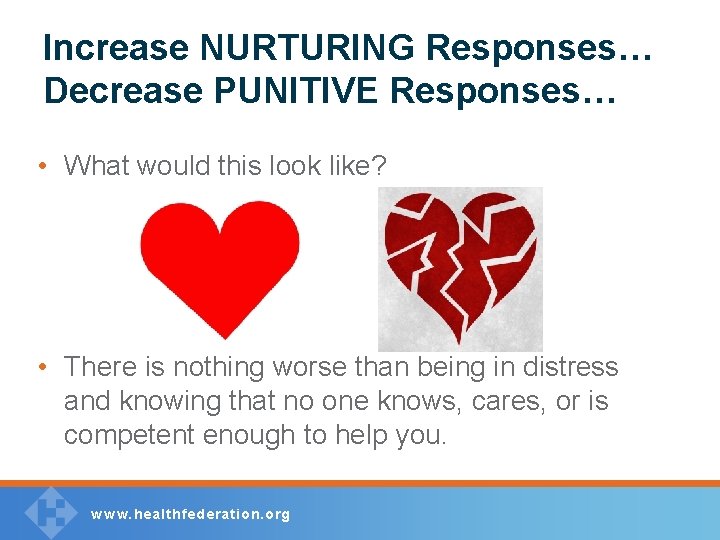
Increase NURTURING Responses… Decrease PUNITIVE Responses… • What would this look like? • There is nothing worse than being in distress and knowing that no one knows, cares, or is competent enough to help you. w w w. healthfederation. org
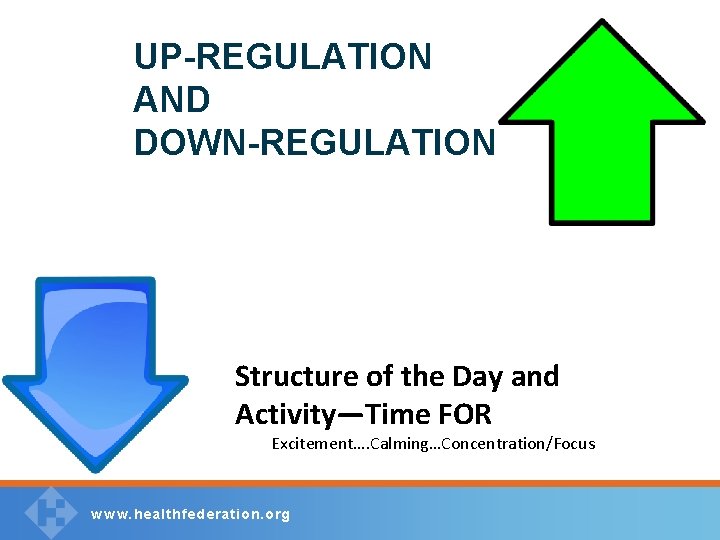
UP-REGULATION AND DOWN-REGULATION Structure of the Day and Activity—Time FOR Excitement…. Calming…Concentration/Focus w w w. healthfederation. org
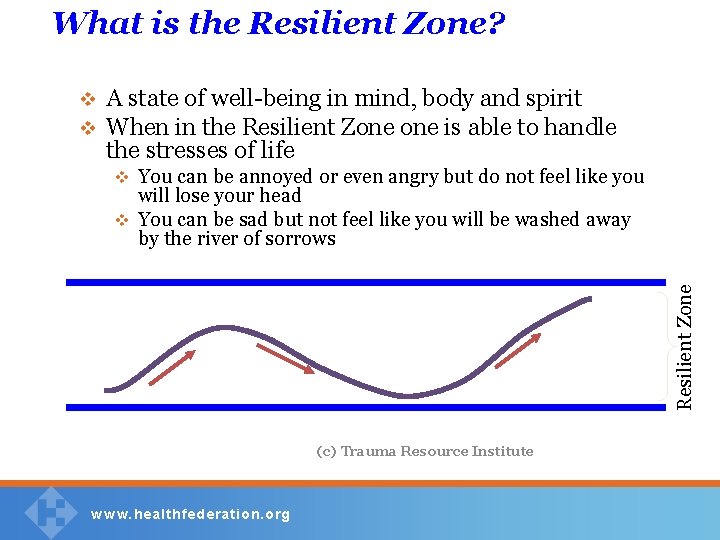
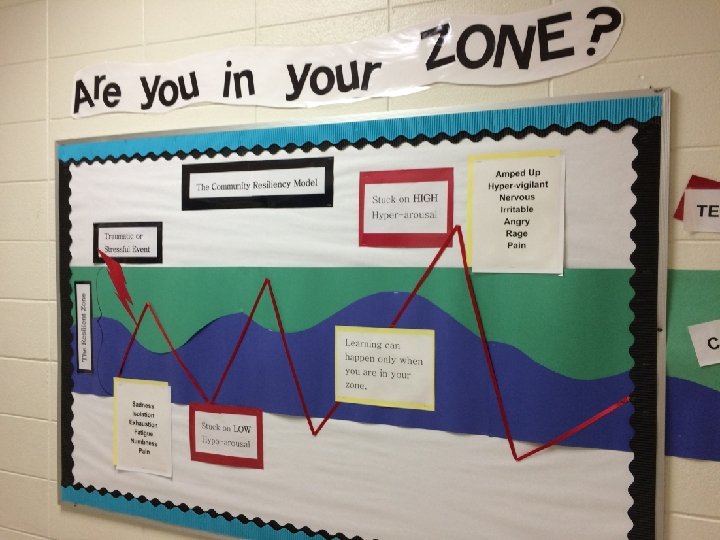
What is the Resilient Zone? v v A state of well-being in mind, body and spirit When in the Resilient Zone is able to handle the stresses of life You can be annoyed or even angry but do not feel like you will lose your head v You can be sad but not feel like you will be washed away by the river of sorrows Resilient Zone v (c) Trauma Resource Institute w w w. healthfederation. org
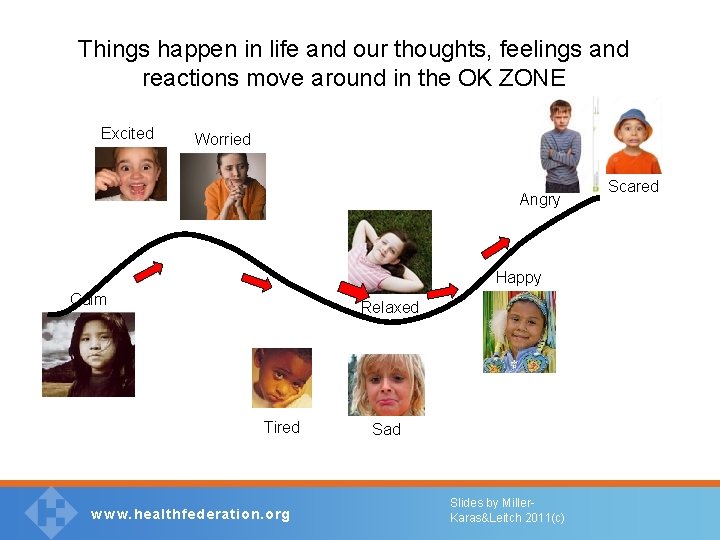
Things happen in life and our thoughts, feelings and reactions move around in the OK ZONE Excited Worried Angry Happy Calm Relaxed Tired w w w. healthfederation. org Sad Slides by Miller. Karas&Leitch 2011(c) Scared
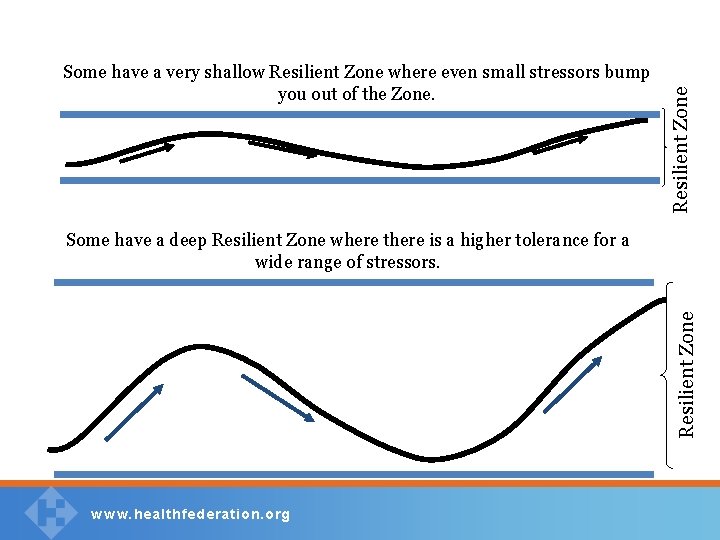
Resilient Zone Some have a very shallow Resilient Zone where even small stressors bump you out of the Zone. Resilient Zone Some have a deep Resilient Zone where there is a higher tolerance for a wide range of stressors. w w w. healthfederation. org
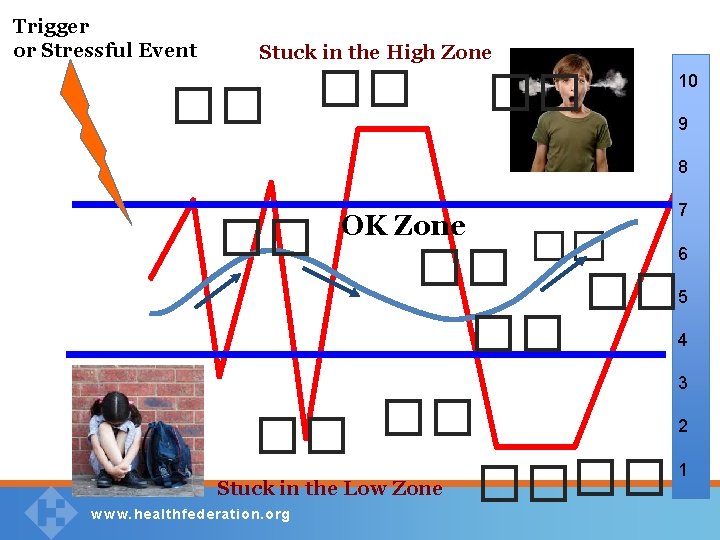
Trigger or Stressful Event Stuck in the High Zone �� �� �� 10 9 8 �� OK Zone 7 �� �� 6 5 4 3 �� �� Stuck in the Low Zone ���� w w w. healthfederation. org 2 1
w w w. healthfederation. org
HOW CAN WE HELP CHILDREN WIDEN THEIR RESILIENCE ZONES? • CALM the physiology FIRST. • Teach and model using calming tools and sensory supports—eventually these are self-directed. • Highlight strengths and give the child a sense of agency • Have many tools that work with various brain regions (Cortex, Limbic, Survival-Brainstem) w w w. healthfederation. org
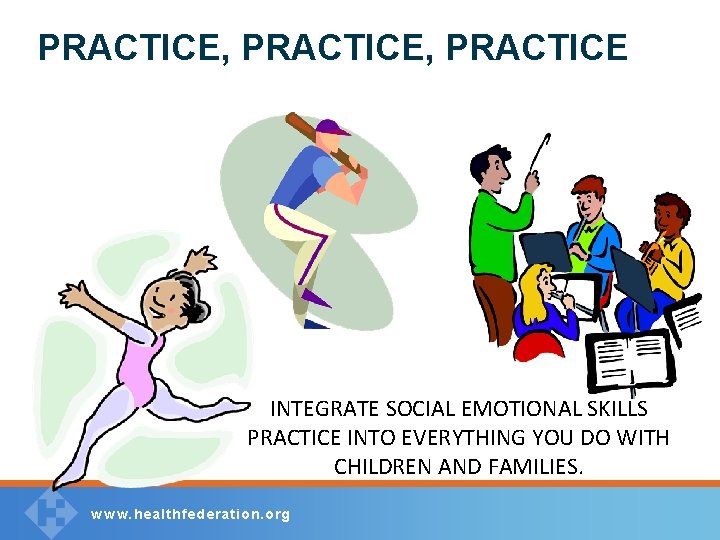
PRACTICE, PRACTICE INTEGRATE SOCIAL EMOTIONAL SKILLS PRACTICE INTO EVERYTHING YOU DO WITH CHILDREN AND FAMILIES. w w w. healthfederation. org
Resources For Schools Making SPACE for Learning: Trauma Informed Practice in Schools www. childhood. org. au The Heart of Teaching and Learning: Compassion, Resiliency, and Academic Success Washington State Schools Calmer Classrooms State Government of Victoria, AU Helping Traumatized Children Learn, MA Advocates for Children, https: //traumasensitiveschools. org/ Trauma Smart, www. traumasmart. org Zones of Regulation Model, http: //www. zonesofregulation. com/index. html w w w. healthfederation. org
- Slides: 53