
Becoming Canadians 1783 1837 Aftermath of the American

Becoming Canadians (1783 -1837)
Aftermath of the American Revolution • Not everyone in the 13 Colonies wanted revolution. • Tens of thousands of Loyalists fled from the States to Canada. • The British and the Americans failed to fulfill the terms of the Treaty of Versailles(not that one). ØBrits to vacate forts in the west ØYanks to compensate the Loyalists for last land
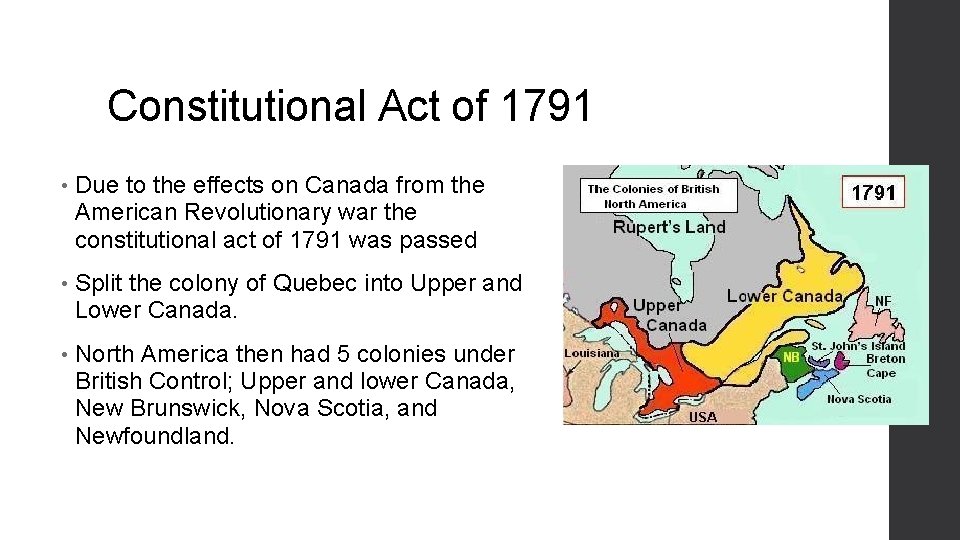
Constitutional Act of 1791 • Due to the effects on Canada from the American Revolutionary war the constitutional act of 1791 was passed • Split the colony of Quebec into Upper and Lower Canada. • North America then had 5 colonies under British Control; Upper and lower Canada, New Brunswick, Nova Scotia, and Newfoundland.
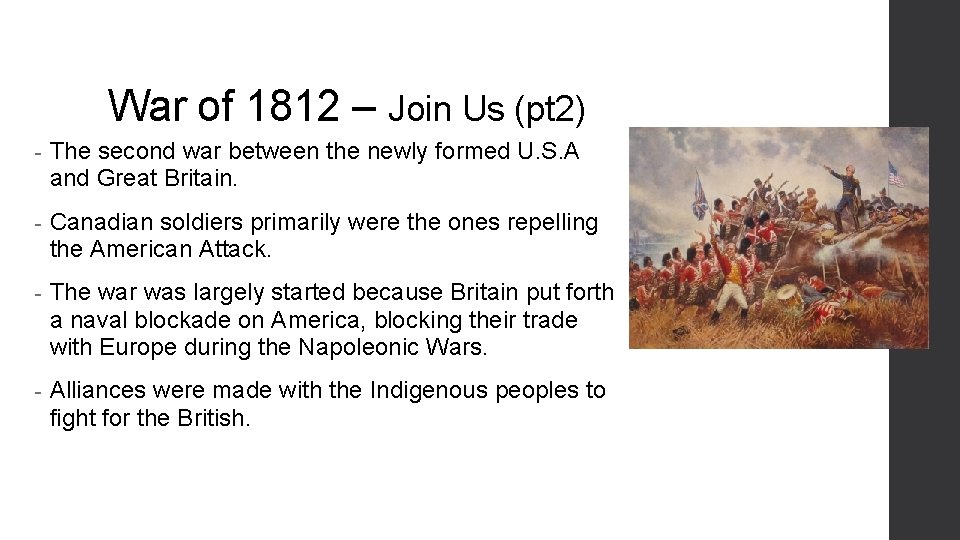
War of 1812 – Join Us (pt 2) - The second war between the newly formed U. S. A and Great Britain. - Canadian soldiers primarily were the ones repelling the American Attack. - The war was largely started because Britain put forth a naval blockade on America, blocking their trade with Europe during the Napoleonic Wars. - Alliances were made with the Indigenous peoples to fight for the British.
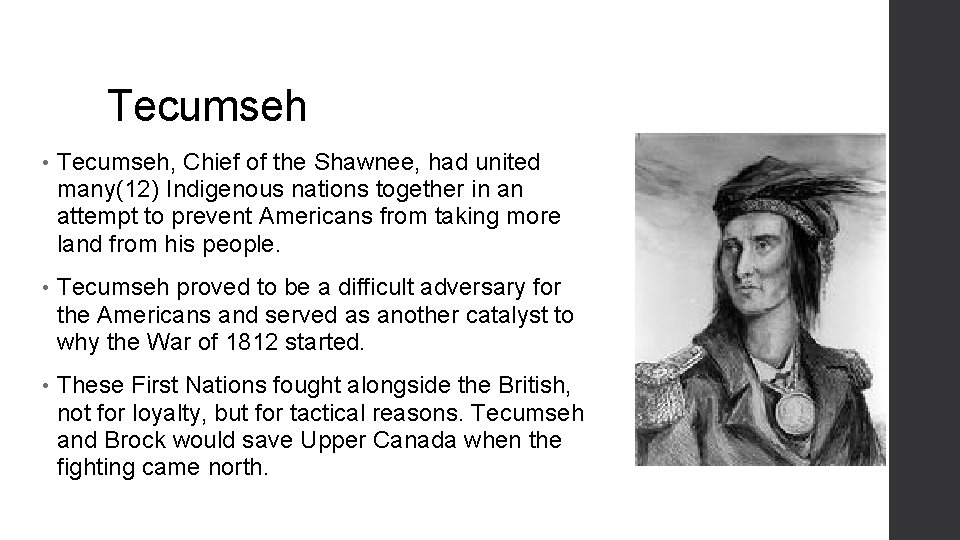
Tecumseh • Tecumseh, Chief of the Shawnee, had united many(12) Indigenous nations together in an attempt to prevent Americans from taking more land from his people. • Tecumseh proved to be a difficult adversary for the Americans and served as another catalyst to why the War of 1812 started. • These First Nations fought alongside the British, not for loyalty, but for tactical reasons. Tecumseh and Brock would save Upper Canada when the fighting came north.
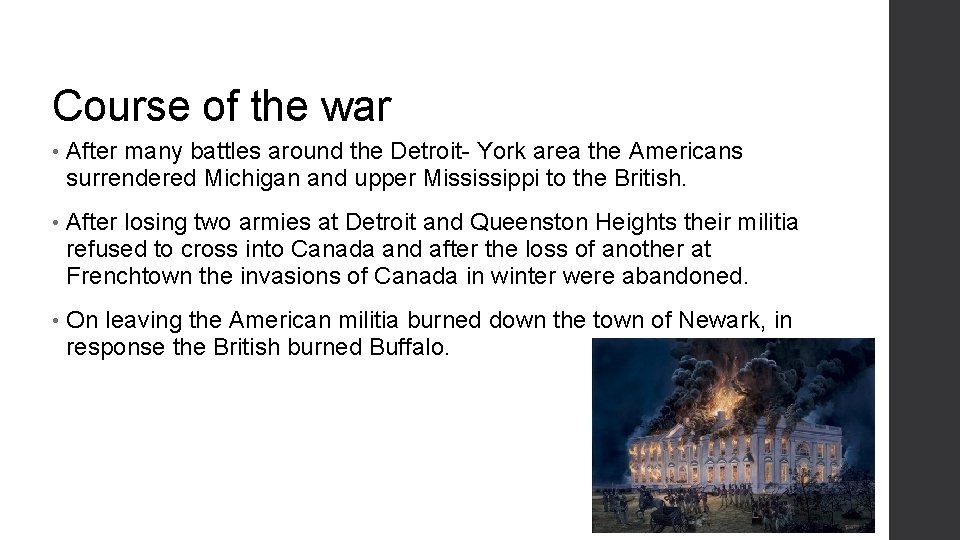
Course of the war • After many battles around the Detroit- York area the Americans surrendered Michigan and upper Mississippi to the British. • After losing two armies at Detroit and Queenston Heights their militia refused to cross into Canada and after the loss of another at Frenchtown the invasions of Canada in winter were abandoned. • On leaving the American militia burned down the town of Newark, in response the British burned Buffalo.
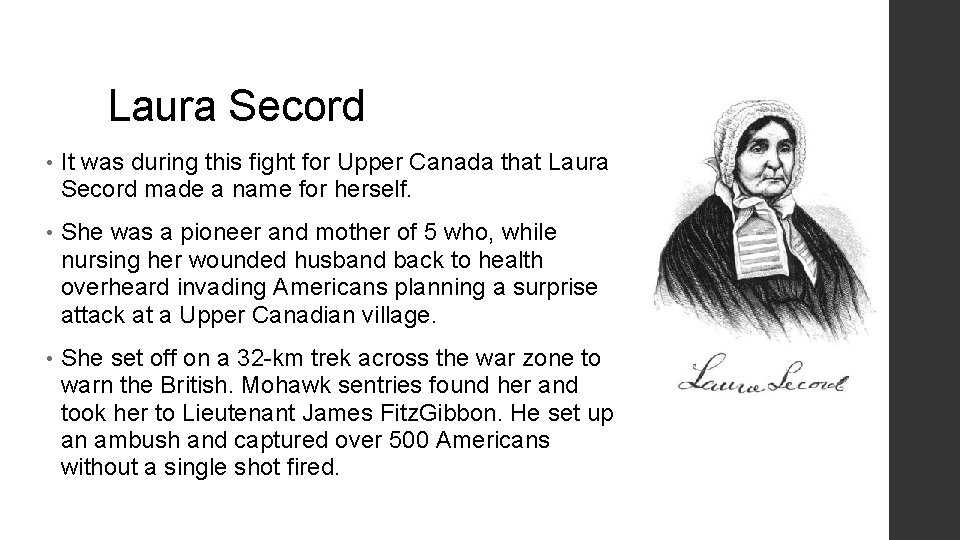
Laura Secord • It was during this fight for Upper Canada that Laura Secord made a name for herself. • She was a pioneer and mother of 5 who, while nursing her wounded husband back to health overheard invading Americans planning a surprise attack at a Upper Canadian village. • She set off on a 32 -km trek across the war zone to warn the British. Mohawk sentries found her and took her to Lieutenant James Fitz. Gibbon. He set up an ambush and captured over 500 Americans without a single shot fired.
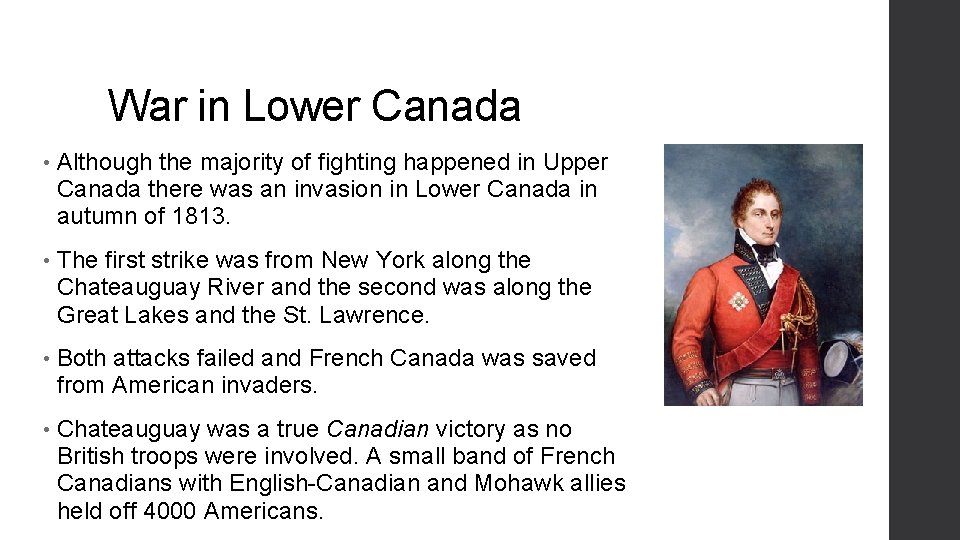
War in Lower Canada • Although the majority of fighting happened in Upper Canada there was an invasion in Lower Canada in autumn of 1813. • The first strike was from New York along the Chateauguay River and the second was along the Great Lakes and the St. Lawrence. • Both attacks failed and French Canada was saved from American invaders. • Chateauguay was a true Canadian victory as no British troops were involved. A small band of French Canadians with English-Canadian and Mohawk allies held off 4000 Americans.
So Who Won? • On the battlefield the Americans were handed lose after lose but… …this war was more political than military. • In the Treaty of Ghent, signed on Christmas eve of 1814, the British and Americans agreed to end the war. • The Treaty reestablished the territories to their original position but the Americans were given free reign of the west and maintained their sovereignty. • This “victory” by the Americans led to the widespread war of extermination, displacement and assimilation against the First Nations.
Final Thoughts • Pierre Berton wrote this quote about the war of 1812… ” It was as if no war had been fought, or to put it more bluntly, as if the war that was fought for no good reason. For nothing has changed; everything is as it was in the beginning save for the graves of those who, it now appears, have fought for a trifle: . . . Lake Erie and Fort Mc. Henry will go into the American history books, Queenston Heights and Crysler's Farm into the Canadian, but without the gore, the stench, the disease, the terror, the conniving, and the imbecilities that march with every army. “ • Does this quote really accurately describe the war? Was anyone really victorious?
Questions • Did the War of 1812 really help solidify a Canadian identity? If so, how?
- Slides: 11