
Becoming a Professional Engineer For graduate students January
Becoming a Professional Engineer For graduate students January 2018 Ensuring public safety Kate Mac. Lachlan, Ph. D. , P. Geo. Director of Academic Review
2 • Who is APEGS ? • Why is there licensing of engineers ? • How to become registered • Q & A Ensuring public safety
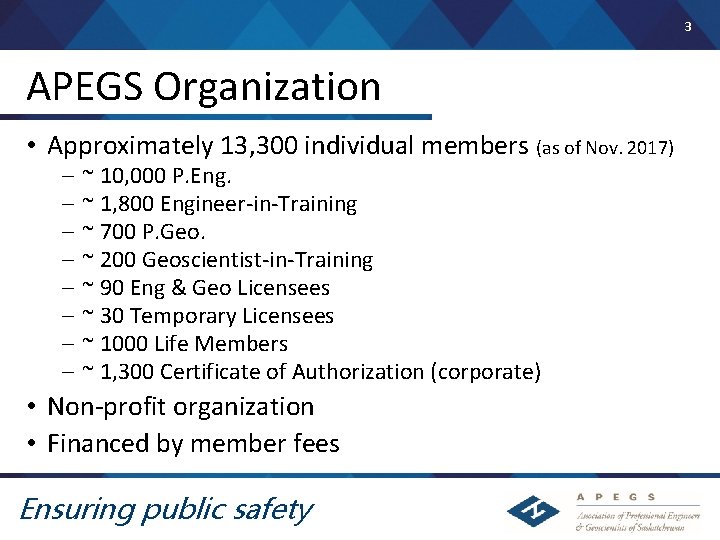
3 APEGS Organization • Approximately 13, 300 individual members (as of Nov. 2017) – – – – ~ 10, 000 P. Eng. ~ 1, 800 Engineer-in-Training ~ 700 P. Geo. ~ 200 Geoscientist-in-Training ~ 90 Eng & Geo Licensees ~ 30 Temporary Licensees ~ 1000 Life Members ~ 1, 300 Certificate of Authorization (corporate) • Non-profit organization • Financed by member fees Ensuring public safety
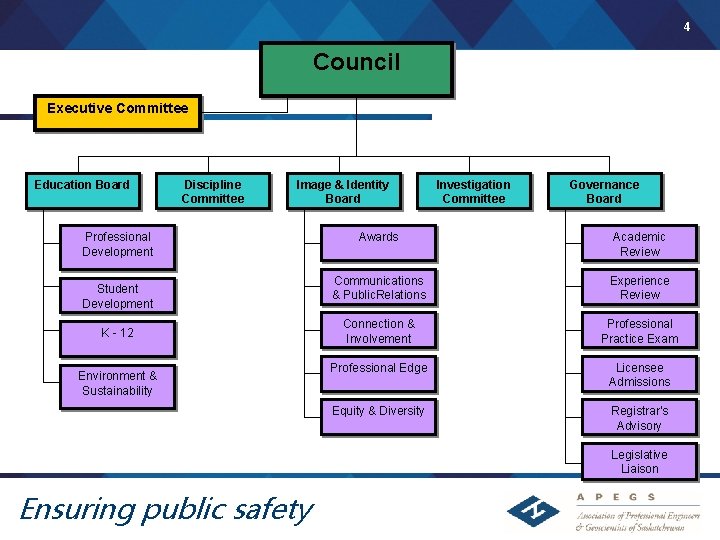
4 Council Executive Committee Education Board Discipline Committee Image & Identity Board Professional Development Student Development K - 12 Environment & Sustainability Investigation Committee Governance Board Awards Academic Review Communications & Public. Relations Experience Review Connection & Involvement Professional Practice Exam Professional Edge Licensee Admissions Equity & Diversity Registrar’s Advisory Legislative Liaison Ensuring public safety
5 Why Does APEGS exist? • Role of Society • Privilege of Self regulation • What is a profession? • The Engineering and Geoscience Professions Act (the Act) • Right to practice Ensuring public safety
6 Role of Society • Through an Act of the Provincial Legislature the people of Saskatchewan have given the professions the privilege and authority of self regulation. • Through the Act there is a “Social contract” between the public and the professions Ensuring public safety
7 Self Regulation • All professions in Canada are self-regulating under provincial / territorial legislation • Members of the profession regulate themselves by ensuring: – only qualified people are licensed – all those practicing are licensed • professional practitioners are in the best position to judge who is competent to practice Ensuring public safety
8 What is a Profession? • A profession is a calling requiring specialized knowledge and long academic preparation • Professionals assign their highest obligation to society above all others • In cases of conflicting responsibilities / interests, public safety, health and welfare, and the environment are paramount Ensuring public safety
9 The Act • APEGS is legally responsible to the people of Saskatchewan for licensing engineers and geoscientists in the province, and for regulating the practice of these professions in the public interest (i. e. , to protect, the health, safety, financial wellbeing of the people and protect the environment). • APEGS is governed by the “Engineering and Geoscience Professions Act” http: //www. publications. gov. sk. ca/details. cfm? p=510 • The regulatory and administrative bylaws that govern the association can be found on our website http: //www. apegs. ca/Portal/Pages/Act-Bylaws Ensuring public safety
10 Right to Practice • If you are doing work that would be considered profession engineering you must be licensed as a professional engineer. • If you are not licensed, then you must be supervised by someone who is taking responsibility for your work. IT’S THE LAW! Ensuring public safety
11 The Act Definition of the practice of engineering - section 2(m): • Any act of planning, designing, composing, measuring, evaluating, inspecting, advising, reporting, directing or supervising, or managing any of the foregoing; that – requires the application of engineering principles – concerns the safeguarding of life, health, property, economic interests, the public interest or the environment. Ensuring public safety
12 The Act Protection of title (Section 26): – No other person other than a professional engineer shall use the title: • Professional Engineer • Consulting Engineer • P. Eng. …either alone or in combination with any other word, title, designation… to imply that he or she is a professional engineer Ensuring public safety
13 The Act Protection of title (Section 26): – Title that engineer-in-training can use: • “Engineer-in-Training” written out in full • Can be used along with a title containing the word “Engineer” (such as Project Engineer) as long as the Engineer-in-Training title is also included. • “EIT” is not a publicly recognized acronym. – Caution that use of title allowed is different in other provinces Ensuring public safety
14 The Act Further protection of title (Section 26): – No sole proprietorship, partnership, association of persons or corporation shall use the word or phrase: • engineer, engineering • P. Eng. • consulting engineer… …either alone or in combination with any other word, title, designation… to imply that the corp. , etc or any of its members are professional engineers Ensuring public safety
15 The Act Authority for scope of practice (Section 27): – No person who is not a member shall hold himself or herself out as being a member – No person who is not a licensed professional engineer shall engage in the practice of professional engineering • This means that even if you are not using the protected titles, you still need to be registered (or supervised by a registered professional) in order to practice engineering. Ensuring public safety
16 The Act As it pertains to Engineers-in-Training: – Are full, licensed members with the rights and responsibilities to: • Vote for Council • Run for Council (member-in-training position) • Vote at Annual / Special meetings of the Association • Seal engineering work Ensuring public safety
17 The Act Provides the authority for the creation of Bylaws: – Regulatory Bylaws • Code of Ethics (section 20) – Administrative Bylaws Ensuring public safety
18 Professional Ethics • Work to only the areas you are competent. Work under the supervision of a competent engineer in the areas you are not independently competent. • All actions must be in accordance with the Code of Ethics • Recognize and support the role of the Association as delegated by society. Ensuring public safety
19 Code of Ethics – Key words • • • Way of life Honourable Ethical Honest Trustworthy Safeguard human life, welfare and the environment Competent Confidentiality Avoid conflict of interest Ensuring public safety
20 Code of Ethics – Key words continued • • • Fair Courteous Give credit where credit is due Honest and fair professional criticism Build your reputation Compete fairly considering all relevant factors, not just fees Ensuring public safety
21 Code of Ethics – continued • – – – • • You are responsible to: Society and the public Employer and clients Colleagues and peers Employees and subordinates APEGS Yourself Report illegal, incompetent and unethical practice Be accountable, assume leadership Ensuring public safety
22 Structure of the Profession • Engineering is regulated on a provincial / territorial basis • “Engineers Canada” is the federation of the provincial and territorial engineering Associations – Accreditation Board (CEAB) – Qualifications Board (CEQB) Ensuring public safety
23 Canadian Mobility • • Agreement on Internal Trade – Labour mobility provisions effective April 2009 – Removes all mobility barriers. Once become a professional engineer in one province, apply directly as such in other provinces. – Most Associations also accept engineer-in-training under mobility Ensuring public safety
24 International Mobility • Academic level agreements (18 countries): – Australia, Canada, Chinese Taipei, France, Hong Kong, China, India, Ireland, Japan, Korea, Malaysia, New Zealand, Pakistan, Russia, Singapore, South Africa, Sri Lanka, Turkey, United Kingdom, USA • Professional level agreements (6 countries): – Australia, Canada, Hong Kong, Ireland, Mexico, USA – Texas only Ensuring public safety
25 Becoming a Professional Engineer HOW? • Education • Experience – Experience Reporting • Professional Practice Exam • English competence • Professional Application – Proefessional References – Good Character Ensuring public safety
26 Becoming a Professional Engineer HOW? • Education • Experience – Experience Reporting • Professional Practice Exam • English competence • Professional Application – References – Good Character Ensuring public safety
27 Education “Bachelor level university program of study in engineering recognized by Council” Ensuring public safety
28 Application Process • All applicants must apply as a member-intraining, regardless of years of experience, unless registered elsewhere in Canada. • Good character – assessed through any information that comes to light during application process – Good Character Guideline Ensuring public safety
29 How to apply as Engineer-in-Training • www. apegs. ca – Apply – International Engineering Graduates or Canadian grads: • Member-in-training application - online • Application fee $210. 00 (includes GST) • Academic Assessment fee ($210) – after you apply, will let you know if this is required - for IEGs only Ensuring public safety
30 What is an International Grad? An international engineering graduate (IEG) is a person who completed his or her relevant Bachelor level university education outside of Canada*. *Even if you have a Canadian graduate degree you are still considered an international graduate Ensuring public safety
31 Documents Required – Cdn grads • Confirmation of graduation – Sent directly to APEGS from the university • Proof of ID – form + copy of picture ID signed by Guarantor Ensuring public safety
32 Documents Required - IEGs Standard Application Process • Member-in-training application form and fee ($210) • World Education Services(WES) – ICAP course-by-course credential assessment. – If you have a WES ECA report you must upgrade to ICAP course-bycourse. ECA report is not acceptable. • Academic Assessment fee ($210) • Self-assessment • Official program syllabus – required if you graduated within the past 10 years • Proof of Identification Form • Resume Ensuring public safety
33 Documents Required - IEGs Special Case #1 Four year bachelor in Eng plus Canadian Grad Degree in related discipline • WES assessment – ICAP document-by-document – includes copies of academic documents • Canadian transcript – sent to APEGS directly from university – must include confirmation of graduation • Proof of ID • Resume Ensuring public safety
34 * WES assessment not required if: 1 - if you have a NCEES Record in the United States 2 - you qualify under a professional level Mutual Recognition Agreement (Australia, Hong Kong, Ireland, Mexico, Texas) Ensuring public safety
35 Registrar’s Acceptance List (Academic Assessment not required) 1. 2. 3. 4. 5. 6. 7. Canadian Engineering Accreditation Board (CEAB) accredited Bachelor’s degree Engineer-in-training with another Canadian jurisdiction Mutual Recognition Agreement (MRA) accredited bachelor degree PE designation* (US) Ph. D faculty* member at Canadian University 4 year Bachelors* according to WES assessment and Canadian / MRA engineering graduate degree in similar discipline Previously recognized by Council *Bachelor’s Degree must be in Engineering Ensuring public safety
36 Academic Assessment – IEGs only • Once all of the required documentation is received by APEGS, application becomes “In Progress” • Your file goes to Reviewers then ARC • Depending on the individual academic background, 2 to 12 months for results, may have to write technical exams • ** The academic assessment result is NOT necessarily “accept/reject”, but may result in the requirement for technical exams, work experience review, or additional course work Ensuring public safety
37 Possible academic review results Deficiencies • must be fulfilled by writing exams, taking acceptable university courses, or by Prior Learning Assessment and Recognition (PLAR). • Once deficiencies are fulfilled, applicant moves to the “confirmatory exam” stage • If there are more than six deficiencies, application is denied Ensuring public safety
38 Confirmatory Exams – IEGs only • After deficiencies fulfilled OR • if there are no deficiencies • Typically 3 exams from the discipline that you were assessed in (discipline of bachelors degree) Ensuring public safety
39 Confirmatory exams may be waived if: • graduate degree(s) in engineering • performance in fulfilling deficiencies / previous confirmatory exams • 5 years of acceptable work experience (anywhere in the world) – Detailed experience reports approved by ERC Ensuring public safety
40 Becoming a Professional Engineer HOW? • Education • Experience • • • – Experience Reporting – – Professional Practice Exam English competence Professional Application References Good Character Ensuring public safety
41 Experience Review 4 years of “acceptable” work experience Experience before registration as an engineer-in-training is eligible for review At least one year Canadian or “equivalent to Canadian” (US, in • • • certain circumstances int’l) At least some “recent” (two years) at time of professional application P. Eng. or P. Geo. sign off: • • – – Supervisor OR Mentor (exceptions – pre-grad and international experience) Ensuring public safety
42 Other Experience Credit Pre-grad experience credit – max 12 months • – – – write reports ASAP, hold until approved as EIT No opportunity for “mentor” arrangement with pre-grad. Have to be supervised by a P. Eng. or P. Geo. (or work closely with one) Only from after half done degree Thesis-based Masters – max 12 months Ph. D – max 24 months • • – but graduate studies max total 24 months Ensuring public safety
43 Experience Reporting • At least 3 experience reports required: – 1 yr, 2 yr, 4 yr points – more reports if you change employers or have a change in job function (separate reports for separate jobs) • Final Report most important / critical Ensuring public safety
44 Experience Reporting • Experience Review Committee • feedback provided • Experience is measured against: – Definition of practice of engineering – Experience Guideline 2 – Components of Acceptable Engineering Work Experience Ensuring public safety
45 Experience Reporting • Experience Guideline 2 - Components of Acceptable Engineering Work Experience includes: – – – Application of theory Practical experience Management of Engineering Social implications Communication skills Ensuring public safety
46 Role of Mentor • When the supervisor is not a P. Eng. or P. Geo. (registered anywhere in Canada), P. Eng. or P. Geo. “mentor” required • Provides a recommendation as to whether or not the experience is acceptable engineering as per definitions from the Act and Guideline 2 • If this person is actually a “career” mentor, that is not the concern of APEGS for experience review purposes • Note: no opportunity for mentor arrangement with pregrad experience credit Ensuring public safety
47 Selection of a Mentor Order of preference (section 4 of Exp Guideline 1): 1. P. Eng. or P. Geo. within the same company, ideally someone parallel to the supervisor. Mentor does not have to work in the same office. – 2. 3. 4. 5. Note – a P. Eng. or P. Geo. above is the second supervisor, not a mentor P. Eng. or P. Geo. who works for a different company but does work with your company. P. Eng. or P. Geo. who is a former or current colleague. P. Eng. or P. Geo. that you know through other means APEGS list of volunteer mentors Ensuring public safety
48 Becoming a Professional Engineer HOW? • Education Experience • Experience Reporting • • Professional Practice Exam • • – – English competence Professional Application References Good Character Ensuring public safety
49 Professional Practice Exam • 3 hour, closed book exam on Canadian law and ethics • Questions are a combination of True/False, short answer, multiple choice, long answer, one essay • 65% passing mark • Two sittings per year – Regina and Saskatoon both times (alternate locations can be arranged) Ensuring public safety
50 Professional Practice Exam • In order to be eligible to write: – must be registered as a member-in-training – Have at least one post-bachelors experience report submitted to the APEGS office by the exam application deadline Ensuring public safety
51 Professional Practice Exam • Law and Ethics Seminar – 2 days long, approx. 6 weeks before the exam – In Saskatoon mid-April, in Regina late September – Excellent seminar which helps prepare you for professional practice Ensuring public safety
52 Becoming a Professional Engineer HOW? • Education Experience • Experience Reporting • Professional Practice Exam • • English competence • – – Professional Application References Good Character Ensuring public safety
53 English competence • First language English • university degree where the language of instruction was English • Acceptable English test • handwritten appeal c/w professional reference • Must be satisfied for the professional member application stage Ensuring public safety
54 Becoming a Professional Engineer HOW? • Education • • Experience Reporting Professional Practice Exam English competence • Professional Application – References – Good Character Ensuring public safety
55 Professional Application Once all requirements are completed, submit the application for registration as a professional member • – – References from at least 3 P. Eng. or P. Geo. One of the references must be from a previous P. Eng. or P. Geo. supervisor or mentor Good character – assessed through references and any information that comes to light during application process • – Good Character Guideline Ensuring public safety
56 When can I start working as an engineer? • Anytime, as long as you are supervised by a P. Eng. or P. Geo. • You do not need to be an engineer-in-training to do supervised engineering work • The P. Eng. supervising the engineering work needs to be registered in the province or territory where the project or property is located • Use title containing the word “Engineer” only if you are an engineer-in-training (or P. Eng) Ensuring public safety
57 When can I apply as an EIT? • any time after your bachelor degree is complete • If you apply before your Cdn Masters of Ph. D is complete, you are assigned confirmatory exams, and if your Masters/Ph. D will be needed in order to waive confirmatory exams, then your file can sit and wait until your Masters/Ph. D is complete • If you are assigned deficiencies and you need more than your Masters/Ph. D, then you can select courses to fulfill deficiencies while you are doing your Masters/Ph. D Ensuring public safety
58 Professional Development • All members required to participate in the Continuing Professional Development (CPD) program – Annual reporting of professional development “points” Ensuring public safety
59 A story of an engineering grad… Ensuring public safety
60 Questions? Don’t rely on second-hand information from your friends! Each applicant has a different background. Contact Information • All registration info under “Apply” on web site • Presentation: see Public, University Students Phone: 306 -525 -9547 or 1 -800 -500 -9547 Website: http: //www. apegs. ca E-mail: apegs@apegs. ca Ensuring public safety
- Slides: 60