
Beauty and Joy of Computing Limits of Computing

Beauty and Joy of Computing Limits of Computing Ivona Bezáková CS 10: UC Berkeley, April 14, 2014 (Slides inspired by Dan Garcia’s slides. )
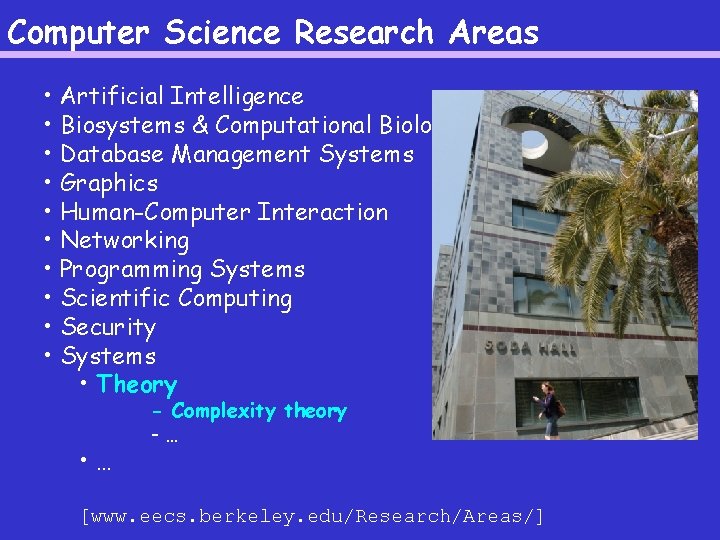
Computer Science Research Areas • Artificial Intelligence • Biosystems & Computational Biology • Database Management Systems • Graphics • Human-Computer Interaction • Networking • Programming Systems • Scientific Computing • Security • Systems • Theory • … - Complexity theory -… [www. eecs. berkeley. edu/Research/Areas/]
Revisiting Algorithm Complexity A variety of problems that: • are tractable with efficient solutions in reasonable time • are intractable • are solvable approximately, not optimally • have no known efficient solution • are not solvable
Revisiting Algorithm Complexity Recall: - running time of an algorithm: how many steps does the algorithm take as a function of the size of the input - various orders of growth, for example: - constant - logarithmic - linear - quadratic - cubic - exponential Examples ?
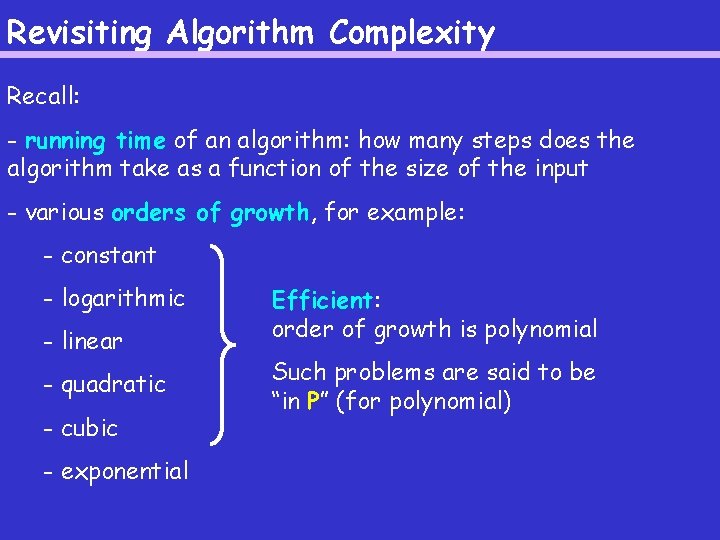
Revisiting Algorithm Complexity Recall: - running time of an algorithm: how many steps does the algorithm take as a function of the size of the input - various orders of growth, for example: - constant - logarithmic - linear - quadratic - cubic - exponential Efficient: order of growth is polynomial Such problems are said to be “in P” (for polynomial)
Intractable Problems - Can be solved, but not fast enough; for example - exponential running time - also, when the running time is polynomial with a huge exponent (e. g. , f(n) = n 10) - in such cases, can solve only for small n…
Hamiltonian Cycle Input: cities with road connections between some pairs of cities Output: possible to go through all such cities (every city exactly once) ? Notice: YES/NO problem (such problems are called decision problems)
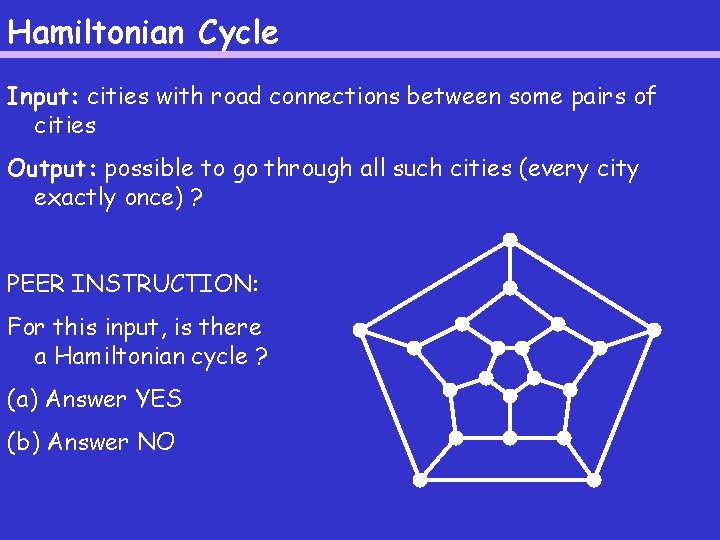
Hamiltonian Cycle Input: cities with road connections between some pairs of cities Output: possible to go through all such cities (every city exactly once) ? PEER INSTRUCTION: For this input, is there a Hamiltonian cycle ? (a) Answer YES (b) Answer NO
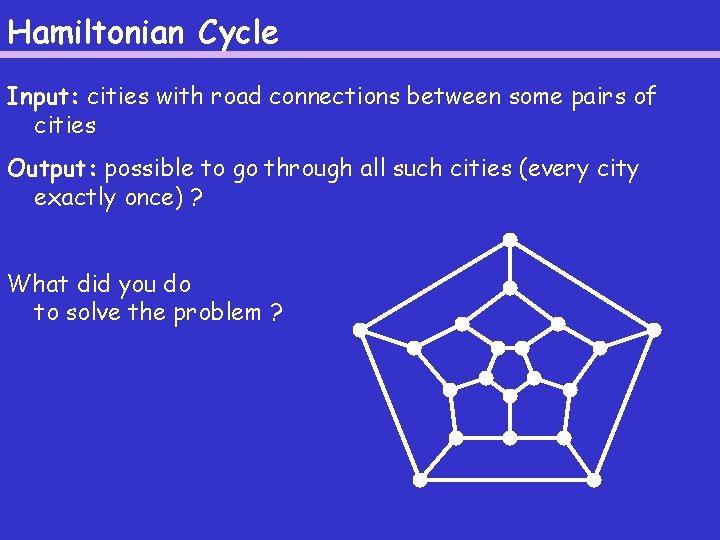
Hamiltonian Cycle Input: cities with road connections between some pairs of cities Output: possible to go through all such cities (every city exactly once) ? What did you do to solve the problem ?
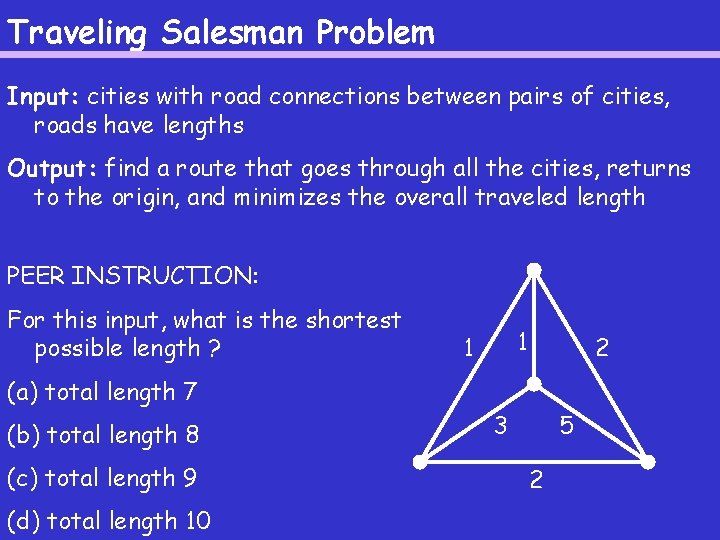
Traveling Salesman Problem Input: cities with road connections between pairs of cities, roads have lengths Output: find a route that goes through all the cities, returns to the origin, and minimizes the overall traveled length PEER INSTRUCTION: For this input, what is the shortest possible length ? 1 1 2 (a) total length 7 (b) total length 8 (c) total length 9 (d) total length 10 3 5 2
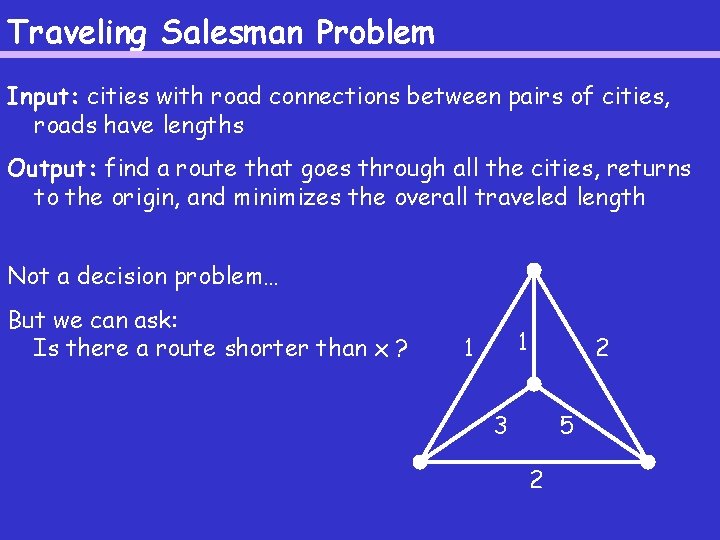
Traveling Salesman Problem Input: cities with road connections between pairs of cities, roads have lengths Output: find a route that goes through all the cities, returns to the origin, and minimizes the overall traveled length Not a decision problem… But we can ask: Is there a route shorter than x ? 1 1 2 3 5 2
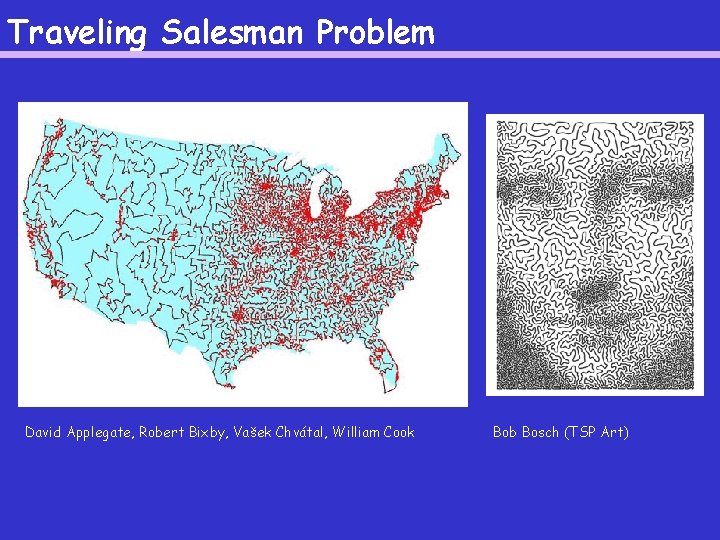
Traveling Salesman Problem David Applegate, Robert Bixby, Vašek Chvátal, William Cook Bob Bosch (TSP Art)
Hamiltonian Cycle vs Traveling Salesman - suppose we have a magic device that solves the Traveling Salesman Problem - can we use it to solve the Hamiltonian Cycle ? This is called a reduction. Find a solution to one problem, then all others that reduce to it can be solved!
P vs NP Recall: P = problems with polynomial-time algorithms We do not know how to solve Hamiltonian Cycle or Traveling Salesman in polynomial time! (No efficient solution known. ) But… If we “guess” a permutation of the cities, we can easily verify whether they form a cycle of length shorter than x. NP = problems whose solutions can be efficiently verified (N stands for non-deterministic [guessing]; P is for polynomial)
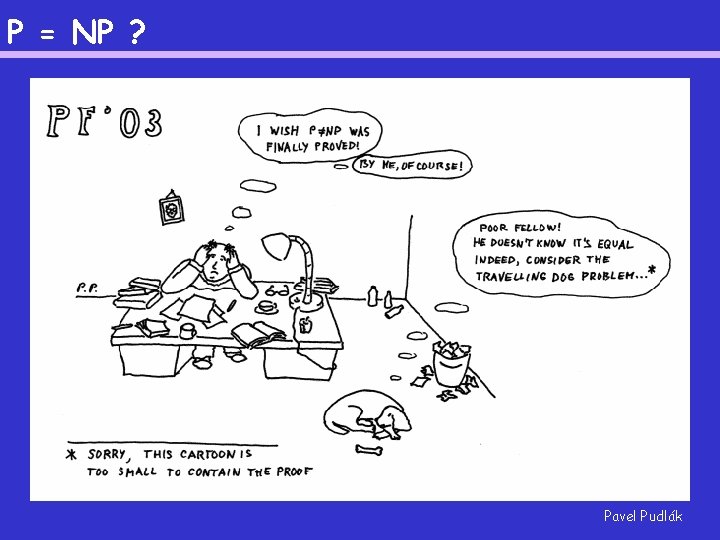
P vs NP P = problems with polynomial-time algorithms NP = problems whose solutions can be efficiently verified The BIG OPEN PROBLEM in CS: Is P = NP ? ? ? $1, 000 reward http: //www. claymath. org/millennium-problems A problem is NP-hard if all problems in NP reduce to it. I. e. , efficiently solving an NP-hard problem gives efficient algorithms for all problems in NP! An NP-hard problem is NP-complete if it is in NP. Examples: Hamiltonian Cycle, Traveling Salesman Problem, …
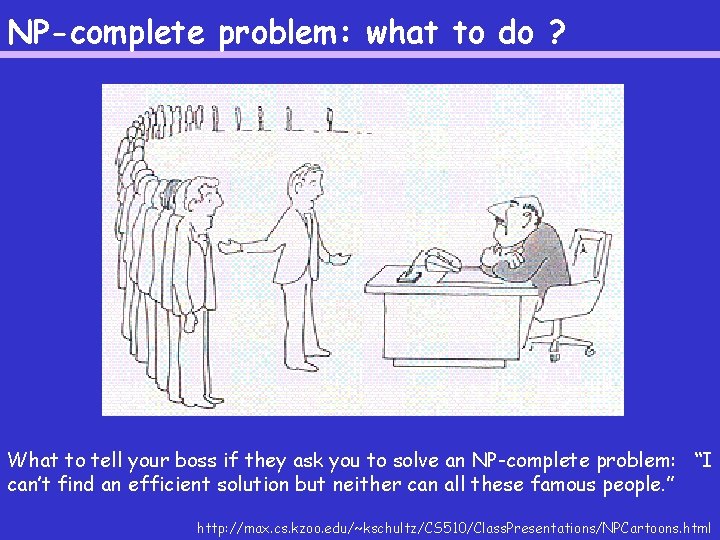
NP-complete problem: what to do ? What to tell your boss if they ask you to solve an NP-complete problem: “I can’t find an efficient solution but neither can all these famous people. ” http: //max. cs. kzoo. edu/~kschultz/CS 510/Class. Presentations/NPCartoons. html
NP-complete problem: what to do ? Another option: approximate the solution - Seems unlikely to solve exactly but sometimes can get “close” to the optimum - For example, traveling salesman: - If the input is a metric (satisfies the triangle inequality), then we can efficiently find a solution that is not worse than 1. 5 x optimum
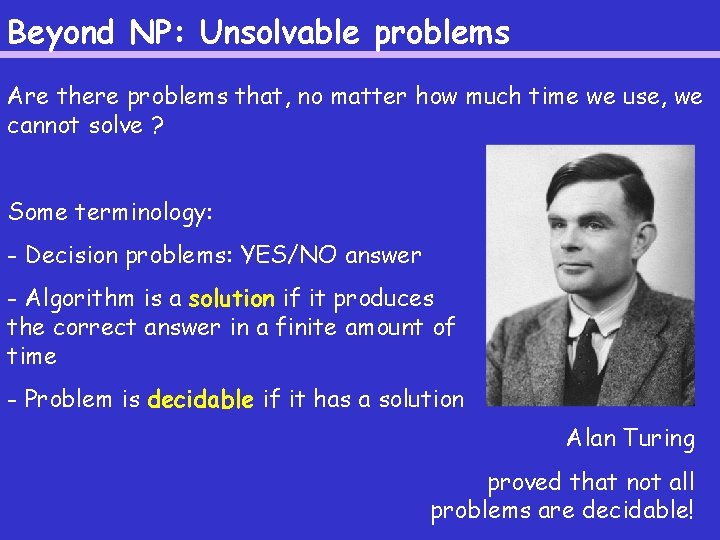
Beyond NP: Unsolvable problems Are there problems that, no matter how much time we use, we cannot solve ? Some terminology: - Decision problems: YES/NO answer - Algorithm is a solution if it produces the correct answer in a finite amount of time - Problem is decidable if it has a solution Alan Turing proved that not all problems are decidable!
Review: Proof by Contradiction How many primes are there ? Euclid www. hisschemoller. com/wpcontent/uploads/2011/01/euclides. jpg
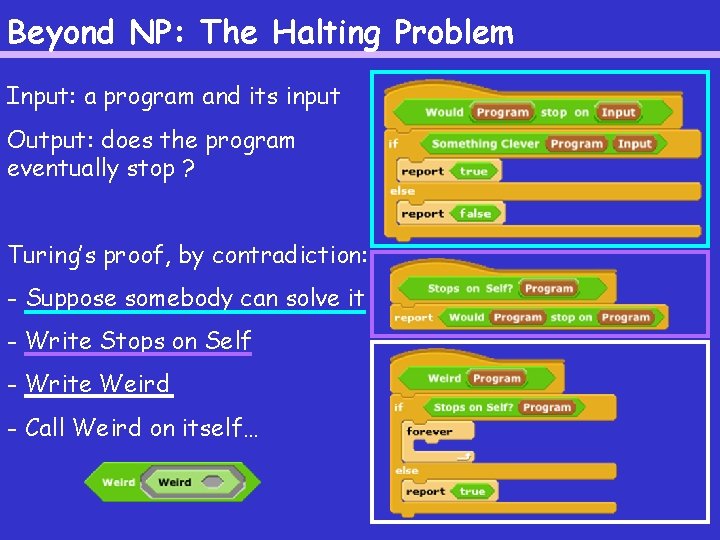
Beyond NP: The Halting Problem Input: a program and its input Output: does the program eventually stop ? Turing’s proof, by contradiction: - Suppose somebody can solve it - Write Stops on Self - Write Weird - Call Weird on itself…
Conclusions - Complexity theory: important part of CS - If given an important problem, rather than try to solve it yourself, see if others have tried similar problems - If you do not need an exact solution, approximation algorithms might help - Some problems are not solvable! http: //www. win. tue. nl/~gwoegi/P-versus-NP. htm
P = NP ? Pavel Pudlák
- Slides: 22