
Beams of the Future Mihai Bondarescu Oleg Kogan
Beams of the Future Mihai Bondarescu, Oleg Kogan, Yanbei Chen, Andrew Lundgreen, Ruxandra Bondarescu, David Tsang A Caltech - AEI - Cornell Collaboration http: //theory. caltech. edu/~mihai@aei. mpg. de
Beams of the Future JOBS WANTED!! Mihai Bondarescu, Oleg Kogan, Yanbei Chen, Andrew Lundgreen, Ruxandra Bondarescu, David Tsang A Caltech - AEI - Cornell Collaboration http: //theory. caltech. edu/~mihai@aei. mpg. de
Advanced LIGO design
Arm Cavities - Current Status • Circulating power over 830 kw » Radiation pressure : ~3*10 -3 N » Compare to 9 -12 kw and ~ 3 -4* 10 -5 N in initial LIGO • Gaussian Beams - Baseline Design » High thermal noise » Nearly Flat Spherical Mirrors ( r= 53. 7 km) – To be changed to nearly concentric • Hyperboloidal beams » Mesa » Finite Mirror Effects • Conical Beams » Largest Noise Reduction to date
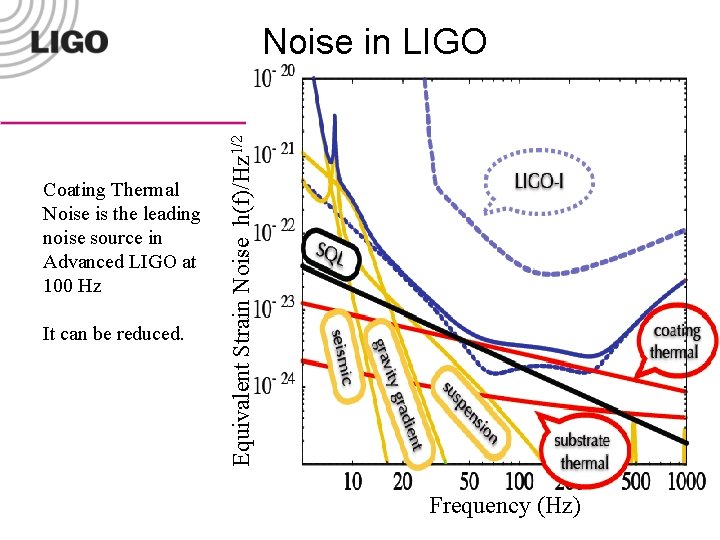
Coating Thermal Noise is the leading noise source in Advanced LIGO at 100 Hz It can be reduced. Equivalent Strain Noise h(f)/Hz 1/2 Noise in LIGO Frequency (Hz)
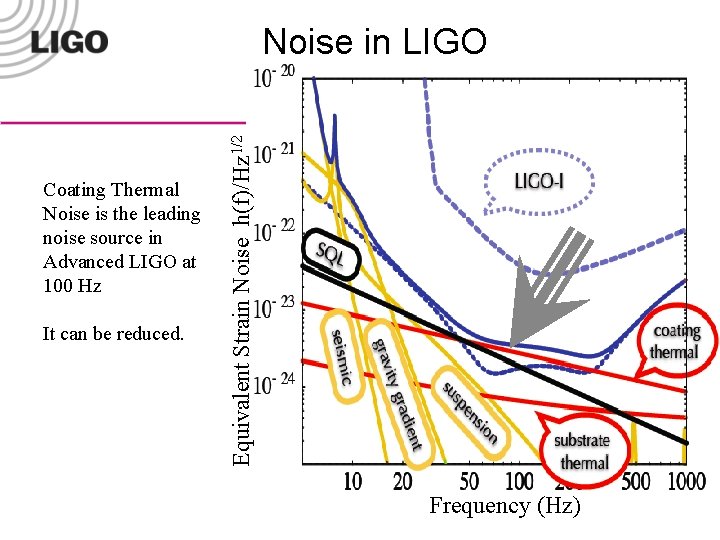
Coating Thermal Noise is the leading noise source in Advanced LIGO at 100 Hz It can be reduced. Equivalent Strain Noise h(f)/Hz 1/2 Noise in LIGO Frequency (Hz)
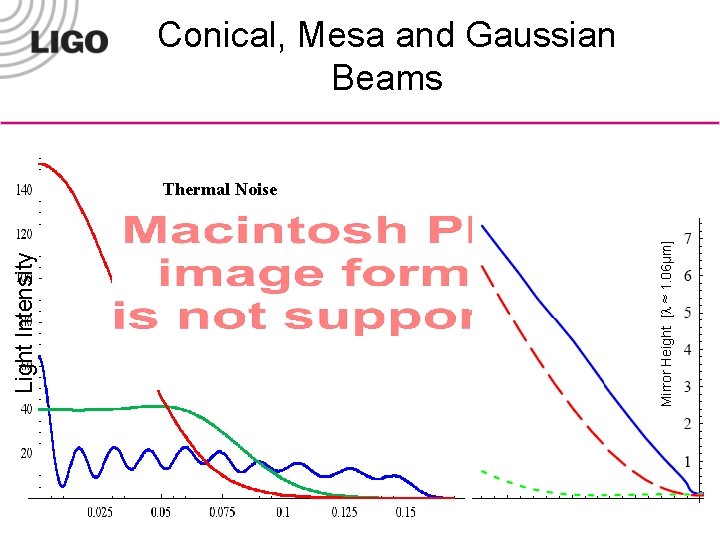
Conical, Mesa and Gaussian Beams Mirror Height [ ≈ 1. 06µm] Light Intensity Thermal Noise
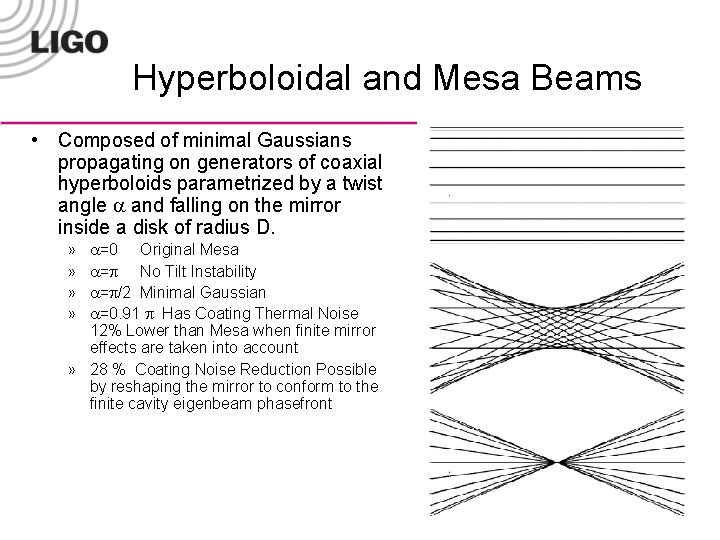
Hyperboloidal and Mesa Beams • Composed of minimal Gaussians propagating on generators of coaxial hyperboloids parametrized by a twist angle and falling on the mirror inside a disk of radius D. =0 Original Mesa = No Tilt Instability = /2 Minimal Gaussian =0. 91 Has Coating Thermal Noise 12% Lower than Mesa when finite mirror effects are taken into account » 28 % Coating Noise Reduction Possible by reshaping the mirror to conform to the finite cavity eigenbeam phasefront » »
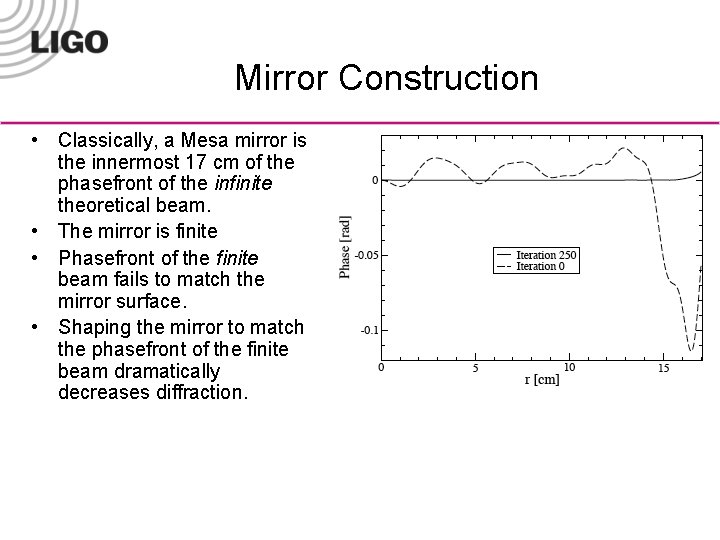
Mirror Construction • Classically, a Mesa mirror is the innermost 17 cm of the phasefront of the infinite theoretical beam. • The mirror is finite • Phasefront of the finite beam fails to match the mirror surface. • Shaping the mirror to match the phasefront of the finite beam dramatically decreases diffraction.
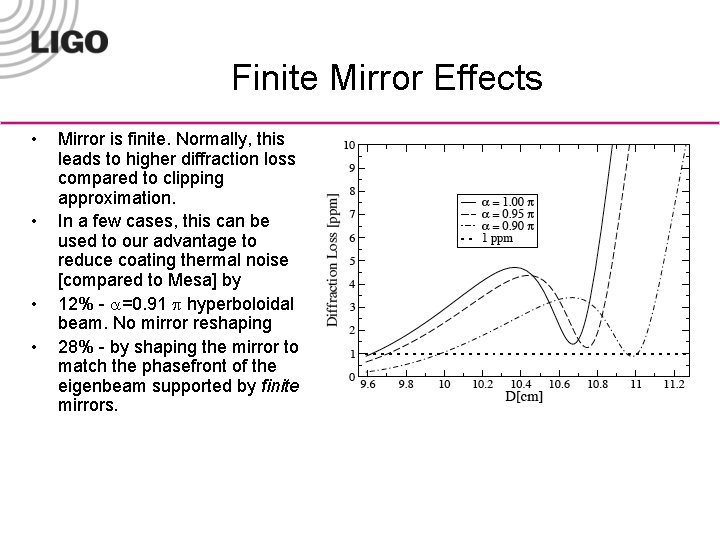
Finite Mirror Effects • • Mirror is finite. Normally, this leads to higher diffraction loss compared to clipping approximation. In a few cases, this can be used to our advantage to reduce coating thermal noise [compared to Mesa] by 12% - =0. 91 hyperboloidal beam. No mirror reshaping 28% - by shaping the mirror to match the phasefront of the eigenbeam supported by finite mirrors.
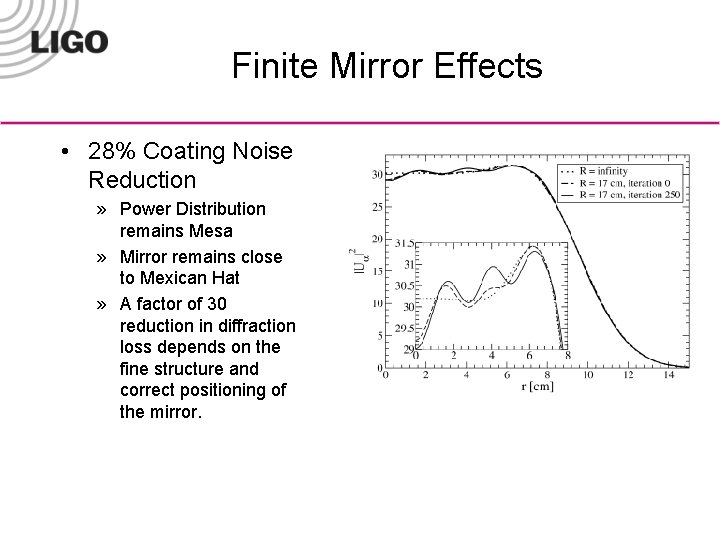
Finite Mirror Effects • 28% Coating Noise Reduction » Power Distribution remains Mesa » Mirror remains close to Mexican Hat » A factor of 30 reduction in diffraction loss depends on the fine structure and correct positioning of the mirror.
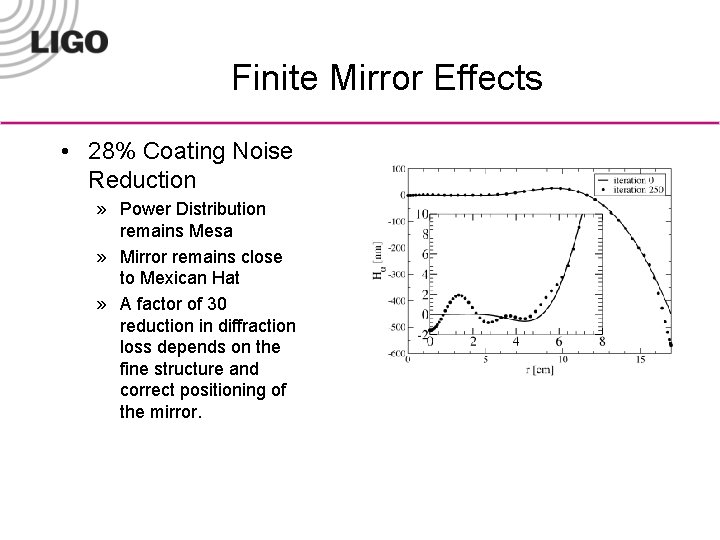
Finite Mirror Effects • 28% Coating Noise Reduction » Power Distribution remains Mesa » Mirror remains close to Mexican Hat » A factor of 30 reduction in diffraction loss depends on the fine structure and correct positioning of the mirror.
The Devil is in the details … … Details Follow.
Thermal Noise • Geoffrey Lovelace and others derived simple scaling laws. Noise • Valid under the assumptions: Coating » Infinite Mirrors – No Mirror Edge effects – No Finite Thickness effects » Quasi-Static approximation – GW frequency is far below the mirror resonant frequencies. Substrate Brownian Thermoelastic
Thermal Noise • Geoffrey Lovelace and others derived simple scaling laws. Noise • Valid under the assumptions: Coating Brownian Thermoelastic » Infinite Mirrors – No Mirror Edge effects – No Finite Thickness effects Substrate » Quasi-Static approximation – Assumes the mirror surface does not change with time Coating noise is the dominant one is Fused Silica mirrors. It is the best candidate for the minimization process. Bonus: involves no Fourier Transforms.
Thermal Noise • Geoffrey Lovelace and others derived simple scaling laws. • Valid under the assumptions: » Infinite Mirrors – No Mirror Edge effects – No Finite Thickness effects » Quasi-Static approximation – Assumes the mirror surface does not change with time Mesa Noise Cone Noise
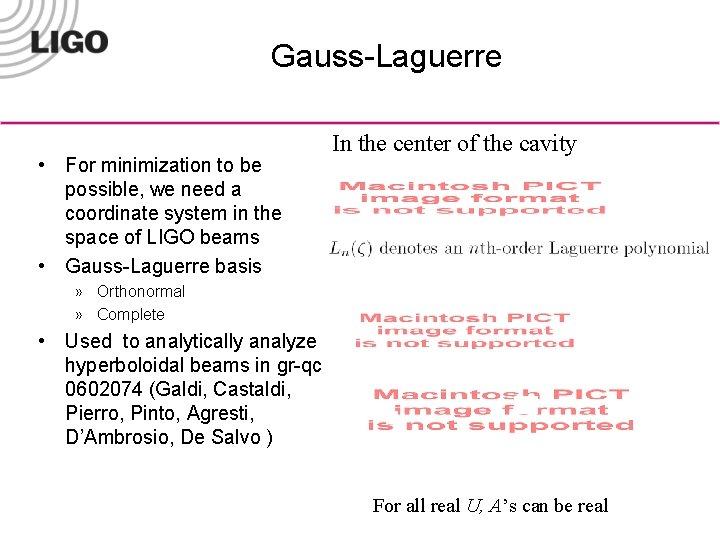
Gauss-Laguerre • For minimization to be possible, we need a coordinate system in the space of LIGO beams • Gauss-Laguerre basis In the center of the cavity » Orthonormal » Complete • Used to analytically analyze hyperboloidal beams in gr-qc 0602074 (Galdi, Castaldi, Pierro, Pinto, Agresti, D’Ambrosio, De Salvo ) For all real U, A’s can be real
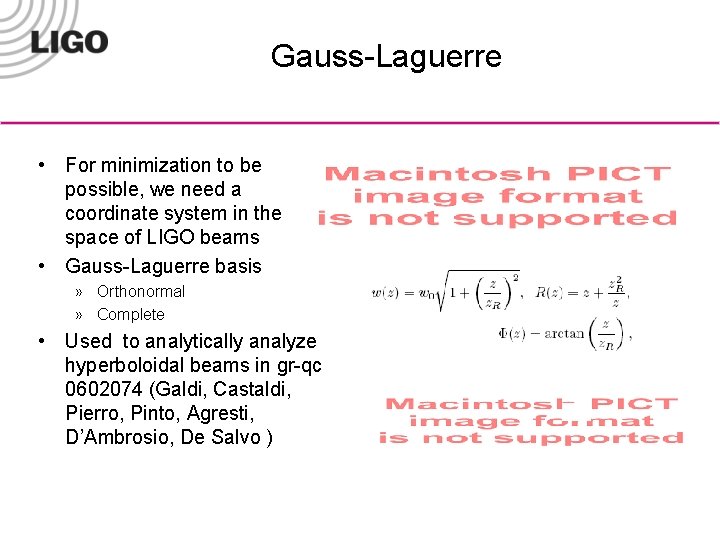
Gauss-Laguerre • For minimization to be possible, we need a coordinate system in the space of LIGO beams • Gauss-Laguerre basis » Orthonormal » Complete • Used to analytically analyze hyperboloidal beams in gr-qc 0602074 (Galdi, Castaldi, Pierro, Pinto, Agresti, D’Ambrosio, De Salvo )
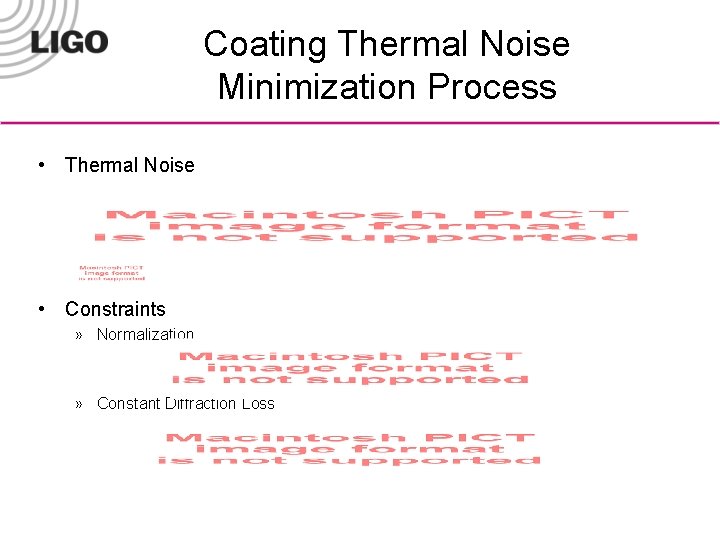
Coating Thermal Noise Minimization Process • Thermal Noise • Constraints » Normalization » Constant Diffraction Loss
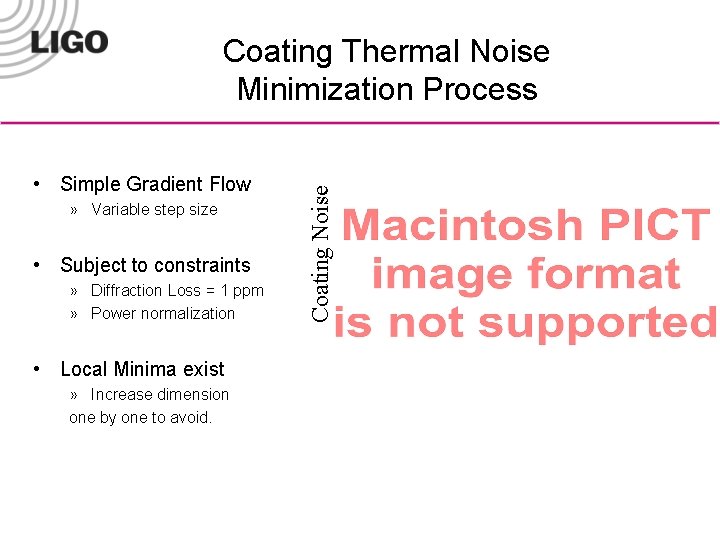
• Simple Gradient Flow » Variable step size • Subject to constraints » Diffraction Loss = 1 ppm » Power normalization • Local Minima exist » Increase dimension one by one to avoid. Coating Noise Coating Thermal Noise Minimization Process
Coating Thermal Noise Minimization Process
Amplitude Profile 35 Coefficients
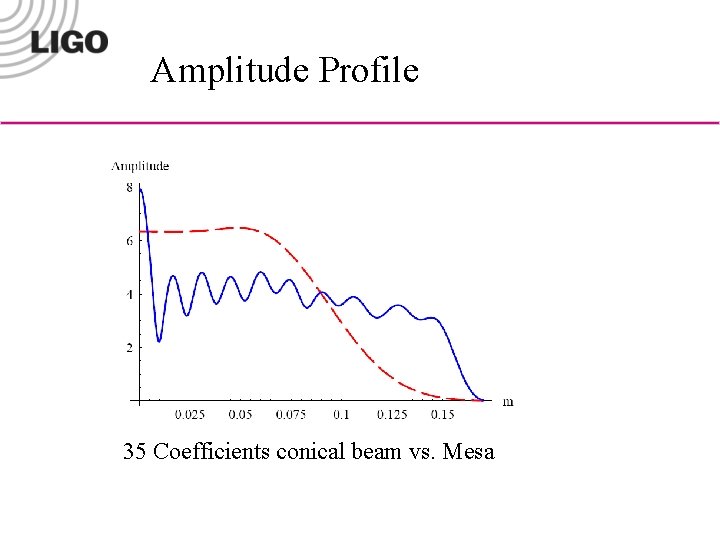
Amplitude Profile 35 Coefficients conical beam vs. Mesa
Amplitude Profile
Power Distribution 35 Coefficients conical beam vs. Mesa
Power Distribution
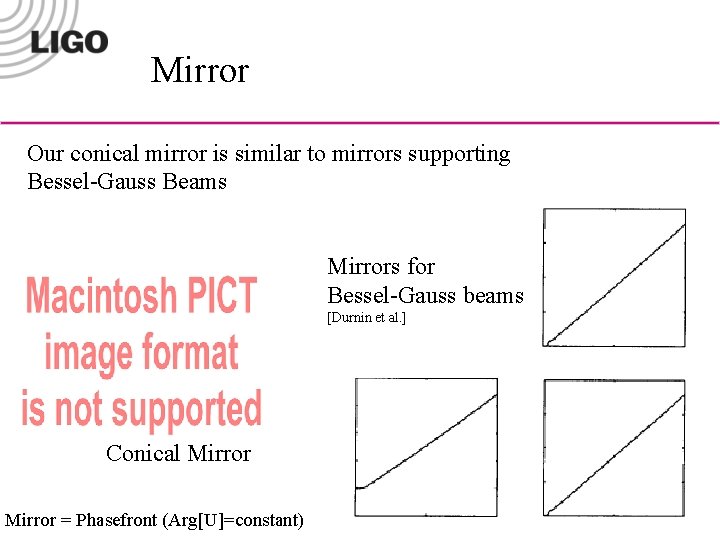
Mirror Our conical mirror is similar to mirrors supporting Bessel-Gauss Beams Mirrors for Bessel-Gauss beams [Durnin et al. ] Conical Mirror = Phasefront (Arg[U]=constant)
Mirror
Bessel and Bessel-Gauss Beams • • Bessel Beams » Diffraction-Free » Not physically realizable (infinite energy) » Conical phasefronts » Intensity independent of z (direction of propagation) Bessel-Gauss beams » Finite energy derivative of Bessel Beams » Physically realizable » Intensity distribution and phasefronts shape depend on z » “Nearly” diffraction-free in a finite region » Nearly conical mirrors in some regime Filed distribution everywhere Bessel Beams Bessel-Gauss Beams field distribution near z=0
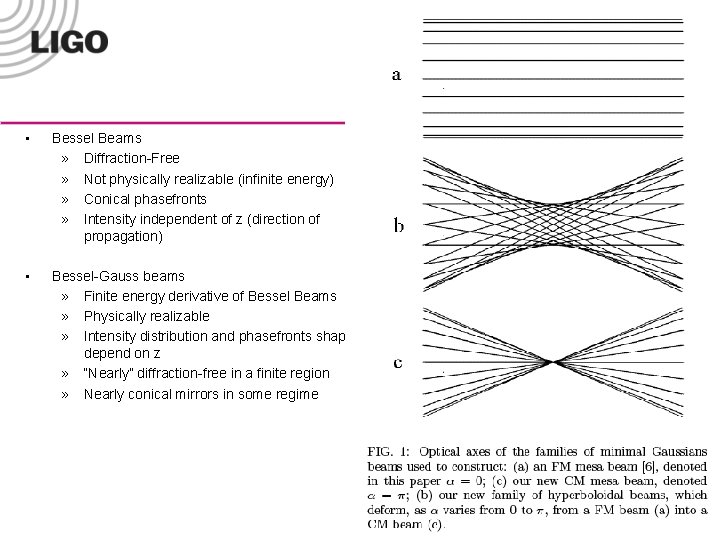
• Bessel Beams » Diffraction-Free » Not physically realizable (infinite energy) » Conical phasefronts » Intensity independent of z (direction of propagation) • Bessel-Gauss beams » Finite energy derivative of Bessel Beams » Physically realizable » Intensity distribution and phasefronts shape depend on z » “Nearly” diffraction-free in a finite region » Nearly conical mirrors in some regime
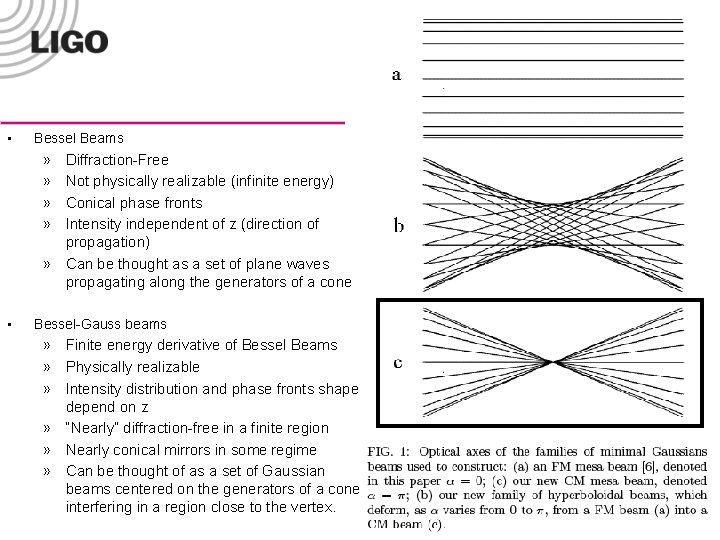
• Bessel Beams » » Diffraction-Free Not physically realizable (infinite energy) Conical phase fronts Intensity independent of z (direction of propagation) » Can be thought as a set of plane waves propagating along the generators of a cone • Bessel-Gauss beams » Finite energy derivative of Bessel Beams » Physically realizable » Intensity distribution and phase fronts shape depend on z » “Nearly” diffraction-free in a finite region » Nearly conical mirrors in some regime » Can be thought of as a set of Gaussian beams centered on the generators of a cone interfering in a region close to the vertex.
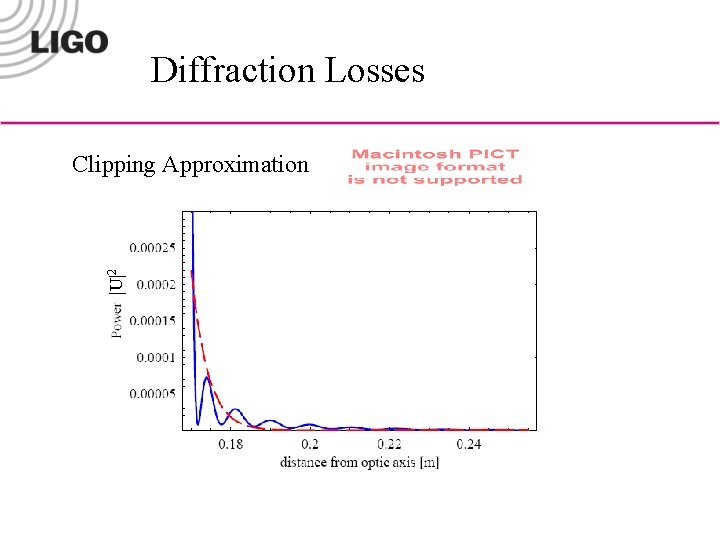
Diffraction Losses |U|2 Clipping Approximation
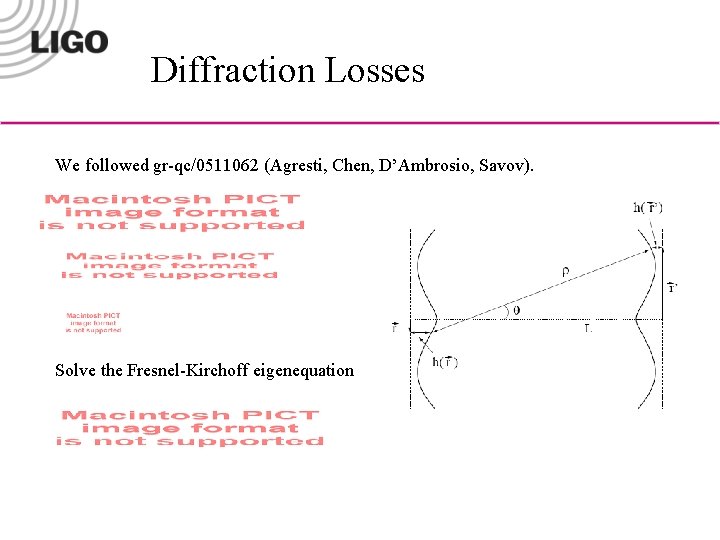
Diffraction Losses We followed gr-qc/0511062 (Agresti, Chen, D’Ambrosio, Savov). Solve the Fresnel-Kirchoff eigenequation
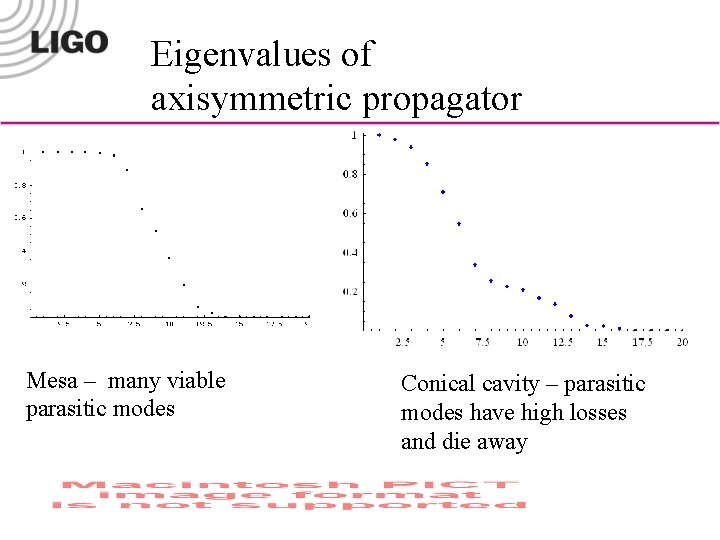
Eigenvalues of axisymmetric propagator Mesa – many viable parasitic modes Conical cavity – parasitic modes have high losses and die away
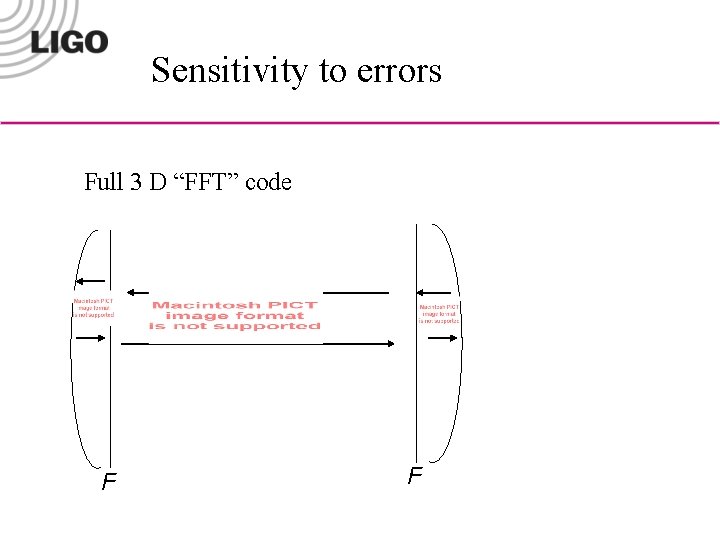
Sensitivity to errors Full 3 D “FFT” code F F
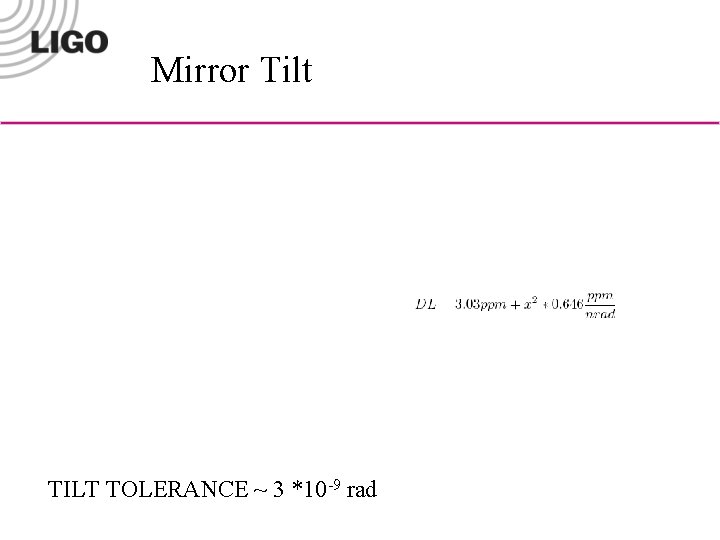
Mirror Tilt TILT TOLERANCE ~ 3 *10 -9 rad
Mirror Displacement TRANSLATION TOLERANCE ~ 4 *10 -6 m This can be traded off if the tilt can be controlled within 1 nanoradian.
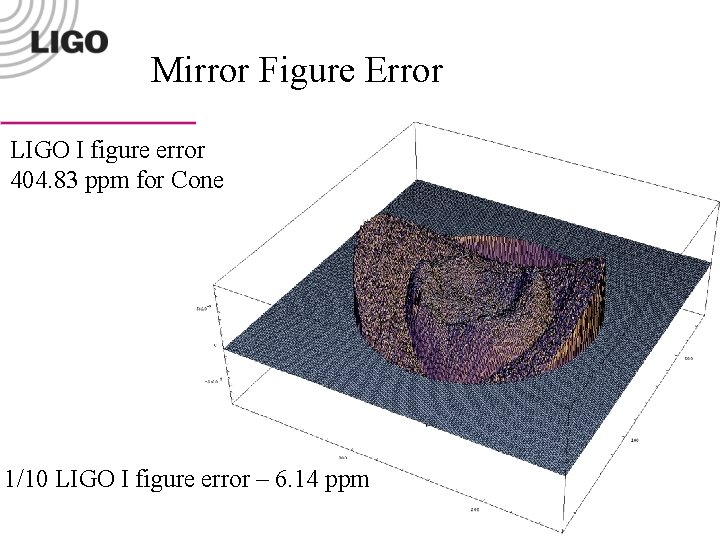
Mirror Figure Error LIGO I figure error 404. 83 ppm for Cone 1/10 LIGO I figure error – 6. 14 ppm
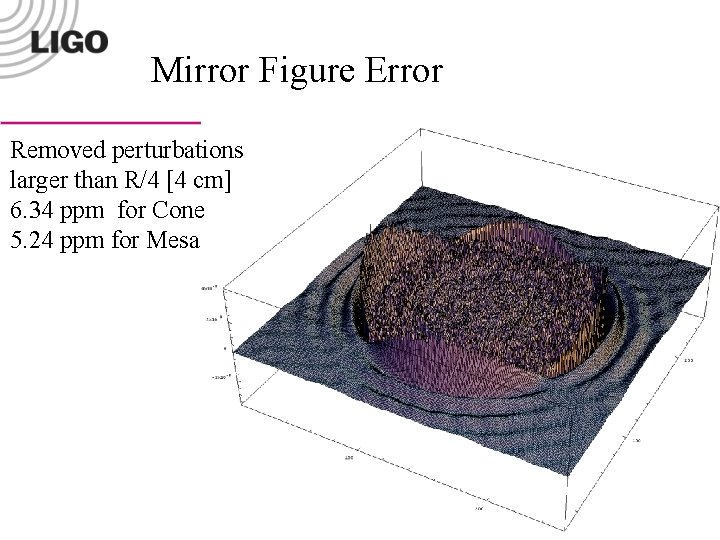
Mirror Figure Error Removed perturbations larger than R/4 [4 cm] 6. 34 ppm for Cone 5. 24 ppm for Mesa
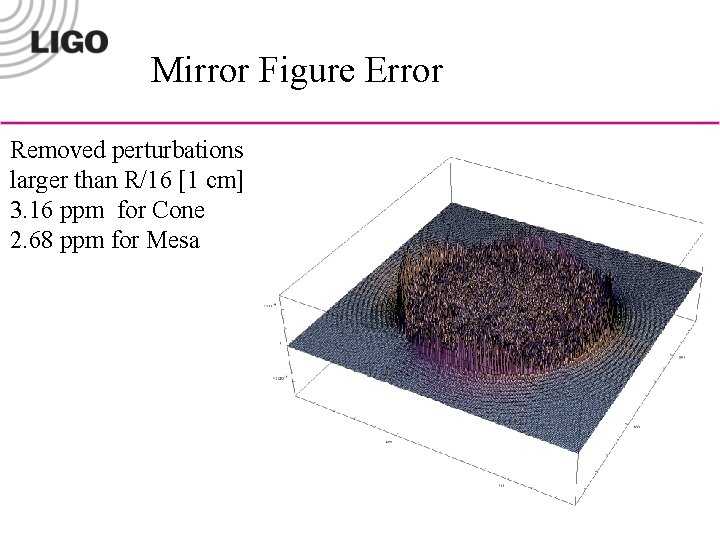
Mirror Figure Error Removed perturbations larger than R/16 [1 cm] 3. 16 ppm for Cone 2. 68 ppm for Mesa
Experimental Requirements Summary • Requirements : Need to satisfy at least one limit in each of the following categories: Noise reduction factors Mesa Noise Cone Noise • Tilt » 3*10 -9 radians • Displacement » 4*10 -6 m » Equivalent to tilt 10 -9 radians • Figure Error » Eliminate perturbations > 4 cm » Decrease overall figure error 10 times
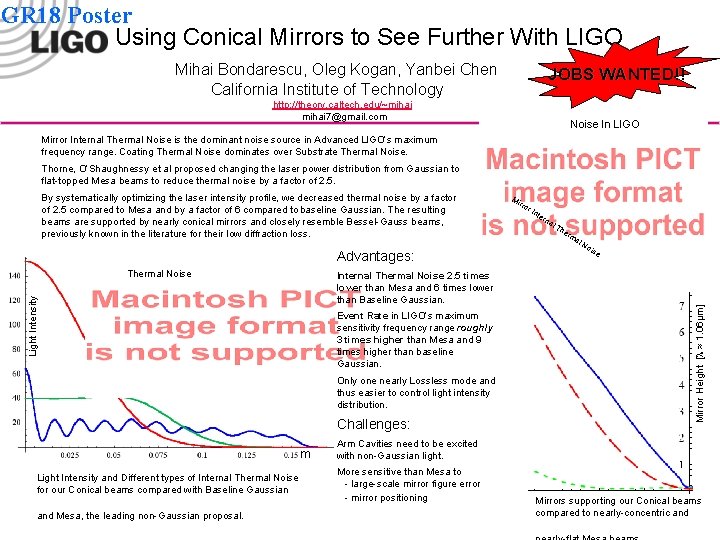
GR 18 Poster Using Conical Mirrors to See Further With LIGO Mihai Bondarescu, Oleg Kogan, Yanbei Chen California Institute of Technology JOBS WANTED!! http: //theory. caltech. edu/~mihai 7@gmail. com Noise In LIGO Mirror Internal Thermal Noise is the dominant noise source in Advanced LIGO’s maximum frequency range. Coating Thermal Noise dominates over Substrate Thermal Noise. Thorne, O’Shaughnessy et al proposed changing the laser power distribution from Gaussian to flat-topped Mesa beams to reduce thermal noise by a factor of 2. 5. Advantages: Thermal Noise Light Intensity Internal Thermal Noise 2. 5 times lower than Mesa and 6 times lower than Baseline Gaussian. Event Rate in LIGO’s maximum sensitivity frequency range roughly 3 times higher than Mesa and 9 times higher than baseline Gaussian. Only one nearly Lossless mode and thus easier to control light intensity distribution. Challenges: m Light Intensity and Different types of Internal Thermal Noise for our Conical beams compared with Baseline Gaussian and Mesa, the leading non-Gaussian proposal. Mi rro r In ter na l. T he rm al No ise Mirror Height [ ≈ 1. 06µm] By systematically optimizing the laser intensity profile, we decreased thermal noise by a factor of 2. 5 compared to Mesa and by a factor of 6 compared to baseline Gaussian. The resulting beams are supported by nearly conical mirrors and closely resemble Bessel-Gauss beams, previously known in the literature for their low diffraction loss. Arm Cavities need to be excited with non-Gaussian light. More sensitive than Mesa to - large-scale mirror figure error - mirror positioning Mirrors supporting our Conical beams compared to nearly-concentric and
- Slides: 42