
BeamPlasma Interaction in Muon Ionization Cooling Lattices James
Beam-Plasma Interaction in Muon Ionization Cooling Lattices James Ellison Illinois Institute of Technology MAP Spring Meeting May 20 th, 2015
Ionization Cooling Muon beams need to be cooled Reduce the beam emittance Ionization cooling only method viable for muons 2. 2µs lifetime Muons pass through a low-Z material, ionizing it They lose their momentum Re-accelerate in longitudinal direction only Overall emittance is reduced Ionization cooling channels are proposed for both a muon collider and neutrino factory 2
Introduction Muons ionize material as they travel through Ionization rates for different materials Generate a plasma Looking at liquid and gaseous absorbers Can compare results for gases to past work (Moses Chung, et al. ) Use WARP for primary study Mostly qualitative so far Comparing basic results against ICOOL model 3
Motivation Beam-plasma interaction is not taken into account when simulating ionization cooling Studied from plasma physics point of view Not from beam physics Estimate impact on cooling rates for both charges Tail of bunch sees material with different properties than head of bunch 4
WARP Simulations n = 1012 muons, p = 200 Me. V/c, 180 atm H 2 gas B = 5. 46 T solenoidal field All units in SI Scattering and straggling are not implemented here Red-beam muons, Green-plasma electrons Plasma added manually Total number of plasma electrons to be added at each step was calculated Added a cylinder containing these electrons at each step Plasma added by WARP Cross section of ionization and absorber density passed into warp Electron and ion placed at location of ionization 5
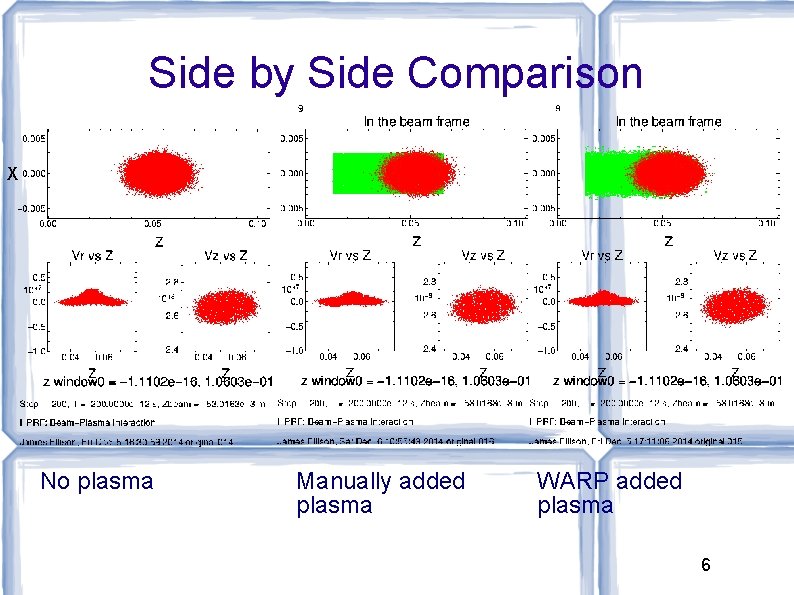
Side by Side Comparison X No plasma Manually added plasma WARP added plasma 6
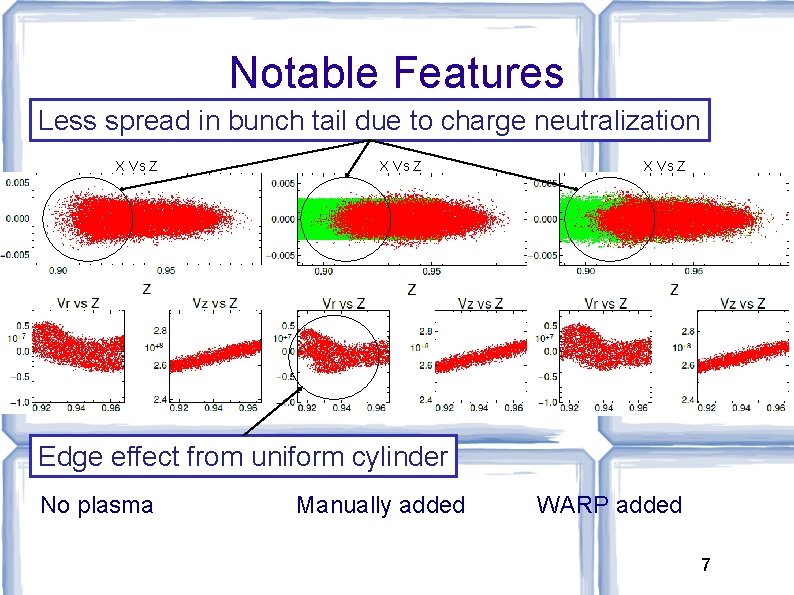
Notable Features Less spread in bunch tail due to charge neutralization X Vs Z Edge effect from uniform cylinder No plasma Manually added WARP added 7
Conclusions from WARP simulations Beam-induced plasma effects need to be taken into account Effect on cooling rates could be significant Need to simulate a complete cooling cell Simple manual addition of plasma is not particularly accurate WARP can calculate plasma effects relatively quickly (15 minutes without ionization, 1. 5 hours with) Not prohibitive 8
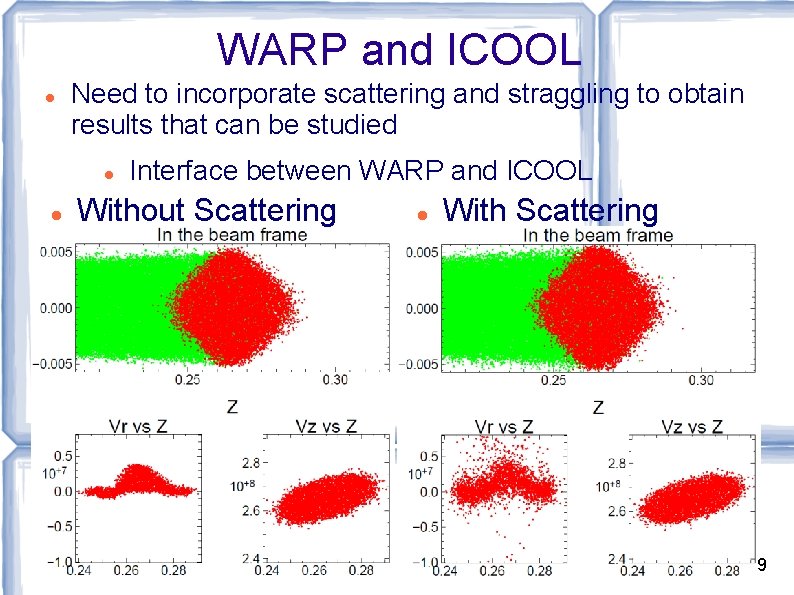
WARP and ICOOL Need to incorporate scattering and straggling to obtain results that can be studied Interface between WARP and ICOOL Without Scattering With Scattering 9
Next steps Incorporate RF fields Time-Dependent RF fields have been applied to WARP Applications to HPRF Correct plasma behavior electron mobility charge neutralization secondary electrons Compare results to: Analytic calculation Applicable experiments Other simulations 10
Simulation of a cooling cell in WARP To accurately simulate beam-plasma effects on ionization cooling rates, a complete cooling cell needs to be simulated First stage of the 6 -D cooling channel ICOOL scattering and straggling implemented in WARP Pre-calculated magnetic field map applied and hardedged 325 MHz cavities inserted An identical system has been set up in ICOOL 11
Simulation of a cooling cell in WARP Without material, a successful comparison has been made with a small sample distribution Progress has been made, but challenges still persist Conversion between ICOOL and WARP distributions RF cavity tuning Large bunches, realistic or Gaussian, give results further from ICOOL 12
What’s next Progress is continuing on WARP simulations Achieve agreement between WARP and ICOOL Compare then WARP with and without plasma effects Plasma effects may be small in the first stage Later stages will be simulated, where beam density is much higher and beam-plasma effects should be much more prominent Describe and include plasma behavior for useful materials 13
What’s next Develop a generic WARP simulation that can be easily adapted to different scenarios HPRF cavities Later stages of the 6 -D cooling channel Compare results to: Analytic calculation Applicable experiments Other simulations 14
- Slides: 14