
Beam Therapy Equipment 2 Linear Accelerator Head Photon

Beam Therapy Equipment 2 Linear Accelerator Head
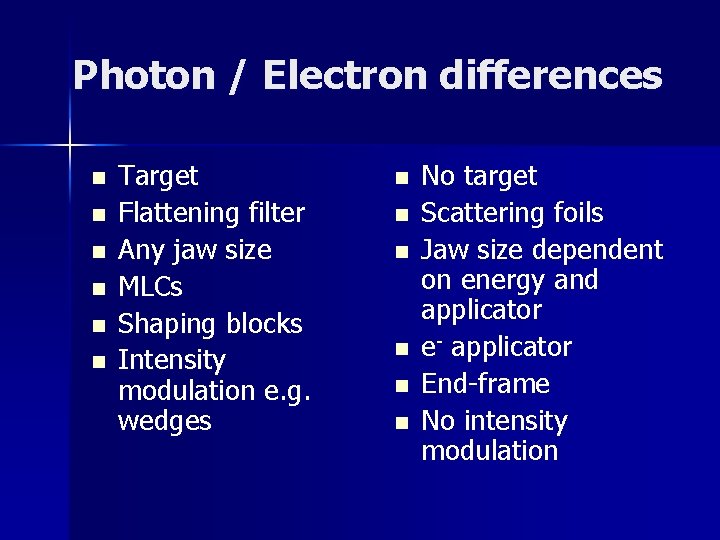
Photon / Electron differences n n n Target Flattening filter Any jaw size MLCs Shaping blocks Intensity modulation e. g. wedges n n n No target Scattering foils Jaw size dependent on energy and applicator e- applicator End-frame No intensity modulation
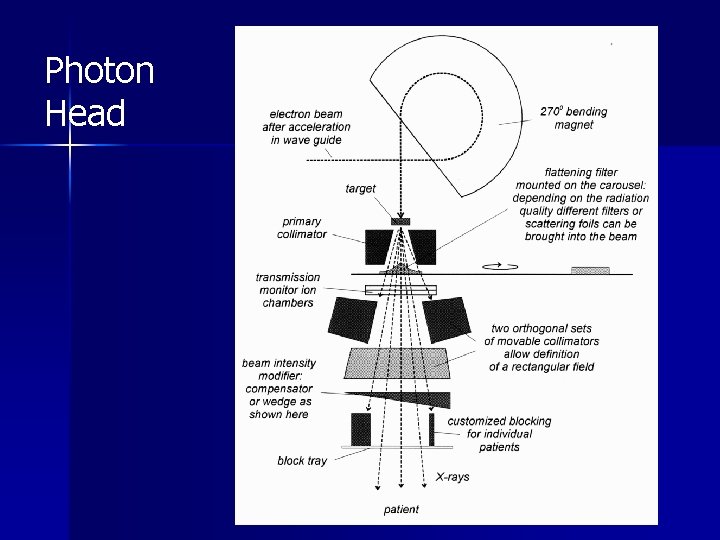
Photon Head
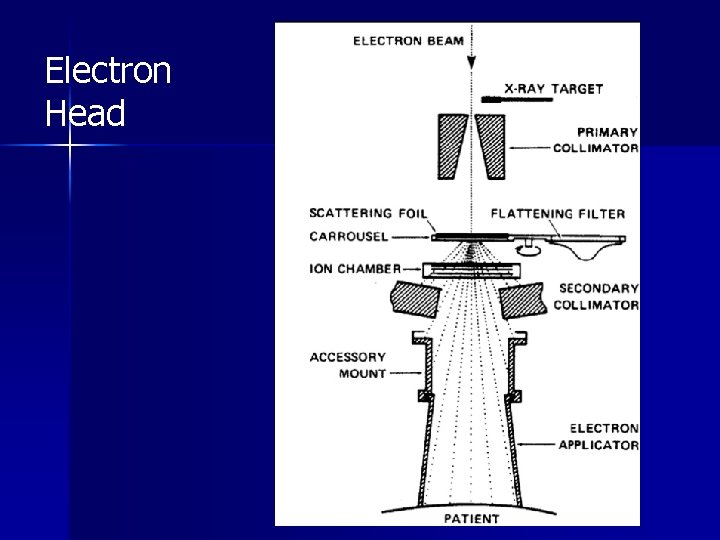
Electron Head

Changes to accelerator when using electrons - automatic n n n Photon target is moved out of the way. Carousel is moved to position scattering foil for particular electron energy in place of photon flattening filter. Gun volts on electron gun are reduced to decrease the number of electrons passing through wave guide. Frequency of rf adjusted to give optimum acceleration of electrons Bending magnet voltages adjusted to finely tune electron energies leaving bending magnet

Changes to accelerator when using electrons – manual Jaws moved to pre-defined position – dependent on applicator size and electron energy. Optimised for flat field (wide scattering) n Electron applicator attached to head n Electron insert fitted into end of applicator – defines final field size n

Scattering foils chosen for wide scattering angle (flat field), energy loss (none) and bremsstrahlung production (none) n Usually made of copper n Not necessarily of uniform thickness n Higher electron energies may use two foils n
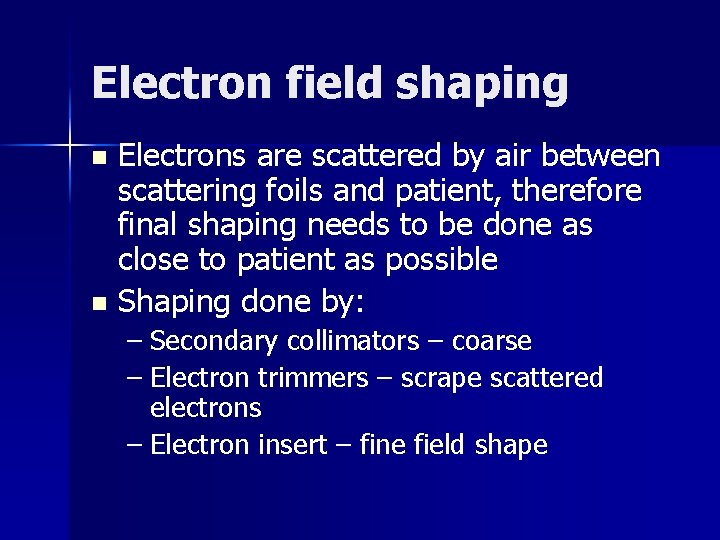
Electron field shaping Electrons are scattered by air between scattering foils and patient, therefore final shaping needs to be done as close to patient as possible n Shaping done by: n – Secondary collimators – coarse – Electron trimmers – scrape scattered electrons – Electron insert – fine field shape

Applicators n n n Applicator consists of progressively smaller scrapers Electrons scattered by foil have a Gaussian distribution, electrons scattered by scrapers are used to flatten the beam Scrapers should be made of low Z material (Aluminium) to limit Xray production

Safety Devices n n The scattering foil, secondary collimator settings, bending magnet voltages are checked for consistency with energy / applicator selected. Presence of the applicator and correct insert may be interlocked. (Applicator interlock very common, insert interlock rare) Collision of applicator with patient, bed etc is also checked using sensors built into applicator. Radiation symmetry, output and energy are monitored by the monitor chamber during treatment
Beam shaping Beam can be modified in 3 D – shape and intensity n Collimators n Applicators n MLCs n Cast blocks n Wedges n Penumbra
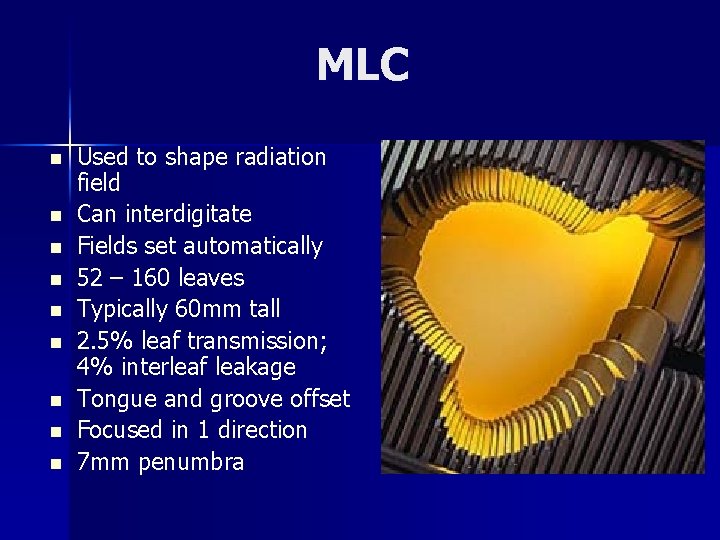
MLC n n n n n Used to shape radiation field Can interdigitate Fields set automatically 52 – 160 leaves Typically 60 mm tall 2. 5% leaf transmission; 4% interleaf leakage Tongue and groove offset Focused in 1 direction 7 mm penumbra
Blocks vs. MLCs BLOCKs ü ü ü X X X Exact shape Move small amounts Easy to check on patient Heavy Facing right way Individual – possibility of using wrong block MLCs X X X ü ü Stepped Movement need re-plan Difficult to check on patient Auto set-up Individual – attached to field
Wedges – to shape the radiation beam n n n Hard – Usually lead, manually placed in accessory mount, range of angles available. Increase energy of primary and dose from scattered Universal – Single 60° Wedge in treatment head, mixed with open field to get intermediate angles. Increase energy of primary and dose from scattered Dynamic – formed by sweeping one of the jaws across the radiation field, range of angles available. Primary same energy
Penumbra Energy n Radiation n Source size n
- Slides: 15