
Beam Stability from Beamline Perspective Boris Podobedov January
Beam Stability from Beamline Perspective Boris Podobedov January 18, 2017 Electron and X-Ray Beam Stability Review 1 BROOKHAVEN SCIENCE
Why I am Talking about This • Beam Stability Taskforce == BSTF • Task force members presently include staff from Acc. Division and Photon Division: W. Cheng, Y. Chu, O. Chubar, Y. Hidaka, P. Ilinski, Y. Li, C. Mazzoli, B. Podobedov (Chair), C. Spataro, Y. Tian, G. Wang, L. Wiegart, S. Wilkins, G. Williams. • Beamlines “permanently represented” in the task force include HXN, CSX, SRX, and CSX but we have closely worked with many more (AMX, FMX, 17 -BM, SMI, CMS, ++) Boris 01 -18 -18
BSTF Responsibilities • • Canvasing the beamlines and identifying potential issues, along with an assessment of the impact of those issues. Identifying a possible path forward in each case to diagnose and correct the issues. It is expected that in some cases this will require local solutions, in others global solutions. Coordination of daily monitoring and quantifying and correlating motion and jitter in electron beam orbit and in the position of the synchrotron radiation beams Formulating requirements for performance specifications and the locations of the instrumentation needed for accurate beam position measurements Delivering assessments of efficiency and recommendations for further development of the tools required for electron and photon beam stability analysis Analysis of performance of electron beam Orbit Feedbacks and Local Feedbacks on beamlines and delivering recommendations for their future development, improvement and upgrades Identifying sources of noise that affect stability of electron beam orbit Boris 01 -18 -18
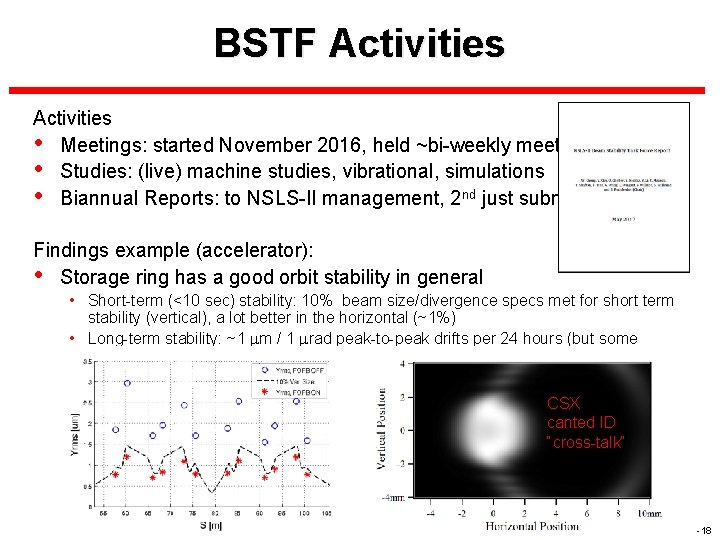
BSTF Activities • Meetings: started November 2016, held ~bi-weekly meetings • Studies: (live) machine studies, vibrational, simulations • Biannual Reports: to NSLS-II management, 2 nd just submitted Findings example (accelerator): • Storage ring has a good orbit stability in general • Short-term (<10 sec) stability: 10% beam size/divergence specs met for short term stability (vertical), a lot better in the horizontal (~1%) • Long-term stability: ~1 mm / 1 mrad peak-to-peak drifts per 24 hours (but some outlier locations) • Reproducibility after beam dumps and machine shutdowns can be much worse CSX canted ID “cross-talk“ Boris 01 -18 -18
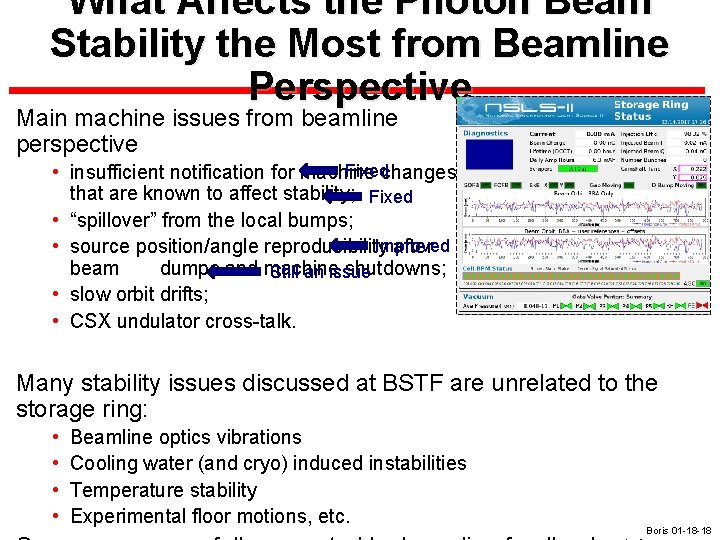
What Affects the Photon Beam Stability the Most from Beamline Perspective Main machine issues from beamline perspective Fixedchanges • insufficient notification for machine that are known to affect stability; Fixed • “spillover” from the local bumps; Improved • source position/angle reproducibility after beam dumps and machine shutdowns; Still an issue • slow orbit drifts; • CSX undulator cross-talk. Many stability issues discussed at BSTF are unrelated to the storage ring: • • Beamline optics vibrations Cooling water (and cryo) induced instabilities Temperature stability Experimental floor motions, etc. Boris 01 -18 -18
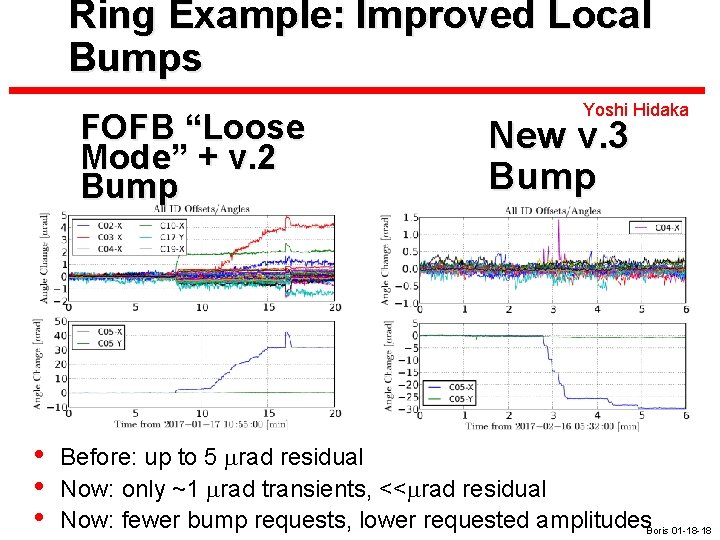
Ring Example: Improved Local Bumps FOFB “Loose Mode” + v. 2 Bump • • • Yoshi Hidaka New v. 3 Bump Before: up to 5 mrad residual Now: only ~1 mrad transients, <<mrad residual Now: fewer bump requests, lower requested amplitudes. Boris 01 -18 -18
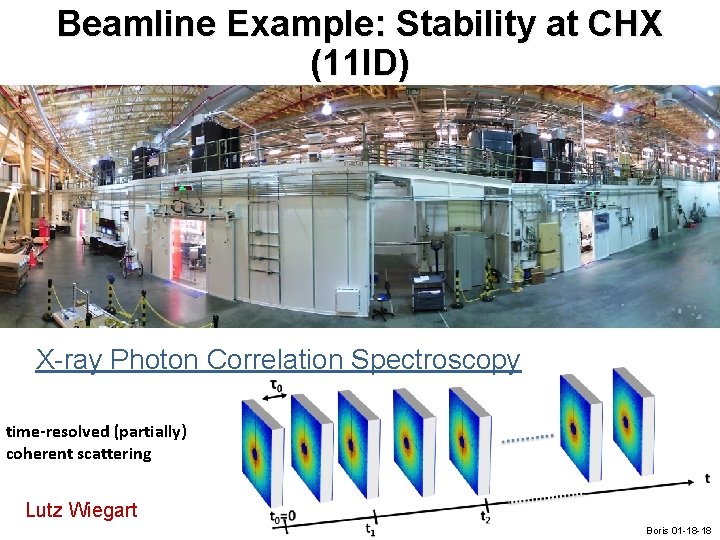
Beamline Example: Stability at CHX (11 ID) X-ray Photon Correlation Spectroscopy time-resolved (partially) coherent scattering Lutz Wiegart Boris 01 -18 -18
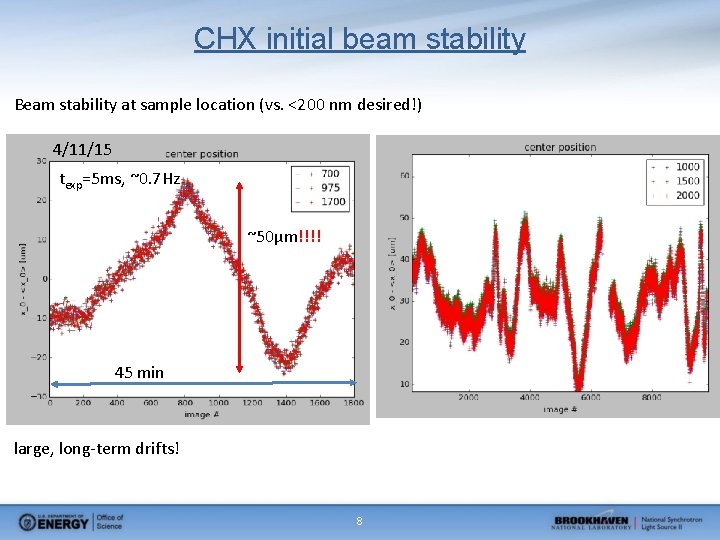
CHX initial beam stability Beam stability at sample location (vs. <200 nm desired!) 4/11/15 texp=5 ms, ~0. 7 Hz ~50µm!!!! 45 min large, long-term drifts! 8
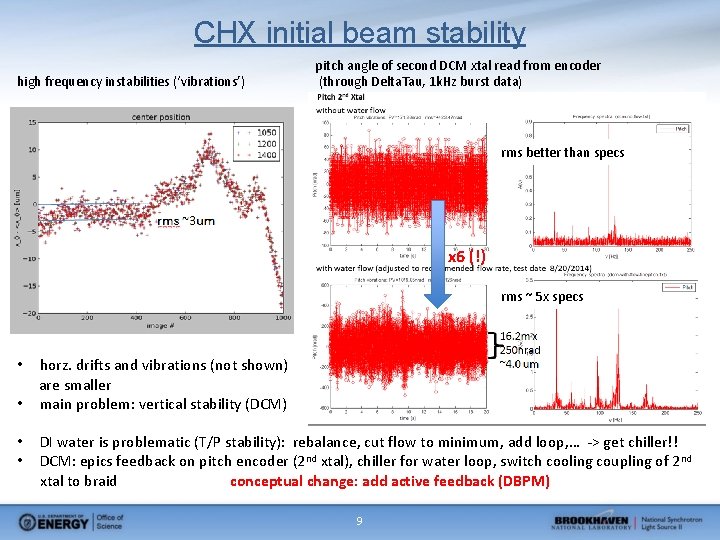
CHX initial beam stability high frequency instabilities (‘vibrations’) pitch angle of second DCM xtal read from encoder (through Delta. Tau, 1 k. Hz burst data) rms better than specs x 6 (!) rms ~ 5 x specs horz. drifts and vibrations (not shown) are smaller • main problem: vertical stability (DCM) • • • DI water is problematic (T/P stability): rebalance, cut flow to minimum, add loop, … -> get chiller!! DCM: epics feedback on pitch encoder (2 nd xtal), chiller for water loop, switch cooling coupling of 2 nd xtal to braid conceptual change: add active feedback (DBPM) 9
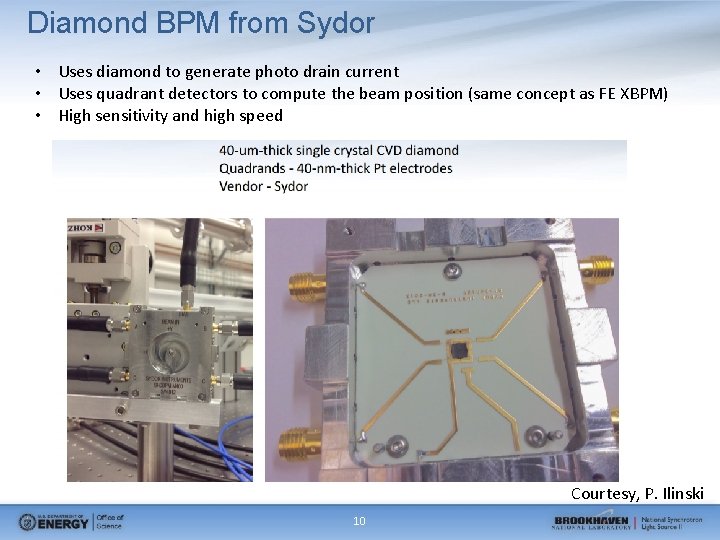
Diamond BPM from Sydor • Uses diamond to generate photo drain current • Uses quadrant detectors to compute the beam position (same concept as FE XBPM) • High sensitivity and high speed Courtesy, P. Ilinski 10
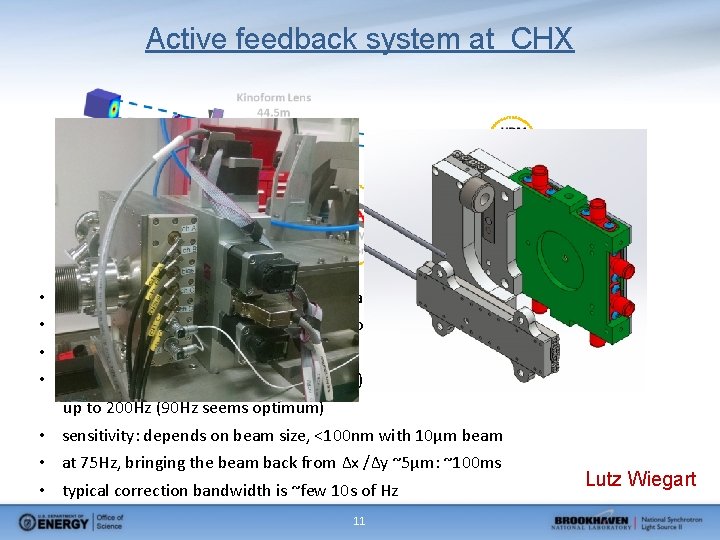
Active feedback system at CHX • • location: right in front of beam defining aperture, 0. 7 m upstream of the sample 50µm diamond, 20 nm Pt electrodes -> couldn’t detect wavefront distortion reads beam position (xy) at 10 k. Hz feedback loop with DBPMon HDM (horz. ) and DCM (vert. ), up to 200 Hz (90 Hz seems optimum) • sensitivity: depends on beam size, <100 nm with 10µm beam • at 75 Hz, bringing the beam back from Δx /Δy ~5µm: ~100 ms • typical correction bandwidth is ~few 10 s of Hz 11 Lutz Wiegart
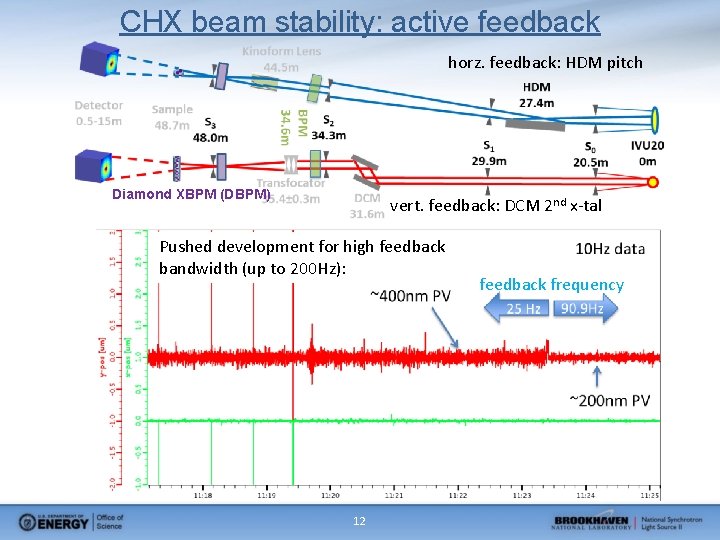
CHX beam stability: active feedback horz. feedback: HDM pitch Diamond XBPM (DBPM) vert. feedback: DCM 2 nd x-tal Pushed development for high feedback bandwidth (up to 200 Hz): 12 feedback frequency
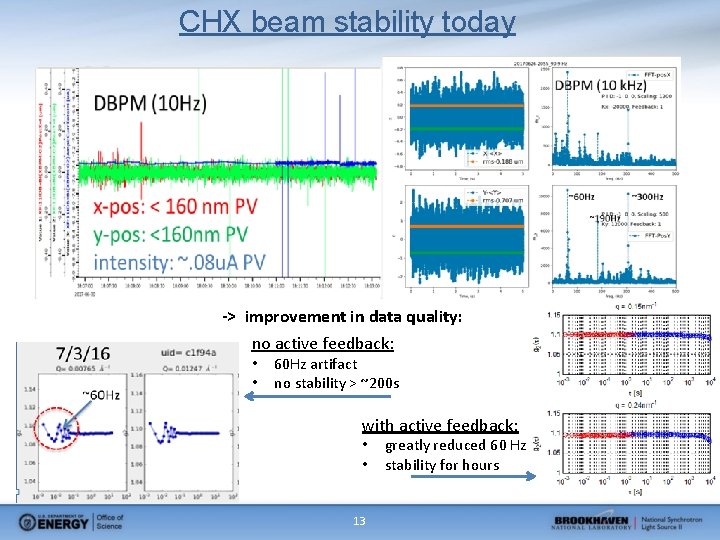
CHX beam stability today -> improvement in data quality: no active feedback: • • 60 Hz artifact no stability > ~200 s with active feedback: • • 13 greatly reduced 60 Hz stability for hours
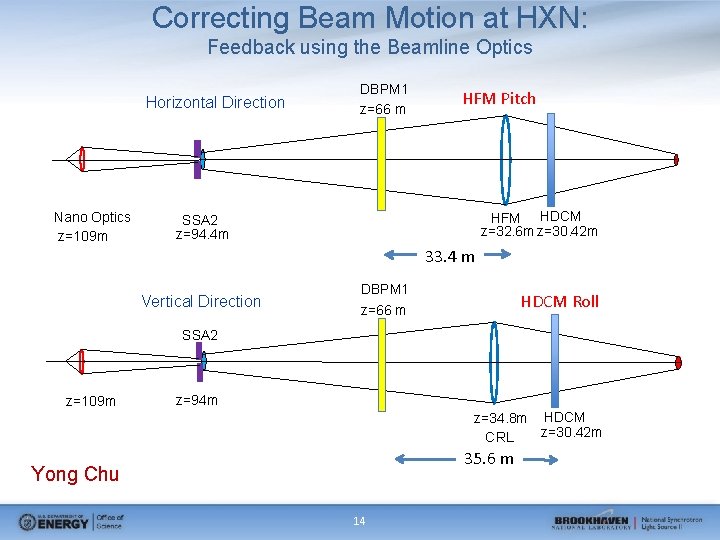
Correcting Beam Motion at HXN: Feedback using the Beamline Optics Horizontal Direction Nano Optics z=109 m DBPM 1 z=66 m HFM Pitch HFM HDCM z=32. 6 m z=30. 42 m SSA 2 z=94. 4 m 33. 4 m Vertical Direction DBPM 1 z=66 m HDCM Roll SSA 2 z=109 m z=94 m z=34. 8 m HDCM z=30. 42 m CRL 35. 6 m Yong Chu 14
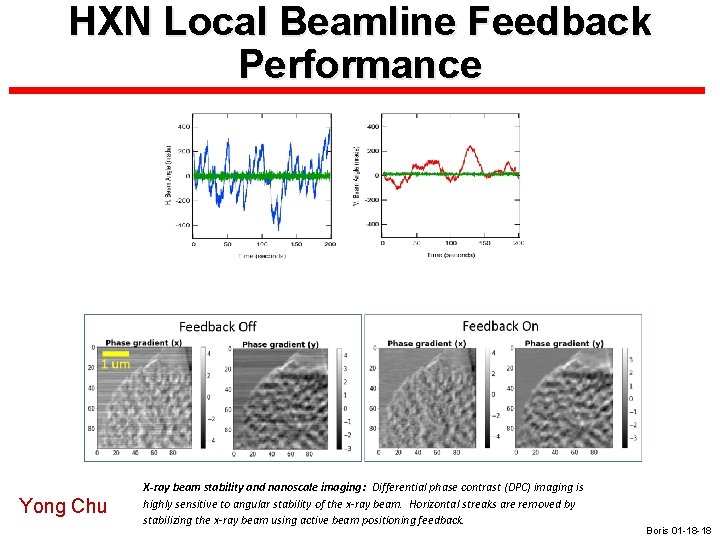
HXN Local Beamline Feedback Performance Yong Chu X-ray beam stability and nanoscale imaging: Differential phase contrast (DPC) imaging is highly sensitive to angular stability of the x-ray beam. Horizontal streaks are removed by stabilizing the x-ray beam using active beam positioning feedback. Boris 01 -18 -18
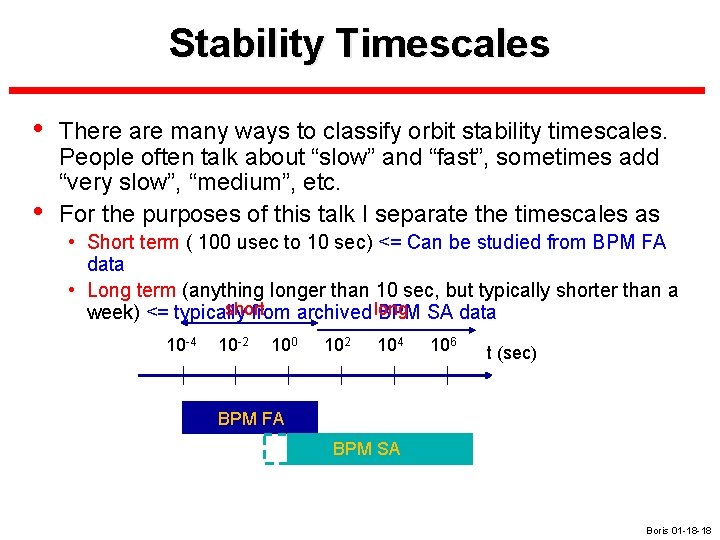
Stability Timescales • • There are many ways to classify orbit stability timescales. People often talk about “slow” and “fast”, sometimes add “very slow”, “medium”, etc. For the purposes of this talk I separate the timescales as • Short term ( 100 usec to 10 sec) <= Can be studied from BPM FA data • Long term (anything longer than 10 sec, but typically shorter than a short week) <= typically from archived long BPM SA data 10 -4 10 -2 100 102 104 106 t (sec) BPM FA BPM SA Boris 01 -18 -18
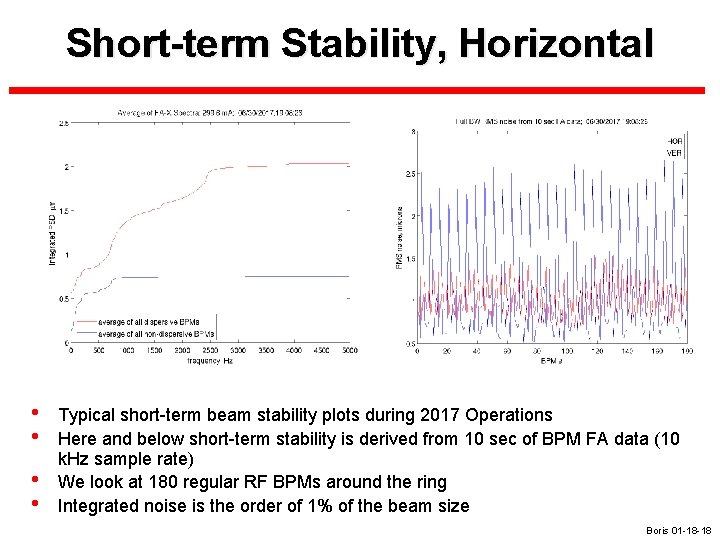
Short-term Stability, Horizontal • • Typical short-term beam stability plots during 2017 Operations Here and below short-term stability is derived from 10 sec of BPM FA data (10 k. Hz sample rate) We look at 180 regular RF BPMs around the ring Integrated noise is the order of 1% of the beam size Boris 01 -18 -18
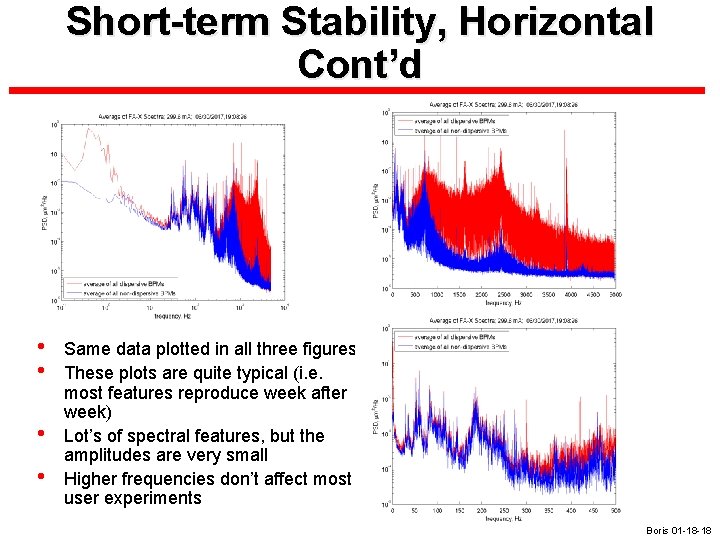
Short-term Stability, Horizontal Cont’d • • Same data plotted in all three figures These plots are quite typical (i. e. most features reproduce week after week) Lot’s of spectral features, but the amplitudes are very small Higher frequencies don’t affect most user experiments Boris 01 -18 -18
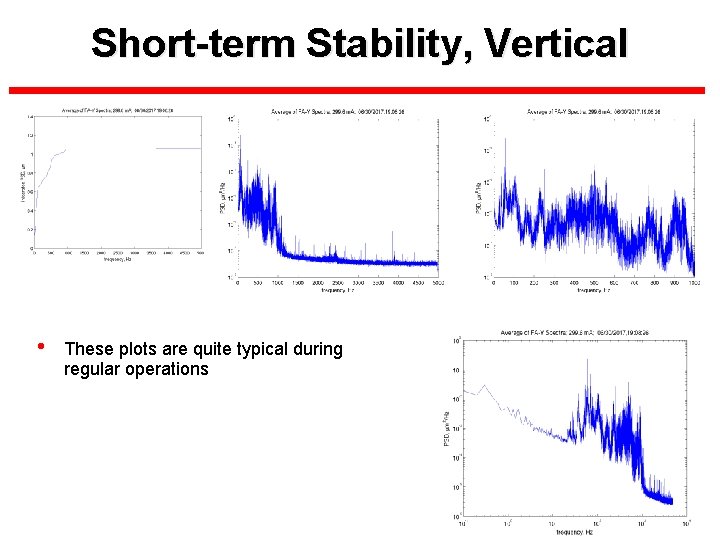
Short-term Stability, Vertical • These plots are quite typical during regular operations Boris 01 -18 -18
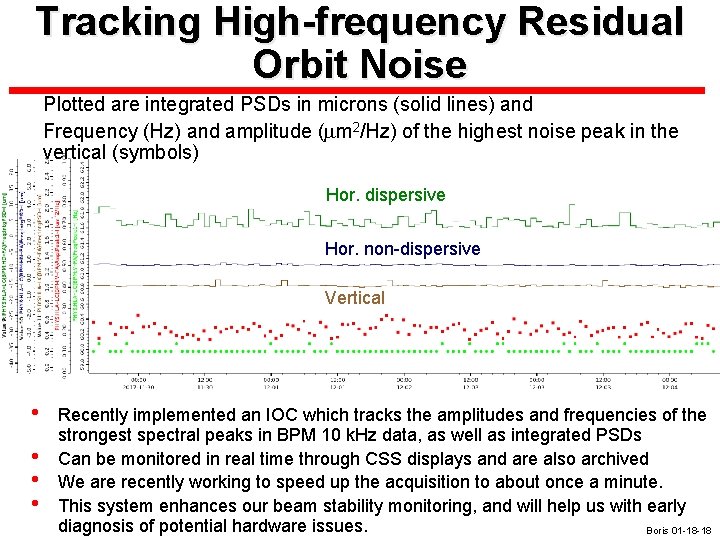
Tracking High-frequency Residual Orbit Noise Plotted are integrated PSDs in microns (solid lines) and Frequency (Hz) and amplitude (mm 2/Hz) of the highest noise peak in the vertical (symbols) Hor. dispersive Hor. non-dispersive Vertical • • Recently implemented an IOC which tracks the amplitudes and frequencies of the strongest spectral peaks in BPM 10 k. Hz data, as well as integrated PSDs Can be monitored in real time through CSS displays and are also archived We are recently working to speed up the acquisition to about once a minute. This system enhances our beam stability monitoring, and will help us with early diagnosis of potential hardware issues. Boris 01 -18 -18
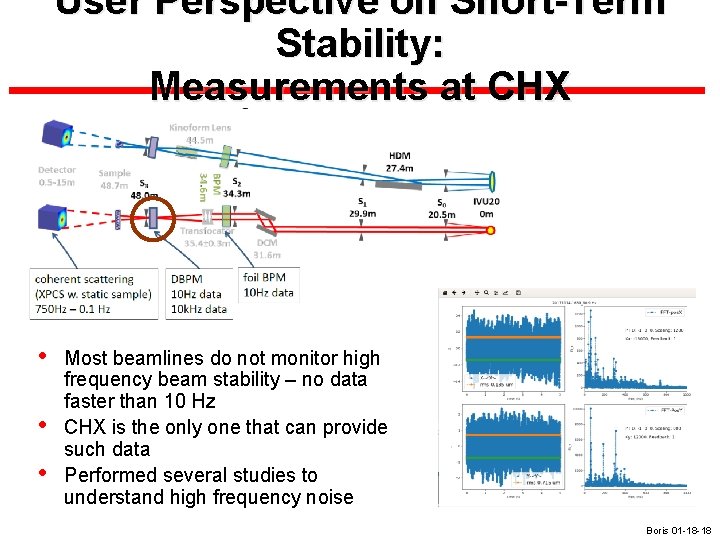
User Perspective on Short-Term Stability: Measurements at CHX • • • Most beamlines do not monitor high frequency beam stability – no data faster than 10 Hz CHX is the only one that can provide such data Performed several studies to understand high frequency noise Boris 01 -18 -18
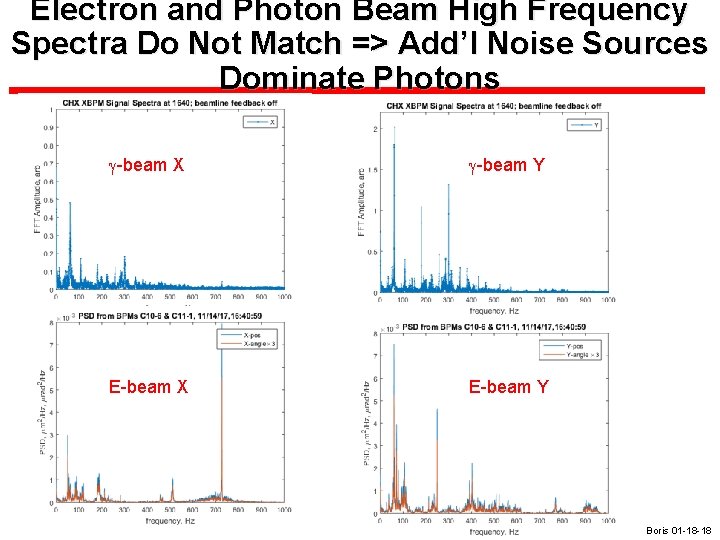
Electron and Photon Beam High Frequency Spectra Do Not Match => Add’l Noise Sources Dominate Photons g-beam X g-beam Y E-beam X E-beam Y Boris 01 -18 -18
Conclusions on Short-term Stability and High-Frequency Noise • • • High frequency noise observed at CHX DBPM does not correlate well with (small) electron beam orbit motion. Frequencies and relative amplitudes of the main peaks do not match. This strongly suggests that additional noise sources (real or measurement) dominate CHX photons positional stability. This noise is lower priority for CHX - up to a certain amplitude, it doesn't affect the experiments. CHX did XPCS experiments at 9 k. Hz and 100 k. Hz (not routine operation yet, testing new detectors): these measurements didn't show any problems with high frequency noise either. We believe this is also typical for other beamlines (high frequency noise at the amplitude that we already have in the Boris 01 -18 -18
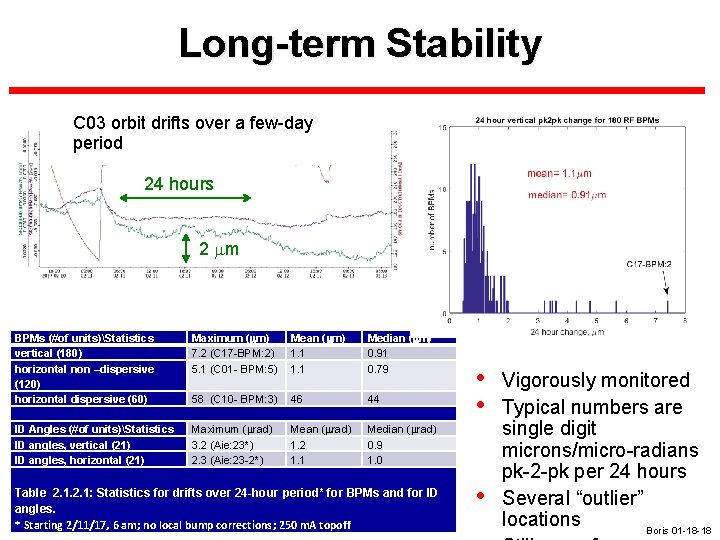
Long-term Stability C 03 orbit drifts over a few-day period 24 hours 2 mm BPMs (#of units)Statistics vertical (180) horizontal non –dispersive (120) horizontal dispersive (60) Maximum (mm) 7. 2 (C 17 -BPM: 2) 5. 1 (C 01 - BPM: 5) Mean (mm) 1. 1 Median (mm) 0. 91 0. 79 58 (C 10 - BPM: 3) 46 44 ID Angles (#of units)Statistics ID angles, vertical (21) ID angles, horizontal (21) Maximum (mrad) 3. 2 (Aie: 23*) 2. 3 (Aie: 23 -2*) Mean (mrad) 1. 2 1. 1 Median (mrad) 0. 9 1. 0 Table 2. 1: Statistics for drifts over 24 -hour period* for BPMs and for ID angles. * Starting 2/11/17, 6 am; no local bump corrections; 250 m. A topoff • • • Vigorously monitored Typical numbers are single digit microns/micro-radians pk-2 -pk per 24 hours Several “outlier” locations Boris 01 -18 -18
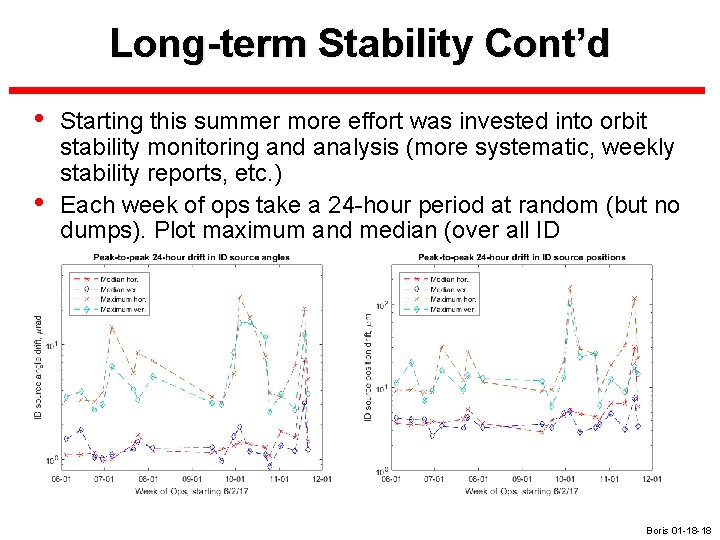
Long-term Stability Cont’d • • Starting this summer more effort was invested into orbit stability monitoring and analysis (more systematic, weekly stability reports, etc. ) Each week of ops take a 24 -hour period at random (but no dumps). Plot maximum and median (over all ID beamlines) drifts of source angle and source position: Boris 01 -18 -18
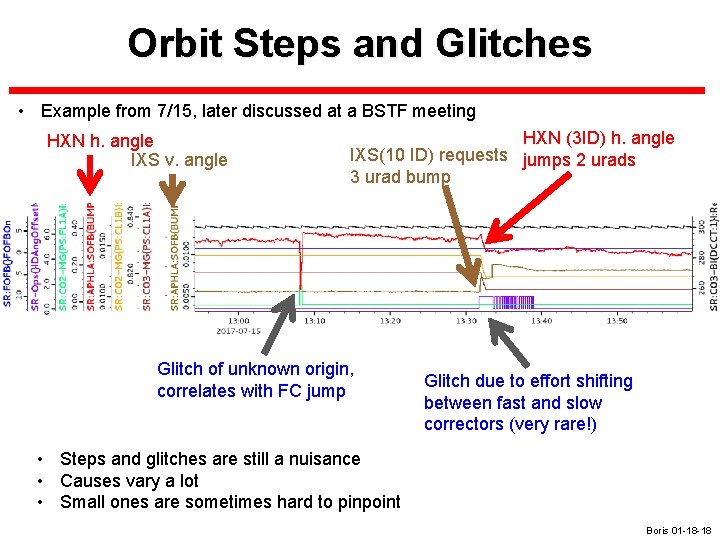
Orbit Steps and Glitches • Example from 7/15, later discussed at a BSTF meeting HXN h. angle IXS v. angle HXN (3 ID) h. angle IXS(10 ID) requests jumps 2 urads 3 urad bump Glitch of unknown origin, correlates with FC jump Glitch due to effort shifting between fast and slow correctors (very rare!) • Steps and glitches are still a nuisance • Causes vary a lot • Small ones are sometimes hard to pinpoint Boris 01 -18 -18
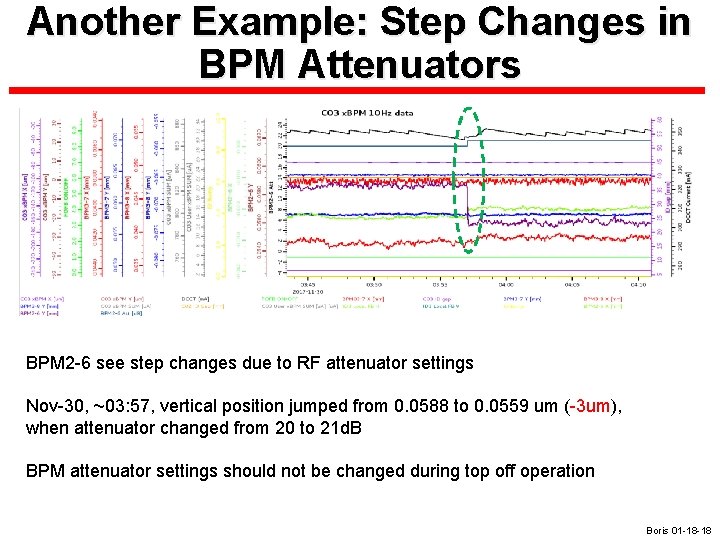
Another Example: Step Changes in BPM Attenuators BPM 2 -6 see step changes due to RF attenuator settings Nov-30, ~03: 57, vertical position jumped from 0. 0588 to 0. 0559 um (-3 um), when attenuator changed from 20 to 21 d. B BPM attenuator settings should not be changed during top off operation Boris 01 -18 -18

• • Participating beamlines: HXN, SRX, CHX, CSX, ++. Goals • Establish beamline tolerance levels to angular and positional orbit motion as well as to beam energy variation • Determine which (high-frequency) orbit noise components are observable at the beamlines Techniques • Operational conditions, beamlines used best diagnostics they had available • Applied small sinusoidal angular and positional perturbations at sub-Hz frequencies (with the orbit otherwise stabilized by FOFB), and had beamlines detect them • Separately, we studied beamline sensitivity to step changes in RF frequency (Figures show f. RF +/-100 Hz • baseline Joint Accelerator-Beamline studies test object Studies of Beamline Sensitivity to ebeam Motion and Sources of Photon Beam Noise Boris 01 -18 -18
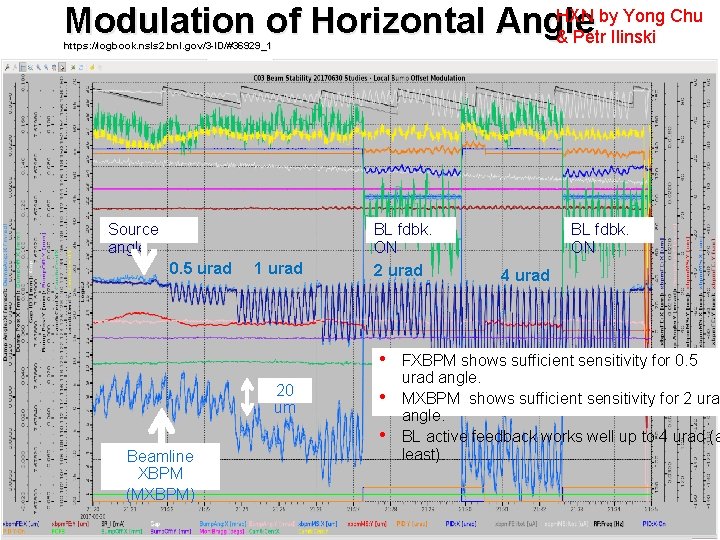
HXN by Yong Chu Modulation of Horizontal Angle & Petr Ilinski https: //logbook. nsls 2. bnl. gov/3 -ID/#36929_1 Source angle 0. 5 urad 1 urad BL fdbk. ON 2 urad • 20 um Beamline XBPM (MXBPM) • • BL fdbk. ON 4 urad FXBPM shows sufficient sensitivity for 0. 5 urad angle. MXBPM shows sufficient sensitivity for 2 urad angle. BL active feedback works well up to 4 urad (a least). Boris 01 -18 -18
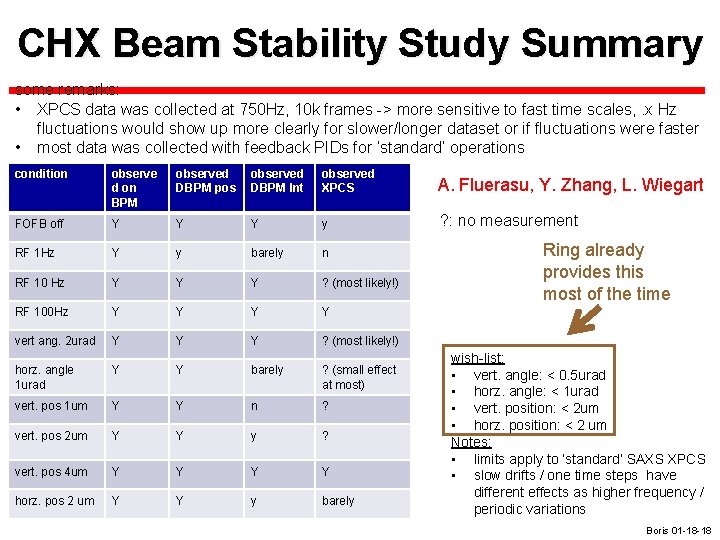
CHX Beam Stability Study Summary some remarks: • XPCS data was collected at 750 Hz, 10 k frames -> more sensitive to fast time scales, . x Hz fluctuations would show up more clearly for slower/longer dataset or if fluctuations were faster • most data was collected with feedback PIDs for ‘standard’ operations condition observe d on BPM observed DBPM pos observed DBPM Int observed XPCS A. Fluerasu, Y. Zhang, L. Wiegart FOFB off Y Y Y y ? : no measurement RF 1 Hz Y y barely n RF 10 Hz Y Y Y ? (most likely!) RF 100 Hz Y Y vert ang. 2 urad Y Y Y ? (most likely!) horz. angle 1 urad Y Y barely ? (small effect at most) vert. pos 1 um Y Y n ? vert. pos 2 um Y Y y ? vert. pos 4 um Y Y horz. pos 2 um Y Y y barely Ring already provides this most of the time wish-list: • vert. angle: < 0. 5 urad • horz. angle: < 1 urad • vert. position: < 2 um • horz. position: < 2 um Notes: • limits apply to ‘standard’ SAXS XPCS • slow drifts / one time steps have different effects as higher frequency / periodic variations Boris 01 -18 -18
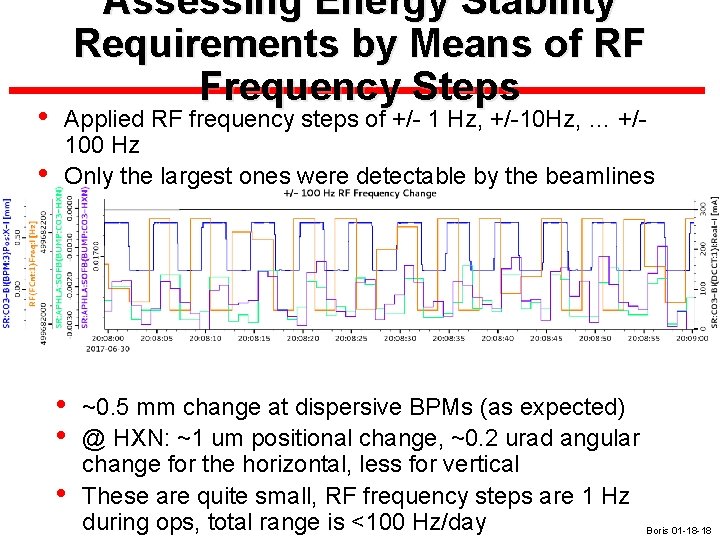
• • Assessing Energy Stability Requirements by Means of RF Frequency Steps Applied RF frequency steps of +/- 1 Hz, +/-10 Hz, … +/100 Hz Only the largest ones were detectable by the beamlines • • • ~0. 5 mm change at dispersive BPMs (as expected) @ HXN: ~1 um positional change, ~0. 2 urad angular change for the horizontal, less for vertical These are quite small, RF frequency steps are 1 Hz during ops, total range is <100 Hz/day Boris 01 -18 -18
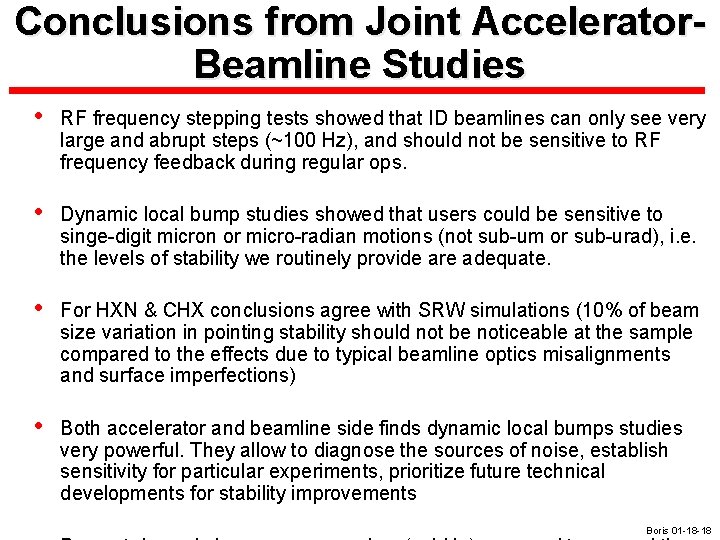
Conclusions from Joint Accelerator. Beamline Studies • RF frequency stepping tests showed that ID beamlines can only see very large and abrupt steps (~100 Hz), and should not be sensitive to RF frequency feedback during regular ops. • Dynamic local bump studies showed that users could be sensitive to singe-digit micron or micro-radian motions (not sub-um or sub-urad), i. e. the levels of stability we routinely provide are adequate. • For HXN & CHX conclusions agree with SRW simulations (10% of beam size variation in pointing stability should not be noticeable at the sample compared to the effects due to typical beamline optics misalignments and surface imperfections) • Both accelerator and beamline side finds dynamic local bumps studies very powerful. They allow to diagnose the sources of noise, establish sensitivity for particular experiments, prioritize future technical developments for stability improvements Boris 01 -18 -18
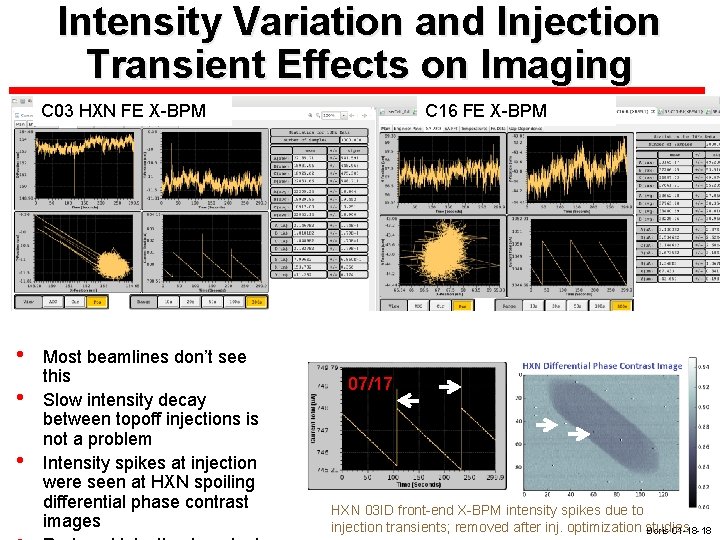
Intensity Variation and Injection Transient Effects on Imaging C 03 HXN FE X-BPM • • • Most beamlines don’t see this Slow intensity decay between topoff injections is not a problem Intensity spikes at injection were seen at HXN spoiling differential phase contrast images C 16 FE X-BPM 07/17 09/17 HXN 03 ID front-end X-BPM intensity spikes due to injection transients; removed after inj. optimization studies Boris 01 -18 -18
Conclusions • • NSLS-II Beam Stability Task Force (BSTF) started in November 2016 We took advantage of significant prior efforts related to beam stability A number of issues were identified and prioritized (local bumps, reproducibility after beam dumps and shutdowns, injection transients, etc. ) and many have been successfully addressed Significant stability improvements (and/or deeper understanding of the cause of instability) have been reported for a number of beamlines Beamline stability “pain thresholds” and noise sources are being clarified through studies and simulation. Most beamlines report that short-term ring stability is adequate Long-term drifts are still an issue for some of the beamlines Good levels of photon beam stability can be achieved by combining accelerator and beamline efforts: for sensitive beamlines flawless running of beamline feedbacks on top of accelerator feedbacks is a must. Boris 01 -18 -18
Extra Slides Boris 01 -18 -18
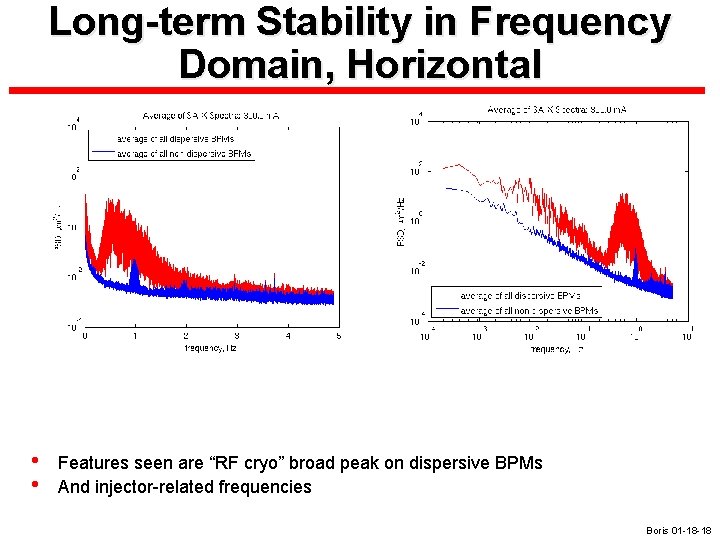
Long-term Stability in Frequency Domain, Horizontal • • Features seen are “RF cryo” broad peak on dispersive BPMs And injector-related frequencies Boris 01 -18 -18
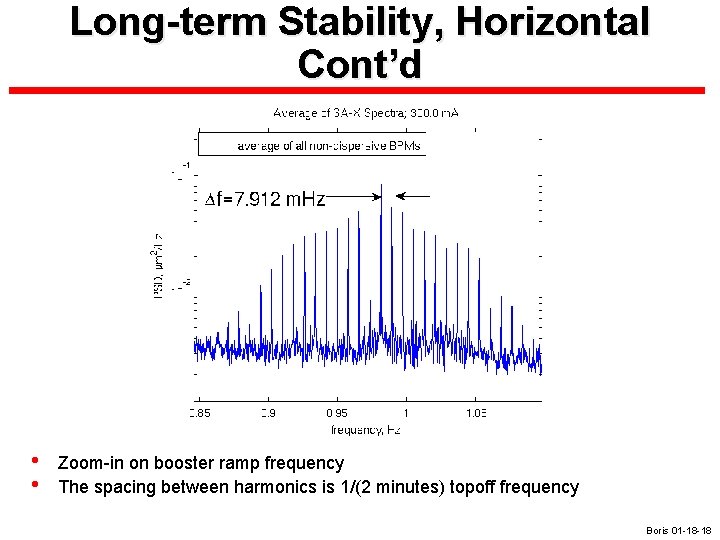
Long-term Stability, Horizontal Cont’d • • Zoom-in on booster ramp frequency The spacing between harmonics is 1/(2 minutes) topoff frequency Boris 01 -18 -18
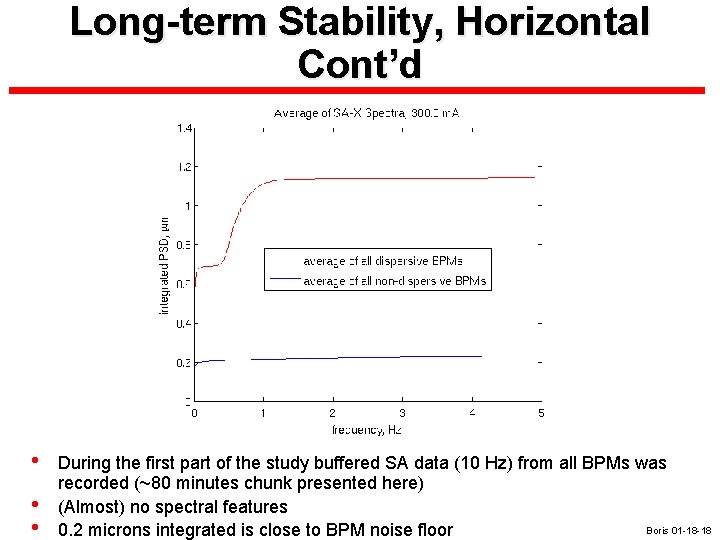
Long-term Stability, Horizontal Cont’d • • • During the first part of the study buffered SA data (10 Hz) from all BPMs was recorded (~80 minutes chunk presented here) (Almost) no spectral features Boris 01 -18 -18 0. 2 microns integrated is close to BPM noise floor
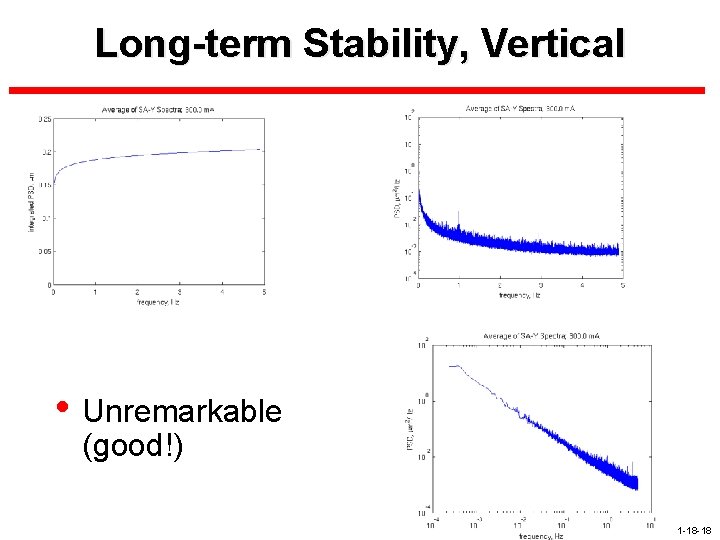
Long-term Stability, Vertical • Unremarkable (good!) Boris 01 -18 -18
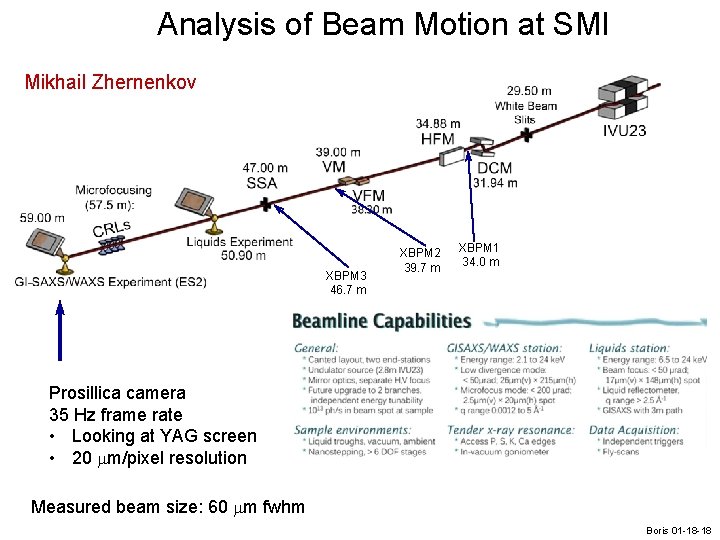
Analysis of Beam Motion at SMI Mikhail Zhernenkov XBPM 3 46. 7 m XBPM 2 39. 7 m XBPM 1 34. 0 m Prosillica camera 35 Hz frame rate • Looking at YAG screen • 20 mm/pixel resolution Measured beam size: 60 mm fwhm Boris 01 -18 -18
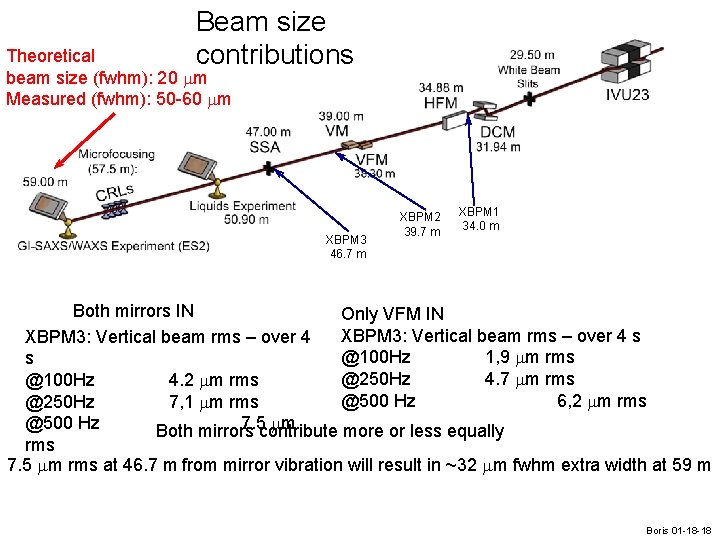
Beam size contributions Theoretical beam size (fwhm): 20 mm Measured (fwhm): 50 -60 mm XBPM 3 46. 7 m XBPM 2 39. 7 m XBPM 1 34. 0 m Both mirrors IN Only VFM IN XBPM 3: Vertical beam rms – over 4 s XBPM 3: Vertical beam rms – over 4 @100 Hz 1, 9 mm rms s @250 Hz 4. 7 mm rms @100 Hz 4. 2 mm rms @500 Hz 6, 2 mm rms @250 Hz 7, 1 mm rms @500 Hz 7. 5 contribute mm Both mirrors more or less equally rms 7. 5 mm rms at 46. 7 m from mirror vibration will result in ~32 mm fwhm extra width at 59 m Boris 01 -18 -18
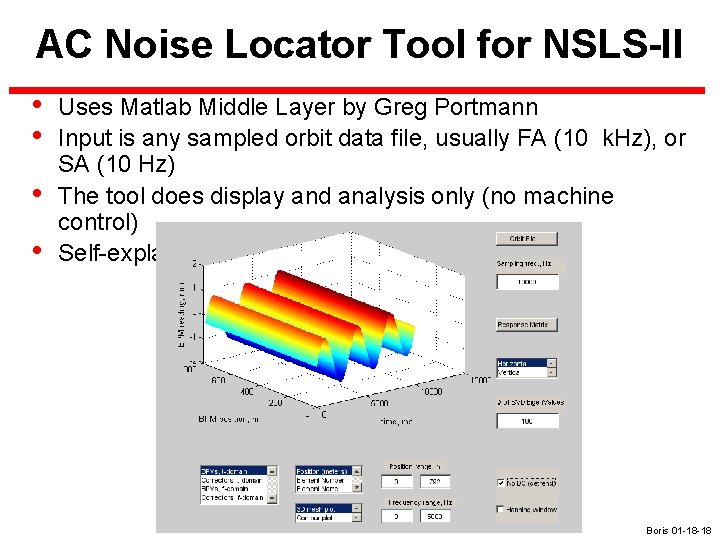
AC Noise Locator Tool for NSLS-II • • Uses Matlab Middle Layer by Greg Portmann Input is any sampled orbit data file, usually FA (10 k. Hz), or SA (10 Hz) The tool does display and analysis only (no machine control) Self-explanatory GUI interface Boris 01 -18 -18
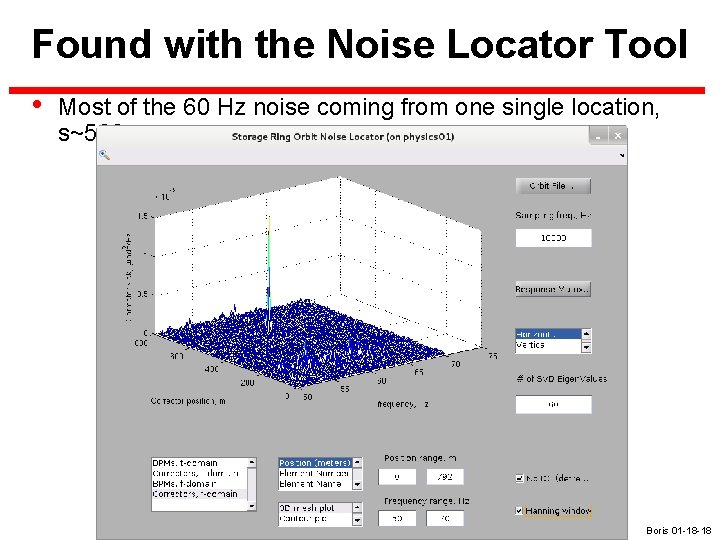
Found with the Noise Locator Tool • Most of the 60 Hz noise coming from one single location, s~580 m Boris 01 -18 -18
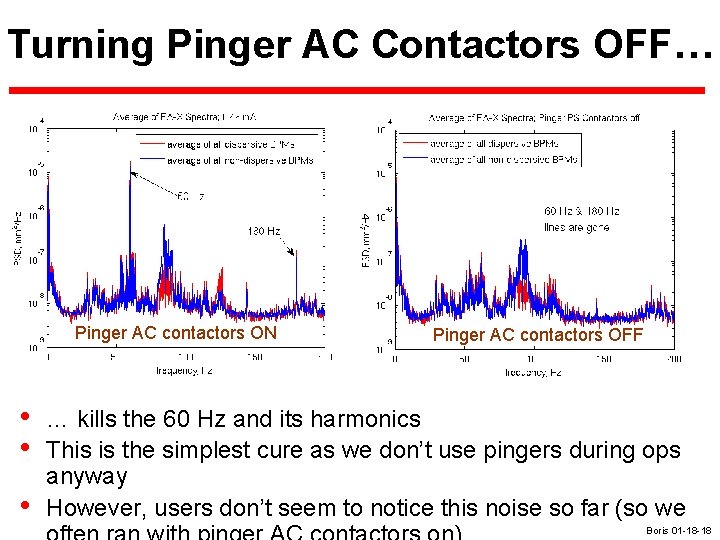
Turning Pinger AC Contactors OFF… Pinger AC contactors ON • • • Pinger AC contactors OFF … kills the 60 Hz and its harmonics This is the simplest cure as we don’t use pingers during ops anyway However, users don’t seem to notice this noise so far (so we Boris 01 -18 -18
- Slides: 44