
Beam Splitter in a LIGO Hiro Yamamoto LIGOCaltech
Beam Splitter in a. LIGO Hiro Yamamoto LIGO/Caltech l l l l BS 02 to BS 05? larger BS? BS in a. LIGO IFO for near future upgrade » All COC optics of L 1 as is except for BS » TCS can correct power terms in ITM substrate – ITM power terms are nullified, to be realized by repolished CP Performance degradation by geometrical hierarchy Effect of RM 3 aperture on the beam beyond BS Effect of ITM inhomogeneity, mixing with BS inhomogeneity Effect of ESD, visible for larger BS Summary LIGO-G 1500634 Hiro Yamamoto GWADW 2015 @ Girdwood, Alaska 1

Geometry related to performance ESD on CP 266 mm (modeled by a simple with hole with 266 mm aperture) BS 230 x 260 mm 262 mm LIGO-G 1500634 Hiro Yamamoto GWADW 2015 @ Girdwood, Alaska 2
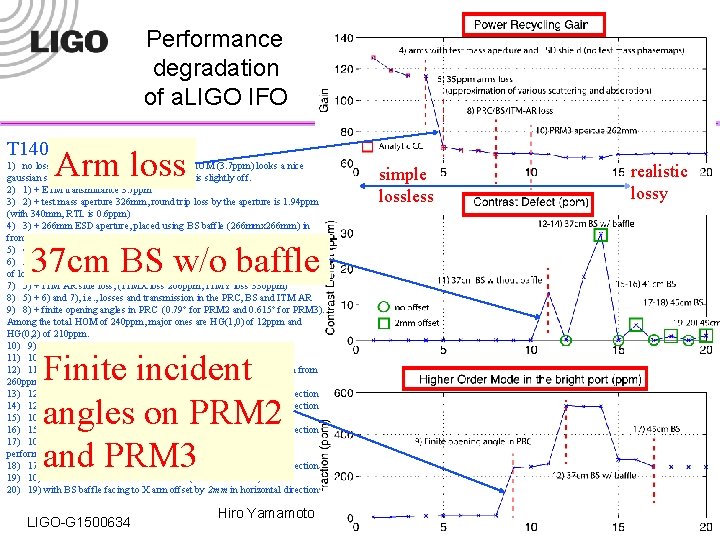
Performance degradation of a. LIGO IFO T 1400055 Arm loss 1) no loss at all, with large mirrors. A finite HOM (3. 7 ppm) looks a nice gaussian so probably the base mode parameter is slightly off. 2) 1) + ETM transmittance 3. 7 ppm 3) 2) + test mass aperture 326 mm, round trip loss by the aperture is 1. 94 ppm (with 340 mm, RTL is 0. 6 ppm) 4) 3) + 266 mm ESD aperture, placed using BS baffle (266 mmx 266 mm) in front of BS 5) 4) + 35 ppm arm loss 6) 5) + power recycling mirror and beam splitter loss and transmission. Sum of losses + RM 2 transmission is 583 ppm 7) 5) + ITM AR side loss, (ITMX loss 206 ppm, ITMY loss 330 ppm) 8) 5) + 6) and 7), i. e. , losses and transmission in the PRC, BS and ITM AR 9) 8) + finite opening angles in PRC (0. 79° for PRM 2 and 0. 615° for PRM 3). Among the total HOM of 240 ppm, major ones are HG(1, 0) of 12 ppm and HG(0, 2) of 210 ppm. 10) 9) + PRM 3 aperture 262 mm 11) 10) + BS 367. 1 mm/60 mm no baffle 12) 11) + BS baffle (210 mmx 260 mm). Total HOM goes up to 540 ppm from 260 ppm by clipping using BF baffle. The major is HG(4, 0) of 170 ppm. 13) 12) with BS baffle facing to X arm offset by 1 mm in horizontal direction 14) 12) with BS baffle facing to X arm offset by 2 mm in horizontal direction 15) 10) + BS 410 mm/67 mm with BS baffle (237 mmx 260 mm) 16) 15) with BS baffle facing to X arm offset by 2 mm in horizontal direction 17) 10) + BS 450 mm/73. 5 mm with BS baffle (260 mmx 260 mm) : no performance impact by the BS baffle 18) 17) with BS baffle facing to X arm offset by 2 mm in horizontal direction 19) 10) + BS 490 mm/80 mm with BS baffle (260 mmx 260 mm) 20) 19) with BS baffle facing to X arm offset by 2 mm in horizontal direction simple lossless realistic lossy 37 cm BS w/o baffle Finite incident angles on PRM 2 and PRM 3 LIGO-G 1500634 Hiro Yamamoto GWADW 2015 @ Girdwood, Alaska 3
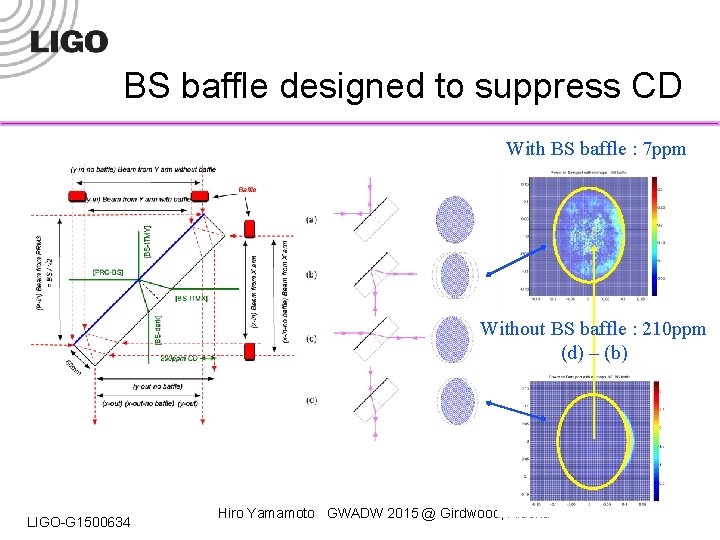
BS baffle designed to suppress CD With BS baffle : 7 ppm Without BS baffle : 210 ppm (d) – (b) LIGO-G 1500634 Hiro Yamamoto GWADW 2015 @ Girdwood, Alaska 4
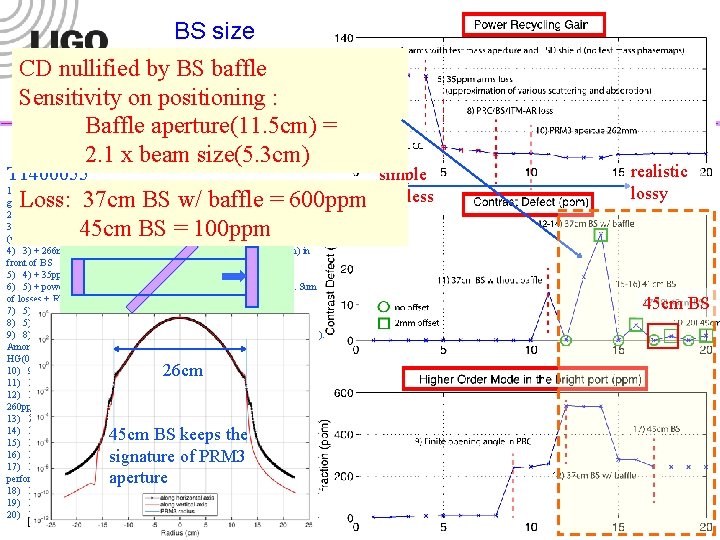
BS size CD nullified by BS baffle Sensitivity on positioning : Baffle aperture(11. 5 cm) = 2. 1 x beam size(5. 3 cm) T 1400055 simple lossless 1) no loss at all, with large mirrors. A finite HOM (3. 7 ppm) looks a nice gaussian so probably the base mode parameter is slightly off. 2) 1) + ETM transmittance 3. 7 ppm 3) 2) + test mass aperture 326 mm, round trip loss by the aperture is 1. 94 ppm (with 340 mm, RTL is 0. 6 ppm) 4) 3) + 266 mm ESD aperture, placed using BS baffle (266 mmx 266 mm) in front of BS 5) 4) + 35 ppm arm loss 6) 5) + power recycling mirror and beam splitter loss and transmission. Sum of losses + RM 2 transmission is 583 ppm 7) 5) + ITM AR side loss, (ITMX loss 206 ppm, ITMY loss 330 ppm) 8) 5) + 6) and 7), i. e. , losses and transmission in the PRC, BS and ITM AR 9) 8) + finite opening angles in PRC (0. 79° for PRM 2 and 0. 615° for PRM 3). Among the total HOM of 240 ppm, major ones are HG(1, 0) of 12 ppm and HG(0, 2) of 210 ppm. 10) 9) + PRM 3 aperture 262 mm 11) 10) + BS 367. 1 mm/60 mm no baffle 12) 11) + BS baffle (210 mmx 260 mm). Total HOM goes up to 540 ppm from 260 ppm by clipping using BF baffle. The major is HG(4, 0) of 170 ppm. 13) 12) with BS baffle facing to X arm offset by 1 mm in horizontal direction 14) 12) with BS baffle facing to X arm offset by 2 mm in horizontal direction 15) 10) + BS 410 mm/67 mm with BS baffle (237 mmx 260 mm) 16) 15) with BS baffle facing to X arm offset by 2 mm in horizontal direction 17) 10) + BS 450 mm/73. 5 mm with BS baffle (260 mmx 260 mm) : no performance impact by the BS baffle 18) 17) with BS baffle facing to X arm offset by 2 mm in horizontal direction 19) 10) + BS 490 mm/80 mm with BS baffle (260 mmx 260 mm) Hiro Yamamoto 20) 19) with BS baffle facing to X arm offset by 2 mm in horizontal direction GWADW Loss: 37 cm BS w/ baffle = 600 ppm 45 cm BS = 100 ppm. ITM RM 3 BS realistic lossy 45 cm BS 26 cm 45 cm BS keeps the signature of PRM 3 aperture LIGO-G 1500634 2015 @ Girdwood, Alaska 5
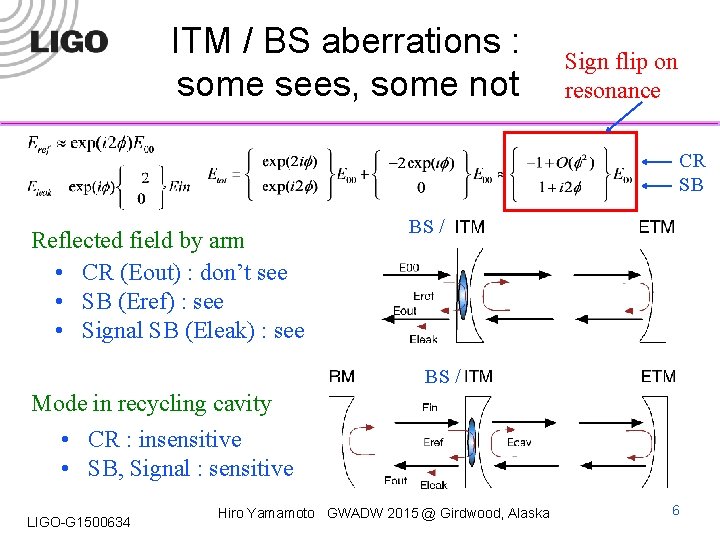
ITM / BS aberrations : some sees, some not Sign flip on resonance CR SB Reflected field by arm • CR (Eout) : don’t see • SB (Eref) : see • Signal SB (Eleak) : see BS / Mode in recycling cavity • CR : insensitive • SB, Signal : sensitive LIGO-G 1500634 Hiro Yamamoto GWADW 2015 @ Girdwood, Alaska 6
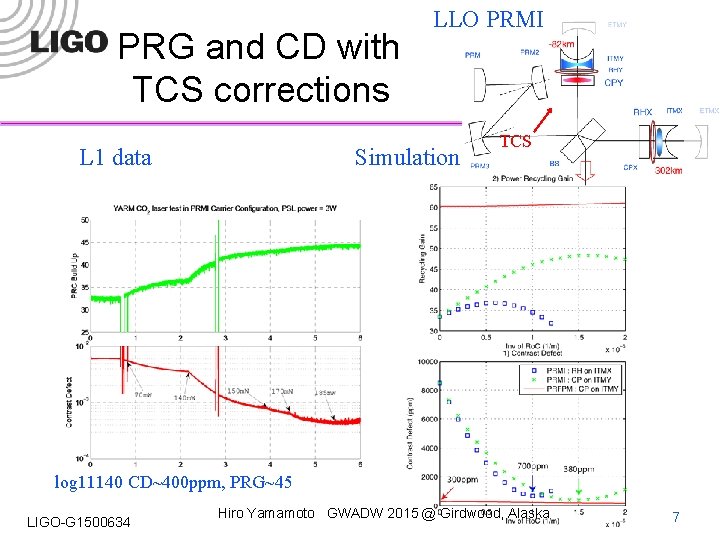
PRG and CD with TCS corrections L 1 data LLO PRMI Simulation TCS log 11140 CD~400 ppm, PRG~45 LIGO-G 1500634 Hiro Yamamoto GWADW 2015 @ Girdwood, Alaska 7
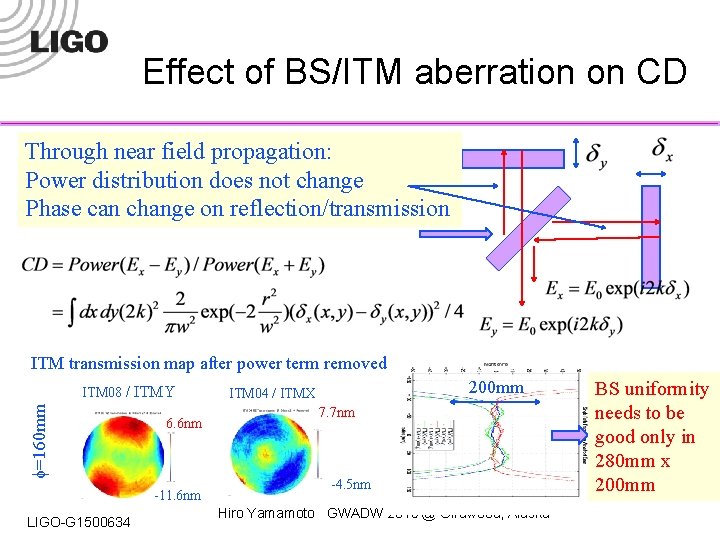
Effect of BS/ITM aberration on CD Through near field propagation: Power distribution does not change Phase can change on reflection/transmission ITM transmission map after power term removed ϕ=160 mm ITM 08 / ITMY 6. 6 nm -11. 6 nm LIGO-G 1500634 200 mm ITM 04 / ITMX 7. 7 nm -4. 5 nm Hiro Yamamoto GWADW 2015 @ Girdwood, Alaska BS uniformity needs to be good only in 280 mm x 200 mm
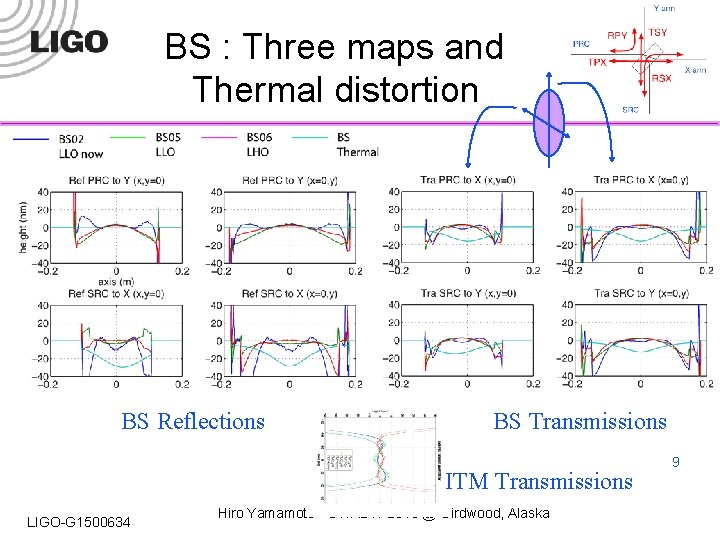
BS : Three maps and Thermal distortion BS Reflections BS Transmissions ITM Transmissions LIGO-G 1500634 Hiro Yamamoto GWADW 2015 @ Girdwood, Alaska 9
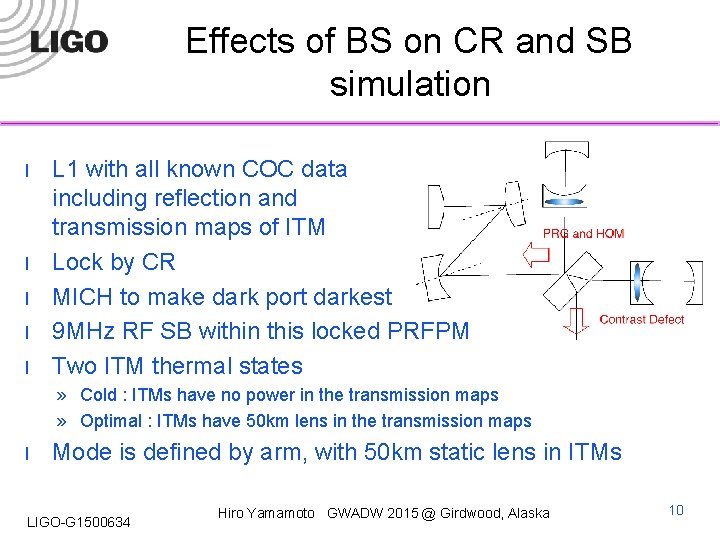
Effects of BS on CR and SB simulation l l l L 1 with all known COC data including reflection and transmission maps of ITM Lock by CR MICH to make dark port darkest 9 MHz RF SB within this locked PRFPM Two ITM thermal states » Cold : ITMs have no power in the transmission maps » Optimal : ITMs have 50 km lens in the transmission maps l Mode is defined by arm, with 50 km static lens in ITMs LIGO-G 1500634 Hiro Yamamoto GWADW 2015 @ Girdwood, Alaska 10
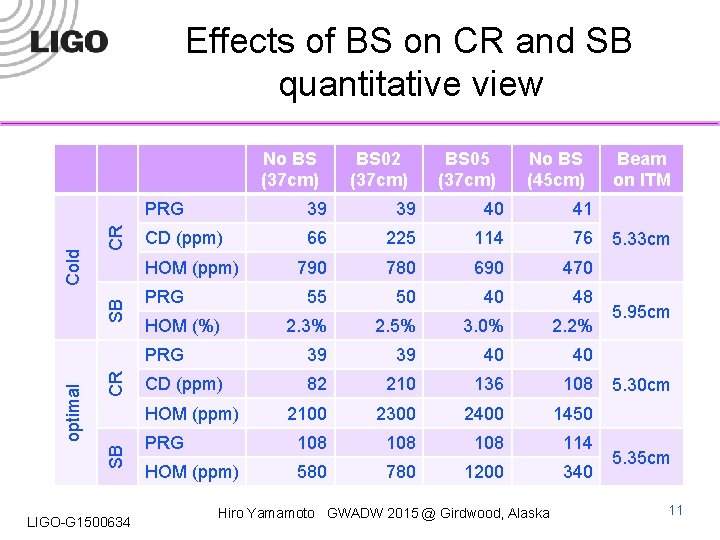
Effects of BS on CR and SB quantitative view CR CR SB optimal BS 05 (37 cm) No BS (45 cm) 39 39 40 41 CD (ppm) 66 225 114 76 790 780 690 470 55 50 40 48 2. 3% 2. 5% 3. 0% 2. 2% PRG 39 39 40 40 CD (ppm) 82 210 136 108 2100 2300 2400 1450 PRG 108 108 114 HOM (ppm) 580 780 1200 340 PRG HOM (%) HOM (ppm) LIGO-G 1500634 BS 02 (37 cm) PRG HOM (ppm) SB Cold No BS (37 cm) Hiro Yamamoto GWADW 2015 @ Girdwood, Alaska Beam on ITM 5. 33 cm 5. 95 cm 5. 30 cm 5. 35 cm 11
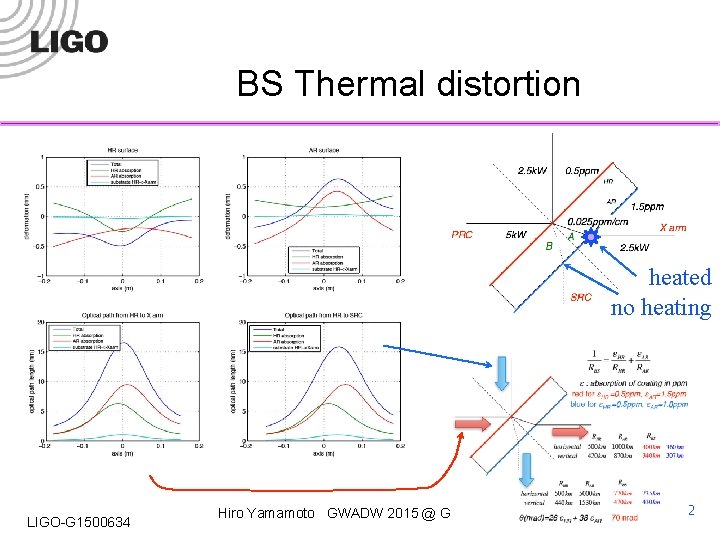
BS Thermal distortion heated no heating LIGO-G 1500634 Hiro Yamamoto GWADW 2015 @ Girdwood, Alaska 12
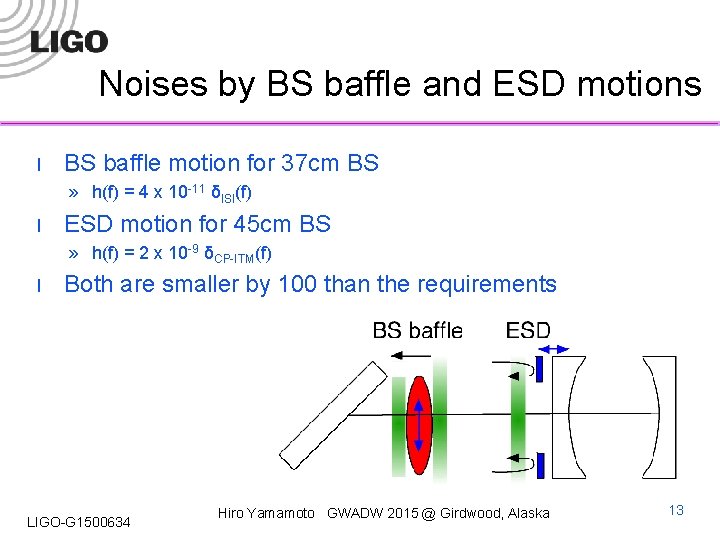
Noises by BS baffle and ESD motions l BS baffle motion for 37 cm BS » h(f) = 4 x 10 -11 δISI(f) l ESD motion for 45 cm BS » h(f) = 2 x 10 -9 δCP-ITM(f) l Both are smaller by 100 than the requirements LIGO-G 1500634 Hiro Yamamoto GWADW 2015 @ Girdwood, Alaska 13
Summary l BS 02 vs BS 05 » If it ain’t broken, don’t fit it. » Some may improve, but will see some new issue l Aperture change from 37 cm to 45 cm » Improve total loss around BS » Less critical to positioning of beams and mechanical structure l Noises due to BS baffle or ESD motions are negligible LIGO-G 1500634 Hiro Yamamoto GWADW 2015 @ Girdwood, Alaska 14
- Slides: 14