
Beam Profiling Using a Scanning Knife Edge Technique
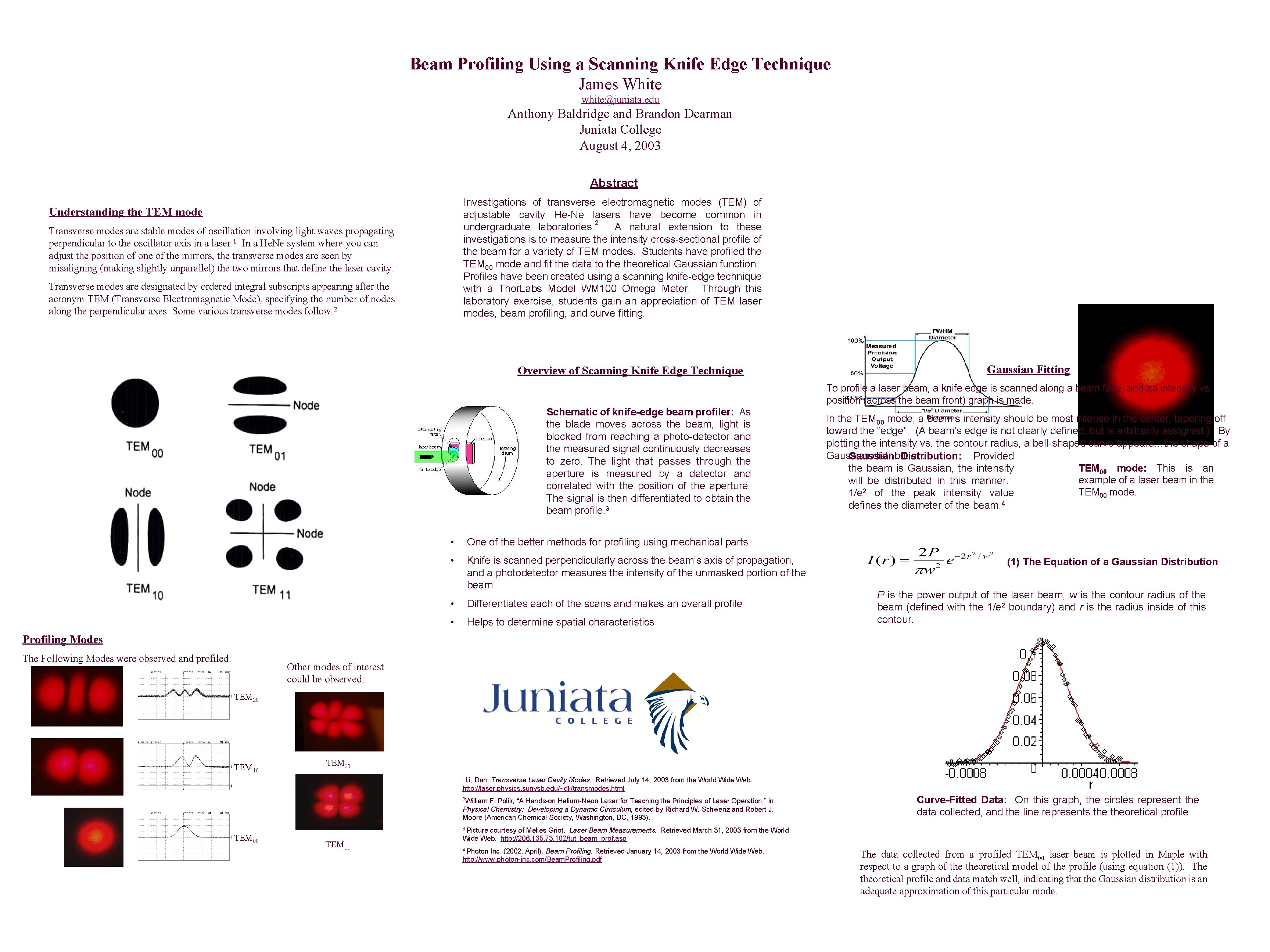
Beam Profiling Using a Scanning Knife Edge Technique James White white@juniata. edu Anthony Baldridge and Brandon Dearman Juniata College August 4, 2003 Abstract Investigations of transverse electromagnetic modes (TEM) of adjustable cavity He-Ne lasers have become common in undergraduate laboratories. 2 A natural extension to these investigations is to measure the intensity cross-sectional profile of the beam for a variety of TEM modes. Students have profiled the TEM 00 mode and fit the data to theoretical Gaussian function. Profiles have been created using a scanning knife-edge technique with a Thor. Labs Model WM 100 Omega Meter. Through this laboratory exercise, students gain an appreciation of TEM laser modes, beam profiling, and curve fitting. Understanding the TEM mode Transverse modes are stable modes of oscillation involving light waves propagating perpendicular to the oscillator axis in a laser. 1 In a He. Ne system where you can adjust the position of one of the mirrors, the transverse modes are seen by misaligning (making slightly unparallel) the two mirrors that define the laser cavity. Transverse modes are designated by ordered integral subscripts appearing after the acronym TEM (Transverse Electromagnetic Mode), specifying the number of nodes along the perpendicular axes. Some various transverse modes follow. 2 Overview of Scanning Knife Edge Technique Gaussian Fitting To profile a laser beam, a knife edge is scanned along a beam face, and an intensity vs. position (across the beam front) graph is made. Schematic of knife-edge beam profiler: As the blade moves across the beam, light is blocked from reaching a photo-detector and the measured signal continuously decreases to zero. The light that passes through the aperture is measured by a detector and correlated with the position of the aperture. The signal is then differentiated to obtain the beam profile. 3 • One of the better methods for profiling using mechanical parts • Knife is scanned perpendicularly across the beam’s axis of propagation, and a photodetector measures the intensity of the unmasked portion of the beam • Differentiates each of the scans and makes an overall profile • Helps to determine spatial characteristics In the TEM 00 mode, a beam’s intensity should be most intense in the center, tapering off toward the “edge”. (A beam’s edge is not clearly defined, but is arbitrarily assigned. ) By plotting the intensity vs. the contour radius, a bell-shaped curve appears…the shape of a Gaussian distribution. Gaussian Distribution: Provided TEM 00 mode: This is an the beam is Gaussian, the intensity example of a laser beam in the will be distributed in this manner. TEM 00 mode. 1/e 2 of the peak intensity value defines the diameter of the beam. 4 (1) The Equation of a Gaussian Distribution P is the power output of the laser beam, w is the contour radius of the beam (defined with the 1/e 2 boundary) and r is the radius inside of this contour. Profiling Modes The Following Modes were observed and profiled: Other modes of interest could be observed: TEM 20 TEM 10 TEM 21 1 Li, Dan, Transverse Laser Cavity Modes. Retrieved July 14, 2003 from the World Wide Web. http: //laser. physics. sunysb. edu/~dli/transmodes. html 2 William F. Polik, “A Hands-on Helium-Neon Laser for Teaching the Principles of Laser Operation, ” in Physical Chemistry: Developing a Dynamic Cirriculum, edited by Richard W. Schwenz and Robert J. Moore (American Chemical Society, Washington, DC, 1993). TEM 00 Curve-Fitted Data: On this graph, the circles represent the data collected, and the line represents theoretical profile. 3 Picture TEM 11 courtesy of Melles Griot. Laser Beam Measurements. Retrieved March 31, 2003 from the World Wide Web. http: //206. 135. 73. 102/tut_beam_prof. asp 4 Photon Inc. (2002, April). Beam Profiling. Retrieved January 14, 2003 from the World Wide Web. http: //www. photon-inc. com/Beam. Profiling. pdf The data collected from a profiled TEM 00 laser beam is plotted in Maple with respect to a graph of theoretical model of the profile (using equation (1)). The theoretical profile and data match well, indicating that the Gaussian distribution is an adequate approximation of this particular mode.
- Slides: 1