
Beam position stabilisation using stripline and cavity beam
Beam position stabilisation using stripline and cavity beam position monitors D. Bett, N. Blaskovic 1, T. Bromwich, R. Bodenstein, P. Burrows, G. Christian, C. Perry, R. Ramjiawan FONT, John Adams Institute, Oxford University (1 now at CERN) N. Blaskovic LCWS 2017 1
Contents • Intra-train feedback at a linear collider • ILC requirements • FONT feedback systems at ATF: – ‘Upstream’ system using stripline BPMs – ‘IP region’ system using cavity BPMs N. Blaskovic LCWS 2017 2
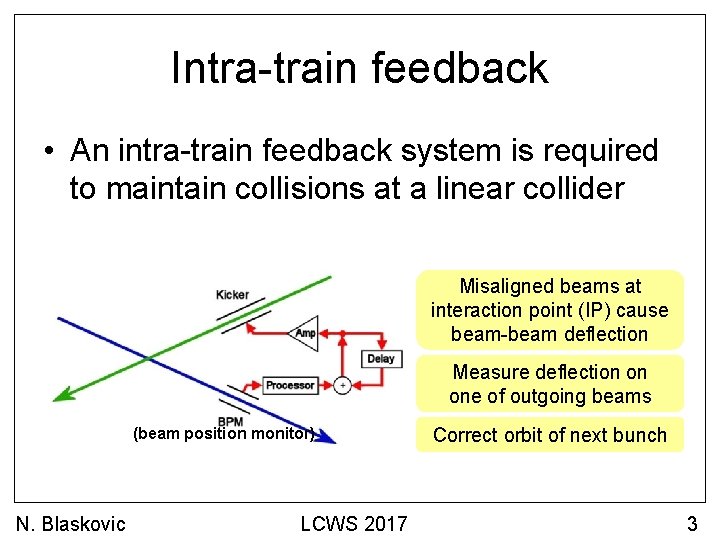
Intra-train feedback • An intra-train feedback system is required to maintain collisions at a linear collider Misaligned beams at interaction point (IP) cause beam-beam deflection Measure deflection on one of outgoing beams (beam position monitor) N. Blaskovic LCWS 2017 Correct orbit of next bunch 3
Intra-train feedback • The FONT intra-train feedback system: – Measures the position of bunch 1 – Processes on an FPGA-based FONT 5 board – Corrects the position of bunch 2 • ILC requirements (for 250 Ge. V/beam): – Latency: < 554 ns (bunch spacing) – Kicker correction range: ± 60 nrad – BPM dynamic range: ± 1400 um – BPM resolution for 99% luminosity: ~ 50 um N. Blaskovic LCWS 2017 4
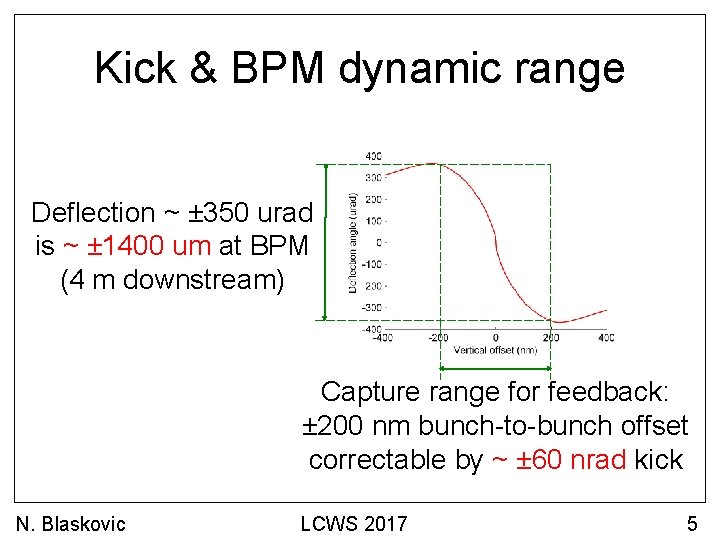
Kick & BPM dynamic range Deflection ~ ± 350 urad is ~ ± 1400 um at BPM (4 m downstream) Capture range for feedback: ± 200 nm bunch-to-bunch offset correctable by ~ ± 60 nrad kick N. Blaskovic LCWS 2017 5
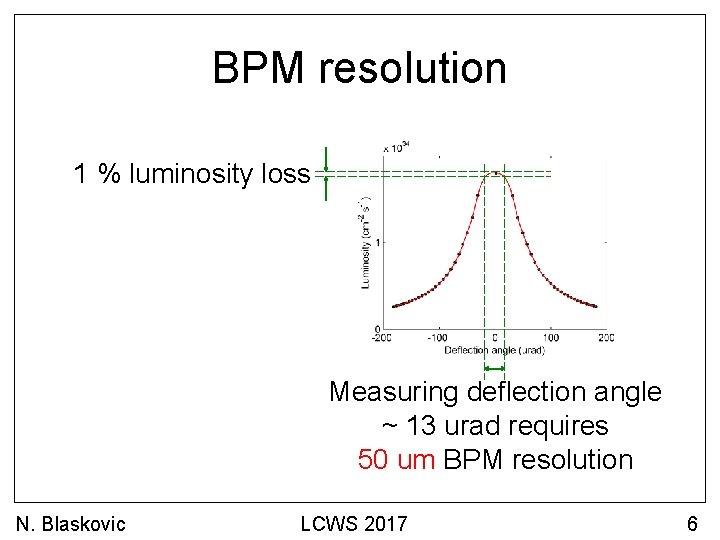
BPM resolution 1 % luminosity loss Measuring deflection angle ~ 13 urad requires 50 um BPM resolution N. Blaskovic LCWS 2017 6
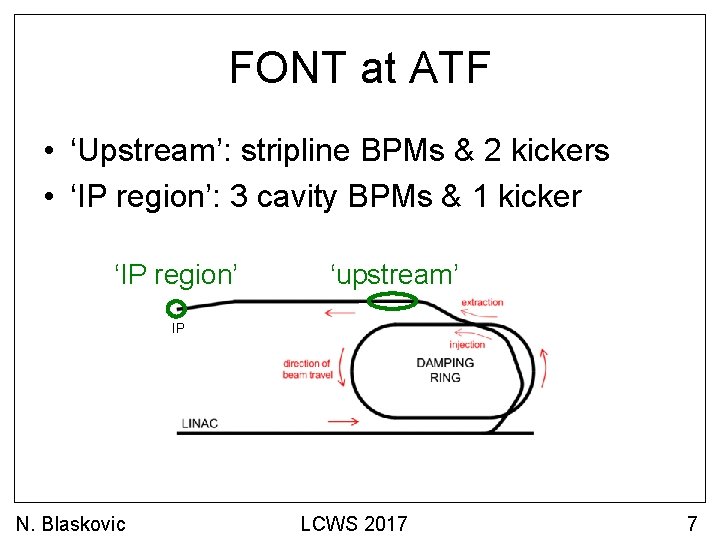
FONT at ATF • ‘Upstream’: stripline BPMs & 2 kickers • ‘IP region’: 3 cavity BPMs & 1 kicker ‘IP region’ ‘upstream’ IP N. Blaskovic LCWS 2017 7
ATF upstream system using stripline BPMs N. Blaskovic LCWS 2017 8
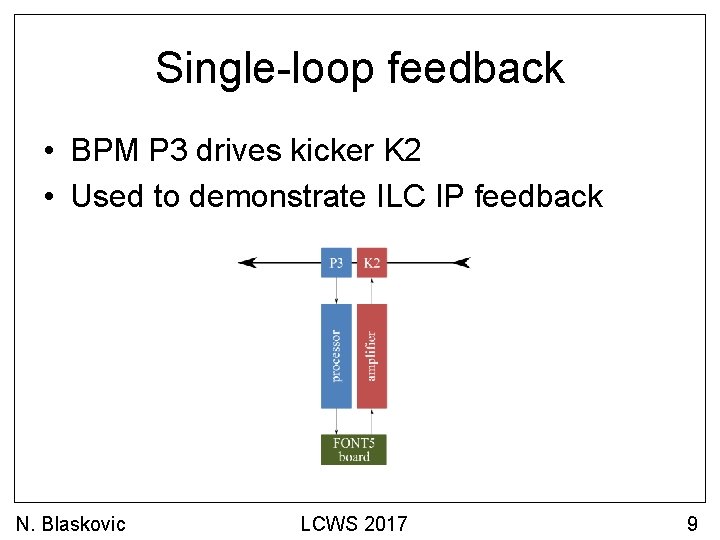
Single-loop feedback • BPM P 3 drives kicker K 2 • Used to demonstrate ILC IP feedback N. Blaskovic LCWS 2017 9
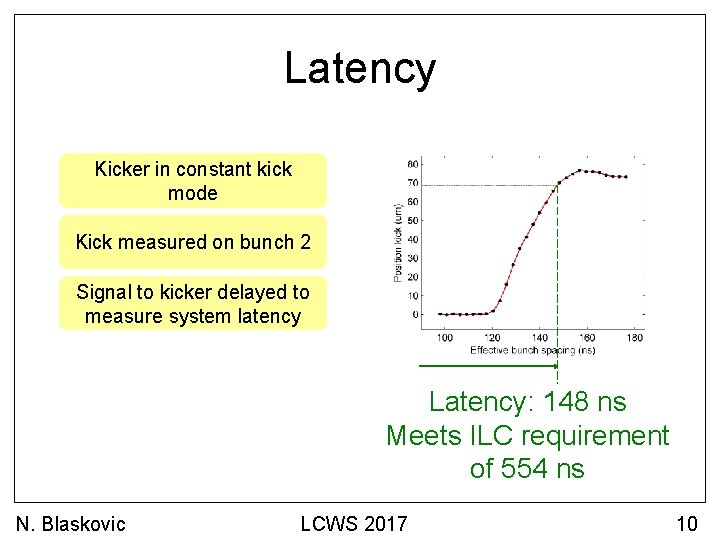
Latency Kicker in constant kick mode Kick measured on bunch 2 Signal to kicker delayed to measure system latency Latency: 148 ns Meets ILC requirement of 554 ns N. Blaskovic LCWS 2017 10
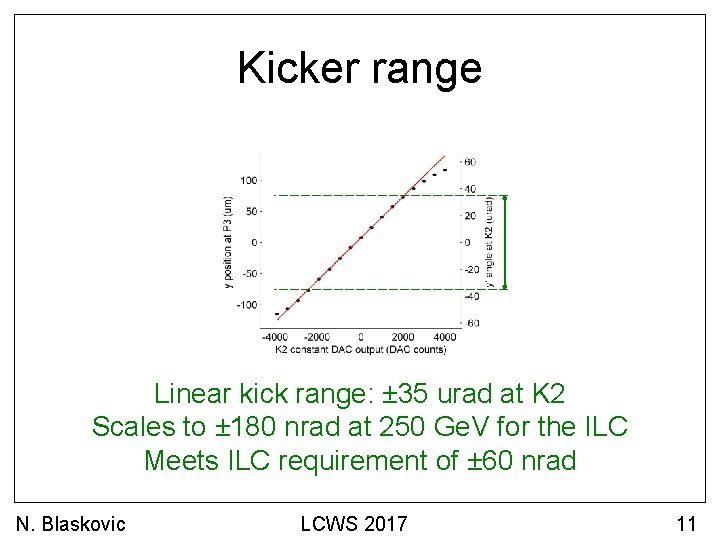
Kicker range Linear kick range: ± 35 urad at K 2 Scales to ± 180 nrad at 250 Ge. V for the ILC Meets ILC requirement of ± 60 nrad N. Blaskovic LCWS 2017 11
BPM performance • FONT stripline BPMs have 12 cm long strips connected to analogue processors • Performance tested at ATF at ~ 1 n. C: – BPM resolution: 291 ± 10 nm – Linear response range: ± 500 um – Results in PRST-AB 18, 032803, 2015 • By attenuating a factor 3, get ± 1500 um linear response range with ~1 um resolution, meeting ILC requirements N. Blaskovic LCWS 2017 12
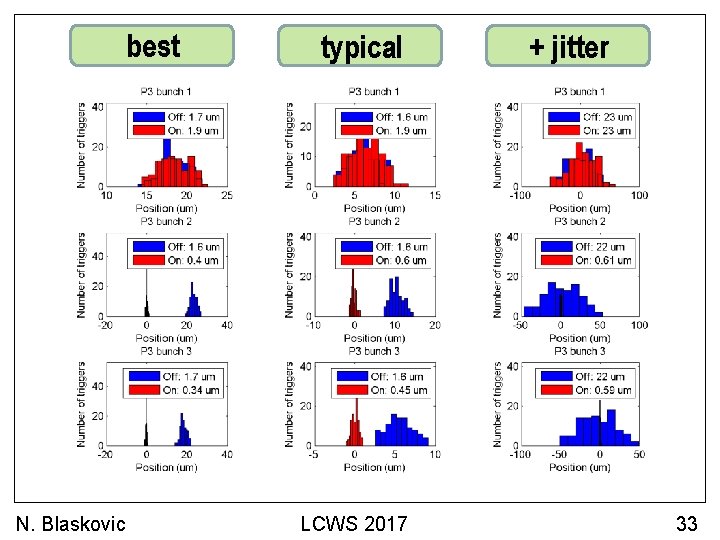
Single-loop feedback • • • 3 -bunch trains with 154 ns bunch spacing Bunch charge: ~0. 5 x 10¹⁰ electrons No stripline BPM attenuation 3 -BPM resolution: ~300 nm Best bunch-to-bunch correlation: 98% (P 3) N. Blaskovic LCWS 2017 13
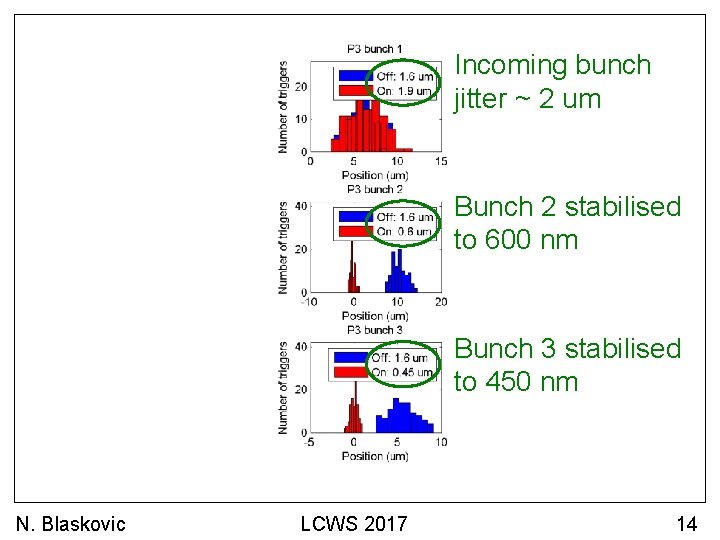
Incoming bunch jitter ~ 2 um Bunch 2 stabilised to 600 nm Bunch 3 stabilised to 450 nm N. Blaskovic LCWS 2017 14
Luminosity recovery at the ILC • FONT beam stabilisation at ATF: 600 nm • Expected beam stabilisation at the ILC: – Stabilisation at the feedback BPM: <2 um (due to factor 3 BPM signal attenuation) – Stabilisation of the deflection angle: <0. 5 urad N. Blaskovic LCWS 2017 15
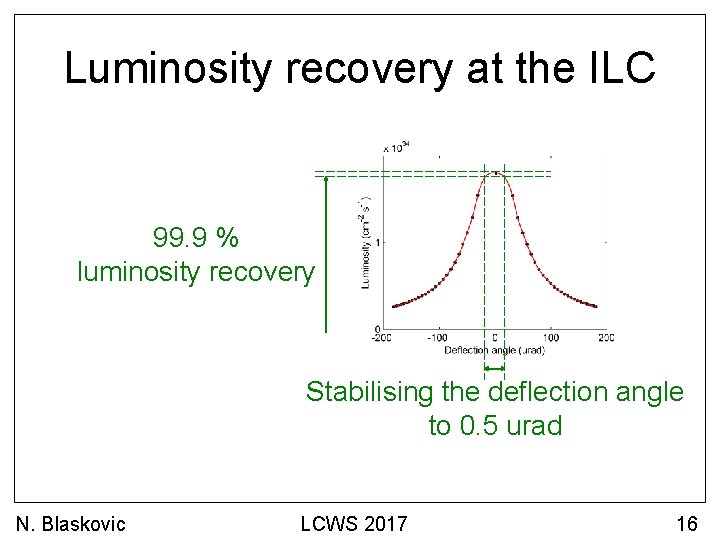
Luminosity recovery at the ILC 99. 9 % luminosity recovery Stabilising the deflection angle to 0. 5 urad N. Blaskovic LCWS 2017 16
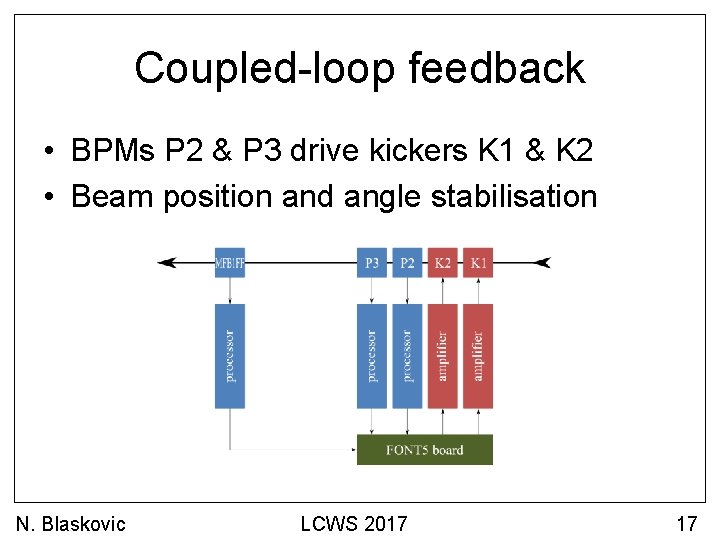
Coupled-loop feedback • BPMs P 2 & P 3 drive kickers K 1 & K 2 • Beam position and angle stabilisation N. Blaskovic LCWS 2017 17
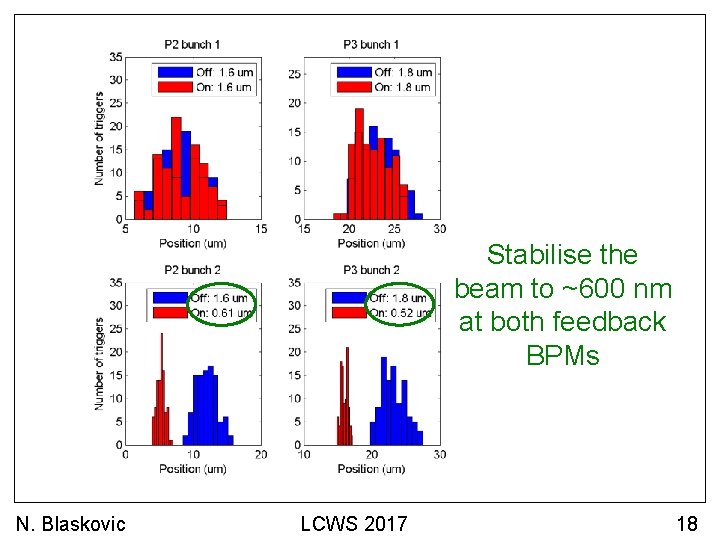
Stabilise the beam to ~600 nm at both feedback BPMs N. Blaskovic LCWS 2017 18
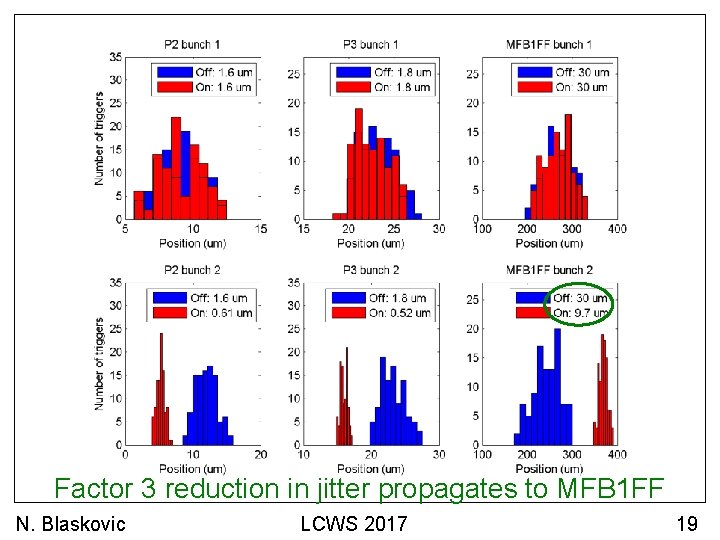
Factor 3 reduction in jitter propagates to MFB 1 FF N. Blaskovic LCWS 2017 19
ATF IP system using cavity BPMs N. Blaskovic LCWS 2017 20
IP BPMs • IP chamber contains three cavity BPMs: IPA, IPB & IPC • Operate with 10 d. B signal attenuation as otherwise signals exceed dynamic range • BPM resolution ~50 nm for feedback runs as firmware used single-point sampling N. Blaskovic LCWS 2017 21
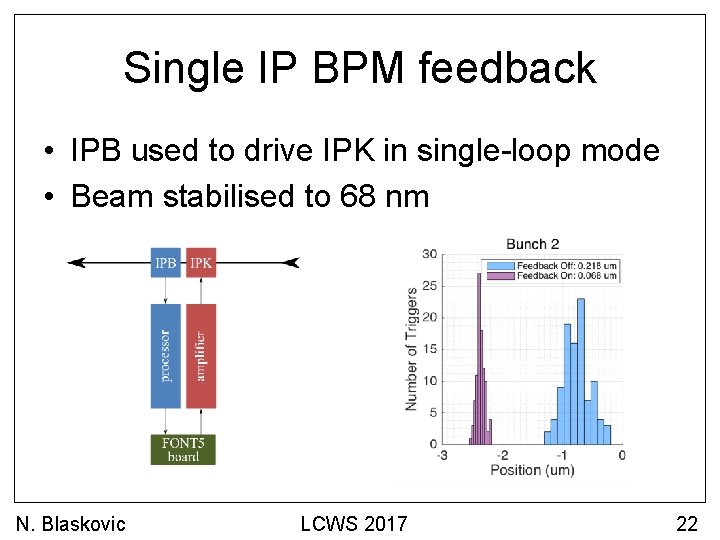
Single IP BPM feedback • IPB used to drive IPK in single-loop mode • Beam stabilised to 68 nm N. Blaskovic LCWS 2017 22
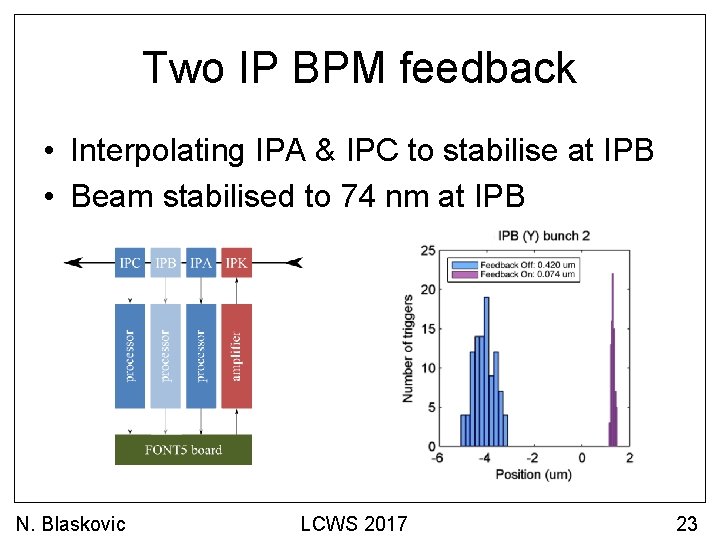
Two IP BPM feedback • Interpolating IPA & IPC to stabilise at IPB • Beam stabilised to 74 nm at IPB N. Blaskovic LCWS 2017 23
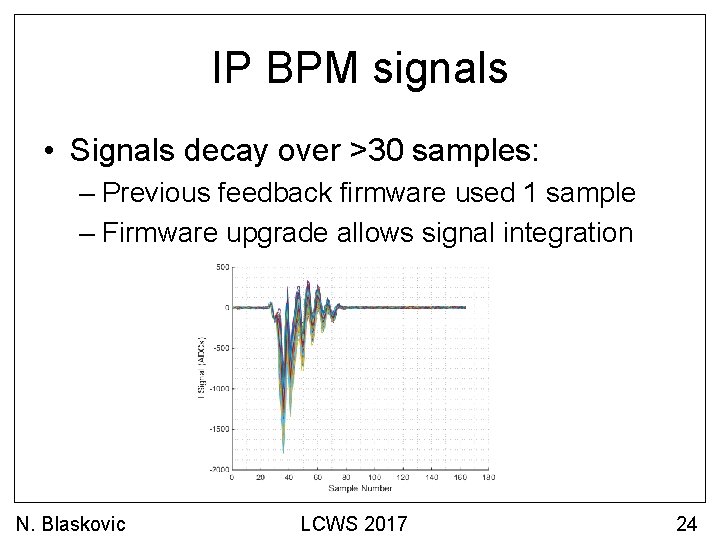
IP BPM signals • Signals decay over >30 samples: – Previous feedback firmware used 1 sample – Firmware upgrade allows signal integration N. Blaskovic LCWS 2017 24
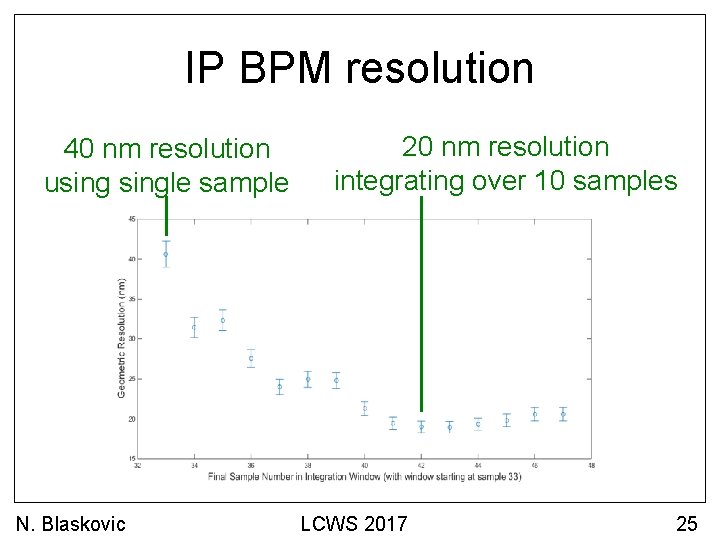
IP BPM resolution 40 nm resolution usingle sample N. Blaskovic 20 nm resolution integrating over 10 samples LCWS 2017 25
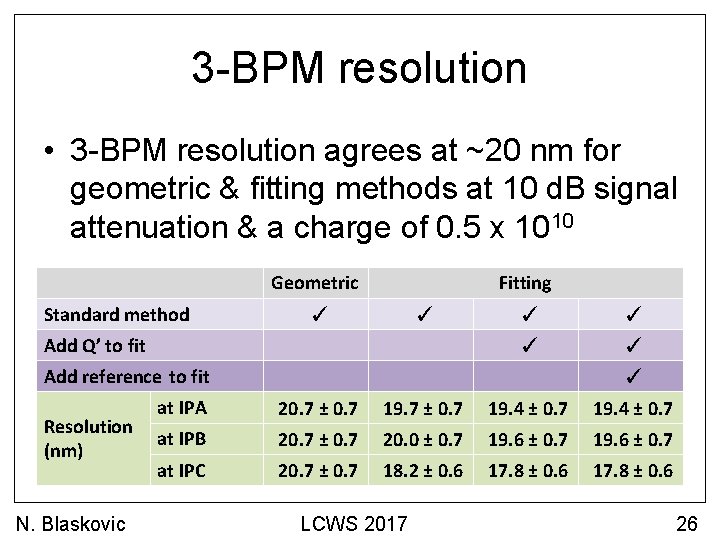
3 -BPM resolution • 3 -BPM resolution agrees at ~20 nm for geometric & fitting methods at 10 d. B signal attenuation & a charge of 0. 5 x 10¹⁰ Geometric Standard method Fitting ✓ ✓ Add Q’ to fit ✓ ✓ Add reference to fit Resolution (nm) N. Blaskovic ✓ at IPA 20. 7 ± 0. 7 19. 4 ± 0. 7 at IPB 20. 7 ± 0. 7 20. 0 ± 0. 7 19. 6 ± 0. 7 at IPC 20. 7 ± 0. 7 18. 2 ± 0. 6 17. 8 ± 0. 6 LCWS 2017 26
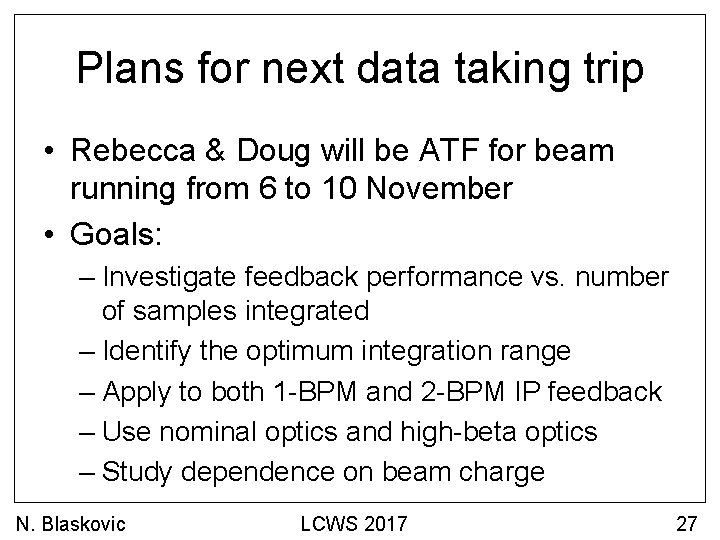
Plans for next data taking trip • Rebecca & Doug will be ATF for beam running from 6 to 10 November • Goals: – Investigate feedback performance vs. number of samples integrated – Identify the optimum integration range – Apply to both 1 -BPM and 2 -BPM IP feedback – Use nominal optics and high-beta optics – Study dependence on beam charge N. Blaskovic LCWS 2017 27
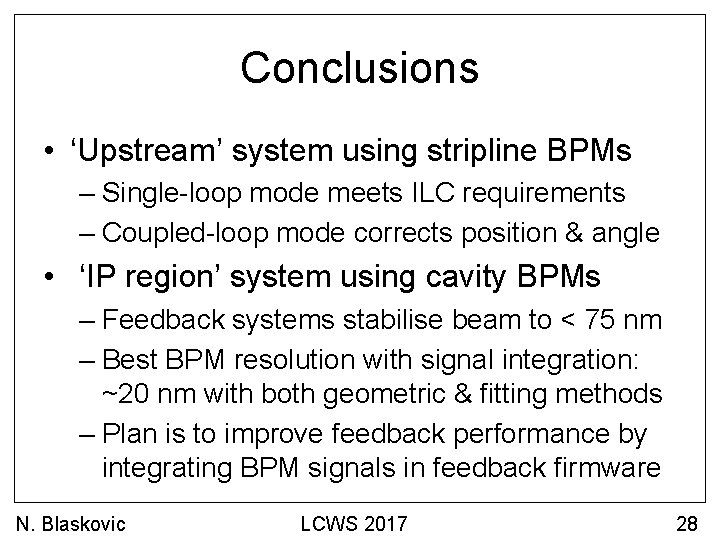
Conclusions • ‘Upstream’ system using stripline BPMs – Single-loop mode meets ILC requirements – Coupled-loop mode corrects position & angle • ‘IP region’ system using cavity BPMs – Feedback systems stabilise beam to < 75 nm – Best BPM resolution with signal integration: ~20 nm with both geometric & fitting methods – Plan is to improve feedback performance by integrating BPM signals in feedback firmware N. Blaskovic LCWS 2017 28
Thank you for your attention! Many thanks to the IP BPM collaborators T. Tauchi, A. Aryshev, S. Wallon & P. Bambade N. Blaskovic LCWS 2017 29
Appendix N. Blaskovic LCWS 2017 30
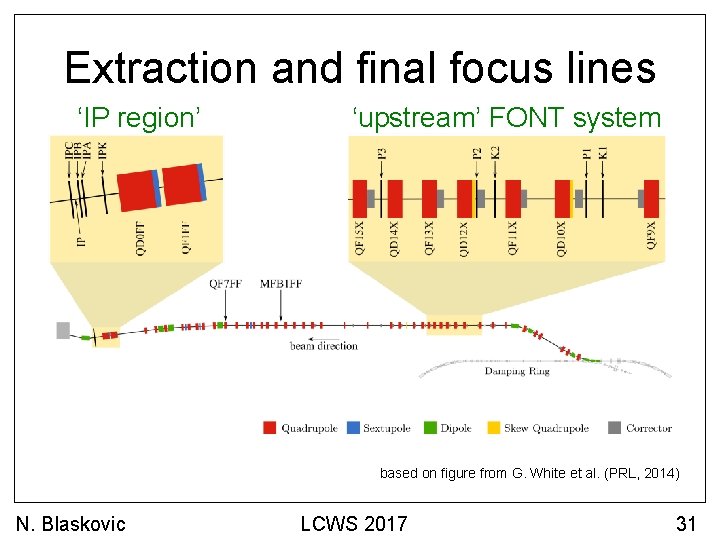
Extraction and final focus lines ‘IP region’ ‘upstream’ FONT system based on figure from G. White et al. (PRL, 2014) N. Blaskovic LCWS 2017 31
Latency • Latency scan performed: – Feedback algorithm is initiated on measuring signal from first bunch – Apply a constant kick to the second bunch – Measure kick as a function of bunch spacing • K 2–P 3 latency ~ 55 buckets (154 ns) • Allows 3 -bunch operation with 154 ns bunch spacing N. Blaskovic LCWS 2017 32
best N. Blaskovic typical LCWS 2017 + jitter 33
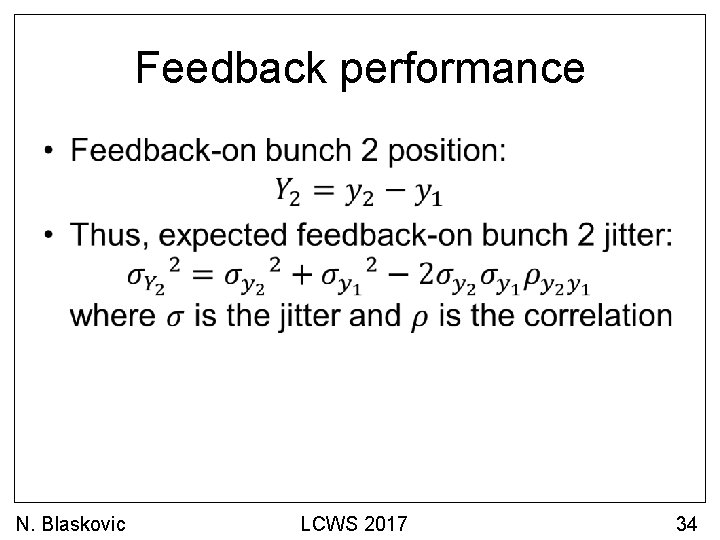
Feedback performance • N. Blaskovic LCWS 2017 34
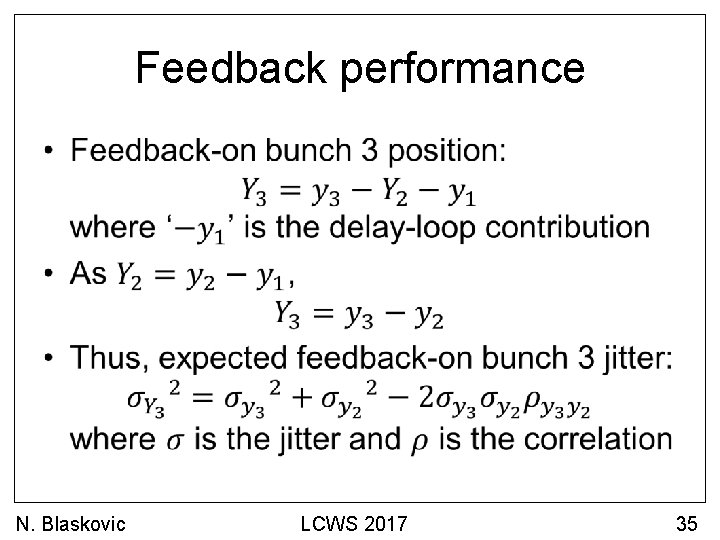
Feedback performance • N. Blaskovic LCWS 2017 35
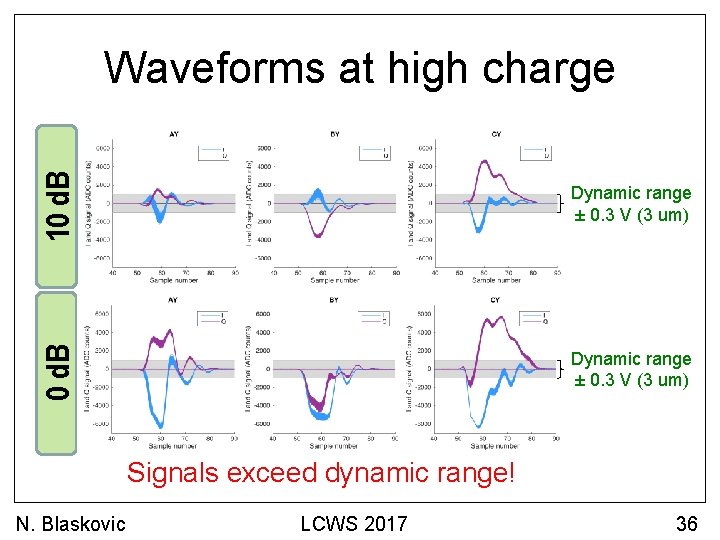
10 d. B Dynamic range ± 0. 3 V (3 um) 0 d. B Waveforms at high charge Dynamic range ± 0. 3 V (3 um) Signals exceed dynamic range! N. Blaskovic LCWS 2017 36
- Slides: 36