
Beam Polarization Introduction Equation of Motion for Spin
Beam Polarization Introduction Equation of Motion for Spin Thomas-BMT Equation Definition of Polarization Measurement of Polarization Equation of Motion Periodic Solution to the Equation of Motion Depolarizing resonances Polarization preservation in storage rings Injection Matching Harmonic Correction Adiabatic Spin Flip Tune Jump Siberian snakes Evaluation of Resonance Strengths Summary
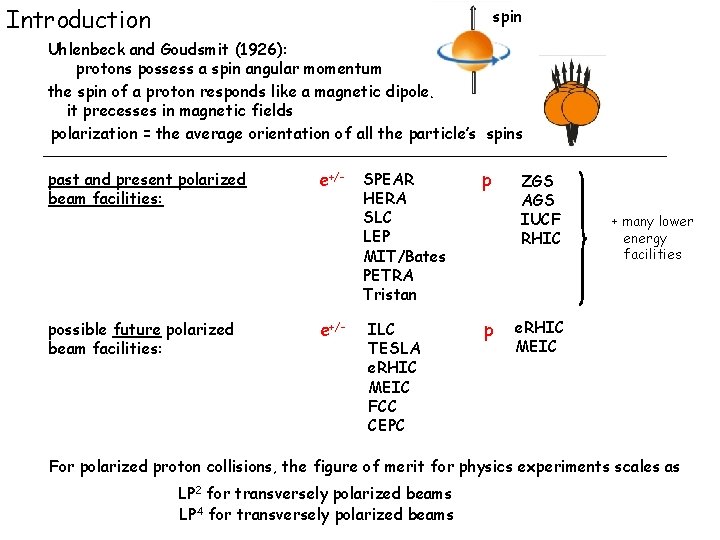
Introduction spin Uhlenbeck and Goudsmit (1926): protons possess a spin angular momentum the spin of a proton responds like a magnetic dipole; it precesses in magnetic fields polarization = the average orientation of all the particle’s spins past and present polarized beam facilities: possible future polarized beam facilities: e+/- SPEAR HERA SLC LEP MIT/Bates PETRA Tristan e+/- ILC TESLA e. RHIC MEIC FCC CEPC p p ZGS AGS IUCF RHIC + many lower energy facilities e. RHIC MEIC For polarized proton collisions, the figure of merit for physics experiments scales as LP 2 for transversely polarized beams LP 4 for transversely polarized beams
Equation of Motion for Spin
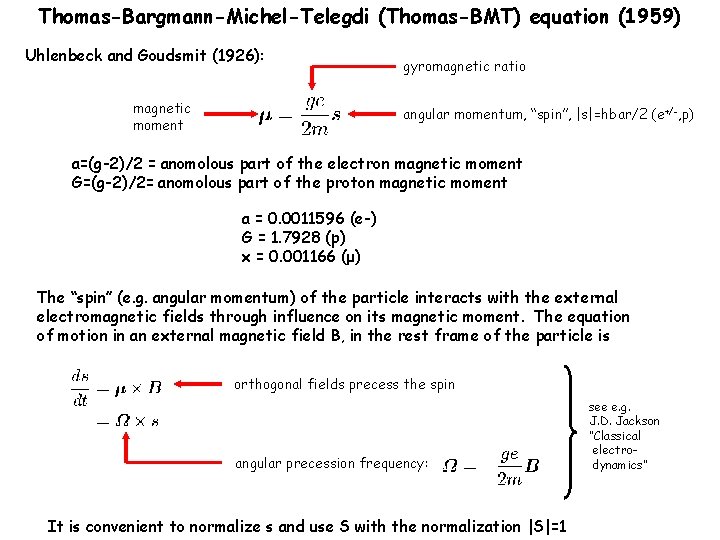
Thomas-Bargmann-Michel-Telegdi (Thomas-BMT) equation (1959) Uhlenbeck and Goudsmit (1926): magnetic moment gyromagnetic ratio angular momentum, “spin”, |s|=hbar/2 (e+/-, p) a=(g-2)/2 = anomolous part of the electron magnetic moment G=(g-2)/2= anomolous part of the proton magnetic moment a = 0. 0011596 (e-) G = 1. 7928 (p) x = 0. 001166 (μ) The “spin” (e. g. angular momentum) of the particle interacts with the external electromagnetic fields through influence on its magnetic moment. The equation of motion in an external magnetic field B, in the rest frame of the particle is orthogonal fields precess the spin angular precession frequency: It is convenient to normalize s and use S with the normalization |S|=1 see e. g. J. D. Jackson “Classical electrodynamics”
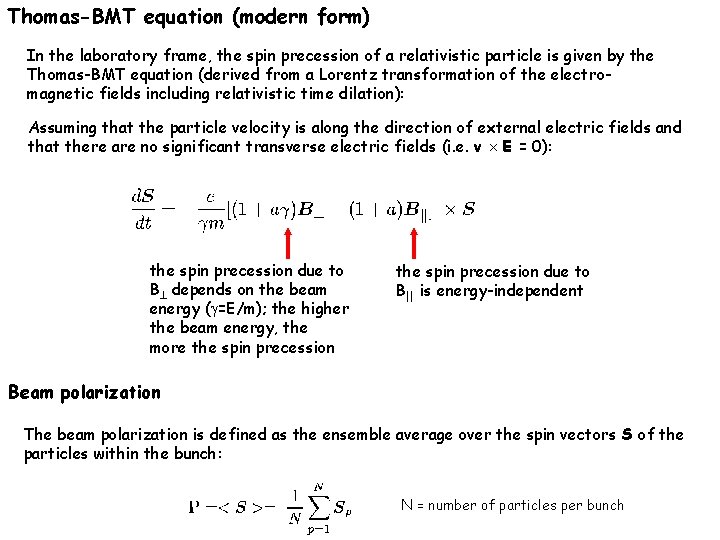
Thomas-BMT equation (modern form) In the laboratory frame, the spin precession of a relativistic particle is given by the Thomas-BMT equation (derived from a Lorentz transformation of the electromagnetic fields including relativistic time dilation): Assuming that the particle velocity is along the direction of external electric fields and that there are no significant transverse electric fields (i. e. v E = 0): the spin precession due to B depends on the beam energy ( =E/m); the higher the beam energy, the more the spin precession due to B|| is energy-independent Beam polarization The beam polarization is defined as the ensemble average over the spin vectors S of the particles within the bunch: N = number of particles per bunch
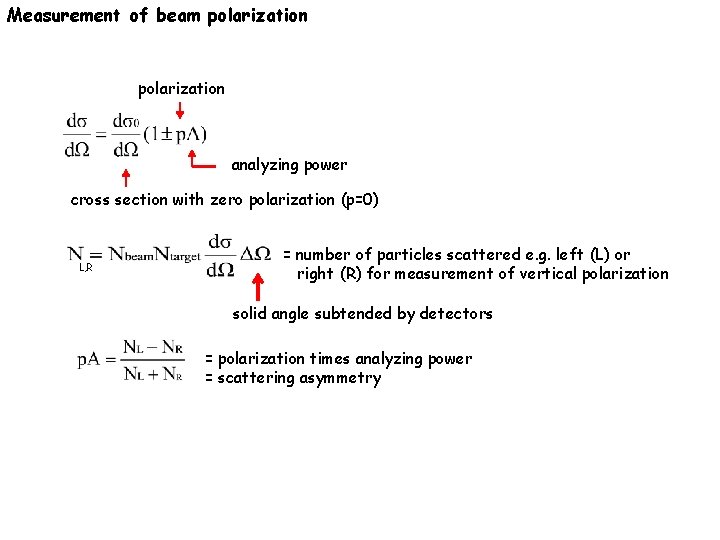
Measurement of beam polarization analyzing power cross section with zero polarization (p=0) L, R = number of particles scattered e. g. left (L) or right (R) for measurement of vertical polarization solid angle subtended by detectors = polarization times analyzing power = scattering asymmetry
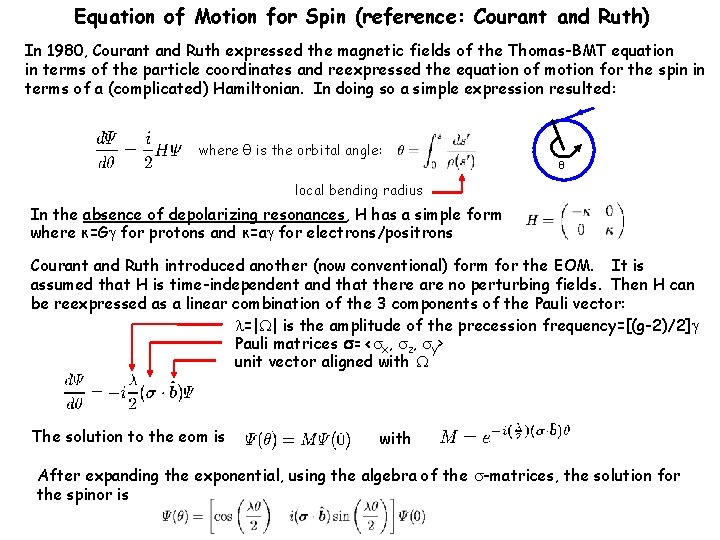
Equation of Motion for Spin (reference: Courant and Ruth) In 1980, Courant and Ruth expressed the magnetic fields of the Thomas-BMT equation in terms of the particle coordinates and reexpressed the equation of motion for the spin in terms of a (complicated) Hamiltonian. In doing so a simple expression resulted: where θ is the orbital angle: θ local bending radius In the absence of depolarizing resonances, H has a simple form where κ=G for protons and κ=a for electrons/positrons Courant and Ruth introduced another (now conventional) form for the EOM. It is assumed that H is time-independent and that there are no perturbing fields. Then H can be reexpressed as a linear combination of the 3 components of the Pauli vector: =| | is the amplitude of the precession frequency=[(g-2)/2] Pauli matrices =< x, z, y> unit vector aligned with The solution to the eom is with After expanding the exponential, using the algebra of the -matrices, the solution for the spinor is
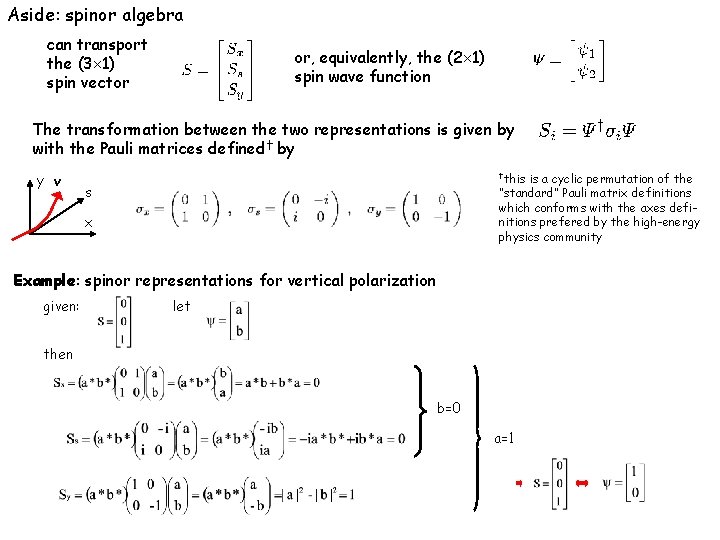
Aside: spinor algebra can transport the (3 1) spin vector or, equivalently, the (2 1) spin wave function The transformation between the two representations is given by with the Pauli matrices defined† by y v †this is a cyclic permutation of the “standard” Pauli matrix definitions which conforms with the axes definitions prefered by the high-energy physics community s x Example: spinor representations for vertical polarization given: let then b=0 a=1
Homework The spinor rotation matrix for precession by an angle about the j-axis (j=x, y, s) is given by exp(i j/2). Assuming an initial polarization that is purely a) horizontal b) vertical c) longitudinal, determine the final polarization after precession about the longitudinal (s) axis by an angle and sketch the final orientation in each of these cases. Note: exp(i j) = cos( )+i jsin( ).
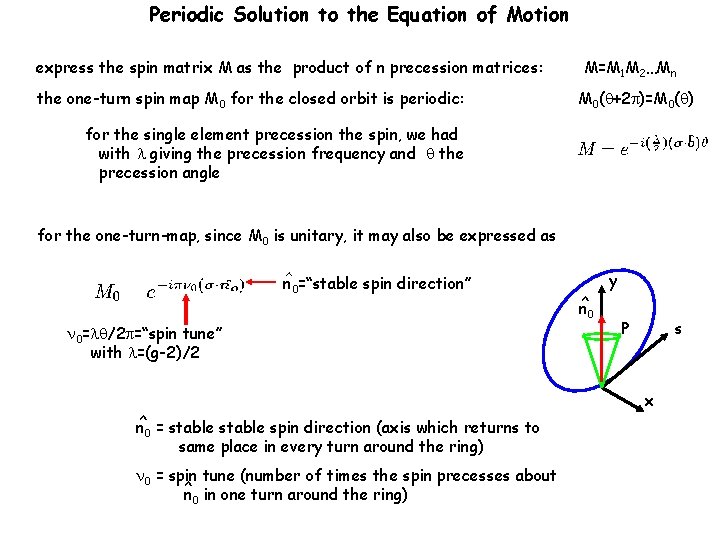
Periodic Solution to the Equation of Motion express the spin matrix M as the product of n precession matrices: the one-turn spin map M 0 for the closed orbit is periodic: M=M 1 M 2…Mn M 0( +2 )=M 0( ) for the single element precession the spin, we had with giving the precession frequency and the precession angle for the one-turn-map, since M 0 is unitary, it may also be expressed as y > n 0=“stable spin direction” > n 0 0= /2 =“spin tune” with =(g-2)/2 P s x > n 0 = stable spin direction (axis which returns to same place in every turn around the ring) > 0 = spin tune (number of times the spin precesses about n 0 in one turn around the ring)
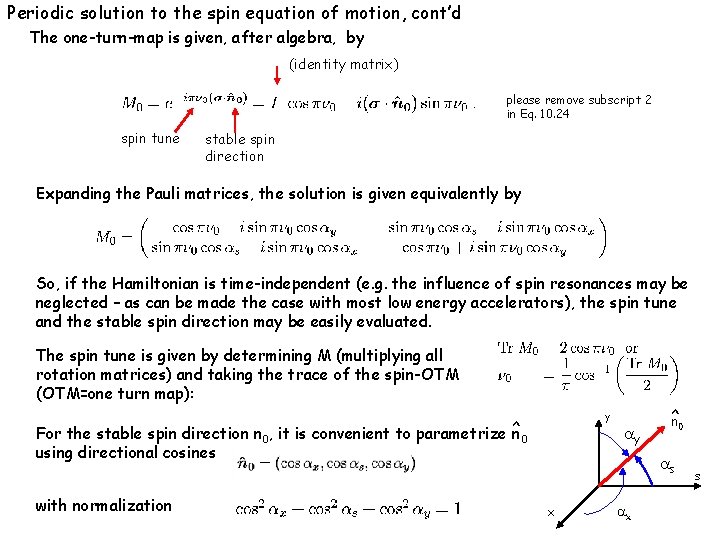
Periodic solution to the spin equation of motion, cont’d The one-turn-map is given, after algebra, by (identity matrix) please remove subscript 2 in Eq. 10. 24 spin tune stable spin direction Expanding the Pauli matrices, the solution is given equivalently by So, if the Hamiltonian is time-independent (e. g. the influence of spin resonances may be neglected – as can be made the case with most low energy accelerators), the spin tune and the stable spin direction may be easily evaluated. y > For the stable spin direction n 0, it is convenient to parametrize n 0 using directional cosines with normalization > The spin tune is given by determining M (multiplying all rotation matrices) and taking the trace of the spin-OTM (OTM=one turn map): y n 0 s x x s
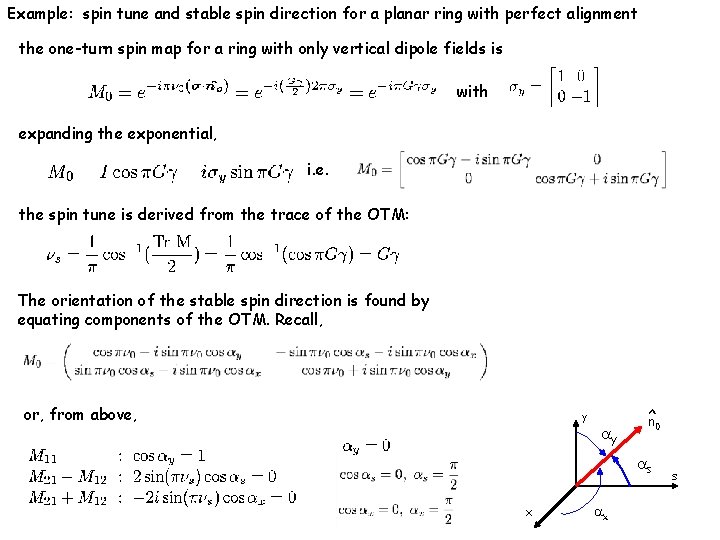
Example: spin tune and stable spin direction for a planar ring with perfect alignment the one-turn spin map for a ring with only vertical dipole fields is with expanding the exponential, i. e. the spin tune is derived from the trace of the OTM: or, from above, y > The orientation of the stable spin direction is found by equating components of the OTM. Recall, y n 0 s x x s
Depolarizing Resonances
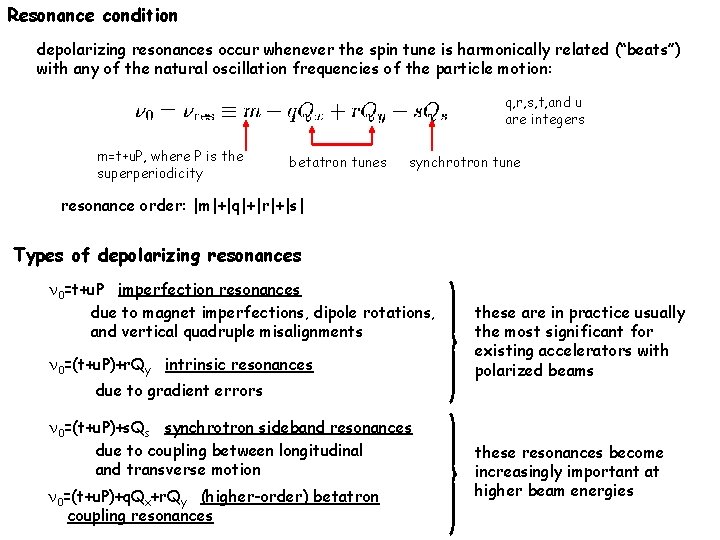
Resonance condition depolarizing resonances occur whenever the spin tune is harmonically related (“beats”) with any of the natural oscillation frequencies of the particle motion: q, r, s, t, and u are integers m=t+u. P, where P is the superperiodicity betatron tunes synchrotron tune resonance order: |m|+|q|+|r|+|s| Types of depolarizing resonances 0=t+u. P imperfection resonances due to magnet imperfections, dipole rotations, and vertical quadruple misalignments 0=(t+u. P)+r. Qy intrinsic resonances due to gradient errors 0=(t+u. P)+s. Qs synchrotron sideband resonances due to coupling between longitudinal and transverse motion 0=(t+u. P)+q. Qx+r. Qy (higher-order) betatron coupling resonances these are in practice usually the most significant for existing accelerators with polarized beams these resonances become increasingly important at higher beam energies
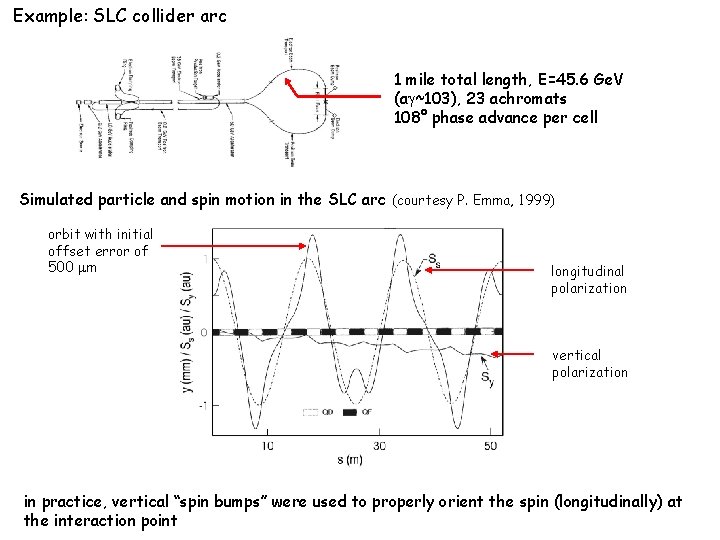
Example: SLC collider arc 1 mile total length, E=45. 6 Ge. V (a ~103), 23 achromats 108° phase advance per cell Simulated particle and spin motion in the SLC arc (courtesy P. Emma, 1999) orbit with initial offset error of 500 m longitudinal polarization vertical polarization in practice, vertical “spin bumps” were used to properly orient the spin (longitudinally) at the interaction point
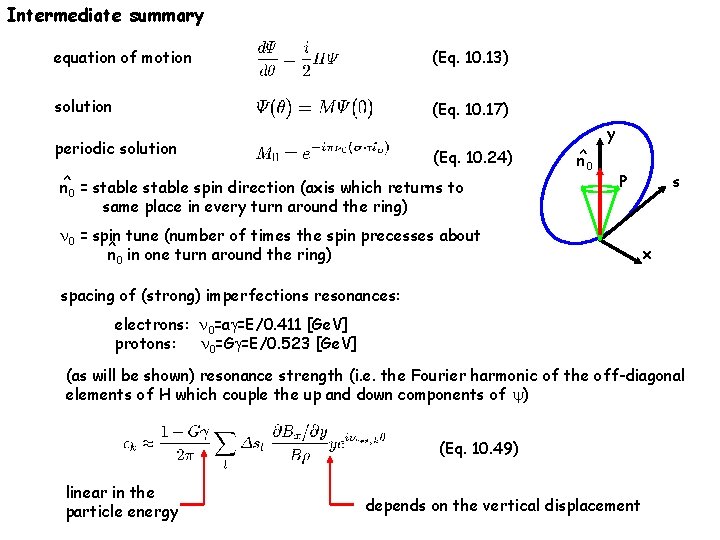
Intermediate summary equation of motion (Eq. 10. 13) solution (Eq. 10. 17) y (Eq. 10. 24) > n 0 = stable spin direction (axis which returns to same place in every turn around the ring) n 0 > periodic solution P > 0 = spin tune (number of times the spin precesses about n 0 in one turn around the ring) s x spacing of (strong) imperfections resonances: electrons: 0=a =E/0. 411 [Ge. V] protons: 0=G =E/0. 523 [Ge. V] (as will be shown) resonance strength (i. e. the Fourier harmonic of the off-diagonal elements of H which couple the up and down components of ) (Eq. 10. 49) linear in the particle energy depends on the vertical displacement

Polarization Preservation in Storage Rings
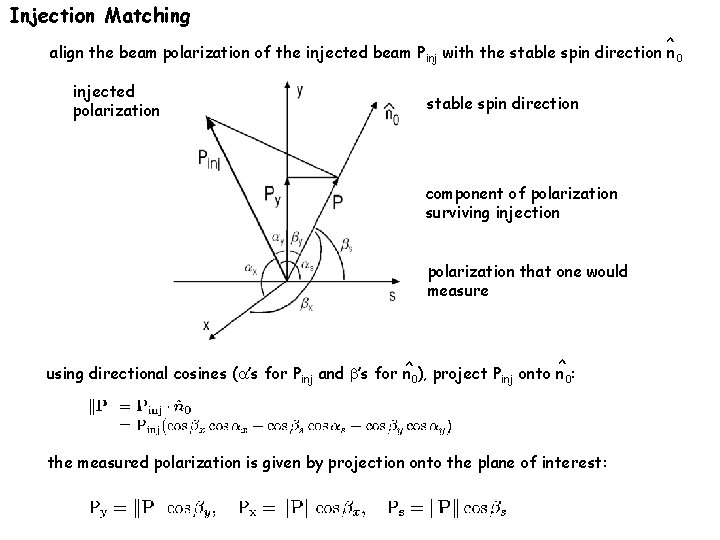
> Injection Matching align the beam polarization of the injected beam P inj with the stable spin direction n 0 injected polarization stable spin direction component of polarization surviving injection > polarization that one would measure > using directional cosines ( ’s for Pinj and ’s for n 0), project Pinj onto n 0: the measured polarization is given by projection onto the plane of interest:
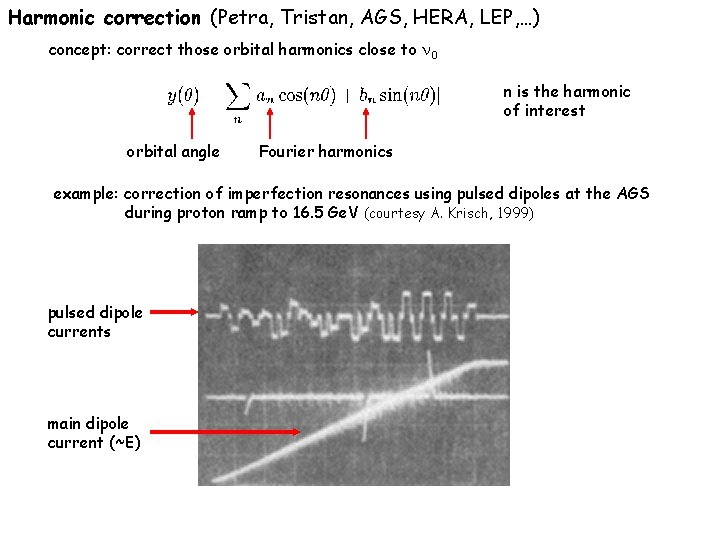
Harmonic correction (Petra, Tristan, AGS, HERA, LEP, …) concept: correct those orbital harmonics close to 0 n is the harmonic of interest orbital angle Fourier harmonics example: correction of imperfection resonances using pulsed dipoles at the AGS during proton ramp to 16. 5 Ge. V (courtesy A. Krisch, 1999) pulsed dipole currents main dipole current (~E)
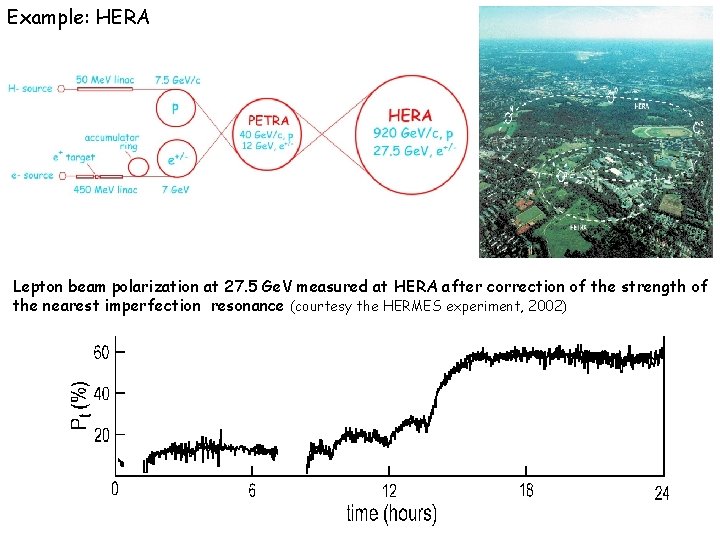
Example: HERA Lepton beam polarization at 27. 5 Ge. V measured at HERA after correction of the strength of the nearest imperfection resonance (courtesy the HERMES experiment, 2002)
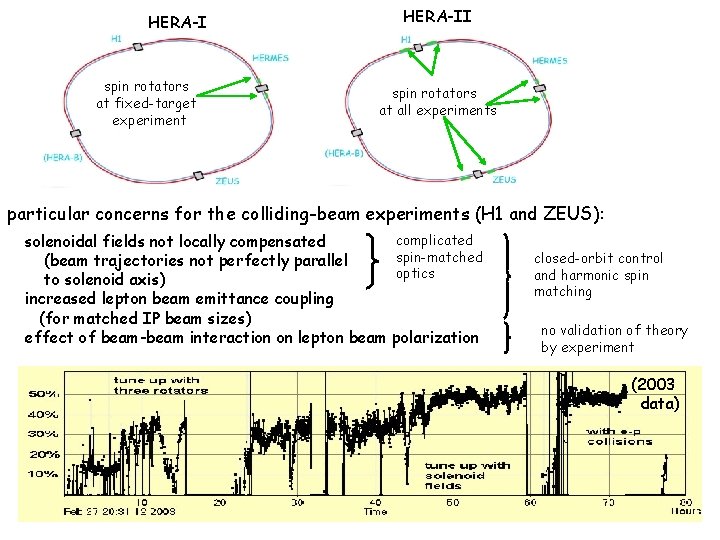
HERA-I spin rotators at fixed-target experiment HERA-II spin rotators at all experiments particular concerns for the colliding-beam experiments (H 1 and ZEUS): complicated solenoidal fields not locally compensated spin-matched (beam trajectories not perfectly parallel optics to solenoid axis) increased lepton beam emittance coupling (for matched IP beam sizes) effect of beam-beam interaction on lepton beam polarization closed-orbit control and harmonic spin matching no validation of theory by experiment (2003 data)
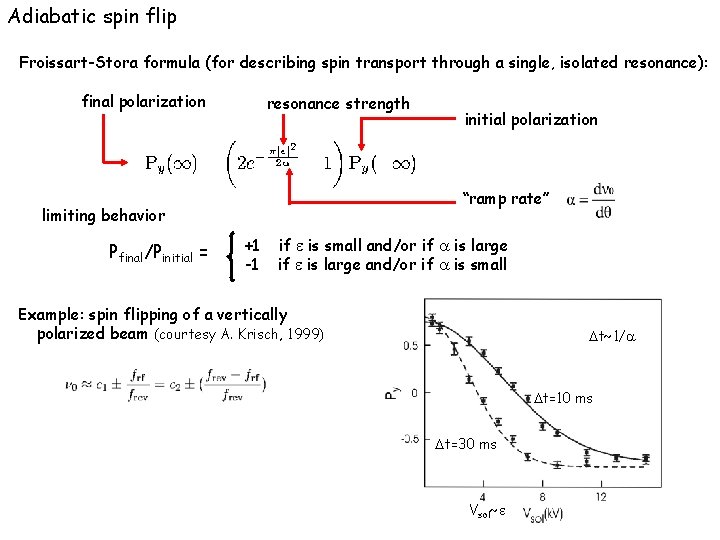
Adiabatic spin flip Froissart-Stora formula (for describing spin transport through a single, isolated resonance): final polarization resonance strength “ramp rate” limiting behavior Pfinal/Pinitial = initial polarization +1 -1 if is small and/or if is large and/or if is small Example: spin flipping of a vertically polarized beam (courtesy A. Krisch, 1999) t~1/ t=10 ms t=30 ms Vsol~
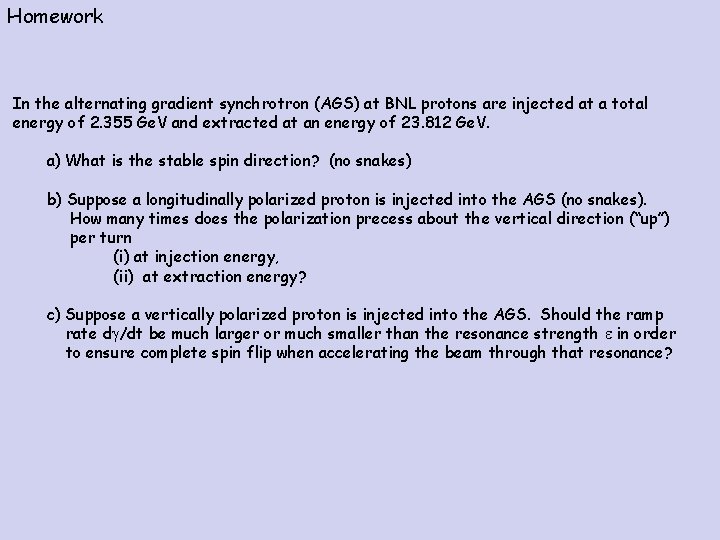
Homework In the alternating gradient synchrotron (AGS) at BNL protons are injected at a total energy of 2. 355 Ge. V and extracted at an energy of 23. 812 Ge. V. a) What is the stable spin direction? (no snakes) b) Suppose a longitudinally polarized proton is injected into the AGS (no snakes). How many times does the polarization precess about the vertical direction (“up”) per turn (i) at injection energy, (ii) at extraction energy? c) Suppose a vertically polarized proton is injected into the AGS. Should the ramp rate d /dt be much larger or much smaller than the resonance strength in order to ensure complete spin flip when accelerating the beam through that resonance?
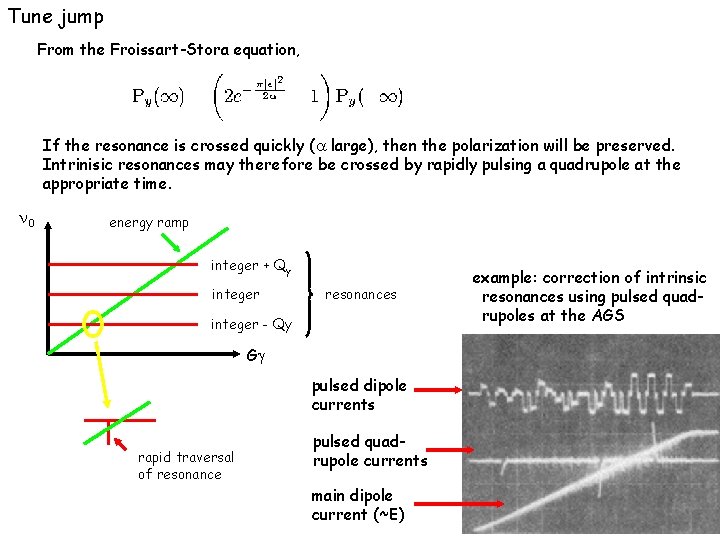
Tune jump From the Froissart-Stora equation, If the resonance is crossed quickly ( large), then the polarization will be preserved. Intrinisic resonances may therefore be crossed by rapidly pulsing a quadrupole at the appropriate time. 0 energy ramp integer + Qy integer resonances integer - Qy G pulsed dipole currents rapid traversal of resonance pulsed quadrupole currents main dipole current (~E) example: correction of intrinsic resonances using pulsed quadrupoles at the AGS
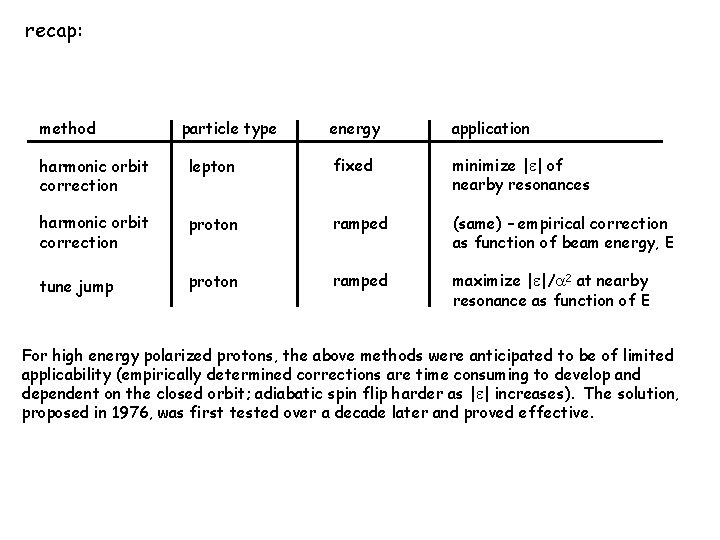
recap: method particle type energy application harmonic orbit correction lepton fixed minimize | | of nearby resonances harmonic orbit correction proton ramped (same) – empirical correction as function of beam energy, E tune jump proton ramped maximize | |/ 2 at nearby resonance as function of E For high energy polarized protons, the above methods were anticipated to be of limited applicability (empirically determined corrections are time consuming to develop and dependent on the closed orbit; adiabatic spin flip harder as | | increases). The solution, proposed in 1976, was first tested over a decade later and proved effective.
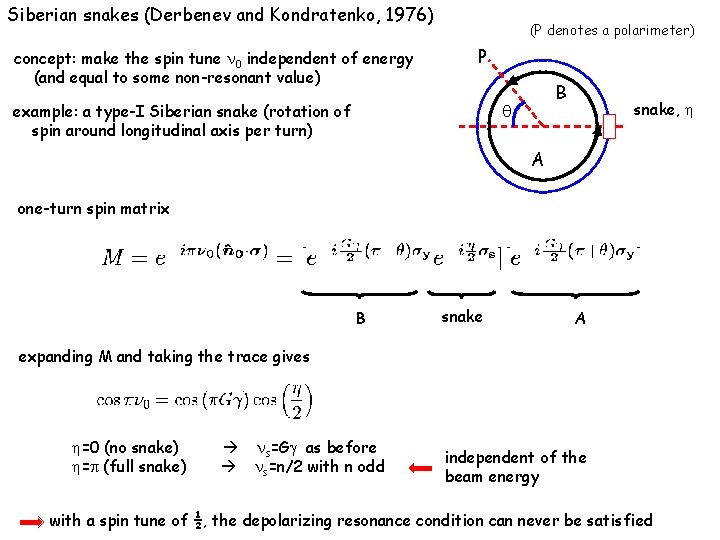
Siberian snakes (Derbenev and Kondratenko, 1976) concept: make the spin tune 0 independent of energy (and equal to some non-resonant value) (P denotes a polarimeter) P B example: a type-I Siberian snake (rotation of spin around longitudinal axis per turn) snake, A one-turn spin matrix B snake A expanding M and taking the trace gives =0 (no snake) = (full snake) s=G as before s=n/2 with n odd independent of the beam energy with a spin tune of ½, the depolarizing resonance condition can never be satisfied
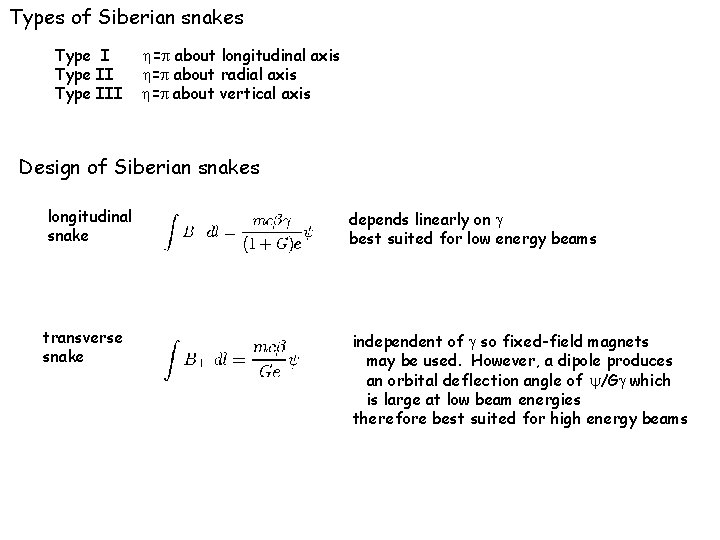
Types of Siberian snakes Type III = about longitudinal axis = about radial axis = about vertical axis Design of Siberian snakes longitudinal snake depends linearly on best suited for low energy beams transverse snake independent of so fixed-field magnets may be used. However, a dipole produces an orbital deflection angle of /G which is large at low beam energies therefore best suited for high energy beams
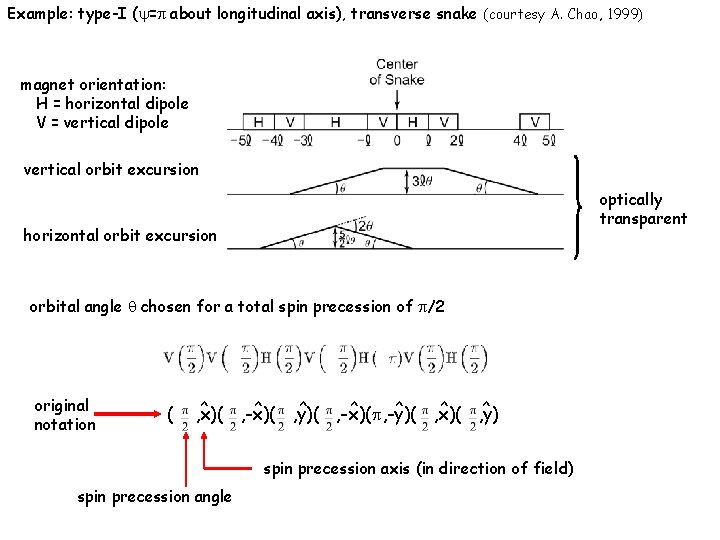
Example: type-I ( = about longitudinal axis), transverse snake (courtesy A. Chao, 1999) magnet orientation: H = horizontal dipole V = vertical dipole vertical orbit excursion optically transparent horizontal orbit excursion orbital angle chosen for a total spin precession of /2 > > > , x)( , -x)( , y)( , -x)( , -y)( , x)( , y) > ( > original notation spin precession axis (in direction of field) spin precession angle
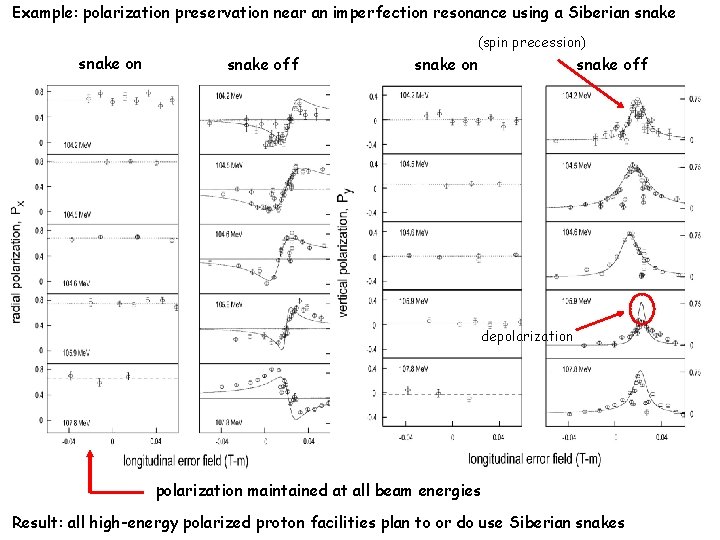
Example: polarization preservation near an imperfection resonance using a Siberian snake (spin precession) snake on snake off depolarization maintained at all beam energies Result: all high-energy polarized proton facilities plan to or do use Siberian snakes
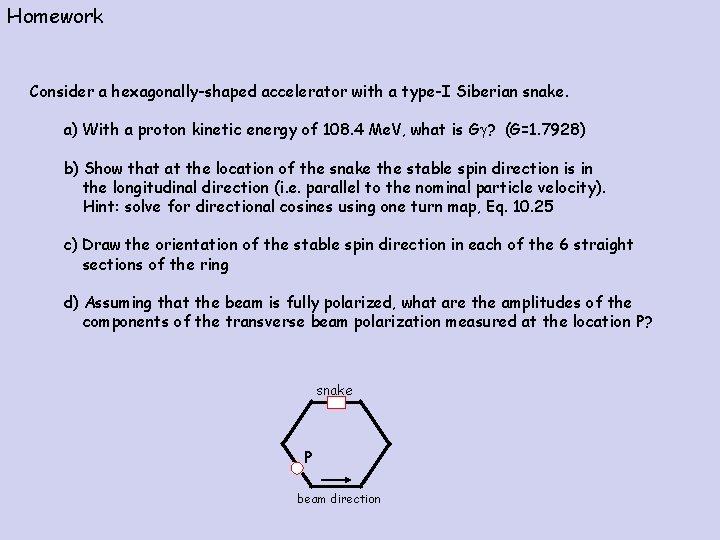
Homework Consider a hexagonally-shaped accelerator with a type-I Siberian snake. a) With a proton kinetic energy of 108. 4 Me. V, what is G ? (G=1. 7928) b) Show that at the location of the snake the stable spin direction is in the longitudinal direction (i. e. parallel to the nominal particle velocity). Hint: solve for directional cosines using one turn map, Eq. 10. 25 c) Draw the orientation of the stable spin direction in each of the 6 straight sections of the ring d) Assuming that the beam is fully polarized, what are the amplitudes of the components of the transverse beam polarization measured at the location P? snake P beam direction
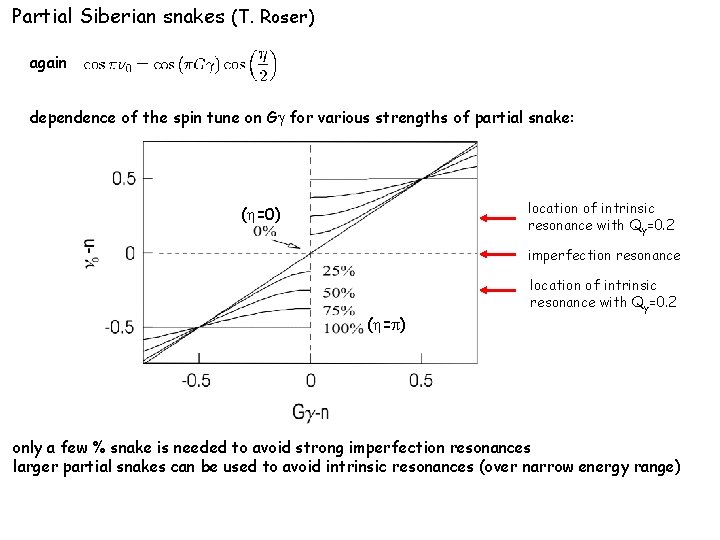
Partial Siberian snakes (T. Roser) again dependence of the spin tune on G for various strengths of partial snake: location of intrinsic resonance with Qy=0. 2 ( =0) imperfection resonance ( = ) location of intrinsic resonance with Qy=0. 2 only a few % snake is needed to avoid strong imperfection resonances larger partial snakes can be used to avoid intrinsic resonances (over narrow energy range)
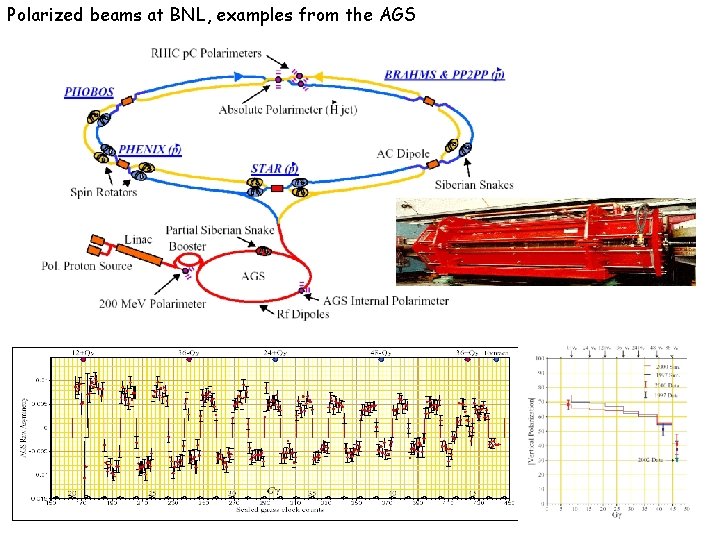
Polarized beams at BNL, examples from the AGS
Evaluation of Resonance Strengths
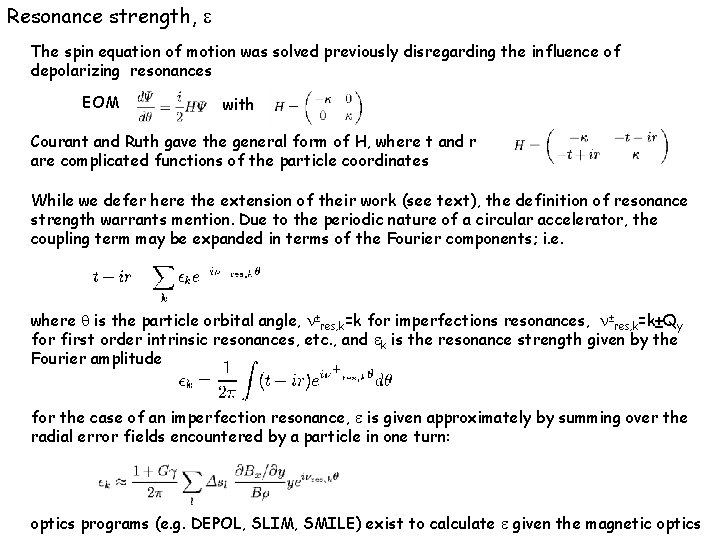
Resonance strength, The spin equation of motion was solved previously disregarding the influence of depolarizing resonances EOM with Courant and Ruth gave the general form of H, where t and r are complicated functions of the particle coordinates While we defer here the extension of their work (see text), the definition of resonance strength warrants mention. Due to the periodic nature of a circular accelerator, the coupling term may be expanded in terms of the Fourier components; i. e. where is the particle orbital angle, ±res, k=k for imperfections resonances, ±res, k=k±Qy for first order intrinsic resonances, etc. , and k is the resonance strength given by the Fourier amplitude for the case of an imperfection resonance, is given approximately by summing over the radial error fields encountered by a particle in one turn: optics programs (e. g. DEPOL, SLIM, SMILE) exist to calculate given the magnetic optics
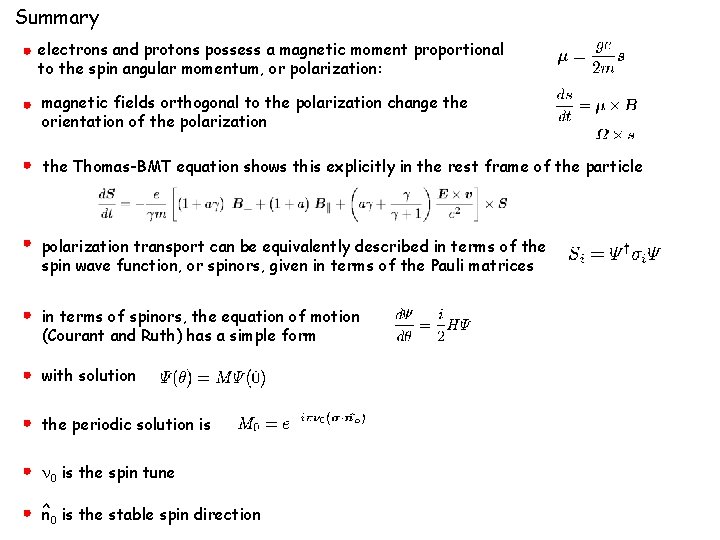
Summary electrons and protons possess a magnetic moment proportional to the spin angular momentum, or polarization: magnetic fields orthogonal to the polarization change the orientation of the polarization the Thomas-BMT equation shows this explicitly in the rest frame of the particle polarization transport can be equivalently described in terms of the spin wave function, or spinors, given in terms of the Pauli matrices in terms of spinors, the equation of motion (Courant and Ruth) has a simple form with solution the periodic solution is 0 is the spin tune > n 0 is the stable spin direction
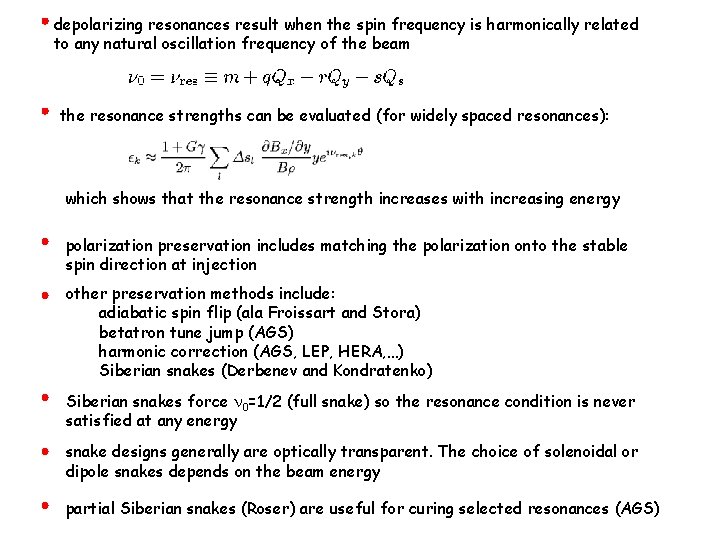
depolarizing resonances result when the spin frequency is harmonically related to any natural oscillation frequency of the beam the resonance strengths can be evaluated (for widely spaced resonances): which shows that the resonance strength increases with increasing energy polarization preservation includes matching the polarization onto the stable spin direction at injection other preservation methods include: adiabatic spin flip (ala Froissart and Stora) betatron tune jump (AGS) harmonic correction (AGS, LEP, HERA, …) Siberian snakes (Derbenev and Kondratenko) Siberian snakes force 0=1/2 (full snake) so the resonance condition is never satisfied at any energy snake designs generally are optically transparent. The choice of solenoidal or dipole snakes depends on the beam energy partial Siberian snakes (Roser) are useful for curing selected resonances (AGS)
To do Add partial snake data (IUCF or AGS) Add harmonic correction in LEP (use prior hand-written USPAS notes) Add new AGS tune jump data Expand on snake designs ala Steffen Add spin tune meter / spin flipper concept ala RHIC Add energy measurement ala resonant depolarization (ala IUCF, LEP)
- Slides: 37