
Beam Physics Application of Diagnostics Natalia Milas Beam

Beam Physics Application of Diagnostics Natalia Milas Beam Physics Section Beam Instrumentation Forum 23. 10. 2019 Warsaw, Poland
Overview • Beam Physics and Diagnostics are in a long term relationship… – What is important – Location • Most common use cases • Non-standard uses • Conclusion 2
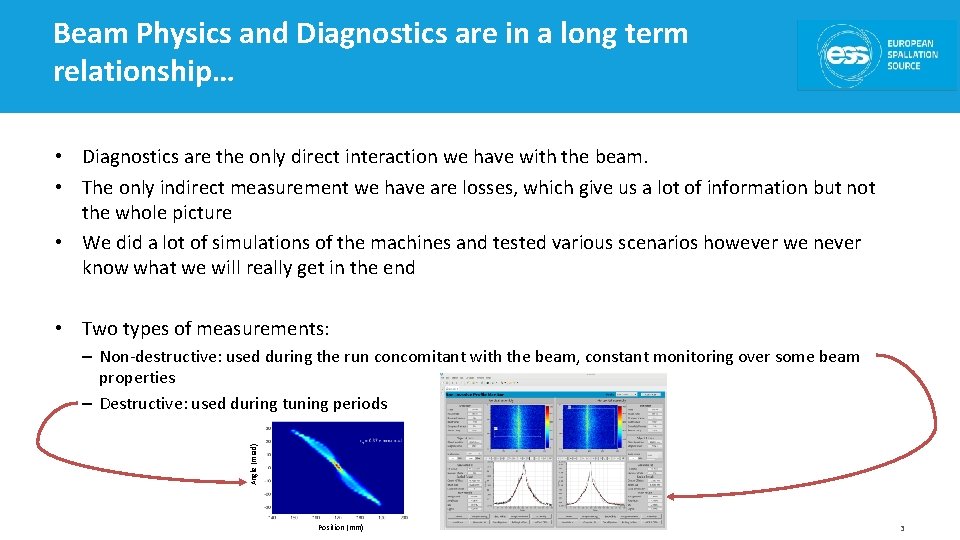
Beam Physics and Diagnostics are in a long term relationship… • Diagnostics are the only direct interaction we have with the beam. • The only indirect measurement we have are losses, which give us a lot of information but not the whole picture • We did a lot of simulations of the machines and tested various scenarios however we never know what we will really get in the end • Two types of measurements: Angle (mrad) – Non-destructive: used during the run concomitant with the beam, constant monitoring over some beam properties – Destructive: used during tuning periods Position (mm) 3
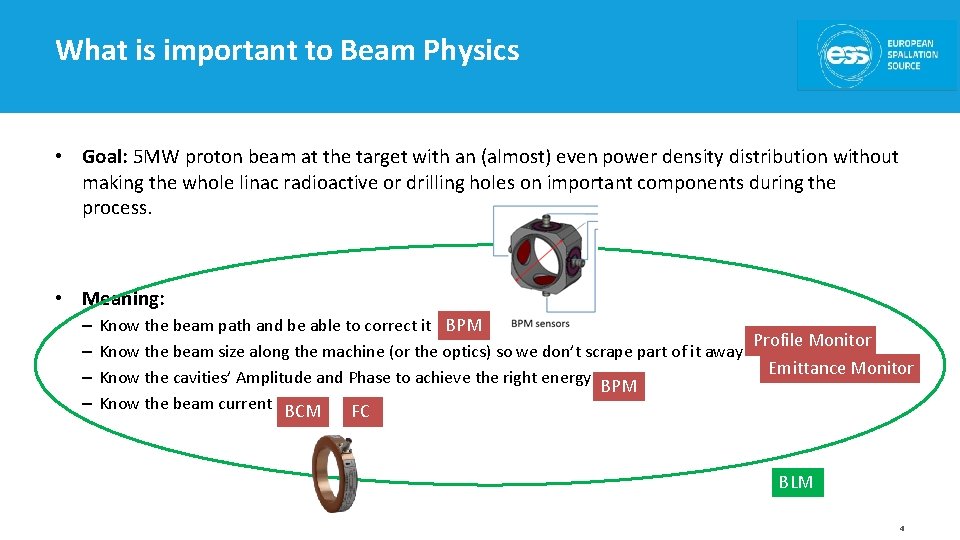
What is important to Beam Physics • Goal: 5 MW proton beam at the target with an (almost) even power density distribution without making the whole linac radioactive or drilling holes on important components during the process. • Meaning: – – Know the beam path and be able to correct it BPM Profile Monitor Know the beam size along the machine (or the optics) so we don’t scrape part of it away Emittance Monitor Know the cavities’ Amplitude and Phase to achieve the right energy BPM Know the beam current BCM FC BLM 4
Interlude: Beam Physics Crash course • To simplify and get some feeling for the beam behaviour it is useful to think that the beam particles behave as a harmonic oscillator. • Since we have 3 dimensions we can think as 3 decoupled oscillators each with its specific constants of motion. • Looking at only one dimension we have some properties that can be drawn: – Volume in phase space should be a constant of the motion (in the absence of non-linear forces) – In phase space the particles describe a circle (in our case since variables are not normalized it is an ellipse) – For an ensemble of particle we can think of an envelope function that describes the evolution of the beam as it goes through the accelerator. – Quads define the restoring force in our oscillator thus defining the envelope function boundaries • In our case (non-relativistic hadrons) we have to account for space charge effects, i. e. , the fact that the electrostatic force between particles is pushing them apart. 5
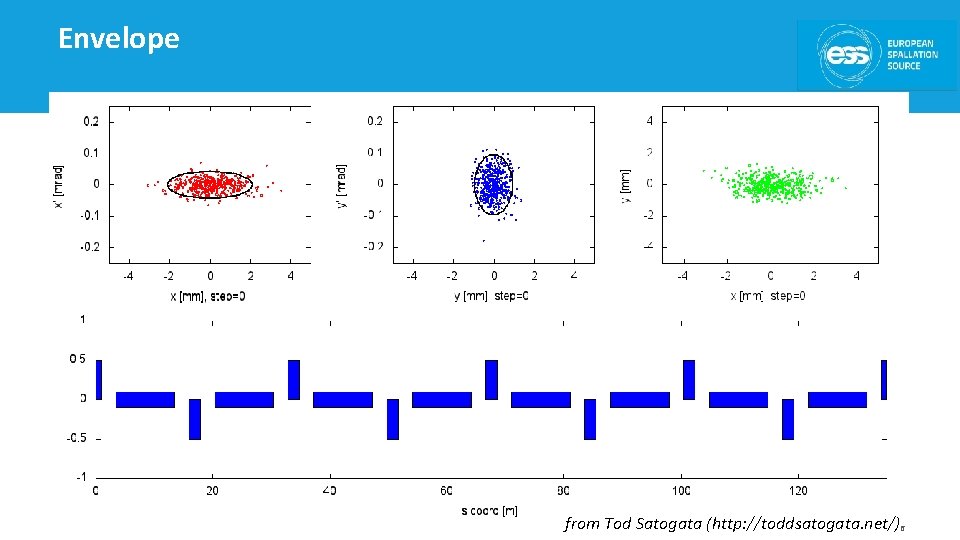
Envelope from Tod Satogata (http: //toddsatogata. net/)6
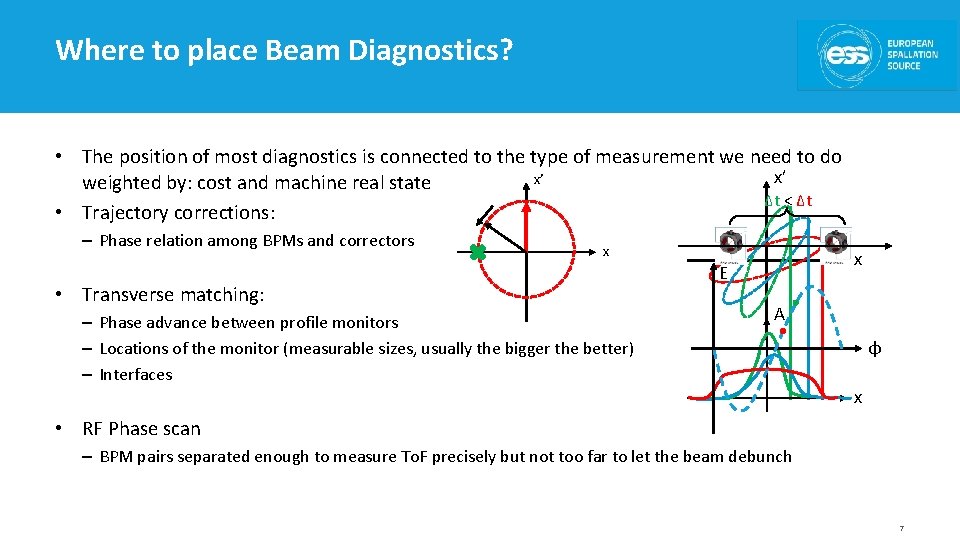
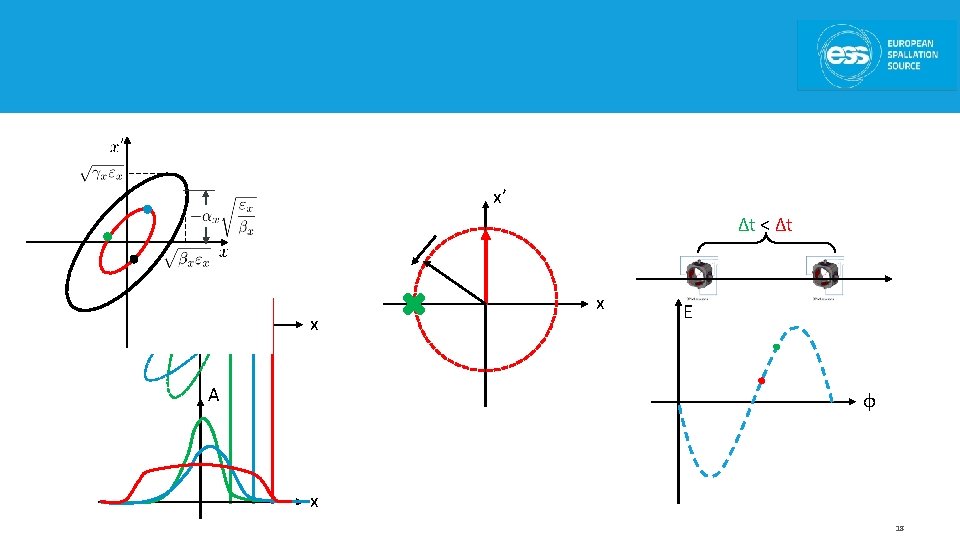
Where to place Beam Diagnostics? • The position of most diagnostics is connected to the type of measurement we need to do x’ x’ weighted by: cost and machine real state ∆t < ∆t • Trajectory corrections: – Phase relation among BPMs and correctors x • Transverse matching: – Phase advance between profile monitors – Locations of the monitor (measurable sizes, usually the bigger the better) – Interfaces x E A φ x • RF Phase scan – BPM pairs separated enough to measure To. F precisely but not too far to let the beam debunch 7
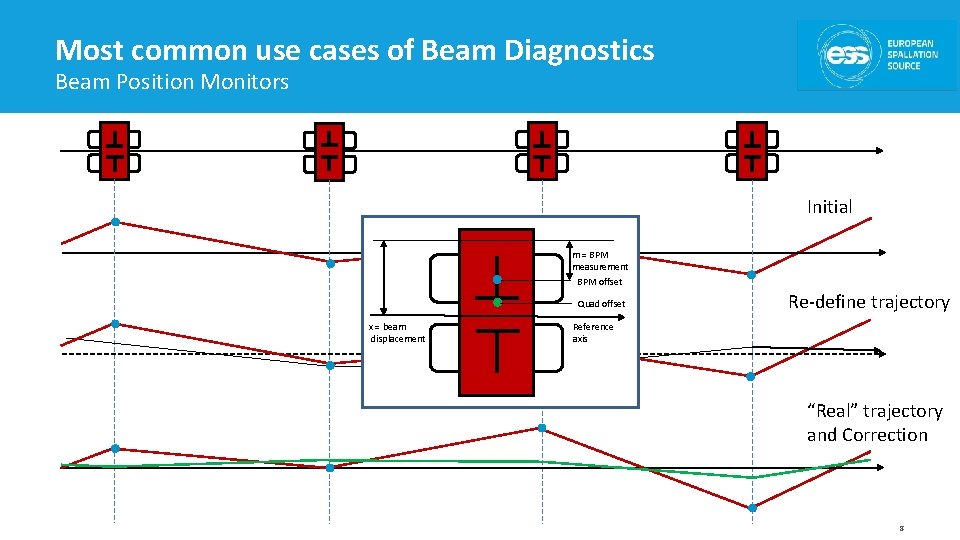
Most common use cases of Beam Diagnostics Beam Position Monitors Initial m = BPM measurement BPM offset Quad offset x = beam displacement Re-define trajectory Reference axis “Real” trajectory and Correction 8
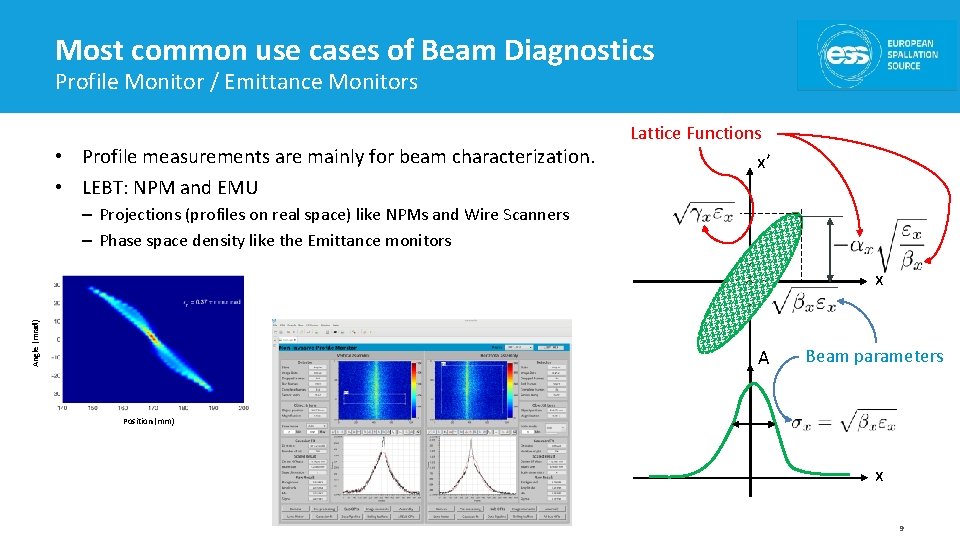
Most common use cases of Beam Diagnostics Profile Monitor / Emittance Monitors • Profile measurements are mainly for beam characterization. • LEBT: NPM and EMU Lattice Functions x’ – Projections (profiles on real space) like NPMs and Wire Scanners – Phase space density like the Emittance monitors Angle (mrad) x A Beam parameters Position (mm) x 9
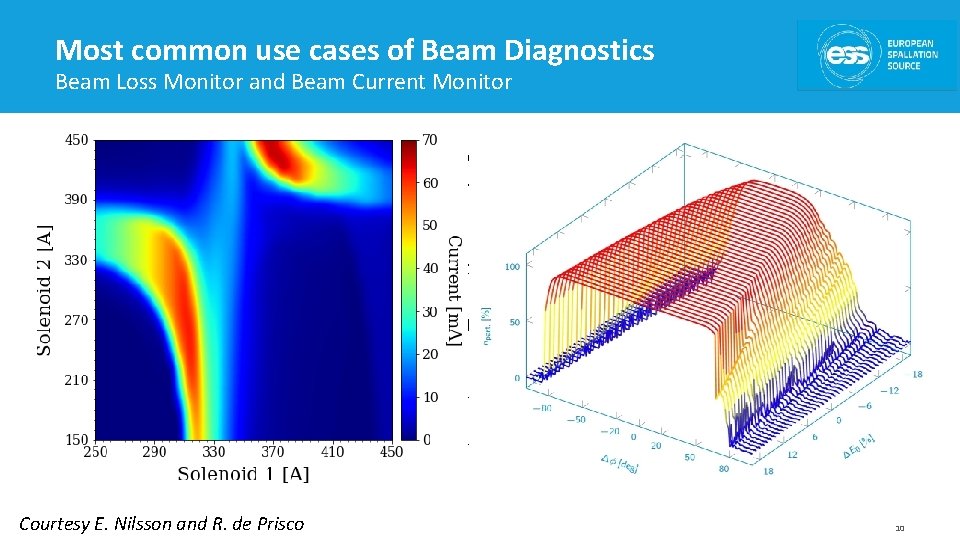
Most common use cases of Beam Diagnostics Beam Loss Monitor and Beam Current Monitor • Those two types of diagnostics are usually closed related to machine protection as well. • Their measurements are complementary in the sense that one measures what is transported and the other what is lost. • ”You do not need a BLM-System as long as you have a perfect machine without any problems. However, you probably do not have such a nice machine, therefore you better install one” • What do they tell us: – Transmission/loss measurements can give us a feel of how matched the beam is to the lattice (RFQ transmissions) – Give us an idea of the RF optimum position -> planned transmission curve measured for DTL 1 – BLM loss pattern can help us understand halo formation and also diagnose sections that might have poor matching. – Fast and reliable diagnostics for machines issues (vacuum leaks, obstructions, etc. . ) Courtesy E. Nilsson and R. de Prisco 10

Unconventional uses Beam Position Monitors • BPMs give us the position of the beam centroid along the Linac, is that the only information in the measured signal? • Quadrupolar terms carry information about the beam rms sizes. • “free” measurement of the beam ellipticity • Usages: – Monitor changes in the relative beam sizes along machine – Matching fine tuning and optimization 11
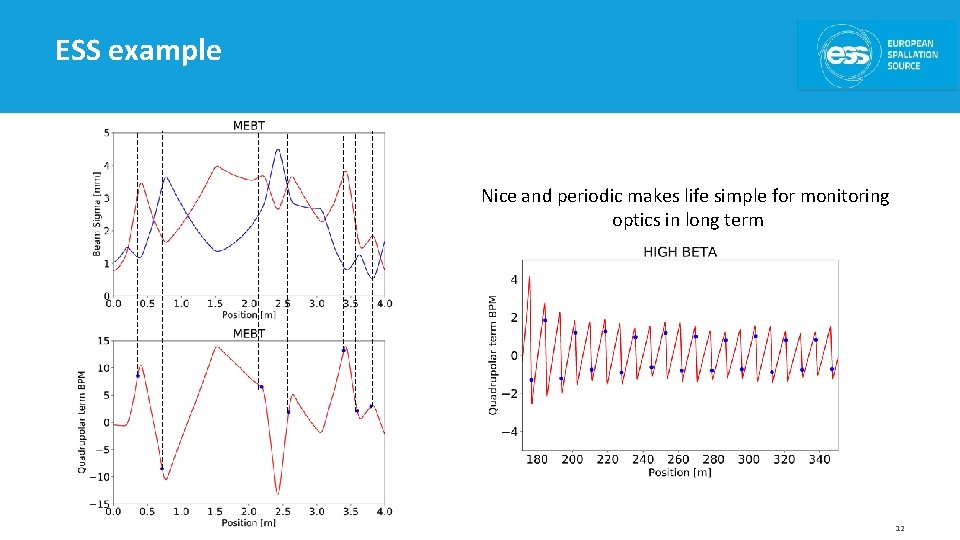
ESS example Nice and periodic makes life simple for monitoring optics in long term 12
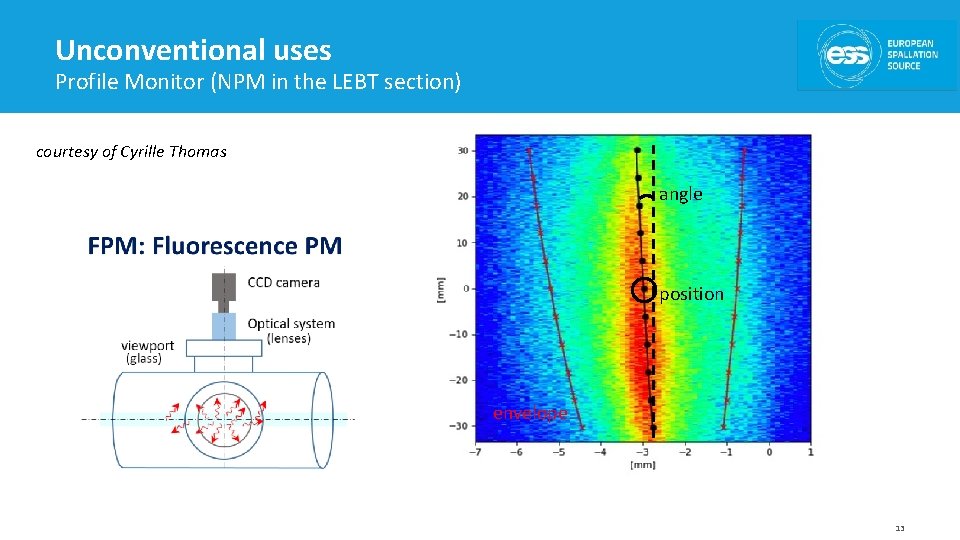
Unconventional uses Profile Monitor (NPM in the LEBT section) courtesy of Cyrille Thomas angle position envelope 13
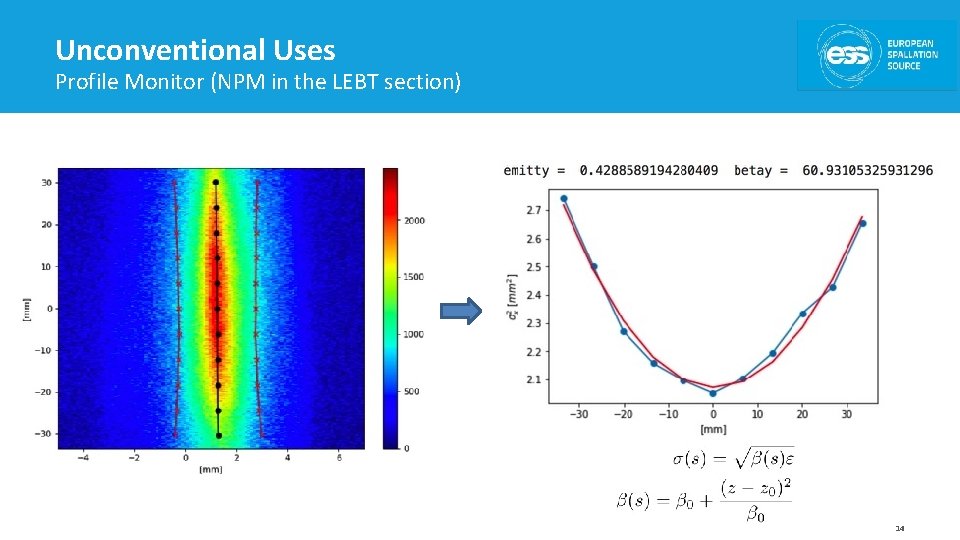
Unconventional Uses Profile Monitor (NPM in the LEBT section) 14
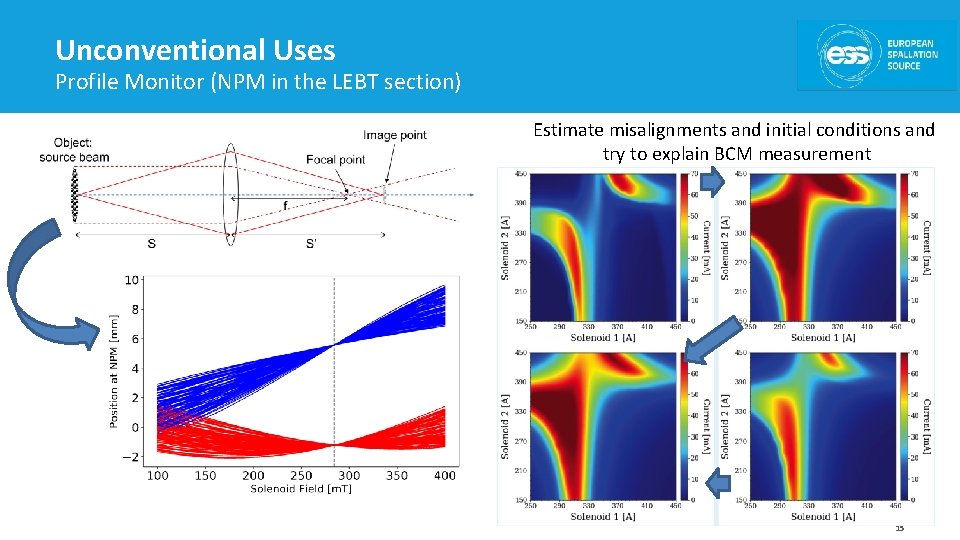
Unconventional Uses Profile Monitor (NPM in the LEBT section) Estimate misalignments and initial conditions and try to explain BCM measurement 15
Conclusion • Diagnostics enable us to verify that the machine we actually put together corresponds to the one we modelled. • Usually they don’t match 100%, again we use BI to make model and reality to get closer together or, in some cases, to find another set point in which the machine works better • Bottom line: We need diagnostics to do anything Beam Physics related. We will always push it to the limit. Very often we will ask from it more than we have previously defined, just to make your life more exciting! 16

Thank you! Questions?
- Slides: 18