
BEAM PATTERNS OF LINEAR ARRAYS Richard Stern Department
BEAM PATTERNS OF LINEAR ARRAYS Richard Stern Department of Electrical and Computer Engineering and School of Computer Science Carnegie Mellon University Pittsburgh, Pennsylvania 15213 Telephone: (412) 268 -2535; FAX: (412) 268 -3890 Email: rms@cs. cmu. edu; http: //www. ece. cmu. edu/~rms November 23, 2020

Delay-and-sum beamforming Simple processing based on equalizing delays to sensors High directivity can be achieved with many sensors z-n 1 Sensor 2 Sensor K Carnegie Mellon z-n 2 Output z-n. K Slide 2 ECE and SCS Robust Speech Group

The physics of delay-and-sum beamforming d q dsin(q) Carnegie Mellon Slide 3 ECE and SCS Robust Speech Group
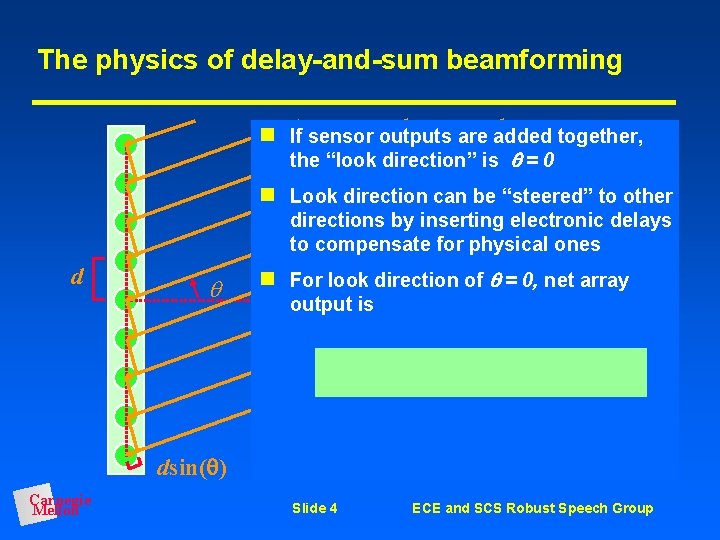
The physics of delay-and-sum beamforming If sensor outputs are added together, the “look direction” is q = 0 Look direction can be “steered” to other directions by inserting electronic delays to compensate for physical ones d q For look direction of q = 0, net array output is dsin(q) Carnegie Mellon Slide 4 ECE and SCS Robust Speech Group
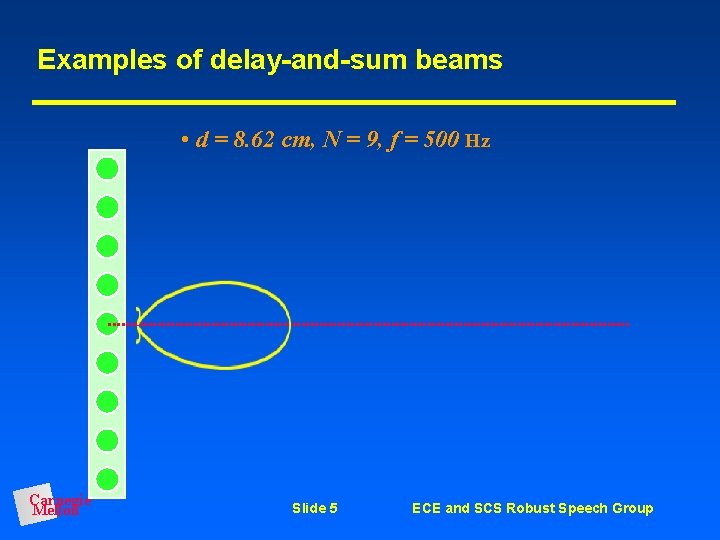
Examples of delay-and-sum beams • d = 8. 62 cm, N = 9, f = 500 Hz Carnegie Mellon Slide 5 ECE and SCS Robust Speech Group
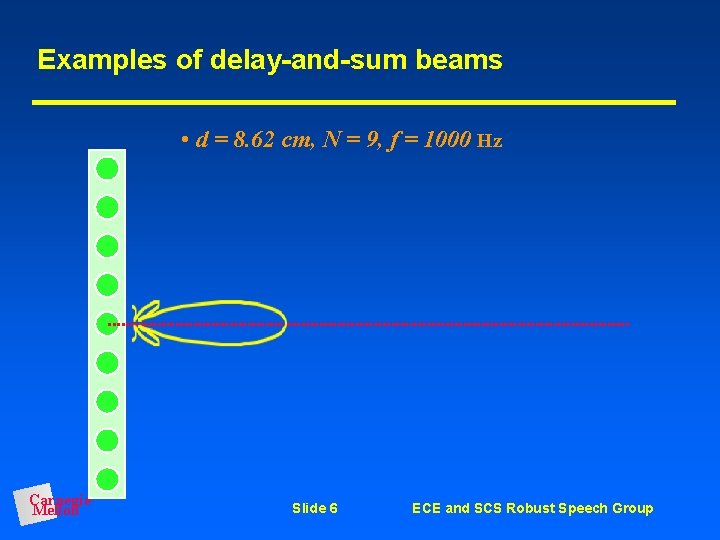
Examples of delay-and-sum beams • d = 8. 62 cm, N = 9, f = 1000 Hz Carnegie Mellon Slide 6 ECE and SCS Robust Speech Group
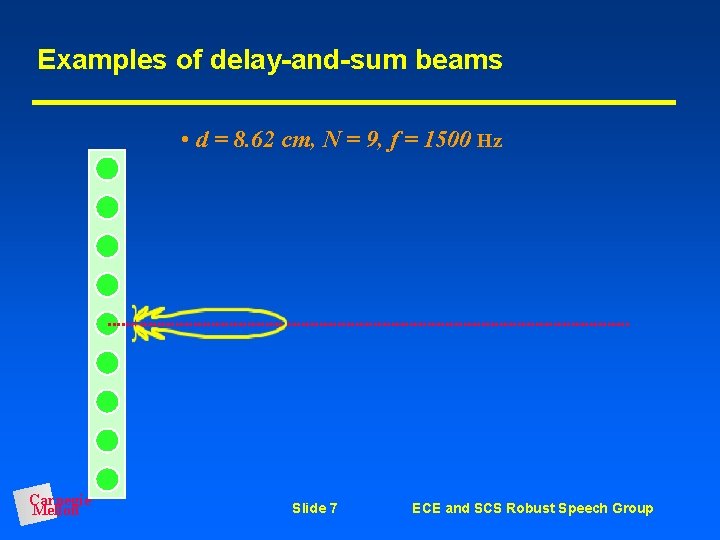
Examples of delay-and-sum beams • d = 8. 62 cm, N = 9, f = 1500 Hz Carnegie Mellon Slide 7 ECE and SCS Robust Speech Group
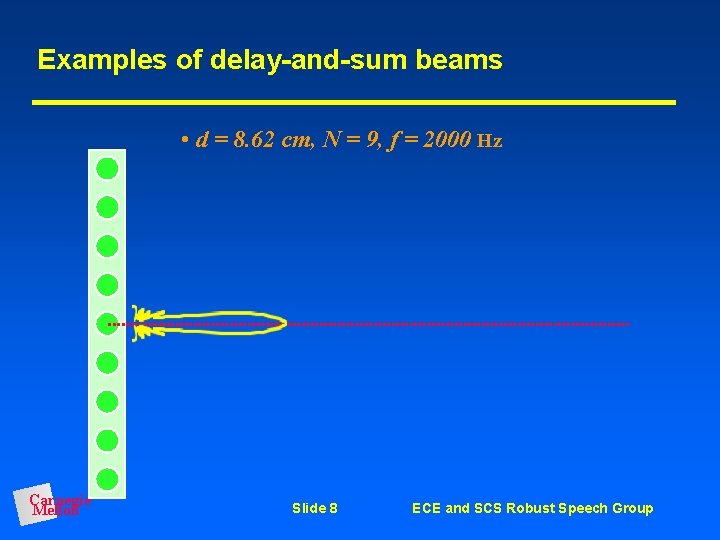
Examples of delay-and-sum beams • d = 8. 62 cm, N = 9, f = 2000 Hz Carnegie Mellon Slide 8 ECE and SCS Robust Speech Group
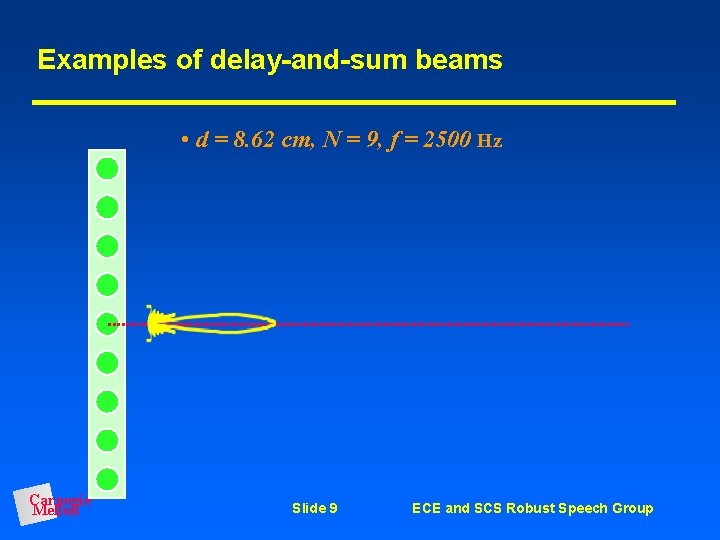
Examples of delay-and-sum beams • d = 8. 62 cm, N = 9, f = 2500 Hz Carnegie Mellon Slide 9 ECE and SCS Robust Speech Group
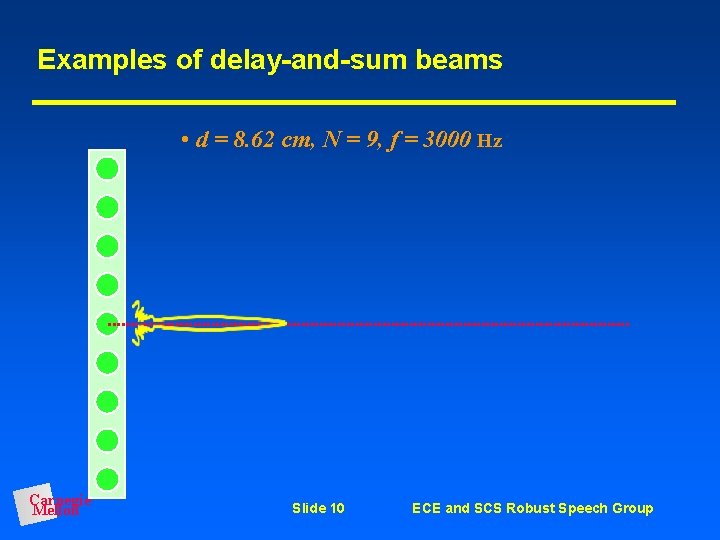
Examples of delay-and-sum beams • d = 8. 62 cm, N = 9, f = 3000 Hz Carnegie Mellon Slide 10 ECE and SCS Robust Speech Group
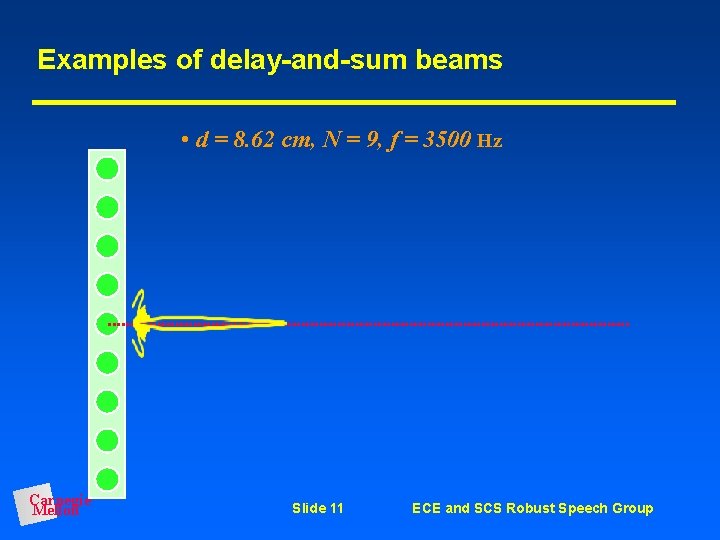
Examples of delay-and-sum beams • d = 8. 62 cm, N = 9, f = 3500 Hz Carnegie Mellon Slide 11 ECE and SCS Robust Speech Group
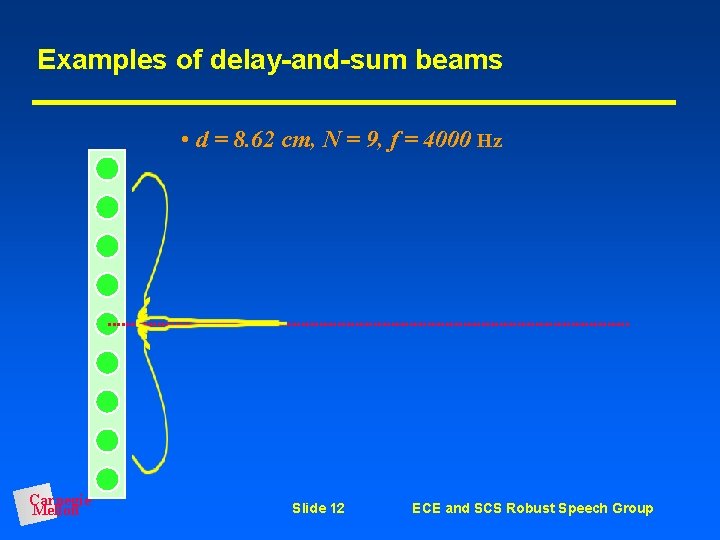
Examples of delay-and-sum beams • d = 8. 62 cm, N = 9, f = 4000 Hz Carnegie Mellon Slide 12 ECE and SCS Robust Speech Group
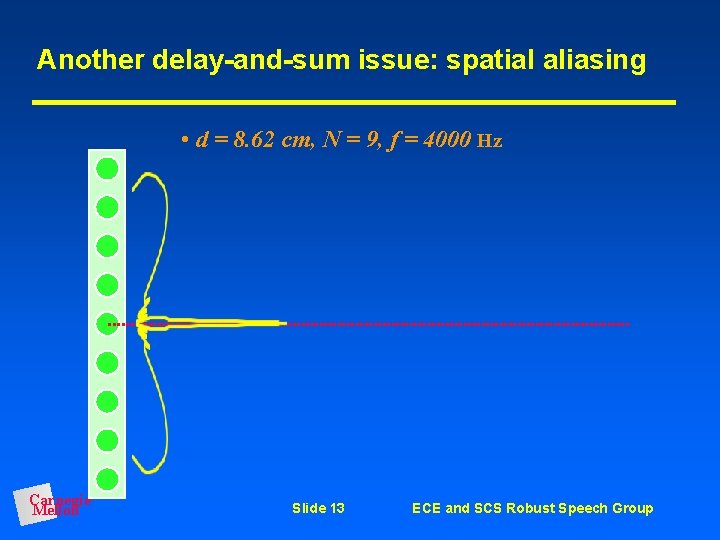
Another delay-and-sum issue: spatial aliasing • d = 8. 62 cm, N = 9, f = 4000 Hz Carnegie Mellon Slide 13 ECE and SCS Robust Speech Group
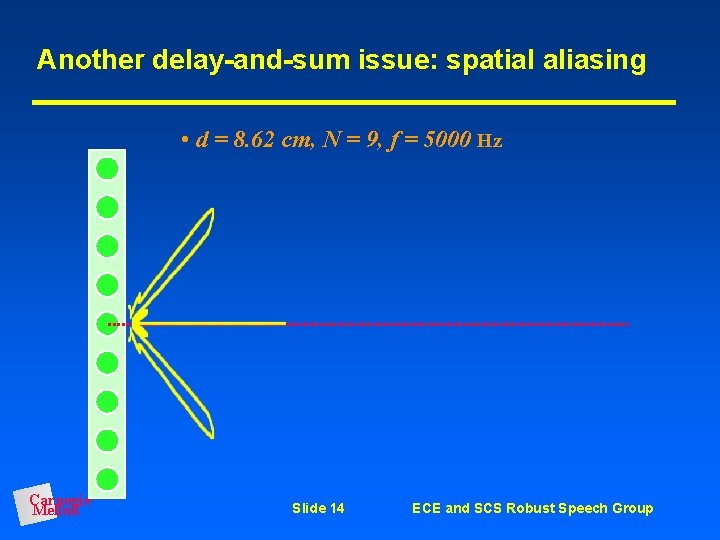
Another delay-and-sum issue: spatial aliasing • d = 8. 62 cm, N = 9, f = 5000 Hz Carnegie Mellon Slide 14 ECE and SCS Robust Speech Group
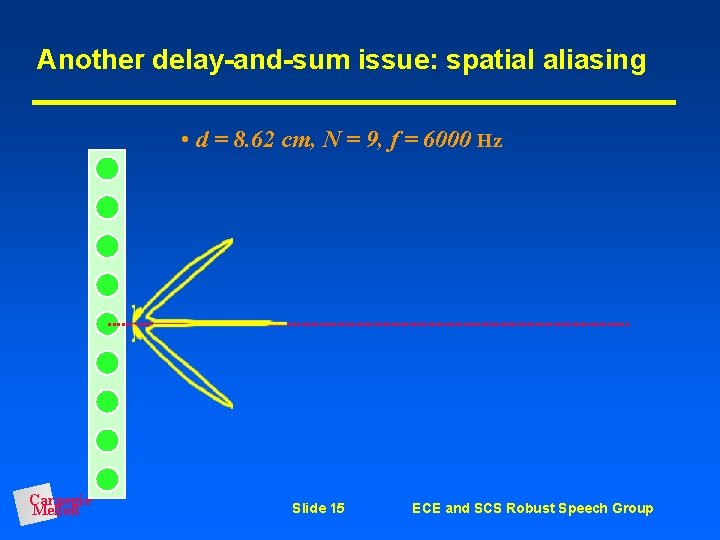
Another delay-and-sum issue: spatial aliasing • d = 8. 62 cm, N = 9, f = 6000 Hz Carnegie Mellon Slide 15 ECE and SCS Robust Speech Group
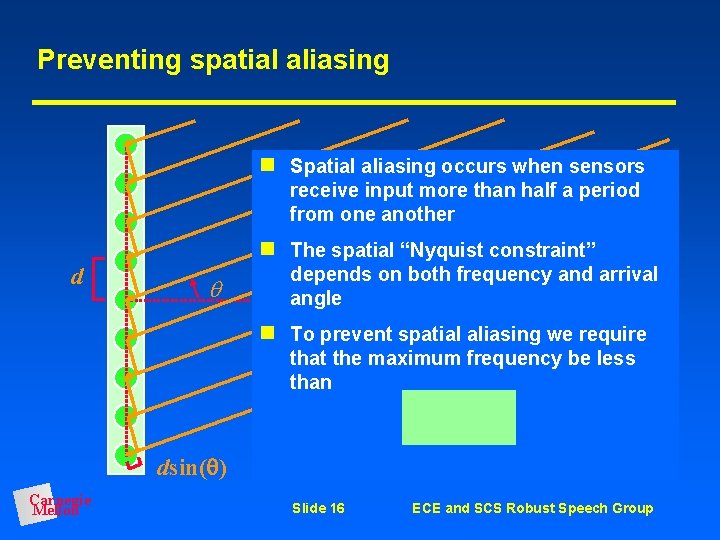
Preventing spatial aliasing Spatial aliasing occurs when sensors receive input more than half a period from one another The spatial “Nyquist constraint” d q depends on both frequency and arrival angle To prevent spatial aliasing we require that the maximum frequency be less than dsin(q) Carnegie Mellon Slide 16 ECE and SCS Robust Speech Group

- Slides: 17