
Beam Line XRays T Ishikawa Part 1 General
Beam Line – X-Rays T. Ishikawa Part 1. General Discussion Part 2. Beamline X-Ray Optics JASS 02 1
Introduction n n 10/29/2021 In the 1 st part, general aspects of x-ray beamlines are presented. The 2 nd part is devoted to the discussion of xray optics for beamlines, including some detail of double-crystal x-ray monochromators. JASS 02 2

Beamline as an Optical System Protection Light Source Performance Source Radiation Heat Load Human Failures End Station Beam Line System Output = X-Ray Beam Requested by Users System Input = Bare SR Beam Safety Available Space Necessary Utilities 10/29/2021 JASS 02 3
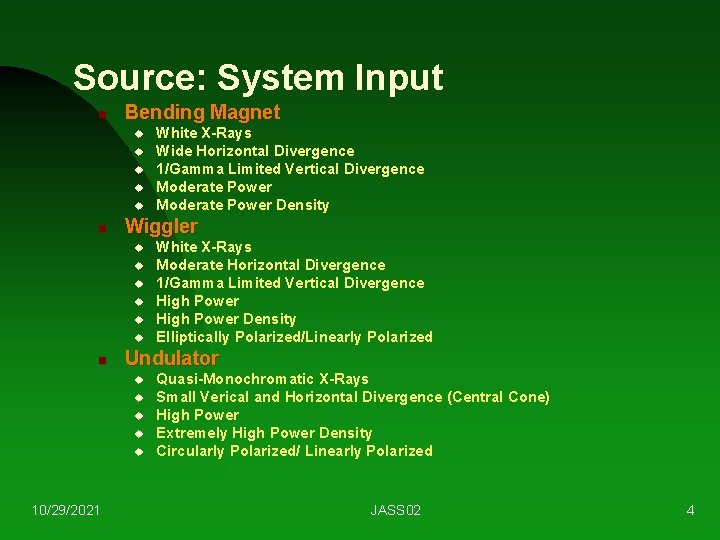
Source: System Input n Bending Magnet u u u n Wiggler u u u n White X-Rays Moderate Horizontal Divergence 1/Gamma Limited Vertical Divergence High Power Density Elliptically Polarized/Linearly Polarized Undulator u u u 10/29/2021 White X-Rays Wide Horizontal Divergence 1/Gamma Limited Vertical Divergence Moderate Power Density Quasi-Monochromatic X-Rays Small Verical and Horizontal Divergence (Central Cone) High Power Extremely High Power Density Circularly Polarized/ Linearly Polarized JASS 02 4
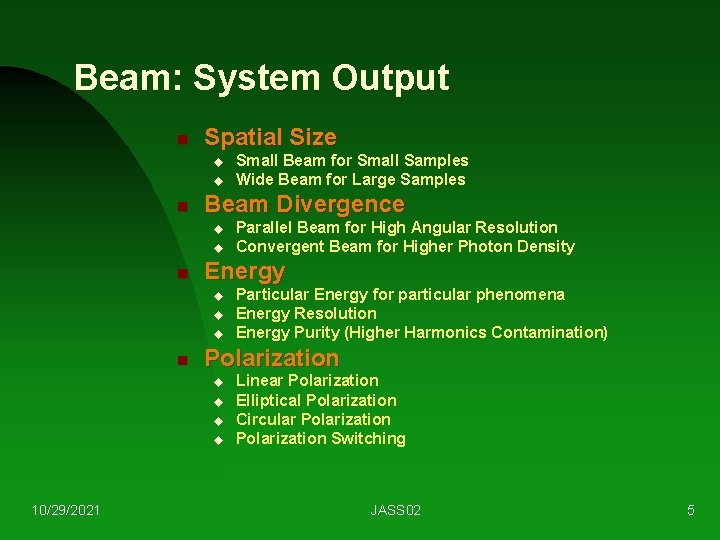
Beam: System Output n Spatial Size u u n Beam Divergence u u n u u Particular Energy for particular phenomena Energy Resolution Energy Purity (Higher Harmonics Contamination) Polarization u u 10/29/2021 Parallel Beam for High Angular Resolution Convergent Beam for Higher Photon Density Energy u n Small Beam for Small Samples Wide Beam for Large Samples Linear Polarization Elliptical Polarization Circular Polarization Switching JASS 02 5
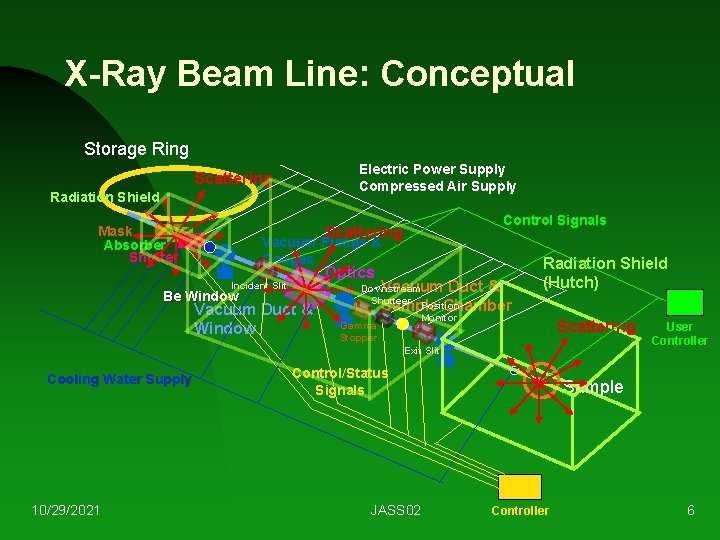
X-Ray Beam Line: Conceptual Storage Ring Electric Power Supply Compressed Air Supply Scattering Radiation Shield Mask Absorber Shutter Scattering Vacuum Pumps & Gauges Optics Incident Slit Be Window Vacuum Duct & Window Cooling Water Supply 10/29/2021 Control Signals Vacuum Duct & Sample Chamber Downstream Shutteer Position Monitor Gamma Stopper Exit Slit Radiation Shield (Hutch) Scattering Control/Status Signals JASS 02 User Controller Sample Controller 6
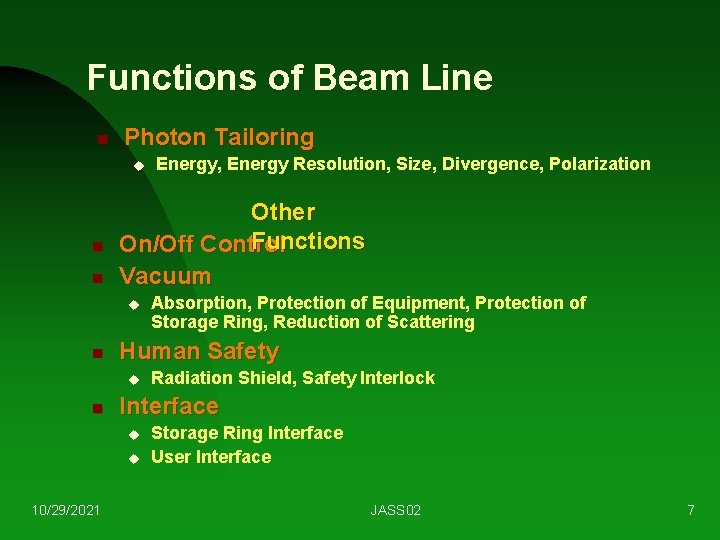
Functions of Beam Line n Photon Tailoring u n n Other Functions On/Off Control Vacuum u n Radiation Shield, Safety Interlock Interface u u 10/29/2021 Absorption, Protection of Equipment, Protection of Storage Ring, Reduction of Scattering Human Safety u n Energy, Energy Resolution, Size, Divergence, Polarization Storage Ring Interface User Interface JASS 02 7
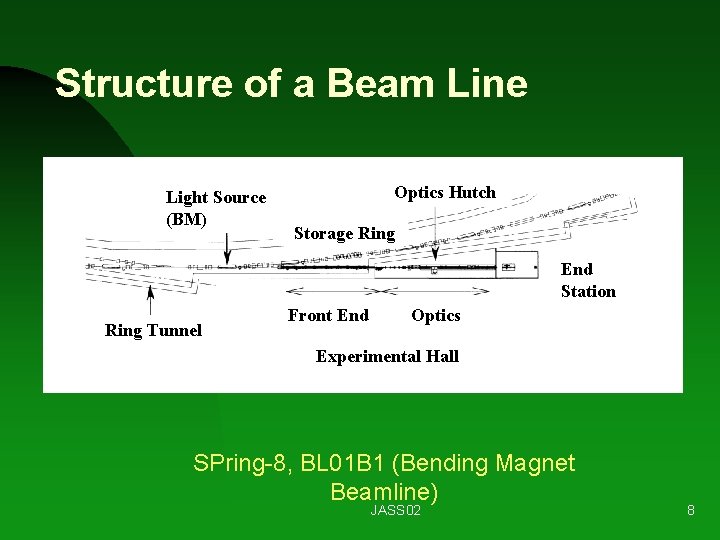
Structure of a Beam Line Light Source (BM) Optics Hutch Storage Ring End Station Ring Tunnel Front End Optics Experimental Hall SPring-8, BL 01 B 1 (Bending Magnet Beamline) JASS 02 8
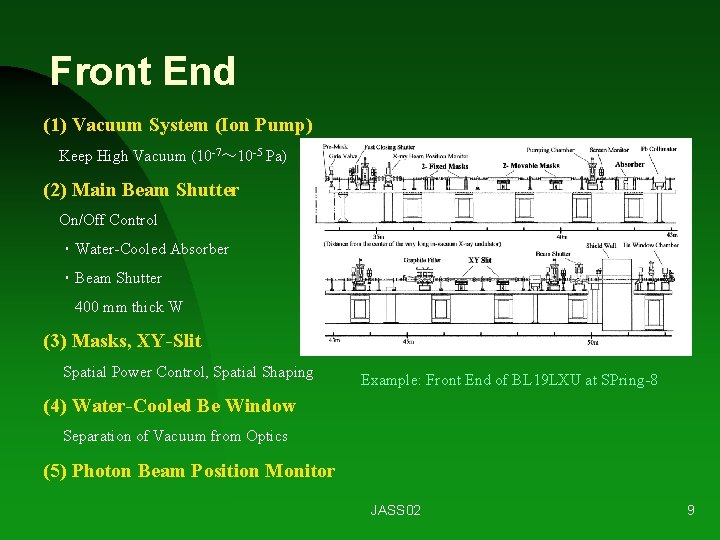
Front End (1) Vacuum System (Ion Pump) Keep High Vacuum (10 -7~ 10 -5 Pa) (2) Main Beam Shutter On/Off Control ・Water-Cooled Absorber ・Beam Shutter 400 mm thick W (3) Masks, XY-Slit Spatial Power Control, Spatial Shaping Example: Front End of BL 19 LXU at SPring-8 (4) Water-Cooled Be Window Separation of Vacuum from Optics (5) Photon Beam Position Monitor JASS 02 9
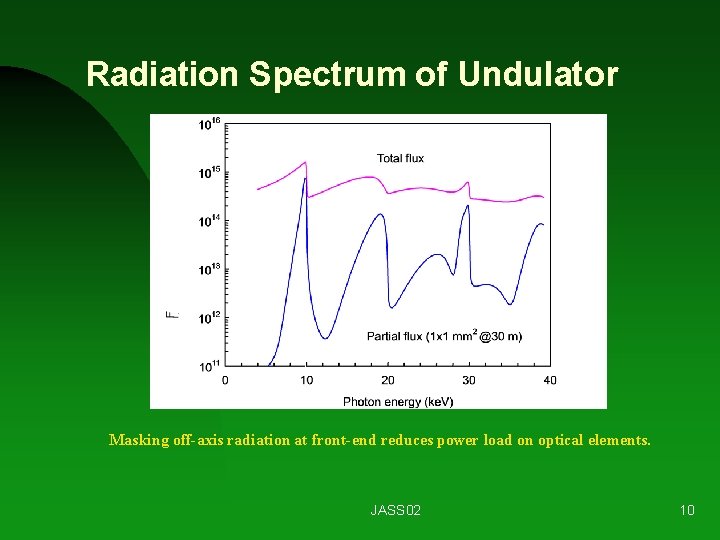
Radiation Spectrum of Undulator Masking off-axis radiation at front-end reduces power load on optical elements. JASS 02 10
Vacuum n Protect Ring Vacuum u u n u transport photon intensity as high as possible avoid radiation leakage due to scattering Avoid Contamination and Deterioration of Optical Elements u 10/29/2021 keep long beam life time suppress high energy gamma-ray Avoid Absorption/Scattering u n Oil-Free Vacuum Carbon contamination, Oxidization JASS 02 11
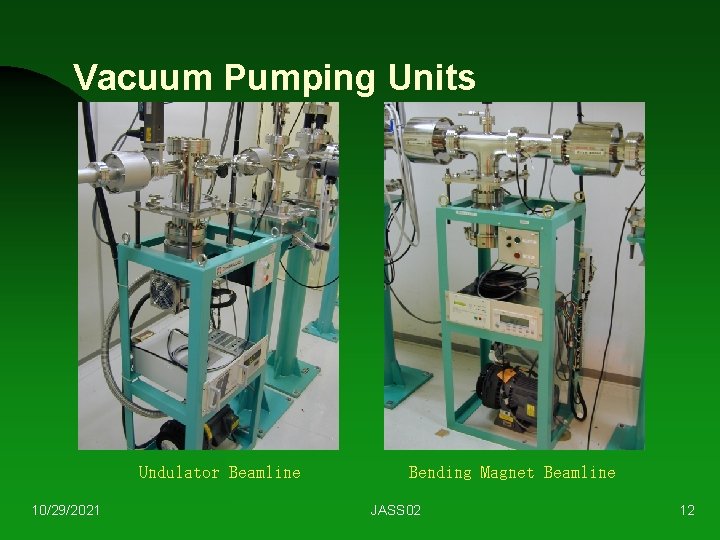
Vacuum Pumping Units Undulator Beamline 10/29/2021 Bending Magnet Beamline JASS 02 12
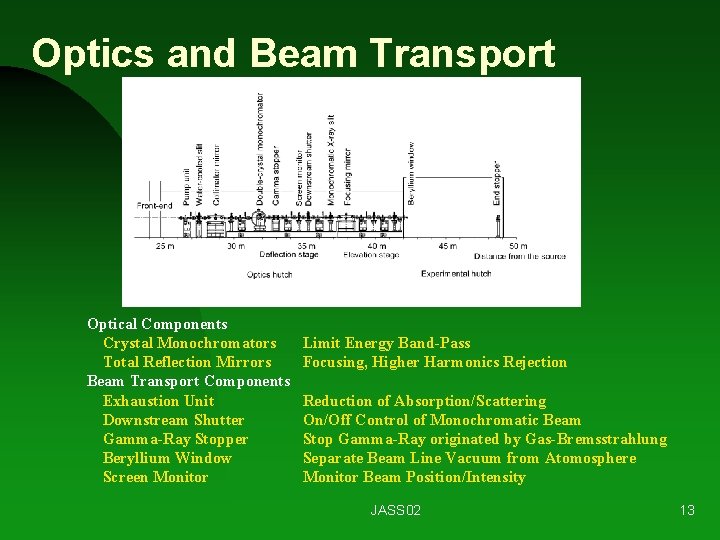
Optics and Beam Transport Optical Components Crystal Monochromators Total Reflection Mirrors Beam Transport Components Exhaustion Unit Downstream Shutter Gamma-Ray Stopper Beryllium Window Screen Monitor Limit Energy Band-Pass Focusing, Higher Harmonics Rejection Reduction of Absorption/Scattering On/Off Control of Monochromatic Beam Stop Gamma-Ray originated by Gas-Bremsstrahlung Separate Beam Line Vacuum from Atomosphere Monitor Beam Position/Intensity JASS 02 13
Major Optical Components in Xray Beam Lines Crystal Monochromators Energy Selection Energy Bandwidth Focusing (Optional) Total Reflection Mirrors Higher Harmonics Rejection Beam Focusing/Collimation Beam Deflection JASS 02 14
Radiation Shielding Hutch 10/29/2021 JASS 02 15
Beam Line Interlock System (Xrays) Good thing for x-ray beam lines (as compared with VUV and SX BLs) is: You can access your sample easily (not in UHV). But you should be very careful to protect yourself from radiation environment. Unfortunately, not all the users are very careful, facilities must take care of them by equipping interlock systems. 10/29/2021 JASS 02 16
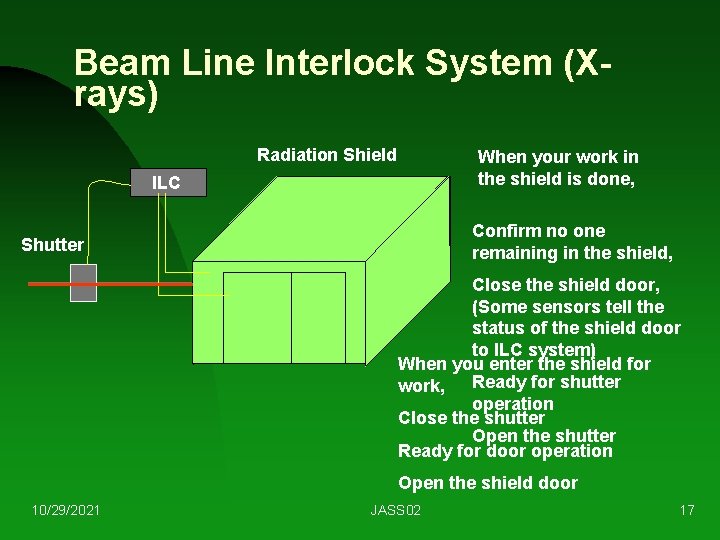
Beam Line Interlock System (Xrays) Radiation Shield When your work in the shield is done, ILC Confirm no one remaining in the shield, Shutter Close the shield door, (Some sensors tell the status of the shield door to ILC system) When you enter the shield for work, Ready for shutter operation Close the shutter Open the shutter Ready for door operation Open the shield door 10/29/2021 JASS 02 17
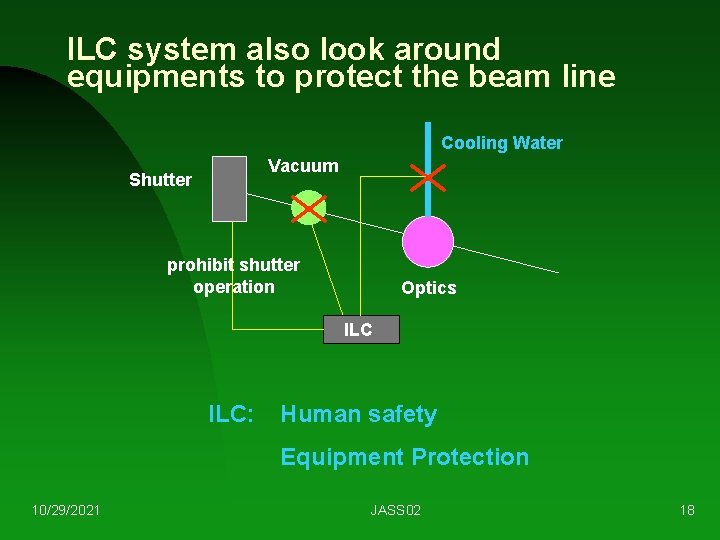
ILC system also look around equipments to protect the beam line Cooling Water Vacuum Shutter prohibit shutter operation Optics ILC: Human safety Equipment Protection 10/29/2021 JASS 02 18
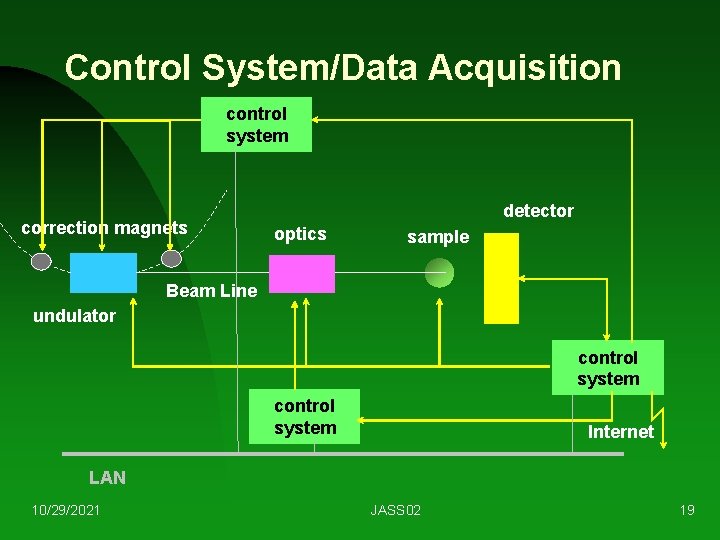
Control System/Data Acquisition control system correction magnets detector optics sample Beam Line undulator control system Internet LAN 10/29/2021 JASS 02 19
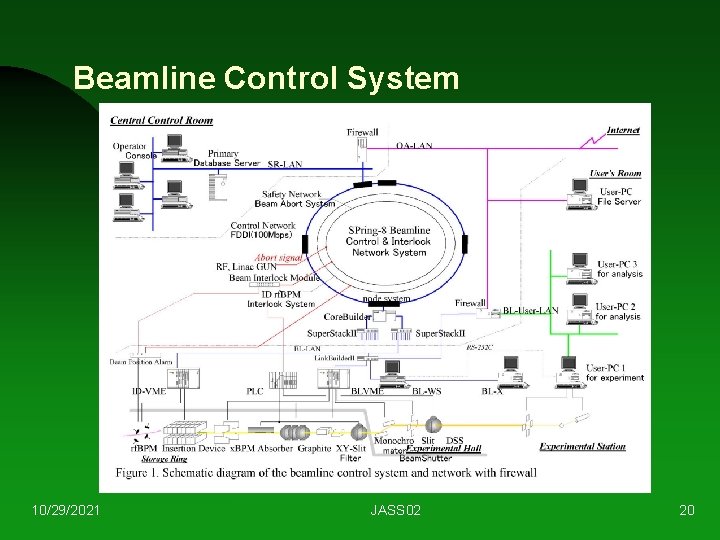
Beamline Control System 10/29/2021 JASS 02 20

Design & Construction of Beam Lines Most Beamline Components are Commercially Available. Some Companies can Make Total Design and Construction. n n Custom Made v. s. Order Made Depends on Facility Strategy, Budget, Man-power and Term n Order Made u u 10/29/2021 Best Optimization More Man-Power More Budget More Operating Staff n Custom Made u u JASS 02 Moderate Optimization Less Man-Power Less Budget Less Operating Staff 21

End of Part 1 10/29/2021 JASS 02 22
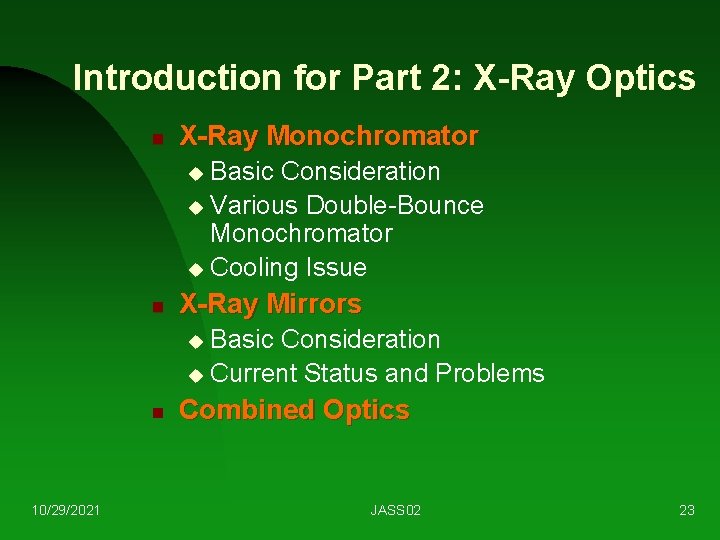
Introduction for Part 2: X-Ray Optics n X-Ray Monochromator Basic Consideration u Various Double-Bounce Monochromator u Cooling Issue u n X-Ray Mirrors Basic Consideration u Current Status and Problems u n 10/29/2021 Combined Optics JASS 02 23
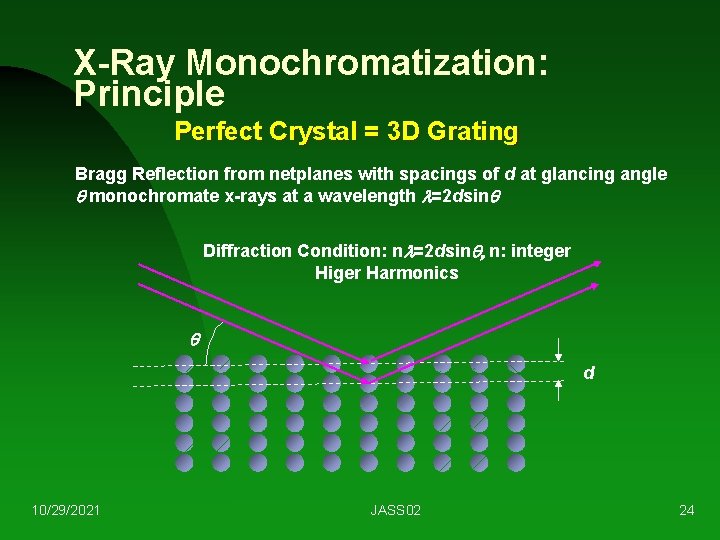
X-Ray Monochromatization: Principle Perfect Crystal = 3 D Grating Bragg Reflection from netplanes with spacings of d at glancing angle q monochromate x-rays at a wavelength l=2 dsinq Diffraction Condition: nl=2 dsinq, n: integer Higer Harmonics q d 10/29/2021 JASS 02 24
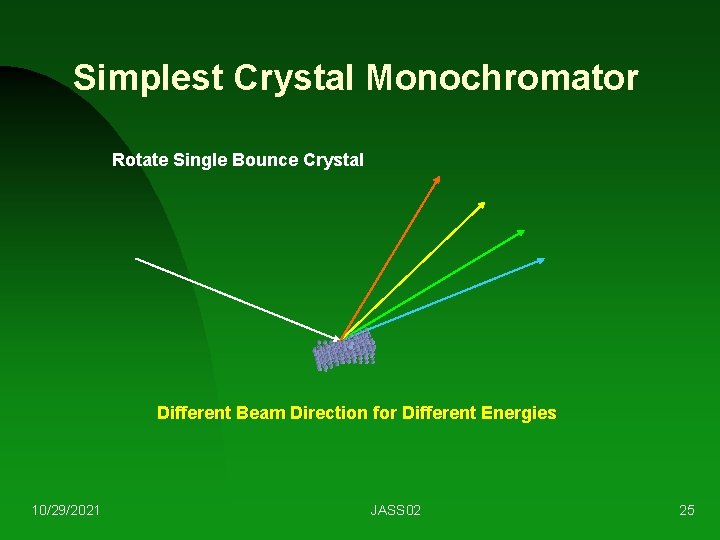
Simplest Crystal Monochromator Rotate Single Bounce Crystal Different Beam Direction for Different Energies 10/29/2021 JASS 02 25
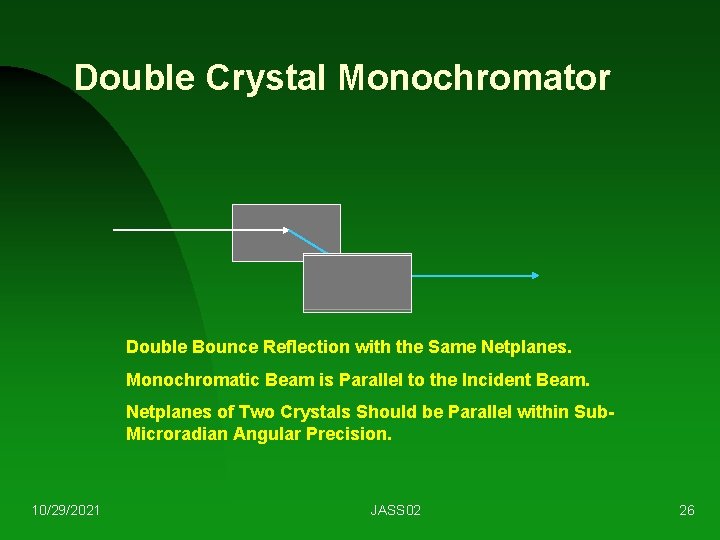
Double Crystal Monochromator Double Bounce Reflection with the Same Netplanes. Monochromatic Beam is Parallel to the Incident Beam. Netplanes of Two Crystals Should be Parallel within Sub. Microradian Angular Precision. 10/29/2021 JASS 02 26
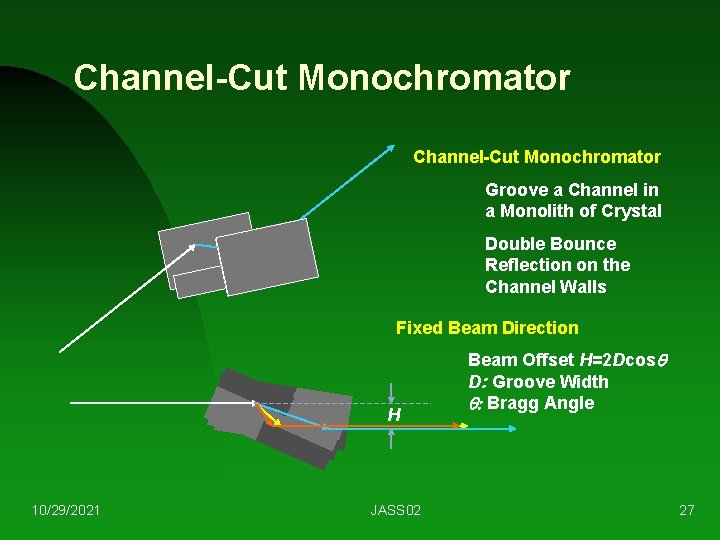
Channel-Cut Monochromator Groove a Channel in a Monolith of Crystal Double Bounce Reflection on the Channel Walls Fixed Beam Direction H 10/29/2021 JASS 02 Beam Offset H=2 Dcosq D: Groove Width q: Bragg Angle 27
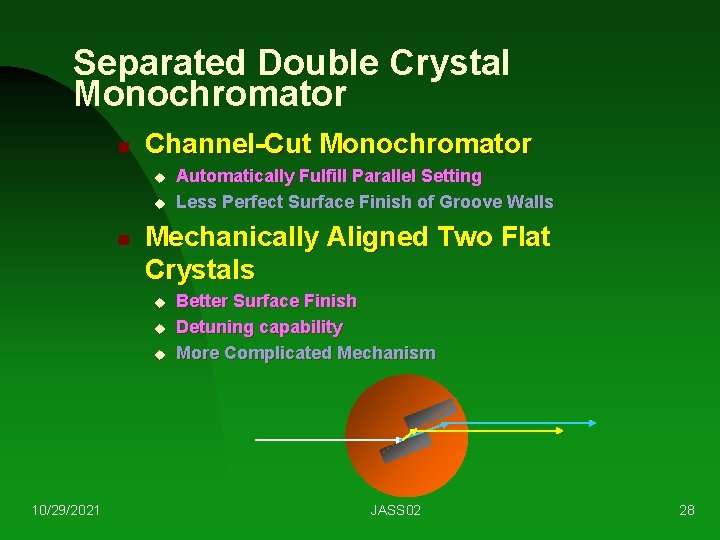
Separated Double Crystal Monochromator n Channel-Cut Monochromator u u n Mechanically Aligned Two Flat Crystals u u u 10/29/2021 Automatically Fulfill Parallel Setting Less Perfect Surface Finish of Groove Walls Better Surface Finish Detuning capability More Complicated Mechanism JASS 02 28
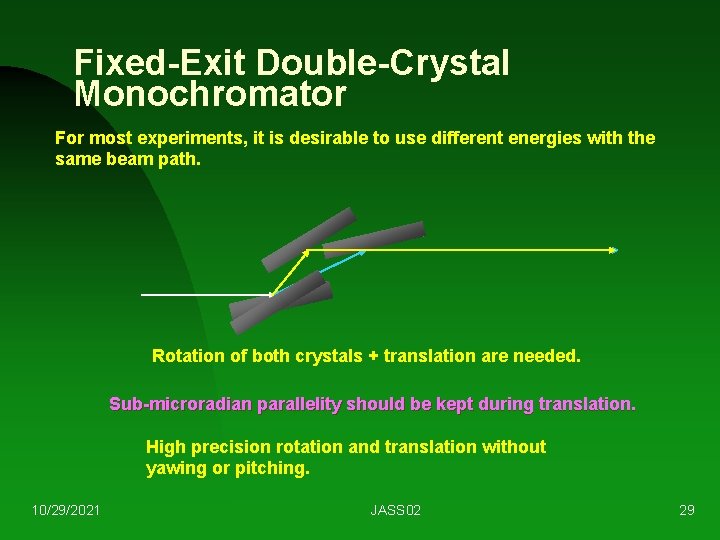
Fixed-Exit Double-Crystal Monochromator For most experiments, it is desirable to use different energies with the same beam path. Rotation of both crystals + translation are needed. Sub-microradian parallelity should be kept during translation. High precision rotation and translation without yawing or pitching. 10/29/2021 JASS 02 29
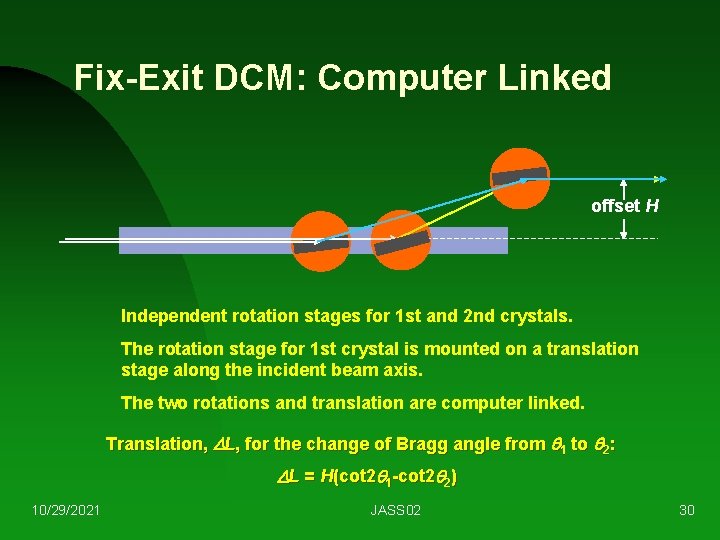
Fix-Exit DCM: Computer Linked offset H Independent rotation stages for 1 st and 2 nd crystals. The rotation stage for 1 st crystal is mounted on a translation stage along the incident beam axis. The two rotations and translation are computer linked. Translation, DL, for the change of Bragg angle from q 1 to q 2: DL = H(cot 2 q 1 -cot 2 q 2) 10/29/2021 JASS 02 30
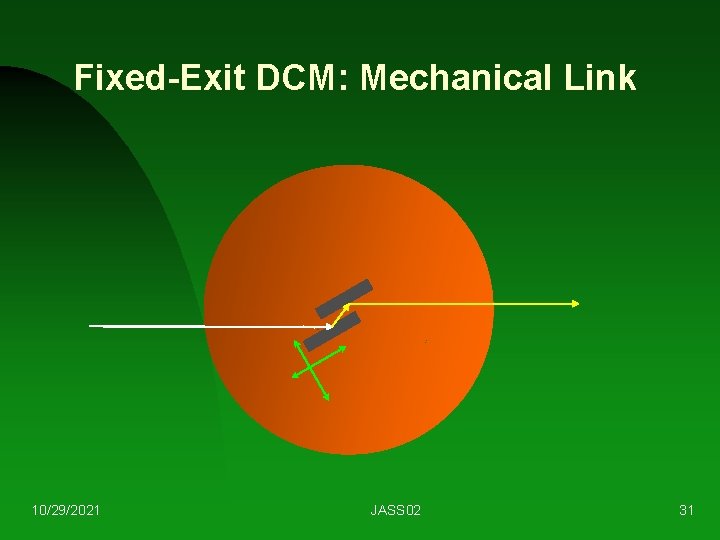
Fixed-Exit DCM: Mechanical Link 10/29/2021 JASS 02 31
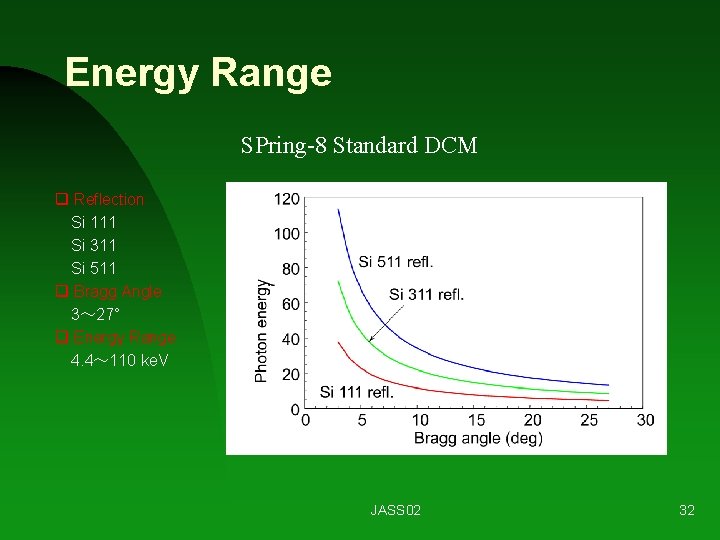
Energy Range SPring-8 Standard DCM q Reflection Si 111 Si 311 Si 511 q Bragg Angle 3~ 27° q Energy Range 4. 4~ 110 ke. V JASS 02 32

Rocking Curve 回折幅 Dynamical Theory of Diffraction ・Diffraction Width: 0. 1~100 mrad ・Peak Reflectivity ~ 1 10/29/2021 JASS 02 33
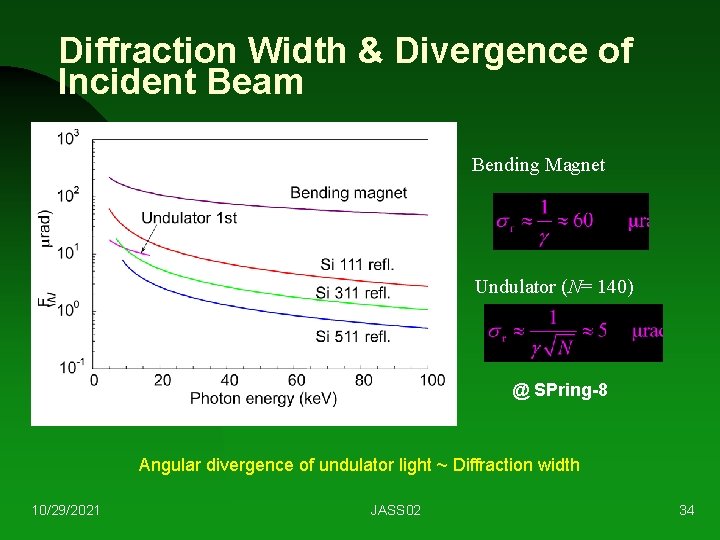
Diffraction Width & Divergence of Incident Beam Bending Magnet Undulator (N= 140) @ SPring-8 Angular divergence of undulator light ~ Diffraction width 10/29/2021 JASS 02 34
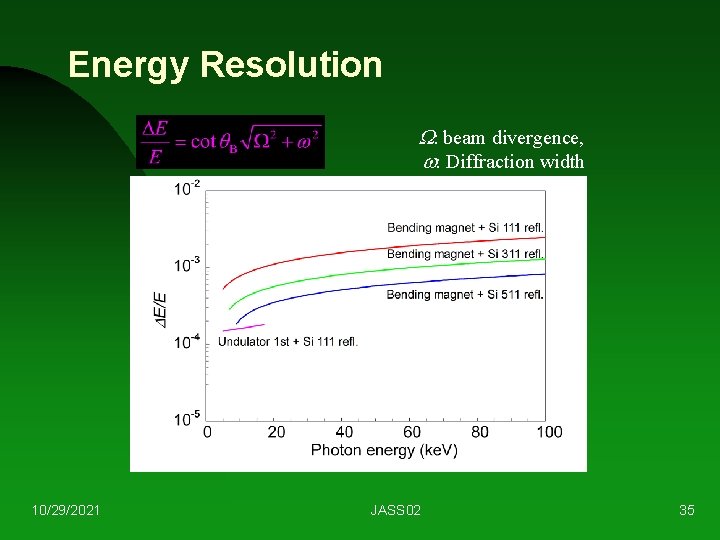
Energy Resolution W: beam divergence, w: Diffraction width 10/29/2021 JASS 02 35
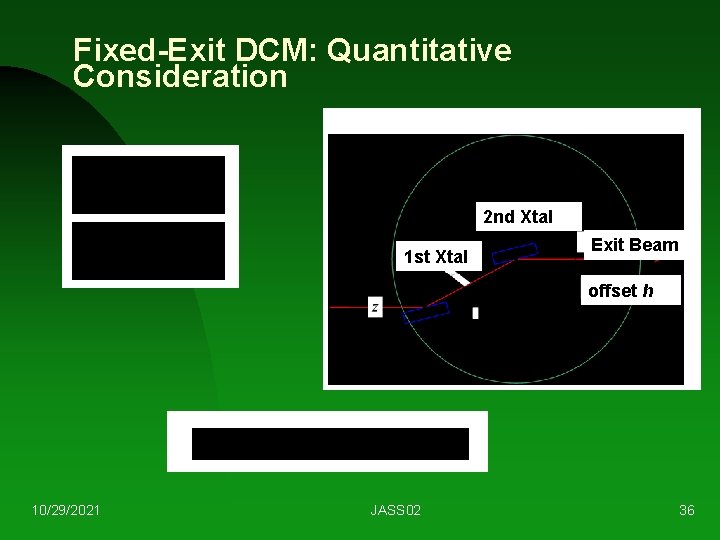
Fixed-Exit DCM: Quantitative Consideration 2 nd Xtal 1 st Xtal Exit Beam offset h 10/29/2021 JASS 02 36
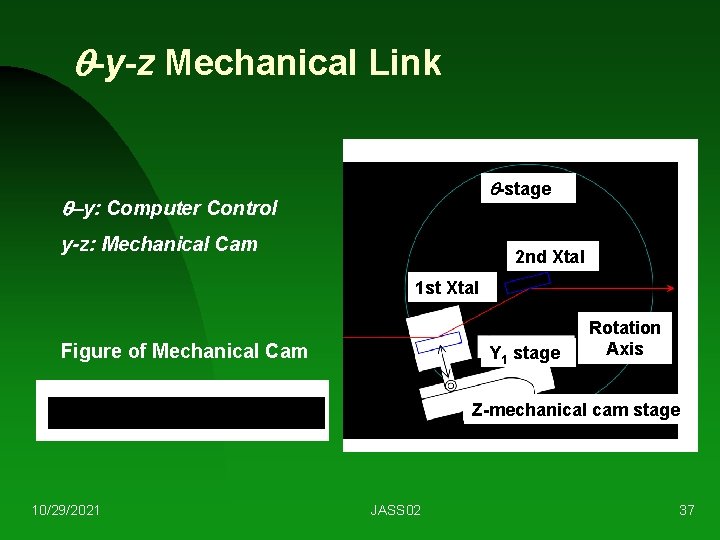
q-y-z Mechanical Link q-stage q-y: Computer Control y-z: Mechanical Cam 2 nd Xtal 1 st Xtal Figure of Mechanical Cam Y 1 stage Rotation Axis Z-mechanical cam stage 10/29/2021 JASS 02 37
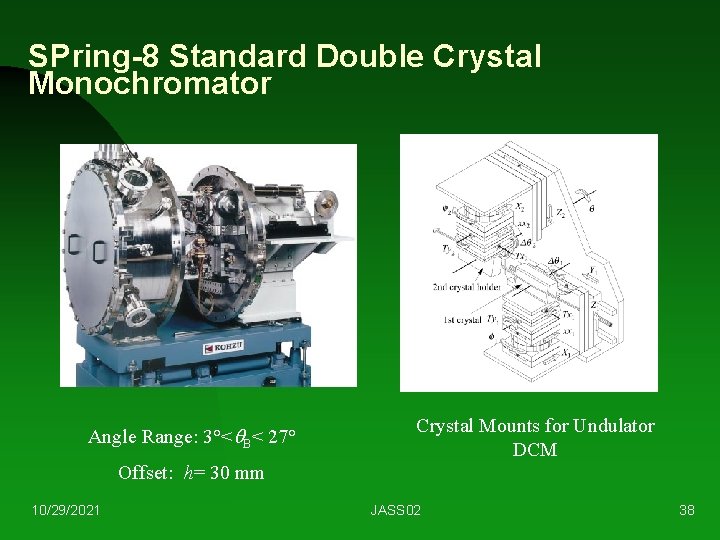
SPring-8 Standard Double Crystal Monochromator Angle Range: 3°<q. B< 27° Crystal Mounts for Undulator DCM Offset: h= 30 mm 10/29/2021 JASS 02 38
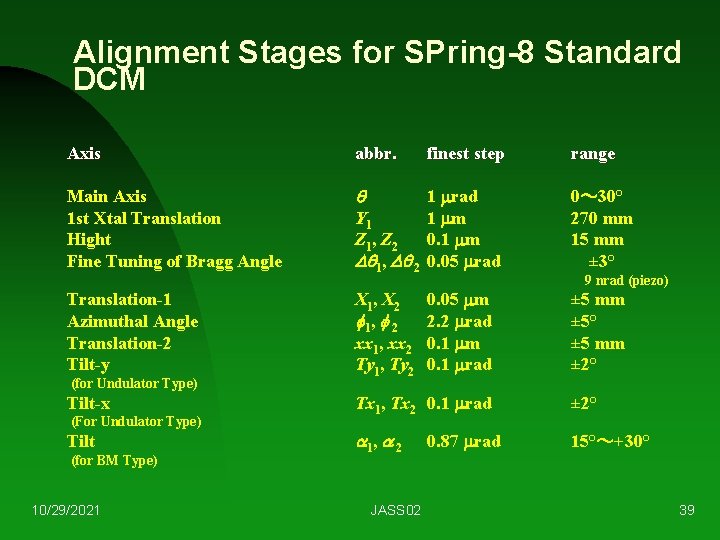
Alignment Stages for SPring-8 Standard DCM Axis abbr. Main Axis 1 st Xtal Translation Hight Fine Tuning of Bragg Angle q Translation-1 Azimuthal Angle Translation-2 Tilt-y (for Undulator Type) Tilt-x (For Undulator Type) Tilt (for BM Type) 10/29/2021 finest step 1 mrad Y 1 1 mm Z 1 , Z 2 0. 1 mm Dq 1, Dq 2 0. 05 mrad X 1 , X 2 f 1 , f 2 xx 1, xx 2 Ty 1, Ty 2 0. 05 mm 2. 2 mrad 0. 1 mm 0. 1 mrad range 0~ 30° 270 mm 15 mm ± 3° 9 nrad (piezo) ± 5 mm ± 5° ± 5 mm ± 2° Tx 1, Tx 2 0. 1 mrad ± 2° a 1 , a 2 15°~+30° JASS 02 0. 87 mrad 39
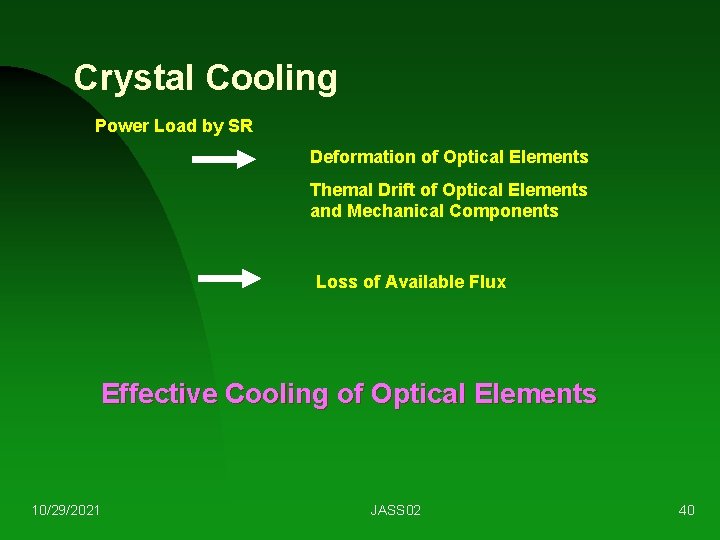
Crystal Cooling Power Load by SR Deformation of Optical Elements Themal Drift of Optical Elements and Mechanical Components Loss of Available Flux Effective Cooling of Optical Elements 10/29/2021 JASS 02 40
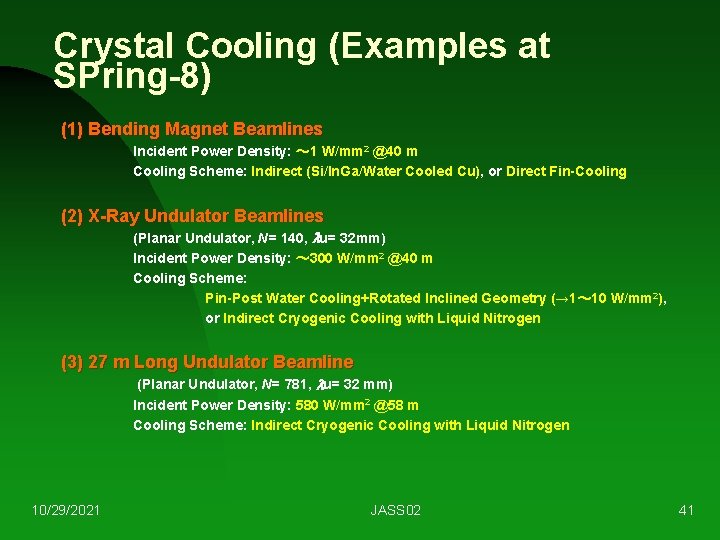
Crystal Cooling (Examples at SPring-8) (1) Bending Magnet Beamlines Incident Power Density: ~ 1 W/mm 2 @40 m Cooling Scheme: Indirect (Si/In. Ga/Water Cooled Cu), or Direct Fin-Cooling (2) X-Ray Undulator Beamlines (Planar Undulator, N= 140, lu= 32 mm) Incident Power Density: ~ 300 W/mm 2 @40 m Cooling Scheme: Pin-Post Water Cooling+Rotated Inclined Geometry (→ 1~ 10 W/mm 2), or Indirect Cryogenic Cooling with Liquid Nitrogen (3) 27 m Long Undulator Beamline (Planar Undulator, N= 781, lu= 32 mm) Incident Power Density: 580 W/mm 2 @58 m Cooling Scheme: Indirect Cryogenic Cooling with Liquid Nitrogen 10/29/2021 JASS 02 41
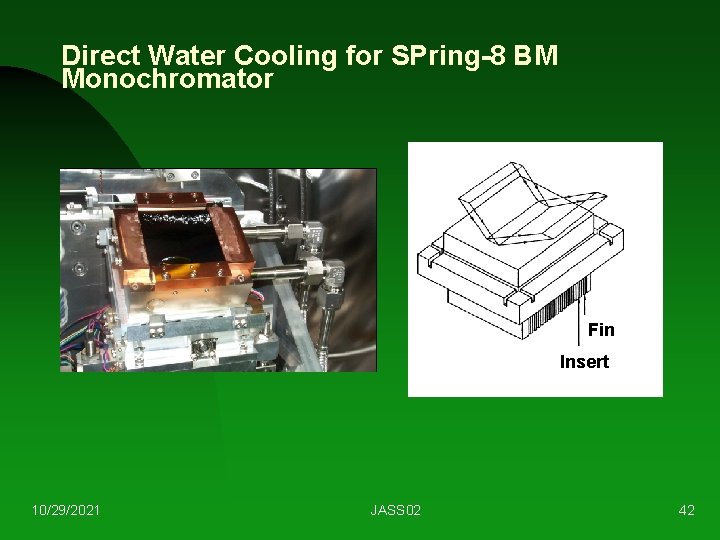
Direct Water Cooling for SPring-8 BM Monochromator Fin Insert 10/29/2021 JASS 02 42
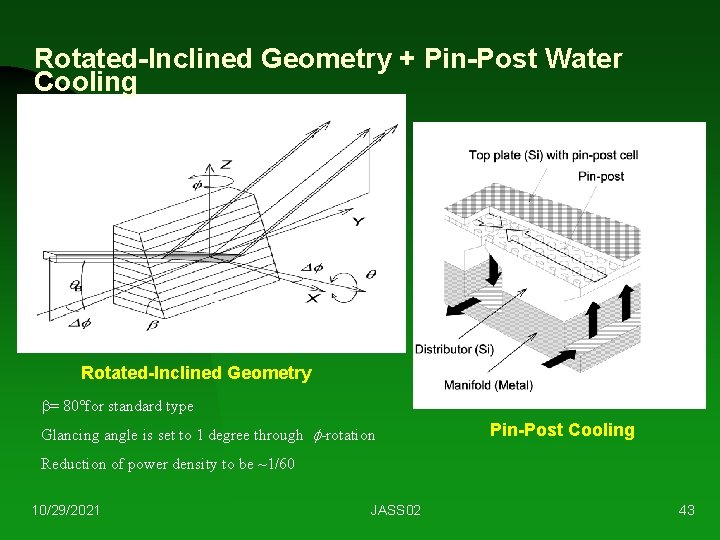
Rotated-Inclined Geometry + Pin-Post Water Cooling Rotated-Inclined Geometry b= 80°for standard type Glancing angle is set to 1 degree through f-rotation Pin-Post Cooling Reduction of power density to be ~1/60 10/29/2021 JASS 02 43
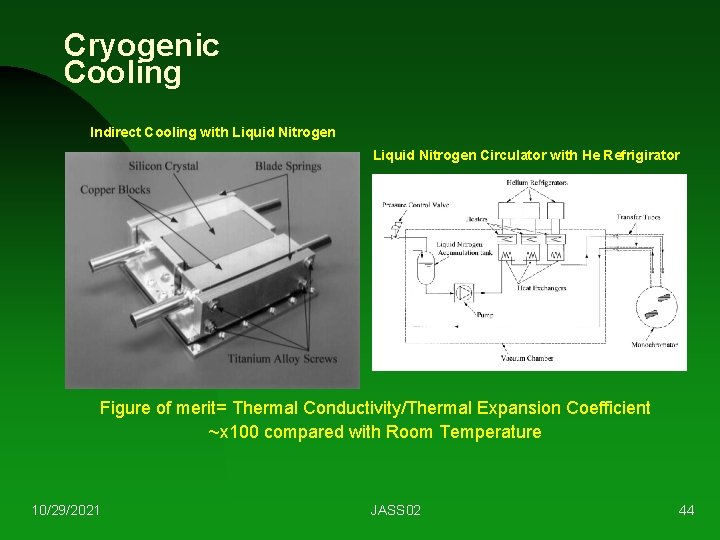
Cryogenic Cooling Indirect Cooling with Liquid Nitrogen Circulator with He Refrigirator Figure of merit= Thermal Conductivity/Thermal Expansion Coefficient ~x 100 compared with Room Temperature 10/29/2021 JASS 02 44
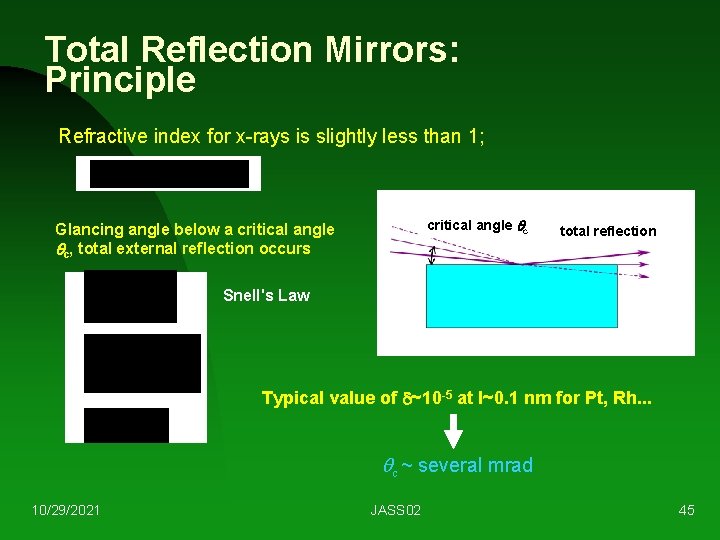
Total Reflection Mirrors: Principle Refractive index for x-rays is slightly less than 1; critical angle qc Glancing angle below a critical angle qc, total external reflection occurs total reflection Snell's Law Typical value of d~10 -5 at l~0. 1 nm for Pt, Rh. . . qc ~ several mrad 10/29/2021 JASS 02 45
Total Reflection Mirrors: Functions (1) Higher Harmonics Rejection cut higher harmonics from crystal monochromators (2) Beam Focusing/Collimation with Figured Mirrors sagittal focusing with cylindrical mirrors meridional focusing with cylindrical/elliptical mirrors point focusing with troidal/ellipsoidal mirrors beam collimation with parabolla mirrors (3) Beam Deflection switching of branch beamlines 10/29/2021 JASS 02 46
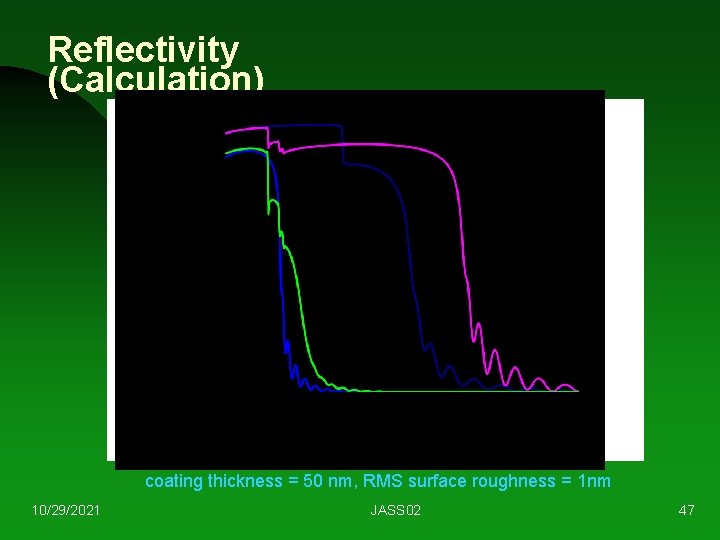
Reflectivity (Calculation) coating thickness = 50 nm, RMS surface roughness = 1 nm 10/29/2021 JASS 02 47
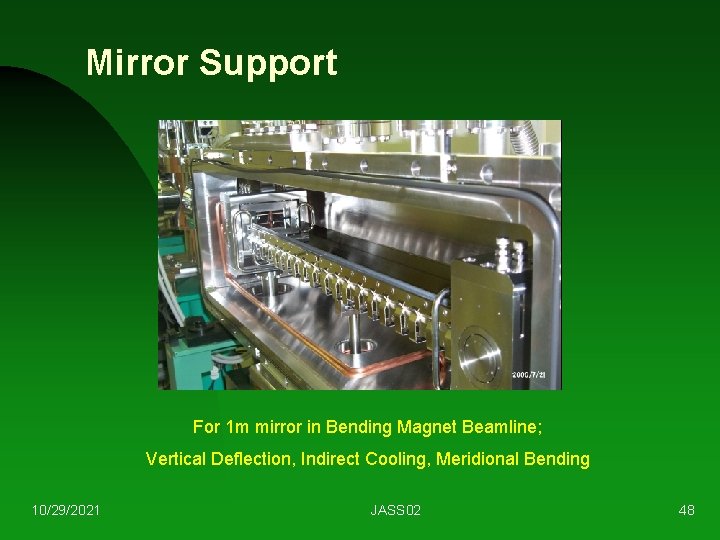
Mirror Support For 1 m mirror in Bending Magnet Beamline; Vertical Deflection, Indirect Cooling, Meridional Bending 10/29/2021 JASS 02 48
Example: SPring-8 Standard BM Beam Line Optics Collimator Mirror: vertical upward deflection, 1 m long, Si, Pt-coated flat mirror, indirect water cooling, bending support beam collimation to make parallel incident beam on crystal mono DCM: standard BM type, Direct water cooling with fin-crystal Focusing Mirror: vertical downward deflection, 1 m long, Quartz, Pt-coated flat mirror, vertical beam focusing at sample position Inclination/Elevation stage: to follow beam path JASS 02 49
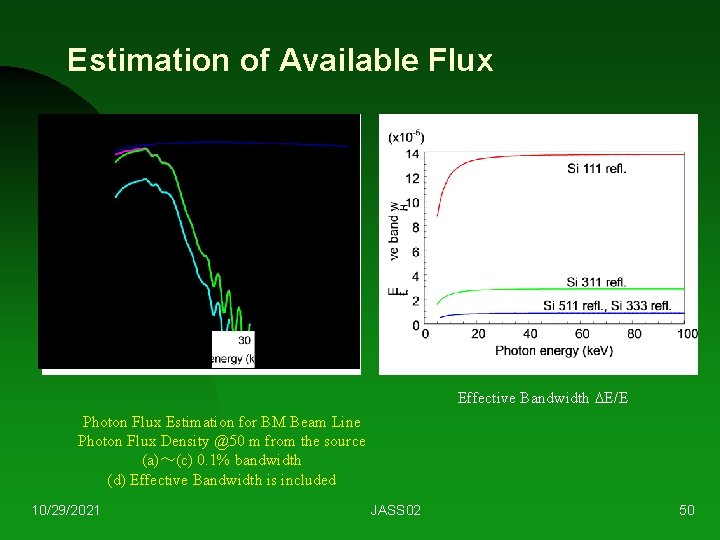
Estimation of Available Flux 実効的バンド幅 Effective Bandwidth DE/E Photon Flux Estimation for BM Beam Line Photon Flux Density @50 m from the source (a)~(c) 0. 1% bandwidth (d) Effective Bandwidth is included 10/29/2021 JASS 02 50

Thank you for your attention. Acknowledgement We would like to thank to Dr. Shunji Goto to prepare some ppt materials for this presentation. Discussion with Drs. Shunji Goto, Kenji Tamasaku and Makina Yabashi is highly appreciated. 10/29/2021 JASS 02 51
- Slides: 51