
Beam Energy Measurement by Synchrotron Radiation some first
Beam Energy Measurement by Synchrotron Radiation (some first ideas) K. Hiller and H. J. Schreiber DESY Zeuthen R. Makarow, E. Syresin and B. Zalikhanov Dzhelepov Laboratory of Nuclear Problems, JINR H. J. Schreiber LC ECFA Vienna, Nov 14 -17 2005
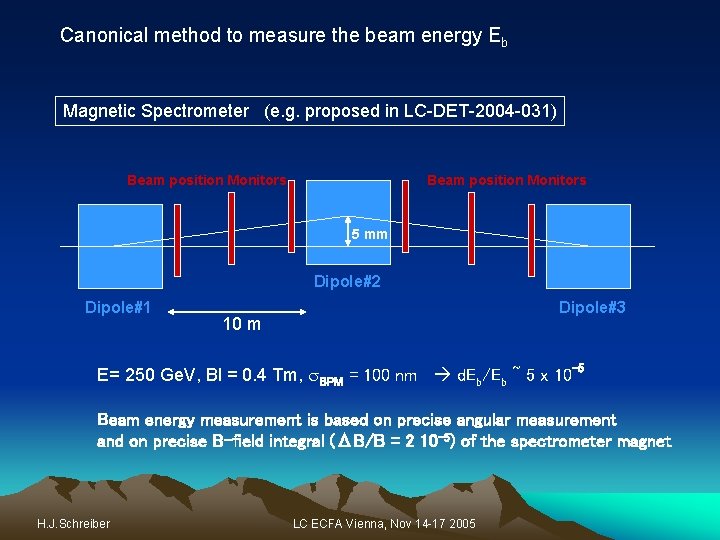
Canonical method to measure the beam energy Eb Magnetic Spectrometer (e. g. proposed in LC-DET-2004 -031) Beam position Monitors 5 mm Dipole#2 Dipole#1 Dipole#3 10 m E= 250 Ge. V, Bl = 0. 4 Tm, s. BPM = 100 nm d. Eb/Eb ~ 5 x 10 -5 Beam energy measurement is based on precise angular measurement and on precise B-field integral (ΔB/B = 2 10 -5) of the spectrometer magnet H. J. Schreiber LC ECFA Vienna, Nov 14 -17 2005

Synchrotron Radiation Fan Beam position Monitors Dipole#2 Dipole#1 Dipole#3 3 radiation fans cover exactly the electron bending angle Measurement the width of the fan resp. the position of both edges allows to determine Eb H. J. Schreiber LC ECFA Vienna, Nov 14 -17 2005
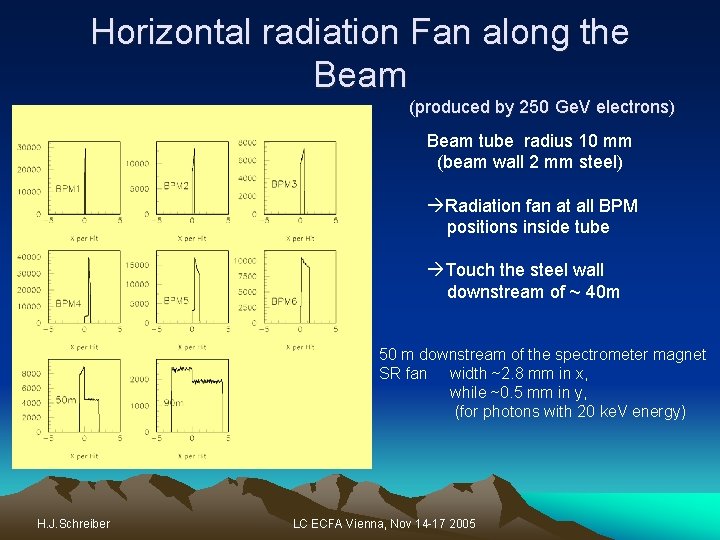
Horizontal radiation Fan along the Beam (produced by 250 Ge. V electrons) Beam tube radius 10 mm (beam wall 2 mm steel) Radiation fan at all BPM positions inside tube Touch the steel wall downstream of ~ 40 m 50 m downstream of the spectrometer magnet SR fan width ~2. 8 mm in x, while ~0. 5 mm in y, (for photons with 20 ke. V energy) H. J. Schreiber LC ECFA Vienna, Nov 14 -17 2005
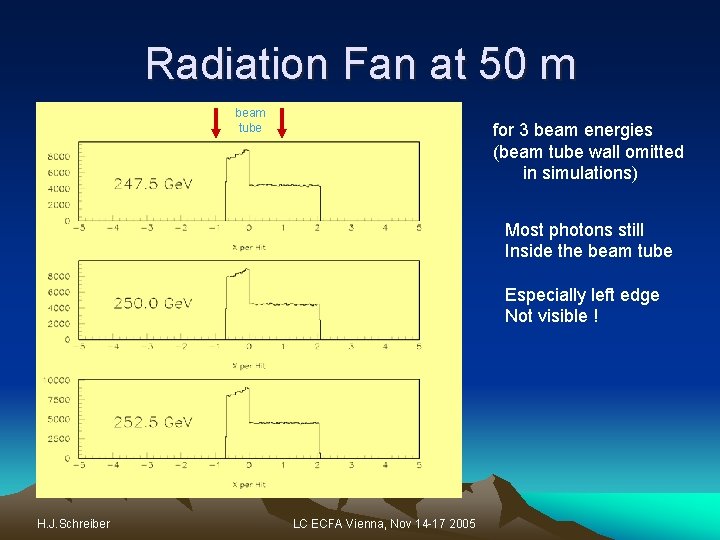
Radiation Fan at 50 m beam tube for 3 beam energies (beam tube wall omitted in simulations) Most photons still Inside the beam tube Especially left edge Not visible ! H. J. Schreiber LC ECFA Vienna, Nov 14 -17 2005
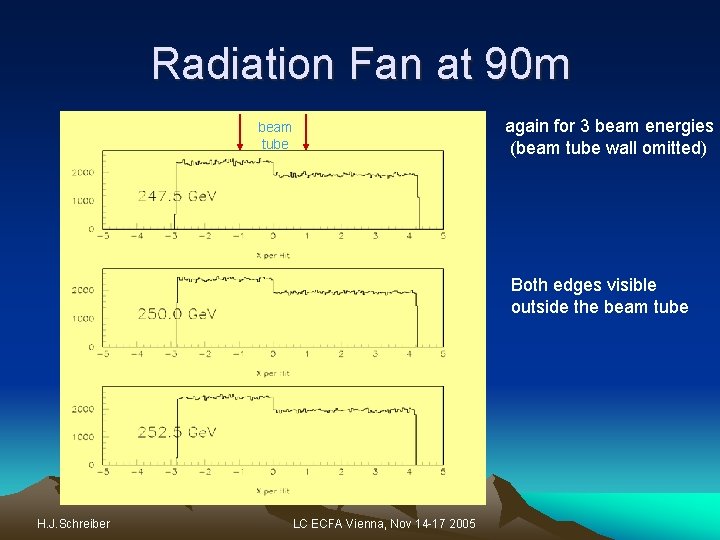
Radiation Fan at 90 m beam tube again for 3 beam energies (beam tube wall omitted) Both edges visible outside the beam tube H. J. Schreiber LC ECFA Vienna, Nov 14 -17 2005
![Radiation Fan at 90 m (2) E [Ge. V] Width [mm], in x 247.](http://slidetodoc.com/presentation_image_h2/9fcd39e8e9012a4509a7ff31cad7cad9/image-7.jpg "Radiation Fan at 90 m (2) E [Ge. V] Width [mm], in x 247.")
Radiation Fan at 90 m (2) E [Ge. V] Width [mm], in x 247. 5 71. 4 252. 5 70. 0 No beam tube wall ! èSensitivity 1. 4 mm / 5 Ge. V H. J. Schreiber LC ECFA Vienna, Nov 14 -17 2005
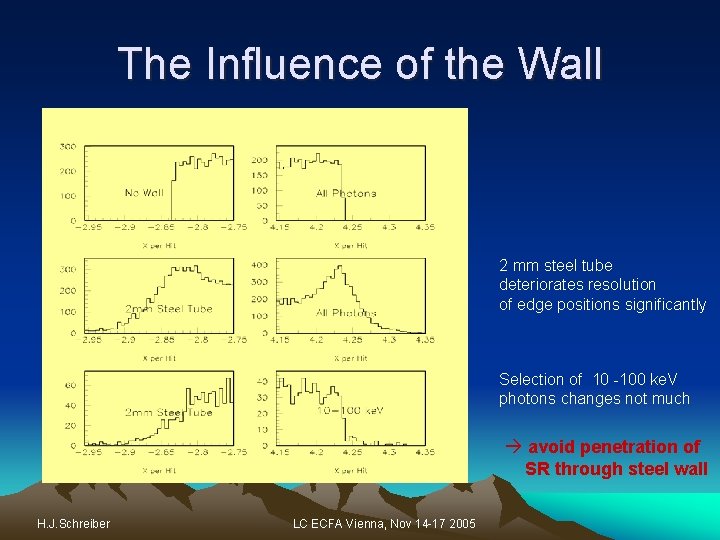
The Influence of the Wall 2 mm steel tube deteriorates resolution of edge positions significantly Selection of 10 -100 ke. V photons changes not much avoid penetration of SR through steel wall H. J. Schreiber LC ECFA Vienna, Nov 14 -17 2005
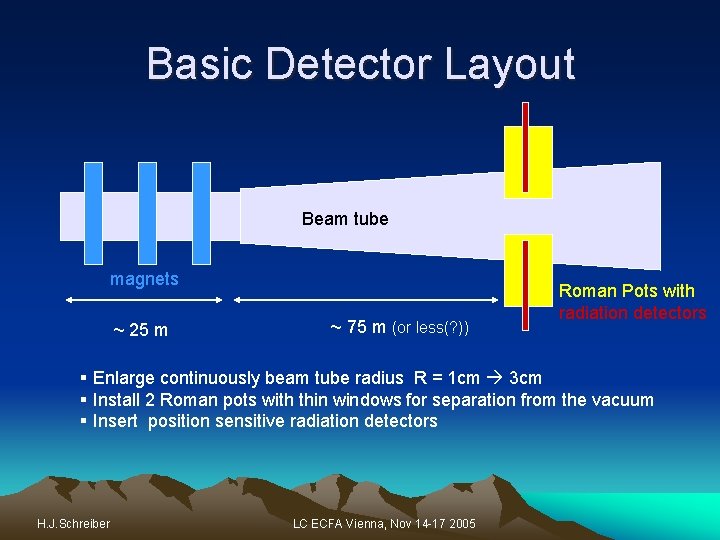
Basic Detector Layout Beam tube magnets ~ 25 m ~ 75 m (or less(? )) Roman Pots with radiation detectors § Enlarge continuously beam tube radius R = 1 cm 3 cm § Install 2 Roman pots with thin windows for separation from the vacuum § Insert position sensitive radiation detectors H. J. Schreiber LC ECFA Vienna, Nov 14 -17 2005
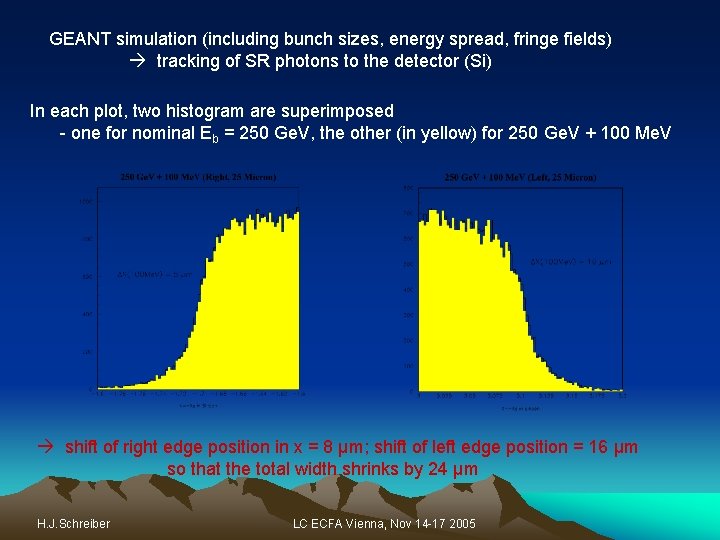
GEANT simulation (including bunch sizes, energy spread, fringe fields) tracking of SR photons to the detector (Si) In each plot, two histogram are superimposed - one for nominal Eb = 250 Ge. V, the other (in yellow) for 250 Ge. V + 100 Me. V shift of right edge position in x = 8 μm; shift of left edge position = 16 μm so that the total width shrinks by 24 μm H. J. Schreiber LC ECFA Vienna, Nov 14 -17 2005
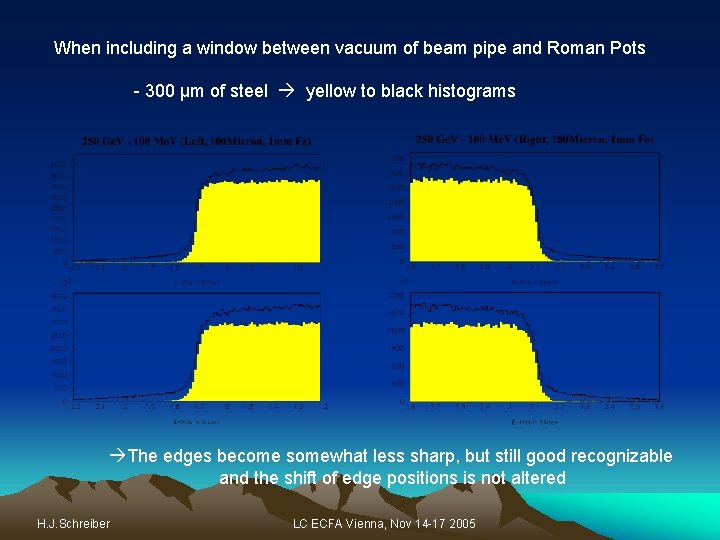
When including a window between vacuum of beam pipe and Roman Pots - 300 μm of steel yellow to black histograms The edges become somewhat less sharp, but still good recognizable and the shift of edge positions is not altered H. J. Schreiber LC ECFA Vienna, Nov 14 -17 2005
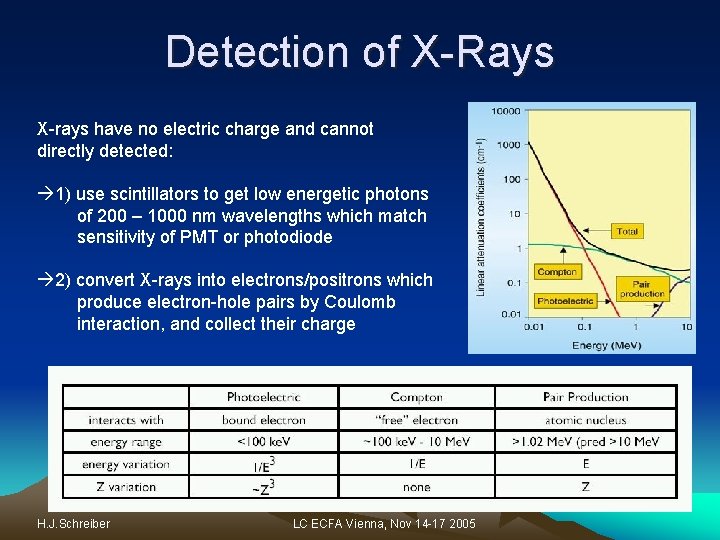
Detection of X-Rays X-rays have no electric charge and cannot directly detected: 1) use scintillators to get low energetic photons of 200 – 1000 nm wavelengths which match sensitivity of PMT or photodiode 2) convert X-rays into electrons/positrons which produce electron-hole pairs by Coulomb interaction, and collect their charge H. J. Schreiber LC ECFA Vienna, Nov 14 -17 2005
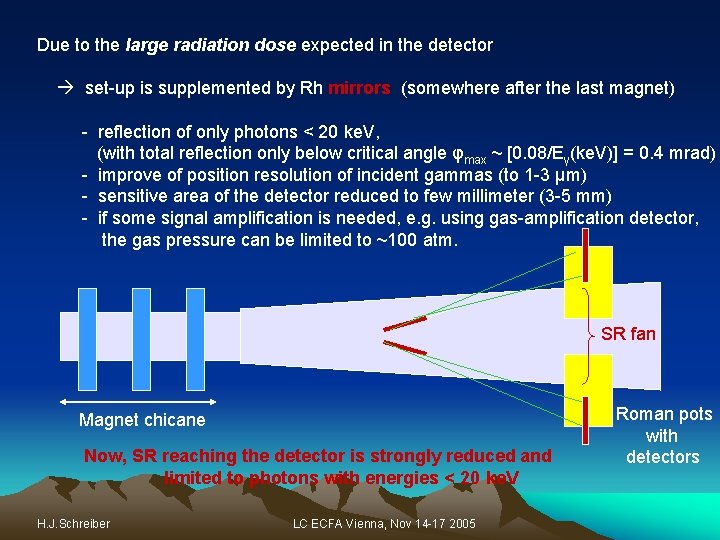
Due to the large radiation dose expected in the detector set-up is supplemented by Rh mirrors (somewhere after the last magnet) - reflection of only photons < 20 ke. V, (with total reflection only below critical angle φmax ~ [0. 08/Eγ(ke. V)] = 0. 4 mrad) - improve of position resolution of incident gammas (to 1 -3 μm) - sensitive area of the detector reduced to few millimeter (3 -5 mm) - if some signal amplification is needed, e. g. using gas-amplification detector, the gas pressure can be limited to ~100 atm. SR fan Magnet chicane Now, SR reaching the detector is strongly reduced and limited to photons with energies < 20 ke. V H. J. Schreiber LC ECFA Vienna, Nov 14 -17 2005 Roman pots with detectors
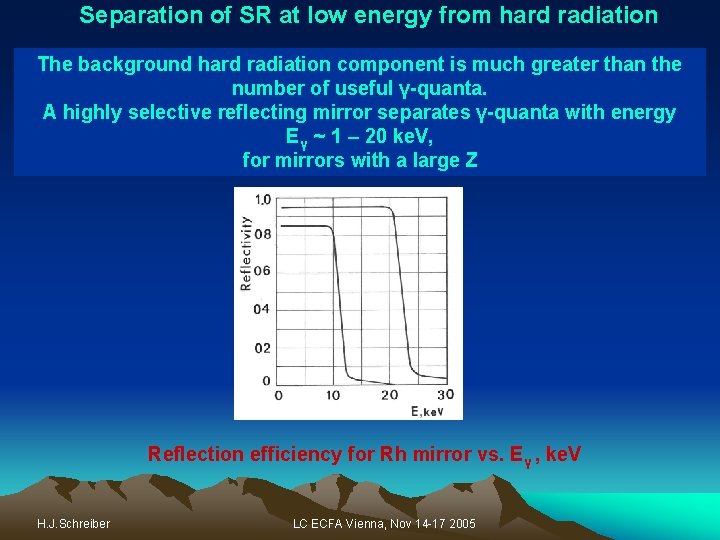
Separation of SR at low energy from hard radiation The background hard radiation component is much greater than the number of useful γ-quanta. A highly selective reflecting mirror separates γ-quanta with energy Eγ ~ 1 – 20 ke. V, for mirrors with a large Z Reflection efficiency for Rh mirror vs. Eγ , ke. V H. J. Schreiber LC ECFA Vienna, Nov 14 -17 2005
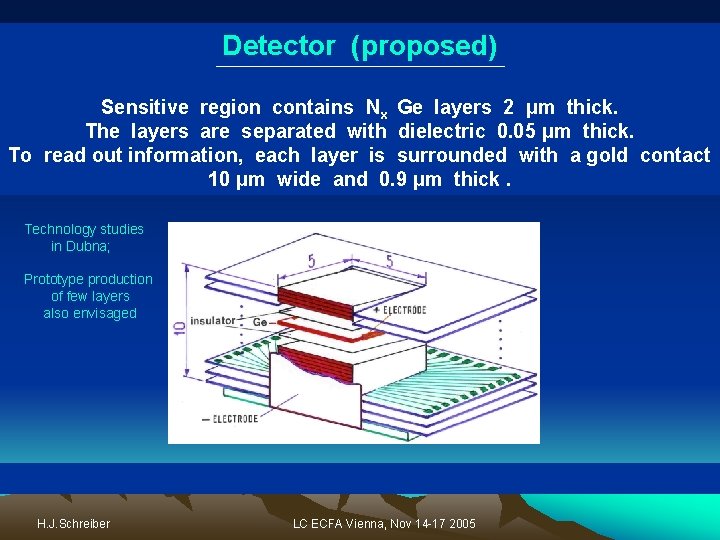
Detector (proposed) Sensitive region contains Nx Ge layers 2 μm thick. The layers are separated with dielectric 0. 05 μm thick. To read out information, each layer is surrounded with a gold contact 10 μm wide and 0. 9 μm thick. Technology studies in Dubna; Prototype production of few layers also envisaged H. J. Schreiber LC ECFA Vienna, Nov 14 -17 2005
Estimate of Signal Size At 70 m the fan width ~70 mm and the # of gammas (<20 ke. V) is ~2 106 4 104 within 1 mm Ge. A photon needs some 10 e. V to generate an electron # of electrons within 1 mm Ge ~8 107 and Ne ≈ 105 per 1μm of Ge. An amplifier conversion factor of 15 m. V/f. C with an input charge of 105 electrons produces an output signal with an amplitude of ~30 m. V H. J. Schreiber LC ECFA Vienna, Nov 14 -17 2005
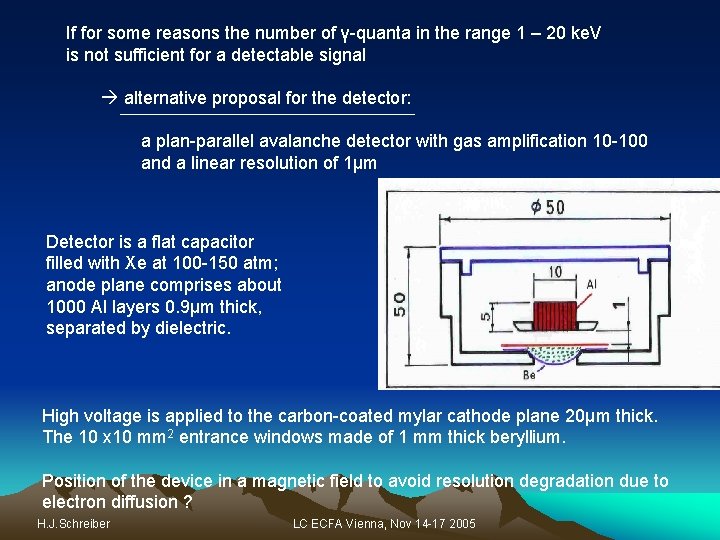
If for some reasons the number of γ-quanta in the range 1 – 20 ke. V is not sufficient for a detectable signal alternative proposal for the detector: a plan-parallel avalanche detector with gas amplification 10 -100 and a linear resolution of 1μm Detector is a flat capacitor filled with Xe at 100 -150 atm; anode plane comprises about 1000 Al layers 0. 9μm thick, separated by dielectric. High voltage is applied to the carbon-coated mylar cathode plane 20μm thick. The 10 x 10 mm 2 entrance windows made of 1 mm thick beryllium. Position of the device in a magnetic field to avoid resolution degradation due to electron diffusion ? H. J. Schreiber LC ECFA Vienna, Nov 14 -17 2005
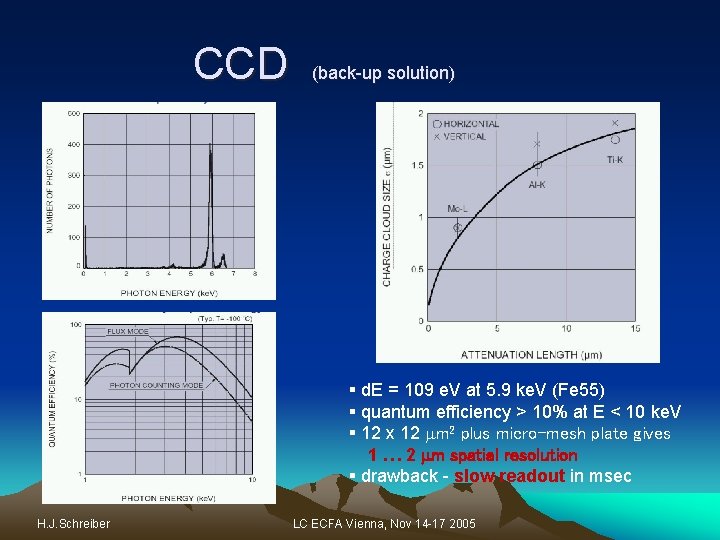
CCD (back-up solution) § d. E = 109 e. V at 5. 9 ke. V (Fe 55) § quantum efficiency > 10% at E < 10 ke. V § 12 x 12 mm 2 plus micro-mesh plate gives 1 … 2 mm spatial resolution § drawback - slow readout in msec H. J. Schreiber LC ECFA Vienna, Nov 14 -17 2005
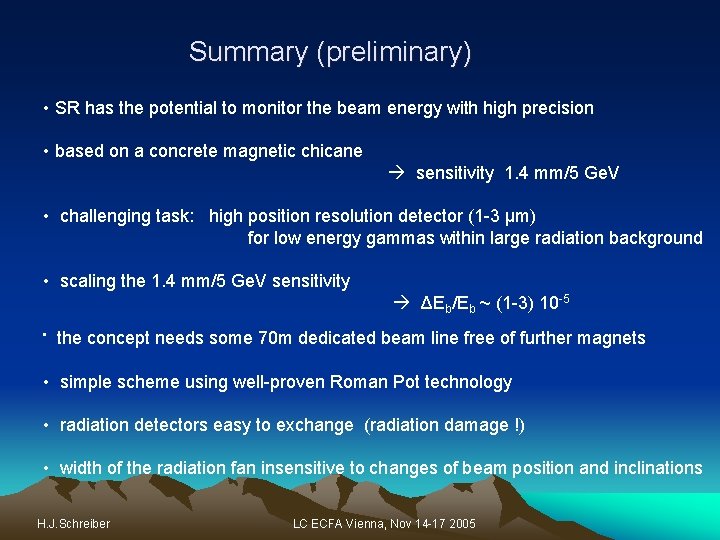
Summary (preliminary) • SR has the potential to monitor the beam energy with high precision • based on a concrete magnetic chicane sensitivity 1. 4 mm/5 Ge. V • challenging task: high position resolution detector (1 -3 μm) for low energy gammas within large radiation background • scaling the 1. 4 mm/5 Ge. V sensitivity ΔEb/Eb ~ (1 -3) 10 -5 • the concept needs some 70 m dedicated beam line free of further magnets • simple scheme using well-proven Roman Pot technology • radiation detectors easy to exchange (radiation damage !) • width of the radiation fan insensitive to changes of beam position and inclinations H. J. Schreiber LC ECFA Vienna, Nov 14 -17 2005
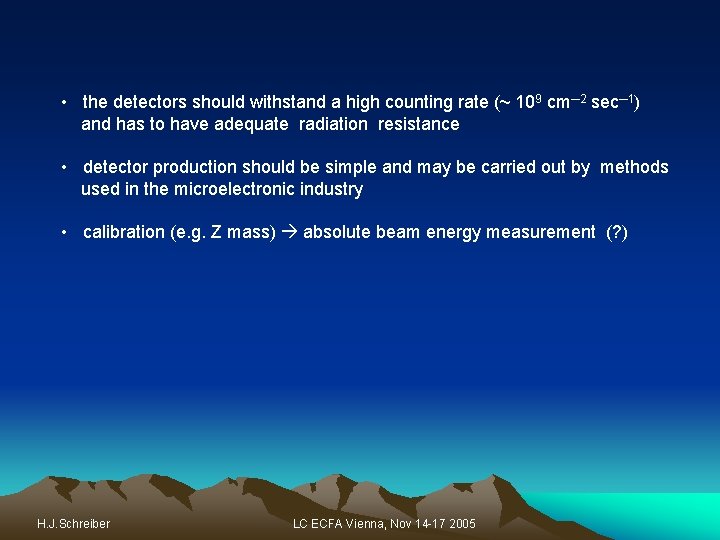
• the detectors should withstand a high counting rate (~ 109 cm─2 sec─1) and has to have adequate radiation resistance • detector production should be simple and may be carried out by methods used in the microelectronic industry • calibration (e. g. Z mass) absolute beam energy measurement (? ) H. J. Schreiber LC ECFA Vienna, Nov 14 -17 2005
- Slides: 20